THERMAL POLLUTION
Application ID: d74283c5f03d11e9be91b5549a39a241
MAHESH.T.M
Maheshtm1098@gmail.com
Academic writing
ACKNOWLEDGEMENT
 This presentation is done to fulfil the
summative assignment 2 of week 13
of the course for Academic Writing
INTRODUCTION
 The term thermal pollution has been used to indicate the detrimental effects of
heated effluents discharged by various power plants. It denotes the impairment
of quality and deterioration of aquatic and terrestrial environment.
 A common cause of thermal pollution is the use of water as a coolant by power
plants and industrial manufacturers.
Source: greentube.com
 The heated effluents are discharged at temperature 8-10 degree Celsius higher
than the temperature of intake water.
 According to World Health Organization (WHO),
“Heated effluents, either from natural or man made sources, contaminated with
water supplies, may be harmful to life because of their toxicity, reduction in
normal oxygen level of water, aesthetically unsuitable and spread diseases.”
Source: conserve-energy-future.com
CAUSES OF THERMAL
POLLUTION
o The major source of thermal pollution is discharge of heated water or wastes
into water body mainly from
 Nuclear power plants
 Industrial effluents
 Hydro electric Power Plants
 Coal fired Plants
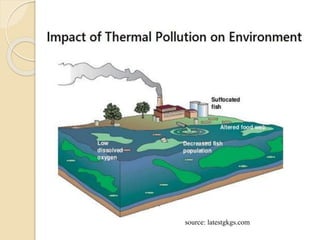
EFFECTS OF THERMAL POLLUTION
 Increase in toxicity: A rise in temperature increases the toxicity of the poison
present in water which increases the mortality rates of the aquatic animals.
 Interference with reproduction and reproductive rates: In fishes, several
activities like nest building, spawning, reproduction etc. depends on some
optimum temperature. The increase in temperature triggers deposition of eggs
by females.
 Increased vulnerability to diseases: Activities of several pathogenic
microorganisms are accelerated by higher temperature. Example: hot water
causes bacterial disease in Salmon fish.
 Growth of Blue-Green Algae: The thermal discharge to a water course may
favor the growth of blue-green algae over green algae, resulting in damage to
ecosystem. Blue-green algae are reported to be the poorer source of food for
aquatic animals.
 Change in water properties: A rise in temperature changes the physical and
chemical properties of water.
source: latestgkgs.com
CONTROL OF THERMAL
POLLUTION
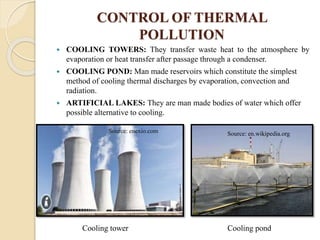
 COOLING TOWERS: They transfer waste heat to the atmosphere by
evaporation or heat transfer after passage through a condenser.
 COOLING POND: Man made reservoirs which constitute the simplest
method of cooling thermal discharges by evaporation, convection and
radiation.
 ARTIFICIAL LAKES: They are man made bodies of water which offer
possible alternative to cooling.
Cooling tower Cooling pond
Source: enexio.com Source: en.wikipedia.org
PREVENTION
 Channeling of thermal effluents
 Using adequate cooling towers and ponds
 Efficient designing of outfalls to prevent thermal block from occurring
 Avoiding interference of hot water mass with fish migration
 Temperature prediction models can be used to develop the safe engineered
designs
 By improving the efficiencies of electric power generating plants
 Through plant setting, coupled with effective use of regulated river system
CASE STUDY
Source: slideshare.net
CHINA 2010: A man collects dead fish in Guanqiao Lake in Wuhan in central
China’s Hubei province
Source: moongazermusings.wordpress.com
REFERENCE
o Wikipedia, accessed 20 October 2019
<www.wikipedia.org>
o Latest GK GS, accessed 22 October 2019
<https://www.latestgkgs.com/thermal-pollution-4324-a>
o Slideshare, accessed 20 October 2019
<https://www.slideshare.net/Haritha47/thermal-pollution-46386170?qid=e1dcf2e5-dc4f-
4182-b40d-ecfa3eea7155&v=&b=&from_search=4>
o SINGH,A. (2008). Textbook of Environmental Chemistry. 1st ed.
New Delhi: Campus Books International
o KAUR,H. (2008). Environmental Chemistry. 3rd ed. Meerut: Pragati Prakashan
Source: Google images

Thermal pollution presentation

  • 1.
    THERMAL POLLUTION Application ID:d74283c5f03d11e9be91b5549a39a241 MAHESH.T.M Maheshtm1098@gmail.com Academic writing
  • 2.
    ACKNOWLEDGEMENT  This presentationis done to fulfil the summative assignment 2 of week 13 of the course for Academic Writing
  • 3.
    INTRODUCTION  The termthermal pollution has been used to indicate the detrimental effects of heated effluents discharged by various power plants. It denotes the impairment of quality and deterioration of aquatic and terrestrial environment.  A common cause of thermal pollution is the use of water as a coolant by power plants and industrial manufacturers. Source: greentube.com
  • 4.
     The heatedeffluents are discharged at temperature 8-10 degree Celsius higher than the temperature of intake water.  According to World Health Organization (WHO), “Heated effluents, either from natural or man made sources, contaminated with water supplies, may be harmful to life because of their toxicity, reduction in normal oxygen level of water, aesthetically unsuitable and spread diseases.” Source: conserve-energy-future.com
  • 5.
    CAUSES OF THERMAL POLLUTION oThe major source of thermal pollution is discharge of heated water or wastes into water body mainly from  Nuclear power plants  Industrial effluents  Hydro electric Power Plants  Coal fired Plants
  • 6.
    EFFECTS OF THERMALPOLLUTION  Increase in toxicity: A rise in temperature increases the toxicity of the poison present in water which increases the mortality rates of the aquatic animals.  Interference with reproduction and reproductive rates: In fishes, several activities like nest building, spawning, reproduction etc. depends on some optimum temperature. The increase in temperature triggers deposition of eggs by females.  Increased vulnerability to diseases: Activities of several pathogenic microorganisms are accelerated by higher temperature. Example: hot water causes bacterial disease in Salmon fish.  Growth of Blue-Green Algae: The thermal discharge to a water course may favor the growth of blue-green algae over green algae, resulting in damage to ecosystem. Blue-green algae are reported to be the poorer source of food for aquatic animals.  Change in water properties: A rise in temperature changes the physical and chemical properties of water.
  • 7.
  • 8.
    CONTROL OF THERMAL POLLUTION COOLING TOWERS: They transfer waste heat to the atmosphere by evaporation or heat transfer after passage through a condenser.  COOLING POND: Man made reservoirs which constitute the simplest method of cooling thermal discharges by evaporation, convection and radiation.  ARTIFICIAL LAKES: They are man made bodies of water which offer possible alternative to cooling. Cooling tower Cooling pond Source: enexio.com Source: en.wikipedia.org
  • 9.
    PREVENTION  Channeling ofthermal effluents  Using adequate cooling towers and ponds  Efficient designing of outfalls to prevent thermal block from occurring  Avoiding interference of hot water mass with fish migration  Temperature prediction models can be used to develop the safe engineered designs  By improving the efficiencies of electric power generating plants  Through plant setting, coupled with effective use of regulated river system
  • 10.
  • 11.
    CHINA 2010: Aman collects dead fish in Guanqiao Lake in Wuhan in central China’s Hubei province Source: moongazermusings.wordpress.com
  • 12.
    REFERENCE o Wikipedia, accessed20 October 2019 <www.wikipedia.org> o Latest GK GS, accessed 22 October 2019 <https://www.latestgkgs.com/thermal-pollution-4324-a> o Slideshare, accessed 20 October 2019 <https://www.slideshare.net/Haritha47/thermal-pollution-46386170?qid=e1dcf2e5-dc4f- 4182-b40d-ecfa3eea7155&v=&b=&from_search=4> o SINGH,A. (2008). Textbook of Environmental Chemistry. 1st ed. New Delhi: Campus Books International o KAUR,H. (2008). Environmental Chemistry. 3rd ed. Meerut: Pragati Prakashan
  • 13.