1
2
Presenter by:
LAVANYA V.
M.tech
Department of PFE
CAE, raichur.
MICROWAVE HEATING
3
 MW are electromagnetic waves
generated by magnetrons and
klystrons.
 Frequency 300MHz and 300GHz
 Wavelength from 1mm to 1m
 industrial heating purposes the
available frequencies are 915 and
2450MHz
INTRODUCTION
4
Electromagnetic waves spectrum
MICROWAVE HEATING
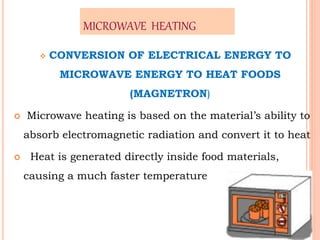
 CONVERSION OF ELECTRICAL ENERGY TO
MICROWAVE ENERGY TO HEAT FOODS
(MAGNETRON)
 Microwave heating is based on the material’s ability to
absorb electromagnetic radiation and convert it to heat
 Heat is generated directly inside food materials,
causing a much faster temperature
5
MICROWAVE HEATING MECHANISM
 MW giving up their energy to the material,
with a consequential rise in temperature
Two imp mechanisms are:
 Ionic polarization: conversion of kinetic
energy of the moving ions into thermal energy
 Dipole rotation: rotation of polar molecules
leads friction with surrounding medium and
heat is generated 6
ENERGY EFFICIENCY, CONSUMPTION,AND CONSERVATION
DURING MICROWAVE HEATING
ENERGY EFFICIENCY:
 During microwave heating, electrical energy is first
converted into microwave energy
 The microwave then interacts with foods and is
converted into heat
TWO EFFICIENCIES:
1. Microwave generation efficiency
2. Microwave absorption efficiency
7
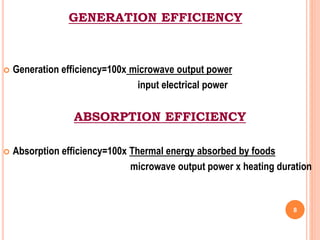
GENERATION EFFICIENCY
 Generation efficiency=100x microwave output power
input electrical power
ABSORPTION EFFICIENCY
 Absorption efficiency=100x Thermal energy absorbed by foods
microwave output power x heating duration
8
 Combine both generation efficiency and absorption
efficiency, we can get the total thermal efficiency
expressed as:
Thermal efficiency=100 X Thermal energy absorbed by foods
input electrical energy
9
ENERGY CONSUMPTION
 Specific energy consumption was defined as the total
energy supplied divided by the amount of water
removed during drying
 Overheating could increase the energy consumption
due to high moisture loss from the overheated region
10
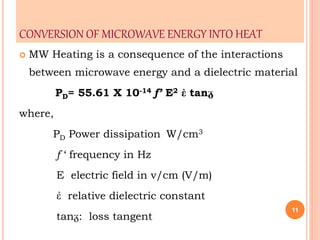
CONVERSION OF MICROWAVE ENERGY INTO HEAT
 MW Heating is a consequence of the interactions
between microwave energy and a dielectric material
PD= 55.61 X 10⁻¹⁴ f’ E2 ἐ tanᵹ
where,
PD Power dissipation W/cm3
f ‘ frequency in Hz
E electric field in v/cm (V/m)
ἐ relative dielectric constant
tanᵹ: loss tangent
11
Basic structure of a microwave oven
12
MICROWAVE OVEN GENERALLY CONSISTS
OF THE FOLLOWING BASIC COMPONENTS
 (i) power supply and control: it controls the power
to be fed to the magnetron as well as the cooking time
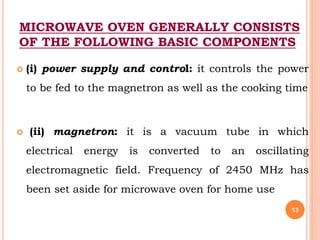
 (ii) magnetron: it is a vacuum tube in which
electrical energy is converted to an oscillating
electromagnetic field. Frequency of 2450 MHz has
been set aside for microwave oven for home use
13
Conti…..
 (iii) waveguide: it is a rectangular metal tube which
directs the microwaves generated from the magnetron
to the cooking cavity
 (iv) stirrer: it is commonly used to distribute
microwaves from the waveguide and allow more
uniform heating of food
 (v) cooking cavity: it is a space inside which the food
is heated when exposed to microwaves
14
Conti….
 (vi) turntable: it rotates the food products through
the fixed hot and cold spots inside the cooking
cavity and allows the food products to be evenly
exposed to microwaves
 (vii) door and choke: it allows the food to the
cooking cavity. they prevent microwaves from
leaking through the gap between the door and the
cooking cavity
15
FACTORS AFFECTING MICROWAVE HEATING
 Dielectric properties
 Temperature and frequency
 Shape and size of food items
16
DIELECTRIC PROPERTIES
 Penetration of microwave energy inside a material
is a function of its dielectric properties.
 The permittivity of foods describes how the food
materials interact with electromagnetic radiation.
17
CONTI….
 Dielectric constant and Dielectric loss factor
decrease with the increase in microwave frequency
 Penetration depth of MW is proportional to wave
length, sq.root of dielectric constant & inversely to
loss factor
18
TEMPERATURE AND FREQUENCY
 The temperature increase in foods during
microwave heating depends on both the
dielectric and thermo physical properties of
foods
 power absorption and radiation penetration
during microwave heating are more effective at
lower frequencies than at higher ones
19
SHAPE AND SIZE OF FOOD ITEMS
 Microwave heating is significantly dependent
on the size and shape of foods.
 In larger samples, a large temperature
gradient occurs from the surface toward the
center during microwave heating.
 In smaller food items, microwave heating is
more uniform
20
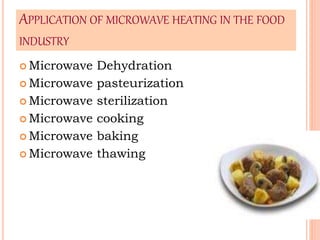
APPLICATION OF MICROWAVE HEATING IN THE FOOD
INDUSTRY
 Microwave Dehydration
 Microwave pasteurization
 Microwave sterilization
 Microwave cooking
 Microwave baking
 Microwave thawing
21
MICROWAVE DEHYDRATION
 Drying is a complex process involving
simultaneous coupled heat and mass transfer
Stages during drying of food materials:
 Increasing rate at the beginning
 Constant rate period in the middle
 Falling rate period at the end
22
Conti….
 MW –assisted combination drying is a rapid dehydration
technique that can be applied to specific foods,
particularly to fruits and vegetables
 It reduce the drying time
 MW has also been as an energy source in vacuum drying
to improve energy efficiency and product quality
23
24
MICROWAVE DRYER
MICROWAVE PASTEURIZATION
 MW heating has been used for HTST pasteurization
of foods, particularly thick food items.
 microwave heating system used for in- package
pasteurization of ready-to-eat meats
 It inactivates the bacteria at the temp of 650C,
750C,and 850C,respectivly.
25
MICROWAVE THAWING
 Microwave thawing include a high thawing speed,
uniformity of thawing , flexibility, and less floor
space requirement
 Significantly reduce the processing time and
weight loss
 It Causes a greater moisture loss
26
MICROWAVE BAKING
 Backing is a new technology in the bakery industry
 Microwave can penetrate into products and thus
rapidly heat the products from the inside
 Microwave backing cannot induce browning and
crust on the surface of breads and cakes
 It increase the quality of bakery products
27
28
Microwave puffing system for snack
foods
MICROWAVE COOKING
 It help us heat and cook almost anything from a cup
of coffee to full diners.
 Reduce cooking time and achieve a uniform
temperature profile
 Microwaves cause molecules in food to vibrate. This
creates heat that cooks the food fast.
 Surface temperature of foods during microwave
cooking may easily reach 1000C 29
30
MICROWAVE COOKING
MICROWAVE STERILIZATION
 inactivation of harmful bacteria from food
 ability to heat solid, semi-solid and meal
combination food products
 more rapid heating and preservation of sensory
and nutritional quality
 Reduction in the thermal processing time
31
THE ADVANTAGES AND DISADVANTAGES OF MICROWAVE
HEATING
ADVANTAGES
 It is fast and easy
 It takes less time to heat the food
 provides a convenient way to thaw, cook and reheat foods
 uniform cooking
 Cook large pieces of meat at medium power for longer
periods
32
DISADVANTAGES :
 The waves usually destroys the vitamins and
minerals found in most fresh foods
 It does not cook to perfection any dish but merely
warms it up to the degree you desire
 Microwaves can at times destroy some taste and
flavour in some dishes
33
SAFE MICROWAVING
 Avoid direct contact with the microwave’s heat
 Use only microwave safe utensils like glass,
ceramic, plastic, or paper.
 Be sure to cover, rotate, stir and re-arrange food to
promote even cooking
 Do not reheat your food for long period of time
 Safe only if the container remains cool
34
CONCLUSION
 Heat the material internally
 Food materials with higher moisture content absorb
more MW energy
 If the piece of the material is smaller than the wave
length, its centre will be overheated
 Use only microwave safe utensils
35
36

microwave heating.pptx

  • 1.
  • 2.
    2 Presenter by: LAVANYA V. M.tech Departmentof PFE CAE, raichur. MICROWAVE HEATING
  • 3.
    3  MW areelectromagnetic waves generated by magnetrons and klystrons.  Frequency 300MHz and 300GHz  Wavelength from 1mm to 1m  industrial heating purposes the available frequencies are 915 and 2450MHz INTRODUCTION
  • 4.
  • 5.
    MICROWAVE HEATING  CONVERSIONOF ELECTRICAL ENERGY TO MICROWAVE ENERGY TO HEAT FOODS (MAGNETRON)  Microwave heating is based on the material’s ability to absorb electromagnetic radiation and convert it to heat  Heat is generated directly inside food materials, causing a much faster temperature 5
  • 6.
    MICROWAVE HEATING MECHANISM MW giving up their energy to the material, with a consequential rise in temperature Two imp mechanisms are:  Ionic polarization: conversion of kinetic energy of the moving ions into thermal energy  Dipole rotation: rotation of polar molecules leads friction with surrounding medium and heat is generated 6
  • 7.
    ENERGY EFFICIENCY, CONSUMPTION,ANDCONSERVATION DURING MICROWAVE HEATING ENERGY EFFICIENCY:  During microwave heating, electrical energy is first converted into microwave energy  The microwave then interacts with foods and is converted into heat TWO EFFICIENCIES: 1. Microwave generation efficiency 2. Microwave absorption efficiency 7
  • 8.
    GENERATION EFFICIENCY  Generationefficiency=100x microwave output power input electrical power ABSORPTION EFFICIENCY  Absorption efficiency=100x Thermal energy absorbed by foods microwave output power x heating duration 8
  • 9.
     Combine bothgeneration efficiency and absorption efficiency, we can get the total thermal efficiency expressed as: Thermal efficiency=100 X Thermal energy absorbed by foods input electrical energy 9
  • 10.
    ENERGY CONSUMPTION  Specificenergy consumption was defined as the total energy supplied divided by the amount of water removed during drying  Overheating could increase the energy consumption due to high moisture loss from the overheated region 10
  • 11.
    CONVERSION OF MICROWAVEENERGY INTO HEAT  MW Heating is a consequence of the interactions between microwave energy and a dielectric material PD= 55.61 X 10⁻¹⁴ f’ E2 ἐ tanᵹ where, PD Power dissipation W/cm3 f ‘ frequency in Hz E electric field in v/cm (V/m) ἐ relative dielectric constant tanᵹ: loss tangent 11
  • 12.
    Basic structure ofa microwave oven 12
  • 13.
    MICROWAVE OVEN GENERALLYCONSISTS OF THE FOLLOWING BASIC COMPONENTS  (i) power supply and control: it controls the power to be fed to the magnetron as well as the cooking time  (ii) magnetron: it is a vacuum tube in which electrical energy is converted to an oscillating electromagnetic field. Frequency of 2450 MHz has been set aside for microwave oven for home use 13
  • 14.
    Conti…..  (iii) waveguide:it is a rectangular metal tube which directs the microwaves generated from the magnetron to the cooking cavity  (iv) stirrer: it is commonly used to distribute microwaves from the waveguide and allow more uniform heating of food  (v) cooking cavity: it is a space inside which the food is heated when exposed to microwaves 14
  • 15.
    Conti….  (vi) turntable:it rotates the food products through the fixed hot and cold spots inside the cooking cavity and allows the food products to be evenly exposed to microwaves  (vii) door and choke: it allows the food to the cooking cavity. they prevent microwaves from leaking through the gap between the door and the cooking cavity 15
  • 16.
    FACTORS AFFECTING MICROWAVEHEATING  Dielectric properties  Temperature and frequency  Shape and size of food items 16
  • 17.
    DIELECTRIC PROPERTIES  Penetrationof microwave energy inside a material is a function of its dielectric properties.  The permittivity of foods describes how the food materials interact with electromagnetic radiation. 17
  • 18.
    CONTI….  Dielectric constantand Dielectric loss factor decrease with the increase in microwave frequency  Penetration depth of MW is proportional to wave length, sq.root of dielectric constant & inversely to loss factor 18
  • 19.
    TEMPERATURE AND FREQUENCY The temperature increase in foods during microwave heating depends on both the dielectric and thermo physical properties of foods  power absorption and radiation penetration during microwave heating are more effective at lower frequencies than at higher ones 19
  • 20.
    SHAPE AND SIZEOF FOOD ITEMS  Microwave heating is significantly dependent on the size and shape of foods.  In larger samples, a large temperature gradient occurs from the surface toward the center during microwave heating.  In smaller food items, microwave heating is more uniform 20
  • 21.
    APPLICATION OF MICROWAVEHEATING IN THE FOOD INDUSTRY  Microwave Dehydration  Microwave pasteurization  Microwave sterilization  Microwave cooking  Microwave baking  Microwave thawing 21
  • 22.
    MICROWAVE DEHYDRATION  Dryingis a complex process involving simultaneous coupled heat and mass transfer Stages during drying of food materials:  Increasing rate at the beginning  Constant rate period in the middle  Falling rate period at the end 22
  • 23.
    Conti….  MW –assistedcombination drying is a rapid dehydration technique that can be applied to specific foods, particularly to fruits and vegetables  It reduce the drying time  MW has also been as an energy source in vacuum drying to improve energy efficiency and product quality 23
  • 24.
  • 25.
    MICROWAVE PASTEURIZATION  MWheating has been used for HTST pasteurization of foods, particularly thick food items.  microwave heating system used for in- package pasteurization of ready-to-eat meats  It inactivates the bacteria at the temp of 650C, 750C,and 850C,respectivly. 25
  • 26.
    MICROWAVE THAWING  Microwavethawing include a high thawing speed, uniformity of thawing , flexibility, and less floor space requirement  Significantly reduce the processing time and weight loss  It Causes a greater moisture loss 26
  • 27.
    MICROWAVE BAKING  Backingis a new technology in the bakery industry  Microwave can penetrate into products and thus rapidly heat the products from the inside  Microwave backing cannot induce browning and crust on the surface of breads and cakes  It increase the quality of bakery products 27
  • 28.
  • 29.
    MICROWAVE COOKING  Ithelp us heat and cook almost anything from a cup of coffee to full diners.  Reduce cooking time and achieve a uniform temperature profile  Microwaves cause molecules in food to vibrate. This creates heat that cooks the food fast.  Surface temperature of foods during microwave cooking may easily reach 1000C 29
  • 30.
  • 31.
    MICROWAVE STERILIZATION  inactivationof harmful bacteria from food  ability to heat solid, semi-solid and meal combination food products  more rapid heating and preservation of sensory and nutritional quality  Reduction in the thermal processing time 31
  • 32.
    THE ADVANTAGES ANDDISADVANTAGES OF MICROWAVE HEATING ADVANTAGES  It is fast and easy  It takes less time to heat the food  provides a convenient way to thaw, cook and reheat foods  uniform cooking  Cook large pieces of meat at medium power for longer periods 32
  • 33.
    DISADVANTAGES :  Thewaves usually destroys the vitamins and minerals found in most fresh foods  It does not cook to perfection any dish but merely warms it up to the degree you desire  Microwaves can at times destroy some taste and flavour in some dishes 33
  • 34.
    SAFE MICROWAVING  Avoiddirect contact with the microwave’s heat  Use only microwave safe utensils like glass, ceramic, plastic, or paper.  Be sure to cover, rotate, stir and re-arrange food to promote even cooking  Do not reheat your food for long period of time  Safe only if the container remains cool 34
  • 35.
    CONCLUSION  Heat thematerial internally  Food materials with higher moisture content absorb more MW energy  If the piece of the material is smaller than the wave length, its centre will be overheated  Use only microwave safe utensils 35
  • 36.

Editor's Notes