MICROWAVE HEATING
REPRESENT BY : RANA MEHUL
REGD NO : 14MMET24
Under the guidance of prof T.N.RAVAL SIR
MICROWAVE HEATING
 INTODUCTION
 PROPERTIES
 ADVANTAGES
 APPLICATIONS
 LIMITATIONS
MICROWAVE ELECTRO MAGNETIC SPECTRUM
INTODUCTION
 Microwaves are electromagnetic waves whose frequencies
ranges from about 300 MHz – 300 GHz (1 MHz = 10 6 Hz
and 1 GHz = 10 9 Hz) or wavelengths in air ranging from
100 cm – 1 mm.
 The word Microwave means very short wave, which is the
shortest wavelength region of the radio spectrum and a part
of the electromagnetic spectrum.
PROPERTIES
 Microwave is an electromagnetic radiation of short
wavelength.
 They can reflect by conducting surfaces just like optical
waves since they travel in straight line.
 Microwave currents flow through a thin outer layer of an
ordinary cable.
 Microwaves are easily attenuated within short distances.
 They are not reflected by ionosphere .
ADVANTAGES
1. INCREASE BANDWIDTH AVAILABILITY
 Microwaves have large bandwidths compared to the common bands
like short waves (SW), ultrahigh frequency (UHF) waves, etc.
 For example, the microwaves extending from = 1 cm - = 10 cm
(i.e) from 30,000 MHz – 3000 MHz, this region has a bandwidth of
27,000 MHz.
2. IMPROVED DIRECTIVE PROPERTIES
 The second advantage of microwaves is their ability to use high gain
directive antennas, any Electro magnetic wave can be focused in a
specified direction (Just as the focusing of light rays with lenses or
reflectors)
ADVANTAGES
3. Fading effect and reliability:
 Fading effect due to the variation in the transmission medium is more
effective at low frequency.
 Due to the Line of Sight (LOS) propagation and high frequencies, there
is less fading effect and hence microwave communication is more
reliable.
4. Power requirements:
 Transmitter / receiver power requirements are pretty low at
microwave frequencies compared to that at short wave band.
ADVANTAGES
5.Transparency property of microwaves:
 Microwave frequency band ranging from 300 MHz – 10 GHz
are capable of freely propagating through the
atmosphere.
APPLICATION
 Microwaves have a wide range of applications in modern
technology, which are listed below
1. Telecommunication: Telephone and TV, space
communication (Earth – to – space and space – to –
Earth), telemetry communication link for railways etc.
2. Radars: detect aircraft, track / guide supersonic
missiles, observe and track weather patterns, air traffic
control (ATC), burglar alarms, garage door openers,
police speed detectors etc.
APPLICATION
3. Commercial and industrial applications:
 Microwave oven
 Drying machines – textile, food and paper industry for drying
clothes, potato chips, printed matters etc.
 Food process industry – Precooling / cooking, pasteurization /
sterility, hat frozen / refrigerated precooled meats, roasting of
food grains / beans.
 Biomedical Applications ( diagnostic / therapeutic ) – diathermy
for localized superficial heating, deep electromagnetic heating
for treatment of cancer, hyperthermia ( local, regional or whole
body for cancer therapy).
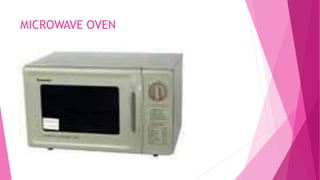
MICROWAVE OVEN
HOW MICROWAVE USED IN
MICROWAVE OVEN FOR COOKING
 Microwaves cause molecules in food to vibrate. This
creates heat that cooks the food. Heat from the food
warms the container that the food is in.
 Some areas get more microwaves, resulting in uneven
cooking—hence rotating disk helps cook evenly
 Microwaves are attracted to water, fat, and sugar
molecules causing them to vibrate and heat
MICROWAVE COOKING
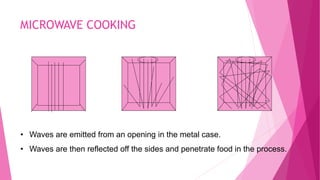
• Waves are emitted from an opening in the metal case.
• Waves are then reflected off the sides and penetrate food in the process.
MICROWAVE COOKING
 Food and cookware taken out of a microwave oven is rarely
much hotter than 100 °C (212 °F). Cookware used in a
microwave oven is often much cooler than the food because
the microwaves heat the food directly and the cookware is
heated by the food. Food and cookware from a conventional
oven, on the other hand, are the same temperature as the
rest of the oven; a typical cooking temperature is 180 °C
(360 °F). That means that conventional stoves and ovens
can cause more serious burns.
LIMITATION
• Microwaves cannot go through metal, but
they do pass through glass, ceramic, plastic,
or paper.
Hence use glass, ceramic, or plastic dishes
that are safe in the microwave oven.
REFRENCES
 METAXAS, A.C. Microwave heating. Power Engineering Journal,
September 1991. pp. 237–247.
 KASHYAP, S.C. and WYSLOUZIL, W. Methods for improving heating
uniformity in microwave ovens. J. Microwave Power and
Electromagnetic Energy,
 Microwave Processing of Materials IV Materials Research Society
Symposium Proceedings Materials Research Society, Pittsburgh, Vol.
MICROWAVE HEATING
 So far we have covered following topics in microwave
and microwave heating
1. PROPERTIES
2. ADVANTAGES
3. APPLICATION
4. LIMITATIONS
 Now we will see how microwave is useful for industry
purpose.
Application of microwaves in textile
finishing processes
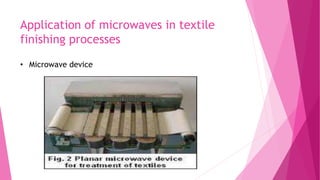
• Microwave device
Application of microwaves in textile
finishing processes
 Microwave device
 This system offers passage of textile material in a wide
state through a waveguides. The system consists of 6
centrally sloted rectangular waveguides (dimensions 4 x 8
cm) and 2 magnetrons fed by 500 W. Waveguide is
terminated with water-based dummy load that prevents
leakage of residual microwave energy.
Application of microwaves in textile
finishing processes
 With proper design of the waveguides and supporting
equipment, a specific environment (at the particular
wavelength) can be created in order to provide controlled
distribution of the microwave energy, making it possible
to achieve uniform exposure to material passed through a
channel. The leakage of microwave energy is inherently
small due to the fact that waveguide slots are oriented
along the wave guideline of symmetry, and therefore they
cannot act as efficient slot antennas
Application of microwaves in textile
finishing processes
 Furthermore, in this way the material lies in the maximum
of the electric field that assures effective coupling to the
flowing microwave energy. In a case that request for slots
symmetry is fulfilled, only the load (textile material)
which passes through the waveguides has an influence on
energy loss. The amount of microwave energy absorbed by
the textile in each waveguide pass depends on the
material thickness and moisture content.
Application of microwaves in textile
finishing processes
 Working
 The energy of microwave photons is very low (125 kJ/mol)
relative to the typical energies for chemical bonds (335-84
kJ/mol); thus microwave will not directly affect the
molecular structure. They cannot change the electronic
structure around atoms or among them, but they can
interact with the electronic differences between atoms.
Application of microwaves in textile
finishing processes
 Different materials can be divided according to their
response on microwave radiation:
 The materials that reflect Microwave radiation (stayed
cold) .
 The materials that is transparent to Microwave radiation
(non-heated).
 The materials that absorb microwave energy (being
heated).
Application of microwaves in textile
finishing processes
 For a microwave electromagnetic field oscillating at 2.5
GHz, which is preferred frequency for heating
applications, the charge changes polarity nearly 5 billion
times per second. Microwave radiation is specially tuned
to the natural frequency of water molecules to maximise
the interactions.
Application of microwaves in textile
finishing processes
 The main difference between conventional heating with hot air
and microwave heating is the heating mechanism. While
conventional techniques heat a surface, the microwaves heat
the whole volume of the treated object. During the
conventional heating, the heat is generated outside the treated
product and conveyed by conduction or convection. Hence, the
surface is heated at first and afterwards the heat flows toward
the inside, which always remains colder than the surface. The
required internal temperature can be reached only by sufficient
increase of the surface temperature of the material above the
temperature needed for particular treatment.
Application of microwaves in textile
finishing processes
 ADVANTAGE
 Microwave radiation for textile finishing has been used for
the combined desizing, scouring and bleaching processes
,dyeing and drying processes, as well as for eradication of
insects from wool textiles. Additional usage was for
continuous measuring of low humidity. All this
experiments were performed in a resonant cavity
Application of microwaves in textile
finishing processes
 REFERENCES
1. Metaxas A.C., R.J. Meredith: Industrial Microwave Heating, Peter
Peregrinus 1983, 111-150
2. Varma R: Solvent- free accelerated organic syntheses using
microwaves, Pure Appl. Chem 73 (2001) 1, 193 – 198
3. Cablewski T. et al: Development and Application of Continuous
Microwave Reactor for Organic Synthesis,.Org.Chem 59 (1994) 3408
3412 Englert R.D., L.P. Berriman: Curing chemically treated cellulosic
fabrics, US Patent 3846845, 1974 1112
Application of microwaves in textile
finishing processes
 REFERENCES
4. Bobbin: Microwaves meet wrinkle-free marketplace, October 1995
NatNews
5. anonimno: Microwave Processes for the Combined Desizing, Scouring
and Bleaching of Grey Cotton Fabrics, J.Text.Institute (1996) 3, 602-607
Conclusion
 By using microwave we can cook food with uniform
temperature and also it is used for industry purpose like
textile technology for drying, dying , etc.
THANK YOU

Microwave heating

  • 1.
    MICROWAVE HEATING REPRESENT BY: RANA MEHUL REGD NO : 14MMET24 Under the guidance of prof T.N.RAVAL SIR
  • 2.
    MICROWAVE HEATING  INTODUCTION PROPERTIES  ADVANTAGES  APPLICATIONS  LIMITATIONS
  • 3.
  • 4.
    INTODUCTION  Microwaves areelectromagnetic waves whose frequencies ranges from about 300 MHz – 300 GHz (1 MHz = 10 6 Hz and 1 GHz = 10 9 Hz) or wavelengths in air ranging from 100 cm – 1 mm.  The word Microwave means very short wave, which is the shortest wavelength region of the radio spectrum and a part of the electromagnetic spectrum.
  • 5.
    PROPERTIES  Microwave isan electromagnetic radiation of short wavelength.  They can reflect by conducting surfaces just like optical waves since they travel in straight line.  Microwave currents flow through a thin outer layer of an ordinary cable.  Microwaves are easily attenuated within short distances.  They are not reflected by ionosphere .
  • 6.
    ADVANTAGES 1. INCREASE BANDWIDTHAVAILABILITY  Microwaves have large bandwidths compared to the common bands like short waves (SW), ultrahigh frequency (UHF) waves, etc.  For example, the microwaves extending from = 1 cm - = 10 cm (i.e) from 30,000 MHz – 3000 MHz, this region has a bandwidth of 27,000 MHz. 2. IMPROVED DIRECTIVE PROPERTIES  The second advantage of microwaves is their ability to use high gain directive antennas, any Electro magnetic wave can be focused in a specified direction (Just as the focusing of light rays with lenses or reflectors)
  • 7.
    ADVANTAGES 3. Fading effectand reliability:  Fading effect due to the variation in the transmission medium is more effective at low frequency.  Due to the Line of Sight (LOS) propagation and high frequencies, there is less fading effect and hence microwave communication is more reliable. 4. Power requirements:  Transmitter / receiver power requirements are pretty low at microwave frequencies compared to that at short wave band.
  • 8.
    ADVANTAGES 5.Transparency property ofmicrowaves:  Microwave frequency band ranging from 300 MHz – 10 GHz are capable of freely propagating through the atmosphere.
  • 9.
    APPLICATION  Microwaves havea wide range of applications in modern technology, which are listed below 1. Telecommunication: Telephone and TV, space communication (Earth – to – space and space – to – Earth), telemetry communication link for railways etc. 2. Radars: detect aircraft, track / guide supersonic missiles, observe and track weather patterns, air traffic control (ATC), burglar alarms, garage door openers, police speed detectors etc.
  • 10.
    APPLICATION 3. Commercial andindustrial applications:  Microwave oven  Drying machines – textile, food and paper industry for drying clothes, potato chips, printed matters etc.  Food process industry – Precooling / cooking, pasteurization / sterility, hat frozen / refrigerated precooled meats, roasting of food grains / beans.  Biomedical Applications ( diagnostic / therapeutic ) – diathermy for localized superficial heating, deep electromagnetic heating for treatment of cancer, hyperthermia ( local, regional or whole body for cancer therapy).
  • 11.
  • 12.
    HOW MICROWAVE USEDIN MICROWAVE OVEN FOR COOKING  Microwaves cause molecules in food to vibrate. This creates heat that cooks the food. Heat from the food warms the container that the food is in.  Some areas get more microwaves, resulting in uneven cooking—hence rotating disk helps cook evenly  Microwaves are attracted to water, fat, and sugar molecules causing them to vibrate and heat
  • 13.
    MICROWAVE COOKING • Wavesare emitted from an opening in the metal case. • Waves are then reflected off the sides and penetrate food in the process.
  • 14.
    MICROWAVE COOKING  Foodand cookware taken out of a microwave oven is rarely much hotter than 100 °C (212 °F). Cookware used in a microwave oven is often much cooler than the food because the microwaves heat the food directly and the cookware is heated by the food. Food and cookware from a conventional oven, on the other hand, are the same temperature as the rest of the oven; a typical cooking temperature is 180 °C (360 °F). That means that conventional stoves and ovens can cause more serious burns.
  • 15.
    LIMITATION • Microwaves cannotgo through metal, but they do pass through glass, ceramic, plastic, or paper. Hence use glass, ceramic, or plastic dishes that are safe in the microwave oven.
  • 17.
    REFRENCES  METAXAS, A.C.Microwave heating. Power Engineering Journal, September 1991. pp. 237–247.  KASHYAP, S.C. and WYSLOUZIL, W. Methods for improving heating uniformity in microwave ovens. J. Microwave Power and Electromagnetic Energy,  Microwave Processing of Materials IV Materials Research Society Symposium Proceedings Materials Research Society, Pittsburgh, Vol.
  • 18.
    MICROWAVE HEATING  Sofar we have covered following topics in microwave and microwave heating 1. PROPERTIES 2. ADVANTAGES 3. APPLICATION 4. LIMITATIONS  Now we will see how microwave is useful for industry purpose.
  • 19.
    Application of microwavesin textile finishing processes • Microwave device
  • 20.
    Application of microwavesin textile finishing processes  Microwave device  This system offers passage of textile material in a wide state through a waveguides. The system consists of 6 centrally sloted rectangular waveguides (dimensions 4 x 8 cm) and 2 magnetrons fed by 500 W. Waveguide is terminated with water-based dummy load that prevents leakage of residual microwave energy.
  • 21.
    Application of microwavesin textile finishing processes  With proper design of the waveguides and supporting equipment, a specific environment (at the particular wavelength) can be created in order to provide controlled distribution of the microwave energy, making it possible to achieve uniform exposure to material passed through a channel. The leakage of microwave energy is inherently small due to the fact that waveguide slots are oriented along the wave guideline of symmetry, and therefore they cannot act as efficient slot antennas
  • 22.
    Application of microwavesin textile finishing processes  Furthermore, in this way the material lies in the maximum of the electric field that assures effective coupling to the flowing microwave energy. In a case that request for slots symmetry is fulfilled, only the load (textile material) which passes through the waveguides has an influence on energy loss. The amount of microwave energy absorbed by the textile in each waveguide pass depends on the material thickness and moisture content.
  • 23.
    Application of microwavesin textile finishing processes  Working  The energy of microwave photons is very low (125 kJ/mol) relative to the typical energies for chemical bonds (335-84 kJ/mol); thus microwave will not directly affect the molecular structure. They cannot change the electronic structure around atoms or among them, but they can interact with the electronic differences between atoms.
  • 24.
    Application of microwavesin textile finishing processes  Different materials can be divided according to their response on microwave radiation:  The materials that reflect Microwave radiation (stayed cold) .  The materials that is transparent to Microwave radiation (non-heated).  The materials that absorb microwave energy (being heated).
  • 25.
    Application of microwavesin textile finishing processes  For a microwave electromagnetic field oscillating at 2.5 GHz, which is preferred frequency for heating applications, the charge changes polarity nearly 5 billion times per second. Microwave radiation is specially tuned to the natural frequency of water molecules to maximise the interactions.
  • 26.
    Application of microwavesin textile finishing processes  The main difference between conventional heating with hot air and microwave heating is the heating mechanism. While conventional techniques heat a surface, the microwaves heat the whole volume of the treated object. During the conventional heating, the heat is generated outside the treated product and conveyed by conduction or convection. Hence, the surface is heated at first and afterwards the heat flows toward the inside, which always remains colder than the surface. The required internal temperature can be reached only by sufficient increase of the surface temperature of the material above the temperature needed for particular treatment.
  • 27.
    Application of microwavesin textile finishing processes  ADVANTAGE  Microwave radiation for textile finishing has been used for the combined desizing, scouring and bleaching processes ,dyeing and drying processes, as well as for eradication of insects from wool textiles. Additional usage was for continuous measuring of low humidity. All this experiments were performed in a resonant cavity
  • 28.
    Application of microwavesin textile finishing processes  REFERENCES 1. Metaxas A.C., R.J. Meredith: Industrial Microwave Heating, Peter Peregrinus 1983, 111-150 2. Varma R: Solvent- free accelerated organic syntheses using microwaves, Pure Appl. Chem 73 (2001) 1, 193 – 198 3. Cablewski T. et al: Development and Application of Continuous Microwave Reactor for Organic Synthesis,.Org.Chem 59 (1994) 3408 3412 Englert R.D., L.P. Berriman: Curing chemically treated cellulosic fabrics, US Patent 3846845, 1974 1112
  • 29.
    Application of microwavesin textile finishing processes  REFERENCES 4. Bobbin: Microwaves meet wrinkle-free marketplace, October 1995 NatNews 5. anonimno: Microwave Processes for the Combined Desizing, Scouring and Bleaching of Grey Cotton Fabrics, J.Text.Institute (1996) 3, 602-607
  • 30.
    Conclusion  By usingmicrowave we can cook food with uniform temperature and also it is used for industry purpose like textile technology for drying, dying , etc.
  • 31.