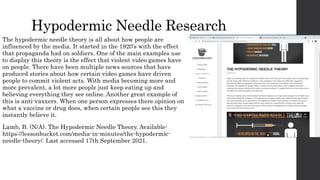
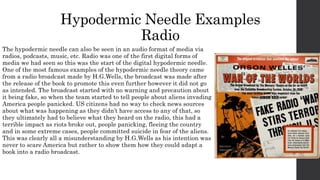
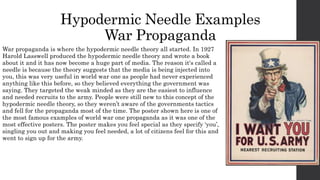
The document discusses the hypodermic needle theory, which suggests that media can directly influence people's beliefs and behaviors. It provides examples of how this theory applies to video games, radio broadcasts, and war propaganda. Specifically, it mentions how some news sources have blamed violent video games for real-world violence, how H.G. Wells' 1938 radio adaptation of The War of the Worlds caused panic among some listeners, and how World War I propaganda posters directly recruited soldiers by making people feel needed for the war effort. The theory contends that media can directly "inject" ideas and information into people's minds without their full awareness or understanding.




![Questionnaire evaluation[2]](https://cdn.slidesharecdn.com/ss_thumbnails/questionnaireevaluation2-101113081538-phpapp02-thumbnail.jpg?width=640&height=640&fit=bounds)
![Questionnaire evaluation[2]](https://cdn.slidesharecdn.com/ss_thumbnails/questionnaireevaluation2-101125155837-phpapp01-thumbnail.jpg?width=640&height=640&fit=bounds)
![Questionnaire evaluation[2]](https://cdn.slidesharecdn.com/ss_thumbnails/questionnaireevaluation2-101125161425-phpapp01-thumbnail.jpg?width=640&height=640&fit=bounds)


