Representation refers to the construction in any medium
(especially the mass media) of aspects of ‘reality’ such as
people, places, objects, events, cultural identities and
other abstract concepts. Such representations may be in
speech or writing as well as still or moving pictures.
The term refers to the processes involved as well as to its
products. For instance, in relation to the key markers of
identity - Class, Age, Gender and Ethnicity (the 'cage' of
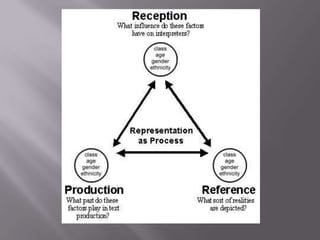
identity) - representation involves not only how
identities are represented (or rather constructed) within
the text but also how they are constructed in the
processes of production and reception by people whose
identities are also differentially marked in relation to
such demographic factors. Consider, for instance, the
issue of 'the gaze'. How do men look at images of
women, women at men, men at men and women at
women?
The Hypodermic needle Theory:
the term hypodermic model has been used to describe the process. The suggestion is
that the media work very much like a hypodermic needle - the information they
pump into the audience goes one way and has an effect.
Most researchers think that the hypodermic idea is too simple to explain the way that
the media work but there is still a lot of opinion and research to suggest that
information from the media has an effect on the audience which soak this up. The
view of an audience being affected in this way is an example of passive audience
behaviour.
Key features of the hypodermic needle theory = this theory suggests that the media
'ingects' information into a passive audience, almost like giving a patient a drug.
Mass audiences consume the same product and receive the same message. During
the second world war, the Nazi party used this approach to inject information to the
Nazi people, they used it as a form of propaganda. Another example is in Orson
Welle's 1938 'War of the Worlds' broadcast in which a radio broadcast about an
invasion of America by aliens was heard. People ran out of their homes believing in
was true, showing the power of the media at that time was immense, to the extent
that some people even evacuated their homes.
The Cultivation Theory – Drip Drip
Approach:
this theory is similar to the hypodermic needle theory in that it regards the audience as
passive and discusses the long-term affect of watching the same reinforced stereotypes
on T.V. In short, the media cultivates opinions in audience through a drip drip
approach of repeated messages in T.V. that slowly have an affect on the viewer and
their beliefs. The theory claims that the cultivation effect occurs only after long-term
cumulative exposure to television and suggest that because television contains so much
violoence, people who spend most of their time in front of the television develop an
exagerated belief in a mean and scary world.

Representation

  • 2.
    Representation refers tothe construction in any medium (especially the mass media) of aspects of ‘reality’ such as people, places, objects, events, cultural identities and other abstract concepts. Such representations may be in speech or writing as well as still or moving pictures. The term refers to the processes involved as well as to its products. For instance, in relation to the key markers of identity - Class, Age, Gender and Ethnicity (the 'cage' of identity) - representation involves not only how identities are represented (or rather constructed) within the text but also how they are constructed in the processes of production and reception by people whose identities are also differentially marked in relation to such demographic factors. Consider, for instance, the issue of 'the gaze'. How do men look at images of women, women at men, men at men and women at women?
  • 4.
    The Hypodermic needleTheory: the term hypodermic model has been used to describe the process. The suggestion is that the media work very much like a hypodermic needle - the information they pump into the audience goes one way and has an effect. Most researchers think that the hypodermic idea is too simple to explain the way that the media work but there is still a lot of opinion and research to suggest that information from the media has an effect on the audience which soak this up. The view of an audience being affected in this way is an example of passive audience behaviour. Key features of the hypodermic needle theory = this theory suggests that the media 'ingects' information into a passive audience, almost like giving a patient a drug. Mass audiences consume the same product and receive the same message. During the second world war, the Nazi party used this approach to inject information to the Nazi people, they used it as a form of propaganda. Another example is in Orson Welle's 1938 'War of the Worlds' broadcast in which a radio broadcast about an invasion of America by aliens was heard. People ran out of their homes believing in was true, showing the power of the media at that time was immense, to the extent that some people even evacuated their homes.
  • 5.
    The Cultivation Theory– Drip Drip Approach: this theory is similar to the hypodermic needle theory in that it regards the audience as passive and discusses the long-term affect of watching the same reinforced stereotypes on T.V. In short, the media cultivates opinions in audience through a drip drip approach of repeated messages in T.V. that slowly have an affect on the viewer and their beliefs. The theory claims that the cultivation effect occurs only after long-term cumulative exposure to television and suggest that because television contains so much violoence, people who spend most of their time in front of the television develop an exagerated belief in a mean and scary world.