Theory stuff   To underpin your understanding
Synergy

• Often as much money can be
  made from the related products
  marketed alongside a major new
  film as the film itself.

• Usually not produced by film
  studios themselves but franchised
  out.

• The planning, marketing &
  coordination of release dates along
  with tie ins & spin offs are crucial
  aspects of modern media activity.

• Eg Harry potter world, this is called
  synergy & is crucial to media
  institutions success.
Diversification

• This is when companies
  diversify into different realms,
  sometimes by taking over or
  merging with other companies..

• Horizontal integration- when
  companies expand sideways
  eg Sherlock holmes game
  onfacebook to promote film.

• Vertical integration - when a
  company takes over all the
  processes of production &
  distribution, eg murdoch's
  news international owning sky,
  times, sun etc.
Audiences

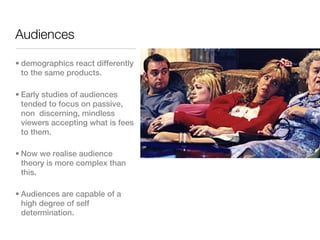
• demographics react differently
  to the same products.

• Early studies of audiences
  tended to focus on passive,
  non discerning, mindless
  viewers accepting what is fees
  to them.

• Now we realise audience
  theory is more complex than
  this.

• Audiences are capable of a
  high degree of self
  determination.
Chomsky
• Noam chomsky is a theorist who
  contends that the ral product is the
  audience itself.

• He says that media institutions
  should be seen as businesses who
  are engaged in driving audiences to
  the real drivers of media activities,
  the advertisers.

• He claims that programmes and films
  are made to deliver audiences into
  the advertisers hands.

• With product placement as well as
  adverts becoming more ubiquitous
  this theory gains more credibility.

• http://www.chomsky.info/
Stuart Hall
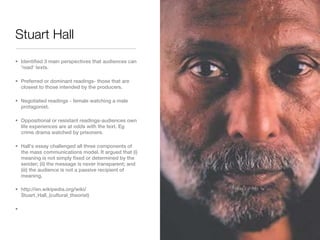
• Identified 3 main perspectives that audiences can
  'read' texts.

• Preferred or dominant readings- those that are
  closest to those intended by the producers.

• Negotiated readings - female watching a male
  protagonist.

• Oppositional or resistant readings-audiences own
  life experiences are at odds with the text. Eg
  crime drama watched by prisoners.

• Hall's essay challenged all three components of
  the mass communications model. It argued that (i)
  meaning is not simply fixed or determined by the
  sender; (ii) the message is never transparent; and
  (iii) the audience is not a passive recipient of
  meaning.

• http://en.wikipedia.org/wiki/
  Stuart_Hall_(cultural_theorist)

•
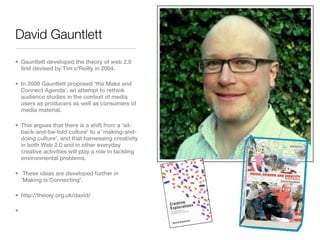
David Gauntlett
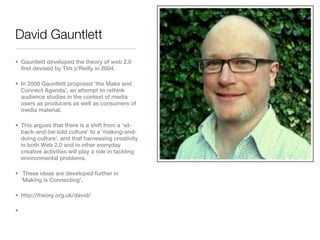
• Gauntlett developed the theory of web 2.0
  first devised by Tim o'Reilly in 2004.

• In 2008 Gauntlett proposed 'the Make and
  Connect Agenda', an attempt to rethink
  audience studies in the context of media
  users as producers as well as consumers of
  media material.

• This argues that there is a shift from a 'sit-
  back-and-be-told culture' to a 'making-and-
  doing culture', and that harnessing creativity
  in both Web 2.0 and in other everyday
  creative activities will play a role in tackling
  environmental problems.

• These ideas are developed further in
  'Making is Connecting'.

• http://theory.org.uk/david/

•
David Gauntlett
• Gauntlett developed the theory of web 2.0
  first devised by Tim o'Reilly in 2004.

• In 2008 Gauntlett proposed 'the Make and
  Connect Agenda', an attempt to rethink
  audience studies in the context of media
  users as producers as well as consumers of
  media material.

• This argues that there is a shift from a 'sit-
  back-and-be-told culture' to a 'making-and-
  doing culture', and that harnessing creativity
  in both Web 2.0 and in other everyday
  creative activities will play a role in tackling
  environmental problems.

• These ideas are developed further in
  'Making is Connecting'.

• http://theory.org.uk/david/

•
David Gauntlett
• Gauntlett developed the theory of web 2.0
  first devised by Tim o'Reilly in 2004.

• In 2008 Gauntlett proposed 'the Make and
  Connect Agenda', an attempt to rethink
  audience studies in the context of media
  users as producers as well as consumers of
  media material.

• This argues that there is a shift from a 'sit-
  back-and-be-told culture' to a 'making-and-
  doing culture', and that harnessing creativity
  in both Web 2.0 and in other everyday
  creative activities will play a role in tackling
  environmental problems.

• These ideas are developed further in
  'Making is Connecting'.

• http://theory.org.uk/david/

•
David Gauntlett
• Gauntlett developed the theory of web 2.0
  first devised by Tim o'Reilly in 2004.

• In 2008 Gauntlett proposed 'the Make and
  Connect Agenda', an attempt to rethink
  audience studies in the context of media
  users as producers as well as consumers of
  media material.

• This argues that there is a shift from a 'sit-
  back-and-be-told culture' to a 'making-and-
  doing culture', and that harnessing creativity
  in both Web 2.0 and in other everyday
  creative activities will play a role in tackling
  environmental problems.

• These ideas are developed further in
  'Making is Connecting'.

• http://theory.org.uk/david/

•
•   In 2007, Gauntlett published online the article Media Studies 2.0, which created some discussion amongst media studies
    educators.

•   The article argues that the traditional form of media studies teaching and research fails to recognise the changing media
    landscape in which the categories of 'audiences' and 'producers' blur together, and in which new research methods and
    approaches are needed.

•   Andy Ruddock has written that Gauntlett's "ironic polemic" includes "much to value", and acknowledges that the argument "is
    more strategy than creed", but argues that audiences still exist, and experience mass media specifically as audience, and so it
    would be premature to dispose of the notion of 'audience' altogether.

•   Gauntlett's website is really worth looking at, he has videos like this on where he explains his ideas.


•   http://www.youtube.com/watch?v=SPuV1PvDlqE&feature=youtube_gdata_player

•   Here http://www.makingisconnecting.org/gauntlett2011-extract1.pdf you will find an extract from his latest book where he
    explains about web 2.0


•
Tapscott & Williams
• Wikinomics: How Mass Collaboration Changes
  Everything is a book by Don Tapscott and Anthony D.
  Williams, first published in December 2006.

•    It explores how some companies in the early 21st
    century have used mass collaboration (also called peer
    production) and open-source technology, such as wikis,
    to be successful.

•   Tapscott and Williams have released a followup to
    Wikinomics, entitled Macrowikinomics: Rebooting
    Business and the World, which was released on
    September 28, 2010.

• According to Tapscott, Wikinomics is based on four
  ideas: Openness, Peering, Sharing, and Acting Globally.
  The use of mass collaboration in a business
  environment, in recent history, can be seen as an
  extension of the trend in business to outsource:
  externalize formerly internal business functions to other
  business entities. The difference however is that instead
  of an organized business body brought into being
  specifically for a unique function, mass collaboration
  relies on free individual agents to come together and
  cooperate to improve a given operation or solve a
  problem. This kind of outsourcing is also referred to as
  crowdsourcing, to reflect this difference. This can be
  incentivized by a reward system, though it is not
  required.
Tapscott & Williams
• Wikinomics: How Mass Collaboration Changes
  Everything is a book by Don Tapscott and Anthony D.
  Williams, first published in December 2006.

•    It explores how some companies in the early 21st
    century have used mass collaboration (also called peer
    production) and open-source technology, such as wikis,
    to be successful.

•   Tapscott and Williams have released a followup to
    Wikinomics, entitled Macrowikinomics: Rebooting
    Business and the World, which was released on
    September 28, 2010.

• According to Tapscott, Wikinomics is based on four
  ideas: Openness, Peering, Sharing, and Acting Globally.
  The use of mass collaboration in a business
  environment, in recent history, can be seen as an
  extension of the trend in business to outsource:
  externalize formerly internal business functions to other
  business entities. The difference however is that instead
  of an organized business body brought into being
  specifically for a unique function, mass collaboration
  relies on free individual agents to come together and
  cooperate to improve a given operation or solve a
  problem. This kind of outsourcing is also referred to as
  crowdsourcing, to reflect this difference. This can be
  incentivized by a reward system, though it is not
  required.
Tapscott & Williams
• Wikinomics: How Mass Collaboration Changes
  Everything is a book by Don Tapscott and Anthony D.
  Williams, first published in December 2006.

•    It explores how some companies in the early 21st
    century have used mass collaboration (also called peer
    production) and open-source technology, such as wikis,
    to be successful.

•   Tapscott and Williams have released a followup to
    Wikinomics, entitled Macrowikinomics: Rebooting
    Business and the World, which was released on
    September 28, 2010.

• According to Tapscott, Wikinomics is based on four
  ideas: Openness, Peering, Sharing, and Acting Globally.
  The use of mass collaboration in a business
  environment, in recent history, can be seen as an
  extension of the trend in business to outsource:
  externalize formerly internal business functions to other
  business entities. The difference however is that instead
  of an organized business body brought into being
  specifically for a unique function, mass collaboration
  relies on free individual agents to come together and
  cooperate to improve a given operation or solve a
  problem. This kind of outsourcing is also referred to as
  crowdsourcing, to reflect this difference. This can be
  incentivized by a reward system, though it is not
  required.
• The book also discusses seven new models of mass collaboration:

• Peering: For example, page 24, "Marketocracy employs a form of peering in a mutual fund that harnesses
  the collective intelligence of the investment community...Though not completely open source, it is an
  example of how meritocratic, peer-to-peer models are seeping into an industry where conventional
  wisdom favors the lone super-star stock advisor."[4]

• Ideagoras: For example, page 98, linking experts with unsolved research and development problems. The
  company InnoCentive is a consulting group that encapsulates the idea of ideagoras.[5]

• Prosumers: For example, page 125, where it discusses the social video game Second Life as being
  created by its customers. When customers are also the producers, you have the phenomenon:
  Prosumer.

• New Alexandrians: This idea is about the Internet and sharing knowledge.

• And many other subjects.

• The last chapter is written by viewers, and was opened for editing on February 5, 2007.

Theory

  • 1.
    Theory stuff To underpin your understanding
  • 2.
    Synergy • Often asmuch money can be made from the related products marketed alongside a major new film as the film itself. • Usually not produced by film studios themselves but franchised out. • The planning, marketing & coordination of release dates along with tie ins & spin offs are crucial aspects of modern media activity. • Eg Harry potter world, this is called synergy & is crucial to media institutions success.
  • 3.
    Diversification • This iswhen companies diversify into different realms, sometimes by taking over or merging with other companies.. • Horizontal integration- when companies expand sideways eg Sherlock holmes game onfacebook to promote film. • Vertical integration - when a company takes over all the processes of production & distribution, eg murdoch's news international owning sky, times, sun etc.
  • 4.
    Audiences • demographics reactdifferently to the same products. • Early studies of audiences tended to focus on passive, non discerning, mindless viewers accepting what is fees to them. • Now we realise audience theory is more complex than this. • Audiences are capable of a high degree of self determination.
  • 5.
    Chomsky • Noam chomskyis a theorist who contends that the ral product is the audience itself. • He says that media institutions should be seen as businesses who are engaged in driving audiences to the real drivers of media activities, the advertisers. • He claims that programmes and films are made to deliver audiences into the advertisers hands. • With product placement as well as adverts becoming more ubiquitous this theory gains more credibility. • http://www.chomsky.info/
  • 6.
    Stuart Hall • Identified3 main perspectives that audiences can 'read' texts. • Preferred or dominant readings- those that are closest to those intended by the producers. • Negotiated readings - female watching a male protagonist. • Oppositional or resistant readings-audiences own life experiences are at odds with the text. Eg crime drama watched by prisoners. • Hall's essay challenged all three components of the mass communications model. It argued that (i) meaning is not simply fixed or determined by the sender; (ii) the message is never transparent; and (iii) the audience is not a passive recipient of meaning. • http://en.wikipedia.org/wiki/ Stuart_Hall_(cultural_theorist) •
  • 7.
    David Gauntlett • Gauntlettdeveloped the theory of web 2.0 first devised by Tim o'Reilly in 2004. • In 2008 Gauntlett proposed 'the Make and Connect Agenda', an attempt to rethink audience studies in the context of media users as producers as well as consumers of media material. • This argues that there is a shift from a 'sit- back-and-be-told culture' to a 'making-and- doing culture', and that harnessing creativity in both Web 2.0 and in other everyday creative activities will play a role in tackling environmental problems. • These ideas are developed further in 'Making is Connecting'. • http://theory.org.uk/david/ •
  • 8.
    David Gauntlett • Gauntlettdeveloped the theory of web 2.0 first devised by Tim o'Reilly in 2004. • In 2008 Gauntlett proposed 'the Make and Connect Agenda', an attempt to rethink audience studies in the context of media users as producers as well as consumers of media material. • This argues that there is a shift from a 'sit- back-and-be-told culture' to a 'making-and- doing culture', and that harnessing creativity in both Web 2.0 and in other everyday creative activities will play a role in tackling environmental problems. • These ideas are developed further in 'Making is Connecting'. • http://theory.org.uk/david/ •
  • 9.
    David Gauntlett • Gauntlettdeveloped the theory of web 2.0 first devised by Tim o'Reilly in 2004. • In 2008 Gauntlett proposed 'the Make and Connect Agenda', an attempt to rethink audience studies in the context of media users as producers as well as consumers of media material. • This argues that there is a shift from a 'sit- back-and-be-told culture' to a 'making-and- doing culture', and that harnessing creativity in both Web 2.0 and in other everyday creative activities will play a role in tackling environmental problems. • These ideas are developed further in 'Making is Connecting'. • http://theory.org.uk/david/ •
  • 10.
    David Gauntlett • Gauntlettdeveloped the theory of web 2.0 first devised by Tim o'Reilly in 2004. • In 2008 Gauntlett proposed 'the Make and Connect Agenda', an attempt to rethink audience studies in the context of media users as producers as well as consumers of media material. • This argues that there is a shift from a 'sit- back-and-be-told culture' to a 'making-and- doing culture', and that harnessing creativity in both Web 2.0 and in other everyday creative activities will play a role in tackling environmental problems. • These ideas are developed further in 'Making is Connecting'. • http://theory.org.uk/david/ •
  • 11.
    In 2007, Gauntlett published online the article Media Studies 2.0, which created some discussion amongst media studies educators. • The article argues that the traditional form of media studies teaching and research fails to recognise the changing media landscape in which the categories of 'audiences' and 'producers' blur together, and in which new research methods and approaches are needed. • Andy Ruddock has written that Gauntlett's "ironic polemic" includes "much to value", and acknowledges that the argument "is more strategy than creed", but argues that audiences still exist, and experience mass media specifically as audience, and so it would be premature to dispose of the notion of 'audience' altogether. • Gauntlett's website is really worth looking at, he has videos like this on where he explains his ideas. • http://www.youtube.com/watch?v=SPuV1PvDlqE&feature=youtube_gdata_player • Here http://www.makingisconnecting.org/gauntlett2011-extract1.pdf you will find an extract from his latest book where he explains about web 2.0 •
  • 12.
    Tapscott & Williams •Wikinomics: How Mass Collaboration Changes Everything is a book by Don Tapscott and Anthony D. Williams, first published in December 2006. • It explores how some companies in the early 21st century have used mass collaboration (also called peer production) and open-source technology, such as wikis, to be successful. • Tapscott and Williams have released a followup to Wikinomics, entitled Macrowikinomics: Rebooting Business and the World, which was released on September 28, 2010. • According to Tapscott, Wikinomics is based on four ideas: Openness, Peering, Sharing, and Acting Globally. The use of mass collaboration in a business environment, in recent history, can be seen as an extension of the trend in business to outsource: externalize formerly internal business functions to other business entities. The difference however is that instead of an organized business body brought into being specifically for a unique function, mass collaboration relies on free individual agents to come together and cooperate to improve a given operation or solve a problem. This kind of outsourcing is also referred to as crowdsourcing, to reflect this difference. This can be incentivized by a reward system, though it is not required.
  • 13.
    Tapscott & Williams •Wikinomics: How Mass Collaboration Changes Everything is a book by Don Tapscott and Anthony D. Williams, first published in December 2006. • It explores how some companies in the early 21st century have used mass collaboration (also called peer production) and open-source technology, such as wikis, to be successful. • Tapscott and Williams have released a followup to Wikinomics, entitled Macrowikinomics: Rebooting Business and the World, which was released on September 28, 2010. • According to Tapscott, Wikinomics is based on four ideas: Openness, Peering, Sharing, and Acting Globally. The use of mass collaboration in a business environment, in recent history, can be seen as an extension of the trend in business to outsource: externalize formerly internal business functions to other business entities. The difference however is that instead of an organized business body brought into being specifically for a unique function, mass collaboration relies on free individual agents to come together and cooperate to improve a given operation or solve a problem. This kind of outsourcing is also referred to as crowdsourcing, to reflect this difference. This can be incentivized by a reward system, though it is not required.
  • 14.
    Tapscott & Williams •Wikinomics: How Mass Collaboration Changes Everything is a book by Don Tapscott and Anthony D. Williams, first published in December 2006. • It explores how some companies in the early 21st century have used mass collaboration (also called peer production) and open-source technology, such as wikis, to be successful. • Tapscott and Williams have released a followup to Wikinomics, entitled Macrowikinomics: Rebooting Business and the World, which was released on September 28, 2010. • According to Tapscott, Wikinomics is based on four ideas: Openness, Peering, Sharing, and Acting Globally. The use of mass collaboration in a business environment, in recent history, can be seen as an extension of the trend in business to outsource: externalize formerly internal business functions to other business entities. The difference however is that instead of an organized business body brought into being specifically for a unique function, mass collaboration relies on free individual agents to come together and cooperate to improve a given operation or solve a problem. This kind of outsourcing is also referred to as crowdsourcing, to reflect this difference. This can be incentivized by a reward system, though it is not required.
  • 15.
    • The bookalso discusses seven new models of mass collaboration: • Peering: For example, page 24, "Marketocracy employs a form of peering in a mutual fund that harnesses the collective intelligence of the investment community...Though not completely open source, it is an example of how meritocratic, peer-to-peer models are seeping into an industry where conventional wisdom favors the lone super-star stock advisor."[4] • Ideagoras: For example, page 98, linking experts with unsolved research and development problems. The company InnoCentive is a consulting group that encapsulates the idea of ideagoras.[5] • Prosumers: For example, page 125, where it discusses the social video game Second Life as being created by its customers. When customers are also the producers, you have the phenomenon: Prosumer. • New Alexandrians: This idea is about the Internet and sharing knowledge. • And many other subjects. • The last chapter is written by viewers, and was opened for editing on February 5, 2007.

Editor's Notes