Feedback on essay
‘How has digital technology impacted on
production, distribution and exchange of UK
film. With particular reference to your case
study.’
‘How has digital technology impacted on production,
distribution and exchange of UK film. With particular
reference to your case study.’


  1. Answer the question!
  Use the words and phrases directly from the essay
  question, particularly in your introduction & conclusion.
‘How has digital technology impacted on production,
distribution and exchange of UK film. With particular
reference to your case study.’

 2. Begin with brief intro....
 eg ‘Digital technology has had a significant impact on
 the UK film industry in all aspects of the process of film
 making and consumption. There are numerous
 advantages as well as disadvantages that can be
 identified when researching micro and macro
 examples. I looked at Working Title/Vertigo/Disney
 (insert your own example) films and in particular, looked very
 closely at the production distribution and exhibition of
 ‘Iron Lady’/‘Street Dance’/‘Avatar (insert your own example) .
‘How has digital technology impacted on production,
distribution and exchange of UK film. With particular
reference to your case study.’
 3. Work through the question chronologically, some of
 you hadn’t even copied the question down in the right
 order!
 The question follows the process of film making, so it
 makes sense to write in this order as well.
 You must always try and be as clear as possible when
 responding.
 This includes your layout. Use paper with a margin,
 leave clear gaps between paragraphs so I can annotate
 and hand write as prep for the exam. For some of you
 handwriting is a real concern!
‘How has digital technology impacted on production,
distribution and exchange of UK film. With particular
reference to your case study.’


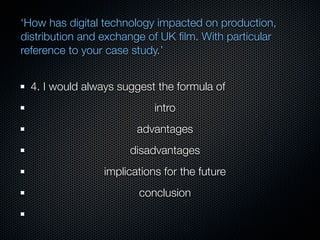
  4. I would always suggest the formula of
                            intro
                        advantages
                      disadvantages
                 implications for the future
                        conclusion
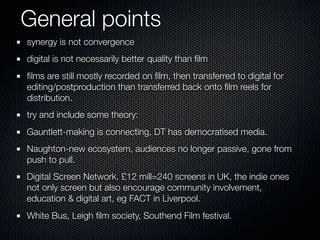
General points
synergy is not convergence
digital is not necessarily better quality than film
films are still mostly recorded on film, then transferred to digital for
editing/postproduction than transferred back onto film reels for
distribution.
try and include some theory:
Gauntlett-making is connecting, DT has democratised media.
Naughton-new ecosystem, audiences no longer passive, gone from
push to pull.
Digital Screen Network. £12 mill=240 screens in UK, the indie ones
not only screen but also encourage community involvement,
education & digital art, eg FACT in Liverpool.
White Bus, Leigh film society, Southend Film festival.
‘How has digital technology impacted on production,
distribution and exchange of UK film. With particular
reference to your case study.’

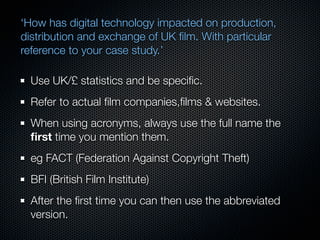
  Use UK/£ statistics and be specific.
  Refer to actual film companies,films & websites.
  When using acronyms, always use the full name the
  first time you mention them.
  eg FACT (Federation Against Copyright Theft)
  BFI (British Film Institute)
  After the first time you can then use the abbreviated
  version.
‘How has digital technology impacted on production,
distribution and exchange of UK film. With particular
reference to your case study.’

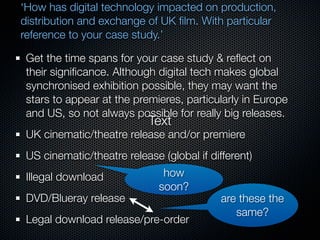
 Get the time spans for your case study & reflect on
 their significance. Although digital tech makes global
 synchronised exhibition possible, they may want the
 stars to appear at the premieres, particularly in Europe
 and US, so not always possible for really big releases.
                            Text
 UK cinematic/theatre release and/or premiere
 US cinematic/theatre release (global if different)
 Illegal download              how
                              soon?
 DVD/Blueray release                        are these the
                                               same?
 Legal download release/pre-order
‘How has digital technology impacted on production,
distribution and exchange of UK film. With particular
reference to your case study.’


  The focus for this unit is Instiutions and Audiences, so
  for any question you need to consider what is the
  impact on both of these?
  What is the demographic of the target audience?
  How will this effect the distribution and exchange
  points?
‘How has digital technology impacted on production,
distribution and exchange of UK film. With particular
reference to your case study.’


  There has been a proliferation of hardware and
  software that has affected all aspects of the film
  process.
  It has made films cheaper and easier to produce,
  distribute and exhange.
  How?
Production
digital cameras, handheld, phone cameras, flip
cameras, longer battery life, no longer need expensive
film or tapes. More mobile & flexible.
editing software, imovie, available on domestic level
computers and even iphones, windows movies maker,
sony vegas etc.     cheaper & easier than big crowd scenes

On a pro level, CGI, 3D, SFX, stop motion animations,
much more cheaply available. A lot of expertise in the
UK in this field. Aardman Animations (Dreamworks).
Can improve quality of film & make piracy harder.
Distribution
 Internet
 Amateurs: can upload and share, via, You tube, Vimeo,
 Myspace, Facebook, digital natives V immigrants.
 Prosumers: short film sites and online festivals/
 competitions.
 Professionals: can use the digital tech for the actual
 movement of the film to the exhibition stage, and the
 marketing.
 Use your own case study, how was it distributed/
 marketed? How much use did they make of dt?
So, due to digital technology, distribution is now,
cheaper, quicker, the quality is retained and it is more
secure than shifting costly film reels that will deteriorate
after every screening, across the globe.


Who does it benefit most? Big institutions or indies?
Exchange

Some of you need to define this more clearly.
What was your experience of consuming the film?
Exchange is the point at which the audience comes
into contact with the product the institution is
exhibiting. What has been the impact of digital
technology on this?
In terms of marketing the cinematic release DT helps us
know about it.
We can find out about it on the internet, reviews,
timings, book online.
It can be distributed digitally to smaller, art house/
independent cinemas. So niche audiences can
potentially have more choice.
Although you will find the industry is still dominated by
blanket distribution of mainstream films to multiplexes,
eg Southend Odeon.
‘How has digital technology impacted on production,
distribution and exchange of UK film. With particular
reference to your case study.’
  negative exchange-piracy
  home/personal consumption/exhibition- the
  proliferation of hardware and software has led to a
  much greater choice and flexibility in how and when we
  can consume media & films.
  We can watch a film phone, PSP, internet site, buy,
  rent, illegally download etc
  You should give some UK statistics about the
  advantages/disadvantages/financial impact & the work
  of bodies such as the BFI & FACT.
‘How has digital technology impacted on production,
distribution and exchange of UK film. With particular
reference to your case study.’

  To conclude, again, refer back to the question and
  consider the implications for the future?
  Will DT ever be good enough to allow home exhibition
  to be on a par with the ‘cinematic experience’. The big
  instutions want this to continue due to profit to be had
  from merchandising, drinks, popcorn, etc, all extra
  profit to be had.
  Will the current disadvantages be solved? (piracy,
  download bandwidths?
  How will the UK film industry in particular, move with
  digital technology?

Feedback on essay

  • 1.
    Feedback on essay ‘Howhas digital technology impacted on production, distribution and exchange of UK film. With particular reference to your case study.’
  • 2.
    ‘How has digitaltechnology impacted on production, distribution and exchange of UK film. With particular reference to your case study.’ 1. Answer the question! Use the words and phrases directly from the essay question, particularly in your introduction & conclusion.
  • 3.
    ‘How has digitaltechnology impacted on production, distribution and exchange of UK film. With particular reference to your case study.’ 2. Begin with brief intro.... eg ‘Digital technology has had a significant impact on the UK film industry in all aspects of the process of film making and consumption. There are numerous advantages as well as disadvantages that can be identified when researching micro and macro examples. I looked at Working Title/Vertigo/Disney (insert your own example) films and in particular, looked very closely at the production distribution and exhibition of ‘Iron Lady’/‘Street Dance’/‘Avatar (insert your own example) .
  • 4.
    ‘How has digitaltechnology impacted on production, distribution and exchange of UK film. With particular reference to your case study.’ 3. Work through the question chronologically, some of you hadn’t even copied the question down in the right order! The question follows the process of film making, so it makes sense to write in this order as well. You must always try and be as clear as possible when responding. This includes your layout. Use paper with a margin, leave clear gaps between paragraphs so I can annotate and hand write as prep for the exam. For some of you handwriting is a real concern!
  • 5.
    ‘How has digitaltechnology impacted on production, distribution and exchange of UK film. With particular reference to your case study.’ 4. I would always suggest the formula of intro advantages disadvantages implications for the future conclusion
  • 6.
    General points synergy isnot convergence digital is not necessarily better quality than film films are still mostly recorded on film, then transferred to digital for editing/postproduction than transferred back onto film reels for distribution. try and include some theory: Gauntlett-making is connecting, DT has democratised media. Naughton-new ecosystem, audiences no longer passive, gone from push to pull. Digital Screen Network. £12 mill=240 screens in UK, the indie ones not only screen but also encourage community involvement, education & digital art, eg FACT in Liverpool. White Bus, Leigh film society, Southend Film festival.
  • 7.
    ‘How has digitaltechnology impacted on production, distribution and exchange of UK film. With particular reference to your case study.’ Use UK/£ statistics and be specific. Refer to actual film companies,films & websites. When using acronyms, always use the full name the first time you mention them. eg FACT (Federation Against Copyright Theft) BFI (British Film Institute) After the first time you can then use the abbreviated version.
  • 8.
    ‘How has digitaltechnology impacted on production, distribution and exchange of UK film. With particular reference to your case study.’ Get the time spans for your case study & reflect on their significance. Although digital tech makes global synchronised exhibition possible, they may want the stars to appear at the premieres, particularly in Europe and US, so not always possible for really big releases. Text UK cinematic/theatre release and/or premiere US cinematic/theatre release (global if different) Illegal download how soon? DVD/Blueray release are these the same? Legal download release/pre-order
  • 9.
    ‘How has digitaltechnology impacted on production, distribution and exchange of UK film. With particular reference to your case study.’ The focus for this unit is Instiutions and Audiences, so for any question you need to consider what is the impact on both of these? What is the demographic of the target audience? How will this effect the distribution and exchange points?
  • 10.
    ‘How has digitaltechnology impacted on production, distribution and exchange of UK film. With particular reference to your case study.’ There has been a proliferation of hardware and software that has affected all aspects of the film process. It has made films cheaper and easier to produce, distribute and exhange. How?
  • 11.
    Production digital cameras, handheld,phone cameras, flip cameras, longer battery life, no longer need expensive film or tapes. More mobile & flexible. editing software, imovie, available on domestic level computers and even iphones, windows movies maker, sony vegas etc. cheaper & easier than big crowd scenes On a pro level, CGI, 3D, SFX, stop motion animations, much more cheaply available. A lot of expertise in the UK in this field. Aardman Animations (Dreamworks). Can improve quality of film & make piracy harder.
  • 12.
    Distribution Internet Amateurs:can upload and share, via, You tube, Vimeo, Myspace, Facebook, digital natives V immigrants. Prosumers: short film sites and online festivals/ competitions. Professionals: can use the digital tech for the actual movement of the film to the exhibition stage, and the marketing. Use your own case study, how was it distributed/ marketed? How much use did they make of dt?
  • 13.
    So, due todigital technology, distribution is now, cheaper, quicker, the quality is retained and it is more secure than shifting costly film reels that will deteriorate after every screening, across the globe. Who does it benefit most? Big institutions or indies?
  • 14.
    Exchange Some of youneed to define this more clearly. What was your experience of consuming the film? Exchange is the point at which the audience comes into contact with the product the institution is exhibiting. What has been the impact of digital technology on this?
  • 15.
    In terms ofmarketing the cinematic release DT helps us know about it. We can find out about it on the internet, reviews, timings, book online. It can be distributed digitally to smaller, art house/ independent cinemas. So niche audiences can potentially have more choice. Although you will find the industry is still dominated by blanket distribution of mainstream films to multiplexes, eg Southend Odeon.
  • 16.
    ‘How has digitaltechnology impacted on production, distribution and exchange of UK film. With particular reference to your case study.’ negative exchange-piracy home/personal consumption/exhibition- the proliferation of hardware and software has led to a much greater choice and flexibility in how and when we can consume media & films. We can watch a film phone, PSP, internet site, buy, rent, illegally download etc You should give some UK statistics about the advantages/disadvantages/financial impact & the work of bodies such as the BFI & FACT.
  • 17.
    ‘How has digitaltechnology impacted on production, distribution and exchange of UK film. With particular reference to your case study.’ To conclude, again, refer back to the question and consider the implications for the future? Will DT ever be good enough to allow home exhibition to be on a par with the ‘cinematic experience’. The big instutions want this to continue due to profit to be had from merchandising, drinks, popcorn, etc, all extra profit to be had. Will the current disadvantages be solved? (piracy, download bandwidths? How will the UK film industry in particular, move with digital technology?