
ONLINE AGE
Changes in Audience Behaviour
How has the creation of the web
changed the way in which
audiences behave and interact
with media?
SOCIAL MEDIA –WEB 2.0
1. What is social media?
2. What forms of social media do you use?
3. What do you use them for? –list the different ways
4. Who else uses social media?
5. Why/How?
CLAY SHIRKY
“Media is Global, Social,
Ubiquitous and Cheap”
Social Determinism
AUDIENCE ?
Media has always had an audience, whether it be film, TV,
newspapers, music…
However, is it correct to address a ‘player’ of a video game as part
of an audience?
The term consumer might be more appropriate.
Traditionally audiences were separate entities to producers. One
produced the media and the other consumed it.
Since the rise of the web there is an increasingly blurred
distinction between the two, as consumers are also producing
content and uploading it via the Internet.
The result is a demographic of prosumers
BEFORE YOU TUBE
SOCIAL MEDIA –WEB 2.0
• New media landscape
• Audience participation
• Technological capital Social capital
• Technological determinism Social determinism*
The Internet has generated the largest increase in expressive media
*audience interaction with media is now more social and this behaviour is having an
impact in determining what new technologies are being developed
SOCIAL MEDIA
MARK ZUCKERBERG PRONOUNCED AT 2010’S WEB 2.0 SUMMIT IN
SAN FRANCISCO THAT,
"OVER THE NEXT FIVE YEARS, MOST INDUSTRIES ARE GOING
TO GET RETHOUGHT TO BE SOCIAL, AND DESIGNED AROUND
PEOPLE.“
AS ZUCKERBERG SAYS,
"HUMANS ARE HARDWIRED TO BE INTERESTED IN PEOPLE."
How does Mark Zuckerberg’s quote relate to
what Clay Shirky says?
HENRY JENKINS PARTICIPATORY CULTURE
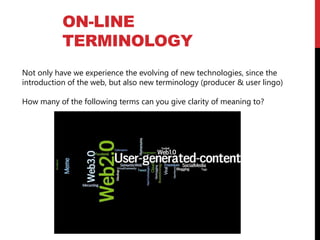
ON-LINE
TERMINOLOGY
Not only have we experience the evolving of new technologies, since the
introduction of the web, but also new terminology (producer & user lingo)
How many of the following terms can you give clarity of meaning to?
ACTIVITY
Numa numa http://www.newgrounds.com/portal/view/206373
Tay Zonday http://tayzonday.ning.com/
Memes http://www.freshnetworks.com/blog/2010/12/6-social-media-memes-of-2010/
Mashups http://videomashup.blogspot.com/
Pick one of the above and do a case study on a Googledoc Presentation
Include:
1. What it is (definition)
2. When and how it began
3. What was the response
4. Examples of how it has developed (via the Web)
5. Future? –what do you predict could follow as a result? [extension]
AUDIENCE THEORY
GRATIFICATIONS MODEL
Blulmer and Katz (1974)
A further study by Blulmer & Katz said that audience media consumption is based on
choices so that an audience will seek out media that meets their desire / need /personal
preference. i.e. They are perhaps seeking media that endorses their already established
views and gratify a need/desire
•Diversion (escapism)
•Relationship (using e.g. soaps to replace family life)
•Personal Identity (finding sense of understanding self)
•Surveillance (seeking useful information)
•
DAVID GAUNTLETT
ANDREW KEEN
SBTV
Watch: SBTV
Who is Jamal Edwards?
Is he a professional? Is he trained, expert, earning a living
How did SBTV start?
SBTV – any up to date news / facts?
Who made the video?
What is the purpose of the video? consider google goldmine
(The Virtual Revolution)
GAUNTLETT VS KEEN DEBATE
David Gauntlett Andrew Keen
prosumer culture
UGC –greater creativity,
prosumer culture, everyone
can produce content. Social
platforms that connect
communities..
Rise of the citizen journalist
Greater distribution and
opportunity, not based on the
traditional conglomerates.
online democratic society
cult of the amateur
In today’s self broadcasting
culture, amateurism is
celebrated and anyone with
an opinion can publish a blog
or video.
He who shouts loudest – with
untrained ignorance
rumours abound rather than
carefully validated facts.
no responsibility
EVGENY MOROZOV
The Net Delusion
cultural utopianism
cyber idealism
techo utopia or techno dystopia
CITIZEN JOURNALISM
China earthquake
London Riots
Arab Springs
US / UK election
Consider how social media played a part in each of the above
What are the advantages / disadvantages of citizen journalism?
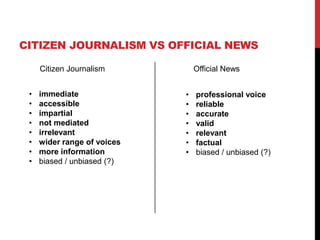
CITIZEN JOURNALISM VS OFFICIAL NEWS
Citizen Journalism Official News
• immediate
• accessible
• impartial
• not mediated
• irrelevant
• wider range of voices
• more information
• biased / unbiased (?)
• professional voice
• reliable
• accurate
• valid
• relevant
• factual
• biased / unbiased (?)
FAKE NEWS
What is fake news?
How does it compare to your researched Citizen Journalism?
In contrast to Citizen Journalism what advantages /
disadvantages are there to fake news?
Sir Tim Berners-Lee
http://www.bbc.co.uk/news/technology-39246810
http://www.bbc.co.uk/news/blogs-trending-37846860
https://www.buzzfeed.com/craigsilverman/viral-fake-election-news-outperformed-real-news-on-
facebook?utm_term=.djNA57VMN#.sf6Rag21o
http://www.bbc.co.uk/newsbeat/article/38827101/how-facebook-is-starting-to-tackle-fake-news-in-your-news-feed
http://www.bbc.co.uk/news/blogs-trending-38769996
FAKE NEWS
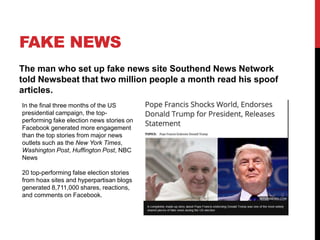
The man who set up fake news site Southend News Network
told Newsbeat that two million people a month read his spoof
articles.
In the final three months of the US
presidential campaign, the top-
performing fake election news stories on
Facebook generated more engagement
than the top stories from major news
outlets such as the New York Times,
Washington Post, Huffington Post, NBC
News
20 top-performing false election stories
from hoax sites and hyperpartisan blogs
generated 8,711,000 shares, reactions,
and comments on Facebook.
EDWARD SNOWDEN
Critical thinking matters
– not censorship –
is the answer to fake news
THE COST OF FREE WEB3.0
Analytics
Algorithms
Advertising
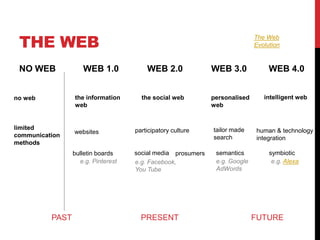
THE WEB
NO WEB WEB 1.0 WEB 2.0 WEB 3.0 WEB 4.0
PAST PRESENT FUTURE
limited
communication
methods
the information
web
websites
bulletin boards
e.g. Pinterest
The Web
Evolution
the social web
social media
e.g. Facebook,
You Tube
participatory culture
prosumers
personalised
web
no web
tailor made
search
semantics
e.g. Google
AdWords
intelligent web
human & technology
integration
symbiotic
e.g. Alexa
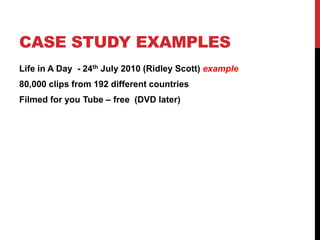
CASE STUDY EXAMPLES
Life in A Day - 24th July 2010 (Ridley Scott) example
80,000 clips from 192 different countries
Filmed for you Tube – free (DVD later)
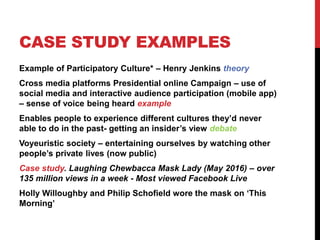
CASE STUDY EXAMPLES
Example of Participatory Culture* – Henry Jenkins theory
Cross media platforms Presidential online Campaign – use of
social media and interactive audience participation (mobile app)
– sense of voice being heard example
Enables people to experience different cultures they’d never
able to do in the past- getting an insider’s view debate
Voyeuristic society – entertaining ourselves by watching other
people’s private lives (now public)
Case study. Laughing Chewbacca Mask Lady (May 2016) – over
135 million views in a week - Most viewed Facebook Live
Holly Willoughby and Philip Schofield wore the mask on ‘This
Morning’
CASE STUDY EXAMPLES
Viral memes were then spread of the mask – creating an
engaged active audience around the world debate
Clay Shirky –“Media is social, global, ubiquitous and cheap”
supportive theory
Discussion – viral videos, memes, blogs, social media, live
video, collaboration* vloggers, crowdfunding, crowdsourcing,
Case study Technology since the online age has enabled
participatory culture e.g. We recreated a ‘life in a day
experience’. As a class we were each able to use our own
mobile phones, camera, go-pros – we edited using fcpx on
iMacs in the class. We could download sound from online
websites to add to our film.
CASE STUDY EXAMPLES
Viral memes were then spread of the mask – creating an
engaged active audience around the world debate
Clay Shirky –“Media is social, global, ubiquitous and cheap”
supportive theory
Discussion – viral videos, memes, blogs, social media, live
video, collaboration* vloggers, crowdfunding, crowdsourcing,
Case study Technology since the online age has enabled
participatory culture e.g. We recreated a ‘life in a day
experience’. As a class we were each able to use our own
mobile phones, camera, go-pros – we edited using fcpx on
iMacs in the class. We could download sound from online
websites to add to our film.
CASE STUDY EXAMPLES
David Gauntlett – Web 2.0 – ‘making is creating’ supportive argument- theory
The Big Gods (Media Conglomerates) – the little people (consumer
audience) – passive – becoming an interactive audience of –Prosumers -
user generated content
Gardens = collaboration – all contributing to content online* - You Tube
Andrew Keen – cult of the Amateur –he who shouts loudest counter
argument
Idealised ideology of democratisation– hippies & techie geeks vs realism –
making a difference
Charlie bit my finger / cute cat videos etc. not making a difference to society
(only entertainment) example
Sir Tim Berners Lee – 1989 created the web (1991) link to the past
Free – dream of levelling, (Aleks Krotoski ‘The Virtual Revolution’)
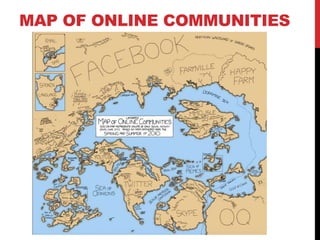
MAP OF ONLINE COMMUNITIES
WEB 2.0
U.G.C.
TAGGING
BLOGGING
VLOGGING
MEMES
OPEN
SOURCE
VIRTUAL
MECASTING
GATEKEEPERS
CITIZEN
JOURNALISM
BRANDS
STRATEGY
GEO-
TAGGING
SEMANTIC

2017 new media

  • 1.
    ONLINE AGE Changes inAudience Behaviour How has the creation of the web changed the way in which audiences behave and interact with media?
  • 2.
    SOCIAL MEDIA –WEB2.0 1. What is social media? 2. What forms of social media do you use? 3. What do you use them for? –list the different ways 4. Who else uses social media? 5. Why/How?
  • 3.
    CLAY SHIRKY “Media isGlobal, Social, Ubiquitous and Cheap” Social Determinism
  • 4.
    AUDIENCE ? Media hasalways had an audience, whether it be film, TV, newspapers, music… However, is it correct to address a ‘player’ of a video game as part of an audience? The term consumer might be more appropriate. Traditionally audiences were separate entities to producers. One produced the media and the other consumed it. Since the rise of the web there is an increasingly blurred distinction between the two, as consumers are also producing content and uploading it via the Internet. The result is a demographic of prosumers
  • 5.
  • 6.
    SOCIAL MEDIA –WEB2.0 • New media landscape • Audience participation • Technological capital Social capital • Technological determinism Social determinism* The Internet has generated the largest increase in expressive media *audience interaction with media is now more social and this behaviour is having an impact in determining what new technologies are being developed
  • 7.
    SOCIAL MEDIA MARK ZUCKERBERGPRONOUNCED AT 2010’S WEB 2.0 SUMMIT IN SAN FRANCISCO THAT, "OVER THE NEXT FIVE YEARS, MOST INDUSTRIES ARE GOING TO GET RETHOUGHT TO BE SOCIAL, AND DESIGNED AROUND PEOPLE.“ AS ZUCKERBERG SAYS, "HUMANS ARE HARDWIRED TO BE INTERESTED IN PEOPLE." How does Mark Zuckerberg’s quote relate to what Clay Shirky says?
  • 8.
  • 9.
    ON-LINE TERMINOLOGY Not only havewe experience the evolving of new technologies, since the introduction of the web, but also new terminology (producer & user lingo) How many of the following terms can you give clarity of meaning to?
  • 10.
    ACTIVITY Numa numa http://www.newgrounds.com/portal/view/206373 TayZonday http://tayzonday.ning.com/ Memes http://www.freshnetworks.com/blog/2010/12/6-social-media-memes-of-2010/ Mashups http://videomashup.blogspot.com/ Pick one of the above and do a case study on a Googledoc Presentation Include: 1. What it is (definition) 2. When and how it began 3. What was the response 4. Examples of how it has developed (via the Web) 5. Future? –what do you predict could follow as a result? [extension]
  • 11.
    AUDIENCE THEORY GRATIFICATIONS MODEL Blulmerand Katz (1974) A further study by Blulmer & Katz said that audience media consumption is based on choices so that an audience will seek out media that meets their desire / need /personal preference. i.e. They are perhaps seeking media that endorses their already established views and gratify a need/desire •Diversion (escapism) •Relationship (using e.g. soaps to replace family life) •Personal Identity (finding sense of understanding self) •Surveillance (seeking useful information) •
  • 12.
  • 13.
  • 14.
    SBTV Watch: SBTV Who isJamal Edwards? Is he a professional? Is he trained, expert, earning a living How did SBTV start? SBTV – any up to date news / facts? Who made the video? What is the purpose of the video? consider google goldmine (The Virtual Revolution)
  • 15.
    GAUNTLETT VS KEENDEBATE David Gauntlett Andrew Keen prosumer culture UGC –greater creativity, prosumer culture, everyone can produce content. Social platforms that connect communities.. Rise of the citizen journalist Greater distribution and opportunity, not based on the traditional conglomerates. online democratic society cult of the amateur In today’s self broadcasting culture, amateurism is celebrated and anyone with an opinion can publish a blog or video. He who shouts loudest – with untrained ignorance rumours abound rather than carefully validated facts. no responsibility
  • 16.
    EVGENY MOROZOV The NetDelusion cultural utopianism cyber idealism techo utopia or techno dystopia
  • 17.
    CITIZEN JOURNALISM China earthquake LondonRiots Arab Springs US / UK election Consider how social media played a part in each of the above What are the advantages / disadvantages of citizen journalism?
  • 18.
    CITIZEN JOURNALISM VSOFFICIAL NEWS Citizen Journalism Official News • immediate • accessible • impartial • not mediated • irrelevant • wider range of voices • more information • biased / unbiased (?) • professional voice • reliable • accurate • valid • relevant • factual • biased / unbiased (?)
  • 19.
    FAKE NEWS What isfake news? How does it compare to your researched Citizen Journalism? In contrast to Citizen Journalism what advantages / disadvantages are there to fake news? Sir Tim Berners-Lee http://www.bbc.co.uk/news/technology-39246810 http://www.bbc.co.uk/news/blogs-trending-37846860 https://www.buzzfeed.com/craigsilverman/viral-fake-election-news-outperformed-real-news-on- facebook?utm_term=.djNA57VMN#.sf6Rag21o http://www.bbc.co.uk/newsbeat/article/38827101/how-facebook-is-starting-to-tackle-fake-news-in-your-news-feed http://www.bbc.co.uk/news/blogs-trending-38769996
  • 20.
    FAKE NEWS The manwho set up fake news site Southend News Network told Newsbeat that two million people a month read his spoof articles. In the final three months of the US presidential campaign, the top- performing fake election news stories on Facebook generated more engagement than the top stories from major news outlets such as the New York Times, Washington Post, Huffington Post, NBC News 20 top-performing false election stories from hoax sites and hyperpartisan blogs generated 8,711,000 shares, reactions, and comments on Facebook.
  • 21.
    EDWARD SNOWDEN Critical thinkingmatters – not censorship – is the answer to fake news
  • 22.
    THE COST OFFREE WEB3.0 Analytics Algorithms Advertising
  • 23.
    THE WEB NO WEBWEB 1.0 WEB 2.0 WEB 3.0 WEB 4.0 PAST PRESENT FUTURE limited communication methods the information web websites bulletin boards e.g. Pinterest The Web Evolution the social web social media e.g. Facebook, You Tube participatory culture prosumers personalised web no web tailor made search semantics e.g. Google AdWords intelligent web human & technology integration symbiotic e.g. Alexa
  • 24.
    CASE STUDY EXAMPLES Lifein A Day - 24th July 2010 (Ridley Scott) example 80,000 clips from 192 different countries Filmed for you Tube – free (DVD later)
  • 25.
    CASE STUDY EXAMPLES Exampleof Participatory Culture* – Henry Jenkins theory Cross media platforms Presidential online Campaign – use of social media and interactive audience participation (mobile app) – sense of voice being heard example Enables people to experience different cultures they’d never able to do in the past- getting an insider’s view debate Voyeuristic society – entertaining ourselves by watching other people’s private lives (now public) Case study. Laughing Chewbacca Mask Lady (May 2016) – over 135 million views in a week - Most viewed Facebook Live Holly Willoughby and Philip Schofield wore the mask on ‘This Morning’
  • 26.
    CASE STUDY EXAMPLES Viralmemes were then spread of the mask – creating an engaged active audience around the world debate Clay Shirky –“Media is social, global, ubiquitous and cheap” supportive theory Discussion – viral videos, memes, blogs, social media, live video, collaboration* vloggers, crowdfunding, crowdsourcing, Case study Technology since the online age has enabled participatory culture e.g. We recreated a ‘life in a day experience’. As a class we were each able to use our own mobile phones, camera, go-pros – we edited using fcpx on iMacs in the class. We could download sound from online websites to add to our film.
  • 27.
    CASE STUDY EXAMPLES Viralmemes were then spread of the mask – creating an engaged active audience around the world debate Clay Shirky –“Media is social, global, ubiquitous and cheap” supportive theory Discussion – viral videos, memes, blogs, social media, live video, collaboration* vloggers, crowdfunding, crowdsourcing, Case study Technology since the online age has enabled participatory culture e.g. We recreated a ‘life in a day experience’. As a class we were each able to use our own mobile phones, camera, go-pros – we edited using fcpx on iMacs in the class. We could download sound from online websites to add to our film.
  • 28.
    CASE STUDY EXAMPLES DavidGauntlett – Web 2.0 – ‘making is creating’ supportive argument- theory The Big Gods (Media Conglomerates) – the little people (consumer audience) – passive – becoming an interactive audience of –Prosumers - user generated content Gardens = collaboration – all contributing to content online* - You Tube Andrew Keen – cult of the Amateur –he who shouts loudest counter argument Idealised ideology of democratisation– hippies & techie geeks vs realism – making a difference Charlie bit my finger / cute cat videos etc. not making a difference to society (only entertainment) example Sir Tim Berners Lee – 1989 created the web (1991) link to the past Free – dream of levelling, (Aleks Krotoski ‘The Virtual Revolution’)
  • 29.
    MAP OF ONLINECOMMUNITIES
  • 30.
  • 31.
  • 32.
  • 33.
  • 34.
  • 35.
  • 36.
  • 37.
  • 38.
  • 39.
  • 40.
  • 41.
  • 42.
  • 43.

Editor's Notes

  • #6 https://youtu.be/HWDCeEJ9ZfI?list=PLFF31241E65BEFE8F
  • #9 https://youtu.be/bhGBfuyN5gg
  • #13 https://youtu.be/U2XzkpdR3dg?list=PLFF31241E65BEFE8F
  • #14 https://youtu.be/U2XzkpdR3dg?list=PLFF31241E65BEFE8F
  • #30 https://xkcd.com/802/