Here starts
the lesson!
Unit-I
INTRODUCTION TO MIDWIFERY
AND OBSTETRICAL NURSING
BHARATHI P,
M.Sc NURSING
ASSOCIATE PROFESSOR
● Midwifery is as old as the
history of human species.
Archeological evidence of
woman demonstrates the
existence of midwifery in
5000BC.
Introduction
ORIGIN OF OBSTETRICS:
● Obstetrics word came from a Latin
word “OBSTETRIX means “MIDWIFE”.
● As we all know that birth is the complex
final act of nature’s greatest miracle i.e.
formation and arrival of a child in the world.
And the science and art that deals with
human reproduction is called Obstetrics
Introduction
● “SORANUS OF EPHESUS”Is the FATHER
OF OBSTETRICS .He was the first to write
about the Podalic Version.
Introduction
● King of Egypt spokes to the midwives, who
helped Hebrew women whent hey gave birth.
They were the first midwives found in the
Literature.
● Hippocrates(460BC), the father of scientific
medicine, organised trained and supervised
Midwives. He believed that the fetus had to
fight its way out of the womb
Introduction
● Aristotle(384-322BC), the father of
embryology, described the uterus and the
female pelvic organs. And the essential
qualities of the midwife.
● Ambroise Pare(1510-1590) laid the
foundations of modern obstetrics. He
performed internal podalic version and
skillfully delivered women. He also sutured
perineal lacerations.
Introduction
● There are references to the
midwives in the old testament.
Genesis 35:17 “and it came to
pass, when she was in hard
labor, that the midwife said
unto her, fear not Rachel, it is
another Boy”
Introduction
 Julius Caesar Aranzi wrote the first book for italian Midwives. He advised
Cesarean section for contracted Pelvis.
● William Harvey(1578-1657), the
father of British midwifery, wrote
the first English text book on
Midwifery. He described the fetal
circulation and the placenta The
first to deliver the placenta by
massaging the uterus.
MIDWIFERY :-
 According to WHO (2013), midwifery encompasses care of women
during pregnancy ,labour and postpartum period as well as care of
newborns.
 International Confederation of Midwives (2014)states that a midwife is a
person who has acquired requisite qualifications to be registered and or
legally licensed to practice midwifery and uses the title ‘midwife’ and
who demonstrates competency in the practice of midwifery
 Formal education has improved
aspects of midwifery and classified
them into two main categories ;
● Certified nurse-midwife
● Direct entry midwife
TYPES OF MIDWIVES
During the 1970’s, there were three categories
of midwives:
• Granny midwives
• Lay midwives
• Traditional birth attendants
LEGAL AND ETHICAL
ASPECTS AND
OBSTERICAL NURSING
INTRODUCTION:-
 Laws and ethics are often seen as complimentary
to each other , but at same time they are also
seen as opposite sides of a coin. Midwives must
follow standard and regulations that range from
the national level to the individual area of
practice, such as hospital, labor and delivery
unit..
1.NATIONAL STANDARDS
OF PRACTICE
 Various levels of legal regulations and
standards define midwifery practice.
National standards provide an
expectation of delivery care. The
educational programs of midwifery
assure that all new nurse midwives can
safely deliver care within the scope of
usual midwifery practice
2.STATE LICENSE
 Midwifery practice is regulated in the
state of practice through license to
practice. If a midwife practices in two
states, she must be licensed by both
states. State license is meant to protect
the consumers by ensuring that the
midwife has appropriate education for
the profession and can provide safe care
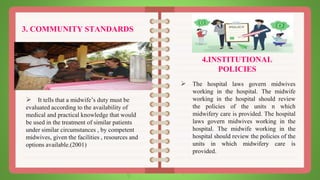
3. COMMUNITY STANDARDS
 It tells that a midwife’s duty must be
evaluated according to the availability of
medical and practical knowledge that would
be used in the treatment of similar patients
under similar circumstances , by competent
midwives, given the facilities , resources and
options available.(2001)
4.INSTITUTIONAL
POLICIES
 The hospital laws govern midwives
working in the hospital. The midwife
working in the hospital should review
the policies of the units n which
midwifery care is provided. The hospital
laws govern midwives working in the
hospital. The midwife working in the
hospital should review the policies of the
units in which midwifery care is
provided.
5.PROFESSIONAL NEGLIGENCE
 Medical malpractice is the legal error committed by medical personnel. In
legal terms, this error is tort a civil wrong that injuries a person. If a tort is
intentional , it becomes a crime of assault or battery . Negligence, a form
of malpractice, is an unintentional tort.
To prove a negligent tort occurred , 4 elements must be there;
1. A duty must exist between the injured party and the professional accused of
wrong doing.
2. A breach of duty must have occurred. The midwife must have practiced
outside the standard of care for a breach to occur.
3. The breach of duty must be proximate cause of the claimed injury.
4. There must be damage or injuries to the claimant that are recognized by the
law and compensable.
LEGAL ISSUE IN OBSTETRIC
AND
GYNAECOLOGY
PROBLEMS OF MEDICATION
 Nurses provide medication to the
clients . Certain problems can occur
during giving medication which can
result into allegation against nurses,
such as improper dosage of
medication, improper client
medication, wrong route of medication
and wrong time
FAILURE IN MONITORING
OF THE CLIENT
 It is the responsibility of the nurse to
monitor the client regularly depending
upon the condition of the client. She is
expected to monitor the condition of the
client admitted with any gynecological
problem..
FAILURE TO REPORT
CHANGES IN THE PATIENT
• Nurses do the regular monitoring and the
assessment of the client.
• During assessment , she may notice any
change in the client’s condition. This has
to be brought to the notice of the
physician. With this, a precious life can
be saved.
FAILURE IN ASSESSING
THE CLIENT
• Assessment is the first thing which
nurses have to do . Based on the
assessment care is provided to the
patients. She is responsible for
assessing and reporting any minute
change in the client’s condition.
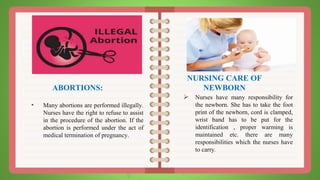
ABORTIONS:
• Many abortions are performed illegally.
Nurses have the right to refuse to assist
in the procedure of the abortion. If the
abortion is performed under the act of
medical termination of pregnancy.
NURSING CARE OF
NEWBORN
 Nurses have many responsibility for
the newborn. She has to take the foot
print of the newborn, cord is clamped,
wrist band has to be put for the
identification , proper warming is
maintained etc. there are many
responsibilities which the nurses have
to carry.
ETHICS IN MIDWIFERY AND
GYNAECOLOGY
According to Thompson and Thompson , to be professional is to be
ethical, and to be ethical is to be professional . To be ethical requires an
understanding of ethics, values, moral reasoning, and ethical decision –
making . The nature of ethics requires one to focus on what it means to be
human and how to interact with others in a respectful manner.
• The goal of ethical midwifery is to do the right thing for the right reasons.
Knowing how to make good decisions as well as why these decisions
were made constitutes of ethical midwifery practice
1.Ethical principle of beneficence: The ethical principle of
beneficence requires one to act in a way that is expected
reliably to produce the greater balance of benefits over harms
in the lives of others.
2. Non- maleficence: It means that health professionals
should prevent causing harm and is understood as expressing
the limits of beneficence.
3. Respect for autonomony: This principle requires one
always to acknowledge and carry out the value based
preference to adult,competent patient.
PRINCIPLES
4. Beneficence and respect for autonomy in
gynecological practice: Beneficence based and
autonomy based clinical judgment in gynecology
practice are usually in harmony. For example;
awoman may present with an ectopic pregnancy. The
gynecological must explain diagnostic findings and
potential for maternal death and unlikelihood of
spontaneous resolution.
5 .Empowerment and advocacy; One of the and help
woman to exercise their autonomy important role of
the midwife is to support.
6.Advocacy means speaking out for someone’s
rights.
CURRENT TRENDS IN
OBSTETRICAL NURSING
Technological advances
● As the technology has revolutionized
and increasingly sophisticated
computers in today's world, it has
become necessary for the nursing
personnel to have thorough knowledge
of the new technology being used.
● Today fetal monitoring has progressed
from the use of fetoscope to electronic
fetal monitors.
Increased cost of high-tech
care
 As the high and sophisticated
technology is being introduced into
todays world, the cost are also
increasing. For the procedures such as
ultrasound, fetal monitoring etc, the
couple has to pay good amount of
money . Gradually, obstetrics care is
becoming a business for the care
providers
Changing patterns of
childibrth
 There are increasing numbers of
working women, until they are in there
thirties. As early marriage practise still
continue , both ends, the older and
younger mothers face increased risks of
complications during pregnancy , such
as preterm delivery, LBW.
Family centred care
● Maternally care today has enhanced to
family centred care. Definition of health
include physical ,social, psychological
and economic dimension ..Family
centered approach is basic unit of
society. Thus emphasis on this aspect is
must that fosters family unity.
Integration and bonding takes high
priority and much anticipatory
counselling is offered.
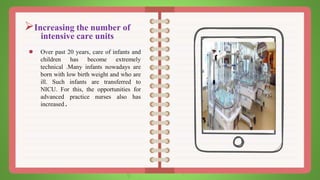
Increasing the number of
intensive care units
● Over past 20 years, care of infants and
children has become extremely
technical .Many infants nowadays are
born with low birth weight and who are
ill. Such infants are transferred to
NICU. For this, the opportunities for
advanced practice nurses also has
increased.
 Increasing use of
alternative treatment modalities
● Families have growing tendency to use
alternative therapies such as
acupuncture or the therapeutic touch.
Health care providers should be aware
of alternative forms of therapy, like
meditation, exercises, herbal
therapies.etc.
Early discharge
● In earlier days, women were
hospitalized for longer duration and
physical activity was increased very
gradually. Over the years now,
however, health care personnel have
realised that early return to normal
activities is the best course for
uncomplicated births
Role of fathers
● With increased societal emphasis on
shared parenting and the recognition of
parental bonding, many fathers are
active in care giving and enjoy the
closeness it brings.
• Promote health and self-care to expectant mothers, infants and families.
• Serves as an advocate for women e.g. cultural sensitivity
• Focuses on health promotion and disease prevention.
• Respect for human dignity and for women as persons with full human rights.
• Although all midwives attend births in hospitals, they may also work in the home, clinics,
communities and maternal units.
ROLES OF A MIDWIFE
LEGAL AND ETHICAL ISSUES IN MIDWIFERY

LEGAL AND ETHICAL ISSUES IN MIDWIFERY

  • 1.
    Here starts the lesson! Unit-I INTRODUCTIONTO MIDWIFERY AND OBSTETRICAL NURSING BHARATHI P, M.Sc NURSING ASSOCIATE PROFESSOR
  • 2.
    ● Midwifery isas old as the history of human species. Archeological evidence of woman demonstrates the existence of midwifery in 5000BC. Introduction
  • 3.
    ORIGIN OF OBSTETRICS: ●Obstetrics word came from a Latin word “OBSTETRIX means “MIDWIFE”. ● As we all know that birth is the complex final act of nature’s greatest miracle i.e. formation and arrival of a child in the world. And the science and art that deals with human reproduction is called Obstetrics Introduction
  • 4.
    ● “SORANUS OFEPHESUS”Is the FATHER OF OBSTETRICS .He was the first to write about the Podalic Version. Introduction
  • 5.
    ● King ofEgypt spokes to the midwives, who helped Hebrew women whent hey gave birth. They were the first midwives found in the Literature. ● Hippocrates(460BC), the father of scientific medicine, organised trained and supervised Midwives. He believed that the fetus had to fight its way out of the womb Introduction
  • 6.
    ● Aristotle(384-322BC), thefather of embryology, described the uterus and the female pelvic organs. And the essential qualities of the midwife. ● Ambroise Pare(1510-1590) laid the foundations of modern obstetrics. He performed internal podalic version and skillfully delivered women. He also sutured perineal lacerations. Introduction
  • 7.
    ● There arereferences to the midwives in the old testament. Genesis 35:17 “and it came to pass, when she was in hard labor, that the midwife said unto her, fear not Rachel, it is another Boy” Introduction
  • 8.
     Julius CaesarAranzi wrote the first book for italian Midwives. He advised Cesarean section for contracted Pelvis.
  • 9.
    ● William Harvey(1578-1657),the father of British midwifery, wrote the first English text book on Midwifery. He described the fetal circulation and the placenta The first to deliver the placenta by massaging the uterus.
  • 10.
    MIDWIFERY :-  Accordingto WHO (2013), midwifery encompasses care of women during pregnancy ,labour and postpartum period as well as care of newborns.  International Confederation of Midwives (2014)states that a midwife is a person who has acquired requisite qualifications to be registered and or legally licensed to practice midwifery and uses the title ‘midwife’ and who demonstrates competency in the practice of midwifery
  • 11.
     Formal educationhas improved aspects of midwifery and classified them into two main categories ; ● Certified nurse-midwife ● Direct entry midwife TYPES OF MIDWIVES During the 1970’s, there were three categories of midwives: • Granny midwives • Lay midwives • Traditional birth attendants
  • 12.
    LEGAL AND ETHICAL ASPECTSAND OBSTERICAL NURSING
  • 13.
    INTRODUCTION:-  Laws andethics are often seen as complimentary to each other , but at same time they are also seen as opposite sides of a coin. Midwives must follow standard and regulations that range from the national level to the individual area of practice, such as hospital, labor and delivery unit..
  • 14.
    1.NATIONAL STANDARDS OF PRACTICE Various levels of legal regulations and standards define midwifery practice. National standards provide an expectation of delivery care. The educational programs of midwifery assure that all new nurse midwives can safely deliver care within the scope of usual midwifery practice 2.STATE LICENSE  Midwifery practice is regulated in the state of practice through license to practice. If a midwife practices in two states, she must be licensed by both states. State license is meant to protect the consumers by ensuring that the midwife has appropriate education for the profession and can provide safe care
  • 15.
    3. COMMUNITY STANDARDS It tells that a midwife’s duty must be evaluated according to the availability of medical and practical knowledge that would be used in the treatment of similar patients under similar circumstances , by competent midwives, given the facilities , resources and options available.(2001) 4.INSTITUTIONAL POLICIES  The hospital laws govern midwives working in the hospital. The midwife working in the hospital should review the policies of the units n which midwifery care is provided. The hospital laws govern midwives working in the hospital. The midwife working in the hospital should review the policies of the units in which midwifery care is provided.
  • 16.
    5.PROFESSIONAL NEGLIGENCE  Medicalmalpractice is the legal error committed by medical personnel. In legal terms, this error is tort a civil wrong that injuries a person. If a tort is intentional , it becomes a crime of assault or battery . Negligence, a form of malpractice, is an unintentional tort. To prove a negligent tort occurred , 4 elements must be there; 1. A duty must exist between the injured party and the professional accused of wrong doing. 2. A breach of duty must have occurred. The midwife must have practiced outside the standard of care for a breach to occur. 3. The breach of duty must be proximate cause of the claimed injury. 4. There must be damage or injuries to the claimant that are recognized by the law and compensable.
  • 17.
    LEGAL ISSUE INOBSTETRIC AND GYNAECOLOGY
  • 18.
    PROBLEMS OF MEDICATION Nurses provide medication to the clients . Certain problems can occur during giving medication which can result into allegation against nurses, such as improper dosage of medication, improper client medication, wrong route of medication and wrong time FAILURE IN MONITORING OF THE CLIENT  It is the responsibility of the nurse to monitor the client regularly depending upon the condition of the client. She is expected to monitor the condition of the client admitted with any gynecological problem..
  • 19.
    FAILURE TO REPORT CHANGESIN THE PATIENT • Nurses do the regular monitoring and the assessment of the client. • During assessment , she may notice any change in the client’s condition. This has to be brought to the notice of the physician. With this, a precious life can be saved. FAILURE IN ASSESSING THE CLIENT • Assessment is the first thing which nurses have to do . Based on the assessment care is provided to the patients. She is responsible for assessing and reporting any minute change in the client’s condition.
  • 20.
    ABORTIONS: • Many abortionsare performed illegally. Nurses have the right to refuse to assist in the procedure of the abortion. If the abortion is performed under the act of medical termination of pregnancy. NURSING CARE OF NEWBORN  Nurses have many responsibility for the newborn. She has to take the foot print of the newborn, cord is clamped, wrist band has to be put for the identification , proper warming is maintained etc. there are many responsibilities which the nurses have to carry.
  • 21.
    ETHICS IN MIDWIFERYAND GYNAECOLOGY According to Thompson and Thompson , to be professional is to be ethical, and to be ethical is to be professional . To be ethical requires an understanding of ethics, values, moral reasoning, and ethical decision – making . The nature of ethics requires one to focus on what it means to be human and how to interact with others in a respectful manner. • The goal of ethical midwifery is to do the right thing for the right reasons. Knowing how to make good decisions as well as why these decisions were made constitutes of ethical midwifery practice
  • 22.
    1.Ethical principle ofbeneficence: The ethical principle of beneficence requires one to act in a way that is expected reliably to produce the greater balance of benefits over harms in the lives of others. 2. Non- maleficence: It means that health professionals should prevent causing harm and is understood as expressing the limits of beneficence. 3. Respect for autonomony: This principle requires one always to acknowledge and carry out the value based preference to adult,competent patient. PRINCIPLES
  • 23.
    4. Beneficence andrespect for autonomy in gynecological practice: Beneficence based and autonomy based clinical judgment in gynecology practice are usually in harmony. For example; awoman may present with an ectopic pregnancy. The gynecological must explain diagnostic findings and potential for maternal death and unlikelihood of spontaneous resolution. 5 .Empowerment and advocacy; One of the and help woman to exercise their autonomy important role of the midwife is to support. 6.Advocacy means speaking out for someone’s rights.
  • 24.
  • 25.
    Technological advances ● Asthe technology has revolutionized and increasingly sophisticated computers in today's world, it has become necessary for the nursing personnel to have thorough knowledge of the new technology being used. ● Today fetal monitoring has progressed from the use of fetoscope to electronic fetal monitors.
  • 26.
    Increased cost ofhigh-tech care  As the high and sophisticated technology is being introduced into todays world, the cost are also increasing. For the procedures such as ultrasound, fetal monitoring etc, the couple has to pay good amount of money . Gradually, obstetrics care is becoming a business for the care providers
  • 27.
    Changing patterns of childibrth There are increasing numbers of working women, until they are in there thirties. As early marriage practise still continue , both ends, the older and younger mothers face increased risks of complications during pregnancy , such as preterm delivery, LBW.
  • 28.
    Family centred care ●Maternally care today has enhanced to family centred care. Definition of health include physical ,social, psychological and economic dimension ..Family centered approach is basic unit of society. Thus emphasis on this aspect is must that fosters family unity. Integration and bonding takes high priority and much anticipatory counselling is offered.
  • 29.
    Increasing the numberof intensive care units ● Over past 20 years, care of infants and children has become extremely technical .Many infants nowadays are born with low birth weight and who are ill. Such infants are transferred to NICU. For this, the opportunities for advanced practice nurses also has increased.
  • 30.
     Increasing useof alternative treatment modalities ● Families have growing tendency to use alternative therapies such as acupuncture or the therapeutic touch. Health care providers should be aware of alternative forms of therapy, like meditation, exercises, herbal therapies.etc.
  • 31.
    Early discharge ● Inearlier days, women were hospitalized for longer duration and physical activity was increased very gradually. Over the years now, however, health care personnel have realised that early return to normal activities is the best course for uncomplicated births
  • 32.
    Role of fathers ●With increased societal emphasis on shared parenting and the recognition of parental bonding, many fathers are active in care giving and enjoy the closeness it brings.
  • 33.
    • Promote healthand self-care to expectant mothers, infants and families. • Serves as an advocate for women e.g. cultural sensitivity • Focuses on health promotion and disease prevention. • Respect for human dignity and for women as persons with full human rights. • Although all midwives attend births in hospitals, they may also work in the home, clinics, communities and maternal units. ROLES OF A MIDWIFE