
TECHNICAL
DRAWING I
THEME 2: BASIC PATHS IN THE PLANE
Basic geometrics elements:

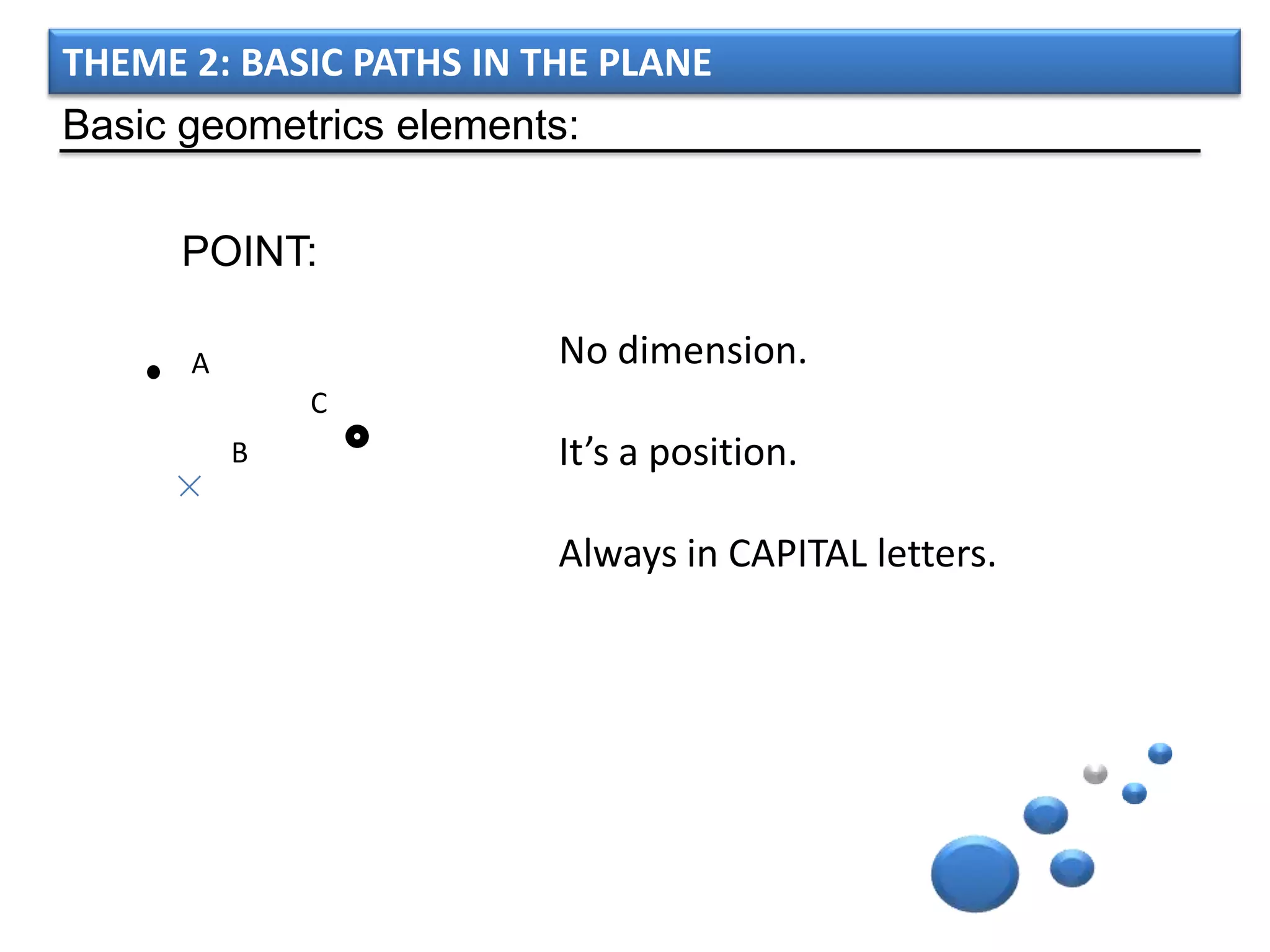
      POINT:

      A                  No dimension.
              C
          B              It’s a position.

                         Always in CAPITAL letters.
THEME 2: BASIC PATHS IN THE PLANE
Basic geometrics elements:


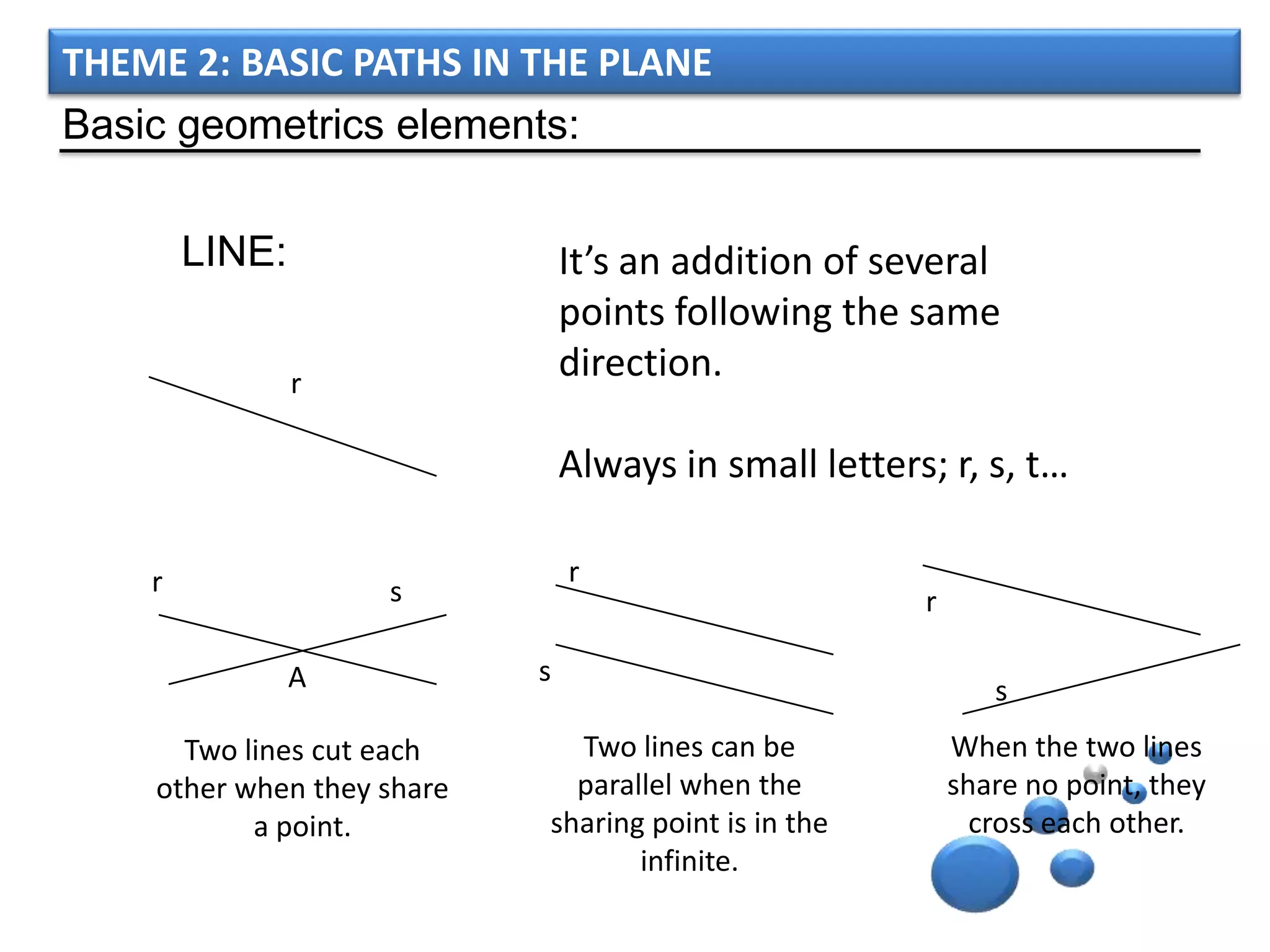
        LINE:                   It’s an addition of several
                                points following the same
                r
                                direction.

                                Always in small letters; r, s, t…

    r                           r
                    s                                  r

                A           s
                                                              s
      Two lines cut each      Two lines can be             When the two lines
    other when they share     parallel when the            share no point, they
           a point.         sharing point is in the          cross each other.
                                   infinite.
THEME 2: BASIC PATHS IN THE PLANE
Basic geometrics elements:

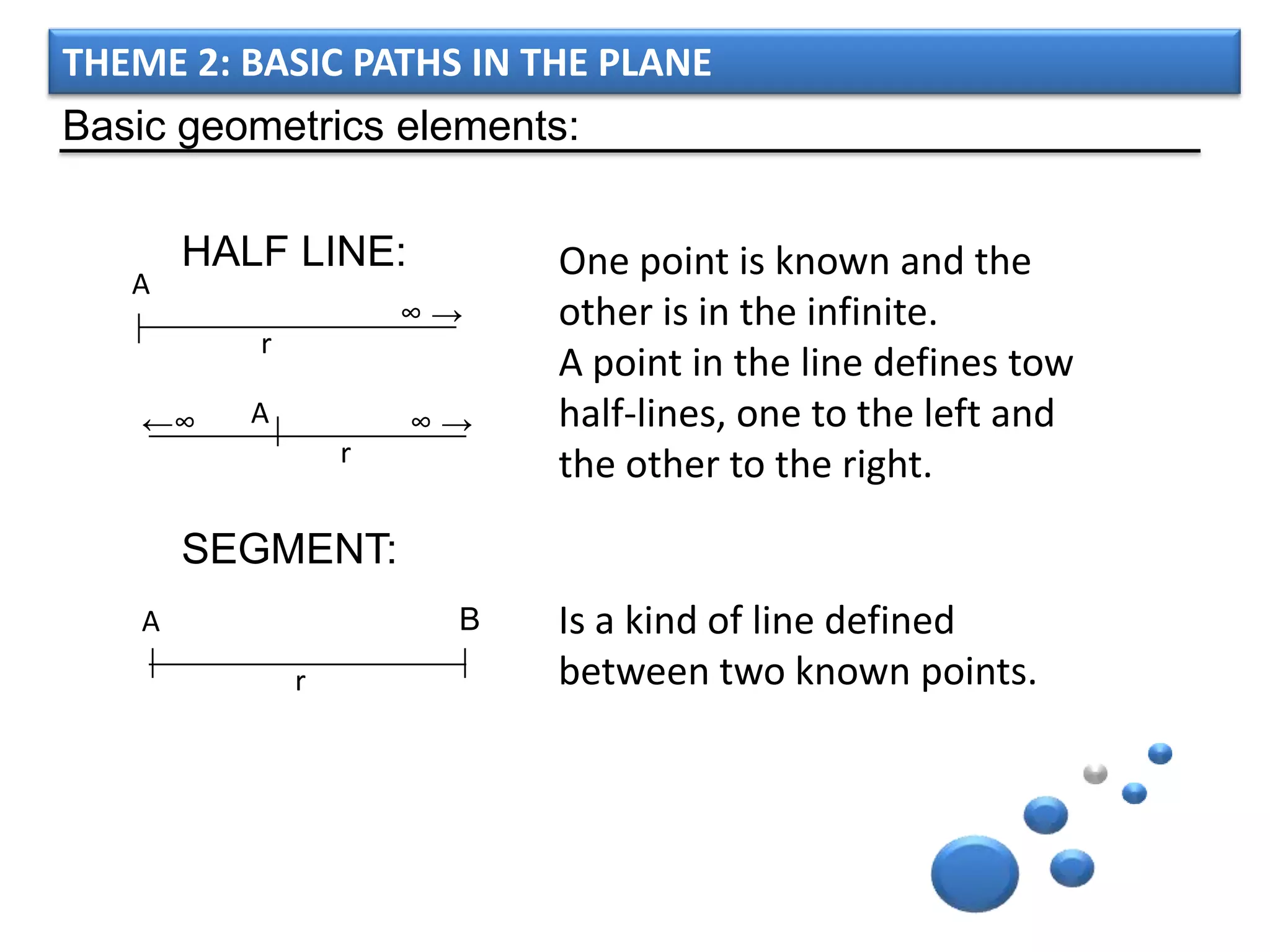
        HALF LINE:          One point is known and the
   A
                       ∞→   other is in the infinite.
           r
                            A point in the line defines tow
    ←∞     A           ∞→   half-lines, one to the left and
                   r        the other to the right.

        SEGMENT:
    A                   B   Is a kind of line defined
               r            between two known points.
THEME 2: BASIC PATHS IN THE PLANE
Basic geometrics elements:

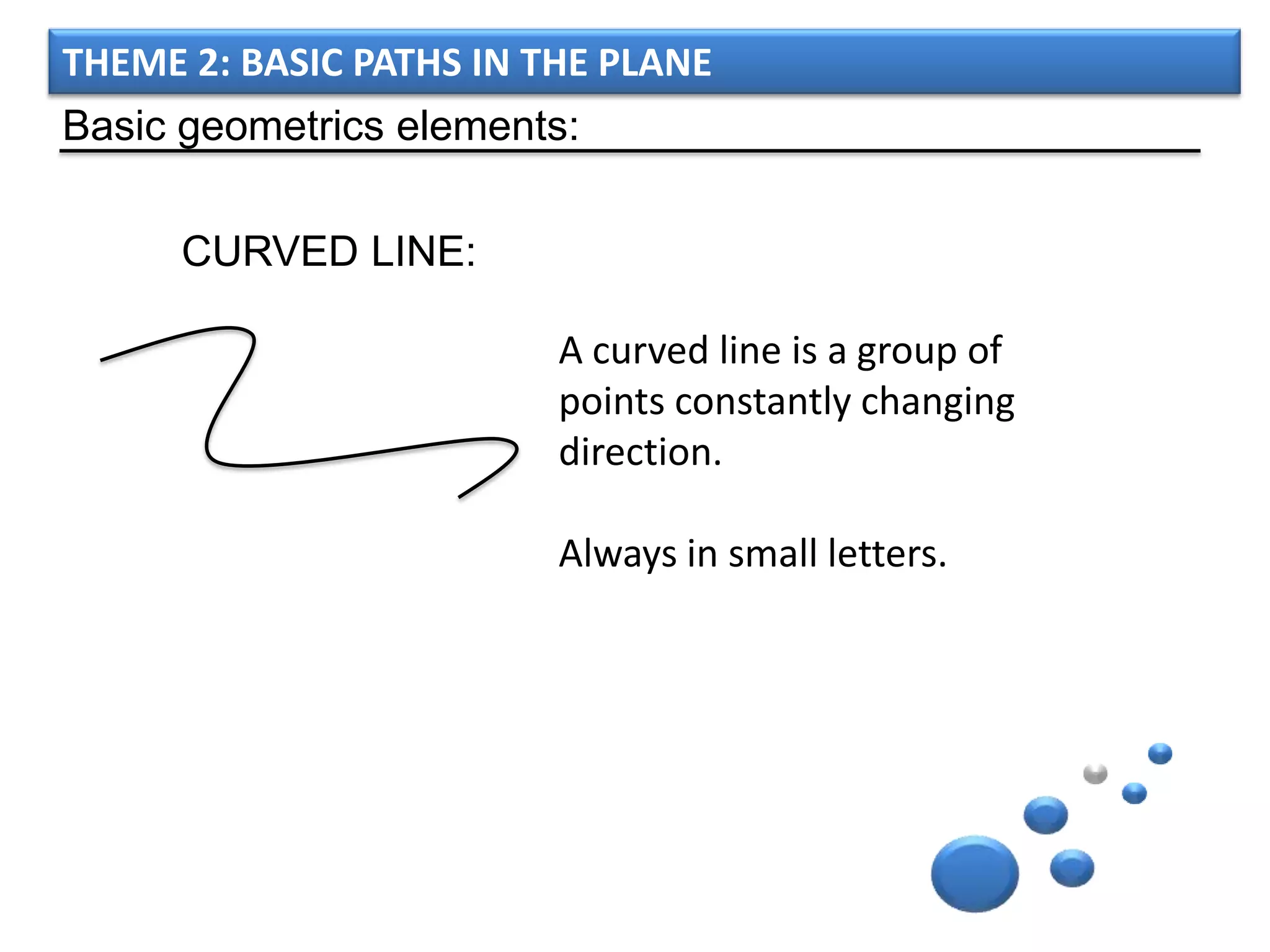
      CURVED LINE:

                         A curved line is a group of
                         points constantly changing
                         direction.

                         Always in small letters.
THEME 2: BASIC PATHS IN THE PLANE
Basic geometrics elements:

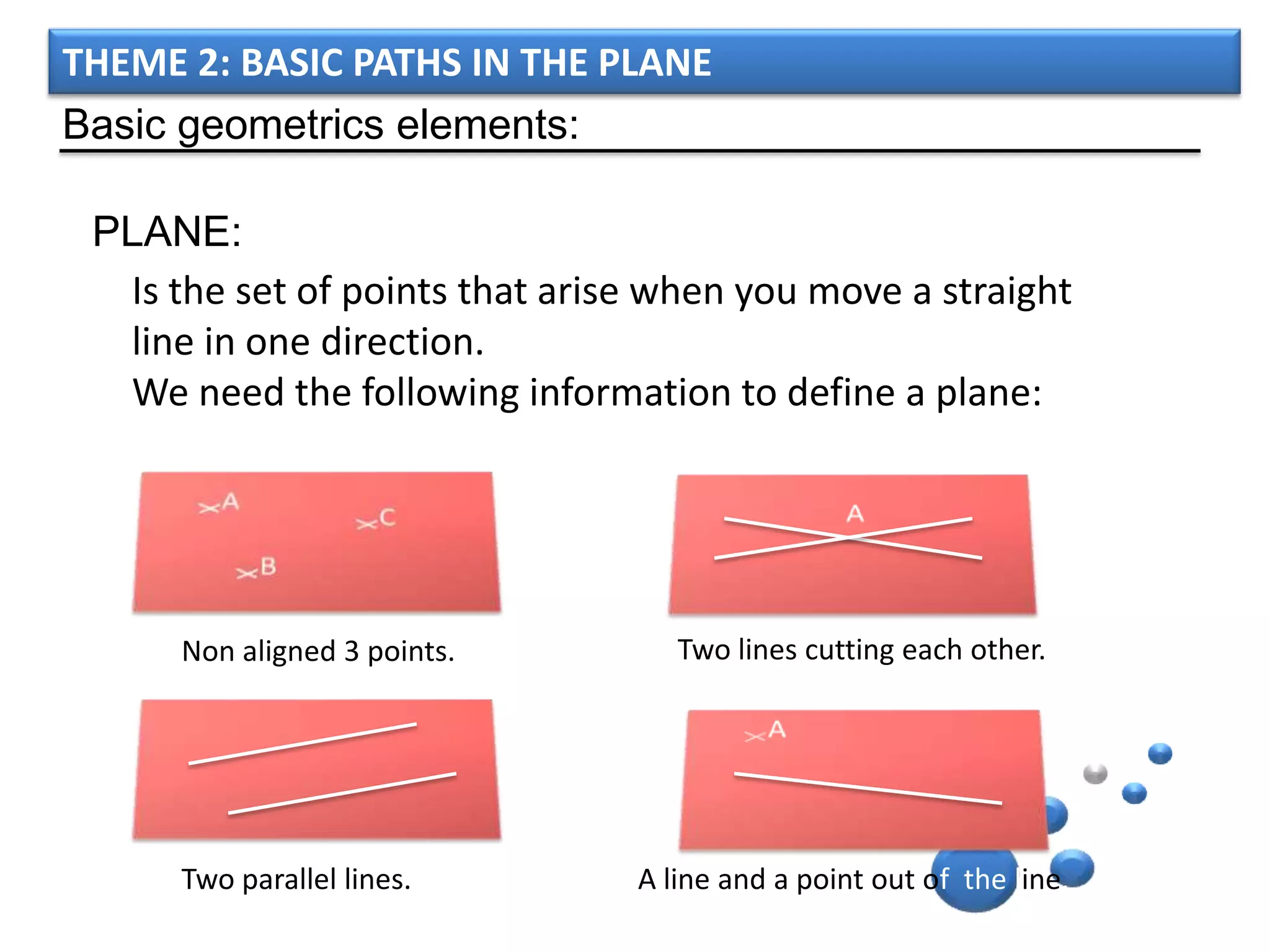
 PLANE:
  Is the set of points that arise when you move a straight
  line in one direction.
  We need the following information to define a plane:


      Non aligned 3 points.        Two lines cutting each other.


      Two parallel lines.       A line and a point out of the line.
THEME 2: BASIC PATHS IN THE PLANE
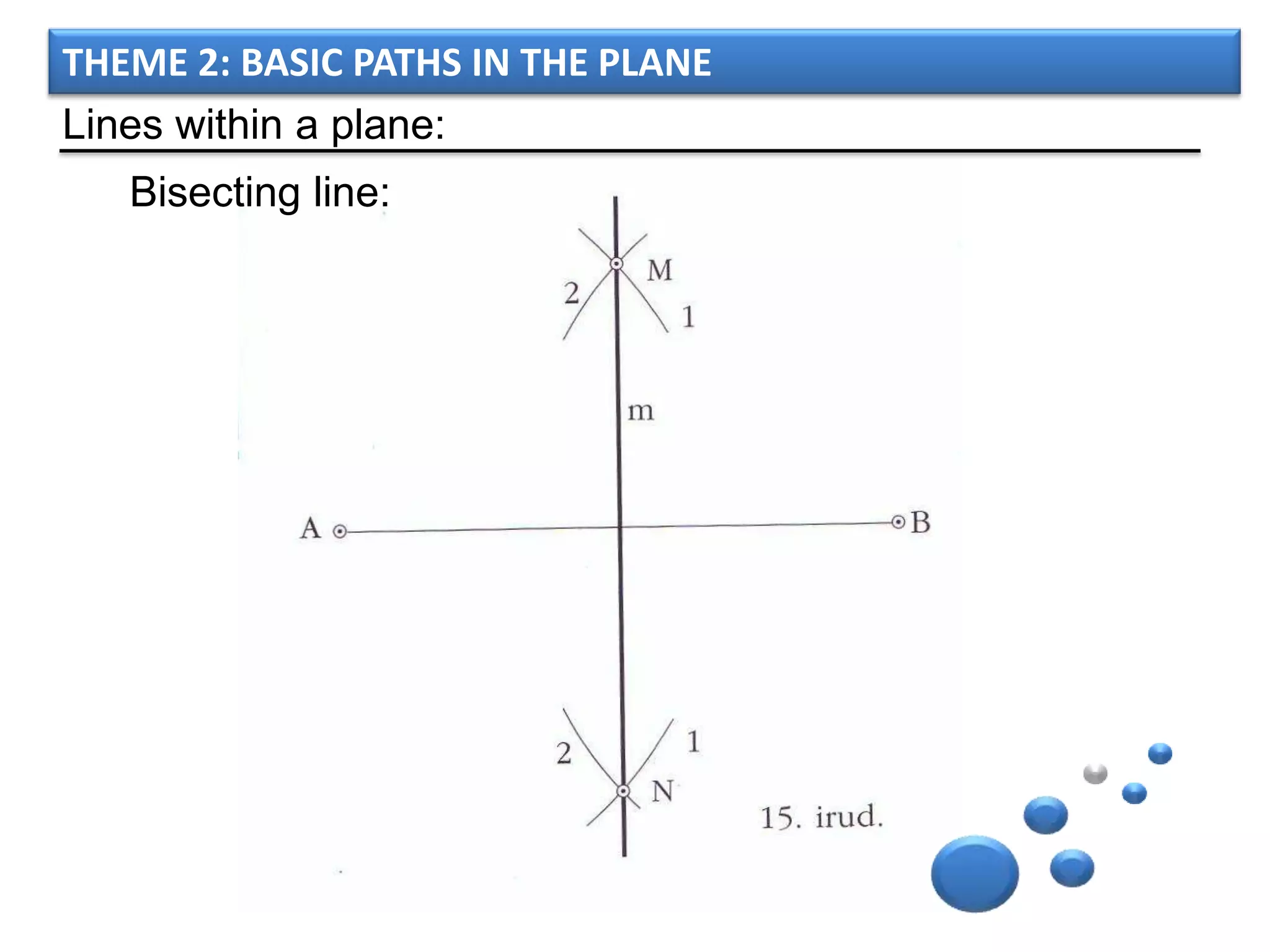
Lines within a plane:
   Bisecting line:
THEME 2: BASIC PATHS IN THE PLANE
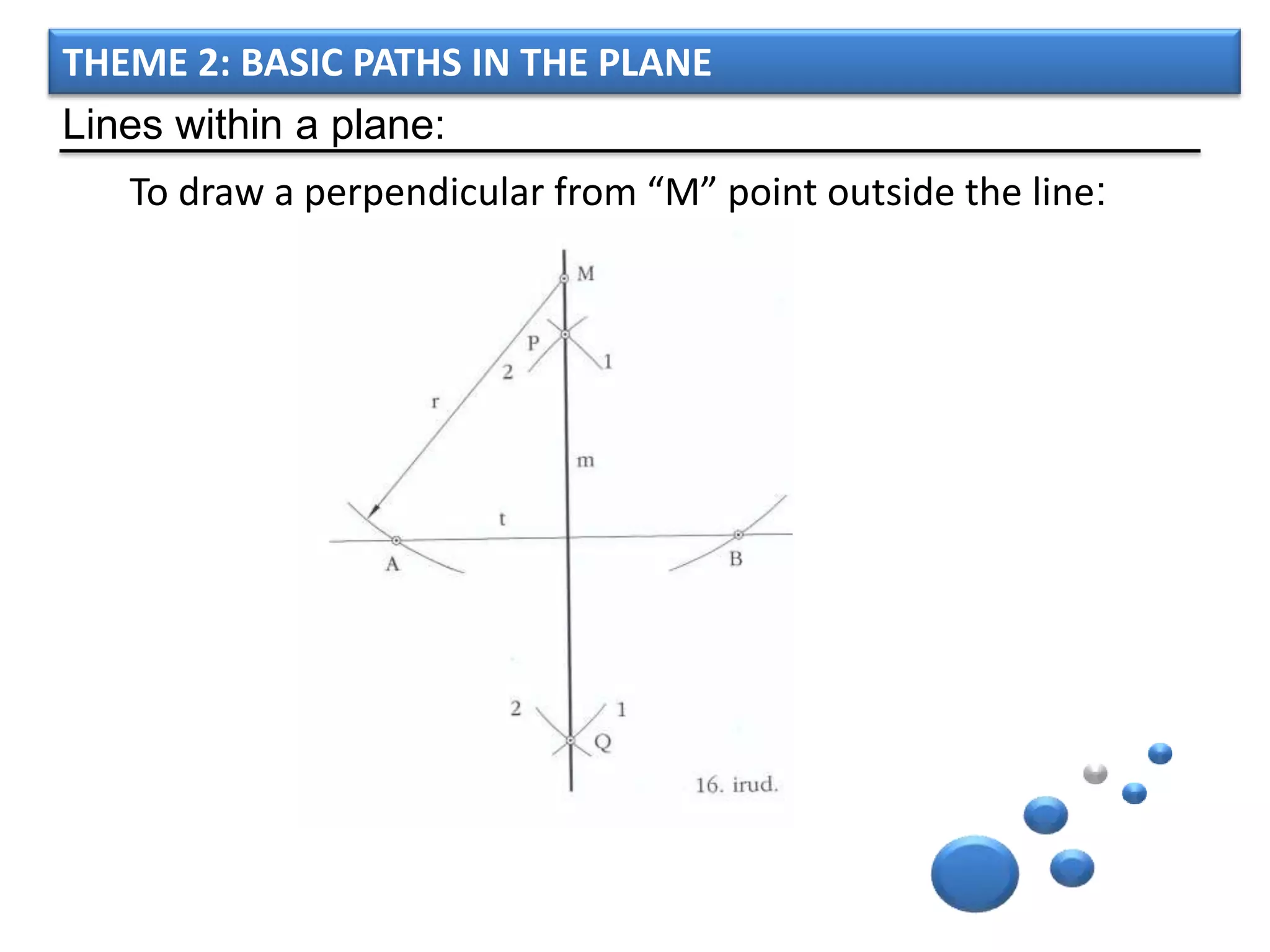
Lines within a plane:
   To draw a perpendicular from “M” point outside the line:
THEME 2: BASIC PATHS IN THE PLANE
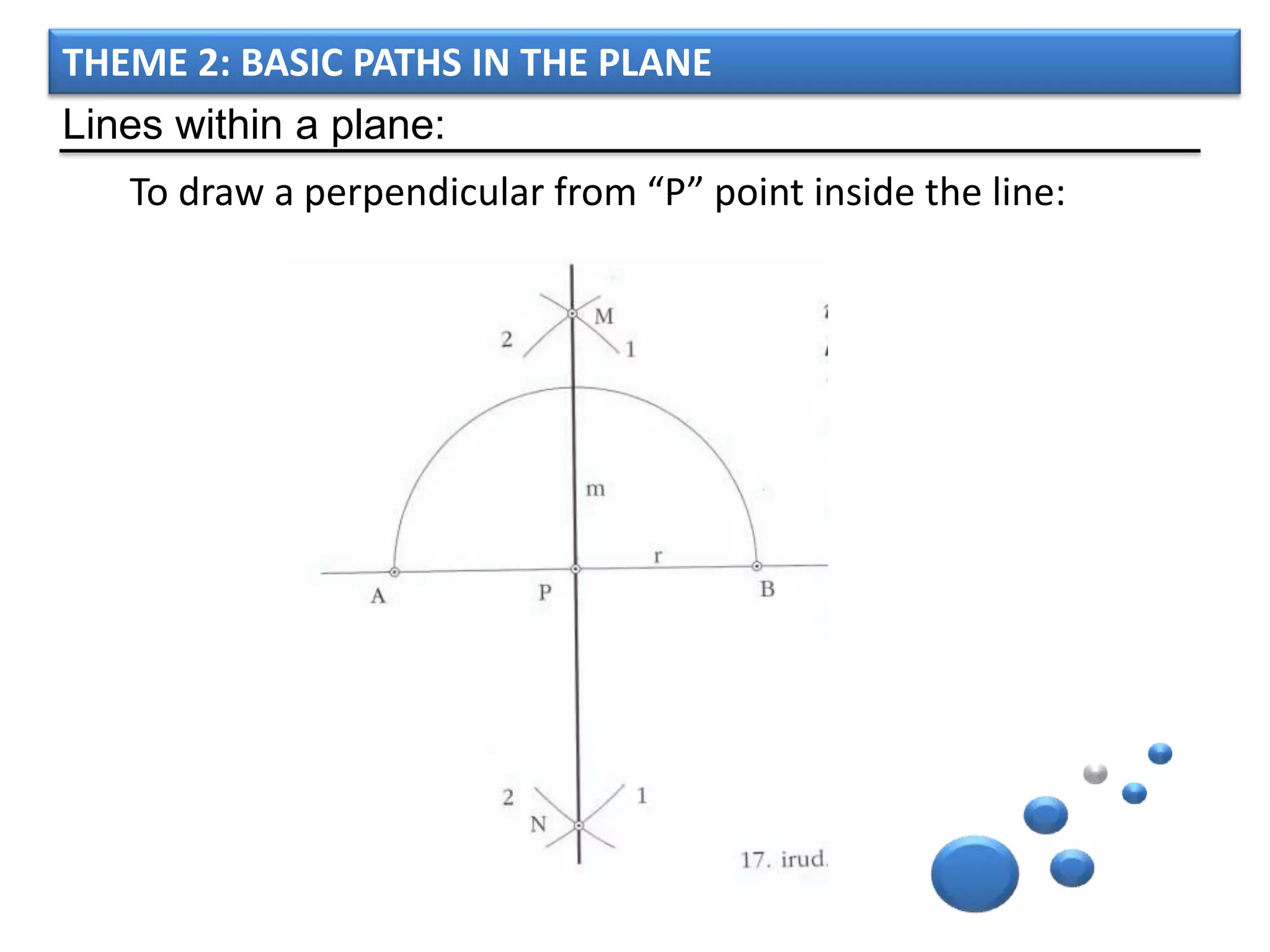
Lines within a plane:
   To draw a perpendicular from “P” point inside the line:
THEME 2: BASIC PATHS IN THE PLANE
Lines within a plane:
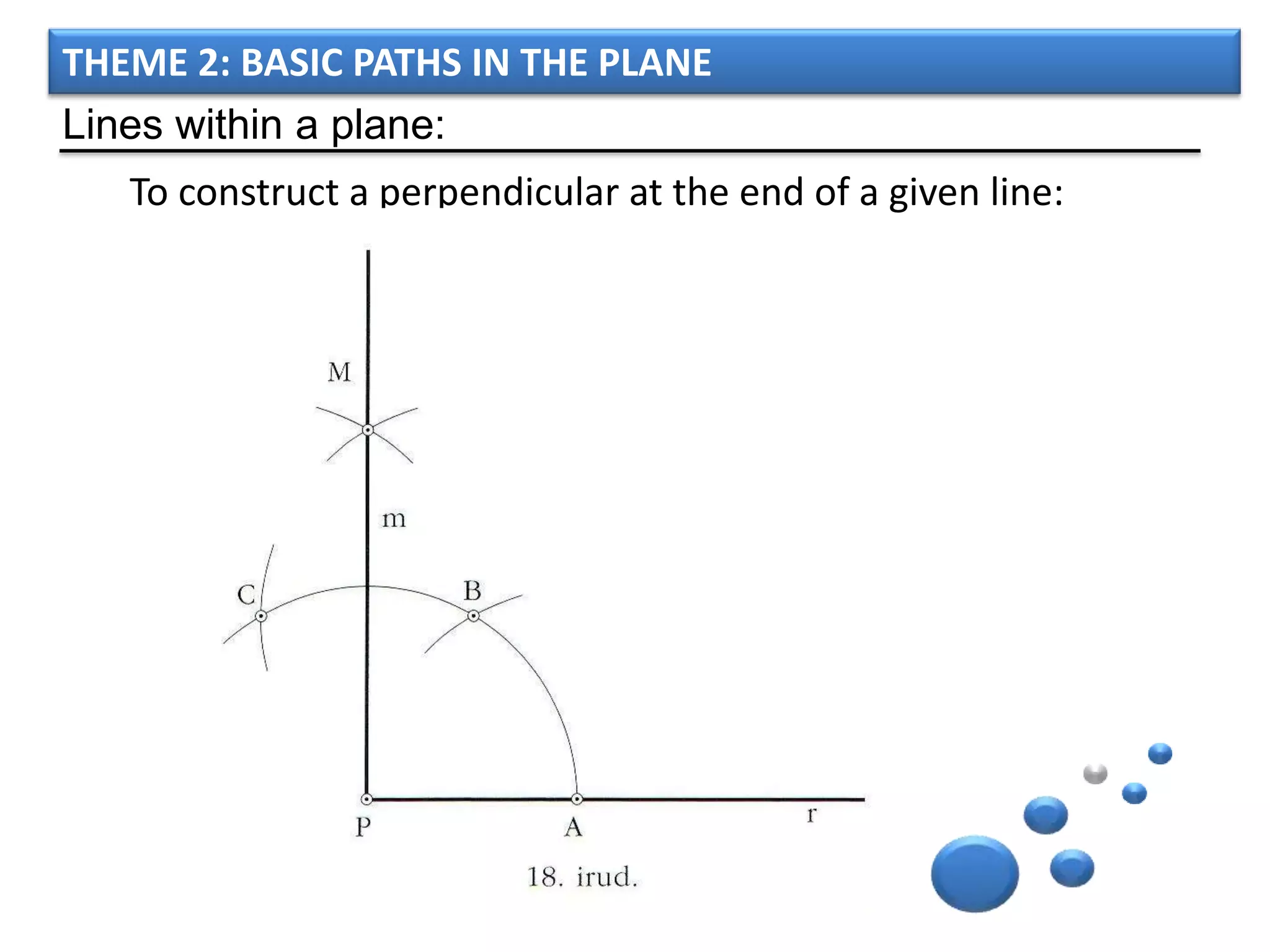
   To construct a perpendicular at the end of a given line:
THEME 2: BASIC PATHS IN THE PLANE
Lines within a plane:
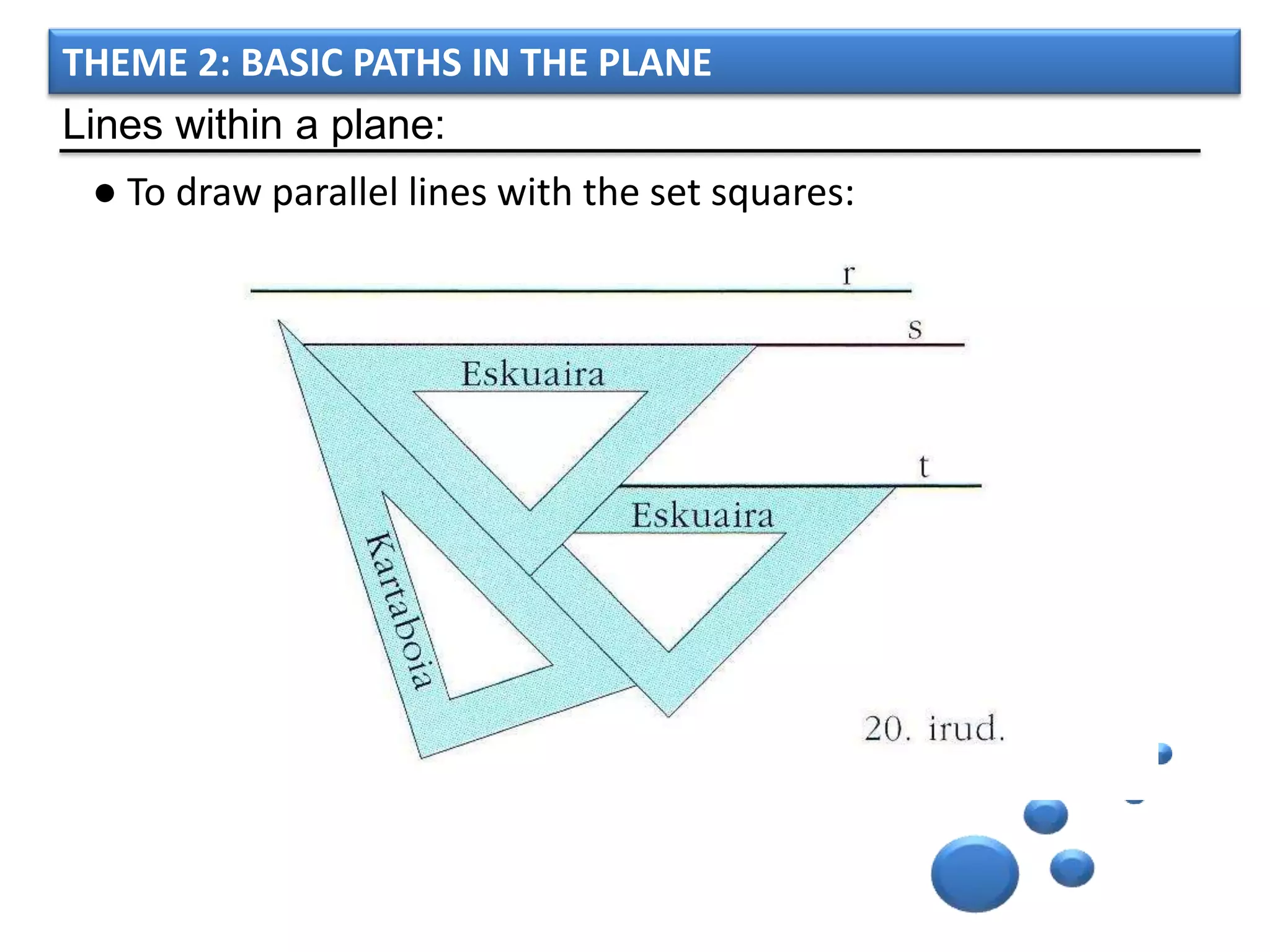
 ● To draw parallel lines with the set squares:
THEME 2: BASIC PATHS IN THE PLANE
Lines within a plane:
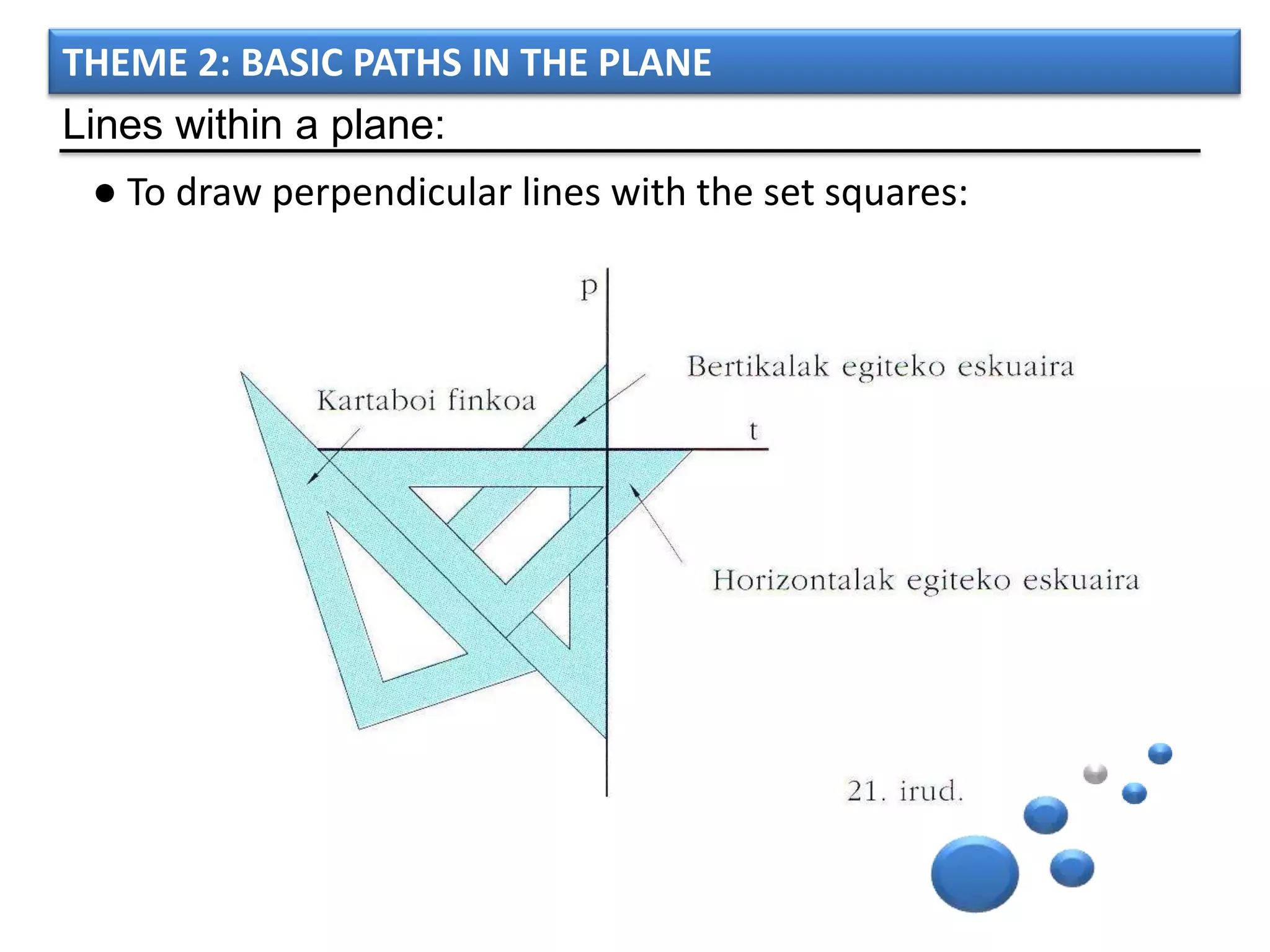
 ● To draw perpendicular lines with the set squares:
THEME 2: BASIC PATHS IN THE PLANE
Basic geometrics elements:
ANGLES:
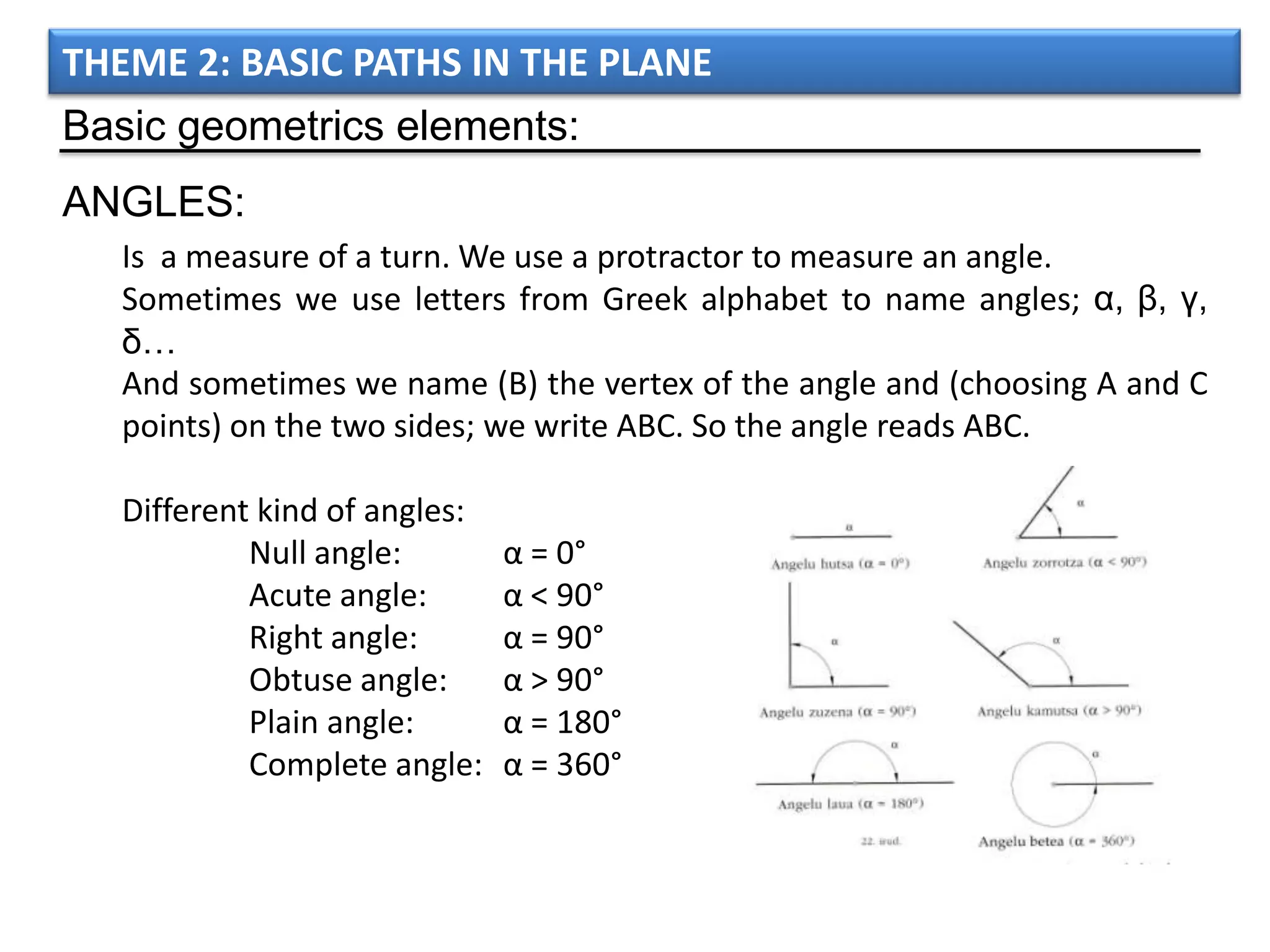
   Is a measure of a turn. We use a protractor to measure an angle.
   Sometimes we use letters from Greek alphabet to name angles; α, β, γ,
   δ…
   And sometimes we name (B) the vertex of the angle and (choosing A and C
   points) on the two sides; we write ABC. So the angle reads ABC.

   Different kind of angles:
            Null angle:        α = 0°
            Acute angle:       α < 90°
            Right angle:       α = 90°
            Obtuse angle:      α > 90°
            Plain angle:       α = 180°
            Complete angle:    α = 360°
THEME 2: BASIC PATHS IN THE PLANE
Basic geometrics elements:
ANGLES:
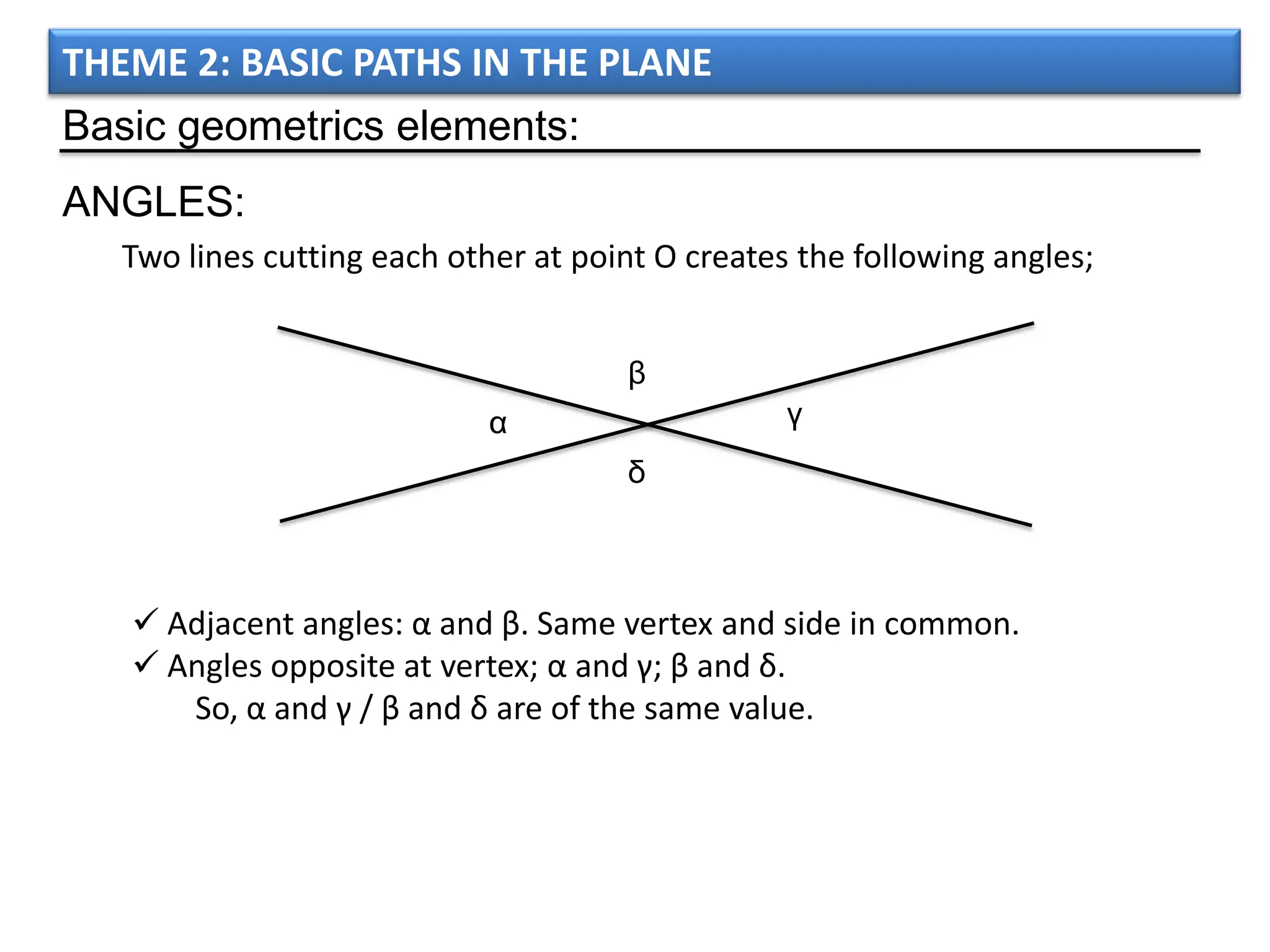
   Two lines cutting each other at point O creates the following angles;


                                      β
                             α                    γ
                                      δ


    Adjacent angles: α and β. Same vertex and side in common.
    Angles opposite at vertex; α and γ; β and δ.
      So, α and γ / β and δ are of the same value.
THEME 2: BASIC PATHS IN THE PLANE
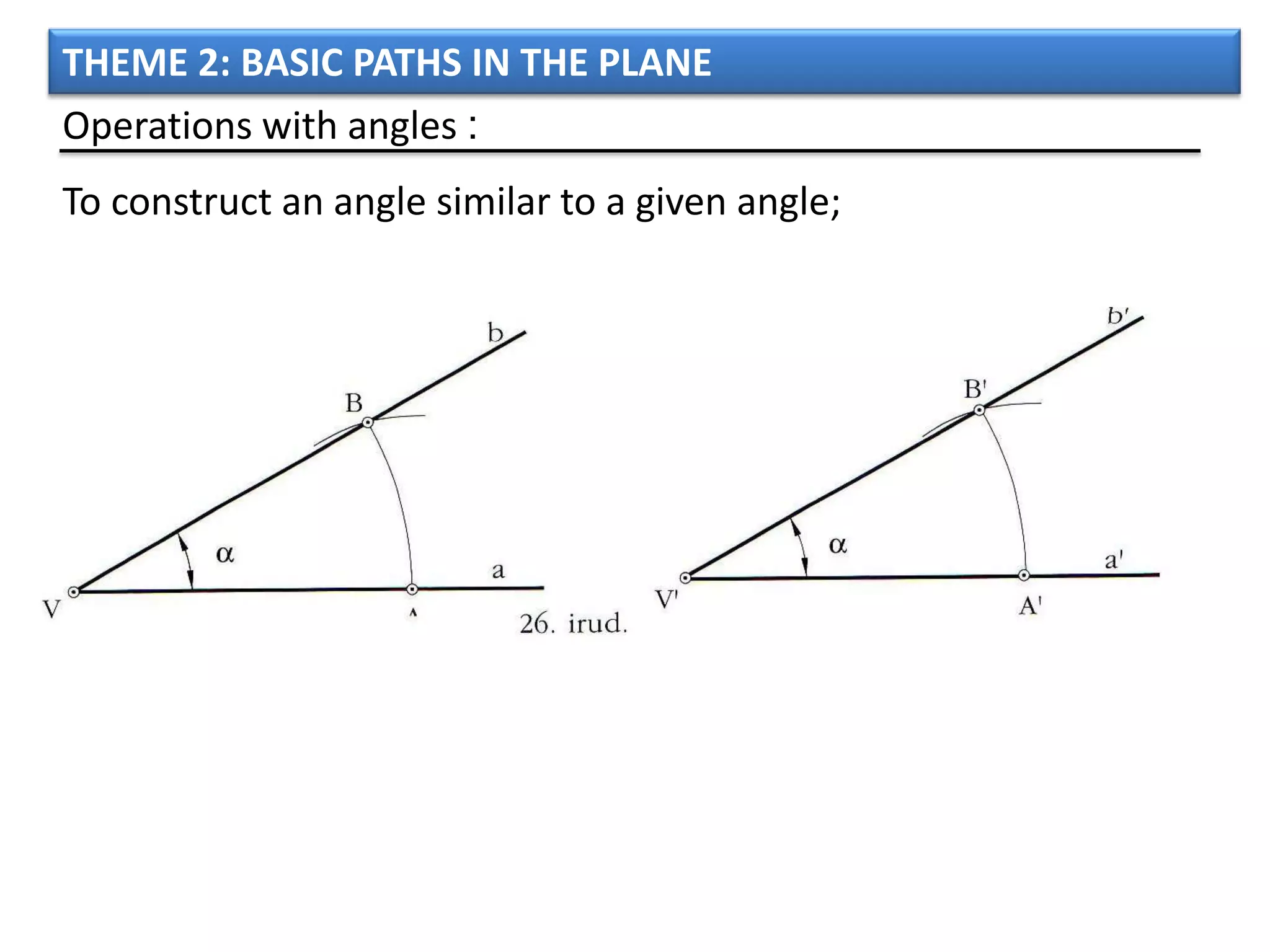
Operations with angles :
To construct an angle similar to a given angle;
THEME 2: BASIC PATHS IN THE PLANE
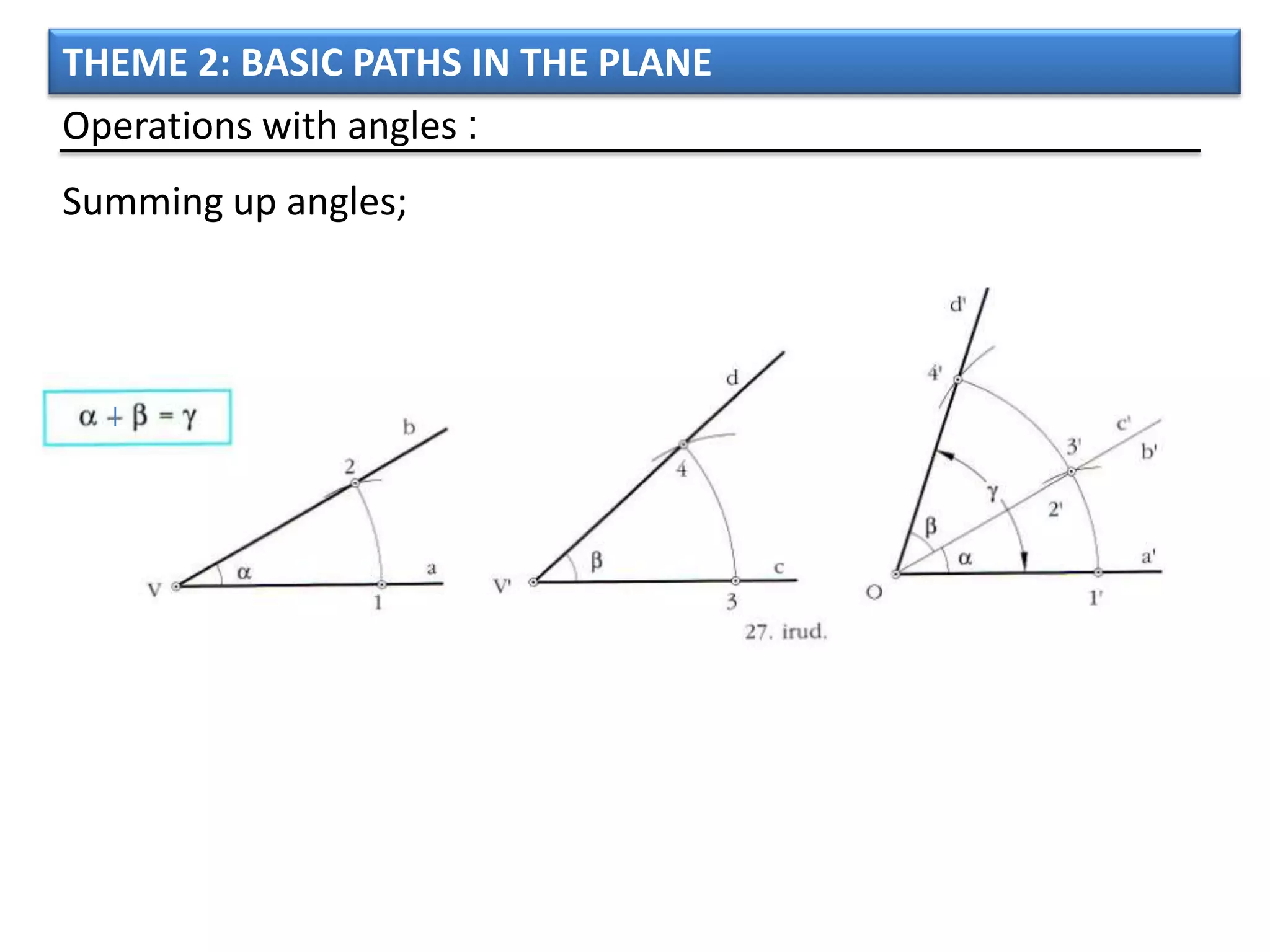
Operations with angles :
Summing up angles;
THEME 2: BASIC PATHS IN THE PLANE
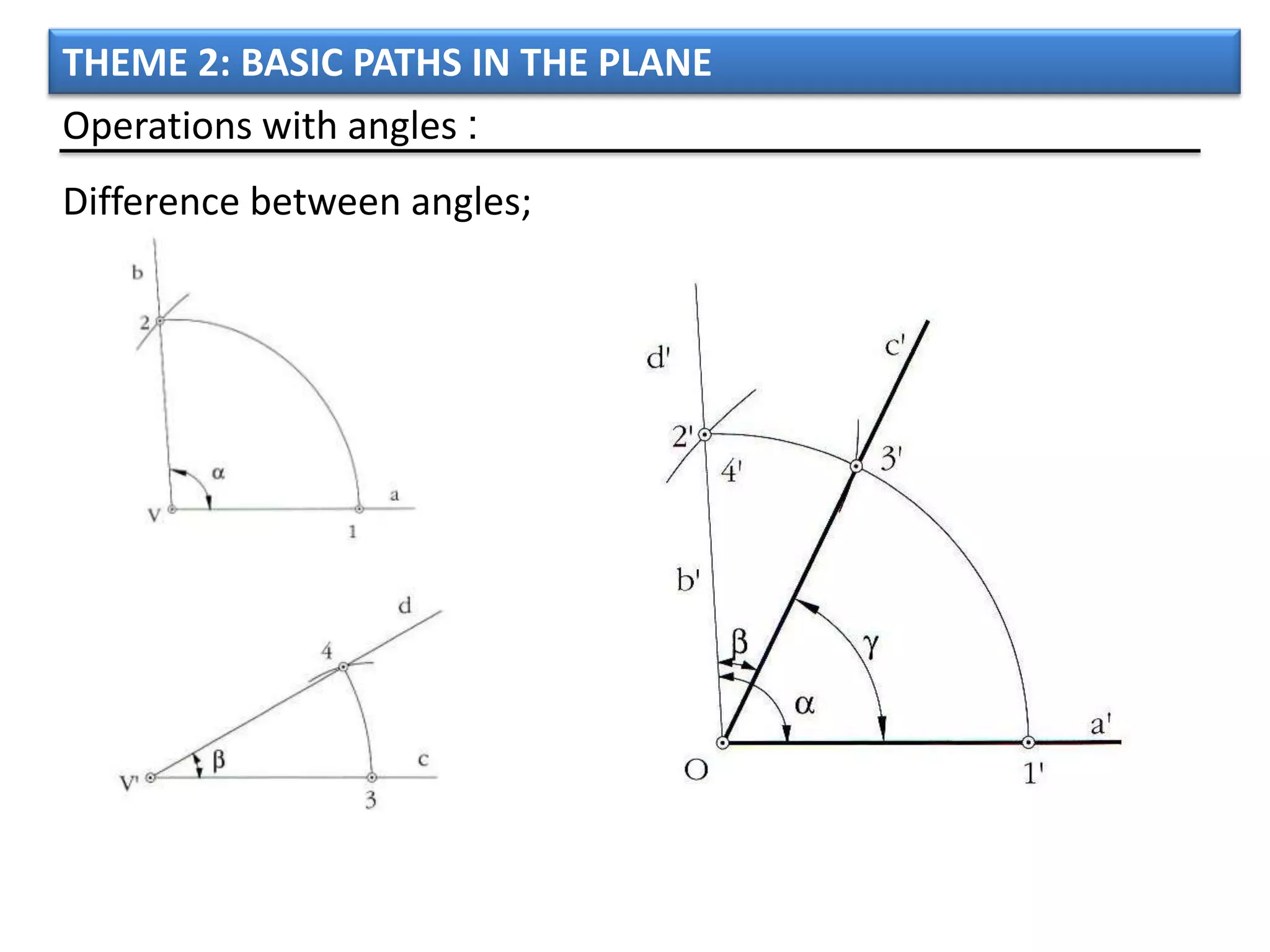
Operations with angles :
Difference between angles;
THEME 2: BASIC PATHS IN THE PLANE
Operations with angles :
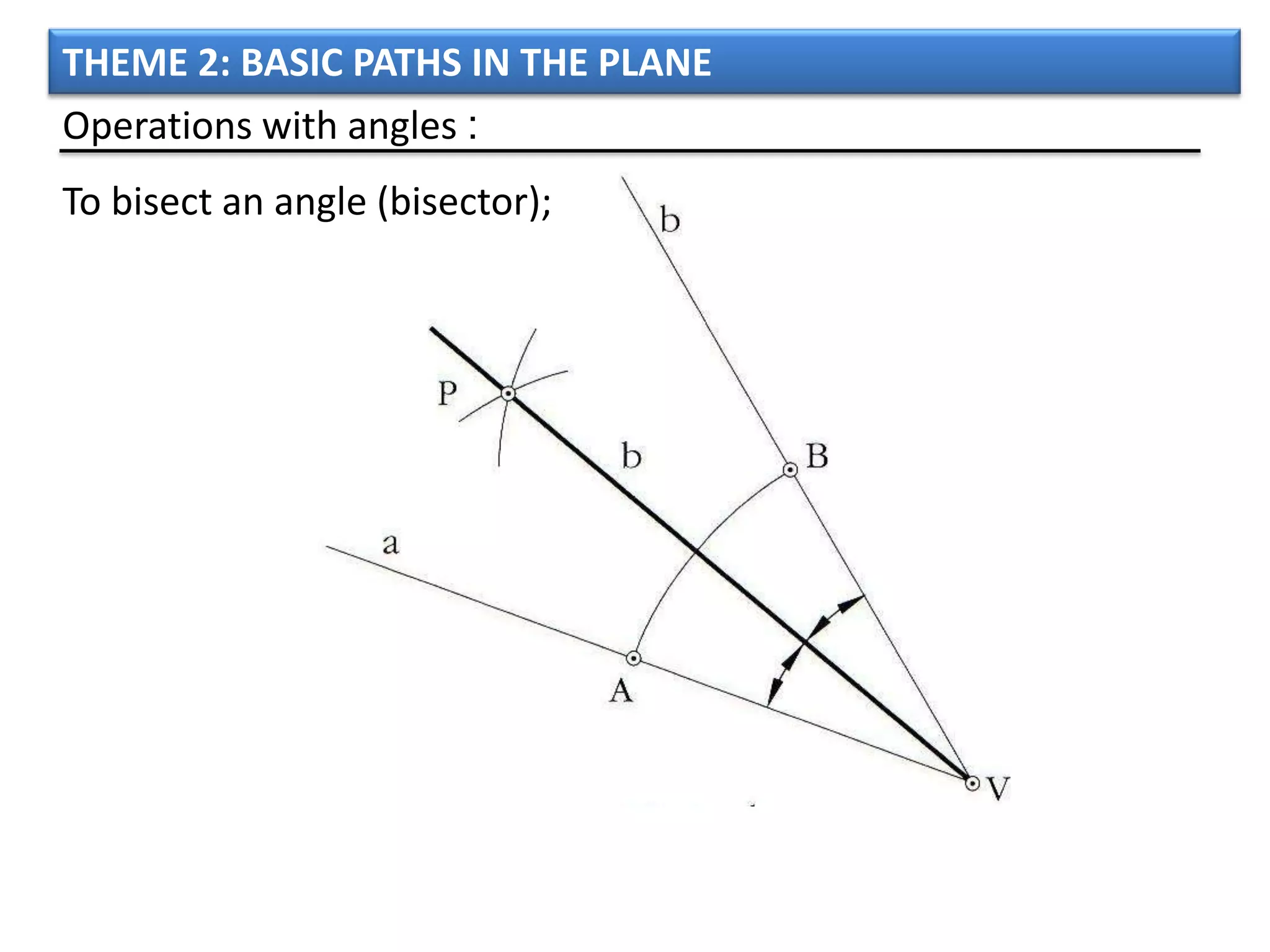
To bisect an angle (bisector);
THEME 2: BASIC PATHS IN THE PLANE
Operations with angles :
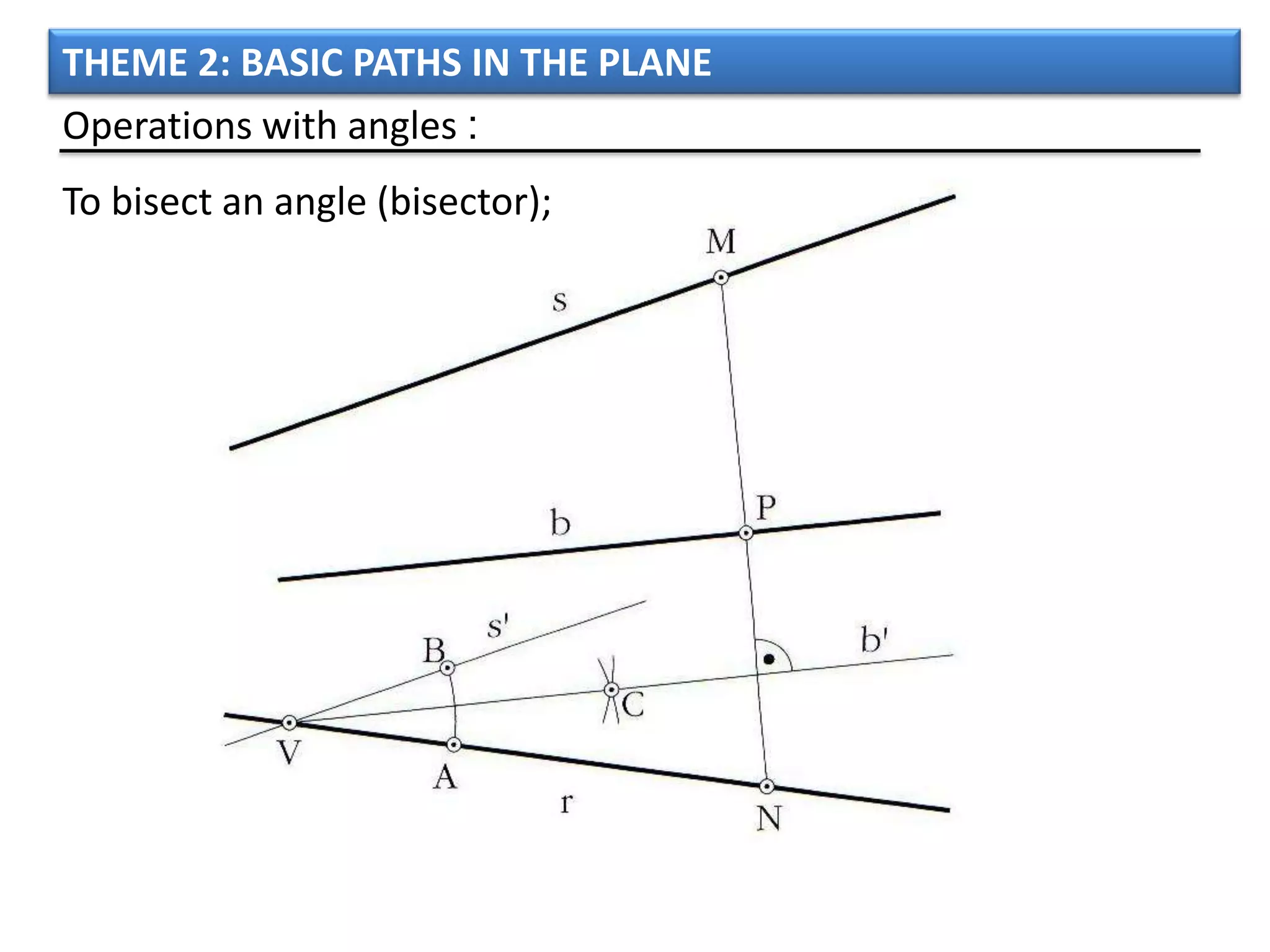
To bisect an angle (bisector);
THEME 2: BASIC PATHS IN THE PLANE
Operations with angles :
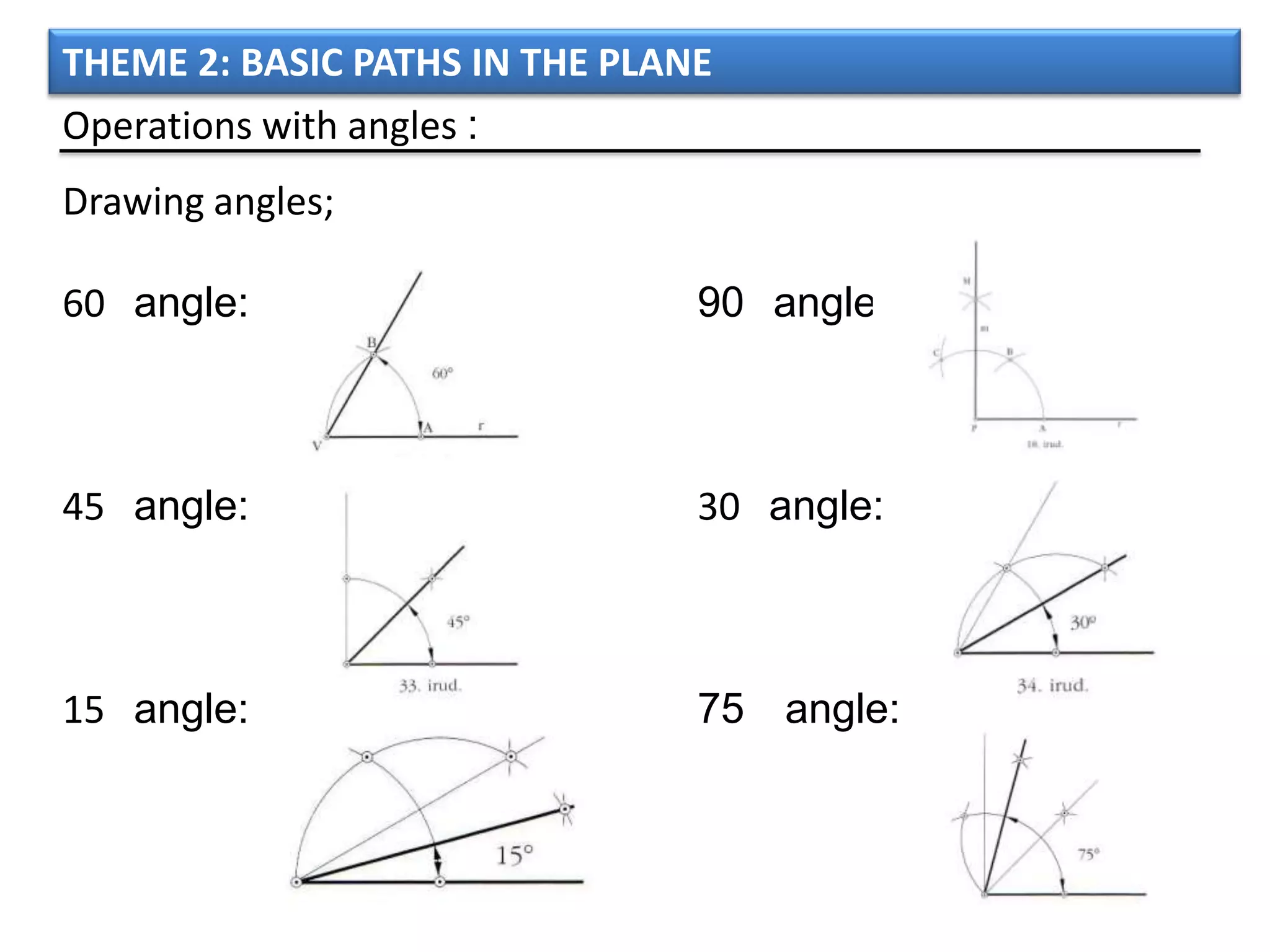
Drawing angles;

60 angle:                       90 angle:


45 angle:                       30 angle:


15 angle:                       75 angle:
THEME 2: BASIC PATHS IN THE PLANE
Operations with angles :
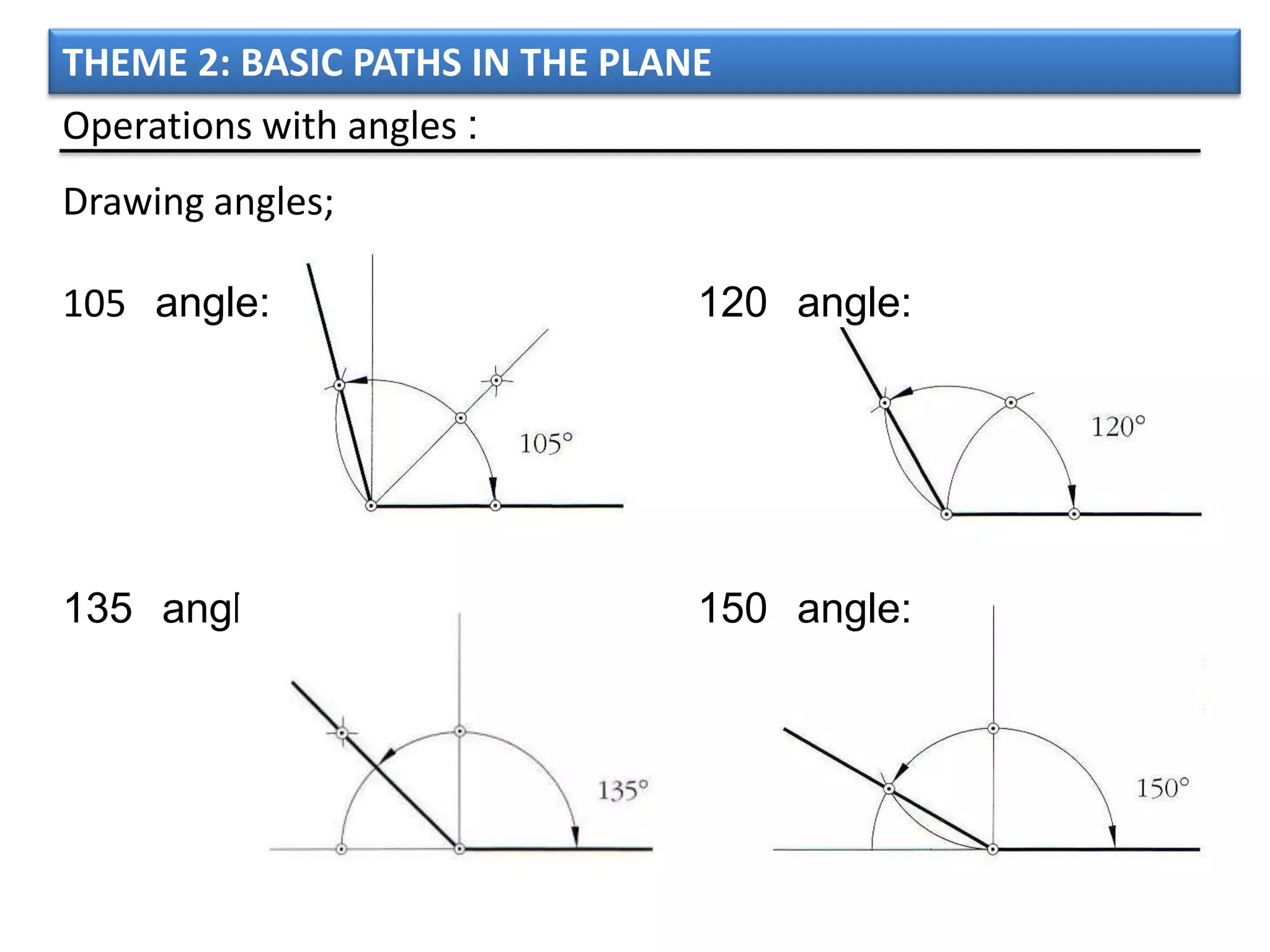
Drawing angles;

105 angle:                      120 angle:


135 angle:                      150 angle:
THEME 2: BASIC PATHS IN THE PLANE
Geometric places:
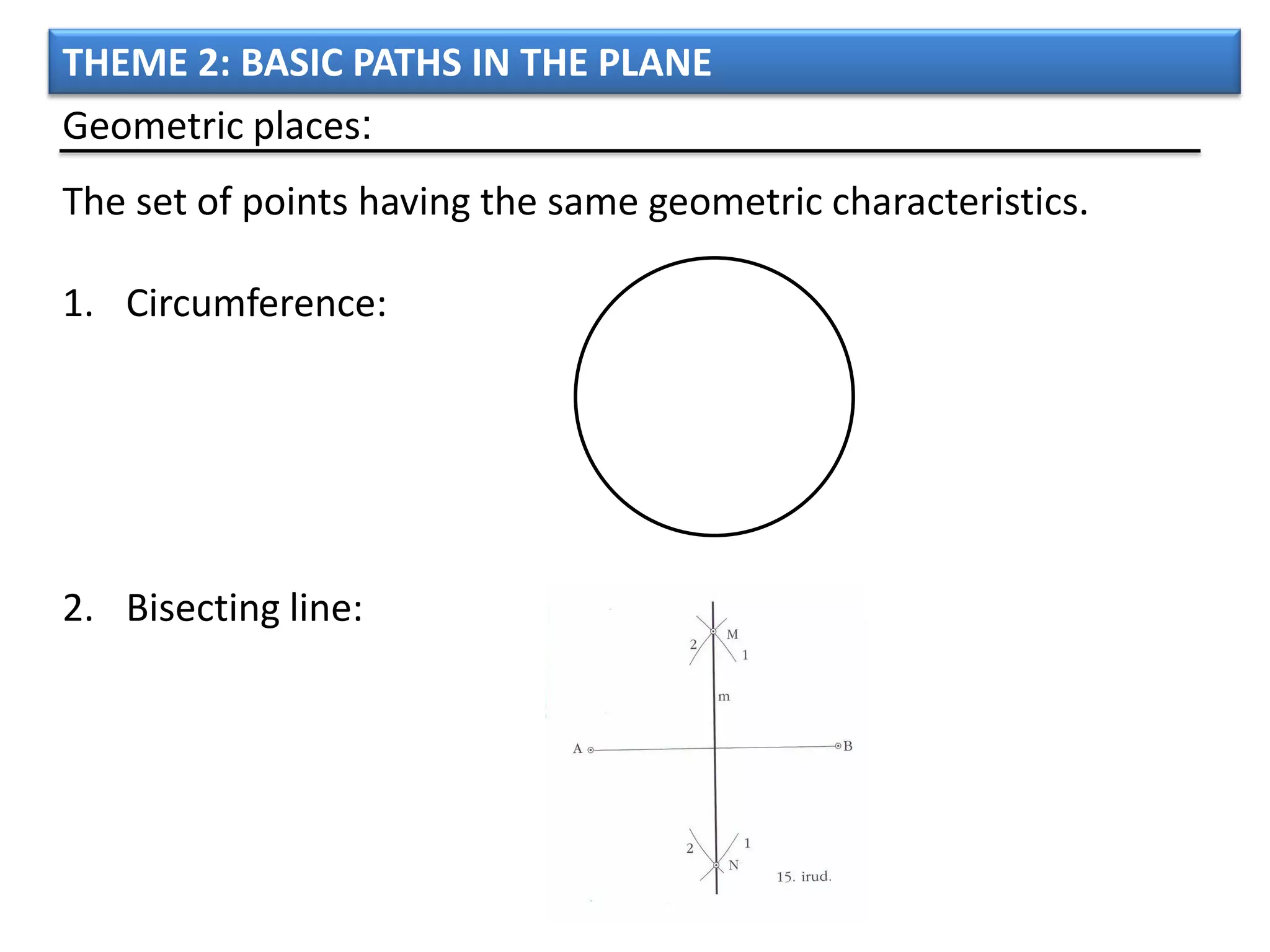
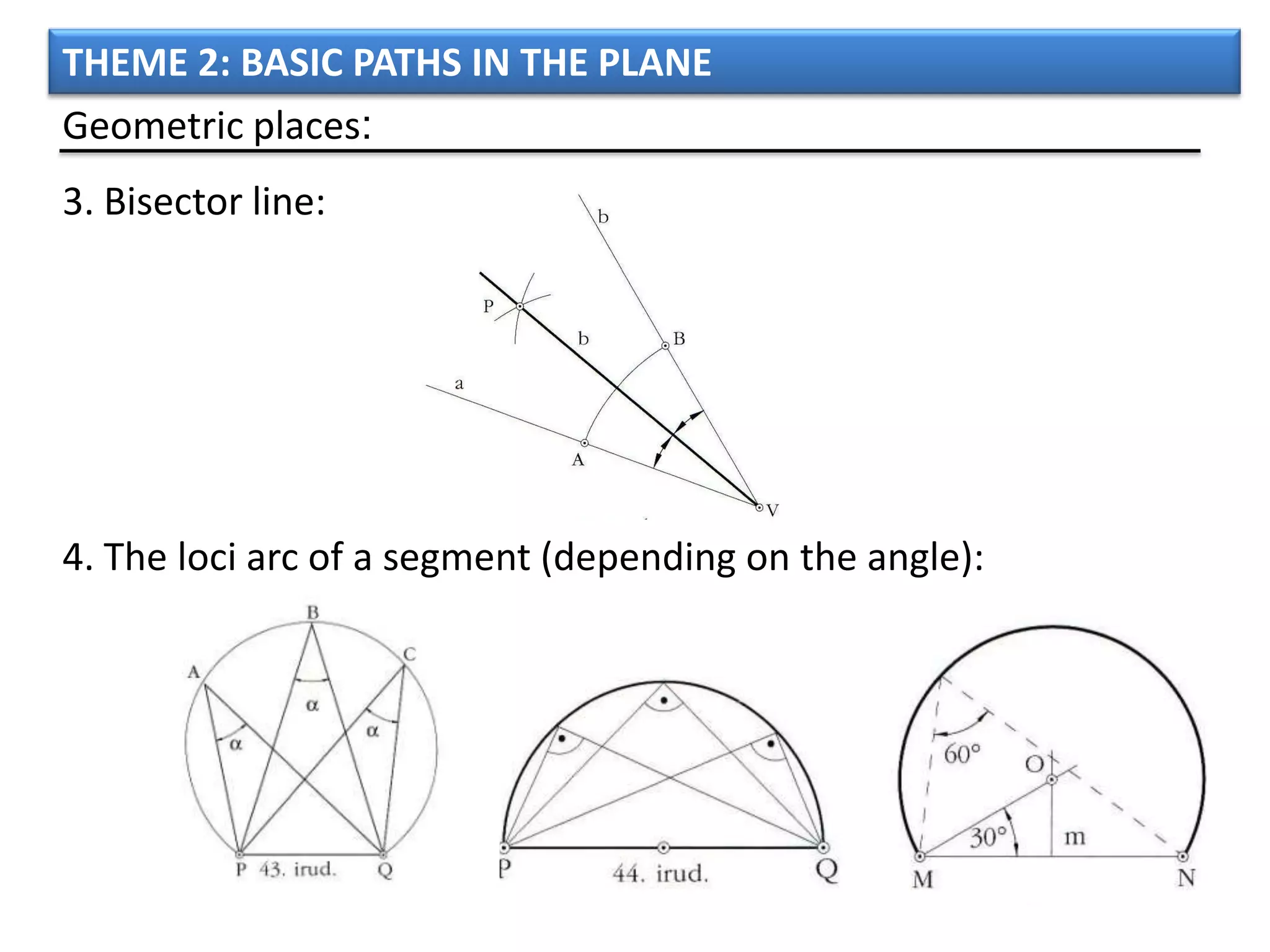
The set of points having the same geometric characteristics.

1. Circumference:


2. Bisecting line:
THEME 2: BASIC PATHS IN THE PLANE
Geometric places:
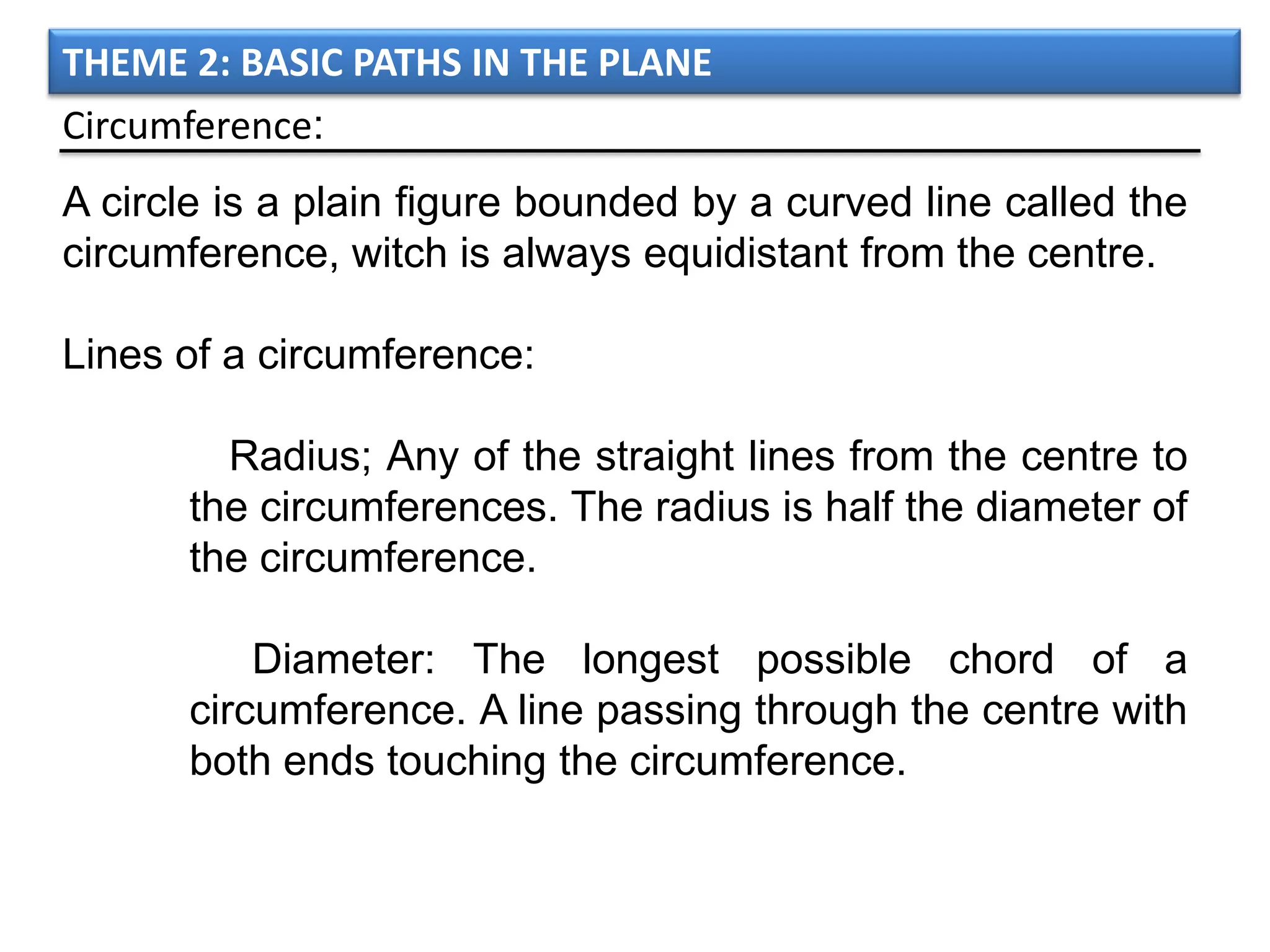
3. Bisector line:


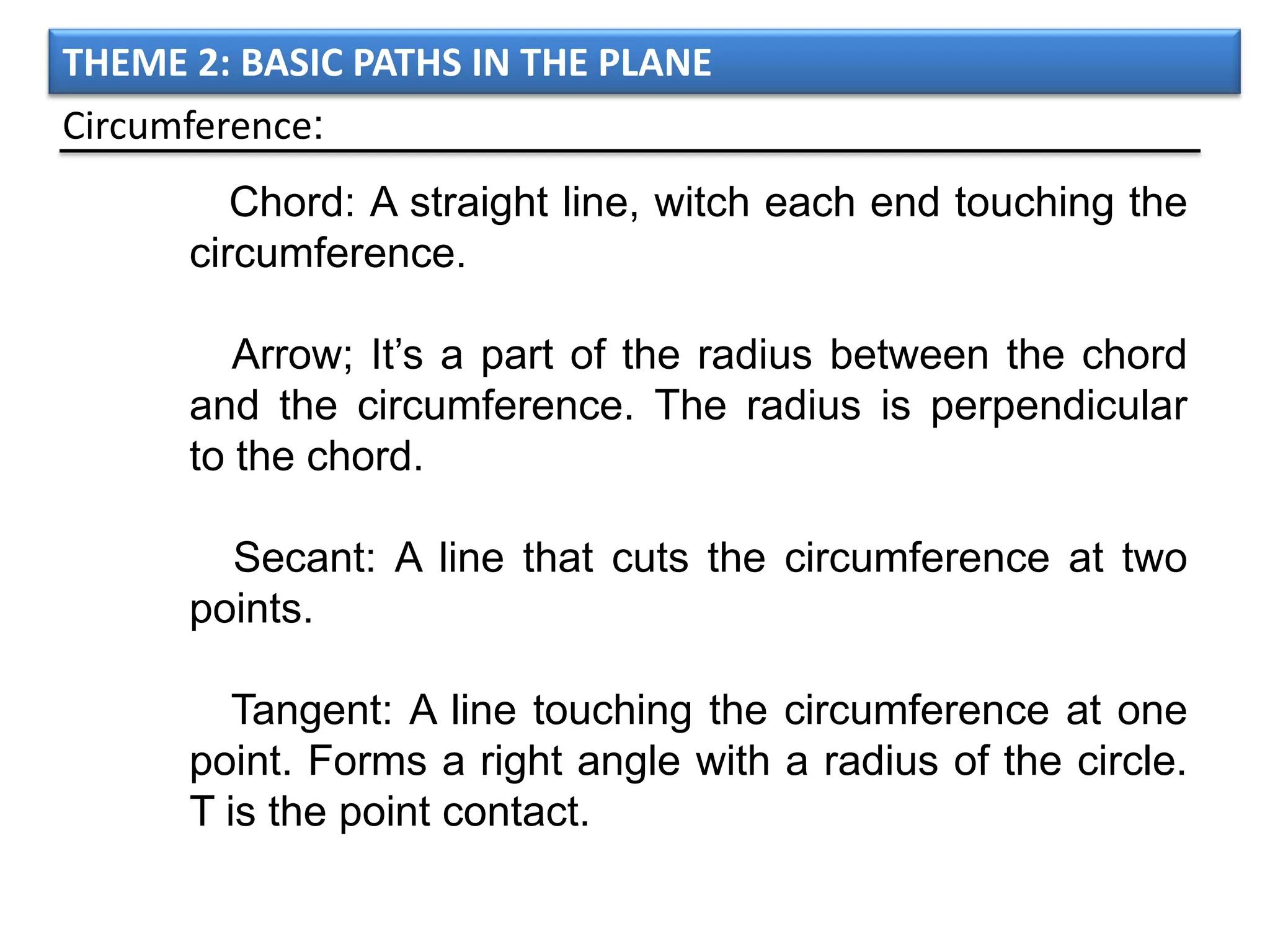
4. The loci arc of a segment (depending on the angle):
THEME 2: BASIC PATHS IN THE PLANE
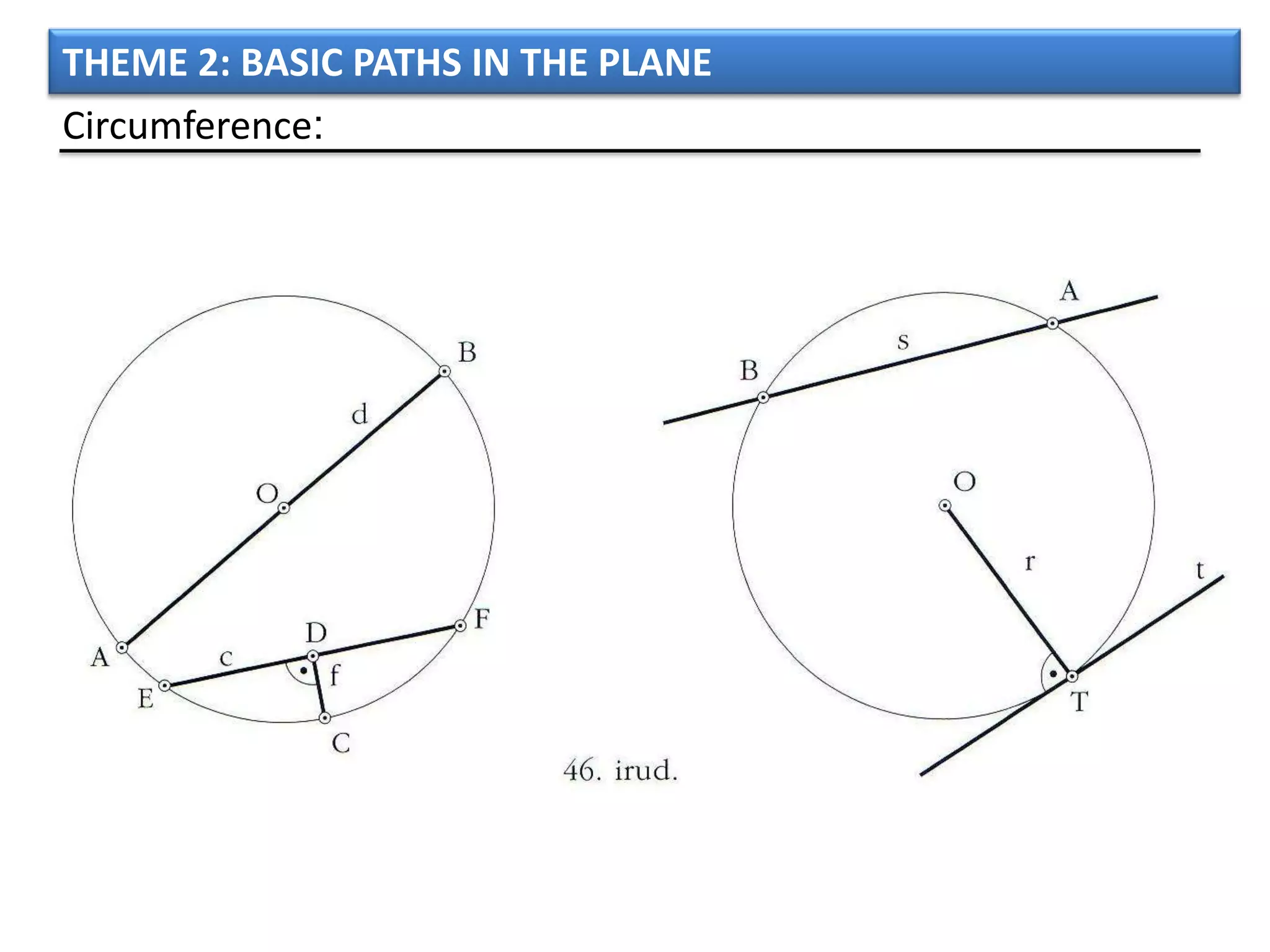
Circumference:
A circle is a plain figure bounded by a curved line called the
circumference, witch is always equidistant from the centre.

Lines of a circumference:

        Radius; Any of the straight lines from the centre to
      the circumferences. The radius is half the diameter of
      the circumference.

          Diameter: The longest possible chord of a
      circumference. A line passing through the centre with
      both ends touching the circumference.
THEME 2: BASIC PATHS IN THE PLANE
Circumference:
         Chord: A straight line, witch each end touching the
      circumference.

         Arrow; It’s a part of the radius between the chord
      and the circumference. The radius is perpendicular
      to the chord.

        Secant: A line that cuts the circumference at two
      points.

         Tangent: A line touching the circumference at one
      point. Forms a right angle with a radius of the circle.
      T is the point contact.
THEME 2: BASIC PATHS IN THE PLANE
Circumference:
THEME 2: BASIC PATHS IN THE PLANE
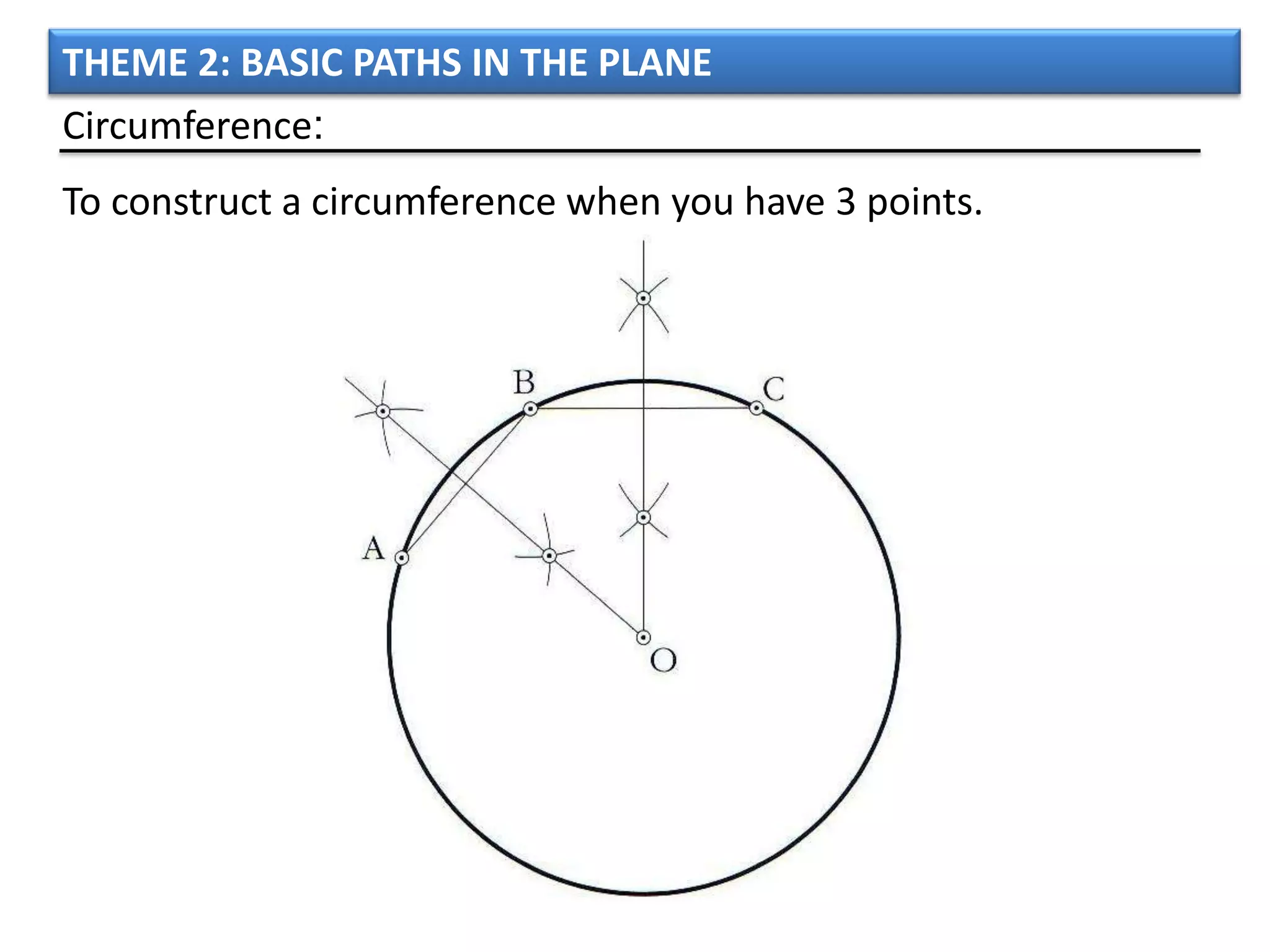
Circumference:
To construct a circumference when you have 3 points.
THEME 3: TRIANGLES, SQUARES AND REGULAR POLYGONS
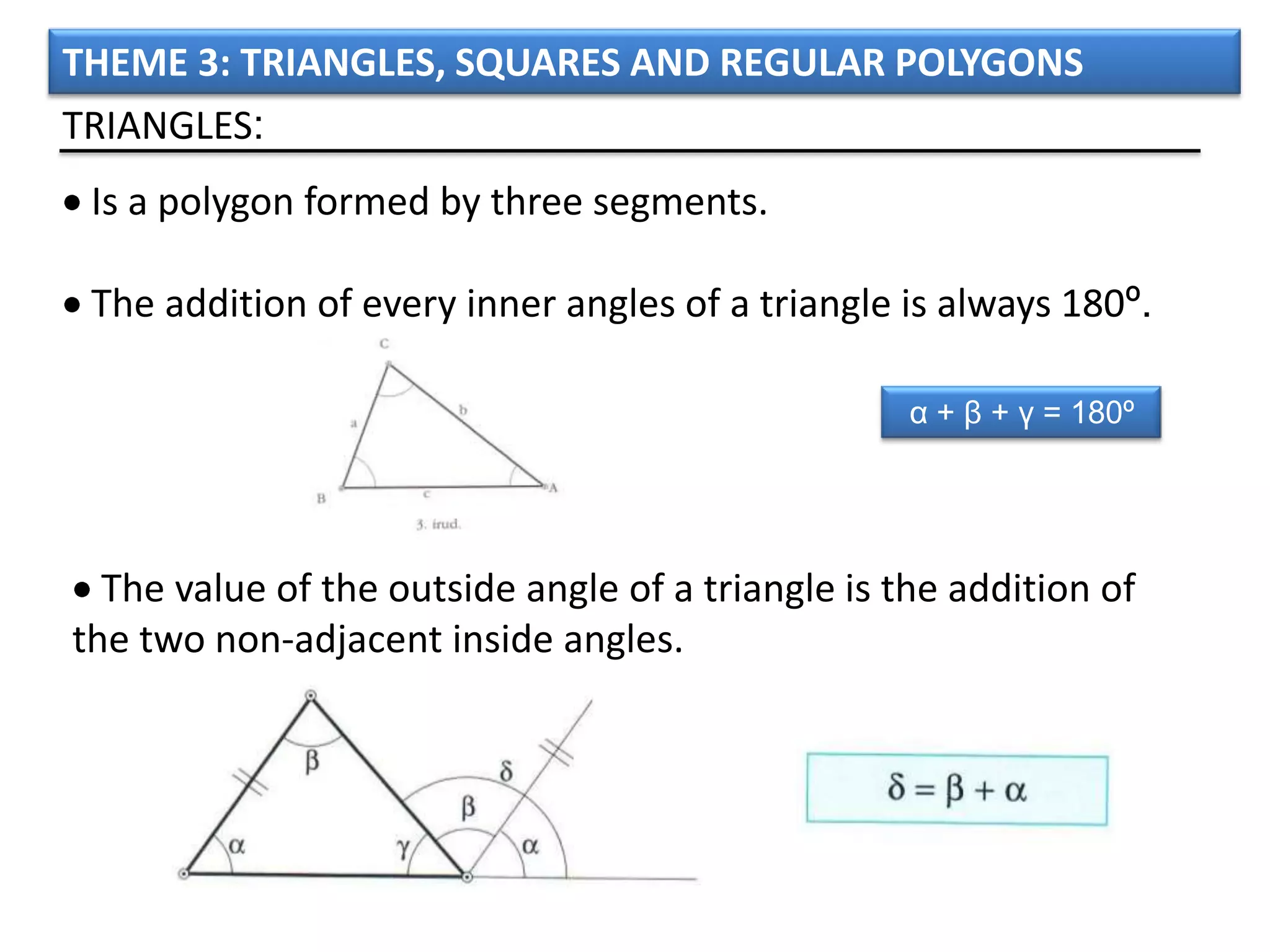
TRIANGLES:
 Is a polygon formed by three segments.

 The addition of every inner angles of a triangle is always 180º.

                                                   α + β + γ = 180º


  The value of the outside angle of a triangle is the addition of
the two non-adjacent inside angles.
THEME 3: TRIANGLES, SQUARES AND REGULAR POLYGONS
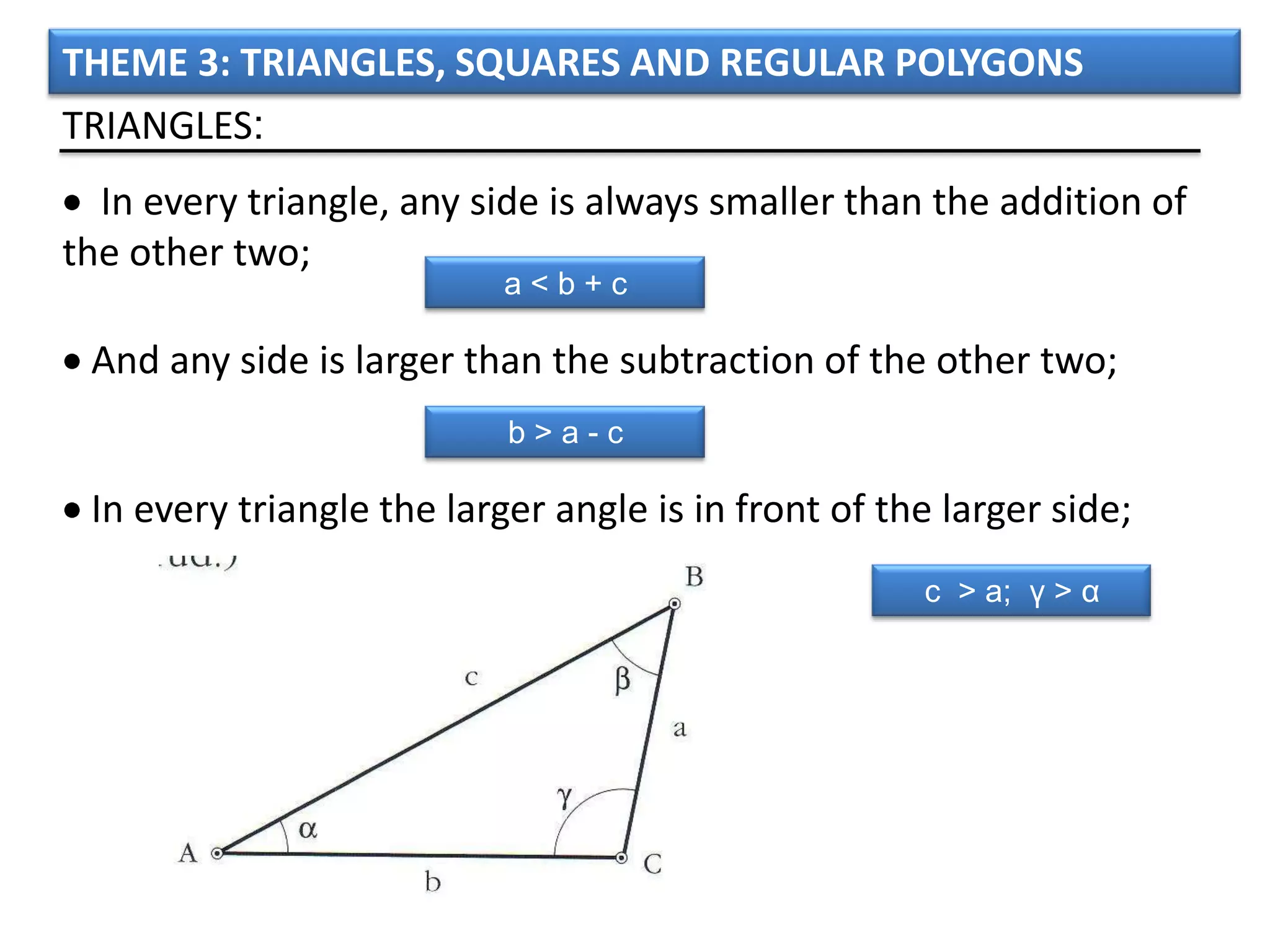
TRIANGLES:
  In every triangle, any side is always smaller than the addition of
the other two;
                           a<b+c

 And any side is larger than the subtraction of the other two;
                           b>a-c

 In every triangle the larger angle is in front of the larger side;
                                                     c > a; γ > α
THEME 3: TRIANGLES, SQUARES AND REGULAR POLYGONS
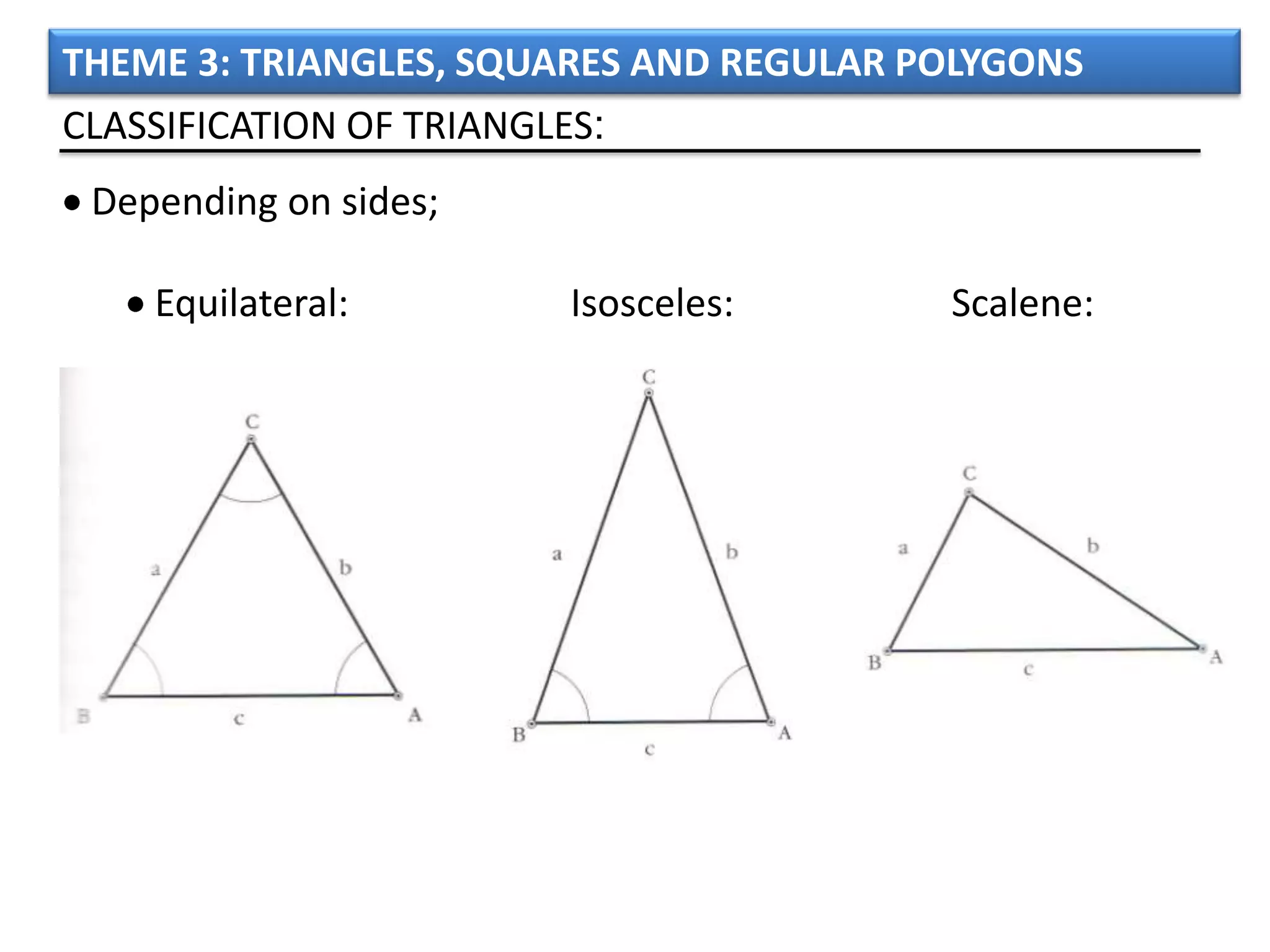
CLASSIFICATION OF TRIANGLES:
 Depending on sides;

    Equilateral:       Isosceles:        Scalene:
THEME 3: TRIANGLES, SQUARES AND REGULAR POLYGONS
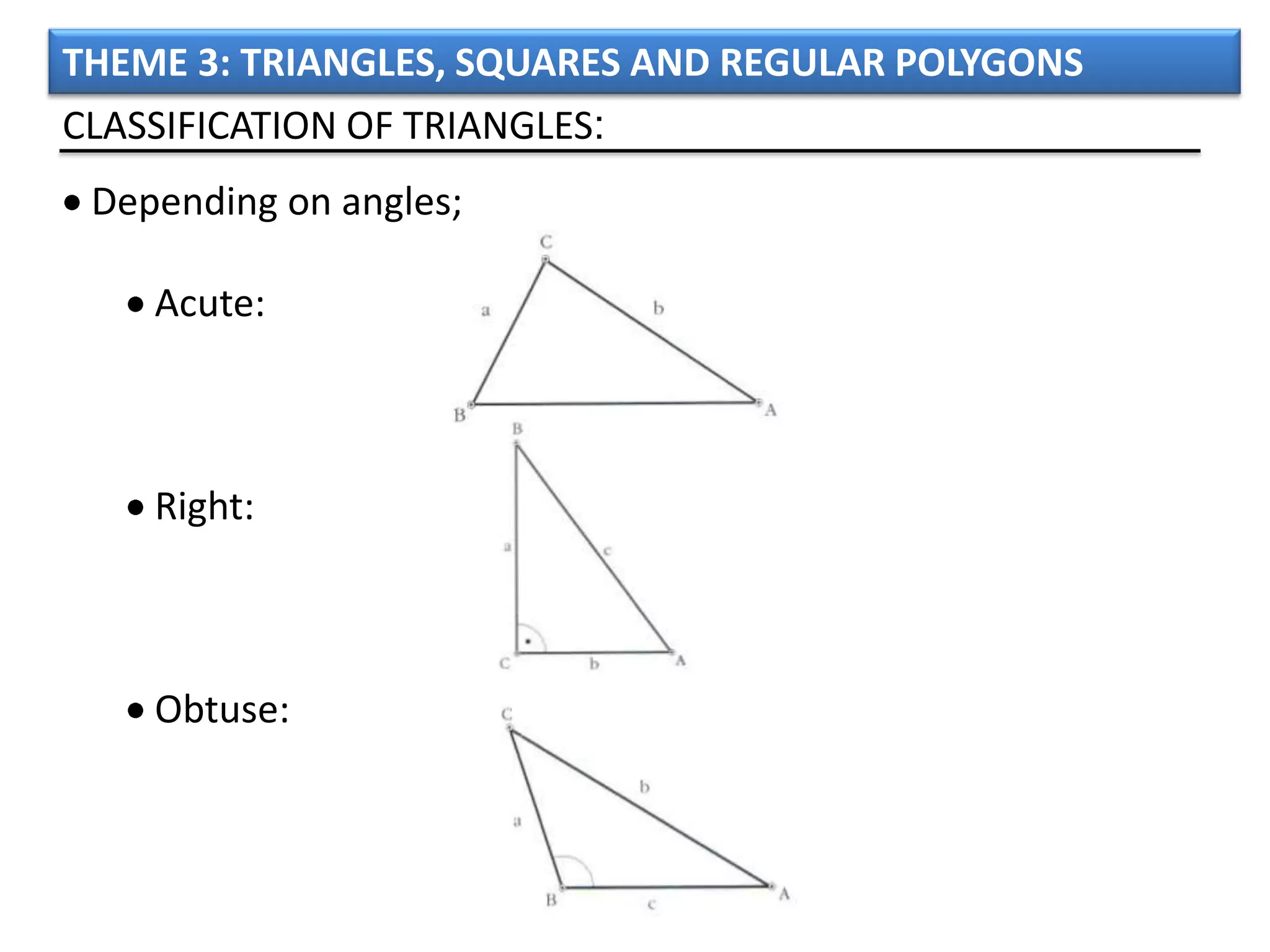
CLASSIFICATION OF TRIANGLES:
 Depending on angles;

    Acute:


    Right:


    Obtuse:
THEME 3: TRIANGLES, SQUARES AND REGULAR POLYGONS
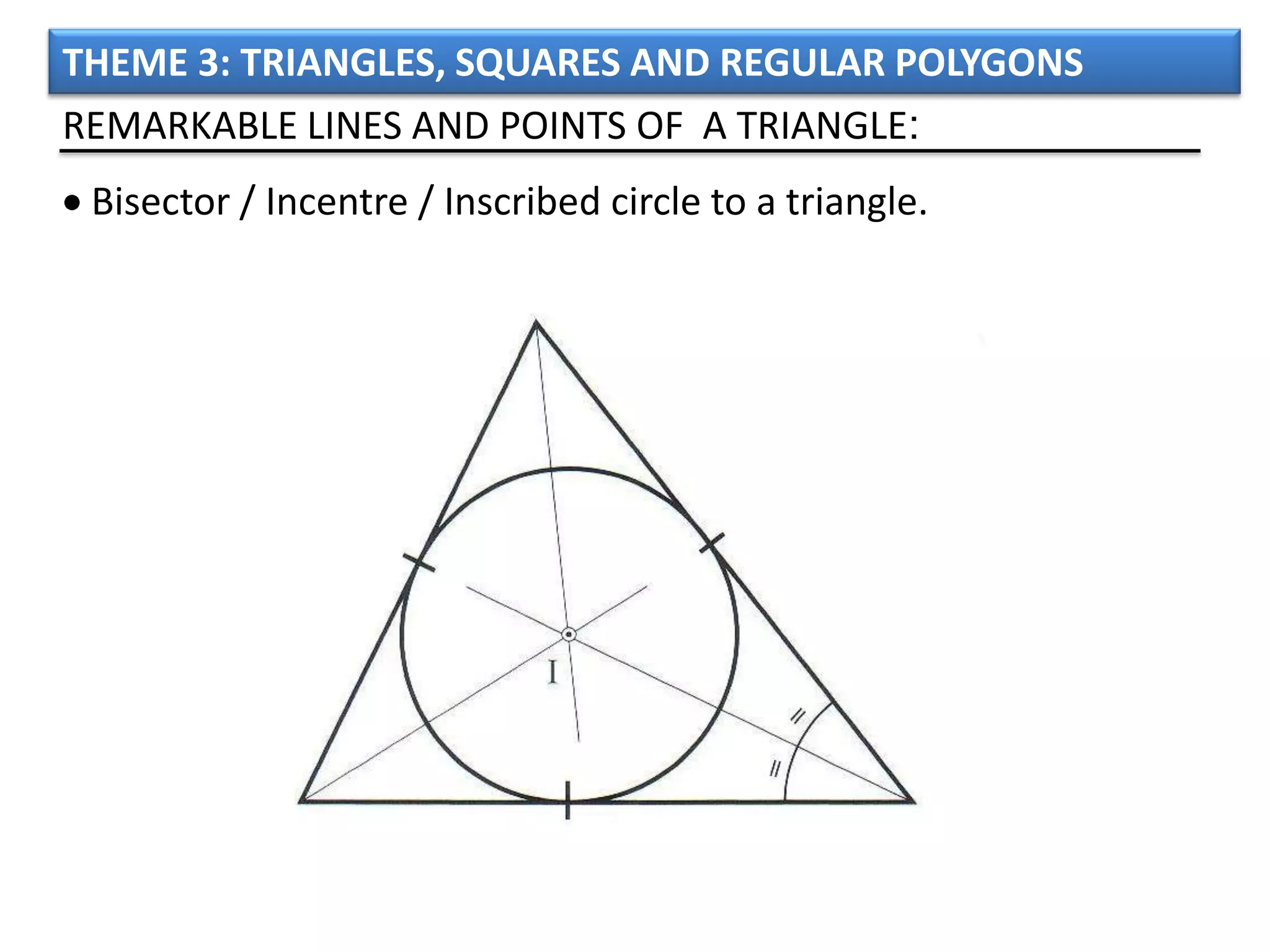
REMARKABLE LINES AND POINTS OF A TRIANGLE:
 Bisector / Incentre / Inscribed circle to a triangle.
THEME 3: TRIANGLES, SQUARES AND REGULAR POLYGONS
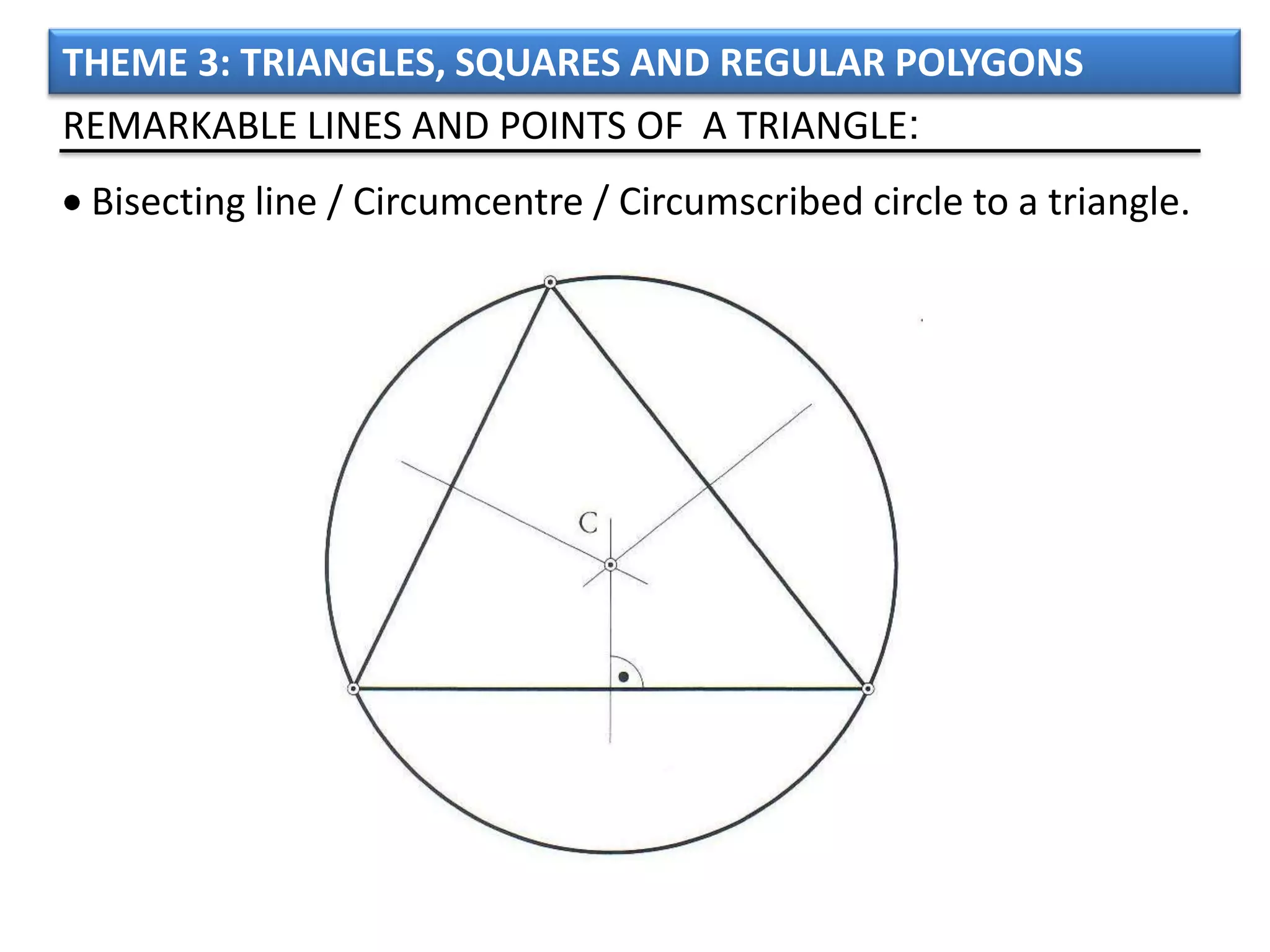
REMARKABLE LINES AND POINTS OF A TRIANGLE:
 Bisecting line / Circumcentre / Circumscribed circle to a triangle.
THEME 3: TRIANGLES, SQUARES AND REGULAR POLYGONS
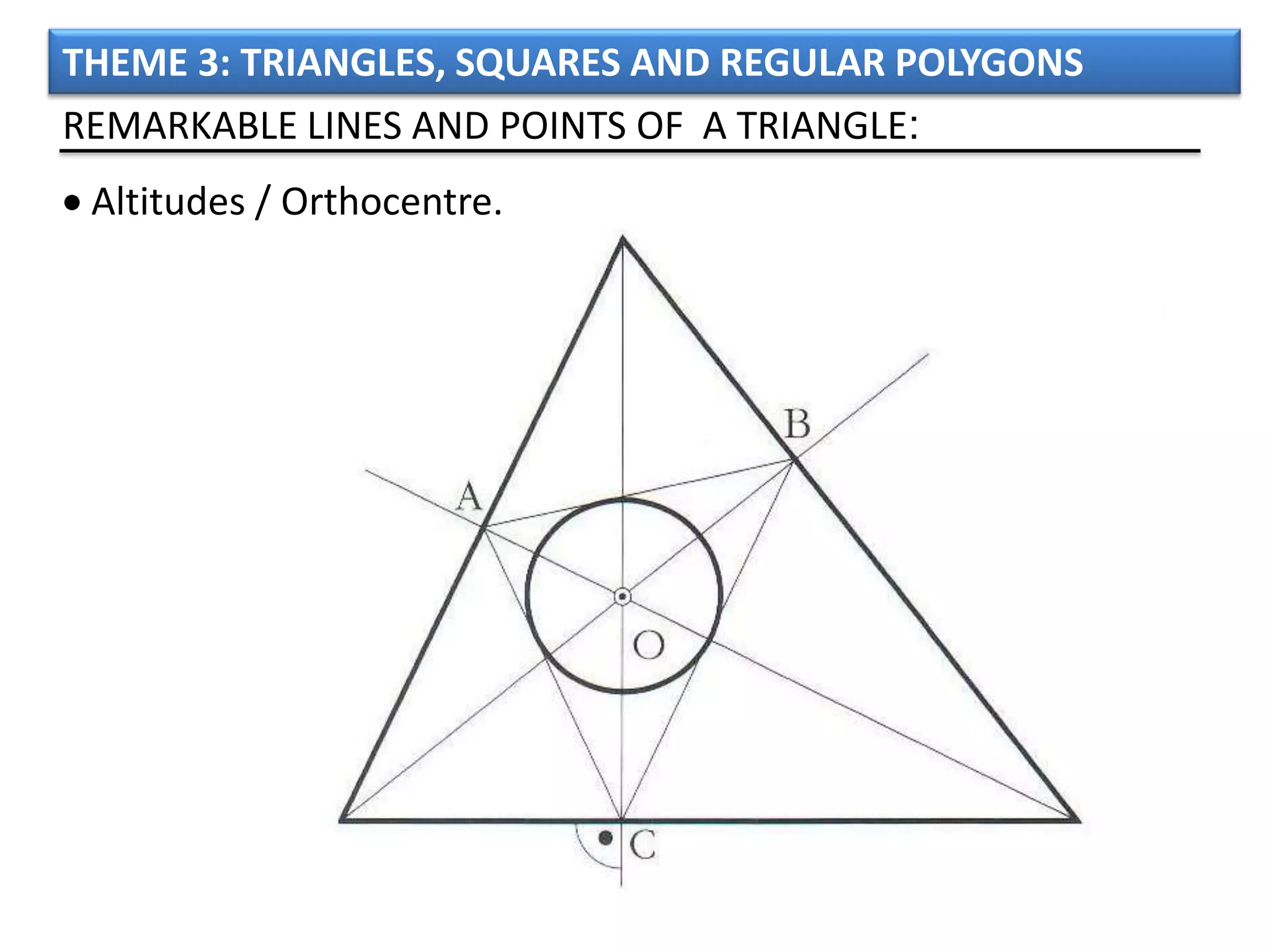
REMARKABLE LINES AND POINTS OF A TRIANGLE:
 Altitudes / Orthocentre.
THEME 3: TRIANGLES, SQUARES AND REGULAR POLYGONS
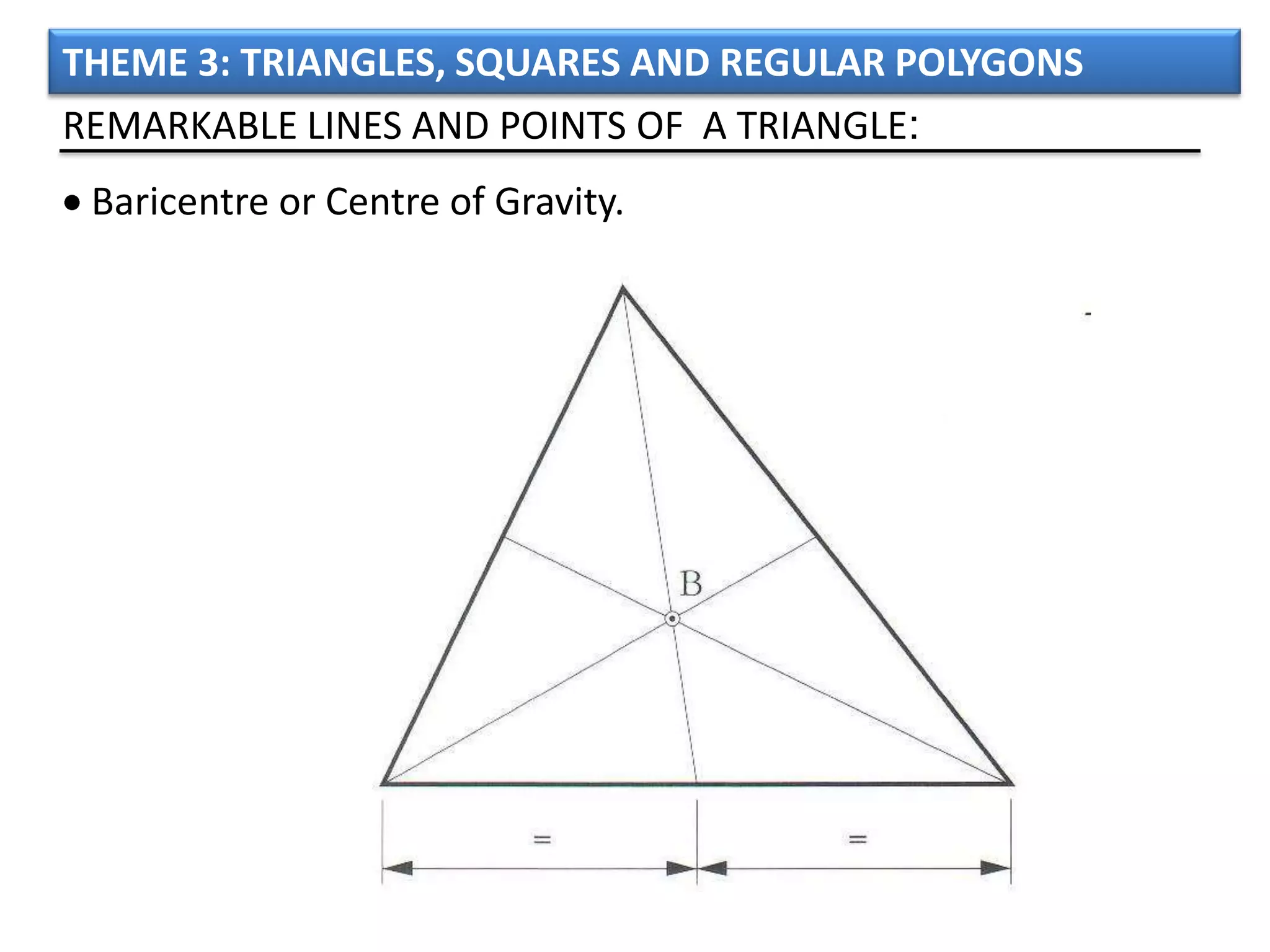
REMARKABLE LINES AND POINTS OF A TRIANGLE:
 Baricentre or Centre of Gravity.
THEME 3: TRIANGLES, SQUARES AND REGULAR POLYGONS
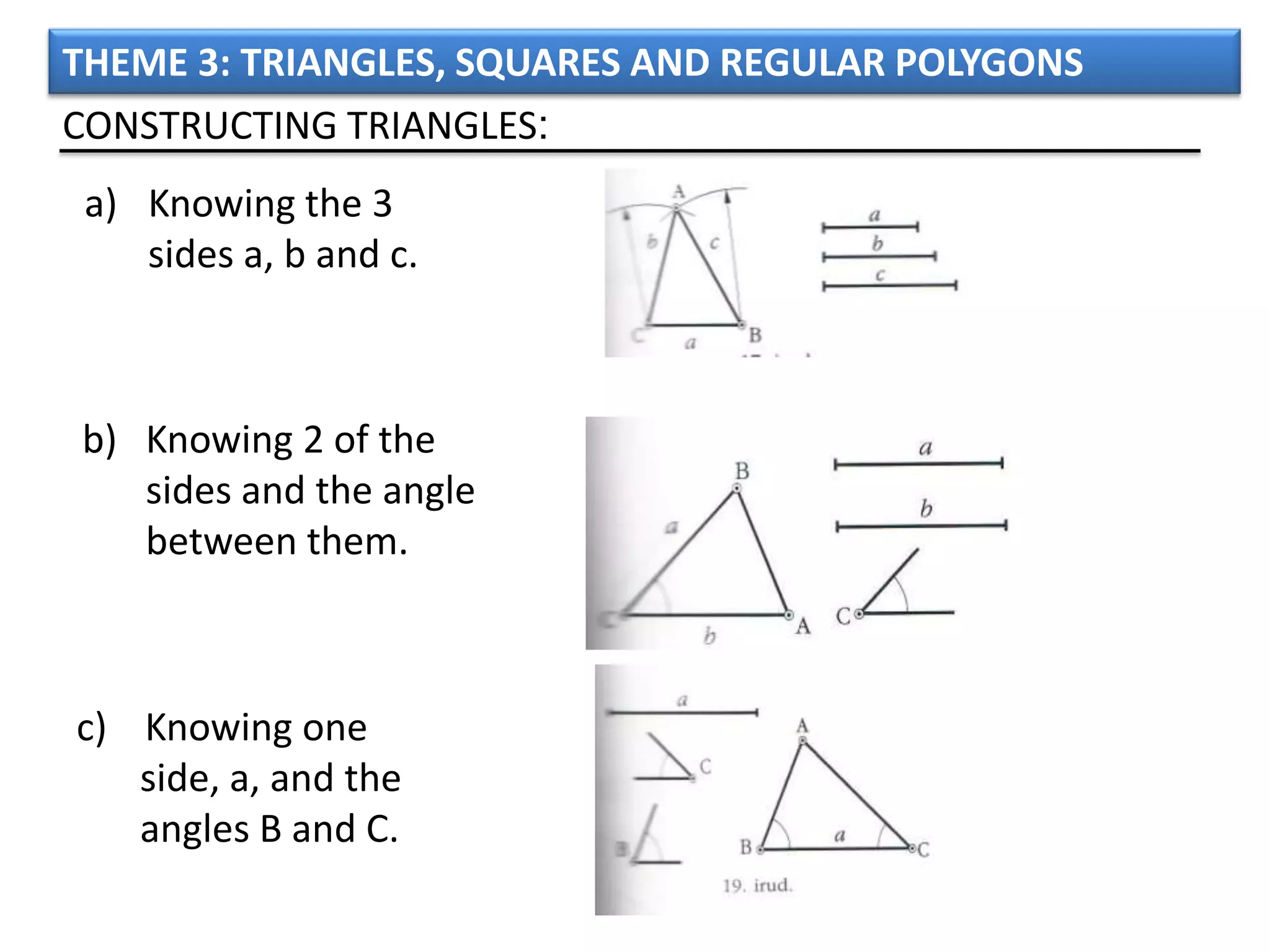
CONSTRUCTING TRIANGLES:
 a) Knowing the 3
    sides a, b and c.


b) Knowing 2 of the
   sides and the angle
   between them.


c) Knowing one
   side, a, and the
   angles B and C.
THEME 3: TRIANGLES, QUADRILATERALS AND REGULAR POLYGONS
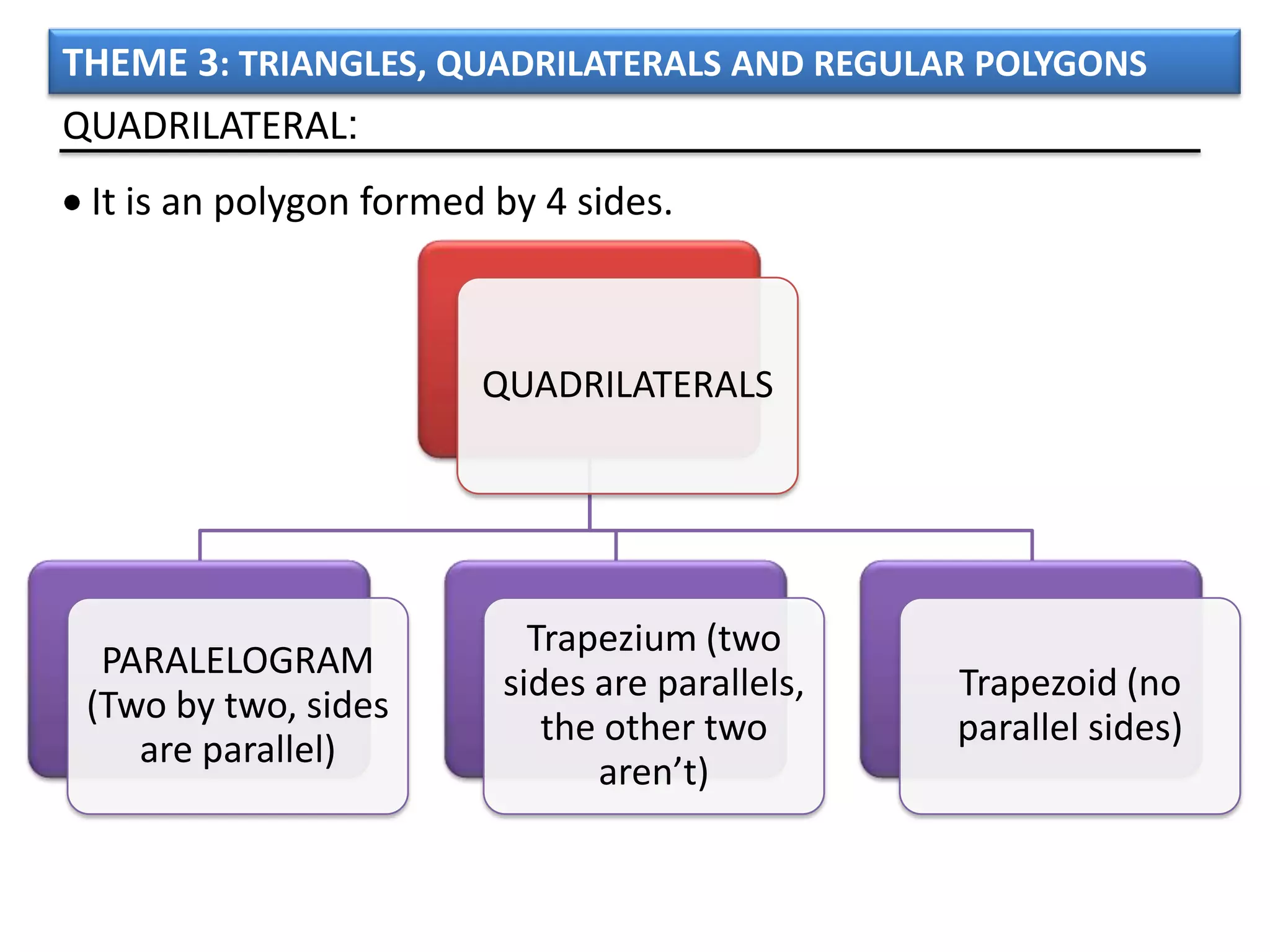
QUADRILATERAL:
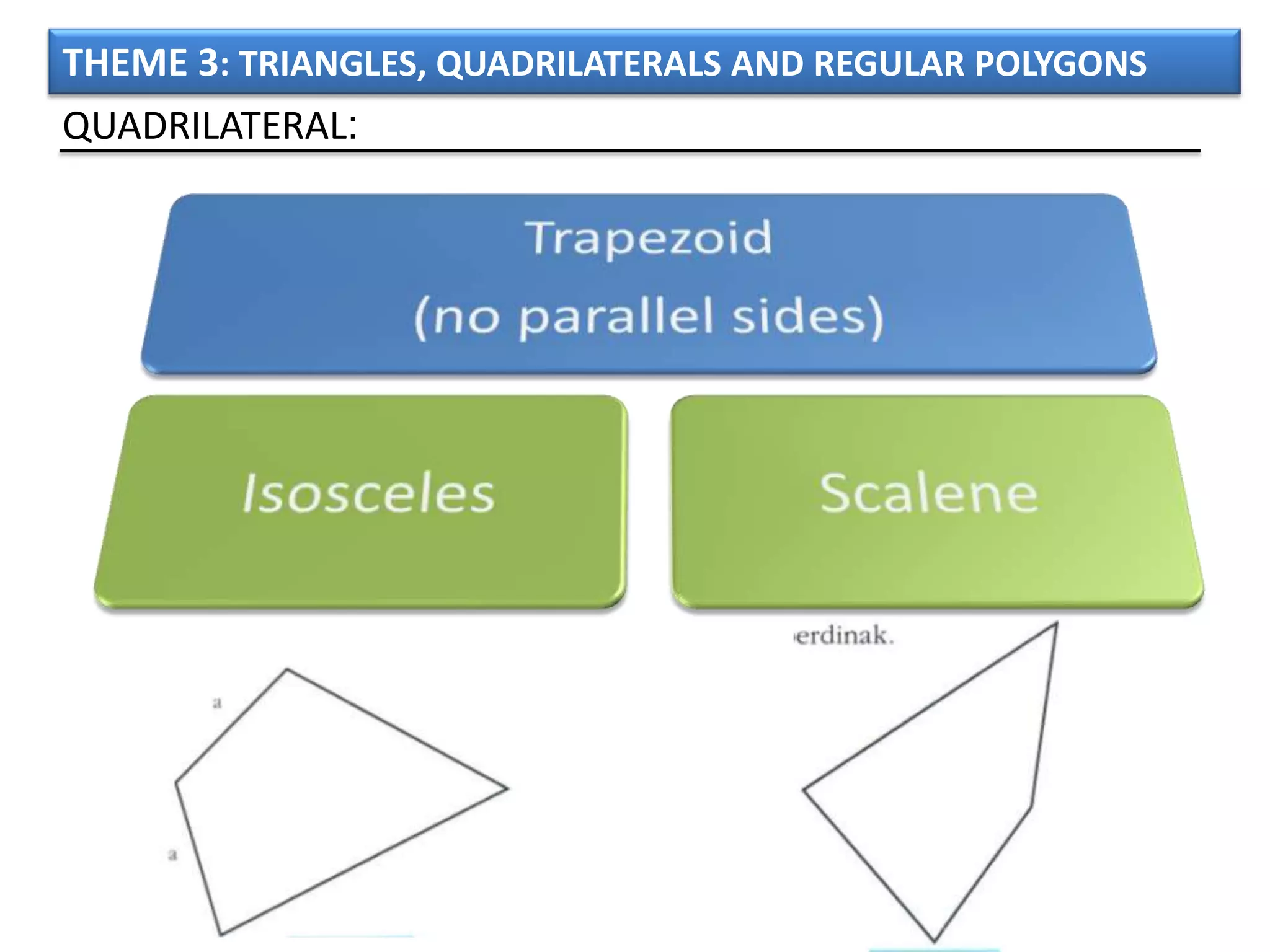
 It is an polygon formed by 4 sides.


                        QUADRILATERALS


                           Trapezium (two
  PARALELOGRAM
                         sides are parallels,   Trapezoid (no
 (Two by two, sides
                            the other two       parallel sides)
    are parallel)
                               aren’t)
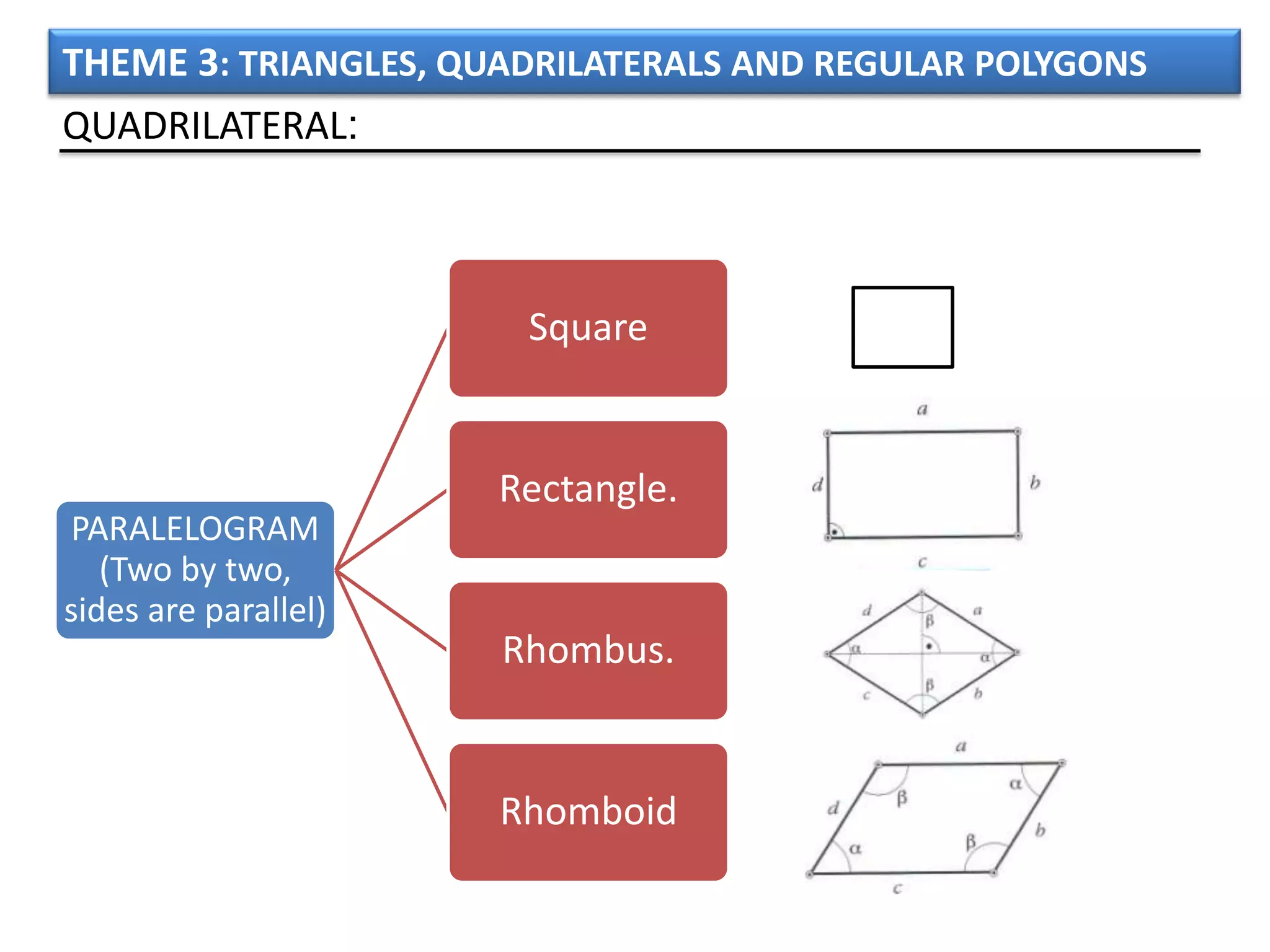
THEME 3: TRIANGLES, QUADRILATERALS AND REGULAR POLYGONS
QUADRILATERAL:


                       Square


                      Rectangle.
PARALELOGRAM
   (Two by two,
sides are parallel)
                      Rhombus.


                      Rhomboid
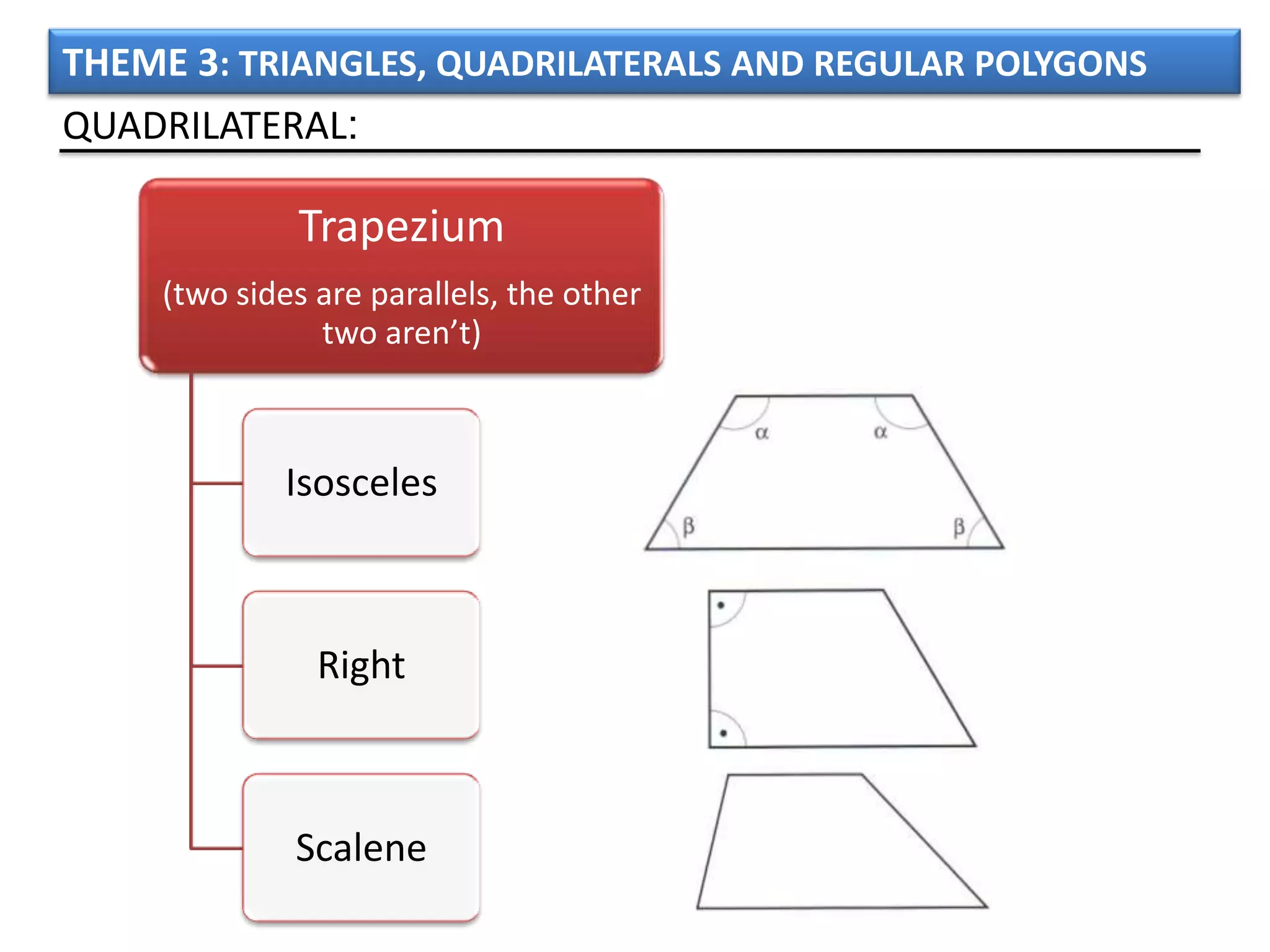
THEME 3: TRIANGLES, QUADRILATERALS AND REGULAR POLYGONS
QUADRILATERAL:

              Trapezium
     (two sides are parallels, the other
                two aren’t)


             Isosceles


                Right


              Scalene
THEME 3: TRIANGLES, QUADRILATERALS AND REGULAR POLYGONS
QUADRILATERAL:
THEME 3: TRIANGLES, QUADRILATERALS AND REGULAR POLYGONS
REGULAR POLYGONS:

     What is a Polygon?

         A closed plane figure made up of several line
   segments that are joined together.

          The sides do not cross each other.

          Exactly two sides meet at every vertex.
THEME 3: TRIANGLES, QUADRILATERALS AND REGULAR POLYGONS
REGULAR POLYGONS:
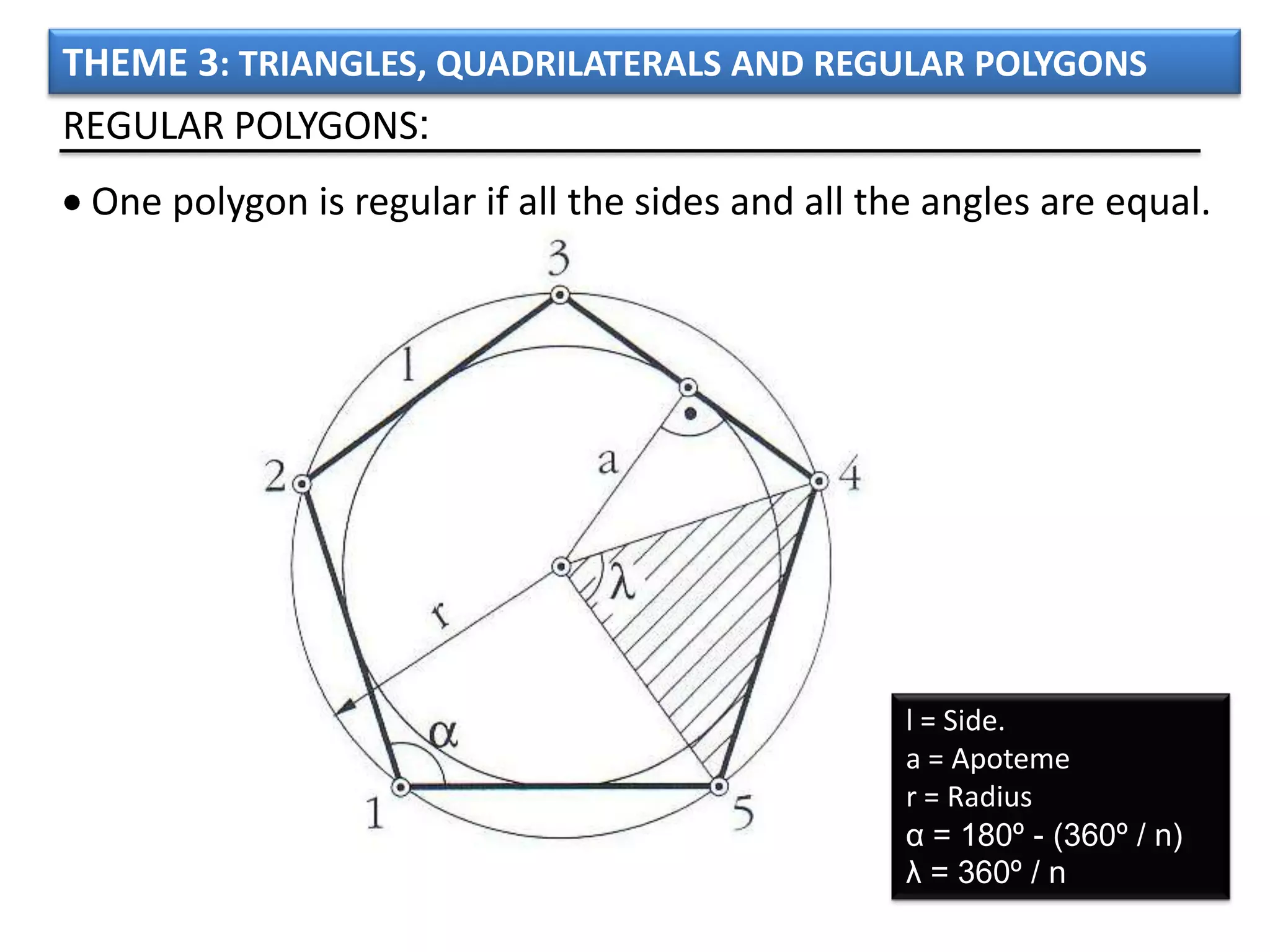
 One polygon is regular if all the sides and all the angles are equal.


                                                   l = Side.
                                                   a = Apoteme
                                                   r = Radius
                                                   α = 180º - (360º / n)
                                                   λ = 360º / n
THEME 3: TRIANGLES, QUADRILATERALS AND REGULAR POLYGONS
REGULAR POLYGONS:
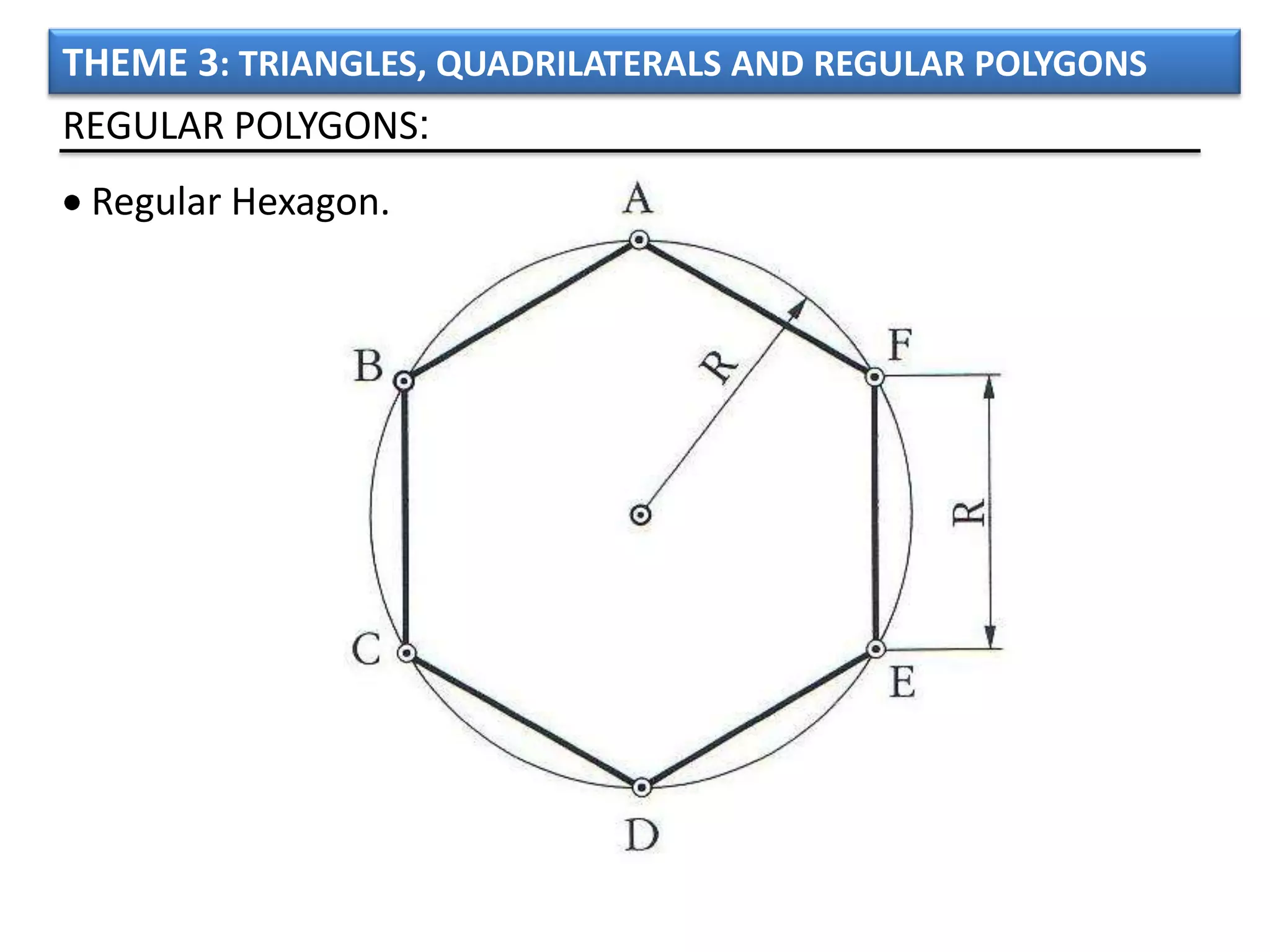
 Regular Hexagon.
THEME 3: TRIANGLES, QUADRILATERALS AND REGULAR POLYGONS
REGULAR POLYGONS:
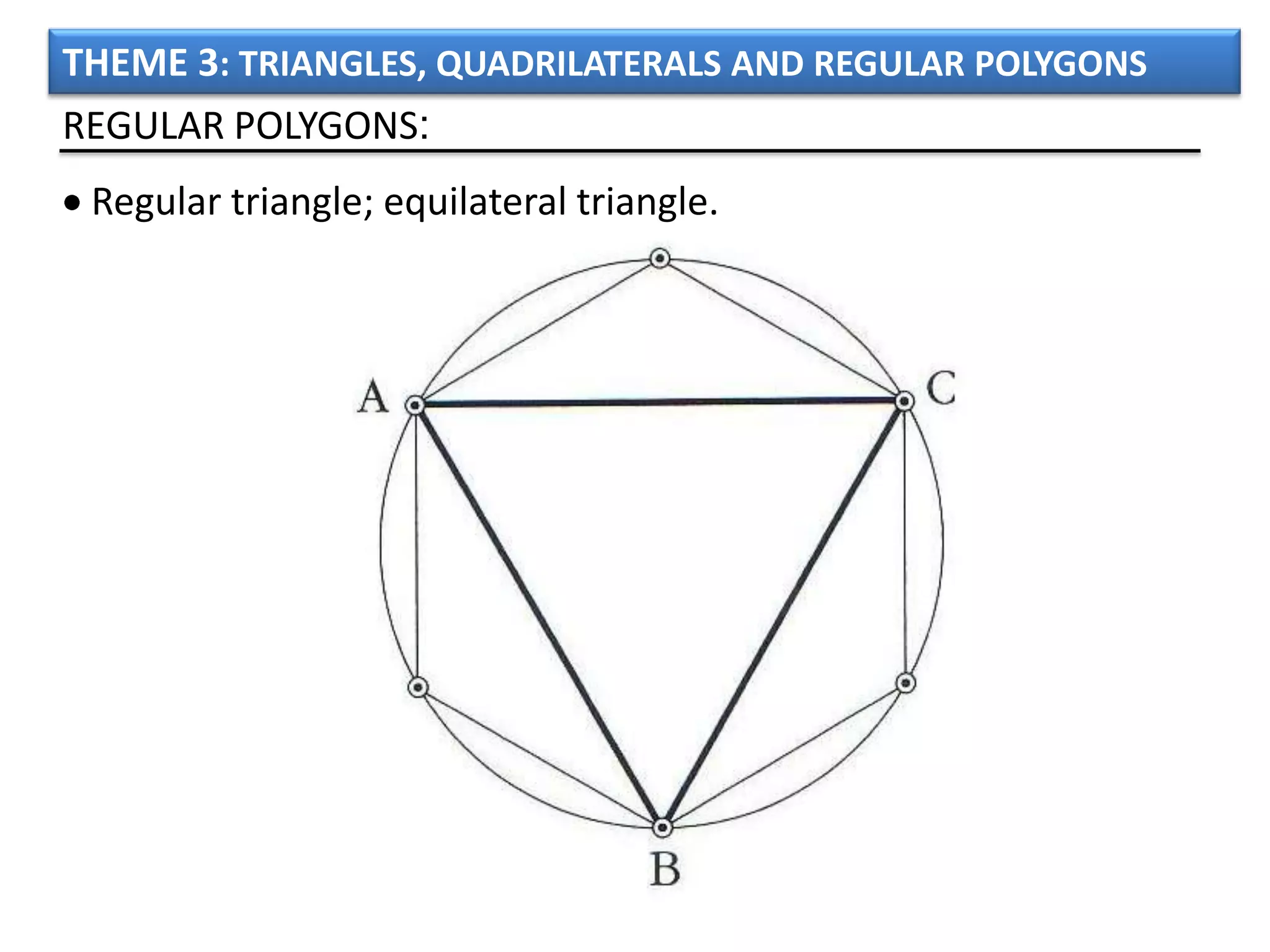
 Regular triangle; equilateral triangle.
THEME 3: TRIANGLES, QUADRILATERALS AND REGULAR POLYGONS
REGULAR POLYGONS:
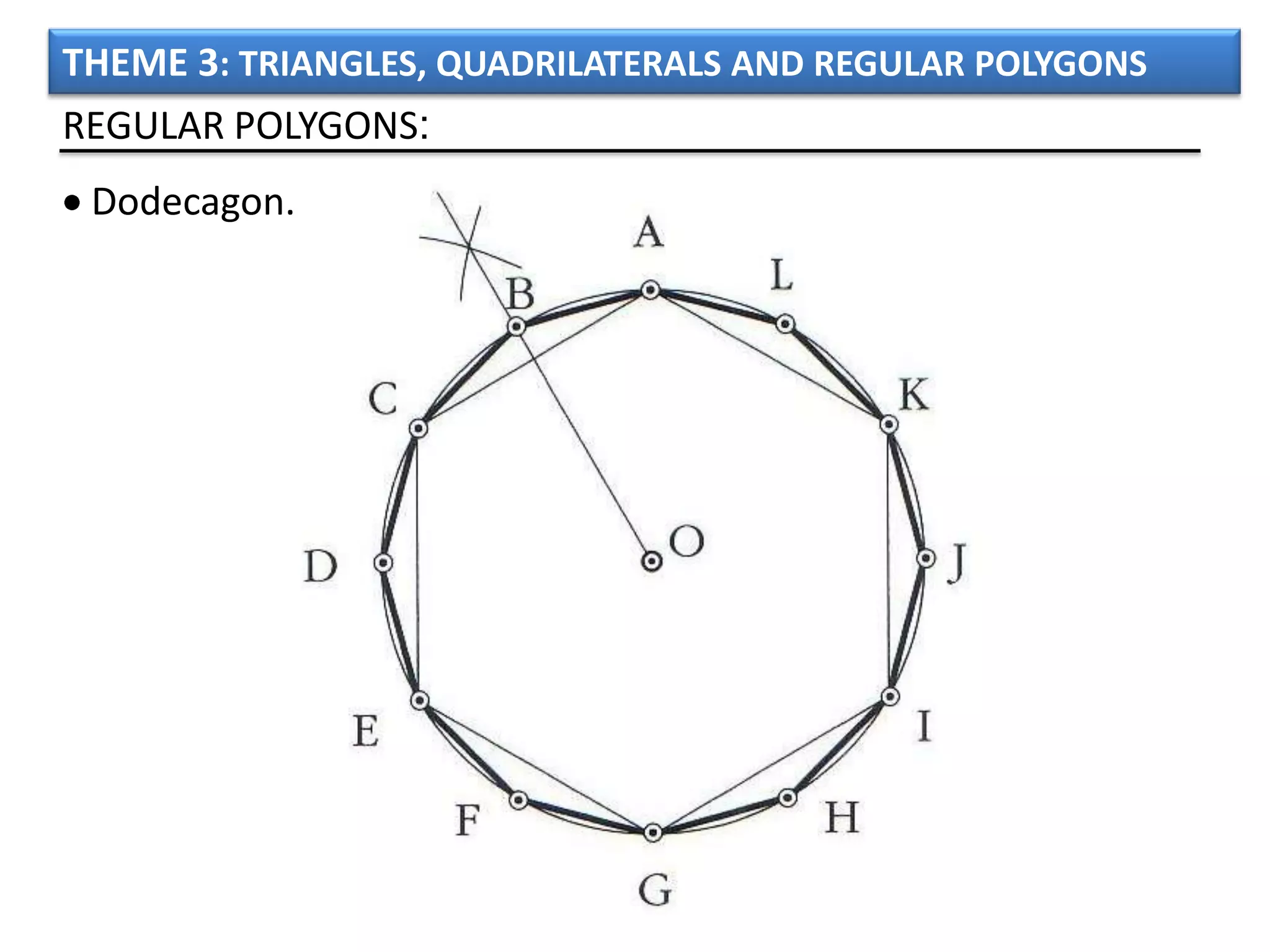
 Dodecagon.
THEME 3: TRIANGLES, QUADRILATERALS AND REGULAR POLYGONS
REGULAR POLYGONS:
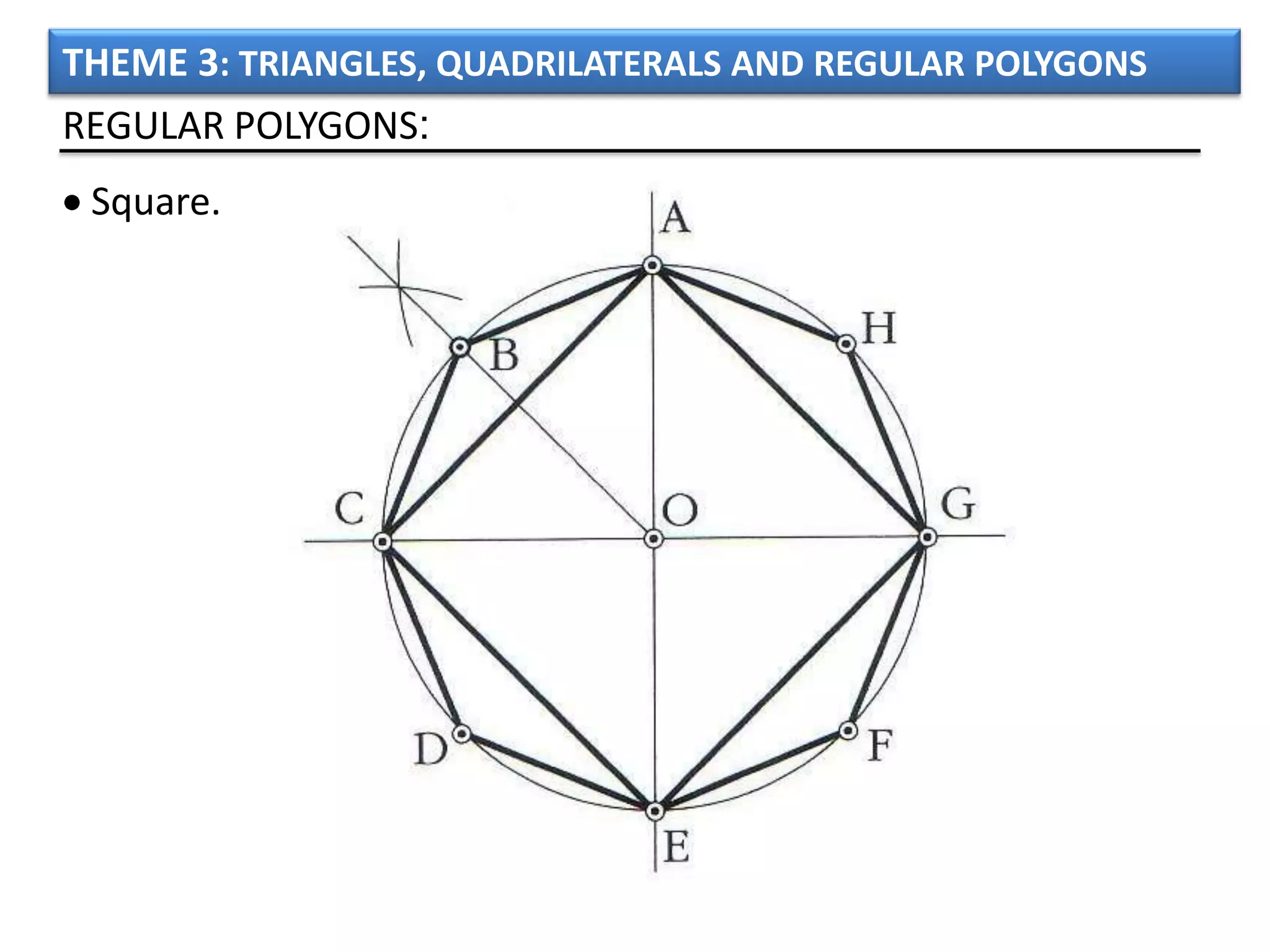
 Square.
THEME 3: TRIANGLES, QUADRILATERALS AND REGULAR POLYGONS
REGULAR POLYGONS:
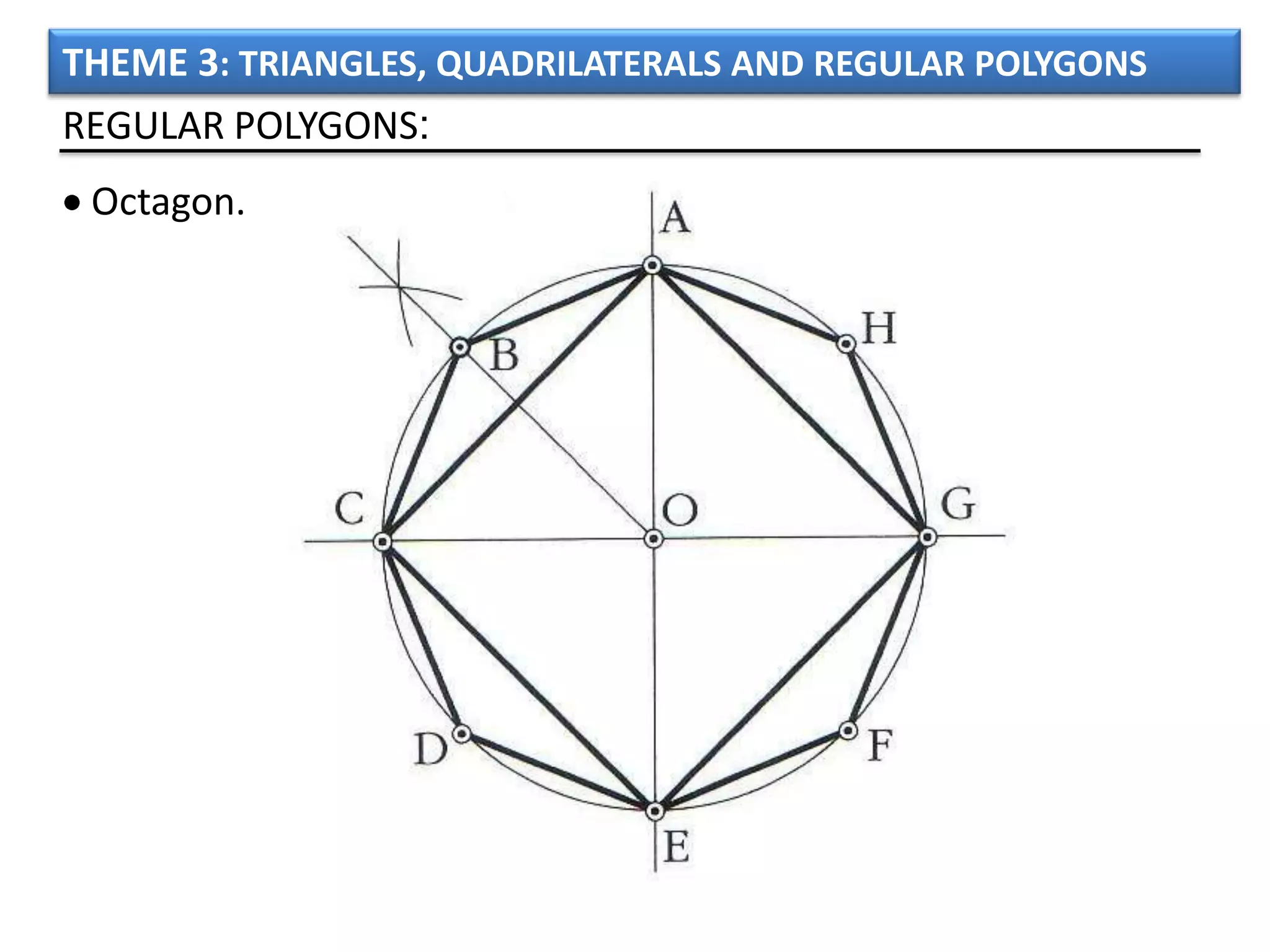
 Octagon.
THEME 3: TRIANGLES, QUADRILATERALS AND REGULAR POLYGONS
REGULAR POLYGONS:
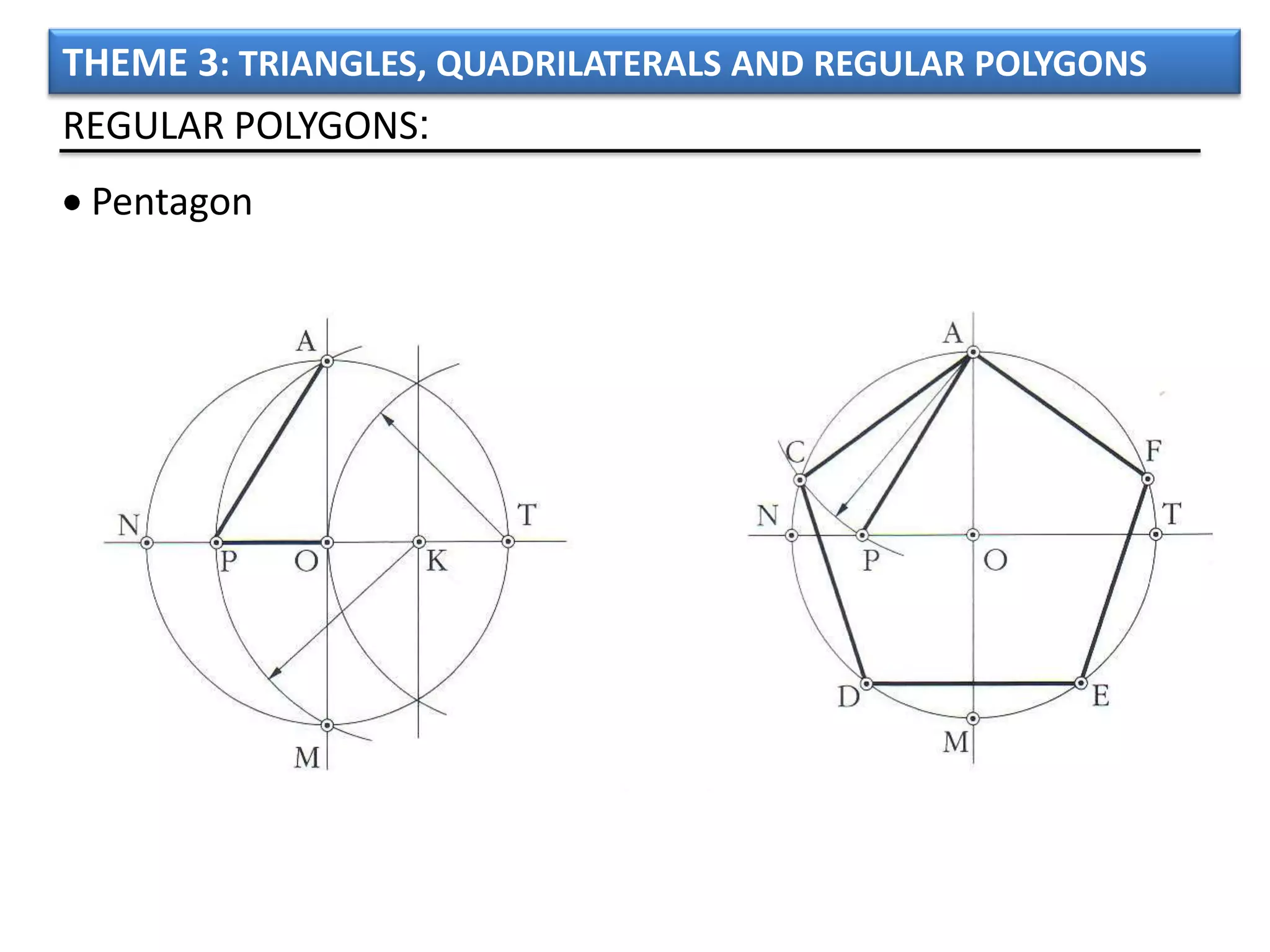
 Pentagon
THEME 3: TRIANGLES, QUADRILATERALS AND REGULAR POLYGONS
REGULAR POLYGONS:
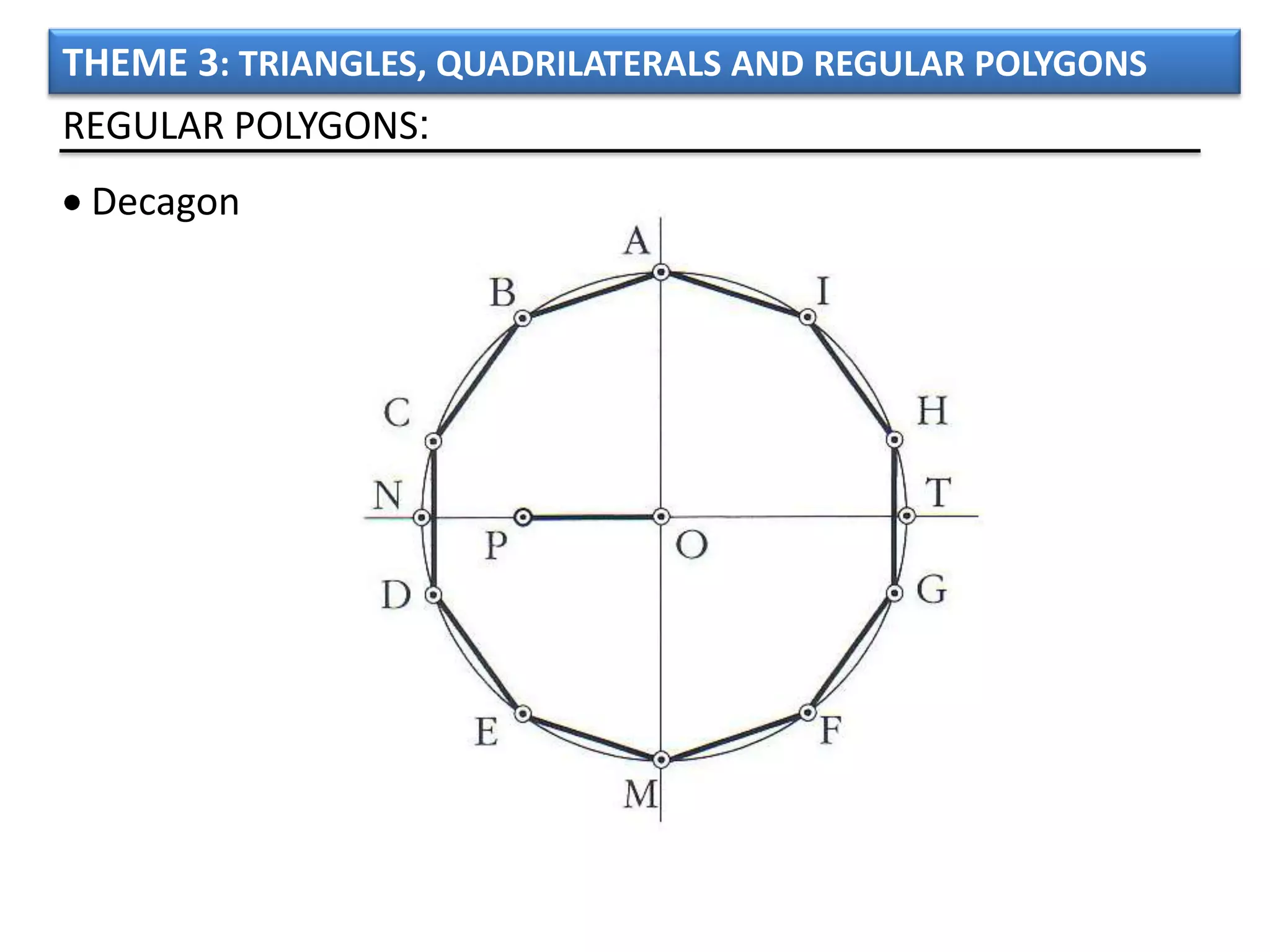
 Decagon
THEME 3: TRIANGLES, QUADRILATERALS AND REGULAR POLYGONS
REGULAR POLYGONS:
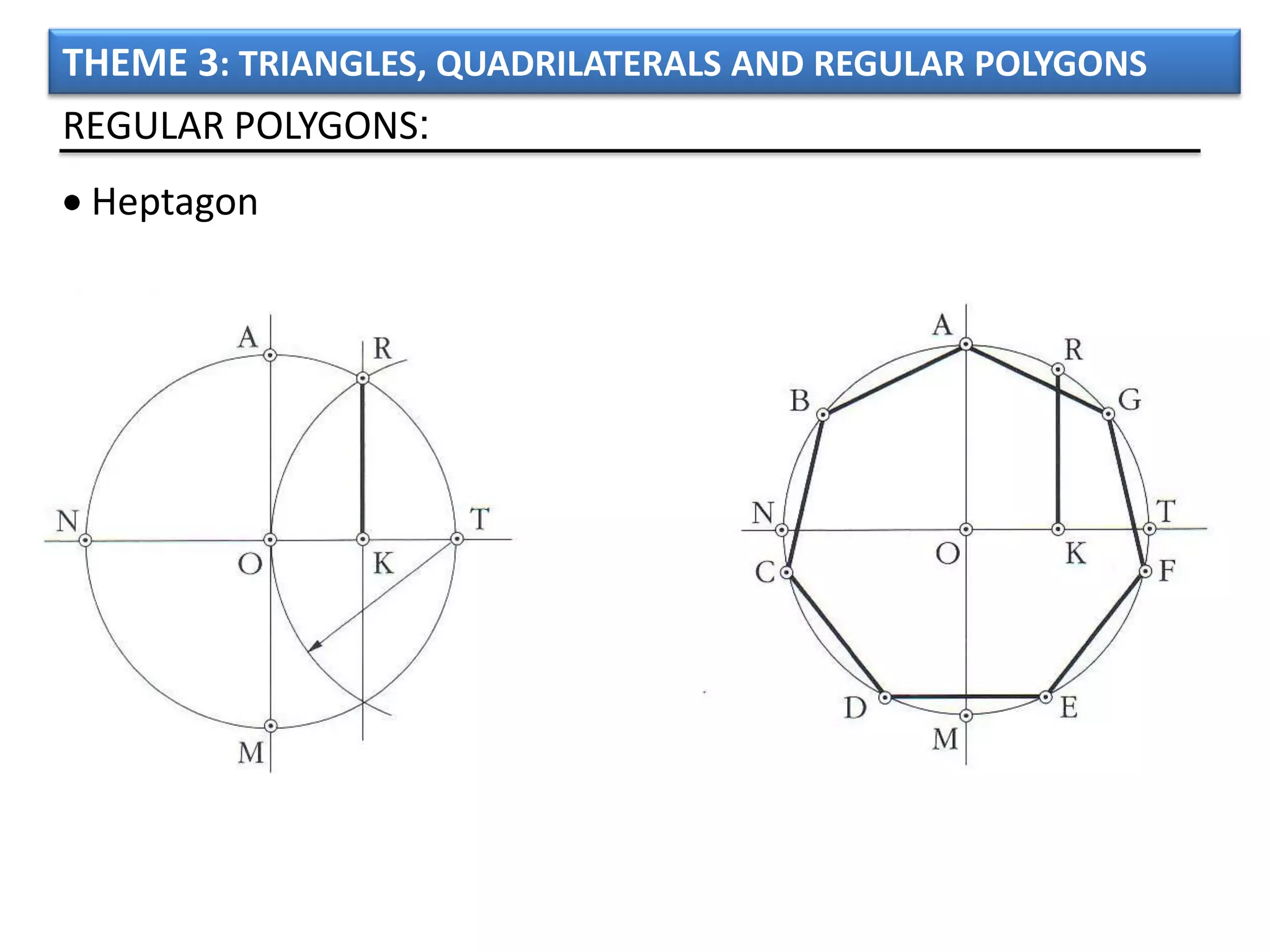
 Heptagon
THEME 3: TRIANGLES, QUADRILATERALS AND REGULAR POLYGONS
REGULAR POLYGONS:
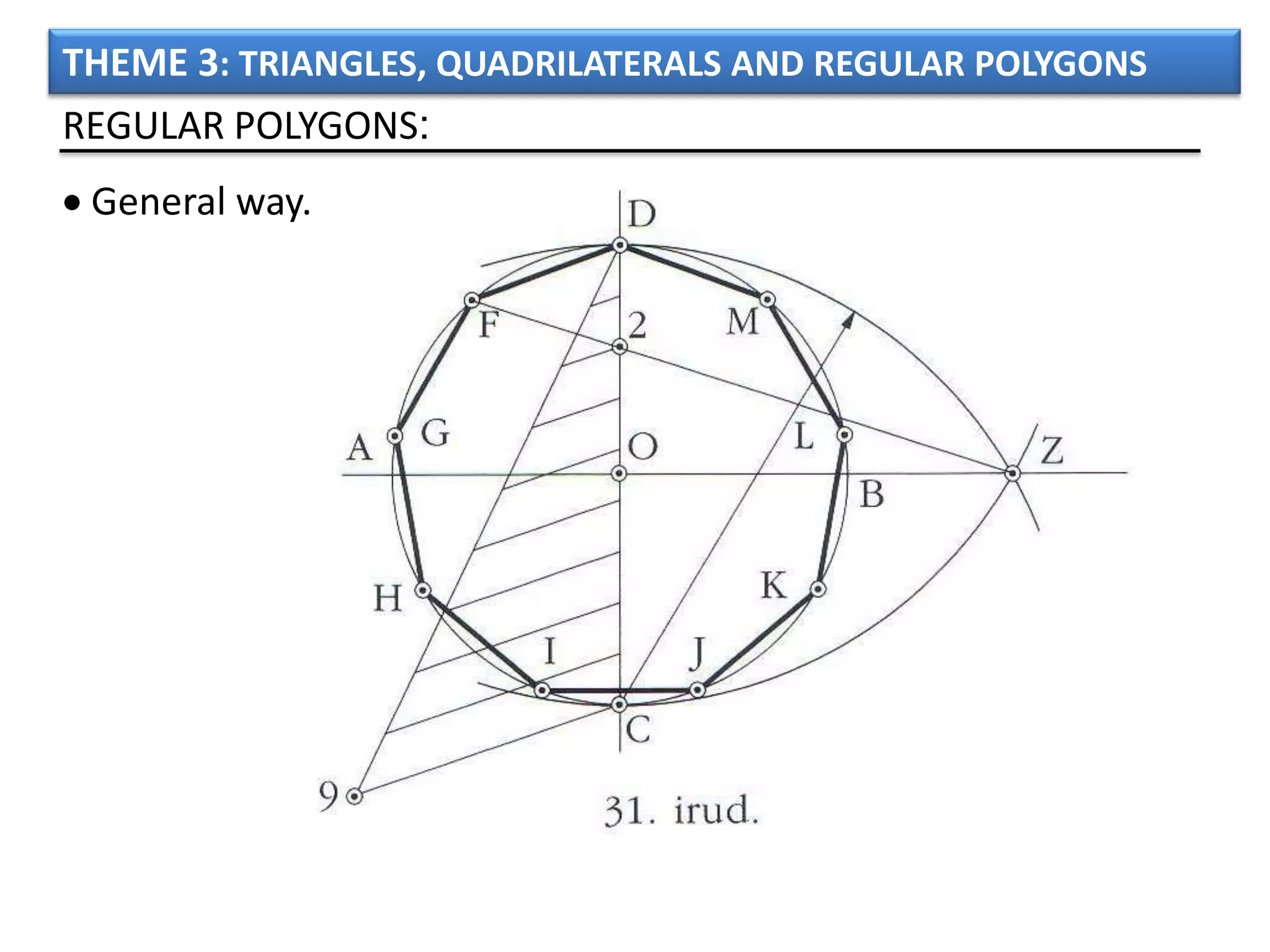
 General way.
THEME 3: TRIANGLES, QUADRILATERALS AND REGULAR POLYGONS
REGULAR POLYGONS:
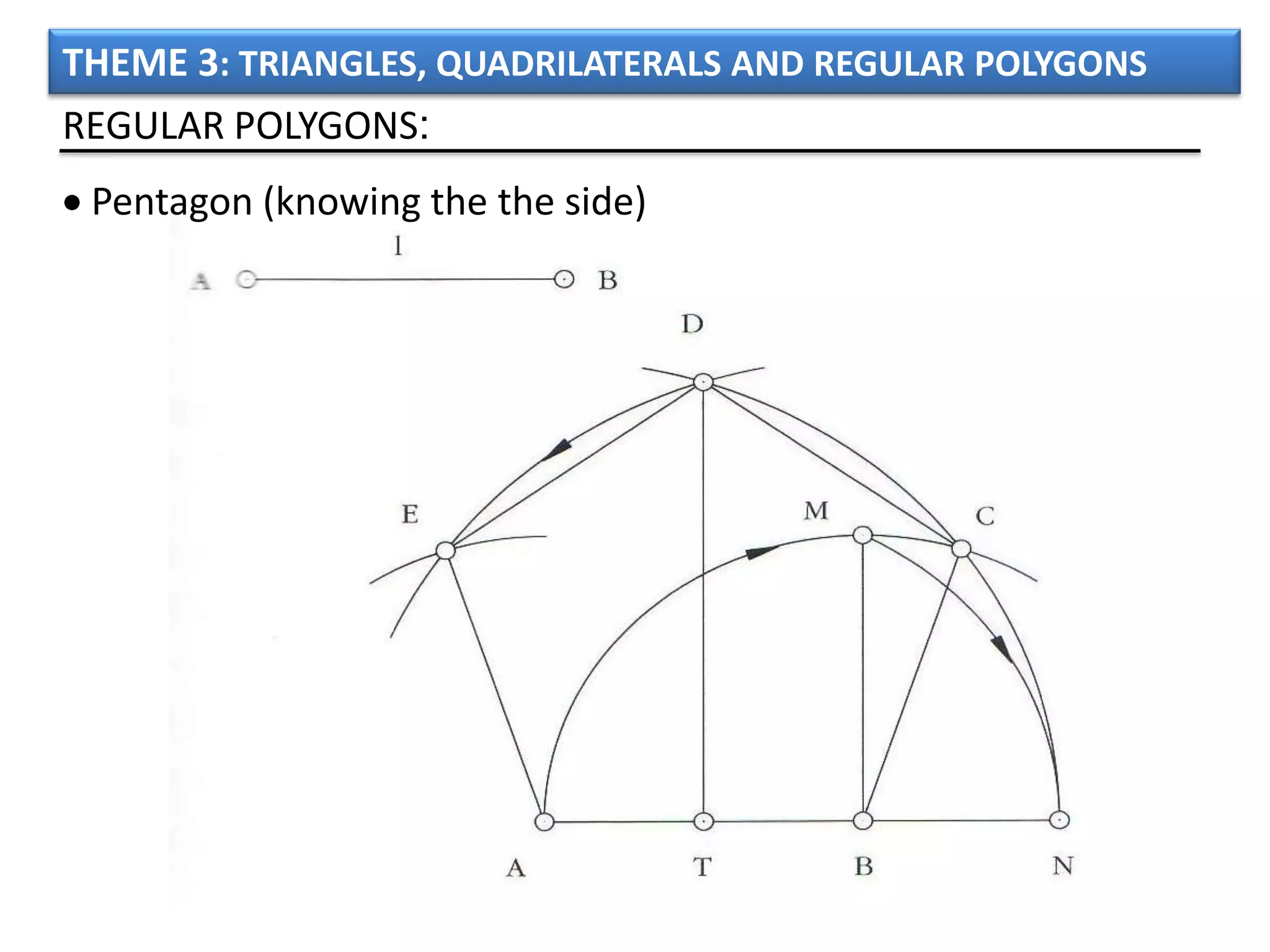
 Pentagon (knowing the the side)
THEME 3: TRIANGLES, QUADRILATERALS AND REGULAR POLYGONS
REGULAR POLYGONS:
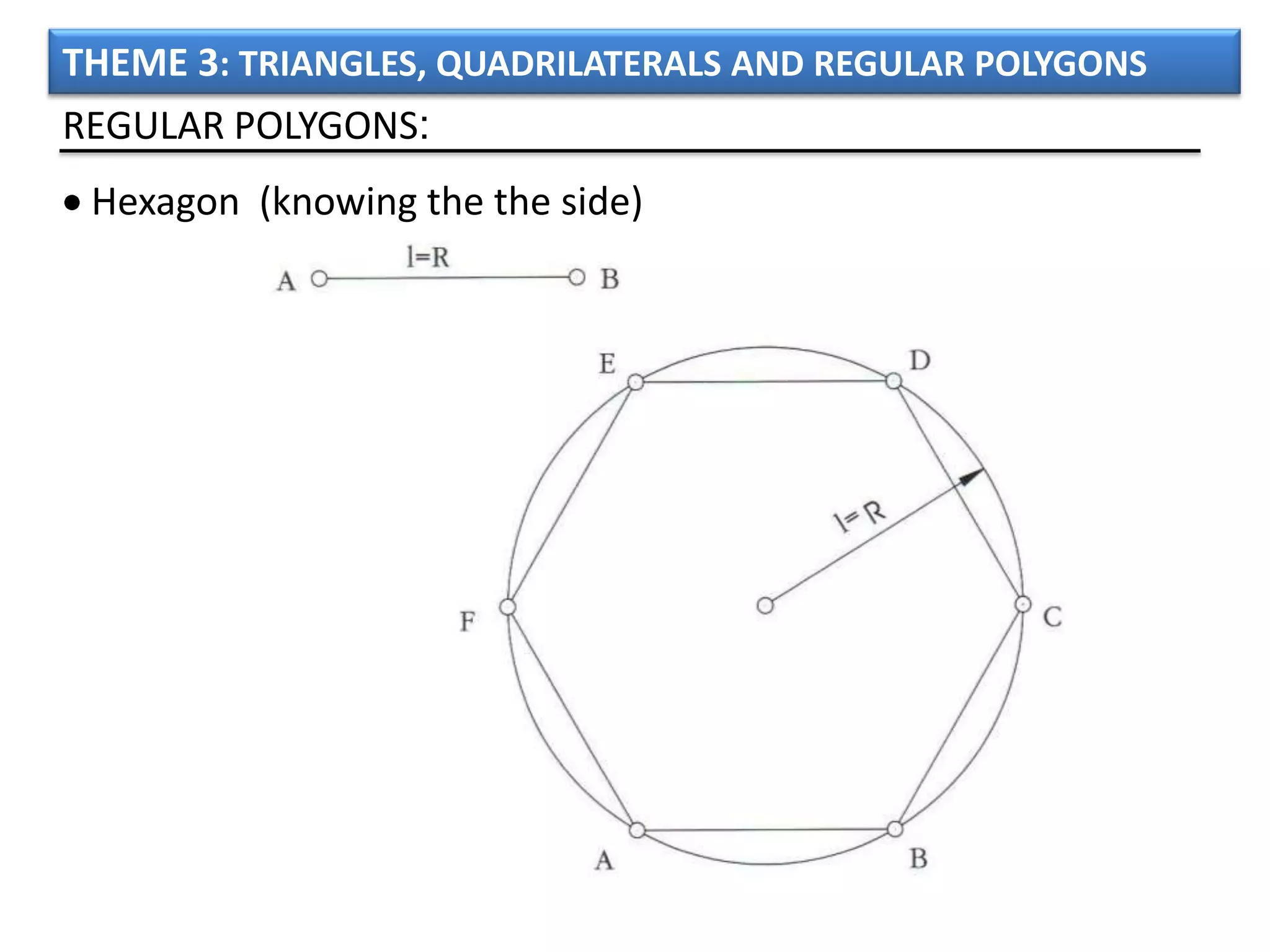
 Hexagon (knowing the the side)
THEME 3: TRIANGLES, QUADRILATERALS AND REGULAR POLYGONS
REGULAR POLYGONS:
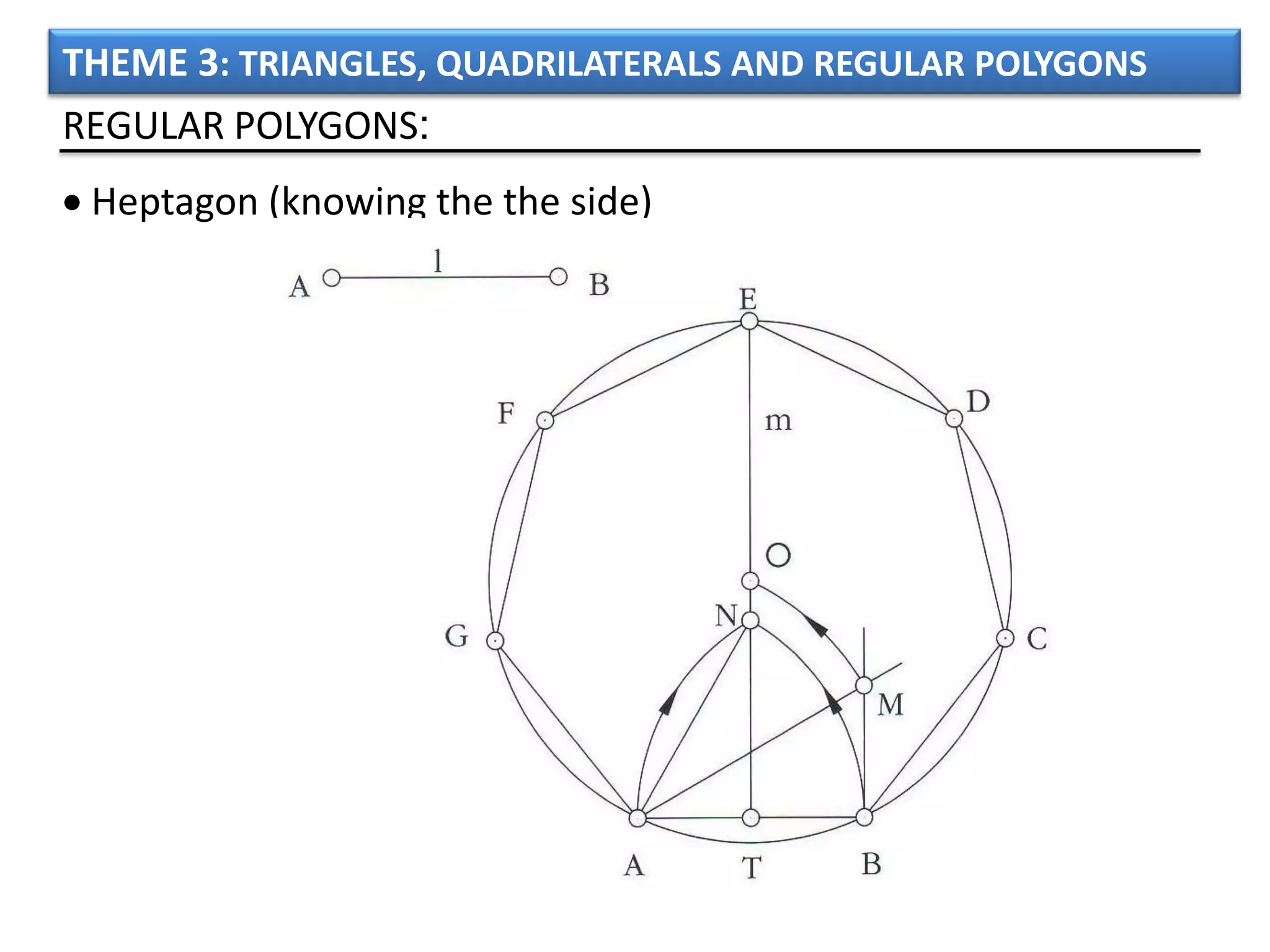
 Heptagon (knowing the the side)
THEME 3: TRIANGLES, QUADRILATERALS AND REGULAR POLYGONS
REGULAR POLYGONS:
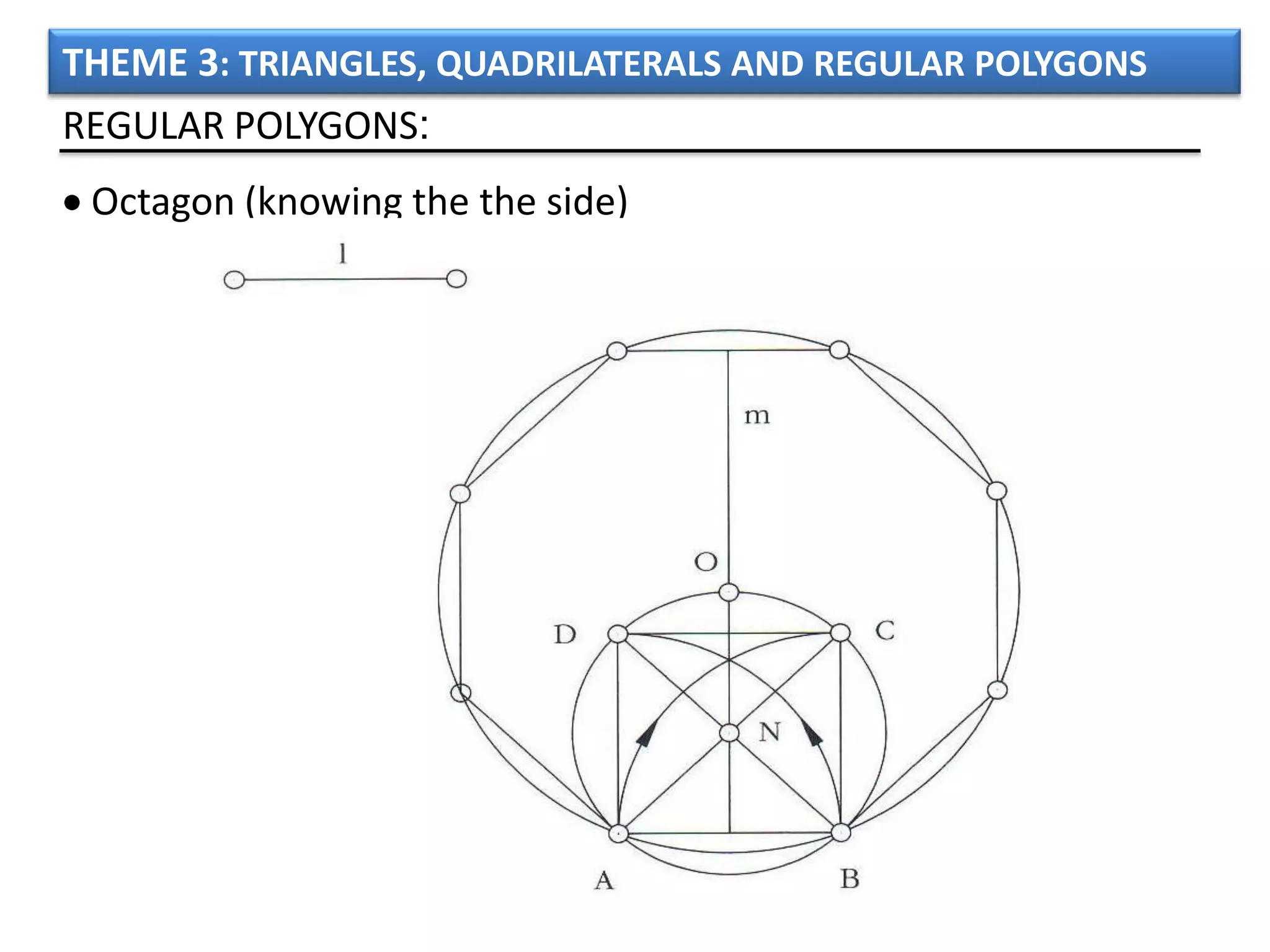
 Octagon (knowing the the side)
THEME 3: TRIANGLES, QUADRILATERALS AND REGULAR POLYGONS
REGULAR POLYGONS:
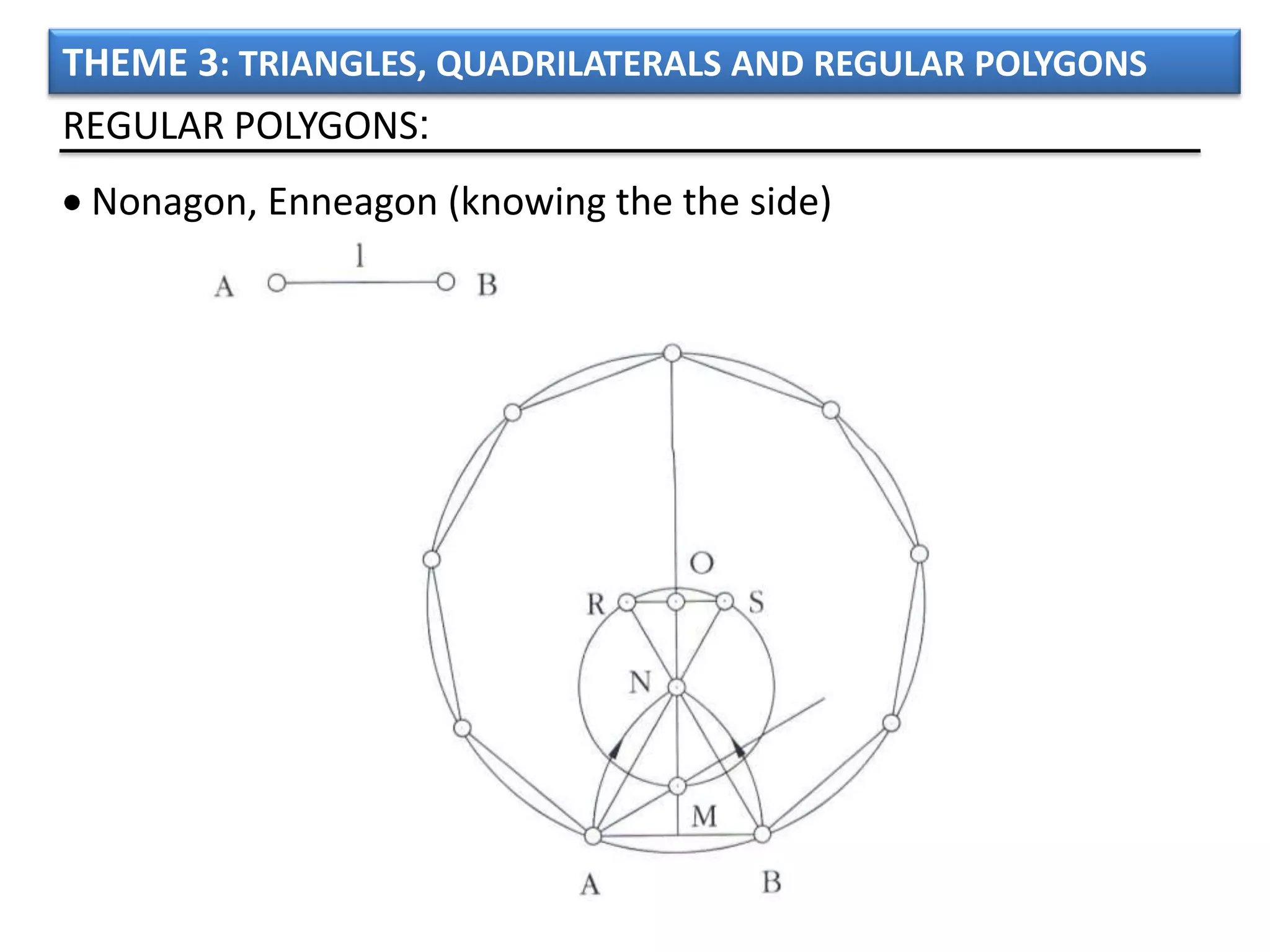
 Nonagon, Enneagon (knowing the the side)
THEME 3: TRIANGLES, QUADRILATERALS AND REGULAR POLYGONS
REGULAR POLYGONS:
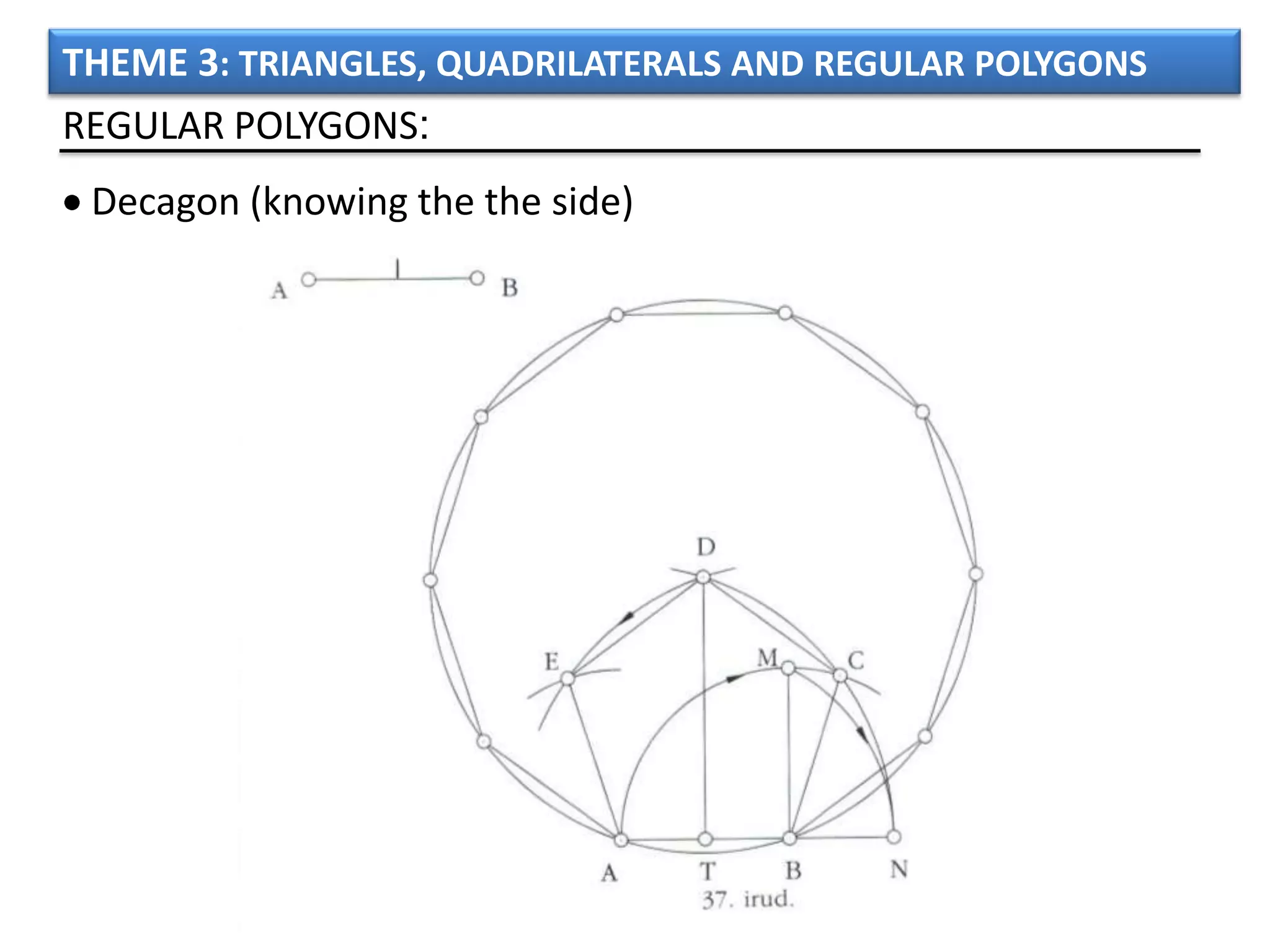
 Decagon (knowing the the side)
THEME 3: TRIANGLES, QUADRILATERALS AND REGULAR POLYGONS
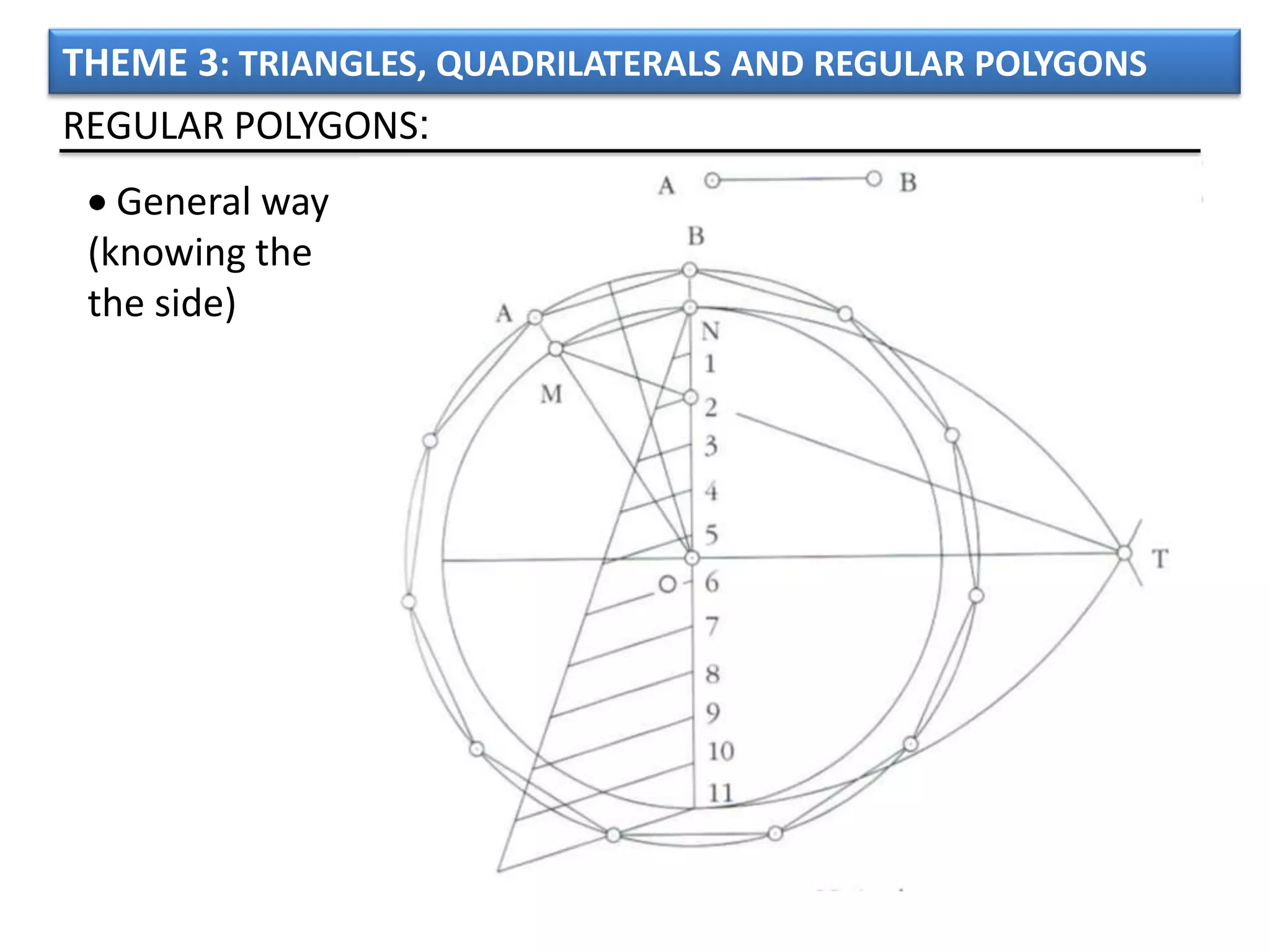
REGULAR POLYGONS:
   General way
 (knowing the
 the side)

Theme 1 basic drawing

  • 1.
  • 2.
    THEME 2: BASICPATHS IN THE PLANE Basic geometrics elements: POINT: A No dimension. C B It’s a position. Always in CAPITAL letters.
  • 3.
    THEME 2: BASICPATHS IN THE PLANE Basic geometrics elements: LINE: It’s an addition of several points following the same r direction. Always in small letters; r, s, t… r r s r A s s Two lines cut each Two lines can be When the two lines other when they share parallel when the share no point, they a point. sharing point is in the cross each other. infinite.
  • 4.
    THEME 2: BASICPATHS IN THE PLANE Basic geometrics elements: HALF LINE: One point is known and the A ∞→ other is in the infinite. r A point in the line defines tow ←∞ A ∞→ half-lines, one to the left and r the other to the right. SEGMENT: A B Is a kind of line defined r between two known points.
  • 5.
    THEME 2: BASICPATHS IN THE PLANE Basic geometrics elements: CURVED LINE: A curved line is a group of points constantly changing direction. Always in small letters.
  • 6.
    THEME 2: BASICPATHS IN THE PLANE Basic geometrics elements: PLANE: Is the set of points that arise when you move a straight line in one direction. We need the following information to define a plane: Non aligned 3 points. Two lines cutting each other. Two parallel lines. A line and a point out of the line.
  • 7.
    THEME 2: BASICPATHS IN THE PLANE Lines within a plane: Bisecting line:
  • 8.
    THEME 2: BASICPATHS IN THE PLANE Lines within a plane: To draw a perpendicular from “M” point outside the line:
  • 9.
    THEME 2: BASICPATHS IN THE PLANE Lines within a plane: To draw a perpendicular from “P” point inside the line:
  • 10.
    THEME 2: BASICPATHS IN THE PLANE Lines within a plane: To construct a perpendicular at the end of a given line:
  • 11.
    THEME 2: BASICPATHS IN THE PLANE Lines within a plane: ● To draw parallel lines with the set squares:
  • 12.
    THEME 2: BASICPATHS IN THE PLANE Lines within a plane: ● To draw perpendicular lines with the set squares:
  • 13.
    THEME 2: BASICPATHS IN THE PLANE Basic geometrics elements: ANGLES: Is a measure of a turn. We use a protractor to measure an angle. Sometimes we use letters from Greek alphabet to name angles; α, β, γ, δ… And sometimes we name (B) the vertex of the angle and (choosing A and C points) on the two sides; we write ABC. So the angle reads ABC. Different kind of angles: Null angle: α = 0° Acute angle: α < 90° Right angle: α = 90° Obtuse angle: α > 90° Plain angle: α = 180° Complete angle: α = 360°
  • 14.
    THEME 2: BASICPATHS IN THE PLANE Basic geometrics elements: ANGLES: Two lines cutting each other at point O creates the following angles; β α γ δ  Adjacent angles: α and β. Same vertex and side in common.  Angles opposite at vertex; α and γ; β and δ. So, α and γ / β and δ are of the same value.
  • 15.
    THEME 2: BASICPATHS IN THE PLANE Operations with angles : To construct an angle similar to a given angle;
  • 16.
    THEME 2: BASICPATHS IN THE PLANE Operations with angles : Summing up angles;
  • 17.
    THEME 2: BASICPATHS IN THE PLANE Operations with angles : Difference between angles;
  • 18.
    THEME 2: BASICPATHS IN THE PLANE Operations with angles : To bisect an angle (bisector);
  • 19.
    THEME 2: BASICPATHS IN THE PLANE Operations with angles : To bisect an angle (bisector);
  • 20.
    THEME 2: BASICPATHS IN THE PLANE Operations with angles : Drawing angles; 60 angle: 90 angle: 45 angle: 30 angle: 15 angle: 75 angle:
  • 21.
    THEME 2: BASICPATHS IN THE PLANE Operations with angles : Drawing angles; 105 angle: 120 angle: 135 angle: 150 angle:
  • 22.
    THEME 2: BASICPATHS IN THE PLANE Geometric places: The set of points having the same geometric characteristics. 1. Circumference: 2. Bisecting line:
  • 23.
    THEME 2: BASICPATHS IN THE PLANE Geometric places: 3. Bisector line: 4. The loci arc of a segment (depending on the angle):
  • 24.
    THEME 2: BASICPATHS IN THE PLANE Circumference: A circle is a plain figure bounded by a curved line called the circumference, witch is always equidistant from the centre. Lines of a circumference: Radius; Any of the straight lines from the centre to the circumferences. The radius is half the diameter of the circumference. Diameter: The longest possible chord of a circumference. A line passing through the centre with both ends touching the circumference.
  • 25.
    THEME 2: BASICPATHS IN THE PLANE Circumference: Chord: A straight line, witch each end touching the circumference. Arrow; It’s a part of the radius between the chord and the circumference. The radius is perpendicular to the chord. Secant: A line that cuts the circumference at two points. Tangent: A line touching the circumference at one point. Forms a right angle with a radius of the circle. T is the point contact.
  • 26.
    THEME 2: BASICPATHS IN THE PLANE Circumference:
  • 27.
    THEME 2: BASICPATHS IN THE PLANE Circumference: To construct a circumference when you have 3 points.
  • 28.
    THEME 3: TRIANGLES,SQUARES AND REGULAR POLYGONS TRIANGLES: Is a polygon formed by three segments. The addition of every inner angles of a triangle is always 180º. α + β + γ = 180º The value of the outside angle of a triangle is the addition of the two non-adjacent inside angles.
  • 29.
    THEME 3: TRIANGLES,SQUARES AND REGULAR POLYGONS TRIANGLES: In every triangle, any side is always smaller than the addition of the other two; a<b+c And any side is larger than the subtraction of the other two; b>a-c In every triangle the larger angle is in front of the larger side; c > a; γ > α
  • 30.
    THEME 3: TRIANGLES,SQUARES AND REGULAR POLYGONS CLASSIFICATION OF TRIANGLES: Depending on sides; Equilateral: Isosceles: Scalene:
  • 31.
    THEME 3: TRIANGLES,SQUARES AND REGULAR POLYGONS CLASSIFICATION OF TRIANGLES: Depending on angles; Acute: Right: Obtuse:
  • 32.
    THEME 3: TRIANGLES,SQUARES AND REGULAR POLYGONS REMARKABLE LINES AND POINTS OF A TRIANGLE: Bisector / Incentre / Inscribed circle to a triangle.
  • 33.
    THEME 3: TRIANGLES,SQUARES AND REGULAR POLYGONS REMARKABLE LINES AND POINTS OF A TRIANGLE: Bisecting line / Circumcentre / Circumscribed circle to a triangle.
  • 34.
    THEME 3: TRIANGLES,SQUARES AND REGULAR POLYGONS REMARKABLE LINES AND POINTS OF A TRIANGLE: Altitudes / Orthocentre.
  • 35.
    THEME 3: TRIANGLES,SQUARES AND REGULAR POLYGONS REMARKABLE LINES AND POINTS OF A TRIANGLE: Baricentre or Centre of Gravity.
  • 36.
    THEME 3: TRIANGLES,SQUARES AND REGULAR POLYGONS CONSTRUCTING TRIANGLES: a) Knowing the 3 sides a, b and c. b) Knowing 2 of the sides and the angle between them. c) Knowing one side, a, and the angles B and C.
  • 37.
    THEME 3: TRIANGLES,QUADRILATERALS AND REGULAR POLYGONS QUADRILATERAL: It is an polygon formed by 4 sides. QUADRILATERALS Trapezium (two PARALELOGRAM sides are parallels, Trapezoid (no (Two by two, sides the other two parallel sides) are parallel) aren’t)
  • 38.
    THEME 3: TRIANGLES,QUADRILATERALS AND REGULAR POLYGONS QUADRILATERAL: Square Rectangle. PARALELOGRAM (Two by two, sides are parallel) Rhombus. Rhomboid
  • 39.
    THEME 3: TRIANGLES,QUADRILATERALS AND REGULAR POLYGONS QUADRILATERAL: Trapezium (two sides are parallels, the other two aren’t) Isosceles Right Scalene
  • 40.
    THEME 3: TRIANGLES,QUADRILATERALS AND REGULAR POLYGONS QUADRILATERAL:
  • 41.
    THEME 3: TRIANGLES,QUADRILATERALS AND REGULAR POLYGONS REGULAR POLYGONS: What is a Polygon? A closed plane figure made up of several line segments that are joined together. The sides do not cross each other. Exactly two sides meet at every vertex.
  • 42.
    THEME 3: TRIANGLES,QUADRILATERALS AND REGULAR POLYGONS REGULAR POLYGONS: One polygon is regular if all the sides and all the angles are equal. l = Side. a = Apoteme r = Radius α = 180º - (360º / n) λ = 360º / n
  • 43.
    THEME 3: TRIANGLES,QUADRILATERALS AND REGULAR POLYGONS REGULAR POLYGONS: Regular Hexagon.
  • 44.
    THEME 3: TRIANGLES,QUADRILATERALS AND REGULAR POLYGONS REGULAR POLYGONS: Regular triangle; equilateral triangle.
  • 45.
    THEME 3: TRIANGLES,QUADRILATERALS AND REGULAR POLYGONS REGULAR POLYGONS: Dodecagon.
  • 46.
    THEME 3: TRIANGLES,QUADRILATERALS AND REGULAR POLYGONS REGULAR POLYGONS: Square.
  • 47.
    THEME 3: TRIANGLES,QUADRILATERALS AND REGULAR POLYGONS REGULAR POLYGONS: Octagon.
  • 48.
    THEME 3: TRIANGLES,QUADRILATERALS AND REGULAR POLYGONS REGULAR POLYGONS: Pentagon
  • 49.
    THEME 3: TRIANGLES,QUADRILATERALS AND REGULAR POLYGONS REGULAR POLYGONS: Decagon
  • 50.
    THEME 3: TRIANGLES,QUADRILATERALS AND REGULAR POLYGONS REGULAR POLYGONS: Heptagon
  • 51.
    THEME 3: TRIANGLES,QUADRILATERALS AND REGULAR POLYGONS REGULAR POLYGONS: General way.
  • 52.
    THEME 3: TRIANGLES,QUADRILATERALS AND REGULAR POLYGONS REGULAR POLYGONS: Pentagon (knowing the the side)
  • 53.
    THEME 3: TRIANGLES,QUADRILATERALS AND REGULAR POLYGONS REGULAR POLYGONS: Hexagon (knowing the the side)
  • 54.
    THEME 3: TRIANGLES,QUADRILATERALS AND REGULAR POLYGONS REGULAR POLYGONS: Heptagon (knowing the the side)
  • 55.
    THEME 3: TRIANGLES,QUADRILATERALS AND REGULAR POLYGONS REGULAR POLYGONS: Octagon (knowing the the side)
  • 56.
    THEME 3: TRIANGLES,QUADRILATERALS AND REGULAR POLYGONS REGULAR POLYGONS: Nonagon, Enneagon (knowing the the side)
  • 57.
    THEME 3: TRIANGLES,QUADRILATERALS AND REGULAR POLYGONS REGULAR POLYGONS: Decagon (knowing the the side)
  • 58.
    THEME 3: TRIANGLES,QUADRILATERALS AND REGULAR POLYGONS REGULAR POLYGONS: General way (knowing the the side)