THE CONTEMPORARY
WORLD
BSEd, BEEd, BPEd
Chapter 6TheGlobalFilipino
The
Contemporary
World
Global Filipino: Global Citizen
One of the proper ways to be a proper Global Filipino is
accepting the works of Globalization, our world is constantly
improving and innovation is always present, we must be
versatile and ready for the changes that the world constantly
make, this is way we are able to contribute to our society in
a proper way.
As a Filipino we must be constantly learning as we go on
our lives, we must see the adversaries that we as a nation
experience and how it will affect the lives of each citizen, as
a global Filipino we have the responsibility of sharing our
knowledge and experiences to lift the lives of our fellow
Filipino citizens.
The
Contemporary
World
Global Filipino: Global Citizen
As a Global Filipino we must be eager to expound our
views and be open to new and helpful advances of our
world.
For example is the use of biotechnology in our
agriculture, while this is one of the most highly
contested views, its’ importance in the implementation
of genetically modified organisms (GMOs) is quite
ground-breaking and helpful.
The
Contemporary
World
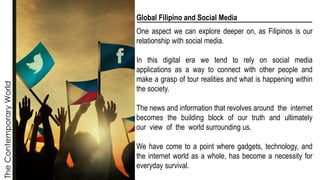
Global Filipino and Social Media
One aspect we can explore deeper on, as Filipinos is our
relationship with social media.
In this digital era we tend to rely on social media
applications as a way to connect with other people and
make a grasp of tour realities and what is happening within
the society.
The news and information that revolves around the internet
becomes the building block of our truth and ultimately
our view of the world surrounding us.
We have come to a point where gadgets, technology, and
the internet world as a whole, has become a necessity for
everyday survival.
The
Contemporary
World
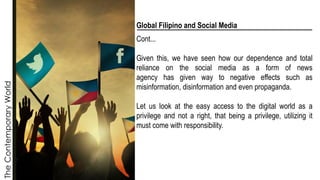
Global Filipino and Social Media
Cont...
Given this, we have seen how our dependence and total
reliance on the social media as a form of news
agency has given way to negative effects such as
misinformation, disinformation and even propaganda.
Let us look at the easy access to the digital world as a
privilege and not a right, that being a privilege, utilizing it
must come with responsibility.
The
Contemporary
World
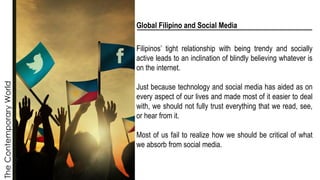
Global Filipino and Social Media
Filipinos’ tight relationship with being trendy and socially
active leads to an inclination of blindly believing whatever is
on the internet.
Just because technology and social media has aided as on
every aspect of our lives and made most of it easier to deal
with, we should not fully trust everything that we read, see,
or hear from it.
Most of us fail to realize how we should be critical of what
we absorb from social media.
The
Contemporary
World
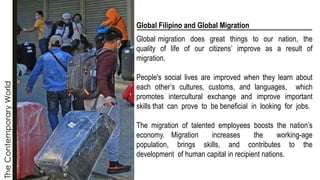
Global Filipino and Global Migration
Global migration does great things to our nation, the
quality of life of our citizens’ improve as a result of
migration.
People's social lives are improved when they learn about
each other’s cultures, customs, and languages, which
promotes intercultural exchange and improve important
skills that can prove to be beneficial in looking for jobs.
The migration of talented employees boosts the nation’s
economy. Migration increases the working-age
population, brings skills, and contributes to the
development of human capital in recipient nations.
The
Contemporary
World
Global Filipino and Global Migration
Cont...
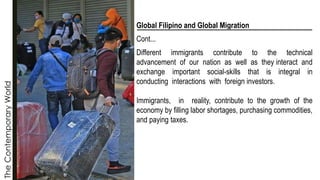
Different immigrants contribute to the technical
advancement of our nation as well as they interact and
exchange important social-skills that is integral in
conducting interactions with foreign investors.
Immigrants, in reality, contribute to the growth of the
economy by filling labor shortages, purchasing commodities,
and paying taxes.
The
Contemporary
World
Global Filipino and Capitalism
For growing economies such as in the Philippines,
global capitalism can be a modern driver that
accelerates the progress a country makes in terms of
the production of goods and services and wealth
accumulation.
As global capitalism essentially transcends borders, the
country’s production and trade can heavily improve as
foreign investments pour in the country, increasing its
working capital and its ability to produce goods.
The Philippines, as a country rich in natural resources, can
participate by exporting valuable inputs and sourcing labor
such as the case for the BPO industry.
The
Contemporary
World
Global Filipino and Capitalism
Cont..
In substance, global capitalism is advantageous when it
promotes economic development through intensified trade,
outsourcing of production and labor, and the mobility of
capital.
It becomes a detriment, however, the moment it uplifts
exploitation and poverty proliferation. Ubiquitous in this type
of system are the exploitation of laborer's wherein they are
not given appropriate benefits and children are sometimes
forced to work. Poverty then follows as a result of such
abuse.
The
Contemporary
World
The globalization experience and its challenges for
the Philippine economy
The
Contemporary
World
❑ Globalization trends in the Philippines
The Philippine economy, like that of most other Emerging
market economies, has become increasingly integrated with
the global economy. This is evident in the general increase
in trade in goods and labor migration. There is also greater
integration in finance, although at a relatively moderate
pace.
The
Contemporary
World
Globalization trends in the Philippines
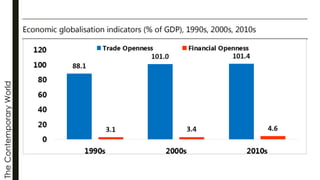
1. Trade Openness
From the 1990s to the 2000s, trade openness in the
Philippines improved from 88.1% to 101.0% of the
country’s gross domestic product (GDP).
Contributing to this increase were the country’s efforts
towards a more open trade policy starting in the 1980s.
This trade openness also reflected declining transport
costs and improved information and communications
technology that supported the development of complex
global value chains, particularly in electronics and
electrical components, allowing companies to manage
their production more efficiently (Dudley (2017)).
The
Contemporary
World
Globalization trends in the Philippines
2. Financial Openness
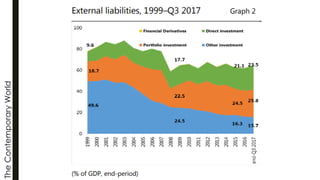
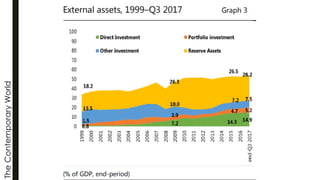
The country’s total capital flows increased from 3.1% of
GDP in the 1990s to 3.4% of GDP in the 2000s. While
the Philippines started to liberalize the foreign exchange
(FX) regulatory system in the 1990s, capital inflows
were dampened by the Tequila (Mexican peso) financial
crisis in 1995 and the Asian financial crisis in 1997–98
(Tetangco (2005)).
In the 2010s, total capital flows rose to 4.6% of GDP.
This could be attributed in part to the nine waves of FX
liberalization reforms undertaken by the BSP starting in
2007.
The
Contemporary
World
The
Contemporary
World
The
Contemporary
World
The
Contemporary
World
Globalization trends in the Philippines
3. Migration
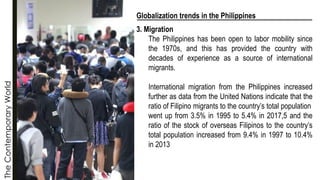
The Philippines has been open to labor mobility since
the 1970s, and this has provided the country with
decades of experience as a source of international
migrants.
International migration from the Philippines increased
further as data from the United Nations indicate that the
ratio of Filipino migrants to the country’s total population
went up from 3.5% in 1995 to 5.4% in 2017,5 and the
ratio of the stock of overseas Filipinos to the country’s
total population increased from 9.4% in 1997 to 10.4%
in 2013
The
Contemporary
World
Globalization trends in the Philippines
3. Migration
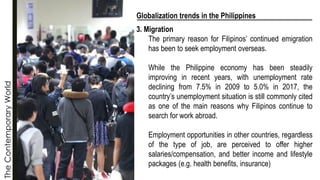
The primary reason for Filipinos’ continued emigration
has been to seek employment overseas.
While the Philippine economy has been steadily
improving in recent years, with unemployment rate
declining from 7.5% in 2009 to 5.0% in 2017, the
country’s unemployment situation is still commonly cited
as one of the main reasons why Filipinos continue to
search for work abroad.
Employment opportunities in other countries, regardless
of the type of job, are perceived to offer higher
salaries/compensation, and better income and lifestyle
packages (e.g. health benefits, insurance)
The
Contemporary
World
The
Contemporary
World
❑ Macroeconomic and distributional impacts of
globalization in the Philippines
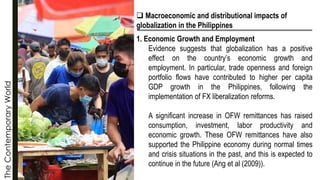
1. Economic Growth and Employment
Evidence suggests that globalization has a positive
effect on the country’s economic growth and
employment. In particular, trade openness and foreign
portfolio flows have contributed to higher per capita
GDP growth in the Philippines, following the
implementation of FX liberalization reforms.
A significant increase in OFW remittances has raised
consumption, investment, labor productivity and
economic growth. These OFW remittances have also
supported the Philippine economy during normal times
and crisis situations in the past, and this is expected to
continue in the future (Ang et al (2009)).
The
Contemporary
World
❑ Macroeconomic and distributional impacts of
globalization in the Philippines
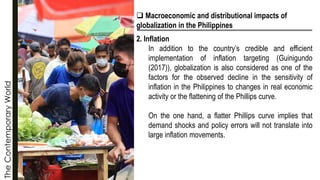
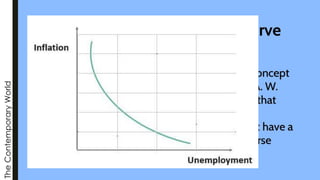
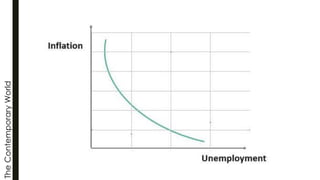
2. Inflation
In addition to the country’s credible and efficient
implementation of inflation targeting (Guinigundo
(2017)), globalization is also considered as one of the
factors for the observed decline in the sensitivity of
inflation in the Philippines to changes in real economic
activity or the flattening of the Phillips curve.
On the one hand, a flatter Phillips curve implies that
demand shocks and policy errors will not translate into
large inflation movements.
The
Contemporary
World
The
Contemporary
World
The
Contemporary
World
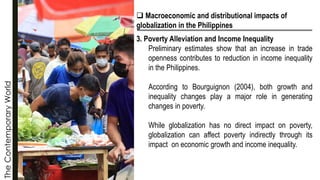
❑ Macroeconomic and distributional impacts of
globalization in the Philippines
3. Poverty Alleviation and Income Inequality
Preliminary estimates show that an increase in trade
openness contributes to reduction in income inequality
in the Philippines.
According to Bourguignon (2004), both growth and
inequality changes play a major role in generating
changes in poverty.
While globalization has no direct impact on poverty,
globalization can affect poverty indirectly through its
impact on economic growth and income inequality.
The
Contemporary
World
The
Contemporary
World
❑ Challenges of Increasing Globalization
While globalization has reportedly strengthened the global
economy and improved welfare in general, the literature
indicates that the distribution of its benefits in many
countries has been uneven and some acknowledge its
potential role in fueling the rising trend towards income
inequality.
The country faces challenges from uncertain global factors
exacerbated by the possible revival of protectionism. These
events could lead to greater volatility and risk-averse
attitudes among the country’s trade and investment
partners.
The
Contemporary
World
❑ Challenges of Increasing Globalization
1. Firms, Labor market and distribution of gains for
growth
Industries that are less able to compete and workers
whose skills have become less relevant may be
adversely affected and will have difficulty in adjusting
due to globalization.
According to Sibal (2005), firms that were among the
losers in the globalization process in the Philippines
were mostly in the small and medium categories in
agriculture (eg producers of vegetables, palay, corn and
poultry), sunset industries and labor-intensive firms (eg
garments and apparel).
These firms need to upgrade their technologies and
improve production efficiency and productivity to be
able to compete.
The
Contemporary
World
❑ Challenges of Increasing Globalization
1. Firms, Labor market and distribution of gains for
growth
Cont...
On the other hand, emigration can be a catalyst for
improvement in the quality of the labor force in the short
term as it can push individuals to improve their skills so
that they can eventually emigrate. This could also lead
eventually to “brain gain,” where OF workers bring the
knowledge they learned abroad back to their home
country.
The
Contemporary
World
❑ Challenges of Increasing Globalization
2. Greater exposure to external shocks and policies
Another challenge posed by globalization is greater
economic exposure to destabilizing external forces due
to greater financial openness.
Unless sufficient safeguards are in place, financial
openness accompanied by poor regulation can threaten
financial stability (BIS (2017c)).
Due to the Philippines’ high degree of trade integration
and significant role in international migration, the
country is likely to be affected by external noise mainly
through OF remittances, offshoring/outsourcing, and
trade channels.
The
Contemporary
World
The
Contemporary
World
❑ Policy responses to the challenges
More inclusive policies will help cushion the negative
consequences of globalization and facilitate the adjustment
in narrowing the gap between the winners and losers.
Workers need some retooling to help them find new well-
paying jobs and for producers to be more productive and
internationally competitive.
For the Philippines, the National Government could work
with the private sector and civil society groups on local
initiatives that provide technology and skills to
disadvantaged groups such as in barangays within and
outside the cities (Roldan (2010)).
The
Contemporary
World
❑ Policy responses to the challenges
Cont..
In the case of Filipino migrants, there is a need to protect
their rights and well-being as well as to facilitate their
participation in the country’s development, particularly
during reintegration.
Like other central banks, the BSP needs to better
understand the implications of globalization on the
performance of the economy, inflation and financial stability.
The
Contemporary
World ❑ Policy responses to the challenges
The BSP’s contribution
1. Promote low and stable inflation
For its part, the BSP has helped to maintain
stable and low inflation, which supports
domestic economic stability, encouraging
investments and business expansion, which, in
turn, fuels employment growth.
2. Promote Financial Inclusion
Ex: in 2008, the BSP developed the Credit
Surety Fund Program (CSF), which has helped
micro, small and medium-sized enterprises
(MSMEs) grow their business.
The BSP has also promoted the offering of
microfinance loans, micro agricultural loans,
microfinance housing loans, micro-deposits and
micro-insurance.
The
Contemporary
World ❑ Policy responses to the challenges
The BSP’s contribution
3. Cooperate in global efforts to further strengthen
rules-based international transactions.
Ex: trade facilitation agreements, level playing
field in trade and tax
The BSP has raised the issue with the Alliance
for Financial Inclusion, the Global Partnership
for Financial Inclusion (GPFI) of the G20, the
Financial Stability Board, the World Bank and
the United States Treasury.
The
Contemporary
World
OFW
The
Contemporary
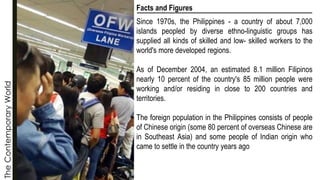
World Facts and Figures
Since 1970s, the Philippines - a country of about 7,000
islands peopled by diverse ethno-linguistic groups has
supplied all kinds of skilled and low- skilled workers to the
world's more developed regions.
As of December 2004, an estimated 8.1 million Filipinos
nearly 10 percent of the country's 85 million people were
working and/or residing in close to 200 countries and
territories.
The foreign population in the Philippines consists of people
of Chinese origin (some 80 percent of overseas Chinese are
in Southeast Asia) and some people of Indian origin who
came to settle in the country years ago
The
Contemporary
World
Facts and Figures
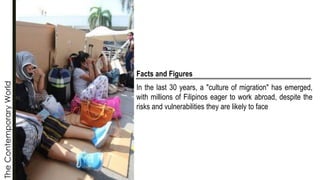
In the last 30 years, a "culture of migration" has emerged,
with millions of Filipinos eager to work abroad, despite the
risks and vulnerabilities they are likely to face
The
Contemporary
World
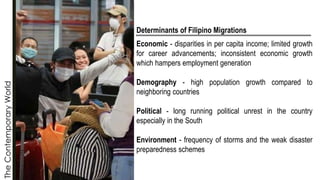
Determinants of Filipino Migrations
Economic - disparities in per capita income; limited growth
for career advancements; inconsistent economic growth
which hampers employment generation
Demography - high population growth compared to
neighboring countries
Political - long running political unrest in the country
especially in the South
Environment - frequency of storms and the weak disaster
preparedness schemes
The
Contemporary
World
The
Contemporary
World
The
Contemporary
World
The
Contemporary
World
The
Contemporary
World
The
Contemporary
World
The
Contemporary
World
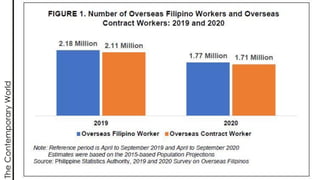
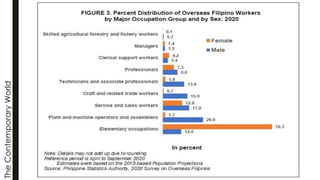
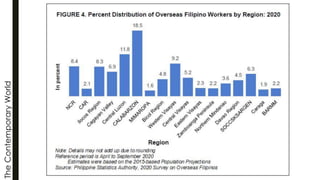
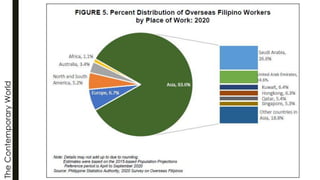
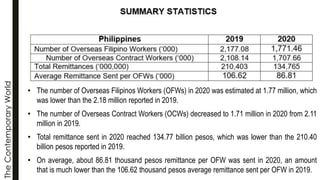
• The number of Overseas Filipinos Workers (OFWs) in 2020 was estimated at 1.77 million, which
was lower than the 2.18 million reported in 2019.
• The number of Overseas Contract Workers (OCWs) decreased to 1.71 million in 2020 from 2.11
million in 2019.
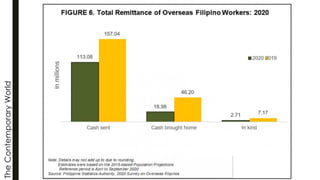
• Total remittance sent in 2020 reached 134.77 billion pesos, which was lower than the 210.40
billion pesos reported in 2019.
• On average, about 86.81 thousand pesos remittance per OFW was sent in 2020, an amount
that is much lower than the 106.62 thousand pesos average remittance sent per OFW in 2019.
The
Contemporary
World Workers’ Protection Order
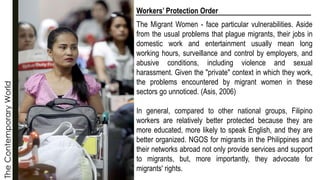
The Migrant Women - face particular vulnerabilities. Aside
from the usual problems that plague migrants, their jobs in
domestic work and entertainment usually mean long
working hours, surveillance and control by employers, and
abusive conditions, including violence and sexual
harassment. Given the "private" context in which they work,
the problems encountered by migrant women in these
sectors go unnoticed. (Asis, 2006)
In general, compared to other national groups, Filipino
workers are relatively better protected because they are
more educated, more likely to speak English, and they are
better organized. NGOS for migrants in the Philippines and
their networks abroad not only provide services and support
to migrants, but, more importantly, they advocate for
migrants' rights.
The
Contemporary
World Workers’ Protection Order
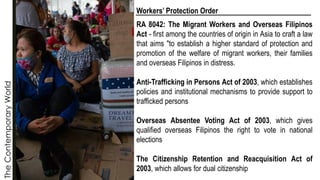
RA 8042: The Migrant Workers and Overseas Filipinos
Act - first among the countries of origin in Asia to craft a law
that aims "to establish a higher standard of protection and
promotion of the welfare of migrant workers, their families
and overseas Filipinos in distress.
Anti-Trafficking in Persons Act of 2003, which establishes
policies and institutional mechanisms to provide support to
trafficked persons
Overseas Absentee Voting Act of 2003, which gives
qualified overseas Filipinos the right to vote in national
elections
The Citizenship Retention and Reacquisition Act of
2003, which allows for dual citizenship
The
Contemporary
World
Filipinos Reaching Greater Heights Here and Abroad
The
Contemporary
World
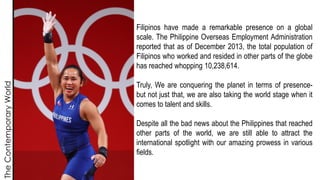
Filipinos have made a remarkable presence on a global
scale. The Philippine Overseas Employment Administration
reported that as of December 2013, the total population of
Filipinos who worked and resided in other parts of the globe
has reached whopping 10,238,614.
Truly, We are conquering the planet in terms of presence-
but not just that, we are also taking the world stage when it
comes to talent and skills.
Despite all the bad news about the Philippines that reached
other parts of the world, we are still able to attract the
international spotlight with our amazing prowess in various
fields.
The
Contemporary
World
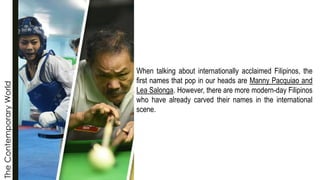
When talking about internationally acclaimed Filipinos, the
first names that pop in our heads are Manny Pacquiao and
Lea Salonga. However, there are more modern-day Filipinos
who have already carved their names in the international
scene.
The
Contemporary
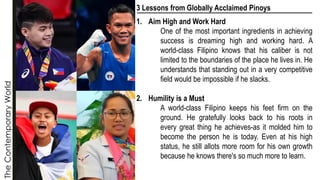
World 3 Lessons from Globally Acclaimed Pinoys
1. Aim High and Work Hard
One of the most important ingredients in achieving
success is dreaming high and working hard. A
world-class Filipino knows that his caliber is not
limited to the boundaries of the place he lives in. He
understands that standing out in a very competitive
field would be impossible if he slacks.
2. Humility is a Must
A world-class Filipino keeps his feet firm on the
ground. He gratefully looks back to his roots in
every great thing he achieves-as it molded him to
become the person he is today. Even at his high
status, he still allots more room for his own growth
because he knows there's so much more to learn.
The
Contemporary
World
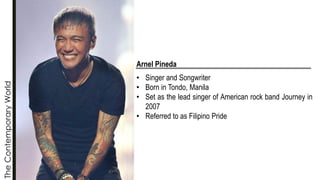
Arnel Pineda
• Singer and Songwriter
• Born in Tondo, Manila
• Set as the lead singer of American rock band Journey in
2007
• Referred to as Filipino Pride
The
Contemporary
World
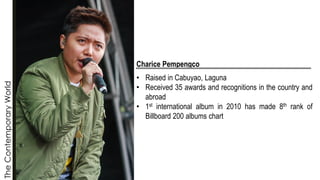
Charice Pempengco
• Raised in Cabuyao, Laguna
• Received 35 awards and recognitions in the country and
abroad
• 1st international album in 2010 has made 8th rank of
Billboard 200 albums chart
The
Contemporary
World
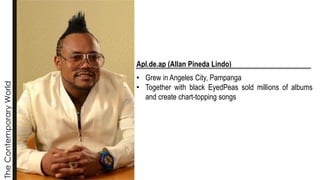
Apl.de.ap (Allan Pineda Lindo)
• Grew in Angeles City, Pampanga
• Together with black EyedPeas sold millions of albums
and create chart-topping songs
The
Contemporary
World
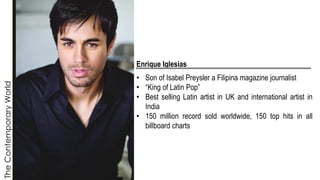
Enrique Iglesias
• Son of Isabel Preysler a Filipina magazine journalist
• “King of Latin Pop”
• Best selling Latin artist in UK and international artist in
India
• 150 million record sold worldwide, 150 top hits in all
billboard charts
The
Contemporary
World
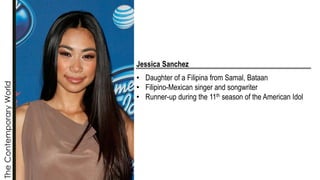
Jessica Sanchez
• Daughter of a Filipina from Samal, Bataan
• Filipino-Mexican singer and songwriter
• Runner-up during the 11th season of the American Idol
The
Contemporary
World
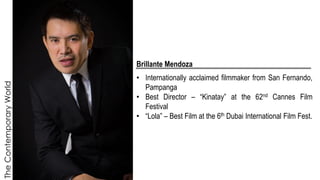
Brillante Mendoza
• Internationally acclaimed filmmaker from San Fernando,
Pampanga
• Best Director – “Kinatay” at the 62nd Cannes Film
Festival
• “Lola” – Best Film at the 6th Dubai International Film Fest.
The
Contemporary
World
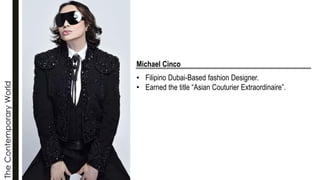
Michael Cinco
• Filipino Dubai-Based fashion Designer.
• Earned the title “Asian Couturier Extraordinaire”.
The
Contemporary
World
Michael Christian Martinez
• World-class Filipino figure skater
• Championed the 2015 Asian Figure Skating Trophy
The
Contemporary
World
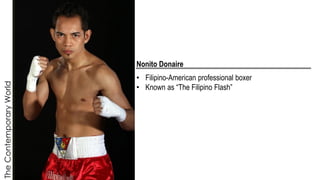
Nonito Donaire
• Filipino-American professional boxer
• Known as “The Filipino Flash”

The-Global-Filipino.pdf

  • 1.
  • 2.
  • 3.
    The Contemporary World Global Filipino: GlobalCitizen One of the proper ways to be a proper Global Filipino is accepting the works of Globalization, our world is constantly improving and innovation is always present, we must be versatile and ready for the changes that the world constantly make, this is way we are able to contribute to our society in a proper way. As a Filipino we must be constantly learning as we go on our lives, we must see the adversaries that we as a nation experience and how it will affect the lives of each citizen, as a global Filipino we have the responsibility of sharing our knowledge and experiences to lift the lives of our fellow Filipino citizens.
  • 4.
    The Contemporary World Global Filipino: GlobalCitizen As a Global Filipino we must be eager to expound our views and be open to new and helpful advances of our world. For example is the use of biotechnology in our agriculture, while this is one of the most highly contested views, its’ importance in the implementation of genetically modified organisms (GMOs) is quite ground-breaking and helpful.
  • 5.
    The Contemporary World Global Filipino andSocial Media One aspect we can explore deeper on, as Filipinos is our relationship with social media. In this digital era we tend to rely on social media applications as a way to connect with other people and make a grasp of tour realities and what is happening within the society. The news and information that revolves around the internet becomes the building block of our truth and ultimately our view of the world surrounding us. We have come to a point where gadgets, technology, and the internet world as a whole, has become a necessity for everyday survival.
  • 6.
    The Contemporary World Global Filipino andSocial Media Cont... Given this, we have seen how our dependence and total reliance on the social media as a form of news agency has given way to negative effects such as misinformation, disinformation and even propaganda. Let us look at the easy access to the digital world as a privilege and not a right, that being a privilege, utilizing it must come with responsibility.
  • 7.
    The Contemporary World Global Filipino andSocial Media Filipinos’ tight relationship with being trendy and socially active leads to an inclination of blindly believing whatever is on the internet. Just because technology and social media has aided as on every aspect of our lives and made most of it easier to deal with, we should not fully trust everything that we read, see, or hear from it. Most of us fail to realize how we should be critical of what we absorb from social media.
  • 8.
    The Contemporary World Global Filipino andGlobal Migration Global migration does great things to our nation, the quality of life of our citizens’ improve as a result of migration. People's social lives are improved when they learn about each other’s cultures, customs, and languages, which promotes intercultural exchange and improve important skills that can prove to be beneficial in looking for jobs. The migration of talented employees boosts the nation’s economy. Migration increases the working-age population, brings skills, and contributes to the development of human capital in recipient nations.
  • 9.
    The Contemporary World Global Filipino andGlobal Migration Cont... Different immigrants contribute to the technical advancement of our nation as well as they interact and exchange important social-skills that is integral in conducting interactions with foreign investors. Immigrants, in reality, contribute to the growth of the economy by filling labor shortages, purchasing commodities, and paying taxes.
  • 10.
    The Contemporary World Global Filipino andCapitalism For growing economies such as in the Philippines, global capitalism can be a modern driver that accelerates the progress a country makes in terms of the production of goods and services and wealth accumulation. As global capitalism essentially transcends borders, the country’s production and trade can heavily improve as foreign investments pour in the country, increasing its working capital and its ability to produce goods. The Philippines, as a country rich in natural resources, can participate by exporting valuable inputs and sourcing labor such as the case for the BPO industry.
  • 11.
    The Contemporary World Global Filipino andCapitalism Cont.. In substance, global capitalism is advantageous when it promotes economic development through intensified trade, outsourcing of production and labor, and the mobility of capital. It becomes a detriment, however, the moment it uplifts exploitation and poverty proliferation. Ubiquitous in this type of system are the exploitation of laborer's wherein they are not given appropriate benefits and children are sometimes forced to work. Poverty then follows as a result of such abuse.
  • 12.
    The Contemporary World The globalization experienceand its challenges for the Philippine economy
  • 13.
    The Contemporary World ❑ Globalization trendsin the Philippines The Philippine economy, like that of most other Emerging market economies, has become increasingly integrated with the global economy. This is evident in the general increase in trade in goods and labor migration. There is also greater integration in finance, although at a relatively moderate pace.
  • 14.
    The Contemporary World Globalization trends inthe Philippines 1. Trade Openness From the 1990s to the 2000s, trade openness in the Philippines improved from 88.1% to 101.0% of the country’s gross domestic product (GDP). Contributing to this increase were the country’s efforts towards a more open trade policy starting in the 1980s. This trade openness also reflected declining transport costs and improved information and communications technology that supported the development of complex global value chains, particularly in electronics and electrical components, allowing companies to manage their production more efficiently (Dudley (2017)).
  • 15.
    The Contemporary World Globalization trends inthe Philippines 2. Financial Openness The country’s total capital flows increased from 3.1% of GDP in the 1990s to 3.4% of GDP in the 2000s. While the Philippines started to liberalize the foreign exchange (FX) regulatory system in the 1990s, capital inflows were dampened by the Tequila (Mexican peso) financial crisis in 1995 and the Asian financial crisis in 1997–98 (Tetangco (2005)). In the 2010s, total capital flows rose to 4.6% of GDP. This could be attributed in part to the nine waves of FX liberalization reforms undertaken by the BSP starting in 2007.
  • 16.
  • 17.
  • 18.
  • 19.
    The Contemporary World Globalization trends inthe Philippines 3. Migration The Philippines has been open to labor mobility since the 1970s, and this has provided the country with decades of experience as a source of international migrants. International migration from the Philippines increased further as data from the United Nations indicate that the ratio of Filipino migrants to the country’s total population went up from 3.5% in 1995 to 5.4% in 2017,5 and the ratio of the stock of overseas Filipinos to the country’s total population increased from 9.4% in 1997 to 10.4% in 2013
  • 20.
    The Contemporary World Globalization trends inthe Philippines 3. Migration The primary reason for Filipinos’ continued emigration has been to seek employment overseas. While the Philippine economy has been steadily improving in recent years, with unemployment rate declining from 7.5% in 2009 to 5.0% in 2017, the country’s unemployment situation is still commonly cited as one of the main reasons why Filipinos continue to search for work abroad. Employment opportunities in other countries, regardless of the type of job, are perceived to offer higher salaries/compensation, and better income and lifestyle packages (e.g. health benefits, insurance)
  • 21.
  • 22.
    The Contemporary World ❑ Macroeconomic anddistributional impacts of globalization in the Philippines 1. Economic Growth and Employment Evidence suggests that globalization has a positive effect on the country’s economic growth and employment. In particular, trade openness and foreign portfolio flows have contributed to higher per capita GDP growth in the Philippines, following the implementation of FX liberalization reforms. A significant increase in OFW remittances has raised consumption, investment, labor productivity and economic growth. These OFW remittances have also supported the Philippine economy during normal times and crisis situations in the past, and this is expected to continue in the future (Ang et al (2009)).
  • 23.
    The Contemporary World ❑ Macroeconomic anddistributional impacts of globalization in the Philippines 2. Inflation In addition to the country’s credible and efficient implementation of inflation targeting (Guinigundo (2017)), globalization is also considered as one of the factors for the observed decline in the sensitivity of inflation in the Philippines to changes in real economic activity or the flattening of the Phillips curve. On the one hand, a flatter Phillips curve implies that demand shocks and policy errors will not translate into large inflation movements.
  • 24.
  • 25.
  • 26.
    The Contemporary World ❑ Macroeconomic anddistributional impacts of globalization in the Philippines 3. Poverty Alleviation and Income Inequality Preliminary estimates show that an increase in trade openness contributes to reduction in income inequality in the Philippines. According to Bourguignon (2004), both growth and inequality changes play a major role in generating changes in poverty. While globalization has no direct impact on poverty, globalization can affect poverty indirectly through its impact on economic growth and income inequality.
  • 27.
  • 28.
    The Contemporary World ❑ Challenges ofIncreasing Globalization While globalization has reportedly strengthened the global economy and improved welfare in general, the literature indicates that the distribution of its benefits in many countries has been uneven and some acknowledge its potential role in fueling the rising trend towards income inequality. The country faces challenges from uncertain global factors exacerbated by the possible revival of protectionism. These events could lead to greater volatility and risk-averse attitudes among the country’s trade and investment partners.
  • 29.
    The Contemporary World ❑ Challenges ofIncreasing Globalization 1. Firms, Labor market and distribution of gains for growth Industries that are less able to compete and workers whose skills have become less relevant may be adversely affected and will have difficulty in adjusting due to globalization. According to Sibal (2005), firms that were among the losers in the globalization process in the Philippines were mostly in the small and medium categories in agriculture (eg producers of vegetables, palay, corn and poultry), sunset industries and labor-intensive firms (eg garments and apparel). These firms need to upgrade their technologies and improve production efficiency and productivity to be able to compete.
  • 30.
    The Contemporary World ❑ Challenges ofIncreasing Globalization 1. Firms, Labor market and distribution of gains for growth Cont... On the other hand, emigration can be a catalyst for improvement in the quality of the labor force in the short term as it can push individuals to improve their skills so that they can eventually emigrate. This could also lead eventually to “brain gain,” where OF workers bring the knowledge they learned abroad back to their home country.
  • 31.
    The Contemporary World ❑ Challenges ofIncreasing Globalization 2. Greater exposure to external shocks and policies Another challenge posed by globalization is greater economic exposure to destabilizing external forces due to greater financial openness. Unless sufficient safeguards are in place, financial openness accompanied by poor regulation can threaten financial stability (BIS (2017c)). Due to the Philippines’ high degree of trade integration and significant role in international migration, the country is likely to be affected by external noise mainly through OF remittances, offshoring/outsourcing, and trade channels.
  • 32.
  • 33.
    The Contemporary World ❑ Policy responsesto the challenges More inclusive policies will help cushion the negative consequences of globalization and facilitate the adjustment in narrowing the gap between the winners and losers. Workers need some retooling to help them find new well- paying jobs and for producers to be more productive and internationally competitive. For the Philippines, the National Government could work with the private sector and civil society groups on local initiatives that provide technology and skills to disadvantaged groups such as in barangays within and outside the cities (Roldan (2010)).
  • 34.
    The Contemporary World ❑ Policy responsesto the challenges Cont.. In the case of Filipino migrants, there is a need to protect their rights and well-being as well as to facilitate their participation in the country’s development, particularly during reintegration. Like other central banks, the BSP needs to better understand the implications of globalization on the performance of the economy, inflation and financial stability.
  • 35.
    The Contemporary World ❑ Policyresponses to the challenges The BSP’s contribution 1. Promote low and stable inflation For its part, the BSP has helped to maintain stable and low inflation, which supports domestic economic stability, encouraging investments and business expansion, which, in turn, fuels employment growth. 2. Promote Financial Inclusion Ex: in 2008, the BSP developed the Credit Surety Fund Program (CSF), which has helped micro, small and medium-sized enterprises (MSMEs) grow their business. The BSP has also promoted the offering of microfinance loans, micro agricultural loans, microfinance housing loans, micro-deposits and micro-insurance.
  • 36.
    The Contemporary World ❑ Policyresponses to the challenges The BSP’s contribution 3. Cooperate in global efforts to further strengthen rules-based international transactions. Ex: trade facilitation agreements, level playing field in trade and tax The BSP has raised the issue with the Alliance for Financial Inclusion, the Global Partnership for Financial Inclusion (GPFI) of the G20, the Financial Stability Board, the World Bank and the United States Treasury.
  • 37.
  • 38.
    The Contemporary World Facts andFigures Since 1970s, the Philippines - a country of about 7,000 islands peopled by diverse ethno-linguistic groups has supplied all kinds of skilled and low- skilled workers to the world's more developed regions. As of December 2004, an estimated 8.1 million Filipinos nearly 10 percent of the country's 85 million people were working and/or residing in close to 200 countries and territories. The foreign population in the Philippines consists of people of Chinese origin (some 80 percent of overseas Chinese are in Southeast Asia) and some people of Indian origin who came to settle in the country years ago
  • 39.
    The Contemporary World Facts and Figures Inthe last 30 years, a "culture of migration" has emerged, with millions of Filipinos eager to work abroad, despite the risks and vulnerabilities they are likely to face
  • 40.
    The Contemporary World Determinants of FilipinoMigrations Economic - disparities in per capita income; limited growth for career advancements; inconsistent economic growth which hampers employment generation Demography - high population growth compared to neighboring countries Political - long running political unrest in the country especially in the South Environment - frequency of storms and the weak disaster preparedness schemes
  • 41.
  • 42.
  • 43.
  • 44.
  • 45.
  • 46.
  • 47.
    The Contemporary World • The numberof Overseas Filipinos Workers (OFWs) in 2020 was estimated at 1.77 million, which was lower than the 2.18 million reported in 2019. • The number of Overseas Contract Workers (OCWs) decreased to 1.71 million in 2020 from 2.11 million in 2019. • Total remittance sent in 2020 reached 134.77 billion pesos, which was lower than the 210.40 billion pesos reported in 2019. • On average, about 86.81 thousand pesos remittance per OFW was sent in 2020, an amount that is much lower than the 106.62 thousand pesos average remittance sent per OFW in 2019.
  • 48.
    The Contemporary World Workers’ ProtectionOrder The Migrant Women - face particular vulnerabilities. Aside from the usual problems that plague migrants, their jobs in domestic work and entertainment usually mean long working hours, surveillance and control by employers, and abusive conditions, including violence and sexual harassment. Given the "private" context in which they work, the problems encountered by migrant women in these sectors go unnoticed. (Asis, 2006) In general, compared to other national groups, Filipino workers are relatively better protected because they are more educated, more likely to speak English, and they are better organized. NGOS for migrants in the Philippines and their networks abroad not only provide services and support to migrants, but, more importantly, they advocate for migrants' rights.
  • 49.
    The Contemporary World Workers’ ProtectionOrder RA 8042: The Migrant Workers and Overseas Filipinos Act - first among the countries of origin in Asia to craft a law that aims "to establish a higher standard of protection and promotion of the welfare of migrant workers, their families and overseas Filipinos in distress. Anti-Trafficking in Persons Act of 2003, which establishes policies and institutional mechanisms to provide support to trafficked persons Overseas Absentee Voting Act of 2003, which gives qualified overseas Filipinos the right to vote in national elections The Citizenship Retention and Reacquisition Act of 2003, which allows for dual citizenship
  • 50.
  • 51.
    The Contemporary World Filipinos have madea remarkable presence on a global scale. The Philippine Overseas Employment Administration reported that as of December 2013, the total population of Filipinos who worked and resided in other parts of the globe has reached whopping 10,238,614. Truly, We are conquering the planet in terms of presence- but not just that, we are also taking the world stage when it comes to talent and skills. Despite all the bad news about the Philippines that reached other parts of the world, we are still able to attract the international spotlight with our amazing prowess in various fields.
  • 52.
    The Contemporary World When talking aboutinternationally acclaimed Filipinos, the first names that pop in our heads are Manny Pacquiao and Lea Salonga. However, there are more modern-day Filipinos who have already carved their names in the international scene.
  • 53.
    The Contemporary World 3 Lessonsfrom Globally Acclaimed Pinoys 1. Aim High and Work Hard One of the most important ingredients in achieving success is dreaming high and working hard. A world-class Filipino knows that his caliber is not limited to the boundaries of the place he lives in. He understands that standing out in a very competitive field would be impossible if he slacks. 2. Humility is a Must A world-class Filipino keeps his feet firm on the ground. He gratefully looks back to his roots in every great thing he achieves-as it molded him to become the person he is today. Even at his high status, he still allots more room for his own growth because he knows there's so much more to learn.
  • 54.
    The Contemporary World Arnel Pineda • Singerand Songwriter • Born in Tondo, Manila • Set as the lead singer of American rock band Journey in 2007 • Referred to as Filipino Pride
  • 55.
    The Contemporary World Charice Pempengco • Raisedin Cabuyao, Laguna • Received 35 awards and recognitions in the country and abroad • 1st international album in 2010 has made 8th rank of Billboard 200 albums chart
  • 56.
    The Contemporary World Apl.de.ap (Allan PinedaLindo) • Grew in Angeles City, Pampanga • Together with black EyedPeas sold millions of albums and create chart-topping songs
  • 57.
    The Contemporary World Enrique Iglesias • Sonof Isabel Preysler a Filipina magazine journalist • “King of Latin Pop” • Best selling Latin artist in UK and international artist in India • 150 million record sold worldwide, 150 top hits in all billboard charts
  • 58.
    The Contemporary World Jessica Sanchez • Daughterof a Filipina from Samal, Bataan • Filipino-Mexican singer and songwriter • Runner-up during the 11th season of the American Idol
  • 59.
    The Contemporary World Brillante Mendoza • Internationallyacclaimed filmmaker from San Fernando, Pampanga • Best Director – “Kinatay” at the 62nd Cannes Film Festival • “Lola” – Best Film at the 6th Dubai International Film Fest.
  • 60.
    The Contemporary World Michael Cinco • FilipinoDubai-Based fashion Designer. • Earned the title “Asian Couturier Extraordinaire”.
  • 61.
    The Contemporary World Michael Christian Martinez •World-class Filipino figure skater • Championed the 2015 Asian Figure Skating Trophy
  • 62.
    The Contemporary World Nonito Donaire • Filipino-Americanprofessional boxer • Known as “The Filipino Flash”