
Philippines During
American Period
Prepared by:
Rowella Reyeg
Jeanne Pauline Sevilla
Marlon Juan
Jairius Sanchez
John Marc Lanzarote
Joanna Fe Ancheta Francia
Michael Bilasano
Gio Lorenzo Calseña
American Colonization of
the Philippines
American Colonization of the
Philippines
 The Spanish-American war which started in Cuba,
changed the history of the Philippines.
 On May 1, 1898, the Americans led by U.S. Navy
Admiral George Dewey, in participation of Emilio
Aguinaldo, attacked the Spanish Navy in Manila
Bay.
 Faced with defeat, the Philippines was ceded to the
United States by Spain in 1898 after a payment of
US$ 20 million to Spain in accordance with the
"Treaty of Paris" ending the Spanish-American
War.
American Colonization of the
Philippines
 On June 12, 1898, Filipinos led by Emilio
Aguinaldo declare independence.
 This declaration was opposed by the U.S. who
had plans of taking over the colony.. And this
led to a guerrilla war against the Americans.
The Philippine-American
War
(1898 – 1946)
The Philippine-American War
(1898 – 1946)
 Hostilities broke out on February 4,1899, after two
American private son patrol killed three Filipino
soldiers in San Juan, a Manila suburb.
 This incident sparked the Philippine-American War,
which would cost far more money and took far more
lives than the Spanish–American War.
The Philippine-American War
(1898 – 1946)
 Some 126,000 American soldiers would be
committed to the conflict; 4,234 Americans died, as
did 16,000 Filipino soldiers who were part of a
nationwide guerrilla movement of indeterminate
numbers.
 At least 34,000Filipinos lost their lives as a direct
result of the war, and as many as 200,000may have
died as a result of the cholera epidemic at the war's
end.
 Atrocities were committed by both sides.
The Philippine-American War
(1898 – 1946)
 Aguinaldo dissolved the regular army in
November 1899 and ordered the establishment
of decentralized guerrilla commands in each of
several military zones.
 The revolution was effectively ended with the
capture (1901) of Aguinaldo by Gen. Frederick
Funston at Palanan, Isabela on March 23, 1901
and was brought to Manila.
The Philippine-American War
(1898 – 1946)
 Free trade, established by an act of 1909, was
expanded in 1913.
 Influenced of the uselessness of further resistance,
he swore allegiance to the United States and
issued a proclamation calling on his compatriots to
lay down their arms, officially bringing an end to the
war.
 However, sporadic insurgent resistance continued
in various parts of the Philippines, especially in the
Muslim south, until 1913.
U.S. Colony
U.S. Colony
 Civil government was established by the
Americans in 1901, with William Howard Taft
as the first American Governor-General of the
Philippines.
 English was declared the official language.
 Six hundred American teachers were imported
aboard the USS Thomas.
U.S. Colony
 Also, the Catholic Church was disestablished,
and a substantial amount of church land was
purchased and redistributed.
 Some measures of Filipino self-rule were
allowed, however. An elected Filipino
legislature was established in 1907.
Consequences of the
American Colonial Rule
Consequences of the American
Colonial Rule
 During the Spanish period the Spaniards had
given enormous land properties to the Catholic
church. One of the first things the Americans
did was to take care for the redistribution of
this land properties.
 To do so they first had to pay an amount of
US $7.2million to the Vatican in 1904.
Consequences of the American
Colonial Rule
 The small farmers or tenants didn't get any
land however. The land became property of
some large landowners.
 Most of the small farmers couldn't pay the
asked price or couldn't prove that they were
the former owners of the land.
The Road Towards
Philippine Independence
The Road Towards Philippine
Independence
1. Jones Law – the law was to approved by
President Woodrow Wilson after it was
proposed by William Atkinson Jones, an
American congressman.
◦ The law stated the right of the Filipinos to attain
freedom in the near future.
The Road Towards Philippine
Independence
2. Tydings-McDuffie Act – this law was
proposed by Milliard Tydings and
congressman John McDuffie of the US.
◦ It stated the 10-year preparation for the Philippine
independence through a commonwealth government.
The Road Towards Philippine
Independence
 In 1916, the Philippine Autonomy Act, widely known
as the Jones Law , was passed by the U. S.
Congress.
 The law which served as the new organic act (or
constitution) for the Philippines, stated in its
preamble that the ultimate independence of the
Philippines would be American policy, subject to the
establishment of a stable government.
The Road Towards Philippine
Independence
 The law placed executive power in the
Governor General of the Philippines, appointed
by the President of the United States, but
established a bicameral Philippine Legislature
to replace the elected Philippine Assembly
(lower house)and appointive Philippine
Commission (upper house) previously in place.
The Road Towards Philippine
Independence
 The Filipino House of Representatives would
be purely elected, while the new Philippine
Senate would have the majority of its member
selected by senatorial district with senators
representing non-Christian areas appointed by
the Governor-General.
The Road Towards Philippine
Independence
 In 1934, the United States Congress, having
originally passed the Hare-Hawes-Cutting Act
as a Philippine Independence Act
over President Hoover's refusal, only to have
the law rejected by the Philippine legislature,
finally passed a new Philippine Independence
Act, popularly known as the Tydings-McDuffie
Act.
 The law provided for the granting of Philippine
independence by 1946.
The Commonwealth
Government
The Commonwealth Government
 The Hare-Hawes Cutting Act, passed by Congress
in 1932,provided for complete independence of
the islands in 1945after 10 years of self-government
under U.S. supervision.
 The bill had been drawn up with the aid of a
commission from the Philippines, but Manuel L.
Quezon, the leader of the leading Nationalist party,
opposed it, partially because of its threat of
American tariffs against Philippine products but
principally because of the provisions leaving naval
bases in U.S. hands.
The Commonwealth Government
 Under his influence, the Philippine legislature
rejected the bill.
 The Tydings-McDuffie Independence Act
(1934) closely looks like the Hare-Hawes
Cutting Act, but struck the provisions for
American bases and carried a promise of
further study to correct “imperfections or
inequalities.”
The Commonwealth Government
 On May 14, 1935, an election to fill the newly
created office of President of the
Commonwealth of the Philippines was won by
Manuel L. Quezon(Nacionalista Party) and a
Filipino government was formed on the basis of
principles apparently similar to the US
Constitution.
The Commonwealth Government
 When Quezon was inaugurated on Nov. 15,
1935, the Commonwealth was formally
established in 1935, featured a very strong
executive, a unicameral National Assembly,
and a Supreme Court composed entirely
of Filipinos for the first time since 1901.
The Commonwealth Government
 The new government embarked on an
ambitious agenda of establishing the basis
for national defense, greater control over the
economy, reforms in education, improvement
of transport, the colonization of the island
of Mindanao, and the promotion of local capital
and industrialization.
The Commonwealth Government
 The Commonwealth however, was also faced
with agrarian unrest, an uncertain diplomatic
and military situation in South East Asia, and
uncertainty about the level of United
States commitment to the future Republic of
the Philippines.
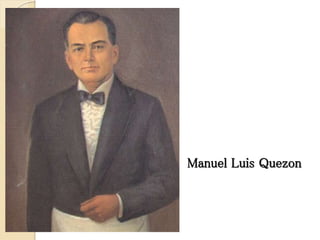
Manuel Luis Quezon
Manuel Luis Quezon
 The Philippines was controlled by the Americans from
1900-1942.
 In 1934 an act was established, which made it
possible that the Philippines could have a
"Commonwealth of the Philippines".
 The first president of this Commonwealth was Manuel
Quezon.
 The first president was given certain power for some
internal affairs.
Changes during the
American Period
Government
 Democracy – the greatest legacy the
Americans gave us.
 3 Branches:
◦ Executive (president)
◦ Legislative (senate and congress)
◦ Judiciary (DOJ)
Education
 Public schools were opened up.
 First teachers were called: Thomasites, because
they came on board the USS Thomas.
 Medium of instruction: English.
 Schools established:
◦ University of the Philippines
◦ Philippine Normal College
◦ Other agricultural schools
Religion
 Protestantism was introduced.
 More or less than 300,000 Filipinos became
protestant.
 There was a separation of the church and
state.
 Freedom of religion was practiced.
Infrastructure
 Transportation and Communication was improved.
 American built roads, streets, and bridges.
 The new infrastructure helped make the movement of
products and services more efficient.
 Boulevards, zone districts, and centers of leisure were
also established.
 American architecture are still present today. PNU,
Manila Hotel and PGH are some examples.
Entertainment
 Hollywood Movies became more popular.
 New kinds of music and dance were introduced
like rock n roll, boogie, jazz, tango, chacha,
polka, and rhumba.
 Filipinos learned to watch and play games like
table tennis, basketball, volleyball, boxing, and
football.
Health and Sanitation
 Filipinos learned the value of cleanliness, and
healthy practices.
 They were taught proper hygiene to make
them healthy and be free from contagious
diseases.
 Hospitals, clinics, and health centers were
established including public hospitals for
lepers.
Clothing
 Modes of Dressings was changed.
 Men: Suits, Polo shirts, ties, and jeans
 Women: Dresses, High-heeled shoes, and
handbags
Food
 Food like ice cream, cakes, beef steak, hotdog,
hamburgers, sandwiches, cookies and donuts
were introduced.
Livelihood
 Philippine Economy improved.
 Increased in Agricultural production.
 Development of new industries.
Attitude
 Filipinos became more frank, and more
humorous.
 We developed a stronger beliefs in rights and
freedom.
 “Pagmamano” was replaced by kissing the
cheeks of parents and elders as a sign of
respect.
Language
 The English language was widely taught all
over the country. Soon some English words
became part of our vocabulary.
 Filipinos adopted American names like Charlie,
Anna, Francis, and Cherry.
Negative Impact of the
American Colonization
Negative Impact of the American
Colonization
 Americanization of Filipinos
 Colonial Mentality
 Respectful Filipino ways of greeting were
replaced by merely saying “hi” or “hello”.
 Filipinos started to prefer white-collar jobs
Negative Impact of the American
Colonization
 Traditional Filipino food like bibingka and
suman were replaced by American food like
hotdog and French fries.
 Lost our sense of “bayanihan”
 In summary, we seemed to reject our own
identity.
Thank you… 

Philippines During American Period

  • 1.
    Philippines During American Period Preparedby: Rowella Reyeg Jeanne Pauline Sevilla Marlon Juan Jairius Sanchez John Marc Lanzarote Joanna Fe Ancheta Francia Michael Bilasano Gio Lorenzo Calseña
  • 2.
  • 3.
    American Colonization ofthe Philippines  The Spanish-American war which started in Cuba, changed the history of the Philippines.  On May 1, 1898, the Americans led by U.S. Navy Admiral George Dewey, in participation of Emilio Aguinaldo, attacked the Spanish Navy in Manila Bay.  Faced with defeat, the Philippines was ceded to the United States by Spain in 1898 after a payment of US$ 20 million to Spain in accordance with the "Treaty of Paris" ending the Spanish-American War.
  • 4.
    American Colonization ofthe Philippines  On June 12, 1898, Filipinos led by Emilio Aguinaldo declare independence.  This declaration was opposed by the U.S. who had plans of taking over the colony.. And this led to a guerrilla war against the Americans.
  • 5.
  • 6.
    The Philippine-American War (1898– 1946)  Hostilities broke out on February 4,1899, after two American private son patrol killed three Filipino soldiers in San Juan, a Manila suburb.  This incident sparked the Philippine-American War, which would cost far more money and took far more lives than the Spanish–American War.
  • 7.
    The Philippine-American War (1898– 1946)  Some 126,000 American soldiers would be committed to the conflict; 4,234 Americans died, as did 16,000 Filipino soldiers who were part of a nationwide guerrilla movement of indeterminate numbers.  At least 34,000Filipinos lost their lives as a direct result of the war, and as many as 200,000may have died as a result of the cholera epidemic at the war's end.  Atrocities were committed by both sides.
  • 8.
    The Philippine-American War (1898– 1946)  Aguinaldo dissolved the regular army in November 1899 and ordered the establishment of decentralized guerrilla commands in each of several military zones.  The revolution was effectively ended with the capture (1901) of Aguinaldo by Gen. Frederick Funston at Palanan, Isabela on March 23, 1901 and was brought to Manila.
  • 9.
    The Philippine-American War (1898– 1946)  Free trade, established by an act of 1909, was expanded in 1913.  Influenced of the uselessness of further resistance, he swore allegiance to the United States and issued a proclamation calling on his compatriots to lay down their arms, officially bringing an end to the war.  However, sporadic insurgent resistance continued in various parts of the Philippines, especially in the Muslim south, until 1913.
  • 10.
  • 11.
    U.S. Colony  Civilgovernment was established by the Americans in 1901, with William Howard Taft as the first American Governor-General of the Philippines.  English was declared the official language.  Six hundred American teachers were imported aboard the USS Thomas.
  • 12.
    U.S. Colony  Also,the Catholic Church was disestablished, and a substantial amount of church land was purchased and redistributed.  Some measures of Filipino self-rule were allowed, however. An elected Filipino legislature was established in 1907.
  • 13.
  • 14.
    Consequences of theAmerican Colonial Rule  During the Spanish period the Spaniards had given enormous land properties to the Catholic church. One of the first things the Americans did was to take care for the redistribution of this land properties.  To do so they first had to pay an amount of US $7.2million to the Vatican in 1904.
  • 15.
    Consequences of theAmerican Colonial Rule  The small farmers or tenants didn't get any land however. The land became property of some large landowners.  Most of the small farmers couldn't pay the asked price or couldn't prove that they were the former owners of the land.
  • 16.
  • 17.
    The Road TowardsPhilippine Independence 1. Jones Law – the law was to approved by President Woodrow Wilson after it was proposed by William Atkinson Jones, an American congressman. ◦ The law stated the right of the Filipinos to attain freedom in the near future.
  • 18.
    The Road TowardsPhilippine Independence 2. Tydings-McDuffie Act – this law was proposed by Milliard Tydings and congressman John McDuffie of the US. ◦ It stated the 10-year preparation for the Philippine independence through a commonwealth government.
  • 19.
    The Road TowardsPhilippine Independence  In 1916, the Philippine Autonomy Act, widely known as the Jones Law , was passed by the U. S. Congress.  The law which served as the new organic act (or constitution) for the Philippines, stated in its preamble that the ultimate independence of the Philippines would be American policy, subject to the establishment of a stable government.
  • 20.
    The Road TowardsPhilippine Independence  The law placed executive power in the Governor General of the Philippines, appointed by the President of the United States, but established a bicameral Philippine Legislature to replace the elected Philippine Assembly (lower house)and appointive Philippine Commission (upper house) previously in place.
  • 21.
    The Road TowardsPhilippine Independence  The Filipino House of Representatives would be purely elected, while the new Philippine Senate would have the majority of its member selected by senatorial district with senators representing non-Christian areas appointed by the Governor-General.
  • 22.
    The Road TowardsPhilippine Independence  In 1934, the United States Congress, having originally passed the Hare-Hawes-Cutting Act as a Philippine Independence Act over President Hoover's refusal, only to have the law rejected by the Philippine legislature, finally passed a new Philippine Independence Act, popularly known as the Tydings-McDuffie Act.  The law provided for the granting of Philippine independence by 1946.
  • 23.
  • 24.
    The Commonwealth Government The Hare-Hawes Cutting Act, passed by Congress in 1932,provided for complete independence of the islands in 1945after 10 years of self-government under U.S. supervision.  The bill had been drawn up with the aid of a commission from the Philippines, but Manuel L. Quezon, the leader of the leading Nationalist party, opposed it, partially because of its threat of American tariffs against Philippine products but principally because of the provisions leaving naval bases in U.S. hands.
  • 25.
    The Commonwealth Government Under his influence, the Philippine legislature rejected the bill.  The Tydings-McDuffie Independence Act (1934) closely looks like the Hare-Hawes Cutting Act, but struck the provisions for American bases and carried a promise of further study to correct “imperfections or inequalities.”
  • 26.
    The Commonwealth Government On May 14, 1935, an election to fill the newly created office of President of the Commonwealth of the Philippines was won by Manuel L. Quezon(Nacionalista Party) and a Filipino government was formed on the basis of principles apparently similar to the US Constitution.
  • 27.
    The Commonwealth Government When Quezon was inaugurated on Nov. 15, 1935, the Commonwealth was formally established in 1935, featured a very strong executive, a unicameral National Assembly, and a Supreme Court composed entirely of Filipinos for the first time since 1901.
  • 28.
    The Commonwealth Government The new government embarked on an ambitious agenda of establishing the basis for national defense, greater control over the economy, reforms in education, improvement of transport, the colonization of the island of Mindanao, and the promotion of local capital and industrialization.
  • 29.
    The Commonwealth Government The Commonwealth however, was also faced with agrarian unrest, an uncertain diplomatic and military situation in South East Asia, and uncertainty about the level of United States commitment to the future Republic of the Philippines.
  • 30.
  • 31.
    Manuel Luis Quezon The Philippines was controlled by the Americans from 1900-1942.  In 1934 an act was established, which made it possible that the Philippines could have a "Commonwealth of the Philippines".  The first president of this Commonwealth was Manuel Quezon.  The first president was given certain power for some internal affairs.
  • 32.
  • 33.
    Government  Democracy –the greatest legacy the Americans gave us.  3 Branches: ◦ Executive (president) ◦ Legislative (senate and congress) ◦ Judiciary (DOJ)
  • 34.
    Education  Public schoolswere opened up.  First teachers were called: Thomasites, because they came on board the USS Thomas.  Medium of instruction: English.  Schools established: ◦ University of the Philippines ◦ Philippine Normal College ◦ Other agricultural schools
  • 35.
    Religion  Protestantism wasintroduced.  More or less than 300,000 Filipinos became protestant.  There was a separation of the church and state.  Freedom of religion was practiced.
  • 36.
    Infrastructure  Transportation andCommunication was improved.  American built roads, streets, and bridges.  The new infrastructure helped make the movement of products and services more efficient.  Boulevards, zone districts, and centers of leisure were also established.  American architecture are still present today. PNU, Manila Hotel and PGH are some examples.
  • 37.
    Entertainment  Hollywood Moviesbecame more popular.  New kinds of music and dance were introduced like rock n roll, boogie, jazz, tango, chacha, polka, and rhumba.  Filipinos learned to watch and play games like table tennis, basketball, volleyball, boxing, and football.
  • 38.
    Health and Sanitation Filipinos learned the value of cleanliness, and healthy practices.  They were taught proper hygiene to make them healthy and be free from contagious diseases.  Hospitals, clinics, and health centers were established including public hospitals for lepers.
  • 39.
    Clothing  Modes ofDressings was changed.  Men: Suits, Polo shirts, ties, and jeans  Women: Dresses, High-heeled shoes, and handbags
  • 40.
    Food  Food likeice cream, cakes, beef steak, hotdog, hamburgers, sandwiches, cookies and donuts were introduced.
  • 41.
    Livelihood  Philippine Economyimproved.  Increased in Agricultural production.  Development of new industries.
  • 42.
    Attitude  Filipinos becamemore frank, and more humorous.  We developed a stronger beliefs in rights and freedom.  “Pagmamano” was replaced by kissing the cheeks of parents and elders as a sign of respect.
  • 43.
    Language  The Englishlanguage was widely taught all over the country. Soon some English words became part of our vocabulary.  Filipinos adopted American names like Charlie, Anna, Francis, and Cherry.
  • 44.
    Negative Impact ofthe American Colonization
  • 45.
    Negative Impact ofthe American Colonization  Americanization of Filipinos  Colonial Mentality  Respectful Filipino ways of greeting were replaced by merely saying “hi” or “hello”.  Filipinos started to prefer white-collar jobs
  • 46.
    Negative Impact ofthe American Colonization  Traditional Filipino food like bibingka and suman were replaced by American food like hotdog and French fries.  Lost our sense of “bayanihan”  In summary, we seemed to reject our own identity.
  • 47.