Operating Theatre DesignOperating Theatre Design
A basic introduction to the design
features of modern operating
theatres and working principles
Martin Smith
2013
Origins of the Word “Theatre”
• Where did the term come from?
• What does it mean?
• What does it mean to you?
We discuss thisWe discuss this
• Definitions of theatre on the Web:
• theater: a building where theatrical performances or motion-picture shows can be presented;
• Theatre: a region in which active military operations are in progress; "the army was in the field awaiting
action"; "he served in the Vietnam theater for three years"
• Theatre: the place that is the setting for dramatic performances.
• Theatre (or theater) is the branch of the performing arts defined by Bernard Beckerman as what "occurs
when one or more persons, isolated in time and/or space, present themselves to another or others.“
• Theatre is that branch of the performing arts concerned with acting out stories in front of an audience using
combinations of speech, gesture, music, dance, sound and spectacle — indeed any one or more elements of
the other performing arts. In addition to the standard narrative dialogue style, theatre takes such forms as
opera, ballet, mime, kabuki, classical Indian dance, Chinese opera, mummers' plays, and pantomime.
• In warfare, a theater or theatre is normally used to define a specific geographic area within which armed
conflict occurs. A war would have to occur over a large portion of the globe in order to be considered to be
large enough to have separate theaters, and the term is not used in the singular. Typically, each theater
would be distinct and separate from other theaters. Very often, the delineation occurs along continental
boundaries or in separate oceans. ...
• Theater in military terms, is a geographic location used for military operations.
• A theater or theatre is a structure where theatrical works or plays are performed or other performances such
as musical concerts may be given. While a theater is not required for performance (see Environmental theatre
or Street theatre), a theater serves to define the acting and audience spaces and organize the theater space
as well as provide facilities for the actors and the tech crew as well as for the audience.
http://en.wikipedia.org/wiki/Theatre_(structure)
• Lecture Theatre: A lecture hall, a large room used for instruction, typically at a college or University (trad.)
There are lots more – see for yourself.
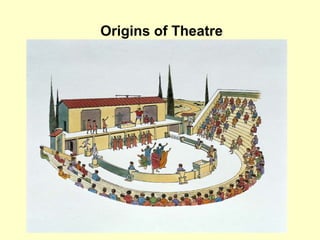
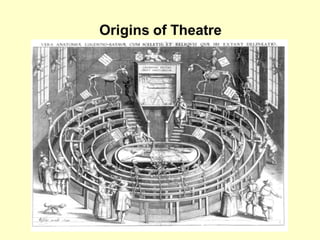
Origins of Theatre
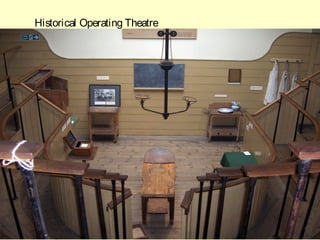
Historical Operating Theatre
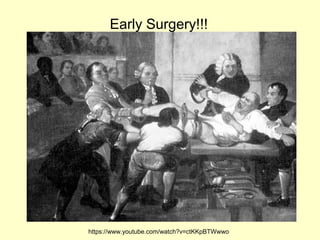
Early Surgery!!!
https://www.youtube.com/watch?v=ctKKpBTWwwo
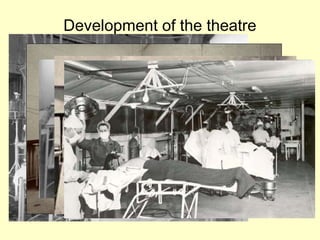
Development of the theatre
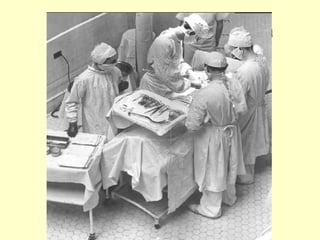
Surgical team operating on a
patient, c.1950s
Environmental requirements
Based on your experience or concepts of
the Operating Theatre Environment, what
is the difference between the classroom
environment and that of the Operating
Room?
Theatre Design Issues
• Building construction (wall and floor
material)
• Heat, light, power, water & drain
requirements
• Access – staff, patients & equipment
• Ventilation
• Support facilities (ancillary rooms and
supplies)
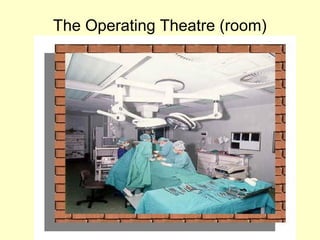
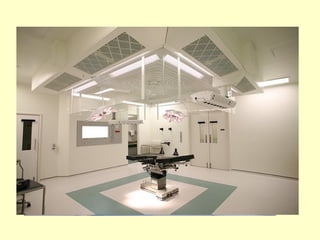
The Operating Theatre (room)
The Built Environment
TheatreTheatre
OrOr
Operating RoomOperating Room
A.RA.R.
ScrubScrub
PrepPrep.“DirtyDirty”
Patient Exit
DisposalDisposal
1 2 3 54 76 8a b
a Air intake
1 Coarse filters
2 Fan
3 Heaters
4 Condensers
5 Filters
6 Heaters
7 Humidifiers
8 Attenuators
b Filtered, humidified (conditioned) air
Theatre Air Conditioning
Remember - maintain pressure gradientsRemember - maintain pressure gradients
“Ideal” conditions *-
Temperature- 18 to 23 O
C
Humidity - 50 to 60%
Air Changes- 20 per hour
* Note -
Conditions may be varied due to patient requirements.
Air changes shown are minimum standard.
Target Humidity in normal temperature ranges is 55%
Theatre Air Conditioning
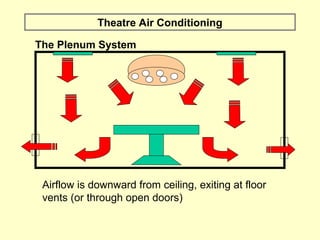
The Plenum System
Airflow is downward from ceiling, exiting at floor
vents (or through open doors)
Theatre Air Conditioning
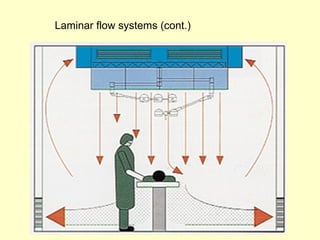
Laminar flow systems
Additional airflow - up to 200 changes per hour.
Laminar flow systems (cont.)
Ceiling Vents of Laminar Flow System
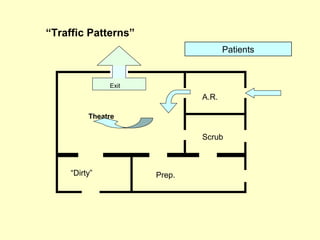
Theatre
A.R.
Scrub
Prep.“Dirty”
Exit
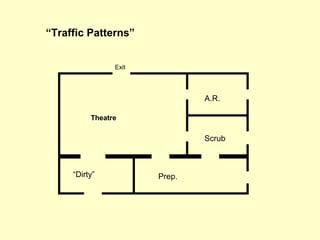
“Traffic Patterns”
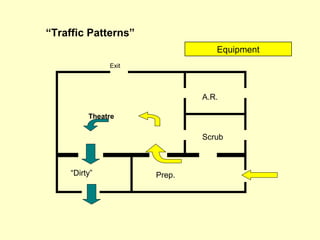
Theatre
A.R.
Scrub
Prep.“Dirty”
Exit
“Traffic Patterns”
Patients
Theatre
A.R.
Scrub
Prep.“Dirty”
Exit
“Traffic Patterns”
Equipment
Theatre
A.R.
Scrub
Prep.“Dirty”
Exit
“Traffic Patterns”
Equipment/instruments
Patients
Staff
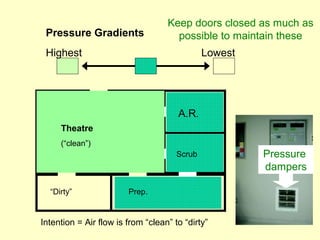
Pressure Gradients
“Dirty”
A.R.
Scrub
Theatre
(“clean”)
Prep.
Highest Lowest
Keep doors closed as much as
possible to maintain these
Pressure
dampers
Intention = Air flow is from “clean” to “dirty”
Charnley-Howarth EXFLOW System
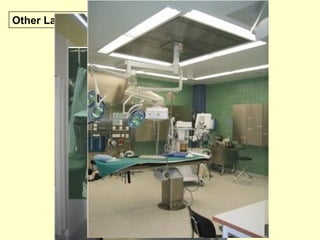
Other Laminar Flow Systems
Quick summary
• Operating Department (Theatres)
• Ideally located near to surgical wards,
CSSD, ITU
• Design should allow for one way traffic
and prevent return flow of contaminants
into clean areas
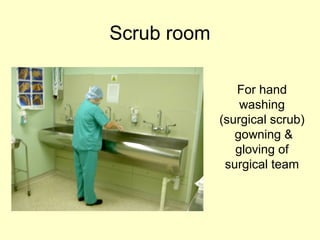
Scrub room
For hand
washing
(surgical scrub)
gowning &
gloving of
surgical team
Prep / instrument room
Sometimes
situated off
the
Operating
room.
Storage of
instruments
& supplies
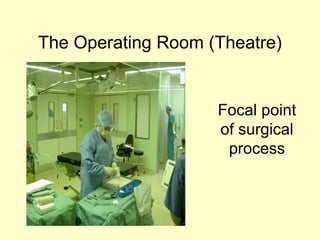
The Operating Room (Theatre)
Focal point
of surgical
process
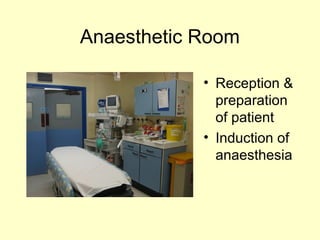
Anaesthetic Room
• Reception &
preparation
of patient
• Induction of
anaesthesia
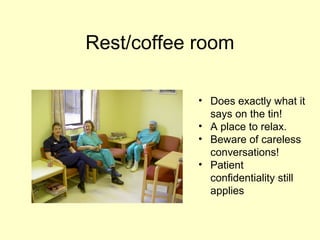
Rest/coffee room
• Does exactly what it
says on the tin!
• A place to relax.
• Beware of careless
conversations!
• Patient
confidentiality still
applies
Operating theatre designOperating theatre design --
conclusionconclusion
• Building /construction
• Heat, light, power, water & drainage
• Access – staff, patients & equipment
• Ventilation
• Support facilities (ancillary rooms and supplies)
• Policies & procedures
• Health & Safety
• Now we consider what goes into the rooms
Stock Control & Management
After considering the built environment we
need to examine the materials utilised
within it.
Question –
What materials (consumables) are
commonly used within the Operating
Theatre Environment?
Materials include -
• Equipment
• Furniture
• Surgical Instruments
• Anaesthetic instruments
• Disposables
• Pharmaceuticals
• Clothing
Issues
• Storage conditions
• Shelf-life
• Expiry dates
• Stock rotation
• Stock control
• Hazard notices
• Damaged goods
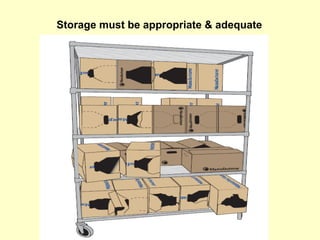
Storage must be appropriate & adequate
1. Type of wine
2. Wine appellation
3. Additional denomination
4. Vintage year
5. Name of the wine
6. Color of the wine
Product Labelling – Essential issues
7. Quantity in millilitres
8. Alcohol content by volume
9. Nation of origin (in our case, obviously Italy)
10. Bottling company data
11. Importer (this information is obviously missing
from labels of wine purchased in Italy)
For those who don’t like wine
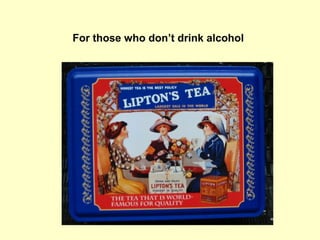
For those who don’t drink alcohol
Fundamental issue –
It is vital you check items are “in date”
and note batch numbers before use
(Also in event of product failure or recall)
Expiry dates & batch numbers
Note
‘Exp’: means for use up to
and until the last day of the
specified month.
‘Use by’: means for use up
to and until the last day of
the specified month.
‘Use before’: means for
use until the first day of the
specified month.
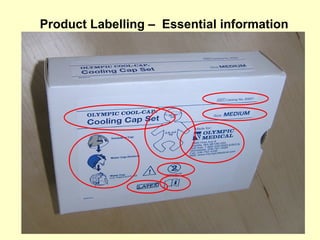
Product Labelling – Essential information
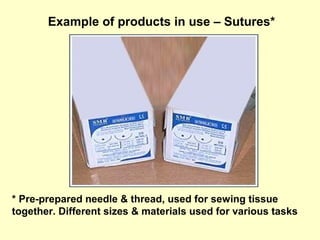
Example of products in use – Sutures*
* Pre-prepared needle & thread, used for sewing tissue
together. Different sizes & materials used for various tasks
Suture box labelling
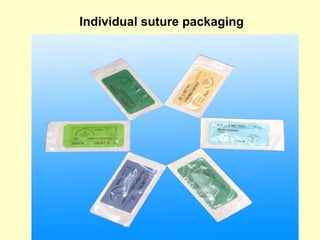
Individual suture packaging
Drug Labelling
Drug ampoule labels
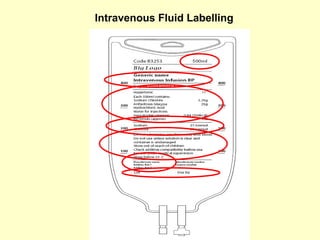
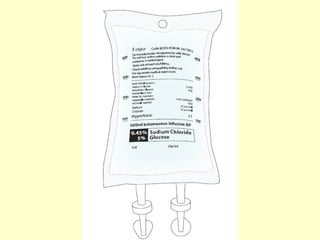
Intravenous Fluid Labelling
Circulated by Drug and safety Agencies –
To alert us (the practitioners) to problems or
concerns with drugs and equipment.
Watch for them and act accordingly
Alert notices –
Questions?
the end
Some further reading
Your Local Department policies.
HBN 26 – Facilities for surgical procedures Vol.1 (2004) A guide.
http://www.michaelbone.plus.com/alexis/hospital/hbn26.pdf
Healthcare Infection Society
http://www.his.org.uk/
The Old Operating Theatre Museum – St Thomas’s hospital
http://www.thegarret.org.uk/oot.htm
AAGBI publications
http://www.aagbi.org/publications/publications-guidelines/A/F
Department of Health
https://www.gov.uk/government/organisations/department-of-health
National Patient Safety Agency (NPSA)
http://www.npsa.nhs.uk/
NPSA Guide to labeling & packaging
http://www.nrls.npsa.nhs.uk/resources/collections/design-for-patient-safety/?entryid45=59831
Medicines & Healthcare products Regulatory Agency (MHRA) Safety information
http://www.mhra.gov.uk/Safetyinformation/index.htm
The Productive Operating Theatre - the well organised theatre
http://www.institute.nhs.uk/quality_and_value/productive_operating_theatre/well_organised_theatre.html
And others – just try searching the web!

Theatre intro design principles - sep 2013

  • 1.
    Operating Theatre DesignOperatingTheatre Design A basic introduction to the design features of modern operating theatres and working principles Martin Smith 2013
  • 2.
    Origins of theWord “Theatre” • Where did the term come from? • What does it mean? • What does it mean to you? We discuss thisWe discuss this
  • 3.
    • Definitions oftheatre on the Web: • theater: a building where theatrical performances or motion-picture shows can be presented; • Theatre: a region in which active military operations are in progress; "the army was in the field awaiting action"; "he served in the Vietnam theater for three years" • Theatre: the place that is the setting for dramatic performances. • Theatre (or theater) is the branch of the performing arts defined by Bernard Beckerman as what "occurs when one or more persons, isolated in time and/or space, present themselves to another or others.“ • Theatre is that branch of the performing arts concerned with acting out stories in front of an audience using combinations of speech, gesture, music, dance, sound and spectacle — indeed any one or more elements of the other performing arts. In addition to the standard narrative dialogue style, theatre takes such forms as opera, ballet, mime, kabuki, classical Indian dance, Chinese opera, mummers' plays, and pantomime. • In warfare, a theater or theatre is normally used to define a specific geographic area within which armed conflict occurs. A war would have to occur over a large portion of the globe in order to be considered to be large enough to have separate theaters, and the term is not used in the singular. Typically, each theater would be distinct and separate from other theaters. Very often, the delineation occurs along continental boundaries or in separate oceans. ... • Theater in military terms, is a geographic location used for military operations. • A theater or theatre is a structure where theatrical works or plays are performed or other performances such as musical concerts may be given. While a theater is not required for performance (see Environmental theatre or Street theatre), a theater serves to define the acting and audience spaces and organize the theater space as well as provide facilities for the actors and the tech crew as well as for the audience. http://en.wikipedia.org/wiki/Theatre_(structure) • Lecture Theatre: A lecture hall, a large room used for instruction, typically at a college or University (trad.) There are lots more – see for yourself.
  • 4.
  • 6.
  • 7.
  • 8.
  • 9.
    Surgical team operatingon a patient, c.1950s
  • 10.
    Environmental requirements Based onyour experience or concepts of the Operating Theatre Environment, what is the difference between the classroom environment and that of the Operating Room?
  • 11.
    Theatre Design Issues •Building construction (wall and floor material) • Heat, light, power, water & drain requirements • Access – staff, patients & equipment • Ventilation • Support facilities (ancillary rooms and supplies)
  • 12.
  • 13.
    The Built Environment TheatreTheatre OrOr OperatingRoomOperating Room A.RA.R. ScrubScrub PrepPrep.“DirtyDirty” Patient Exit DisposalDisposal
  • 14.
    1 2 354 76 8a b a Air intake 1 Coarse filters 2 Fan 3 Heaters 4 Condensers 5 Filters 6 Heaters 7 Humidifiers 8 Attenuators b Filtered, humidified (conditioned) air Theatre Air Conditioning
  • 15.
    Theatre Air Conditioning Remember- maintain pressure gradientsRemember - maintain pressure gradients “Ideal” conditions *- Temperature- 18 to 23 O C Humidity - 50 to 60% Air Changes- 20 per hour * Note - Conditions may be varied due to patient requirements. Air changes shown are minimum standard. Target Humidity in normal temperature ranges is 55%
  • 16.
    Theatre Air Conditioning ThePlenum System Airflow is downward from ceiling, exiting at floor vents (or through open doors)
  • 17.
    Theatre Air Conditioning Laminarflow systems Additional airflow - up to 200 changes per hour.
  • 18.
  • 19.
    Ceiling Vents ofLaminar Flow System
  • 20.
  • 21.
  • 22.
  • 23.
  • 24.
    Pressure Gradients “Dirty” A.R. Scrub Theatre (“clean”) Prep. Highest Lowest Keepdoors closed as much as possible to maintain these Pressure dampers Intention = Air flow is from “clean” to “dirty”
  • 25.
  • 26.
  • 28.
    Quick summary • OperatingDepartment (Theatres) • Ideally located near to surgical wards, CSSD, ITU • Design should allow for one way traffic and prevent return flow of contaminants into clean areas
  • 29.
    Scrub room For hand washing (surgicalscrub) gowning & gloving of surgical team
  • 30.
    Prep / instrumentroom Sometimes situated off the Operating room. Storage of instruments & supplies
  • 31.
    The Operating Room(Theatre) Focal point of surgical process
  • 32.
    Anaesthetic Room • Reception& preparation of patient • Induction of anaesthesia
  • 33.
    Rest/coffee room • Doesexactly what it says on the tin! • A place to relax. • Beware of careless conversations! • Patient confidentiality still applies
  • 34.
    Operating theatre designOperatingtheatre design -- conclusionconclusion • Building /construction • Heat, light, power, water & drainage • Access – staff, patients & equipment • Ventilation • Support facilities (ancillary rooms and supplies) • Policies & procedures • Health & Safety • Now we consider what goes into the rooms
  • 35.
    Stock Control &Management After considering the built environment we need to examine the materials utilised within it. Question – What materials (consumables) are commonly used within the Operating Theatre Environment?
  • 36.
    Materials include - •Equipment • Furniture • Surgical Instruments • Anaesthetic instruments • Disposables • Pharmaceuticals • Clothing
  • 37.
    Issues • Storage conditions •Shelf-life • Expiry dates • Stock rotation • Stock control • Hazard notices • Damaged goods
  • 38.
    Storage must beappropriate & adequate
  • 39.
    1. Type ofwine 2. Wine appellation 3. Additional denomination 4. Vintage year 5. Name of the wine 6. Color of the wine Product Labelling – Essential issues 7. Quantity in millilitres 8. Alcohol content by volume 9. Nation of origin (in our case, obviously Italy) 10. Bottling company data 11. Importer (this information is obviously missing from labels of wine purchased in Italy)
  • 40.
    For those whodon’t like wine
  • 41.
    For those whodon’t drink alcohol
  • 42.
    Fundamental issue – Itis vital you check items are “in date” and note batch numbers before use (Also in event of product failure or recall) Expiry dates & batch numbers
  • 43.
    Note ‘Exp’: means foruse up to and until the last day of the specified month. ‘Use by’: means for use up to and until the last day of the specified month. ‘Use before’: means for use until the first day of the specified month.
  • 44.
    Product Labelling –Essential information
  • 45.
    Example of productsin use – Sutures* * Pre-prepared needle & thread, used for sewing tissue together. Different sizes & materials used for various tasks
  • 46.
  • 47.
  • 48.
  • 49.
  • 50.
  • 51.
  • 53.
    Circulated by Drugand safety Agencies – To alert us (the practitioners) to problems or concerns with drugs and equipment. Watch for them and act accordingly Alert notices –
  • 54.
  • 55.
    Some further reading YourLocal Department policies. HBN 26 – Facilities for surgical procedures Vol.1 (2004) A guide. http://www.michaelbone.plus.com/alexis/hospital/hbn26.pdf Healthcare Infection Society http://www.his.org.uk/ The Old Operating Theatre Museum – St Thomas’s hospital http://www.thegarret.org.uk/oot.htm AAGBI publications http://www.aagbi.org/publications/publications-guidelines/A/F Department of Health https://www.gov.uk/government/organisations/department-of-health National Patient Safety Agency (NPSA) http://www.npsa.nhs.uk/ NPSA Guide to labeling & packaging http://www.nrls.npsa.nhs.uk/resources/collections/design-for-patient-safety/?entryid45=59831 Medicines & Healthcare products Regulatory Agency (MHRA) Safety information http://www.mhra.gov.uk/Safetyinformation/index.htm The Productive Operating Theatre - the well organised theatre http://www.institute.nhs.uk/quality_and_value/productive_operating_theatre/well_organised_theatre.html And others – just try searching the web!

Editor's Notes

  • #9 First picture – we see the beginnings of asepsis (note some staff are dressed in Theatre clothing) but the viewing galleries still remain Second picture – here we see the abolition of the viewing gallery, more emphasis on a clean environment and the advent of specialised equipment such as the focussed theatre light & easily cleaned furniture Third picture – even more development – sterilisation drums, a viewing window and early anaesthetic apparatus. Fourth picture – here we see the surgical team adopting hats and facemasks as part of the “rituals”. Fifth picture – military expediency – once again advances in medical & surgical techniques (including the operating theatre) is made during times of conflict.
  • #10 Here we see the Operating theatre in the mid 19590’s The clothing and equipment are very similar to modern day equivalents. Materials are mainly re-usable (linin based clothing & drapes) unlike the disposables of today.
  • #14 This plan is a “typical” set up for a single operating room. The Theatre or Operating Room is supported by several ancillary rooms – A.R = Anaesthetic Room Scrub = the room where surgical staff wash their hands & “gown & glove” prior to entering the “sterile field” Prep. = the room where sterile supplies (instrument trays & disposables) are stored prior to use – sometimes this is where the surgical instrument trollies are opened & prepared. Dirty = used to be called the sluice – this may be an actual room or a hatch to the “dirty” corridor through which used instruments, equipment & waste materials are disposed of after use (either for disposal or re-processing)
  • #15 Principles of air-conditioning Air enters at a Course filters remove particulate material Fans propel air through the system Heating coils to heat the air then – Cooling coils rapidly chill the air to condense out water The dry cold air (a known quantity) is then filtered to remove all particulate matter (dust, skin scales etc.) Once filtered the air is now heated and humidified to provide a safe, comfortable environment for the Operating room.