SURGICAL SAFETY
CHECKLIST
PRESENTER:
Dr Pushpendra Singh
Dr Niraj Raj
Guide:
Dr. John Mukhopadhaya
Introduction
 Definition :- Safety checklists in medicine are designed to identify a
potential error before it results in harm to a patient
 Why is a checklist ?
 When ?
 Strategies
Why a checklist
 To avoid surgery of wrong patients, wrong side.
 To improve team communication and consistency of care.
 To avoid: complications and avoidable death associated
with surgery.
 To avoid: adverse legal issues
When surgical safety checklist
apply?
 WHO checklist be completed for every patient undergoing a
surgical procedure.
 The WHO has defined a surgical condition as ‘any condition that
requires suture, incision, excision, manipulation, or other invasive
procedure that usually, but not always, requires local, regional, or
general anesthesia.
 Invasive procedures requiring written consent, even if not
involving surgeons, should be considered to be ‘surgical
procedures’ for the purposes of this checklist.
Surgical safety checklist
 In 2008, WHO ( 2008)
 Intended to be globally applicable
The Role Of Surgical Safety
Checklist
Oral confirmation by surgical teams of the completion of
the basic steps to ensure:
 Safe delivery of anaesthesia
 Prophylaxis against infection
 Effective team work
 Other essentials
How the checklist is used
It is used at three critical juncture:
 Sign in: before anaesthesia is administered,
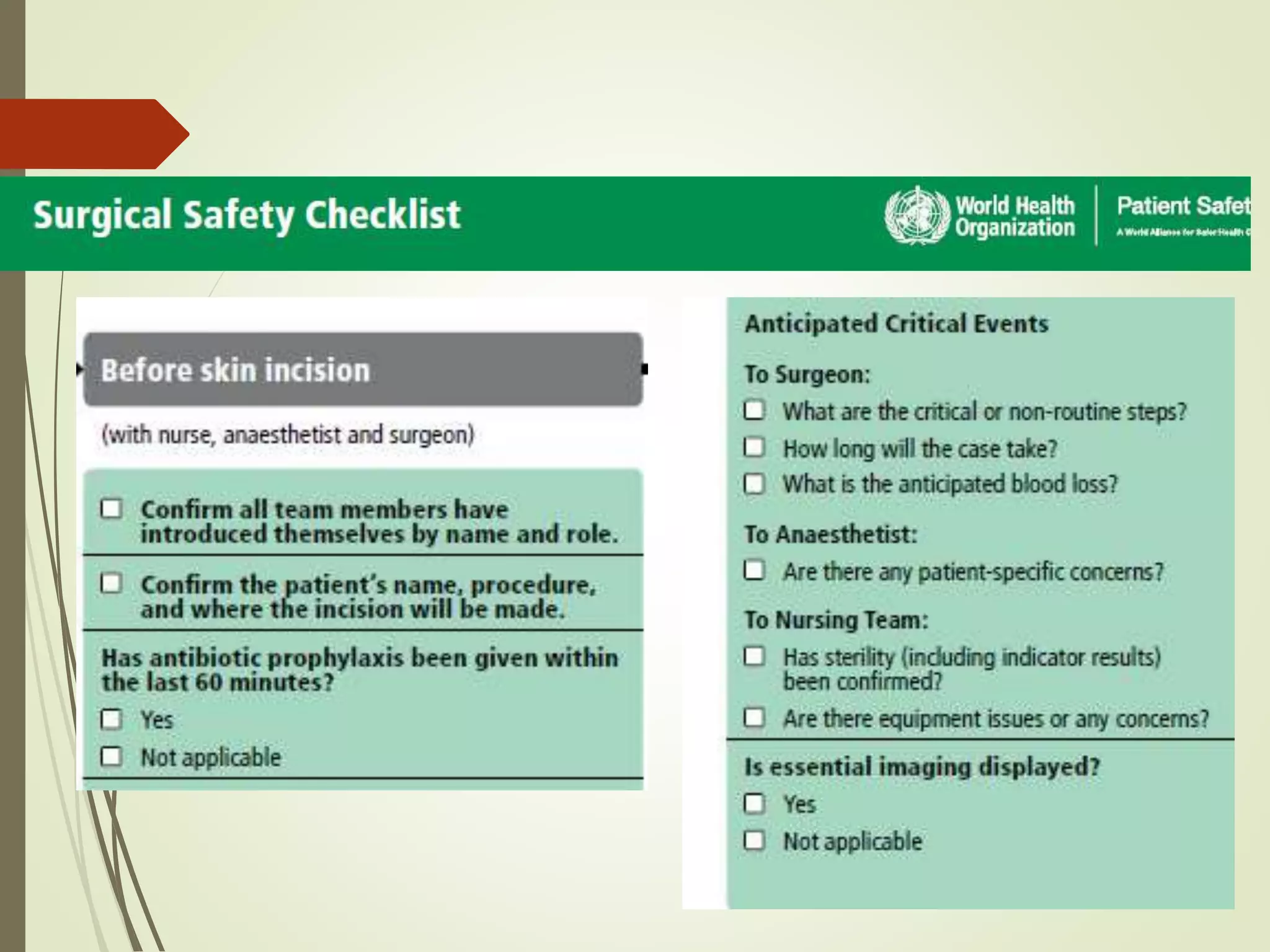
 Time out: immediately before incision and
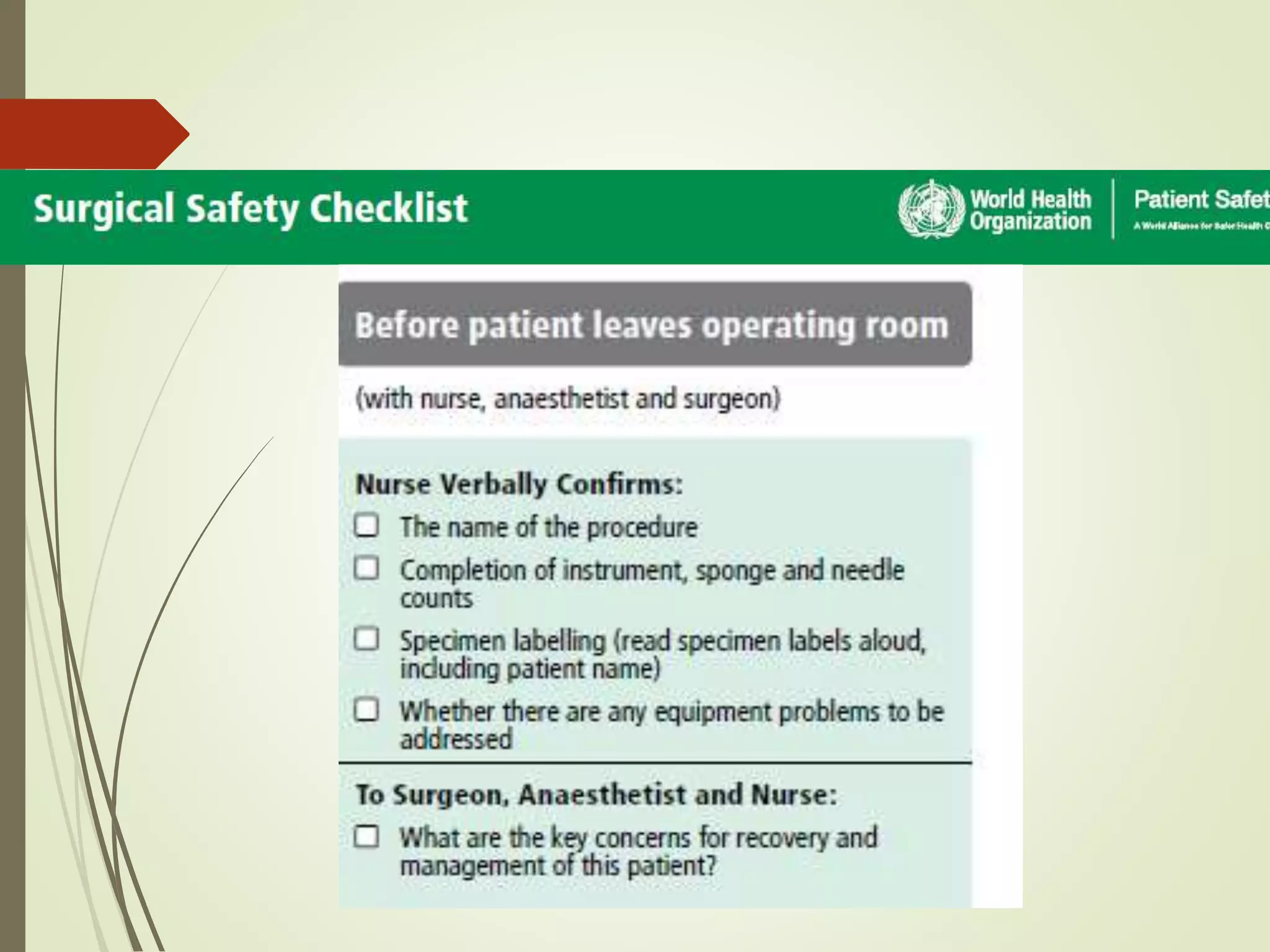
 Sign out: before the patient is taken out of the operating
room.
World Health Organization’s 10
aims for safe surgery.
 1 The team will operate on the correct patient at the correct
site.
 2 The team will use methods known to prevent harm from
administration of anaesthetics, while protecting the patient
from pain.
 3 The team will recognise and effectively prepare for life
threatening loss of airway or respiratory function.
 4 The team will recognise and effectively prepare for risk of
high blood loss.
 5 The team will avoid inducing an allergic or adverse drug
reaction for which the patient is known to be at significant
risk
 6 The team will consistently use methods known to minimise the risk
for surgical site infection.
 7 The team will prevent inadvertent retention of instruments or
sponges in surgical wounds.
 8 The team will secure and accurately identify all surgical specimens.
 9 The team will effectively communicate and exchange critical
information for the safe conduct of the operation.
 10 Hospitals and public health systems will establish routine
surveillance of surgical capacity, volume and results.
Outcome of checklist
 Marked improvements in surgical outcomes
Take Home
Take Home
 EVERY CHECK CAN SAVE LIFE
 Can help us to be safe for our work and safe for our patient.

SURGICAL SAFETY CHECKLIST symposium (2).pptx

  • 1.
    SURGICAL SAFETY CHECKLIST PRESENTER: Dr PushpendraSingh Dr Niraj Raj Guide: Dr. John Mukhopadhaya
  • 2.
    Introduction  Definition :-Safety checklists in medicine are designed to identify a potential error before it results in harm to a patient  Why is a checklist ?  When ?  Strategies
  • 3.
    Why a checklist To avoid surgery of wrong patients, wrong side.  To improve team communication and consistency of care.  To avoid: complications and avoidable death associated with surgery.  To avoid: adverse legal issues
  • 4.
    When surgical safetychecklist apply?  WHO checklist be completed for every patient undergoing a surgical procedure.  The WHO has defined a surgical condition as ‘any condition that requires suture, incision, excision, manipulation, or other invasive procedure that usually, but not always, requires local, regional, or general anesthesia.  Invasive procedures requiring written consent, even if not involving surgeons, should be considered to be ‘surgical procedures’ for the purposes of this checklist.
  • 5.
    Surgical safety checklist In 2008, WHO ( 2008)  Intended to be globally applicable
  • 6.
    The Role OfSurgical Safety Checklist Oral confirmation by surgical teams of the completion of the basic steps to ensure:  Safe delivery of anaesthesia  Prophylaxis against infection  Effective team work  Other essentials
  • 7.
    How the checklistis used It is used at three critical juncture:  Sign in: before anaesthesia is administered,  Time out: immediately before incision and  Sign out: before the patient is taken out of the operating room.
  • 11.
    World Health Organization’s10 aims for safe surgery.  1 The team will operate on the correct patient at the correct site.  2 The team will use methods known to prevent harm from administration of anaesthetics, while protecting the patient from pain.  3 The team will recognise and effectively prepare for life threatening loss of airway or respiratory function.  4 The team will recognise and effectively prepare for risk of high blood loss.  5 The team will avoid inducing an allergic or adverse drug reaction for which the patient is known to be at significant risk
  • 12.
     6 Theteam will consistently use methods known to minimise the risk for surgical site infection.  7 The team will prevent inadvertent retention of instruments or sponges in surgical wounds.  8 The team will secure and accurately identify all surgical specimens.  9 The team will effectively communicate and exchange critical information for the safe conduct of the operation.  10 Hospitals and public health systems will establish routine surveillance of surgical capacity, volume and results.
  • 13.
    Outcome of checklist Marked improvements in surgical outcomes
  • 14.
  • 15.
    Take Home  EVERYCHECK CAN SAVE LIFE  Can help us to be safe for our work and safe for our patient.