







What is Architecture?
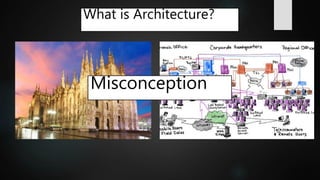
Misconception
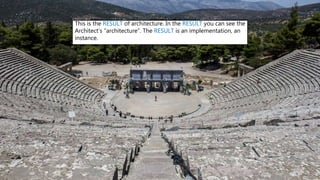
This is the RESULT of architecture. In the RESULT you can see the
Architect’s “architecture”. The RESULT is an implementation, an
instance.
Complexity & Change
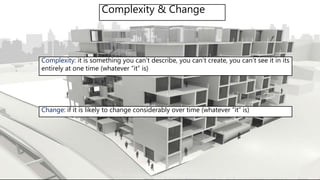
Complexity: it is something you can’t describe, you can’t create, you can’t see it in its
entirely at one time (whatever “it” is)
Change: if it is likely to change considerably over time (whatever “it” is)
The key to complexity and change is
ARCHITECTURE
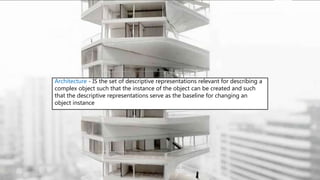
Architecture - IS the set of descriptive representations relevant for describing a
complex object such that the instance of the object can be created and such
that the descriptive representations serve as the baseline for changing an
object instance
Are there any problems with
Architecture definition?
“Architecture is Architecture is
Architecture”
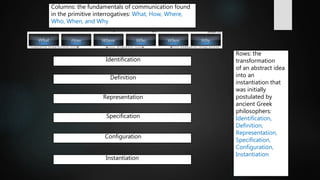
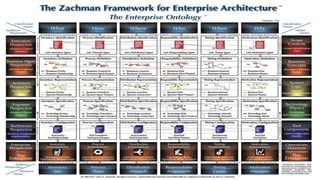
Zachman Framework - is a schema!
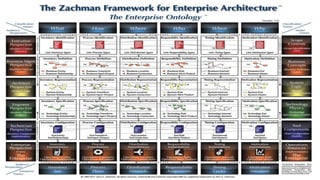
Columns: the fundamentals of communication found
in the primitive interrogatives: What, How, Where,
Who, When, and Why
Identification
Definition
Representation
Configuration
Instantiation
Rows: the
transformation
of an abstract idea
into an
instantiation that
was initially
postulated by
ancient Greek
philosophers:
Identification,
Definition,
Representation,
Specification,
Configuration,
Instantiation
Specification
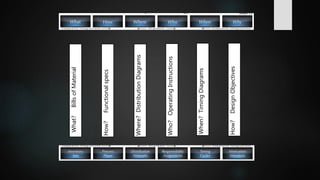
What?BillsofMaterial
How?Functionalspecs
Where?DistributionDiagrams
Who?OperatingInstructions
When?TimingDiagrams
How?DesignObjectives
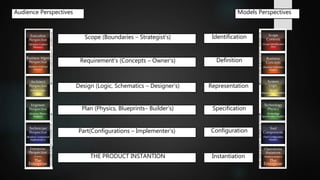
Scope (Boundaries – Strategist’s)
Requirement’s (Concepts – Owner’s)
Design (Logic, Schematics – Designer’s)
Plan (Physics, Blueprints– Builder’s)
Part(Configurations – Implementer’s)
THE PRODUCT INSTANTION
Audience Perspectives Models Perspectives
Identification
Definition
Representation
Specification
Instantiation
Configuration
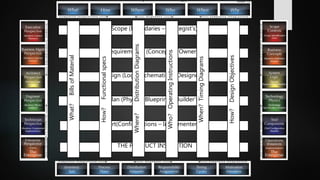
Scope (Boundaries – Strategist’s)
Requirement’s (Concepts – Owner’s)
Design (Logic, Schematics – Designer’s)
Plan (Physics, Blueprints– Builder’s)
Part(Configurations – Implementer’s)
THE PRODUCT INSTANTION
What?BillsofMaterial
How?Functionalspecs
Where?DistributionDiagrams
Who?OperatingInstructions
When?TimingDiagrams
How?DesignObjectives
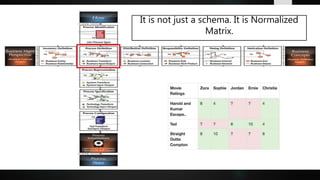
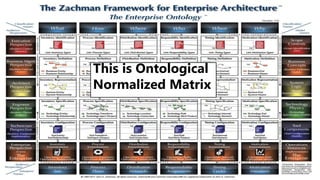
It is not just a schema. It is Normalized
Matrix.
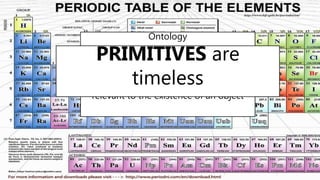
Ontology
An Ontology is the classification of the
total set of “PRIMITIVE” (elemental)
components that exist and that are
relevant to the existence of an object
PRIMITIVES are
timeless
Methodology (process)
Methodology – a process of
transformation. A methodology
produces “COMPOSITE”(compound)
implementation of “PRIMITIVES”
COPMPOSITES are
temporal
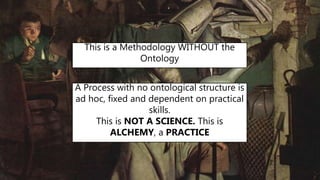
This is a Methodology WITHOUT the
Ontology
A Process with no ontological structure is
ad hoc, fixed and dependent on practical
skills.
This is NOT A SCIENCE. This is
ALCHEMY, a PRACTICE
This is a Methodology WITH the
Ontology
Alchemist can ignore Periodic Table and define a process (a
methodology) that will produce results, point-in-time solutions, based
on their own skills and experience (heuristics). The process
(methodology) will be fixed (not changeable) but the alchemist will
forever remain ALCHEMIST
Methodologies WITH Ontology produce
ARCHITECTURE
This is NOT a
methodology
(process)
This is Ontological
Normalized Matrix
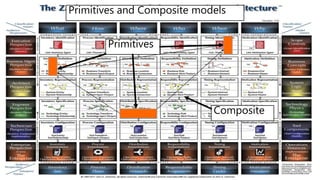
Primitives and Composite models
Primitives
Composite
Customer Order
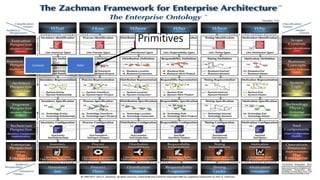
Primitives
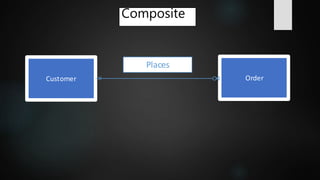
Customer Order
Places
Composite
Primitives
Place
Composite
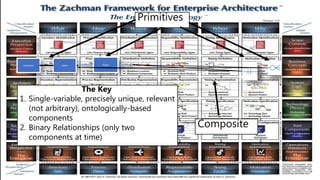
The Key
1. Single-variable, precisely unique, relevant
(not arbitrary), ontologically-based
components
2. Binary Relationships (only two
components at time)
Customer Order
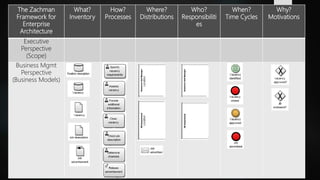
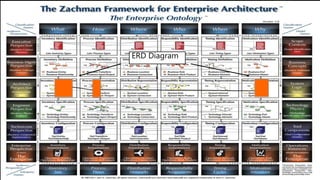
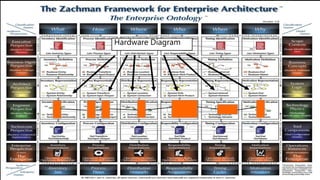
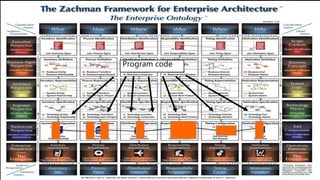
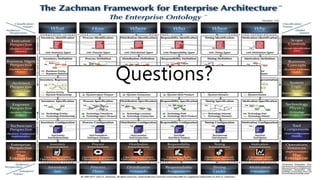
The Zachman
Framework for
Enterprise
Architecture
What?
Inventory
How?
Processes
Where?
Distributions
Who?
Responsibiliti
es
When?
Time Cycles
Why?
Motivations
Executive
Perspective
(Scope)
Business Mgmt
Perspective
(Business Models)
LocationLocation
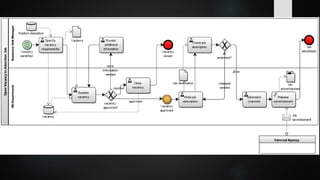
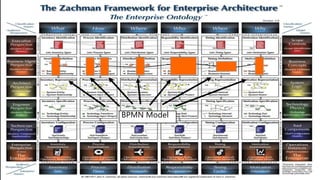
BPMN Model
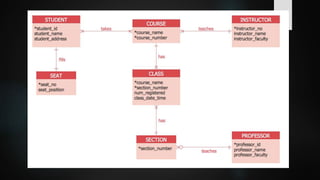
ERD Diagram
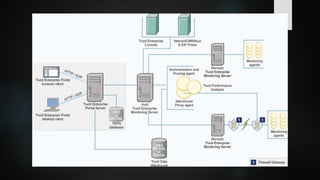
Hardware Diagram
Program code
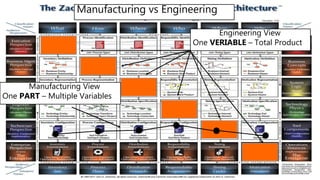
Manufacturing vs Engineering
Engineering View
One VERIABLE – Total Product
Manufacturing View
One PART – Multiple Variables
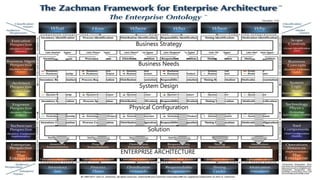
ENTERPRISE ARCHITECTURE
Business Strategy
Business Needs
System Design
Physical Configuration
Solution
1. Make-to-Order Strategy. If IT is in the business of building
and running systems and the objective is to build systems
faster and cheaper, then break them down into smaller pieces
and start writing the code. Result is more of the same …
LEGACY. (NOT reusable, NOT interoperable, etc., etc.,…BUT
running).
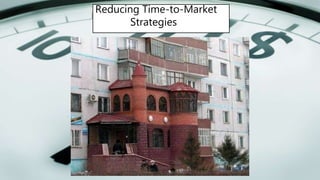
Reducing Time-to-Market
Strategies
Reducing Time-to-Market
Strategies
2. Provide-from-Stock Strategy. If the IT strategy is to buy
rather than build then implement “as is”, change the Enterprise
to fit the package. Build and maintain “interfaces” with any
replicated concerns in the existing legacy or in future system
implementations.
Reducing Time-to-Market
Strategies
3. Assemble-to-Order Strategy. If IT is in the business of
engineering and manufacturing Enterprises, then start build an
inventory of Enterprise Architecture assets, engineering them to
be reused in any implementation. The “asset paradigm”.
Questions?

Діма Зубець ” The Zachman Framework for Enterprise Architecture”