REAL 
LIFE
CLEAN ARCHITECTURE
@BattistonMattia
ABOUT ME
●  from Verona, Italy
●  software dev & continuous improvement
●  Kanban, Lean, Agile “helper”
●  Sky Network Services

Mattia Battiston
@BattistonMattia
mattia.battiston@gmail.com
mattia-battiston
DISCLAIMER #1
MICROSERVICES
“Normal” apps
DISCLAIMER #2
THE ONE WAY
Our experience
(pragmatism, tradeoffs)
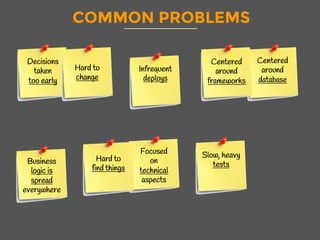
Infrequent
deploys
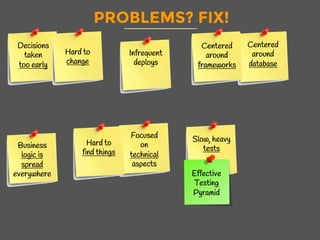
COMMON PROBLEMS
Decisions
taken
too early
Hard to
change
Centered
around
database
Centered
around
frameworks
Business
logic is
spread
everywhere
Focused
on
technical
aspects
Slow, heavy
tests
Hard to
find things
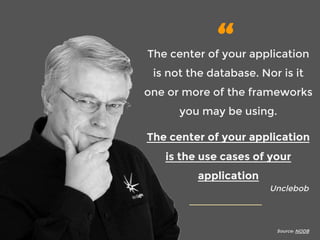
“
The center of your application
is not the database. Nor is it
one or more of the frameworks
you may be using. 
The center of your application
is the use cases of your
application
Unclebob
Source: NODB
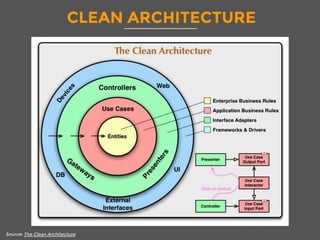
CLEAN ARCHITECTURE
Source: The Clean Architecture
THANK YOU!
THE END
Just Kidding,
The fun is about to
start :-)
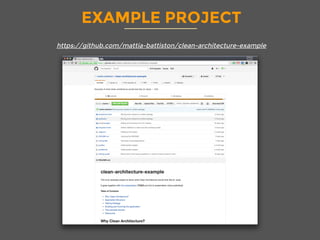
EXAMPLE PROJECT
https://github.com/mattia-battiston/clean-architecture-example
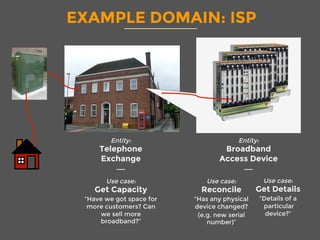
EXAMPLE DOMAIN: ISP
Entity:
Telephone 
Exchange
Entity:
Broadband 
Access Device
Use case: 
Get Capacity
“Have we got space for
more customers? Can
we sell more
broadband?”

Use case: 
Reconcile
“Has any physical
device changed?
(e.g. new serial
number)”

Use case: 
Get Details
“Details of a
particular
device?”
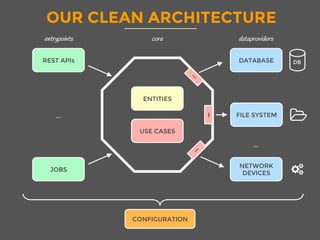
OUR CLEAN ARCHITECTURE
ENTITIES
USE CASES
REST APIs
JOBS
DATABASE
FILE SYSTEM
NETWORK
DEVICES
DB
I
...
...
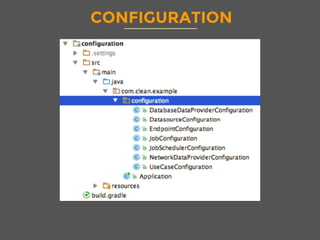
CONFIGURATION
coreentrypoints dataproviders
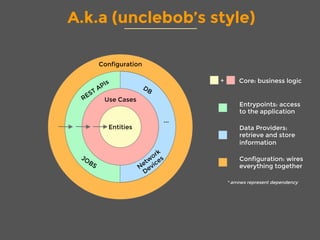
A.k.a (unclebob’s style)
Entities
Use Cases
Configuration
+
 Core: business logic
Entrypoints: access
to the application
Data Providers:
retrieve and store
information
...
Configuration: wires
everything together
* arrows represent dependency
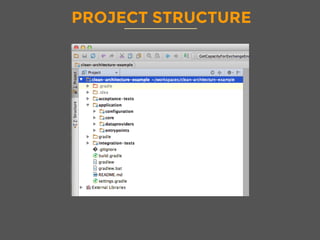
PROJECT STRUCTURE
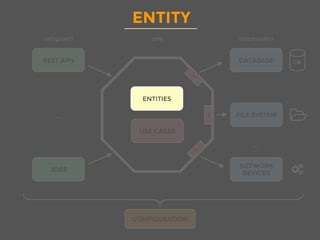
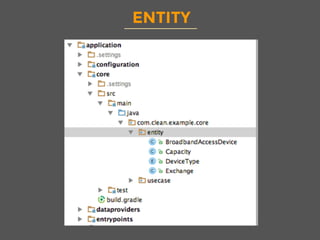
ENTITY
ENTITIES
USE CASES
REST APIs
JOBS
DATABASE
FILE SYSTEM
NETWORK
DEVICES
DB
I
...
...
CONFIGURATION
coreentrypoints dataproviderscore
ENTITIES
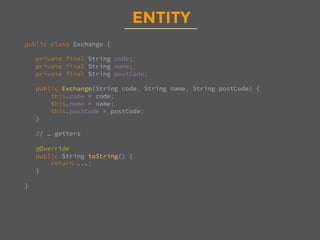
ENTITY
ENTITY
public class Exchange {

private final String code;
private final String name;
private final String postCode;

public Exchange(String code, String name, String postCode) {
this.code = code;
this.name = name;
this.postCode = postCode;
}

// … getters

@Override
public String toString() {
return ...;
}

}
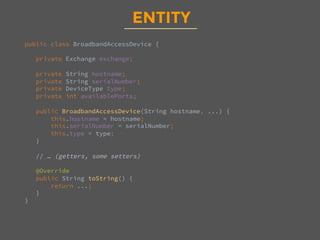
ENTITY
public class BroadbandAccessDevice {

private Exchange exchange;

private String hostname;
private String serialNumber;
private DeviceType type;
private int availablePorts;

public BroadbandAccessDevice(String hostname, ...) {
this.hostname = hostname;
this.serialNumber = serialNumber;
this.type = type;
}

// … (getters, some setters)

@Override
public String toString() {
return ...;
}
}
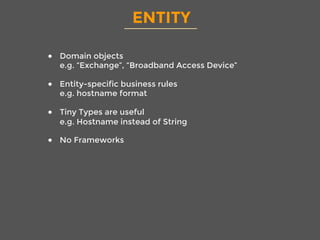
ENTITY
●  Domain objects
e.g. “Exchange”, “Broadband Access Device”
●  Entity-specific business rules
e.g. hostname format
●  Tiny Types are useful
e.g. Hostname instead of String
●  No Frameworks
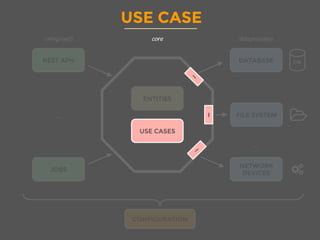
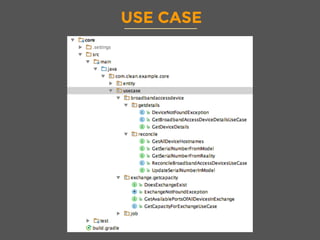
USE CASE
ENTITIES
USE CASES
REST APIs
JOBS
DATABASE
FILE SYSTEM
NETWORK
DEVICES
DB
I
...
...
CONFIGURATION
coreentrypoints dataproviders
USE CASES
I
core
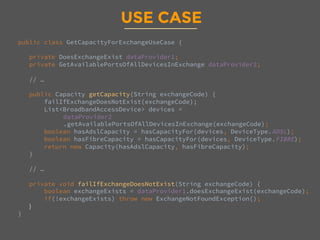
USE CASE
USE CASE
public class GetCapacityForExchangeUseCase {

private DoesExchangeExist dataProvider1; 
private GetAvailablePortsOfAllDevicesInExchange dataProvider2;

// … 

public Capacity getCapacity(String exchangeCode) {
failIfExchangeDoesNotExist(exchangeCode);
List<BroadbandAccessDevice> devices = 
dataProvider2
.getAvailablePortsOfAllDevicesInExchange(exchangeCode);
boolean hasAdslCapacity = hasCapacityFor(devices, DeviceType.ADSL);
boolean hasFibreCapacity = hasCapacityFor(devices, DeviceType.FIBRE);
return new Capacity(hasAdslCapacity, hasFibreCapacity);
}

// …

private void failIfExchangeDoesNotExist(String exchangeCode) {
boolean exchangeExists = dataProvider1.doesExchangeExist(exchangeCode);
if(!exchangeExists) throw new ExchangeNotFoundException();
}
}
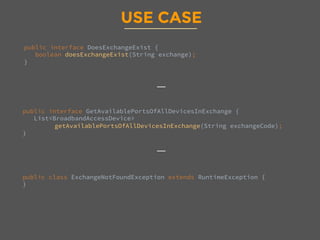
USE CASE
public interface DoesExchangeExist {
boolean doesExchangeExist(String exchange);
}

public interface GetAvailablePortsOfAllDevicesInExchange {
List<BroadbandAccessDevice> 
getAvailablePortsOfAllDevicesInExchange(String exchangeCode);
}

public class ExchangeNotFoundException extends RuntimeException {
}
USE CASE
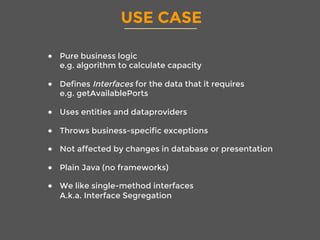
●  Pure business logic
e.g. algorithm to calculate capacity
●  Defines Interfaces for the data that it requires
e.g. getAvailablePorts
●  Uses entities and dataproviders
●  Throws business-specific exceptions
●  Not affected by changes in database or presentation
●  Plain Java (no frameworks)
●  We like single-method interfaces 
A.k.a. Interface Segregation
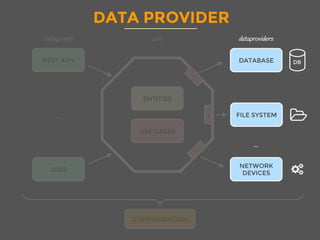
DATA PROVIDER
ENTITIES
USE CASES
REST APIs
JOBS
DATABASE
FILE SYSTEM
NETWORK
DEVICES
DB
I
...
...
CONFIGURATION
coreentrypoints dataproviders
DATABASE
FILE SYSTEM
NETWORK
DEVICES
DB
...
dataproviders
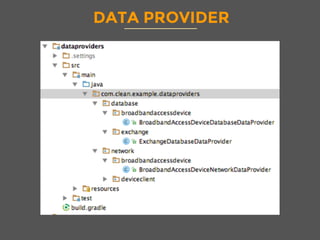
DATA PROVIDER
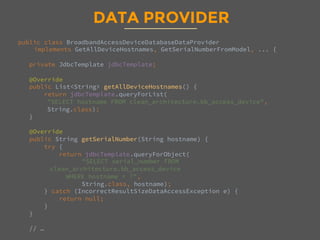
DATA PROVIDER
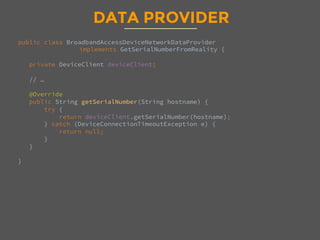
public class BroadbandAccessDeviceDatabaseDataProvider 
implements GetAllDeviceHostnames, GetSerialNumberFromModel, ... {

private JdbcTemplate jdbcTemplate;

@Override
public List<String> getAllDeviceHostnames() {
return jdbcTemplate.queryForList(
"SELECT hostname FROM clean_architecture.bb_access_device", 
String.class);
}

@Override
public String getSerialNumber(String hostname) {
try {
return jdbcTemplate.queryForObject(

"SELECT serial_number FROM
clean_architecture.bb_access_device 
WHERE hostname = ?", 

String.class, hostname);
} catch (IncorrectResultSizeDataAccessException e) {
return null;
}
}

// …
DATA PROVIDER
public class BroadbandAccessDeviceNetworkDataProvider 
implements GetSerialNumberFromReality {

private DeviceClient deviceClient;

// …

@Override
public String getSerialNumber(String hostname) {
try {
return deviceClient.getSerialNumber(hostname);
} catch (DeviceConnectionTimeoutException e) {
return null;
}
}

}
DATA PROVIDER
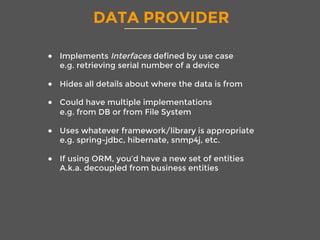
●  Implements Interfaces defined by use case
e.g. retrieving serial number of a device
●  Hides all details about where the data is from
●  Could have multiple implementations
e.g. from DB or from File System
●  Uses whatever framework/library is appropriate
e.g. spring-jdbc, hibernate, snmp4j, etc.
●  If using ORM, you’d have a new set of entities
A.k.a. decoupled from business entities
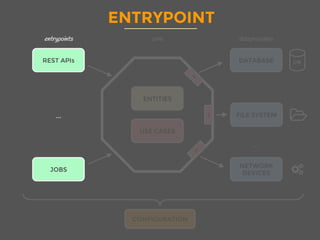
ENTRYPOINT
ENTITIES
USE CASES
REST APIs
JOBS
DATABASE
FILE SYSTEM
NETWORK
DEVICES
DB
I
...
...
CONFIGURATION
coreentrypoints dataproviders
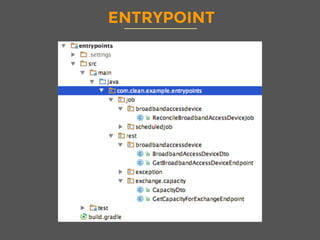
REST APIs
JOBS
...
entrypoints
ENTRYPOINT
ENTRYPOINT
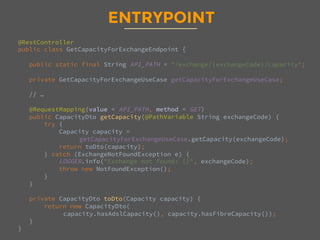
@RestController
public class GetCapacityForExchangeEndpoint {

public static final String API_PATH = "/exchange/{exchangeCode}/capacity";

private GetCapacityForExchangeUseCase getCapacityForExchangeUseCase;

// …

@RequestMapping(value = API_PATH, method = GET)
public CapacityDto getCapacity(@PathVariable String exchangeCode) {
try {
Capacity capacity = 
getCapacityForExchangeUseCase.getCapacity(exchangeCode);
return toDto(capacity);
} catch (ExchangeNotFoundException e) {
LOGGER.info("Exchange not found: {}", exchangeCode);
throw new NotFoundException();
}
}

private CapacityDto toDto(Capacity capacity) {
return new CapacityDto(
capacity.hasAdslCapacity(), capacity.hasFibreCapacity());
}
}
ENTRYPOINT
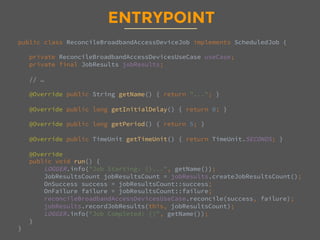
public class ReconcileBroadbandAccessDeviceJob implements ScheduledJob {

private ReconcileBroadbandAccessDevicesUseCase useCase;
private final JobResults jobResults;

// …

@Override public String getName() { return "..."; }

@Override public long getInitialDelay() { return 0; }

@Override public long getPeriod() { return 5; }

@Override public TimeUnit getTimeUnit() { return TimeUnit.SECONDS; }

@Override
public void run() {
LOGGER.info("Job Starting: {}...", getName());
JobResultsCount jobResultsCount = jobResults.createJobResultsCount();
OnSuccess success = jobResultsCount::success;
OnFailure failure = jobResultsCount::failure;
reconcileBroadbandAccessDevicesUseCase.reconcile(success, failure);
jobResults.recordJobResults(this, jobResultsCount);
LOGGER.info("Job Completed: {}", getName());
}
}
ENTRYPOINT
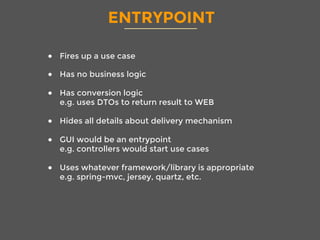
●  Fires up a use case
●  Has no business logic
●  Has conversion logic 
e.g. uses DTOs to return result to WEB
●  Hides all details about delivery mechanism
●  GUI would be an entrypoint
e.g. controllers would start use cases
●  Uses whatever framework/library is appropriate
e.g. spring-mvc, jersey, quartz, etc.
CONFIGURATION
ENTITIES
USE CASES
REST APIs
JOBS
DATABASE
FILE SYSTEM
NETWORK
DEVICES
DB
I
...
...
CONFIGURATION
coreentrypoints dataproviders
CONFIGURATION
CONFIGURATION
CONFIGURATION
@Configuration
@EnableAutoConfiguration
@ComponentScan(basePackages = "com.clean.example.configuration")
public class Application {
public static void main(String[] args) {
SpringApplication.run(Application.class, args);
}
}


@Configuration
public class EndpointConfiguration {
@Bean
public GetBroadbandAccessDeviceEndpoint getBroadbandAccessDeviceEndpoint() {
return new GetBroadbandAccessDeviceEndpoint(...);
}
// …other endpoints… 
}


@Configuration
public class WebServerConfiguration {
// …wires web server with framework… 
}
CONFIGURATION
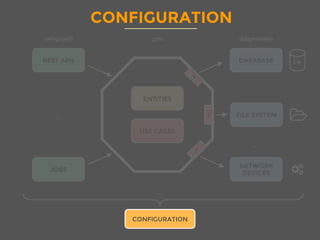
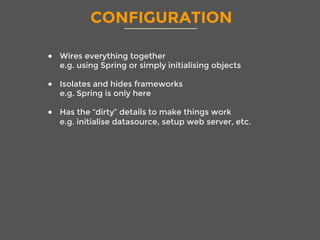
●  Wires everything together
e.g. using Spring or simply initialising objects
●  Isolates and hides frameworks
e.g. Spring is only here
●  Has the “dirty” details to make things work
e.g. initialise datasource, setup web server, etc.
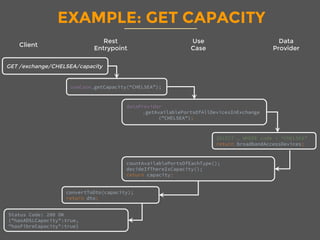
EXAMPLE: GET CAPACITY
Rest 
Entrypoint
Client
Use 
Case
Data 
Provider
GET /exchange/CHELSEA/capacity
useCase.getCapacity(“CHELSEA”);
dataProvider 
.getAvailablePortsOfAllDevicesInExchange
(”CHELSEA”);
SELECT … WHERE code = “CHELSEA”
return broadbandAccessDevices;
countAvailablePortsOfEachType();
decideIfThereIsCapacity();
return capacity;
convertToDto(capacity);
return dto;
Status Code: 200 OK
{"hasADSLCapacity":true,
"hasFibreCapacity":true}
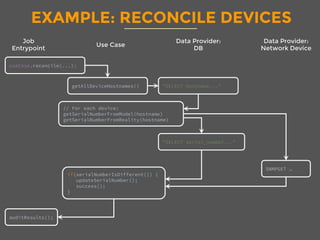
EXAMPLE: RECONCILE DEVICES
Use Case
Job
Entrypoint
Data Provider:
DB
Data Provider:
Network Device
useCase.reconcile(...);
getAllDeviceHostnames()
 "SELECT hostname...”
// For each device:
getSerialNumberFromModel(hostname)
getSerialNumberFromReality(hostname)
"SELECT serial_number...”
SNMPGET … 
if(serialNumberIsDifferent()) {
updateSerialNumber();
success();
}
auditResults();
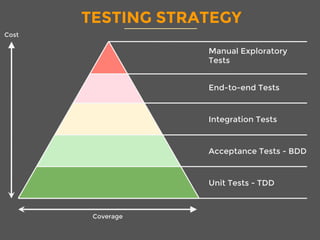
Coverage
TESTING STRATEGY
Unit Tests - TDD
Acceptance Tests - BDD
Integration Tests
End-to-end Tests
Manual Exploratory
Tests
Cost
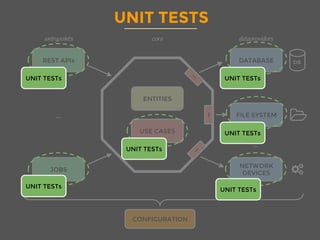
UNIT TESTS
ENTITIES
USE CASES
REST APIs
JOBS
DATABASE
FILE SYSTEM
NETWORK
DEVICES
DB
I
...
...
CONFIGURATION
coreentrypoints dataproviders
UNIT TESTs
UNIT TESTs
UNIT TESTs
UNIT TESTs
UNIT TESTs
UNIT TESTs
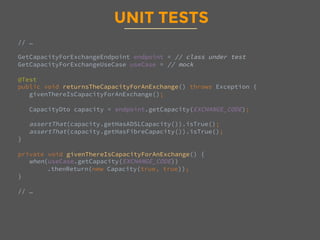
UNIT TESTS
// …

GetCapacityForExchangeEndpoint endpoint = // class under test
GetCapacityForExchangeUseCase useCase = // mock

@Test
public void returnsTheCapacityForAnExchange() throws Exception {
givenThereIsCapacityForAnExchange();

CapacityDto capacity = endpoint.getCapacity(EXCHANGE_CODE);

assertThat(capacity.getHasADSLCapacity()).isTrue();
assertThat(capacity.getHasFibreCapacity()).isTrue();
}

private void givenThereIsCapacityForAnExchange() {
when(useCase.getCapacity(EXCHANGE_CODE))
.thenReturn(new Capacity(true, true));
}

// …
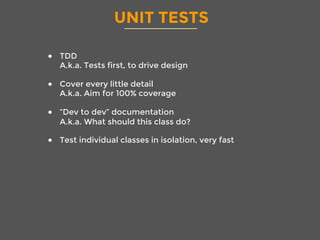
UNIT TESTS
●  TDD
A.k.a. Tests first, to drive design
●  Cover every little detail
A.k.a. Aim for 100% coverage
●  “Dev to dev” documentation
A.k.a. What should this class do?
●  Test individual classes in isolation, very fast
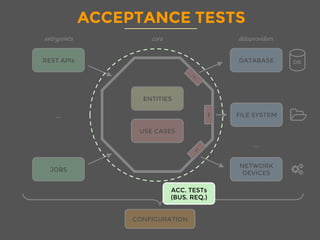
ACCEPTANCE TESTS
ENTITIES
USE CASES
REST APIs
JOBS
DATABASE
FILE SYSTEM
NETWORK
DEVICES
DB
I
...
...
CONFIGURATION
coreentrypoints dataproviders
ACC. TESTs
(BUS. REQ.)
ACCEPTANCE TESTS
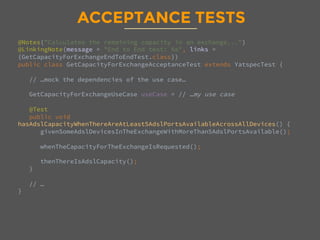
@Notes("Calculates the remaining capacity in an exchange...")
@LinkingNote(message = "End to End test: %s", links =
{GetCapacityForExchangeEndToEndTest.class})
public class GetCapacityForExchangeAcceptanceTest extends YatspecTest {

// …mock the dependencies of the use case… 

GetCapacityForExchangeUseCase useCase = // …my use case

@Test
public void
hasAdslCapacityWhenThereAreAtLeast5AdslPortsAvailableAcrossAllDevices() {
givenSomeAdslDevicesInTheExchangeWithMoreThan5AdslPortsAvailable();

whenTheCapacityForTheExchangeIsRequested();

thenThereIsAdslCapacity();
}

// … 
}
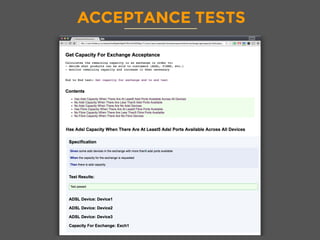
ACCEPTANCE TESTS
ACCEPTANCE TESTS
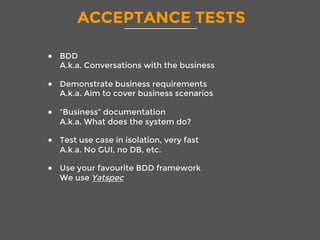
●  BDD
A.k.a. Conversations with the business
●  Demonstrate business requirements
A.k.a. Aim to cover business scenarios
●  “Business” documentation
A.k.a. What does the system do? 
●  Test use case in isolation, very fast
A.k.a. No GUI, no DB, etc.
●  Use your favourite BDD framework
We use Yatspec
http
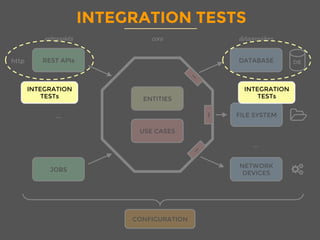
INTEGRATION TESTS
ENTITIES
USE CASES
REST APIs
JOBS
DATABASE
FILE SYSTEM
NETWORK
DEVICES
DB
I
...
...
CONFIGURATION
coreentrypoints dataproviders
INTEGRATION
TESTs
INTEGRATION
TESTs
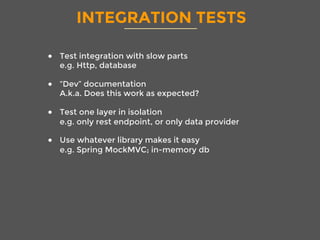
INTEGRATION TESTS
●  Test integration with slow parts
e.g. Http, database
●  “Dev” documentation
A.k.a. Does this work as expected? 
●  Test one layer in isolation
e.g. only rest endpoint, or only data provider
●  Use whatever library makes it easy
e.g. Spring MockMVC; in-memory db
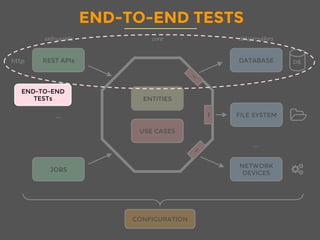
END-TO-END TESTS
ENTITIES
USE CASES
REST APIs
JOBS
DATABASE
FILE SYSTEM
NETWORK
DEVICES
DB
I
...
...
CONFIGURATION
coreentrypoints dataproviders
http
END-TO-END
TESTs
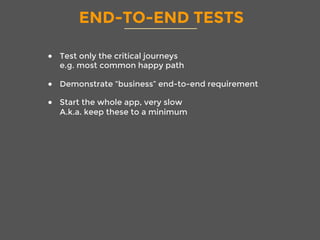
END-TO-END TESTS
●  Test only the critical journeys
e.g. most common happy path
●  Demonstrate “business” end-to-end requirement
●  Start the whole app, very slow
A.k.a. keep these to a minimum
PRO: TESTING STRATEGY
EFFECTIVE
TESTING STRATEGY
Infrequent
deploys
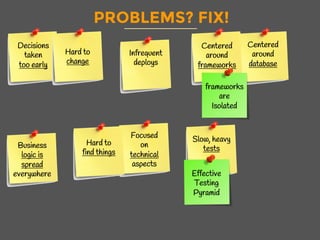
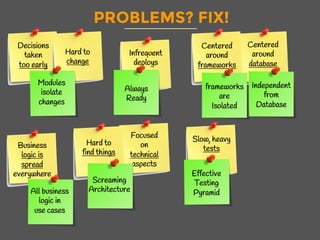
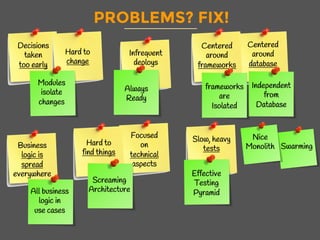
PROBLEMS? FIX!
Decisions
taken
too early
Hard to
change
Centered
around
database
Centered
around
frameworks
Business
logic is
spread
everywhere
Focused
on
technical
aspects
Slow, heavy
tests
Hard to
find things
Effective
Testing
Pyramid
PRO: FRAMEWORKS
FRAMEWORKS ARE
ISOLATED
easy(er) to
change our mind
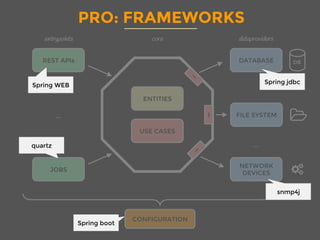
PRO: FRAMEWORKS
ENTITIES
USE CASES
REST APIs
JOBS
DATABASE
FILE SYSTEM
NETWORK
DEVICES
DB
I
...
...
CONFIGURATION
coreentrypoints dataproviders
Spring WEB
Spring boot
Spring jdbc
snmp4j
quartz
Infrequent
deploys
PROBLEMS? FIX!
Decisions
taken
too early
Hard to
change
Centered
around
database
Centered
around
frameworks
Business
logic is
spread
everywhere
Focused
on
technical
aspects
Slow, heavy
tests
Hard to
find things
Effective
Testing
Pyramid
frameworks
are
Isolated
PRO: DATABASE
INDEPENDENT
FROM DATABASE
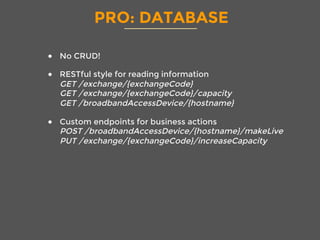
PRO: DATABASE
●  No CRUD!
●  RESTful style for reading information
GET /exchange/{exchangeCode}
GET /exchange/{exchangeCode}/capacity
GET /broadbandAccessDevice/{hostname}
●  Custom endpoints for business actions
POST /broadbandAccessDevice/{hostname}/makeLive
PUT /exchange/{exchangeCode}/increaseCapacity
Infrequent
deploys
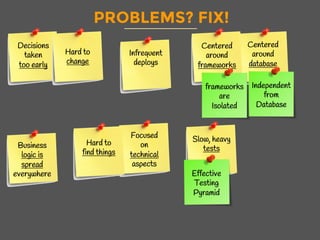
PROBLEMS? FIX!
Decisions
taken
too early
Hard to
change
Centered
around
database
Centered
around
frameworks
Business
logic is
spread
everywhere
Focused
on
technical
aspects
Slow, heavy
tests
Hard to
find things
Effective
Testing
Pyramid
Independent
from
Database
frameworks
are
Isolated
PRO: SCREAMING ARCHITECTURE
SCREAMS THE
INTENDED USAGE
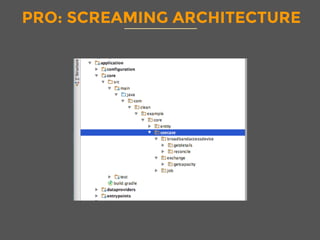
PRO: SCREAMING ARCHITECTURE
Infrequent
deploys
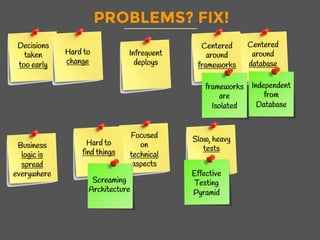
PROBLEMS? FIX!
Decisions
taken
too early
Hard to
change
Centered
around
database
Centered
around
frameworks
Business
logic is
spread
everywhere
Focused
on
technical
aspects
Slow, heavy
tests
Hard to
find things
Effective
Testing
Pyramid
Independent
from
Database
Screaming
Architecture
frameworks
are
Isolated
PRO: EASY TO FIND THINGS
ALL BUSINESS
LOGIC IS IN 
USE CASE
Infrequent
deploys
PROBLEMS? FIX!
Decisions
taken
too early
Hard to
change
Centered
around
database
Centered
around
frameworks
Business
logic is
spread
everywhere
Focused
on
technical
aspects
Slow, heavy
tests
Hard to
find things
Effective
Testing
Pyramid
Independent
from
Database
Screaming
ArchitectureAll business
logic in
use cases
frameworks
are
Isolated
PRO: MODULES
HARD TO DO THE
WRONG THING
Infrequent
deploys
PROBLEMS? FIX!
Decisions
taken
too early
Hard to
change
Centered
around
database
Centered
around
frameworks
Business
logic is
spread
everywhere
Focused
on
technical
aspects
Slow, heavy
tests
Hard to
find things
Effective
Testing
Pyramid
Independent
from
Database
Screaming
ArchitectureAll business
logic in
use cases
Modules
isolate
changes
frameworks
are
Isolated
PRO: ALWAYS READY
ALWAYS READY TO
DEPLOY
real continuous
integration
Infrequent
deploys
PROBLEMS? FIX!
Decisions
taken
too early
Hard to
change
Centered
around
database
Centered
around
frameworks
Business
logic is
spread
everywhere
Focused
on
technical
aspects
Slow, heavy
tests
Hard to
find things
Effective
Testing
Pyramid
Independent
from
Database
Screaming
ArchitectureAll business
logic in
use cases
Modules
isolate
changes
Always
Ready
frameworks
are
Isolated
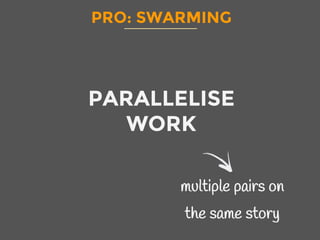
PRO: SWARMING
PARALLELISE
WORK
multiple pairs on
the same story
Infrequent
deploys
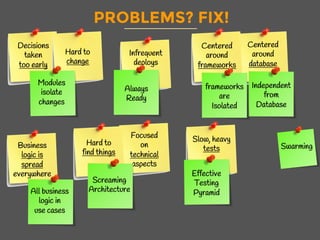
PROBLEMS? FIX!
Decisions
taken
too early
Hard to
change
Centered
around
database
Centered
around
frameworks
Business
logic is
spread
everywhere
Focused
on
technical
aspects
Slow, heavy
tests
Hard to
find things
Effective
Testing
Pyramid
Independent
from
Database
Screaming
ArchitectureAll business
logic in
use cases
Modules
isolate
changes
Always
Ready
Swarming
frameworks
are
Isolated
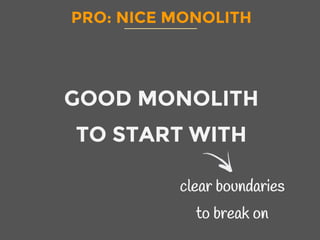
PRO: NICE MONOLITH
GOOD MONOLITH 
TO START WITH
clear boundaries
to break on
Infrequent
deploys
PROBLEMS? FIX!
Decisions
taken
too early
Hard to
change
Centered
around
database
Centered
around
frameworks
Business
logic is
spread
everywhere
Focused
on
technical
aspects
Slow, heavy
tests
Hard to
find things
Effective
Testing
Pyramid
Independent
from
Database
Screaming
ArchitectureAll business
logic in
use cases
Modules
isolate
changes
Always
Ready
Swarming
frameworks
are
Isolated
Nice
Monolith
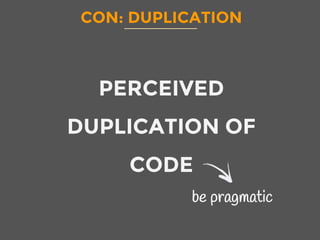
CON: DUPLICATION
PERCEIVED
DUPLICATION OF
CODE
be pragmatic
Infrequent
deploys
PROBLEMS? FIX!
Decisions
taken
too early
Hard to
change
Centered
around
database
Centered
around
frameworks
Business
logic is
spread
everywhere
Focused
on
technical
aspects
Slow, heavy
tests
Hard to
find things
Effective
Testing
Pyramid
Independent
from
Database
Screaming
ArchitectureAll business
logic in
use cases
Modules
isolate
changes
Always
Ready
Swarming
frameworks
are
Isolated
Nice
Monolith
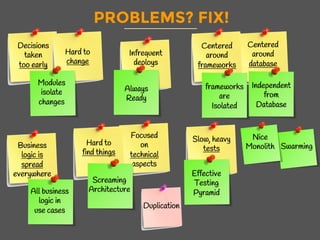
Duplication
CON: IT NEEDS LOGIC
YOU NEED
INTERESTING
BUSINESS LOGIC
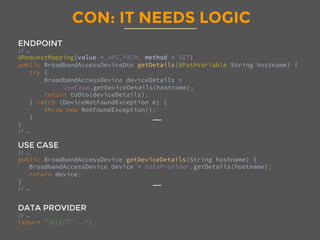
CON: IT NEEDS LOGIC
ENDPOINT
// … 
@RequestMapping(value = API_PATH, method = GET)
public BroadbandAccessDeviceDto getDetails(@PathVariable String hostname) {
try {
BroadbandAccessDevice deviceDetails = 
useCase.getDeviceDetails(hostname);
return toDto(deviceDetails);
} catch (DeviceNotFoundException e) {
throw new NotFoundException();
}
}
// … 

USE CASE
// … 
public BroadbandAccessDevice getDeviceDetails(String hostname) {
BroadbandAccessDevice device = dataProvider.getDetails(hostname);
return device;
}
// … 


DATA PROVIDER
// … 
return "SELECT ...";
Infrequent
deploys
Always
Ready
PROBLEMS? FIX!
Decisions
taken
too early
Hard to
change
Centered
around
database
Centered
around
frameworks
Business
logic is
spread
everywhere
Focused
on
technical
aspects
Slow, heavy
tests
Hard to
find things
Effective
Testing
Pyramid
frameworks
are
Isolated
Independent
from
Database
Screaming
ArchitectureAll business
logic in
use cases
Modules
isolate
changes
Nice
Monolith Swarming
Duplication
Needs
Interesting
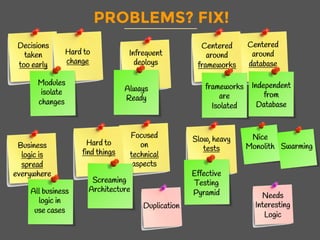
Logic
KEY TAKEAWAY
“
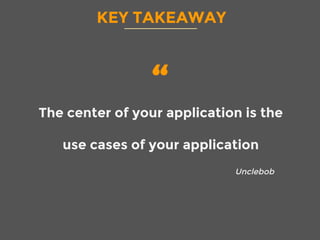
The center of your application is the
use cases of your application
Unclebob
RESOURCES
Example Project (with all code shown in the presentation)
●  Clean Architecture Example 
https://github.com/mattia-battiston/clean-architecture-example 

Blogs & Articles
●  The Clean Architecture 
https://blog.8thlight.com/uncle-bob/2012/08/13/the-clean-architecture.html
●  Screaming Architecture
http://blog.8thlight.com/uncle-bob/2011/09/30/Screaming-Architecture.html
●  NODB 
https://blog.8thlight.com/uncle-bob/2012/05/15/NODB.html
●  Hexagonal Architecture 
http://alistair.cockburn.us/Hexagonal+architecture

Videos & Presentations
●  Clean Coders ep. 7: Architecture, Use Cases, and High Level Design
https://cleancoders.com/episode/clean-code-episode-7/show 
●  Robert C. Martin - Clean Architecture 
https://vimeo.com/43612849
●  Robert C. Martin - Clean Architecture and Design
https://www.youtube.com/watch?v=Nsjsiz2A9mg
really, really appreciated! Help me improve
@BattistonMattia 
mattia.battiston@gmail.com
mattia-battiston
THANK YOU!

Real Life Clean Architecture

  • 1.
  • 2.
    ABOUT ME ●  fromVerona, Italy ●  software dev & continuous improvement ●  Kanban, Lean, Agile “helper” ●  Sky Network Services Mattia Battiston @BattistonMattia mattia.battiston@gmail.com mattia-battiston
  • 3.
  • 4.
    DISCLAIMER #2 THE ONEWAY Our experience (pragmatism, tradeoffs)
  • 5.
    Infrequent deploys COMMON PROBLEMS Decisions taken too early Hardto change Centered around database Centered around frameworks Business logic is spread everywhere Focused on technical aspects Slow, heavy tests Hard to find things
  • 6.
    “ The center ofyour application is not the database. Nor is it one or more of the frameworks you may be using. The center of your application is the use cases of your application Unclebob Source: NODB
  • 7.
  • 8.
    THANK YOU! THE END JustKidding, The fun is about to start :-)
  • 9.
  • 10.
    EXAMPLE DOMAIN: ISP Entity: Telephone Exchange Entity: Broadband Access Device Use case: Get Capacity “Have we got space for more customers? Can we sell more broadband?” Use case: Reconcile “Has any physical device changed? (e.g. new serial number)” Use case: Get Details “Details of a particular device?”
  • 11.
    OUR CLEAN ARCHITECTURE ENTITIES USECASES REST APIs JOBS DATABASE FILE SYSTEM NETWORK DEVICES DB I ... ... CONFIGURATION coreentrypoints dataproviders
  • 12.
    A.k.a (unclebob’s style) Entities UseCases Configuration + Core: business logic Entrypoints: access to the application Data Providers: retrieve and store information ... Configuration: wires everything together * arrows represent dependency
  • 13.
  • 14.
    ENTITY ENTITIES USE CASES REST APIs JOBS DATABASE FILESYSTEM NETWORK DEVICES DB I ... ... CONFIGURATION coreentrypoints dataproviderscore ENTITIES
  • 15.
  • 16.
    ENTITY public class Exchange{ private final String code; private final String name; private final String postCode; public Exchange(String code, String name, String postCode) { this.code = code; this.name = name; this.postCode = postCode; } // … getters @Override public String toString() { return ...; } }
  • 17.
    ENTITY public class BroadbandAccessDevice{ private Exchange exchange; private String hostname; private String serialNumber; private DeviceType type; private int availablePorts; public BroadbandAccessDevice(String hostname, ...) { this.hostname = hostname; this.serialNumber = serialNumber; this.type = type; } // … (getters, some setters) @Override public String toString() { return ...; } }
  • 18.
    ENTITY ●  Domain objects e.g.“Exchange”, “Broadband Access Device” ●  Entity-specific business rules e.g. hostname format ●  Tiny Types are useful e.g. Hostname instead of String ●  No Frameworks
  • 19.
    USE CASE ENTITIES USE CASES RESTAPIs JOBS DATABASE FILE SYSTEM NETWORK DEVICES DB I ... ... CONFIGURATION coreentrypoints dataproviders USE CASES I core
  • 20.
  • 21.
    USE CASE public classGetCapacityForExchangeUseCase { private DoesExchangeExist dataProvider1; private GetAvailablePortsOfAllDevicesInExchange dataProvider2; // … public Capacity getCapacity(String exchangeCode) { failIfExchangeDoesNotExist(exchangeCode); List<BroadbandAccessDevice> devices = dataProvider2 .getAvailablePortsOfAllDevicesInExchange(exchangeCode); boolean hasAdslCapacity = hasCapacityFor(devices, DeviceType.ADSL); boolean hasFibreCapacity = hasCapacityFor(devices, DeviceType.FIBRE); return new Capacity(hasAdslCapacity, hasFibreCapacity); } // … private void failIfExchangeDoesNotExist(String exchangeCode) { boolean exchangeExists = dataProvider1.doesExchangeExist(exchangeCode); if(!exchangeExists) throw new ExchangeNotFoundException(); } }
  • 22.
    USE CASE public interfaceDoesExchangeExist { boolean doesExchangeExist(String exchange); } public interface GetAvailablePortsOfAllDevicesInExchange { List<BroadbandAccessDevice> getAvailablePortsOfAllDevicesInExchange(String exchangeCode); } public class ExchangeNotFoundException extends RuntimeException { }
  • 23.
    USE CASE ●  Purebusiness logic e.g. algorithm to calculate capacity ●  Defines Interfaces for the data that it requires e.g. getAvailablePorts ●  Uses entities and dataproviders ●  Throws business-specific exceptions ●  Not affected by changes in database or presentation ●  Plain Java (no frameworks) ●  We like single-method interfaces A.k.a. Interface Segregation
  • 24.
    DATA PROVIDER ENTITIES USE CASES RESTAPIs JOBS DATABASE FILE SYSTEM NETWORK DEVICES DB I ... ... CONFIGURATION coreentrypoints dataproviders DATABASE FILE SYSTEM NETWORK DEVICES DB ... dataproviders
  • 25.
  • 26.
    DATA PROVIDER public classBroadbandAccessDeviceDatabaseDataProvider implements GetAllDeviceHostnames, GetSerialNumberFromModel, ... { private JdbcTemplate jdbcTemplate; @Override public List<String> getAllDeviceHostnames() { return jdbcTemplate.queryForList( "SELECT hostname FROM clean_architecture.bb_access_device", String.class); } @Override public String getSerialNumber(String hostname) { try { return jdbcTemplate.queryForObject( "SELECT serial_number FROM clean_architecture.bb_access_device WHERE hostname = ?", String.class, hostname); } catch (IncorrectResultSizeDataAccessException e) { return null; } } // …
  • 27.
    DATA PROVIDER public classBroadbandAccessDeviceNetworkDataProvider implements GetSerialNumberFromReality { private DeviceClient deviceClient; // … @Override public String getSerialNumber(String hostname) { try { return deviceClient.getSerialNumber(hostname); } catch (DeviceConnectionTimeoutException e) { return null; } } }
  • 28.
    DATA PROVIDER ●  ImplementsInterfaces defined by use case e.g. retrieving serial number of a device ●  Hides all details about where the data is from ●  Could have multiple implementations e.g. from DB or from File System ●  Uses whatever framework/library is appropriate e.g. spring-jdbc, hibernate, snmp4j, etc. ●  If using ORM, you’d have a new set of entities A.k.a. decoupled from business entities
  • 29.
    ENTRYPOINT ENTITIES USE CASES REST APIs JOBS DATABASE FILESYSTEM NETWORK DEVICES DB I ... ... CONFIGURATION coreentrypoints dataproviders REST APIs JOBS ... entrypoints
  • 30.
  • 31.
    ENTRYPOINT @RestController public class GetCapacityForExchangeEndpoint{ public static final String API_PATH = "/exchange/{exchangeCode}/capacity"; private GetCapacityForExchangeUseCase getCapacityForExchangeUseCase; // … @RequestMapping(value = API_PATH, method = GET) public CapacityDto getCapacity(@PathVariable String exchangeCode) { try { Capacity capacity = getCapacityForExchangeUseCase.getCapacity(exchangeCode); return toDto(capacity); } catch (ExchangeNotFoundException e) { LOGGER.info("Exchange not found: {}", exchangeCode); throw new NotFoundException(); } } private CapacityDto toDto(Capacity capacity) { return new CapacityDto( capacity.hasAdslCapacity(), capacity.hasFibreCapacity()); } }
  • 32.
    ENTRYPOINT public class ReconcileBroadbandAccessDeviceJobimplements ScheduledJob { private ReconcileBroadbandAccessDevicesUseCase useCase; private final JobResults jobResults; // … @Override public String getName() { return "..."; } @Override public long getInitialDelay() { return 0; } @Override public long getPeriod() { return 5; } @Override public TimeUnit getTimeUnit() { return TimeUnit.SECONDS; } @Override public void run() { LOGGER.info("Job Starting: {}...", getName()); JobResultsCount jobResultsCount = jobResults.createJobResultsCount(); OnSuccess success = jobResultsCount::success; OnFailure failure = jobResultsCount::failure; reconcileBroadbandAccessDevicesUseCase.reconcile(success, failure); jobResults.recordJobResults(this, jobResultsCount); LOGGER.info("Job Completed: {}", getName()); } }
  • 33.
    ENTRYPOINT ●  Fires upa use case ●  Has no business logic ●  Has conversion logic e.g. uses DTOs to return result to WEB ●  Hides all details about delivery mechanism ●  GUI would be an entrypoint e.g. controllers would start use cases ●  Uses whatever framework/library is appropriate e.g. spring-mvc, jersey, quartz, etc.
  • 34.
    CONFIGURATION ENTITIES USE CASES REST APIs JOBS DATABASE FILESYSTEM NETWORK DEVICES DB I ... ... CONFIGURATION coreentrypoints dataproviders CONFIGURATION
  • 35.
  • 36.
    CONFIGURATION @Configuration @EnableAutoConfiguration @ComponentScan(basePackages = "com.clean.example.configuration") publicclass Application { public static void main(String[] args) { SpringApplication.run(Application.class, args); } } @Configuration public class EndpointConfiguration { @Bean public GetBroadbandAccessDeviceEndpoint getBroadbandAccessDeviceEndpoint() { return new GetBroadbandAccessDeviceEndpoint(...); } // …other endpoints… } @Configuration public class WebServerConfiguration { // …wires web server with framework… }
  • 37.
    CONFIGURATION ●  Wires everythingtogether e.g. using Spring or simply initialising objects ●  Isolates and hides frameworks e.g. Spring is only here ●  Has the “dirty” details to make things work e.g. initialise datasource, setup web server, etc.
  • 38.
    EXAMPLE: GET CAPACITY Rest Entrypoint Client Use Case Data Provider GET /exchange/CHELSEA/capacity useCase.getCapacity(“CHELSEA”); dataProvider .getAvailablePortsOfAllDevicesInExchange (”CHELSEA”); SELECT … WHERE code = “CHELSEA” return broadbandAccessDevices; countAvailablePortsOfEachType(); decideIfThereIsCapacity(); return capacity; convertToDto(capacity); return dto; Status Code: 200 OK {"hasADSLCapacity":true, "hasFibreCapacity":true}
  • 39.
    EXAMPLE: RECONCILE DEVICES UseCase Job Entrypoint Data Provider: DB Data Provider: Network Device useCase.reconcile(...); getAllDeviceHostnames() "SELECT hostname...” // For each device: getSerialNumberFromModel(hostname) getSerialNumberFromReality(hostname) "SELECT serial_number...” SNMPGET … if(serialNumberIsDifferent()) { updateSerialNumber(); success(); } auditResults();
  • 40.
    Coverage TESTING STRATEGY Unit Tests- TDD Acceptance Tests - BDD Integration Tests End-to-end Tests Manual Exploratory Tests Cost
  • 41.
    UNIT TESTS ENTITIES USE CASES RESTAPIs JOBS DATABASE FILE SYSTEM NETWORK DEVICES DB I ... ... CONFIGURATION coreentrypoints dataproviders UNIT TESTs UNIT TESTs UNIT TESTs UNIT TESTs UNIT TESTs UNIT TESTs
  • 42.
    UNIT TESTS // … GetCapacityForExchangeEndpointendpoint = // class under test GetCapacityForExchangeUseCase useCase = // mock @Test public void returnsTheCapacityForAnExchange() throws Exception { givenThereIsCapacityForAnExchange(); CapacityDto capacity = endpoint.getCapacity(EXCHANGE_CODE); assertThat(capacity.getHasADSLCapacity()).isTrue(); assertThat(capacity.getHasFibreCapacity()).isTrue(); } private void givenThereIsCapacityForAnExchange() { when(useCase.getCapacity(EXCHANGE_CODE)) .thenReturn(new Capacity(true, true)); } // …
  • 43.
    UNIT TESTS ●  TDD A.k.a.Tests first, to drive design ●  Cover every little detail A.k.a. Aim for 100% coverage ●  “Dev to dev” documentation A.k.a. What should this class do? ●  Test individual classes in isolation, very fast
  • 44.
    ACCEPTANCE TESTS ENTITIES USE CASES RESTAPIs JOBS DATABASE FILE SYSTEM NETWORK DEVICES DB I ... ... CONFIGURATION coreentrypoints dataproviders ACC. TESTs (BUS. REQ.)
  • 45.
    ACCEPTANCE TESTS @Notes("Calculates theremaining capacity in an exchange...") @LinkingNote(message = "End to End test: %s", links = {GetCapacityForExchangeEndToEndTest.class}) public class GetCapacityForExchangeAcceptanceTest extends YatspecTest { // …mock the dependencies of the use case… GetCapacityForExchangeUseCase useCase = // …my use case @Test public void hasAdslCapacityWhenThereAreAtLeast5AdslPortsAvailableAcrossAllDevices() { givenSomeAdslDevicesInTheExchangeWithMoreThan5AdslPortsAvailable(); whenTheCapacityForTheExchangeIsRequested(); thenThereIsAdslCapacity(); } // … }
  • 46.
  • 47.
    ACCEPTANCE TESTS ●  BDD A.k.a.Conversations with the business ●  Demonstrate business requirements A.k.a. Aim to cover business scenarios ●  “Business” documentation A.k.a. What does the system do? ●  Test use case in isolation, very fast A.k.a. No GUI, no DB, etc. ●  Use your favourite BDD framework We use Yatspec
  • 48.
    http INTEGRATION TESTS ENTITIES USE CASES RESTAPIs JOBS DATABASE FILE SYSTEM NETWORK DEVICES DB I ... ... CONFIGURATION coreentrypoints dataproviders INTEGRATION TESTs INTEGRATION TESTs
  • 49.
    INTEGRATION TESTS ●  Testintegration with slow parts e.g. Http, database ●  “Dev” documentation A.k.a. Does this work as expected? ●  Test one layer in isolation e.g. only rest endpoint, or only data provider ●  Use whatever library makes it easy e.g. Spring MockMVC; in-memory db
  • 50.
    END-TO-END TESTS ENTITIES USE CASES RESTAPIs JOBS DATABASE FILE SYSTEM NETWORK DEVICES DB I ... ... CONFIGURATION coreentrypoints dataproviders http END-TO-END TESTs
  • 51.
    END-TO-END TESTS ●  Testonly the critical journeys e.g. most common happy path ●  Demonstrate “business” end-to-end requirement ●  Start the whole app, very slow A.k.a. keep these to a minimum
  • 52.
  • 53.
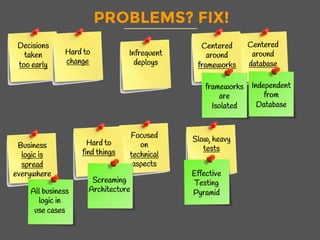
    Infrequent deploys PROBLEMS? FIX! Decisions taken too early Hardto change Centered around database Centered around frameworks Business logic is spread everywhere Focused on technical aspects Slow, heavy tests Hard to find things Effective Testing Pyramid
  • 54.
  • 55.
    PRO: FRAMEWORKS ENTITIES USE CASES RESTAPIs JOBS DATABASE FILE SYSTEM NETWORK DEVICES DB I ... ... CONFIGURATION coreentrypoints dataproviders Spring WEB Spring boot Spring jdbc snmp4j quartz
  • 56.
    Infrequent deploys PROBLEMS? FIX! Decisions taken too early Hardto change Centered around database Centered around frameworks Business logic is spread everywhere Focused on technical aspects Slow, heavy tests Hard to find things Effective Testing Pyramid frameworks are Isolated
  • 57.
  • 58.
    PRO: DATABASE ●  NoCRUD! ●  RESTful style for reading information GET /exchange/{exchangeCode} GET /exchange/{exchangeCode}/capacity GET /broadbandAccessDevice/{hostname} ●  Custom endpoints for business actions POST /broadbandAccessDevice/{hostname}/makeLive PUT /exchange/{exchangeCode}/increaseCapacity
  • 59.
    Infrequent deploys PROBLEMS? FIX! Decisions taken too early Hardto change Centered around database Centered around frameworks Business logic is spread everywhere Focused on technical aspects Slow, heavy tests Hard to find things Effective Testing Pyramid Independent from Database frameworks are Isolated
  • 60.
  • 61.
  • 62.
    Infrequent deploys PROBLEMS? FIX! Decisions taken too early Hardto change Centered around database Centered around frameworks Business logic is spread everywhere Focused on technical aspects Slow, heavy tests Hard to find things Effective Testing Pyramid Independent from Database Screaming Architecture frameworks are Isolated
  • 63.
    PRO: EASY TOFIND THINGS ALL BUSINESS LOGIC IS IN USE CASE
  • 64.
    Infrequent deploys PROBLEMS? FIX! Decisions taken too early Hardto change Centered around database Centered around frameworks Business logic is spread everywhere Focused on technical aspects Slow, heavy tests Hard to find things Effective Testing Pyramid Independent from Database Screaming ArchitectureAll business logic in use cases frameworks are Isolated
  • 65.
    PRO: MODULES HARD TODO THE WRONG THING
  • 66.
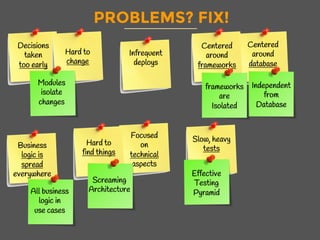
    Infrequent deploys PROBLEMS? FIX! Decisions taken too early Hardto change Centered around database Centered around frameworks Business logic is spread everywhere Focused on technical aspects Slow, heavy tests Hard to find things Effective Testing Pyramid Independent from Database Screaming ArchitectureAll business logic in use cases Modules isolate changes frameworks are Isolated
  • 67.
    PRO: ALWAYS READY ALWAYSREADY TO DEPLOY real continuous integration
  • 68.
    Infrequent deploys PROBLEMS? FIX! Decisions taken too early Hardto change Centered around database Centered around frameworks Business logic is spread everywhere Focused on technical aspects Slow, heavy tests Hard to find things Effective Testing Pyramid Independent from Database Screaming ArchitectureAll business logic in use cases Modules isolate changes Always Ready frameworks are Isolated
  • 69.
  • 70.
    Infrequent deploys PROBLEMS? FIX! Decisions taken too early Hardto change Centered around database Centered around frameworks Business logic is spread everywhere Focused on technical aspects Slow, heavy tests Hard to find things Effective Testing Pyramid Independent from Database Screaming ArchitectureAll business logic in use cases Modules isolate changes Always Ready Swarming frameworks are Isolated
  • 71.
    PRO: NICE MONOLITH GOODMONOLITH TO START WITH clear boundaries to break on
  • 72.
    Infrequent deploys PROBLEMS? FIX! Decisions taken too early Hardto change Centered around database Centered around frameworks Business logic is spread everywhere Focused on technical aspects Slow, heavy tests Hard to find things Effective Testing Pyramid Independent from Database Screaming ArchitectureAll business logic in use cases Modules isolate changes Always Ready Swarming frameworks are Isolated Nice Monolith
  • 73.
  • 74.
    Infrequent deploys PROBLEMS? FIX! Decisions taken too early Hardto change Centered around database Centered around frameworks Business logic is spread everywhere Focused on technical aspects Slow, heavy tests Hard to find things Effective Testing Pyramid Independent from Database Screaming ArchitectureAll business logic in use cases Modules isolate changes Always Ready Swarming frameworks are Isolated Nice Monolith Duplication
  • 75.
    CON: IT NEEDSLOGIC YOU NEED INTERESTING BUSINESS LOGIC
  • 76.
    CON: IT NEEDSLOGIC ENDPOINT // … @RequestMapping(value = API_PATH, method = GET) public BroadbandAccessDeviceDto getDetails(@PathVariable String hostname) { try { BroadbandAccessDevice deviceDetails = useCase.getDeviceDetails(hostname); return toDto(deviceDetails); } catch (DeviceNotFoundException e) { throw new NotFoundException(); } } // … USE CASE // … public BroadbandAccessDevice getDeviceDetails(String hostname) { BroadbandAccessDevice device = dataProvider.getDetails(hostname); return device; } // … DATA PROVIDER // … return "SELECT ...";
  • 77.
    Infrequent deploys Always Ready PROBLEMS? FIX! Decisions taken too early Hardto change Centered around database Centered around frameworks Business logic is spread everywhere Focused on technical aspects Slow, heavy tests Hard to find things Effective Testing Pyramid frameworks are Isolated Independent from Database Screaming ArchitectureAll business logic in use cases Modules isolate changes Nice Monolith Swarming Duplication Needs Interesting Logic
  • 78.
    KEY TAKEAWAY “ The centerof your application is the use cases of your application Unclebob
  • 79.
    RESOURCES Example Project (withall code shown in the presentation) ●  Clean Architecture Example https://github.com/mattia-battiston/clean-architecture-example Blogs & Articles ●  The Clean Architecture https://blog.8thlight.com/uncle-bob/2012/08/13/the-clean-architecture.html ●  Screaming Architecture http://blog.8thlight.com/uncle-bob/2011/09/30/Screaming-Architecture.html ●  NODB https://blog.8thlight.com/uncle-bob/2012/05/15/NODB.html ●  Hexagonal Architecture http://alistair.cockburn.us/Hexagonal+architecture Videos & Presentations ●  Clean Coders ep. 7: Architecture, Use Cases, and High Level Design https://cleancoders.com/episode/clean-code-episode-7/show ●  Robert C. Martin - Clean Architecture https://vimeo.com/43612849 ●  Robert C. Martin - Clean Architecture and Design https://www.youtube.com/watch?v=Nsjsiz2A9mg
  • 80.
    really, really appreciated!Help me improve @BattistonMattia mattia.battiston@gmail.com mattia-battiston THANK YOU!