Introduction to
Domain-Driven Design
Speaker


               Eduards Sizovs
Software Architect at 4finance
               - linkedin/in/eduardsi
        - eduards.sizovs@gmail.com
Agenda
•   What is DDD
•   Principles
•   Benefits
•   Why people do not use DDD
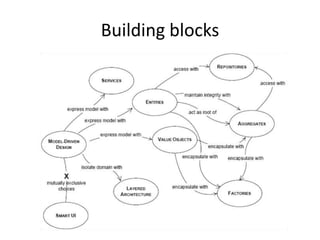
•   Building blocks
•   How to start
What is DDD
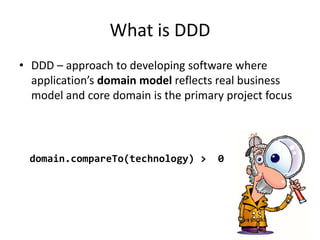
• DDD – approach to developing software where
  application’s domain model reflects real business
  model and core domain is the primary project focus


 domain.compareTo(technology) >      0
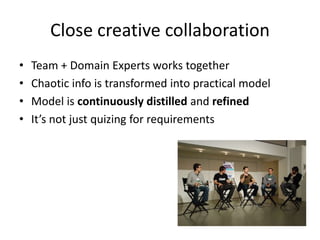
Close creative collaboration
•   Team + Domain Experts works together
•   Chaotic info is transformed into practical model
•   Model is continuously distilled and refined
•   It’s not just quizing for requirements
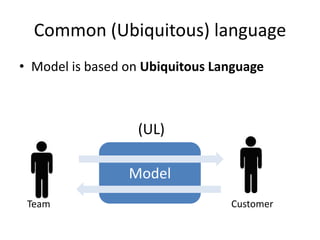
Common (Ubiquitous) language
• Model is based on Ubiquitous Language


                  (UL)

                 Model
 Team                            Customer
UL example (user story)
• Bad: When user logs in using valid data, his
  active credits are displayed

• Good: When borrower logs in using valid
  credentials, his open loans are displayed
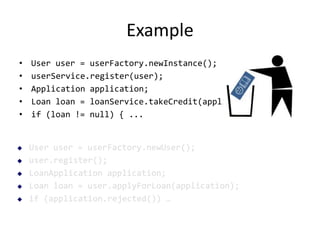
Example
•   User user = userFactory.newInstance();
•   userService.register(user);
•   Application application;
•   Loan loan = loanService.takeCredit(application, user);
•   if (loan != null) { ...


   User user = userFactory.newUser();
   user.register();
   LoanApplication application;
   Loan loan = user.applyForLoan(application);
   if (application.rejected()) …
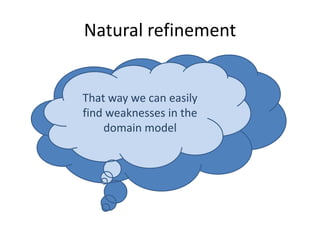
Natural refinement


If sophisticated can easily
   That way we domain experts
 do notweaknesses in the
    find understand the model,
 there is something wrong with
        domain model
            the model
Domain encapsulation
• Focus on specific business operation (e.g. Loans)
• Isolation from other domains (Loans from Credit
  Bureau)
• Isolated from other layers (UI, integration)
• Loose coupling with external dependencies (anti-
  corruption layer)
Technical simplicity
• No heavyweight framework dependencies
• POJOlicious design
Domain’s richness
• Domain is a rich model of entities, relations, rules
  and conditions, not just a data carrying entities
Benefits
• Ubiquitous Language in communication, requirements,
  specification, domain model, tests
• Common model that the team can use to communicate about
  business requirements
• The model is modular, extensible and easy to maintain
• Business model is encapsulated in one place
• Model is easy testable based on real business scenarios
• Final Code = Domain specification
If you do not follow DDD
• Likely you will have a fat service layer with anemic
  domain model
• Domain rules and business logic are scattered in
  many helpers and facades
• Harder to react to business requirement changes
• Communication is difficult
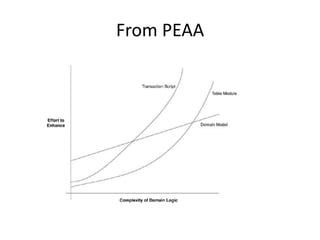
From PEAA
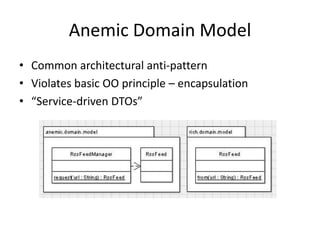
Anemic Domain Model
• Common architectural anti-pattern
• Violates basic OO principle – encapsulation
• “Service-driven DTOs”
Why people do not use DDD
• Complex component model with layering
  enforcements (EJB 2.*)
• Easier to grasp with development with no prior
  analysis (ad hoc development)
• Adapted to anemic domain model
• No access to domain experts
• No iterative development process
• Unwillingness to understand new domains
• Lack of good examples
Why people do not use DDD
• Clinging to technical things and frameworks
• DDD requires good OOA&D skills
• Thinking in terms of Computing
Building blocks
Entity
• An object defined primarily by its identity
• May have multiple representations
• Distinguished from another entity even both might
  have the same attributes

• Example: Customer, Book, Vehicle
• Example: Two deposit transactions
Value Object
• An object having no identity and defined by its
  attributes
• Describes state of entities
• Really powerful when built immutable

• Example: Money, Time
• Example: GPS program returns Route connecting
  Boston and Rhode Island entities
Module (or package)
•   Contains cohesive set of concepts
•   Coevolves with a model
•   Speaks UL
•   When you place some classes together in a module,
    you are telling next developer to think about them
    together
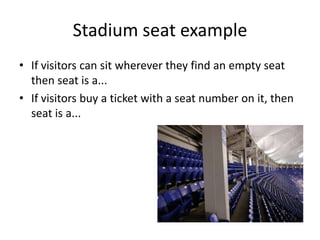
Stadium seat example
• If visitors can sit wherever they find an empty seat
  then seat is a...
• If visitors buy a ticket with a seat number on it, then
  seat is a...
Aggregate
• A collection of objects that are bound together by a
  root entity. The aggregrate root guarantees the
  consistency of changes being made within the
  aggregate by forbidding external objects from
  holding references to its members
Repository
• A contract between application and data storage,
  that speaks UL
• Pretends to be a collection of Aggregate Roots
• Repository is persistence ignorant
Example
• Payment Schedule comprises of Regular Installments
• Client pays-off Regular Installments
• Payment Schedule must be closed when all Regular
  Installments get paid
• Payment Schedule gets processed according to client
  payments
Factory
• Methods for creating domain objects should
  delegate to a specialized Factory
• Helps when entity creation is complicated or reveals
  its internal structure
• Decouples object creation from other layers
Service
• When an operation does not conceptually belong to
  an Entity nor to a Value Object you can put it in a
  service
• Services are still a natural part of a model
• Domain services should be distinguished from other
  services (application, infrastructural)
Events
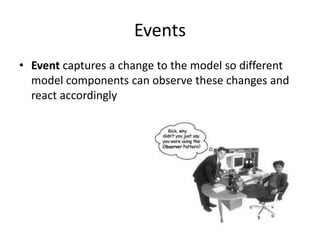
• Event captures a change to the model so different
  model components can observe these changes and
  react accordingly
Specification & Function
• Entity.satisfies(Specification)
• Entity.apply(Function)


• Specification.satisfiedBy(Entity)
• Function.applyTo(Entity)
Strategic design
• Abstract Core Domain & Generic Subdomains

• Bounded Context & Context Map

• Anti-Corruption Layer
More reading
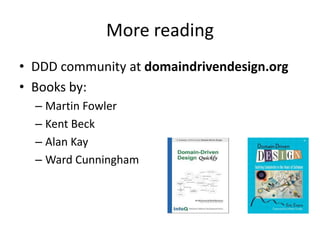
• DDD community at domaindrivendesign.org
• Books by:
  – Martin Fowler
  – Kent Beck
  – Alan Kay
  – Ward Cunningham
Thank you!

Introduction to DDD

  • 1.
  • 2.
    Speaker Eduards Sizovs Software Architect at 4finance - linkedin/in/eduardsi - eduards.sizovs@gmail.com
  • 3.
    Agenda • What is DDD • Principles • Benefits • Why people do not use DDD • Building blocks • How to start
  • 4.
    What is DDD •DDD – approach to developing software where application’s domain model reflects real business model and core domain is the primary project focus domain.compareTo(technology) > 0
  • 5.
    Close creative collaboration • Team + Domain Experts works together • Chaotic info is transformed into practical model • Model is continuously distilled and refined • It’s not just quizing for requirements
  • 6.
    Common (Ubiquitous) language •Model is based on Ubiquitous Language (UL) Model Team Customer
  • 7.
    UL example (userstory) • Bad: When user logs in using valid data, his active credits are displayed • Good: When borrower logs in using valid credentials, his open loans are displayed
  • 8.
    Example • User user = userFactory.newInstance(); • userService.register(user); • Application application; • Loan loan = loanService.takeCredit(application, user); • if (loan != null) { ...  User user = userFactory.newUser();  user.register();  LoanApplication application;  Loan loan = user.applyForLoan(application);  if (application.rejected()) …
  • 9.
    Natural refinement If sophisticatedcan easily That way we domain experts do notweaknesses in the find understand the model, there is something wrong with domain model the model
  • 10.
    Domain encapsulation • Focuson specific business operation (e.g. Loans) • Isolation from other domains (Loans from Credit Bureau) • Isolated from other layers (UI, integration) • Loose coupling with external dependencies (anti- corruption layer)
  • 11.
    Technical simplicity • Noheavyweight framework dependencies • POJOlicious design
  • 12.
    Domain’s richness • Domainis a rich model of entities, relations, rules and conditions, not just a data carrying entities
  • 13.
    Benefits • Ubiquitous Languagein communication, requirements, specification, domain model, tests • Common model that the team can use to communicate about business requirements • The model is modular, extensible and easy to maintain • Business model is encapsulated in one place • Model is easy testable based on real business scenarios • Final Code = Domain specification
  • 14.
    If you donot follow DDD • Likely you will have a fat service layer with anemic domain model • Domain rules and business logic are scattered in many helpers and facades • Harder to react to business requirement changes • Communication is difficult
  • 15.
  • 16.
    Anemic Domain Model •Common architectural anti-pattern • Violates basic OO principle – encapsulation • “Service-driven DTOs”
  • 17.
    Why people donot use DDD • Complex component model with layering enforcements (EJB 2.*) • Easier to grasp with development with no prior analysis (ad hoc development) • Adapted to anemic domain model • No access to domain experts • No iterative development process • Unwillingness to understand new domains • Lack of good examples
  • 18.
    Why people donot use DDD • Clinging to technical things and frameworks • DDD requires good OOA&D skills • Thinking in terms of Computing
  • 19.
  • 20.
    Entity • An objectdefined primarily by its identity • May have multiple representations • Distinguished from another entity even both might have the same attributes • Example: Customer, Book, Vehicle • Example: Two deposit transactions
  • 21.
    Value Object • Anobject having no identity and defined by its attributes • Describes state of entities • Really powerful when built immutable • Example: Money, Time • Example: GPS program returns Route connecting Boston and Rhode Island entities
  • 22.
    Module (or package) • Contains cohesive set of concepts • Coevolves with a model • Speaks UL • When you place some classes together in a module, you are telling next developer to think about them together
  • 23.
    Stadium seat example •If visitors can sit wherever they find an empty seat then seat is a... • If visitors buy a ticket with a seat number on it, then seat is a...
  • 24.
    Aggregate • A collectionof objects that are bound together by a root entity. The aggregrate root guarantees the consistency of changes being made within the aggregate by forbidding external objects from holding references to its members
  • 25.
    Repository • A contractbetween application and data storage, that speaks UL • Pretends to be a collection of Aggregate Roots • Repository is persistence ignorant
  • 26.
    Example • Payment Schedulecomprises of Regular Installments • Client pays-off Regular Installments • Payment Schedule must be closed when all Regular Installments get paid • Payment Schedule gets processed according to client payments
  • 27.
    Factory • Methods forcreating domain objects should delegate to a specialized Factory • Helps when entity creation is complicated or reveals its internal structure • Decouples object creation from other layers
  • 28.
    Service • When anoperation does not conceptually belong to an Entity nor to a Value Object you can put it in a service • Services are still a natural part of a model • Domain services should be distinguished from other services (application, infrastructural)
  • 29.
    Events • Event capturesa change to the model so different model components can observe these changes and react accordingly
  • 30.
    Specification & Function •Entity.satisfies(Specification) • Entity.apply(Function) • Specification.satisfiedBy(Entity) • Function.applyTo(Entity)
  • 31.
    Strategic design • AbstractCore Domain & Generic Subdomains • Bounded Context & Context Map • Anti-Corruption Layer
  • 32.
    More reading • DDDcommunity at domaindrivendesign.org • Books by: – Martin Fowler – Kent Beck – Alan Kay – Ward Cunningham
  • 33.

Editor's Notes