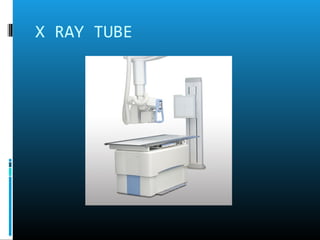
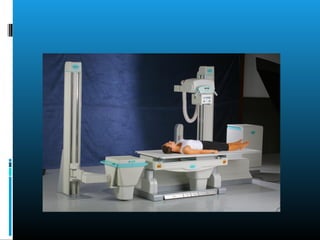
X RAY TUBE
Functions of protective housing 
 Prevent leakage of radiation 
 Prevent accidental electric shock 
 Mechanical support to the x ray tube
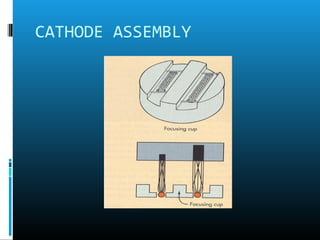
CATHODE ASSEMBLY
Filaments are usually made of thoriated 
tungsten because 
1.Its melting point is very high 
2.Does not vaporize easily
ANODE 
 Common anode materials are 
Copper 
molybdenum 
graphite
ANODE ASSEMBLY
 STATIONARY ANODE 
 ROTATING ANODE
ROTATING VS STATIONARY 
ANODE 
 Rotating anodes let you have higher tube 
current and shorter exposure times. 
 Rotating anodes are powered by induction 
motors.
INDUCTION MOTOR
Tungsten is used as target material because of 
 atomic number is high (74) make good x-ray 
production. 
 Thermal Conductivity is very good in 
tungsten. 
 High Melting point for tungsten, 3400C.
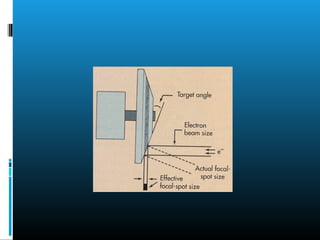
FOCAL SPOT 
 This is where the high-voltage electrons hit 
the anode.
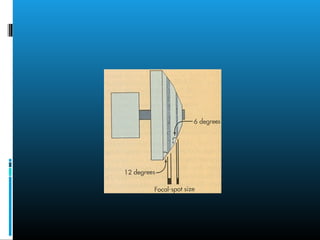
Line-focus Principle 
the process of making the angle between the 
anode surface and the central ray of the X-ray 
beam such that the effective focal spot size is 
made small as compared to the actual focal 
spot size.
Heel Effect 
 Reduction of the X-ray intensity at the anode 
side of an X-ray field. In an X-ray field it can 
be observed that the film density is lower on 
the anode side than on the cathode side. This 
phenomenon is termed the heel effect
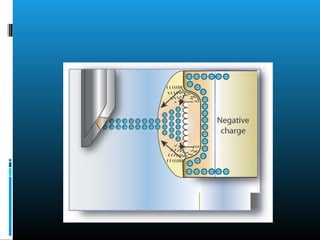
space charge 
 The excess of electrons or ions in a given 
volume.
Space Charge Effect 
 When a low voltage is applied across the 
tube, the current is small due to space charge 
effects. 
 The electron cloud surrounding the filament 
has a tendency to repel other electrons back 
to the filament unless sufficient accelerating 
voltage is applied to pull them away from the 
filament as fast as they are produced.
 With increasing kV, the effects of space 
charge are gradually overcome and the 
current (mA) increases until all electrons that 
are released at the filament reach the anode.
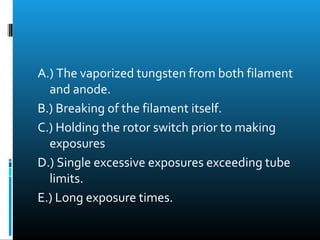
X RAY TUBE FAILURE 
1. Tungsten target (anode) pitting 
2. Bearing failures/glass envelope breaking 
3. Heat 
4. Filament failure 
5. arcing
A.) The vaporized tungsten from both filament 
and anode. 
B.) Breaking of the filament itself. 
C.) Holding the rotor switch prior to making 
exposures 
D.) Single excessive exposures exceeding tube 
limits. 
E.) Long exposure times.
Open Filament 
 It is the condition where in the filament wire 
becomes thinner and eventually breaks. The 
excessive heating of the filament causes the 
filament to vaporize. Occurs due to 
prolonged periods of high mA operation.
Arcing 
 It is a sustained luminous discharge of 
electricity across a gap in a circuit or between 
electrodes.
Methods of heat transfer 
 Radiation - transfer of heat through emission 
of infared radiation. 
 Conduction - transfer of energy by contact. 
 Convection - transfer of heat by movement of 
heated air, oil from one place to another. 
HEAT IS THE MOST IMPORTANT CAUSE OF 
TUBE FAILURE
VOLTAGE RECTIFICATION 
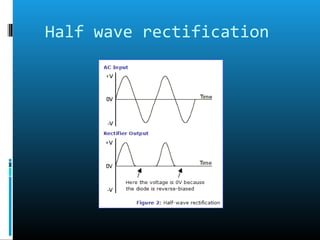
 Process of converting AC into DC
Half wave rectification
Shortcomings of half wave 
 Waste of supply 
 Increase exposure time
Full wave rectification
Diods 
 A diode is a device which only allows current 
to flow through it in one direction. In this 
direction, the diode is said to be 'forward-biased'
During the positive half 
cycle of input voltage, 
the diode is forward 
biased and it conducts 
for all volts which is 
greater than its barrier 
potential. 
During negative half of 
the cycle, the diode is 
reverse biased hence it 
does not conduct
Q. What will happen if unrectified current is 
passed through x ray tube?
Bremsstrahlung Radiation 
 When an electron is propelled towards the 
nucleus of an atom, its velocity increases then 
decreases as it moves away from the nucleus 
due to electrostatic attraction of positively 
charged protons in the nucleus.
 The energy of the E= mc2 has a continuous 
spectrum up to a maximum equal to the 
maximum kinetic energy of the electron. 
 The production of Bremsstrahlung radiation 
increases with the atomic number of the 
target atom; thus, it increases electrostatic 
attraction
Characteristic Radiation 
 The second method of X-Ray production is by 
orbital electron transitions. 
 Characteristic X-Rays are emitted at specific 
energies dependent on the type of target 
material.
 High energy electrons interact with an 
electron in an inner orbital shell and if the 
energy is high enough may eject that 
electron, producing a vacancy in the inner 
orbital shell.
 The vacancy is filled by an outer orbital 
electron, the excess energy is emitted as an 
X-Ray with discrete energy equal to the 
difference between the energy states of the 
inner and outer electron shell
X-RAY Tube Output 
 The combined output of Bremsstrahlung and 
Characteristic X-Rays results in an X-Ray 
spectrum
X RAY INTERACTION WITH MATTER 
 The higher the energy of the x-ray, the 
shorter the wavelength. 
 Low energy x-rays interact with whole atoms. 
 Moderate energy x-rays interact with 
electrons. 
 High energy x-rays interact with the nuclei.
Five forms of x-ray Interactions 
 Classical or Coherent Scattering 
 Compton Effect 
 Photoelectric Effect 
 Pair production 
 Photodisintegration
Two Forms of X-ray Interactions Important to 
Diagnostic X-ray 
 Compton Effect 
 Photoelectric Effect
Changes in X-Ray Beam Quality 
and Quantity 
 An increase in: Results in: 
Current (mAs) Increase in quantity 
Voltage (kVp) Increase in quantity and quality 
Added Filtration decrease in quantity, increase in 
quality 
Increased target Z increase in quantity and quality 
Increased voltage ripple decrease in quantity and quality
BRAIN STORMING SESSION
1.When filtration is added to an x-ray tube, 
radiation__________ increases 
2.The quality of the x-ray beam is controlled by 
the ... 
3.Filtration is added to the x-ray beam in order 
to remove___________x-rays. 
4.The unit of measurement for the patient 
absorbed dose is the---------------
5.The wavelength of a bremsstrahlung x-ray is 
_________ proportional to it's frequency. 
6.As the atomic number of an atom increases, 
the chances of a photoelectric effect 
occurring ------------ 
7. A _____________ interaction involves a 
photon collision with a loosely bound 
electron and formation of a scattered photon
8.___________________ must be known in order to 
calculate the energy of the x-ray photon 
9.Adding filtration is sometimes called 
_______________________the beam. 
10What versus what is used to plot the x-ray 
emission spectrum? 
11.The target of an x-ray tube is often made from: 
Balsa wood 
Cobalt 
Tungsten 
Aluminum
12.What are the two types of radiation? 
Particulate and electromagnetic 
Alpha and Beta 
Alpha and Gamma 
Positive and negative 
13.Who discovered natural radioactivity? 
Wilhelm Roentgen 
Marie Curie 
Henri Becquerel 
None of the above
13.The primary risk from occupational radiation 
exposure is the increased risk of: 
Cancer 
Blindness 
Abrasions 
None of the above
2 
3 
4 
5 
1
THANKS

The x ray beam

  • 4.
  • 7.
    Functions of protectivehousing  Prevent leakage of radiation  Prevent accidental electric shock  Mechanical support to the x ray tube
  • 8.
  • 10.
    Filaments are usuallymade of thoriated tungsten because 1.Its melting point is very high 2.Does not vaporize easily
  • 11.
    ANODE  Commonanode materials are Copper molybdenum graphite
  • 12.
  • 14.
     STATIONARY ANODE  ROTATING ANODE
  • 16.
    ROTATING VS STATIONARY ANODE  Rotating anodes let you have higher tube current and shorter exposure times.  Rotating anodes are powered by induction motors.
  • 17.
  • 18.
    Tungsten is usedas target material because of  atomic number is high (74) make good x-ray production.  Thermal Conductivity is very good in tungsten.  High Melting point for tungsten, 3400C.
  • 19.
    FOCAL SPOT This is where the high-voltage electrons hit the anode.
  • 22.
    Line-focus Principle theprocess of making the angle between the anode surface and the central ray of the X-ray beam such that the effective focal spot size is made small as compared to the actual focal spot size.
  • 24.
    Heel Effect Reduction of the X-ray intensity at the anode side of an X-ray field. In an X-ray field it can be observed that the film density is lower on the anode side than on the cathode side. This phenomenon is termed the heel effect
  • 28.
    space charge The excess of electrons or ions in a given volume.
  • 29.
    Space Charge Effect  When a low voltage is applied across the tube, the current is small due to space charge effects.  The electron cloud surrounding the filament has a tendency to repel other electrons back to the filament unless sufficient accelerating voltage is applied to pull them away from the filament as fast as they are produced.
  • 30.
     With increasingkV, the effects of space charge are gradually overcome and the current (mA) increases until all electrons that are released at the filament reach the anode.
  • 32.
    X RAY TUBEFAILURE 1. Tungsten target (anode) pitting 2. Bearing failures/glass envelope breaking 3. Heat 4. Filament failure 5. arcing
  • 33.
    A.) The vaporizedtungsten from both filament and anode. B.) Breaking of the filament itself. C.) Holding the rotor switch prior to making exposures D.) Single excessive exposures exceeding tube limits. E.) Long exposure times.
  • 34.
    Open Filament It is the condition where in the filament wire becomes thinner and eventually breaks. The excessive heating of the filament causes the filament to vaporize. Occurs due to prolonged periods of high mA operation.
  • 35.
    Arcing  Itis a sustained luminous discharge of electricity across a gap in a circuit or between electrodes.
  • 36.
    Methods of heattransfer  Radiation - transfer of heat through emission of infared radiation.  Conduction - transfer of energy by contact.  Convection - transfer of heat by movement of heated air, oil from one place to another. HEAT IS THE MOST IMPORTANT CAUSE OF TUBE FAILURE
  • 37.
    VOLTAGE RECTIFICATION Process of converting AC into DC
  • 38.
  • 39.
    Shortcomings of halfwave  Waste of supply  Increase exposure time
  • 40.
  • 41.
    Diods  Adiode is a device which only allows current to flow through it in one direction. In this direction, the diode is said to be 'forward-biased'
  • 42.
    During the positivehalf cycle of input voltage, the diode is forward biased and it conducts for all volts which is greater than its barrier potential. During negative half of the cycle, the diode is reverse biased hence it does not conduct
  • 43.
    Q. What willhappen if unrectified current is passed through x ray tube?
  • 44.
    Bremsstrahlung Radiation When an electron is propelled towards the nucleus of an atom, its velocity increases then decreases as it moves away from the nucleus due to electrostatic attraction of positively charged protons in the nucleus.
  • 45.
     The energyof the E= mc2 has a continuous spectrum up to a maximum equal to the maximum kinetic energy of the electron.  The production of Bremsstrahlung radiation increases with the atomic number of the target atom; thus, it increases electrostatic attraction
  • 48.
    Characteristic Radiation The second method of X-Ray production is by orbital electron transitions.  Characteristic X-Rays are emitted at specific energies dependent on the type of target material.
  • 49.
     High energyelectrons interact with an electron in an inner orbital shell and if the energy is high enough may eject that electron, producing a vacancy in the inner orbital shell.
  • 50.
     The vacancyis filled by an outer orbital electron, the excess energy is emitted as an X-Ray with discrete energy equal to the difference between the energy states of the inner and outer electron shell
  • 54.
    X-RAY Tube Output  The combined output of Bremsstrahlung and Characteristic X-Rays results in an X-Ray spectrum
  • 55.
    X RAY INTERACTIONWITH MATTER  The higher the energy of the x-ray, the shorter the wavelength.  Low energy x-rays interact with whole atoms.  Moderate energy x-rays interact with electrons.  High energy x-rays interact with the nuclei.
  • 56.
    Five forms ofx-ray Interactions  Classical or Coherent Scattering  Compton Effect  Photoelectric Effect  Pair production  Photodisintegration
  • 57.
    Two Forms ofX-ray Interactions Important to Diagnostic X-ray  Compton Effect  Photoelectric Effect
  • 58.
    Changes in X-RayBeam Quality and Quantity  An increase in: Results in: Current (mAs) Increase in quantity Voltage (kVp) Increase in quantity and quality Added Filtration decrease in quantity, increase in quality Increased target Z increase in quantity and quality Increased voltage ripple decrease in quantity and quality
  • 59.
  • 60.
    1.When filtration isadded to an x-ray tube, radiation__________ increases 2.The quality of the x-ray beam is controlled by the ... 3.Filtration is added to the x-ray beam in order to remove___________x-rays. 4.The unit of measurement for the patient absorbed dose is the---------------
  • 61.
    5.The wavelength ofa bremsstrahlung x-ray is _________ proportional to it's frequency. 6.As the atomic number of an atom increases, the chances of a photoelectric effect occurring ------------ 7. A _____________ interaction involves a photon collision with a loosely bound electron and formation of a scattered photon
  • 62.
    8.___________________ must beknown in order to calculate the energy of the x-ray photon 9.Adding filtration is sometimes called _______________________the beam. 10What versus what is used to plot the x-ray emission spectrum? 11.The target of an x-ray tube is often made from: Balsa wood Cobalt Tungsten Aluminum
  • 63.
    12.What are thetwo types of radiation? Particulate and electromagnetic Alpha and Beta Alpha and Gamma Positive and negative 13.Who discovered natural radioactivity? Wilhelm Roentgen Marie Curie Henri Becquerel None of the above
  • 64.
    13.The primary riskfrom occupational radiation exposure is the increased risk of: Cancer Blindness Abrasions None of the above
  • 65.
    2 3 4 5 1
  • 66.