Module 4
PRODUCTION
Basic
Microeconomics
AND COST
• A firm (or business) combines inputs of labor, capital, land,
and raw or finished component materials to produce
outputs.
• This activity of production goes beyond manufacturing. It
includes any process or service that creates value,
including transportation, distribution, wholesale and retail
sales. Production involves a number of important
decisions that define the behavior of firms.
• If the firm is successful, the outputs are more valuable
than the inputs
WHAT IS PRODUCTION?
These decisions include, but are not limited to:
a. What product or products should the firm produce?
(Products that have strong market demand and can generate sufficient revenue)
b. How should the products be produced
(Firms must choose the most efficient production technology, considering factors
like cost, quality, and scale)
c. How much output should the firm produce?
(Firms aim to produce the quantity of output that maximizes their profits)
d. What price should the firm charge for its products?
(The firm's pricing strategy will depend on the market structure (perfect competition,
monopoly, monopolistic competition, or oligopoly)
e. How much labor should the firm employ?
(Firms should hire labor up to the point where the marginal revenue product of labor
equals the wage rate)
WHAT IS PRODUCTION?
WHAT IS PRODUCTION?
• The answers to those questions depend on the production and cost
conditions facing each firm
• The answers also depend on the structure of the market for the product(s) in
question.
• From the firm’s perspective, cost is what they pay for the inputs necessary to
produce the product.
Thus, cost and price are not the same thing.
Price is what firm receives from selling the product.
C ost is what the firm pays for producing and selling its products.
WHAT IS PRODUCTION? CONT.
Ø Perfect competition - is an idealized market structure characterized by numerous
buyers and sellers, identical products, perfect information, and easy entry and exit.
Ø Monopolistic competition - is a market structure where many firms compete by
offering similar but differentiated products. This differentiation can be based on
brand name, quality, style, or other features.
Ø Oligopoly - is a market structure where a few large firms dominate the industry.
These firms have significant market power and can influence prices and output levels.
Ø Monopoly - is a market structure characterized by a single seller or producer that
dominates an industry or sector.
FACTORS OF PRODUCTION
• Production is the process (or processes) a firm uses to transform inputs
(e.g. labor, capital, raw materials) into outputs, i.e. the goods or services
the firm wishes to sell.
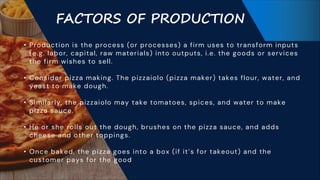
• Consider pizza making. The pizzaiolo (pizza maker) takes flour, water, and
yeast to make dough.
• Similarly, the pizzaiolo may take tomatoes, spices, and water to make
pizza sauce.
• He or she rolls out the dough, brushes on the pizza sauce, and adds
cheese and other toppings.
• Once baked, the pizza goes into a box (if it’s for takeout) and the
customer pays for the good
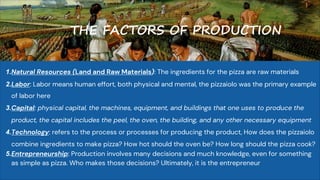
THE FACTORS OF PRODUCTION
1.Natural Resources (Land and Raw Materials): The ingredients for the pizza are raw materials
2.Labor: Labor means human effort, both physical and mental, the pizzaiolo was the primary example
of labor here
3.Capital: physical capital, the machines, equipment, and buildings that one uses to produce the
product, the capital includes the peel, the oven, the building, and any other necessary equipment
4.Technology: refers to the process or processes for producing the product, How does the pizzaiolo
combine ingredients to make pizza? How hot should the oven be? How long should the pizza cook?
5.Entrepreneurship: Production involves many decisions and much knowledge, even for something
as simple as pizza. Who makes those decisions? Ultimately, it is the entrepreneur
• A mathematical expression or equation that explains
the relationship between a firm’s inputs and its
outputs:
Q = F [NR,L,K,t,E]
• By plugging in the amount of labor, capital and other
inputs the firm is using, the production function tells
how much output will be produced by those inputs.
• Different products have different production
functions.
• The amount of labor a farmer uses to produce a
bushel of corn is likely different than that required to
produce an automobile.
• Firms in the same industry may have somewhat
different production functions, since each firm may
produce a little differently.
• We can describe inputs as either fixed or variable.
THE PRODUCTION FUNCTION
Fixed inputs are those that can’t easily be
increased or decreased in a short period of time.
• If one owns a pizza restaurant, the building is a
fixed input.
• Once the entrepreneur signs the lease, he or
she is stuck in the building until the lease
expires.
• Fixed inputs define the firm’s maximum output
capacity.
• This is analogous to the potential real GDP
shown by society’s production possibilities
curve.
• Fixed inputs do not change as output changes.
FIXED INPUTS
VARIABLE INPUTS
Variable inputs are those that can easily be increased or
decreased in a short period of time.
• In the pizza example, the pizzaiolo can order more
ingredients with a phone call, so ingredients would be
variable inputs.
• The owner could hire a new person to work the counter
pretty quickly as well.
• Variable inputs increase or decrease as output changes.
Note:
Economics often use a short-hand form for the
production:
Q = f [L,K]
where L represents all the variables inputs, and K
represents all the fixed inputs.
Short Run and Long Run
Economists also differentiate between short and
long run production
The Short Run is the period of time during which
at least some factors of production are fixed.
During the period of the pizza restaurant lease,
the pizza restaurant is operating in the short run,
because it is limited to using the current building.
The Long Run is the period of time during which
all factors are variable.
Once the lease expires for the pizza restaurant,
the shop owner can move to a larger or smaller
place.
• Note that there is another important distinction between fixed and variable
inputs.
• In the short run, since the firm’s fixed inputs are fixed, the only way to vary a
firm’s output is by changing its variable inputs.
• Example: tree-cutting with a two-person crosscut saw.
• Since by definition capital is fixed in the short run, our production function
becomes:
Q=f [L, K] or Q = f [L]
• This equation simply indicates that since capital is fixed, then changing the
amount of output (e.g. trees cut down per day) depends only on changing the
amount of labor employed (e.g. number of lumberjacks working).
Short Run
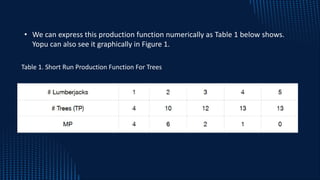
Table 1. Short Run Production Function For Trees
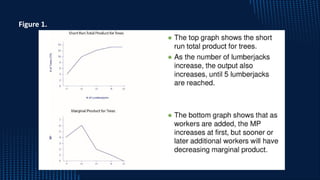
• We can express this production function numerically as Table 1 below shows.
Yopu can also see it graphically in Figure 1.
Figure 1.
TOTAL and MARGINAL PRODUCT
Total Product (TP) is the amount of output produced with a given ampount of labor and a fixed
amount of capital.
Marginal Product (MP) is the additional output of one more worker.
• Mathematically, Marginal Product is the change in total pro duct divided by the change in
labor. MP= TP/ L
• Since 0 workers produce 0 trees, the marginal product of the first worker is four trees per
day, but the marginal product of the second worker is six trees per day.
• Suppose we add a third lumberjack to the story. What will that person’s marginal product be?
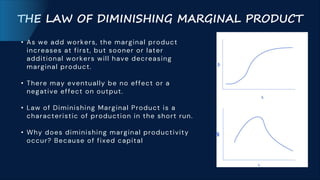
THE LAW OF DIMINISHING MARGINAL PRODUCT
• As we add workers, the marginal product
increases at first, but sooner or later
additional workers will have decreasing
marginal product.
• There may eventually be no effect or a
negative effect on output.
• Law of Diminishing Marginal Product is a
characteristic of production in the short run.
• Why does diminishing marginal productivity
occur? Because of fixed capital
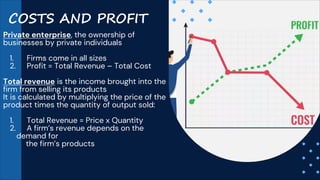
COSTS AND PROFIT
Private enterprise, the ownership of
businesses by private individuals
1. Firms come in all sizes
2. Profit = Total Revenue – Total Cost
Total revenue is the income brought into the
firm from selling its products
It is calculated by multiplying the price of the
product times the quantity of output sold:
1. Total Revenue = Price x Quantity
2. A firm’s revenue depends on the
demand for
the firm’s products
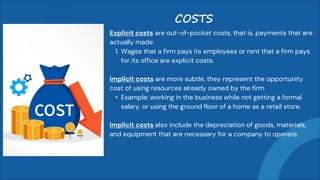
Explicit costs are out-of-pocket costs, that is, payments that are
actually made
1. Wages that a firm pays its employees or rent that a firm pays
for its office are explicit costs.
Implicit costs are more subtle, they represent the opportunity
cost of using resources already owned by the firm
• Example: working in the business while not getting a formal
salary, or using the ground floor of a home as a retail store.
Implicit costs also include the depreciation of goods, materials,
and equipment that are necessary for a company to operate.
COSTS
Profit
Accounting profit means total revenue minus
explicit costs (cash concept)
• The difference between dollars brought in
and dollars paid out.
Economic profit is total revenue minus total
cost, including both explicit and implicit costs
• The difference is even though a business
pays income taxes based on its accounting
profit, whether or not it is economically
successful depends on its economic profit
COSTS IN THE SHORT RUN
• For every factor of production (or input), there is an associated factor payment.
• Factor payments are what the firm pays for the use of the factors of production.
• From the firm’s perspective, factor payments are costs.
• From the owner of the factor’s perspective factor payments are income.
• Factor Payments include:
a. Raw materials prices for raw materials
b. Rent for land or buildings
c. Wages and salaries for labor
d. Interest and dividends for the use of financial capital (loans and equity investments)
e. Profit for entrepreneurship
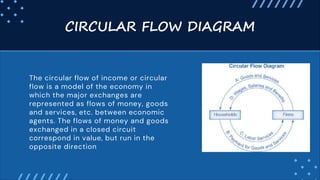
CIRCULAR FLOW DIAGRAM
The circular flow of income or circular
flow is a model of the economy in
which the major exchanges are
represented as flows of money, goods
and services, etc. between economic
agents. The flows of money and goods
exchanged in a closed circuit
correspond in value, but run in the
opposite direction
AVERAGE AND MARGINAL COSTS
• The cost of producing a firm’s output depends on how much labor and capital
the firm uses.
• We can measure costs in a variety of ways.
• Each way provides its own insight into costs.
• There are two ways to measure per unit costs:
Average cost is the cost on average of producing a given quantity. We can define
average cost as total cost divided by the quantity of output produced.
AC = TC/Q
Marginal cost is the cost of producing one more unit (or a few more units) of
output. Mathematically, marginal cost is the change in total cost divided by the
change in output.
MC = TC/ Q
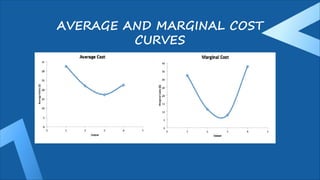
AVERAGE AND MARGINAL COST
CURVES
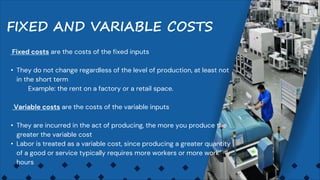
Fixed costs are the costs of the fixed inputs
• They do not change regardless of the level of production, at least not
in the short term
Example: the rent on a factory or a retail space.
Variable costs are the costs of the variable inputs
• They are incurred in the act of producing, the more you produce the
greater the variable cost
• Labor is treated as a variable cost, since producing a greater quantity
of a good or service typically requires more workers or more work
hours
FIXED AND VARIABLE COSTS
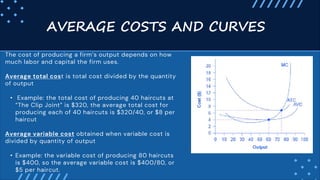
The cost of producing a firm’s output depends on how
much labor and capital the firm uses.
Average total cost is total cost divided by the quantity
of output
• Example: the total cost of producing 40 haircuts at
“The Clip Joint” is $320, the average total cost for
producing each of 40 haircuts is $320/40, or $8 per
haircut
Average variable cost obtained when variable cost is
divided by quantity of output
• Example: the variable cost of producing 80 haircuts
is $400, so the average variable cost is $400/80, or
$5 per haircut.
AVERAGE COSTS AND CURVES
Lessons From Alternative Measures of
Cost
• Fixed costs are often sunk costs that, once incurred, cannot be recouped.
• Sunk costs should typically be ignored, since this spending has already
been made and cannot be changed.
• Profit margin tells a firm for any level of output are they making money or
losing money.
• Profit is defined as revenues minus costs
Total Profit = total revenue – total cost
Production in the Long Run
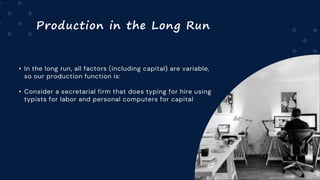
• In the long run, all factors (including capital) are variable,
so our production function is:
• Consider a secretarial firm that does typing for hire using
typists for labor and personal computers for capital
LONG RUN COSTS AND
PRODUCTION TECHNOLOGY
• The long run is the period of time when all costs are variable.
• Depends on the specifics of the firm in question.
• In planning for the long run, the firm will compare alternative production
technologies (or processes).
• In this context, technology refers to all alternative methods of combining
inputs to produce outputs.
• An improvement in production technology leads to a reduction in
production cost.
ECONOMIES OF SCALE
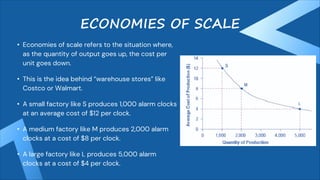
• Economies of scale refers to the situation where,
as the quantity of output goes up, the cost per
unit goes down.
• This is the idea behind “warehouse stores” like
Costco or Walmart.
• A small factory like S produces 1,000 alarm clocks
at an average cost of $12 per clock.
• A medium factory like M produces 2,000 alarm
clocks at a cost of $8 per clock.
• A large factory like L produces 5,000 alarm
clocks at a cost of $4 per clock.
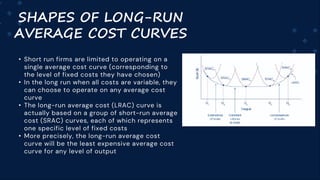
• Short run firms are limited to operating on a
single average cost curve (corresponding to
the level of fixed costs they have chosen)
• In the long run when all costs are variable, they
can choose to operate on any average cost
curve
• The long-run average cost (LRAC) curve is
actually based on a group of short-run average
cost (SRAC) curves, each of which represents
one specific level of fixed costs
• More precisely, the long-run average cost
curve will be the least expensive average cost
curve for any level of output
SHAPES OF LONG-RUN
AVERAGE COST CURVES
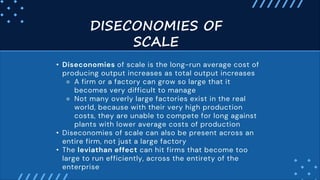
• Diseconomies of scale is the long-run average cost of
producing output increases as total output increases
⚬ A firm or a factory can grow so large that it
becomes very difficult to manage
⚬ Not many overly large factories exist in the real
world, because with their very high production
costs, they are unable to compete for long against
plants with lower average costs of production
• Diseconomies of scale can also be present across an
entire firm, not just a large factory
• The leviathan effect can hit firms that become too
large to run efficiently, across the entirety of the
enterprise
DISECONOMIES OF
SCALE
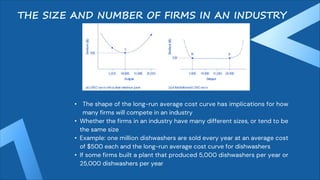
• The shape of the long-run average cost curve has implications for how
many firms will compete in an industry
• Whether the firms in an industry have many different sizes, or tend to be
the same size
• Example: one million dishwashers are sold every year at an average cost
of $500 each and the long-run average cost curve for dishwashers
• If some firms built a plant that produced 5,000 dishwashers per year or
25,000 dishwashers per year
THE SIZE AND NUMBER OF FIRMS IN AN INDUSTRY
THANK YOU!
G R O U P 4
M E M B E R S :
A L L E G O , NI C O L E
C A O Y O N, K I A NA
G R I J A L D O , B E A H
I S I D R O , Z Y R A NA O M I
M A B A T E , R O B E M I E
S A NC H O , S A R A H G W Y NE T H
V I C T O R I A , A L E X S A A R L

Basic Microeconomics: PRODUCTION AND COST

  • 1.
  • 2.
    • A firm(or business) combines inputs of labor, capital, land, and raw or finished component materials to produce outputs. • This activity of production goes beyond manufacturing. It includes any process or service that creates value, including transportation, distribution, wholesale and retail sales. Production involves a number of important decisions that define the behavior of firms. • If the firm is successful, the outputs are more valuable than the inputs WHAT IS PRODUCTION?
  • 3.
    These decisions include,but are not limited to: a. What product or products should the firm produce? (Products that have strong market demand and can generate sufficient revenue) b. How should the products be produced (Firms must choose the most efficient production technology, considering factors like cost, quality, and scale) c. How much output should the firm produce? (Firms aim to produce the quantity of output that maximizes their profits) d. What price should the firm charge for its products? (The firm's pricing strategy will depend on the market structure (perfect competition, monopoly, monopolistic competition, or oligopoly) e. How much labor should the firm employ? (Firms should hire labor up to the point where the marginal revenue product of labor equals the wage rate) WHAT IS PRODUCTION?
  • 4.
    WHAT IS PRODUCTION? •The answers to those questions depend on the production and cost conditions facing each firm • The answers also depend on the structure of the market for the product(s) in question. • From the firm’s perspective, cost is what they pay for the inputs necessary to produce the product. Thus, cost and price are not the same thing. Price is what firm receives from selling the product. C ost is what the firm pays for producing and selling its products.
  • 5.
    WHAT IS PRODUCTION?CONT. Ø Perfect competition - is an idealized market structure characterized by numerous buyers and sellers, identical products, perfect information, and easy entry and exit. Ø Monopolistic competition - is a market structure where many firms compete by offering similar but differentiated products. This differentiation can be based on brand name, quality, style, or other features. Ø Oligopoly - is a market structure where a few large firms dominate the industry. These firms have significant market power and can influence prices and output levels. Ø Monopoly - is a market structure characterized by a single seller or producer that dominates an industry or sector.
  • 6.
    FACTORS OF PRODUCTION •Production is the process (or processes) a firm uses to transform inputs (e.g. labor, capital, raw materials) into outputs, i.e. the goods or services the firm wishes to sell. • Consider pizza making. The pizzaiolo (pizza maker) takes flour, water, and yeast to make dough. • Similarly, the pizzaiolo may take tomatoes, spices, and water to make pizza sauce. • He or she rolls out the dough, brushes on the pizza sauce, and adds cheese and other toppings. • Once baked, the pizza goes into a box (if it’s for takeout) and the customer pays for the good
  • 7.
    THE FACTORS OFPRODUCTION 1.Natural Resources (Land and Raw Materials): The ingredients for the pizza are raw materials 2.Labor: Labor means human effort, both physical and mental, the pizzaiolo was the primary example of labor here 3.Capital: physical capital, the machines, equipment, and buildings that one uses to produce the product, the capital includes the peel, the oven, the building, and any other necessary equipment 4.Technology: refers to the process or processes for producing the product, How does the pizzaiolo combine ingredients to make pizza? How hot should the oven be? How long should the pizza cook? 5.Entrepreneurship: Production involves many decisions and much knowledge, even for something as simple as pizza. Who makes those decisions? Ultimately, it is the entrepreneur
  • 8.
    • A mathematicalexpression or equation that explains the relationship between a firm’s inputs and its outputs: Q = F [NR,L,K,t,E] • By plugging in the amount of labor, capital and other inputs the firm is using, the production function tells how much output will be produced by those inputs. • Different products have different production functions. • The amount of labor a farmer uses to produce a bushel of corn is likely different than that required to produce an automobile. • Firms in the same industry may have somewhat different production functions, since each firm may produce a little differently. • We can describe inputs as either fixed or variable. THE PRODUCTION FUNCTION
  • 9.
    Fixed inputs arethose that can’t easily be increased or decreased in a short period of time. • If one owns a pizza restaurant, the building is a fixed input. • Once the entrepreneur signs the lease, he or she is stuck in the building until the lease expires. • Fixed inputs define the firm’s maximum output capacity. • This is analogous to the potential real GDP shown by society’s production possibilities curve. • Fixed inputs do not change as output changes. FIXED INPUTS
  • 10.
    VARIABLE INPUTS Variable inputsare those that can easily be increased or decreased in a short period of time. • In the pizza example, the pizzaiolo can order more ingredients with a phone call, so ingredients would be variable inputs. • The owner could hire a new person to work the counter pretty quickly as well. • Variable inputs increase or decrease as output changes. Note: Economics often use a short-hand form for the production: Q = f [L,K] where L represents all the variables inputs, and K represents all the fixed inputs.
  • 11.
    Short Run andLong Run Economists also differentiate between short and long run production The Short Run is the period of time during which at least some factors of production are fixed. During the period of the pizza restaurant lease, the pizza restaurant is operating in the short run, because it is limited to using the current building. The Long Run is the period of time during which all factors are variable. Once the lease expires for the pizza restaurant, the shop owner can move to a larger or smaller place.
  • 12.
    • Note thatthere is another important distinction between fixed and variable inputs. • In the short run, since the firm’s fixed inputs are fixed, the only way to vary a firm’s output is by changing its variable inputs. • Example: tree-cutting with a two-person crosscut saw. • Since by definition capital is fixed in the short run, our production function becomes: Q=f [L, K] or Q = f [L] • This equation simply indicates that since capital is fixed, then changing the amount of output (e.g. trees cut down per day) depends only on changing the amount of labor employed (e.g. number of lumberjacks working). Short Run
  • 13.
    Table 1. ShortRun Production Function For Trees • We can express this production function numerically as Table 1 below shows. Yopu can also see it graphically in Figure 1.
  • 14.
  • 15.
    TOTAL and MARGINALPRODUCT Total Product (TP) is the amount of output produced with a given ampount of labor and a fixed amount of capital. Marginal Product (MP) is the additional output of one more worker. • Mathematically, Marginal Product is the change in total pro duct divided by the change in labor. MP= TP/ L • Since 0 workers produce 0 trees, the marginal product of the first worker is four trees per day, but the marginal product of the second worker is six trees per day. • Suppose we add a third lumberjack to the story. What will that person’s marginal product be?
  • 16.
    THE LAW OFDIMINISHING MARGINAL PRODUCT • As we add workers, the marginal product increases at first, but sooner or later additional workers will have decreasing marginal product. • There may eventually be no effect or a negative effect on output. • Law of Diminishing Marginal Product is a characteristic of production in the short run. • Why does diminishing marginal productivity occur? Because of fixed capital
  • 17.
    COSTS AND PROFIT Privateenterprise, the ownership of businesses by private individuals 1. Firms come in all sizes 2. Profit = Total Revenue – Total Cost Total revenue is the income brought into the firm from selling its products It is calculated by multiplying the price of the product times the quantity of output sold: 1. Total Revenue = Price x Quantity 2. A firm’s revenue depends on the demand for the firm’s products
  • 18.
    Explicit costs areout-of-pocket costs, that is, payments that are actually made 1. Wages that a firm pays its employees or rent that a firm pays for its office are explicit costs. Implicit costs are more subtle, they represent the opportunity cost of using resources already owned by the firm • Example: working in the business while not getting a formal salary, or using the ground floor of a home as a retail store. Implicit costs also include the depreciation of goods, materials, and equipment that are necessary for a company to operate. COSTS
  • 19.
    Profit Accounting profit meanstotal revenue minus explicit costs (cash concept) • The difference between dollars brought in and dollars paid out. Economic profit is total revenue minus total cost, including both explicit and implicit costs • The difference is even though a business pays income taxes based on its accounting profit, whether or not it is economically successful depends on its economic profit
  • 20.
    COSTS IN THESHORT RUN • For every factor of production (or input), there is an associated factor payment. • Factor payments are what the firm pays for the use of the factors of production. • From the firm’s perspective, factor payments are costs. • From the owner of the factor’s perspective factor payments are income. • Factor Payments include: a. Raw materials prices for raw materials b. Rent for land or buildings c. Wages and salaries for labor d. Interest and dividends for the use of financial capital (loans and equity investments) e. Profit for entrepreneurship
  • 21.
    CIRCULAR FLOW DIAGRAM Thecircular flow of income or circular flow is a model of the economy in which the major exchanges are represented as flows of money, goods and services, etc. between economic agents. The flows of money and goods exchanged in a closed circuit correspond in value, but run in the opposite direction
  • 22.
    AVERAGE AND MARGINALCOSTS • The cost of producing a firm’s output depends on how much labor and capital the firm uses. • We can measure costs in a variety of ways. • Each way provides its own insight into costs. • There are two ways to measure per unit costs: Average cost is the cost on average of producing a given quantity. We can define average cost as total cost divided by the quantity of output produced. AC = TC/Q Marginal cost is the cost of producing one more unit (or a few more units) of output. Mathematically, marginal cost is the change in total cost divided by the change in output. MC = TC/ Q
  • 23.
  • 24.
    Fixed costs arethe costs of the fixed inputs • They do not change regardless of the level of production, at least not in the short term Example: the rent on a factory or a retail space. Variable costs are the costs of the variable inputs • They are incurred in the act of producing, the more you produce the greater the variable cost • Labor is treated as a variable cost, since producing a greater quantity of a good or service typically requires more workers or more work hours FIXED AND VARIABLE COSTS
  • 25.
    The cost ofproducing a firm’s output depends on how much labor and capital the firm uses. Average total cost is total cost divided by the quantity of output • Example: the total cost of producing 40 haircuts at “The Clip Joint” is $320, the average total cost for producing each of 40 haircuts is $320/40, or $8 per haircut Average variable cost obtained when variable cost is divided by quantity of output • Example: the variable cost of producing 80 haircuts is $400, so the average variable cost is $400/80, or $5 per haircut. AVERAGE COSTS AND CURVES
  • 26.
    Lessons From AlternativeMeasures of Cost • Fixed costs are often sunk costs that, once incurred, cannot be recouped. • Sunk costs should typically be ignored, since this spending has already been made and cannot be changed. • Profit margin tells a firm for any level of output are they making money or losing money. • Profit is defined as revenues minus costs Total Profit = total revenue – total cost
  • 27.
    Production in theLong Run • In the long run, all factors (including capital) are variable, so our production function is: • Consider a secretarial firm that does typing for hire using typists for labor and personal computers for capital
  • 28.
    LONG RUN COSTSAND PRODUCTION TECHNOLOGY • The long run is the period of time when all costs are variable. • Depends on the specifics of the firm in question. • In planning for the long run, the firm will compare alternative production technologies (or processes). • In this context, technology refers to all alternative methods of combining inputs to produce outputs. • An improvement in production technology leads to a reduction in production cost.
  • 29.
    ECONOMIES OF SCALE •Economies of scale refers to the situation where, as the quantity of output goes up, the cost per unit goes down. • This is the idea behind “warehouse stores” like Costco or Walmart. • A small factory like S produces 1,000 alarm clocks at an average cost of $12 per clock. • A medium factory like M produces 2,000 alarm clocks at a cost of $8 per clock. • A large factory like L produces 5,000 alarm clocks at a cost of $4 per clock.
  • 30.
    • Short runfirms are limited to operating on a single average cost curve (corresponding to the level of fixed costs they have chosen) • In the long run when all costs are variable, they can choose to operate on any average cost curve • The long-run average cost (LRAC) curve is actually based on a group of short-run average cost (SRAC) curves, each of which represents one specific level of fixed costs • More precisely, the long-run average cost curve will be the least expensive average cost curve for any level of output SHAPES OF LONG-RUN AVERAGE COST CURVES
  • 31.
    • Diseconomies ofscale is the long-run average cost of producing output increases as total output increases ⚬ A firm or a factory can grow so large that it becomes very difficult to manage ⚬ Not many overly large factories exist in the real world, because with their very high production costs, they are unable to compete for long against plants with lower average costs of production • Diseconomies of scale can also be present across an entire firm, not just a large factory • The leviathan effect can hit firms that become too large to run efficiently, across the entirety of the enterprise DISECONOMIES OF SCALE
  • 32.
    • The shapeof the long-run average cost curve has implications for how many firms will compete in an industry • Whether the firms in an industry have many different sizes, or tend to be the same size • Example: one million dishwashers are sold every year at an average cost of $500 each and the long-run average cost curve for dishwashers • If some firms built a plant that produced 5,000 dishwashers per year or 25,000 dishwashers per year THE SIZE AND NUMBER OF FIRMS IN AN INDUSTRY
  • 33.
    THANK YOU! G RO U P 4 M E M B E R S : A L L E G O , NI C O L E C A O Y O N, K I A NA G R I J A L D O , B E A H I S I D R O , Z Y R A NA O M I M A B A T E , R O B E M I E S A NC H O , S A R A H G W Y NE T H V I C T O R I A , A L E X S A A R L