The Stakeholder Model BTEC Business
Pressures on Business Competitive pressures –  Modern business faces greater competitive pressure: More open markets  Globalisation  Shareholders seeking ever higher profits
Pressures on Business Pressure of responsibility - G rowing importance to consumers of ethical business: Total UK sales of Fair Trade products grew in 2004 by more than 50% to £140 million Environmental legislation
How Should Firms Respond? ‘ Inclusivity’: Take a wide view of why the firm exists Recognise range of interest groups  Form partnerships with wide range of groups
What’s Different About This? Firms used to aim for maximum profits to keep shareholders happy This was often against interests  of groups outside organisation Now, interdependence seen  as vital Partnerships with all interest groups
What Does This Mean? Difficult to balance the different short term demands of shareholders and stakeholders   Firms can benefit considerably from cooperating with stakeholder groups   Their needs can be built into the firm’s decision making processes
Benefits Firms Can Expect Better public relations More favourable reporting  of firm’s activities in media Quality relationships with suppliers Lower staff turnover
Benefits Firms Can Expect Higher employee motivation Reduced impact of pressure groups on firm’s activities But only if firm genuinely commits to stakeholder model.
Meeting the Needs of Stakeholders BTEC Business
What are Stakeholders? Stakeholders are groups of people who have an interest in a business organisation They can be seen as being either external to the organisation, or internal But some may be both!
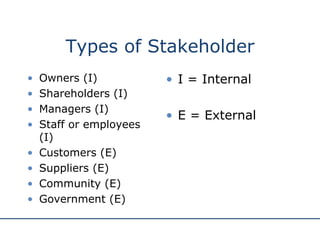
Types of Stakeholder Owners (I) Shareholders (I) Managers (I) Staff or employees (I) Customers (E) Suppliers (E) Community (E) Government (E) I = Internal E = External
Internal and External Stakeholders Internal stakeholders are those who are  ‘members’ of the business organisation Owners and shareholders Managers Staff and employees External stakeholders are not part of the firm
But…..! Some groups can be both internal and external stakeholders Such as staff or shareholders who are also local residents Can you think of any others?
Characteristics of Stakeholders 1. Owners and Shareholders The number of owners and the roles they carry out differ according to the size of the firm In small businesses there may be only one owner (sole trader) or perhaps a small number of partners (partnership) In large firms there are often thousands of shareholders, who each own a small part of the business
2. Managers: organise make decisions plan control are accountable to the owner(s) Characteristics of Stakeholders
Characteristics of Stakeholders 3. Employees or Staff: A business needs staff or employees to carry out its activities Employees agree to work a certain number of hours in return for a wage or salary Pay levels vary with skills, qualifications, age, location, types of work and industry and other factors
Characteristics of Stakeholders 4. Customers: Customers buy the goods or services produced by firms They may be individuals or other businesses Firms must understand and meet the needs of their customers, otherwise they will fail to make a profit or, indeed, survive
5. Suppliers: Firms get the resources they need to produce goods and services from suppliers Businesses should have effective relationships with their suppliers in order to get quality resources at reasonable prices This is a two-way process, as suppliers depend on the firms they supply Characteristics of Stakeholders
6. Community: Firms and the communities they exist in are also in a two-way relationship The local community may often provide many of the firm’s staff and customers The business often supplies goods and services vital to the local area But at times the community can feel aggrieved by some aspects of what a firm does Characteristics of Stakeholders
7. Government: Economic policies affect firms’ costs (through taxation and interest rates) Legislation regulates what business can do in areas such as the environment and occupational safety and health Successful firms are good for governments as they create wealth and employment Characteristics of Stakeholders

Stakeholder Model

  • 1.
    The Stakeholder ModelBTEC Business
  • 2.
    Pressures on BusinessCompetitive pressures – Modern business faces greater competitive pressure: More open markets Globalisation Shareholders seeking ever higher profits
  • 3.
    Pressures on BusinessPressure of responsibility - G rowing importance to consumers of ethical business: Total UK sales of Fair Trade products grew in 2004 by more than 50% to £140 million Environmental legislation
  • 4.
    How Should FirmsRespond? ‘ Inclusivity’: Take a wide view of why the firm exists Recognise range of interest groups Form partnerships with wide range of groups
  • 5.
    What’s Different AboutThis? Firms used to aim for maximum profits to keep shareholders happy This was often against interests of groups outside organisation Now, interdependence seen as vital Partnerships with all interest groups
  • 6.
    What Does ThisMean? Difficult to balance the different short term demands of shareholders and stakeholders Firms can benefit considerably from cooperating with stakeholder groups Their needs can be built into the firm’s decision making processes
  • 7.
    Benefits Firms CanExpect Better public relations More favourable reporting of firm’s activities in media Quality relationships with suppliers Lower staff turnover
  • 8.
    Benefits Firms CanExpect Higher employee motivation Reduced impact of pressure groups on firm’s activities But only if firm genuinely commits to stakeholder model.
  • 9.
    Meeting the Needsof Stakeholders BTEC Business
  • 10.
    What are Stakeholders?Stakeholders are groups of people who have an interest in a business organisation They can be seen as being either external to the organisation, or internal But some may be both!
  • 11.
    Types of StakeholderOwners (I) Shareholders (I) Managers (I) Staff or employees (I) Customers (E) Suppliers (E) Community (E) Government (E) I = Internal E = External
  • 12.
    Internal and ExternalStakeholders Internal stakeholders are those who are ‘members’ of the business organisation Owners and shareholders Managers Staff and employees External stakeholders are not part of the firm
  • 13.
    But…..! Some groupscan be both internal and external stakeholders Such as staff or shareholders who are also local residents Can you think of any others?
  • 14.
    Characteristics of Stakeholders1. Owners and Shareholders The number of owners and the roles they carry out differ according to the size of the firm In small businesses there may be only one owner (sole trader) or perhaps a small number of partners (partnership) In large firms there are often thousands of shareholders, who each own a small part of the business
  • 15.
    2. Managers: organisemake decisions plan control are accountable to the owner(s) Characteristics of Stakeholders
  • 16.
    Characteristics of Stakeholders3. Employees or Staff: A business needs staff or employees to carry out its activities Employees agree to work a certain number of hours in return for a wage or salary Pay levels vary with skills, qualifications, age, location, types of work and industry and other factors
  • 17.
    Characteristics of Stakeholders4. Customers: Customers buy the goods or services produced by firms They may be individuals or other businesses Firms must understand and meet the needs of their customers, otherwise they will fail to make a profit or, indeed, survive
  • 18.
    5. Suppliers: Firmsget the resources they need to produce goods and services from suppliers Businesses should have effective relationships with their suppliers in order to get quality resources at reasonable prices This is a two-way process, as suppliers depend on the firms they supply Characteristics of Stakeholders
  • 19.
    6. Community: Firmsand the communities they exist in are also in a two-way relationship The local community may often provide many of the firm’s staff and customers The business often supplies goods and services vital to the local area But at times the community can feel aggrieved by some aspects of what a firm does Characteristics of Stakeholders
  • 20.
    7. Government: Economicpolicies affect firms’ costs (through taxation and interest rates) Legislation regulates what business can do in areas such as the environment and occupational safety and health Successful firms are good for governments as they create wealth and employment Characteristics of Stakeholders