Long-run production and cost theory
Changing the scale of operations
                           In the short-run, the level of production
   1 small plant with      can be changed within limits of the
   60 workers can          fixed factor/s of production (e.g.
   produce 300             capital). To break these limits, firms
   units per week.         are able to increase the scale of their
                           operations in the long-run by investing
                           in fixed factors (e.g. building bigger
                           factories).
        1 medium sized
        plant with 80
        workers can       1 large plant with
        produce 600       100 workers can
        units per week.   produce 1000
                          units per week.


                                 Note how the output per worker
                                 increases as the plant size
                                 increases. This effect is known
                                 as increasing returns of scale.
Returns to scale

    Increasing returns to scale is when an increase in the
    scale of the factors of production leads to a more than
    proportionate increase in output

    Constant returns to scale is when an increase in the
    scale of the factors of production leads to a proportionate
    increase in output

    Decreasing returns to scale is when an increase in the
    scale of the factors of production leads to a less than
    proportionate increase in output
A U-shaped long-run average
  cost curve and its related short-
  run average cost curves
                                         Long-run costs
Costs                                                                                        The shape of the LRAC
                                                                                             curve
                                                                      SRATC7
                  SRATC1                                                       LRAC          As firms increase the scale of
                                                                                             production and experience
                           SRATC2                                SRATC6                      increasing returns to scale,
                                                                                             so the average cost of
                                      SRATC3            SRATC5                               production falls. However,
          Economies                            SRATC4               Dis-economies
                                                                                             when the scale reaches a
          of scale                                                  of scale                 certain level there can be
  C1                                                                                         decreasing returns therefore
                                                                                             increasing average costs.
                                                                                             The long-run average cost
                                                                                             curve therefore is often
    0                                                                                        drawn as U-shaped.
                                                Q1                                  Output


                           Economies and dis-economies

                           The falling LRAC is due to economies of scale and the rising LRAC at higher levels of
                           output are due to dis-economies of scale.

    Short-run curves along the LRAC curve

    At each point along the LRAC curve the short-run rules of production apply; costs fall due to the division of
    labour and falling AFC, then rise as diminishing marginal returns kick in. As the scale of production increases
    the long-run costs fall or increase, but the short-run curve still applies at each scale. It is important not to
    confuse the short-run reasons for changing costs with the long-run reasons.
Economies and Dis-economies
Technical economies of scale                           Dis-economies of scale

Increasing returns to scale lead to economies of       When the output of a firm increases it may
scale when the effect is translated into cost          experience rising unit costs. This is often due to
theory. This reason for falling unit costs is known    what are known as managerial dis-economies of
as technical economies of scale. There are other       scale.
types of economies of scale apart from technical
economies.                                             Managerial dis-economies occur as the firm gets
                                                       larger and it becomes more difficult to manage
The main types of technical economies are:             the complexity of the firm. Often, levels of
                                                       hierarchy are introduced and different functional
Indivisibilities whereby there is a minimum            parts of the firm are divided into departments.
efficient scale for a piece of equipment               Communication problems may increasingly result,
                                                       both from the top to bottom of the hierarchy, and
Spreading of R&D costs over higher production          between the departments.
levels

Volume economies which occur when the
increasing dimensions lead to proportionally
higher volume increases. For example, a factory
of twice the height, width and length will have four
times the volume.

Economies of massed resources e.g. fewer
spare parts need to be held if multiple identical
machines are run.
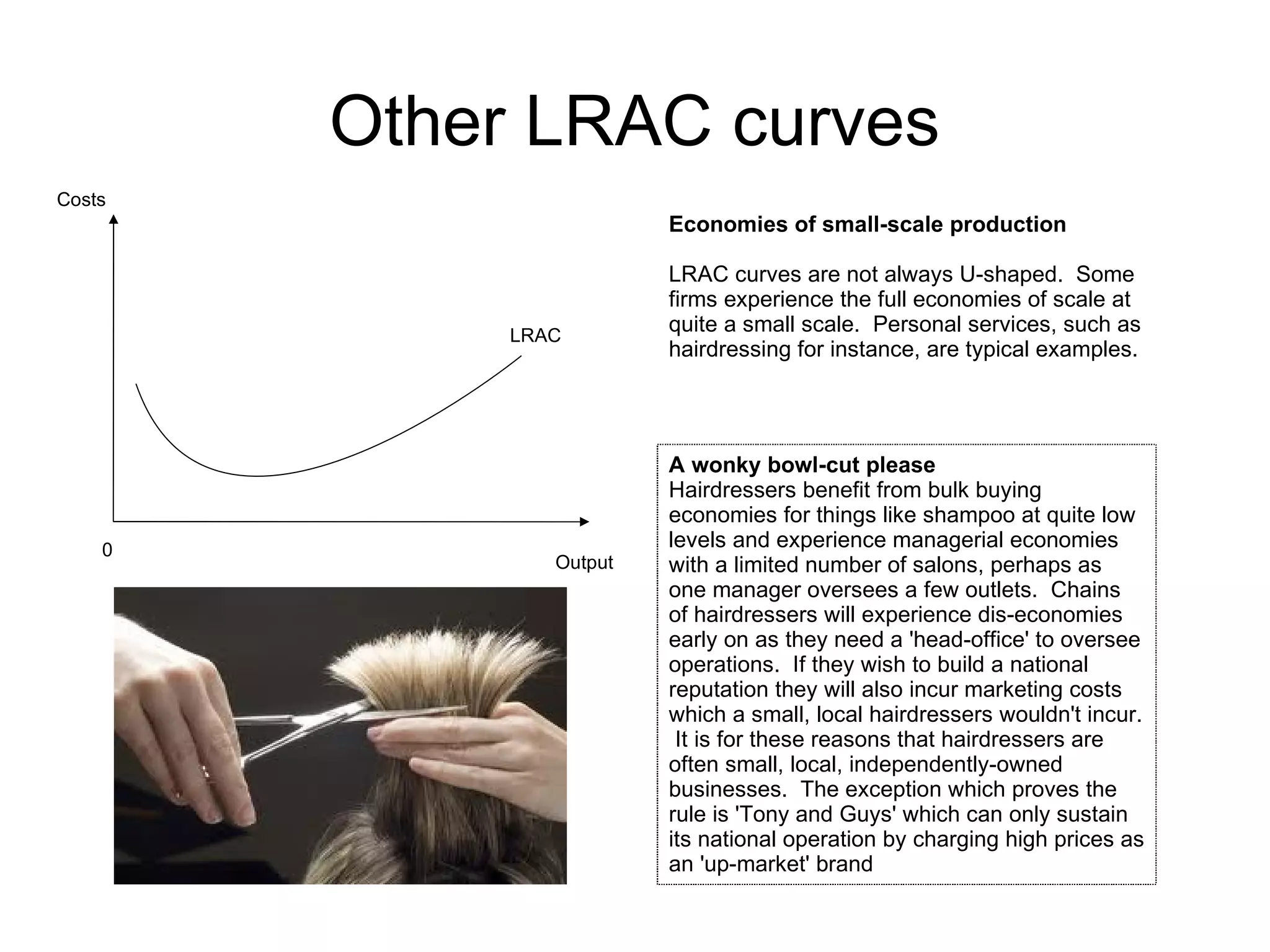
Other LRAC curves
Costs
                         Economies of small-scale production

                         LRAC curves are not always U-shaped. Some
                         firms experience the full economies of scale at
             LRAC
                         quite a small scale. Personal services, such as
                         hairdressing for instance, are typical examples.


                         A wonky bowl-cut please
                         Hairdressers benefit from bulk buying
                         economies for things like shampoo at quite low
    0                    levels and experience managerial economies
                Output   with a limited number of salons, perhaps as
                         one manager oversees a few outlets. Chains
                         of hairdressers will experience dis-economies
                         early on as they need a 'head-office' to oversee
                         operations. If they wish to build a national
                         reputation they will also incur marketing costs
                         which a small, local hairdressers wouldn't incur.
                          It is for these reasons that hairdressers are
                         often small, local, independently-owned
                         businesses. The exception which proves the
                         rule is 'Tony and Guys' which can only sustain
                         its national operation by charging high prices as
                         an 'up-market' brand
Other LRAC curves
Costs
                                             An L-shaped LRAC curve

                                             In some industries, such as manufacturing, there
                                             are significant economies of scale to be gained
                                             but not dis-economies (at least not at the scale of
                                             production required by the market).


                                   LRAC      Driving down costs
  C1                                         Car manufacturing requires significant
        Minimum Efficient Scale              investment in equipment and set-up costs are
                                             therefore very high. It is simply not cost-
    0                         Q1
                                    Output
                                             effective to spend all that money to only
                                             produce a few cars. Large scale production is
                                             achievable through the use of technology, such
                                             as computer controlled robotics, and although
                                             expensive, the average cost falls rapidly as
                                             automation replaces labour and speeds up
                                             production. Economies can also be gained as
                                             firms source cheaper components
                                             internationally, or set up their own plants in
                                             countries where costs are low. Consumers
                                             also want cars which have a recognisable
                                             brand and large firms can benefit from mass-
                                             market advertising which, if the market is large,
                                             can be cost effective.
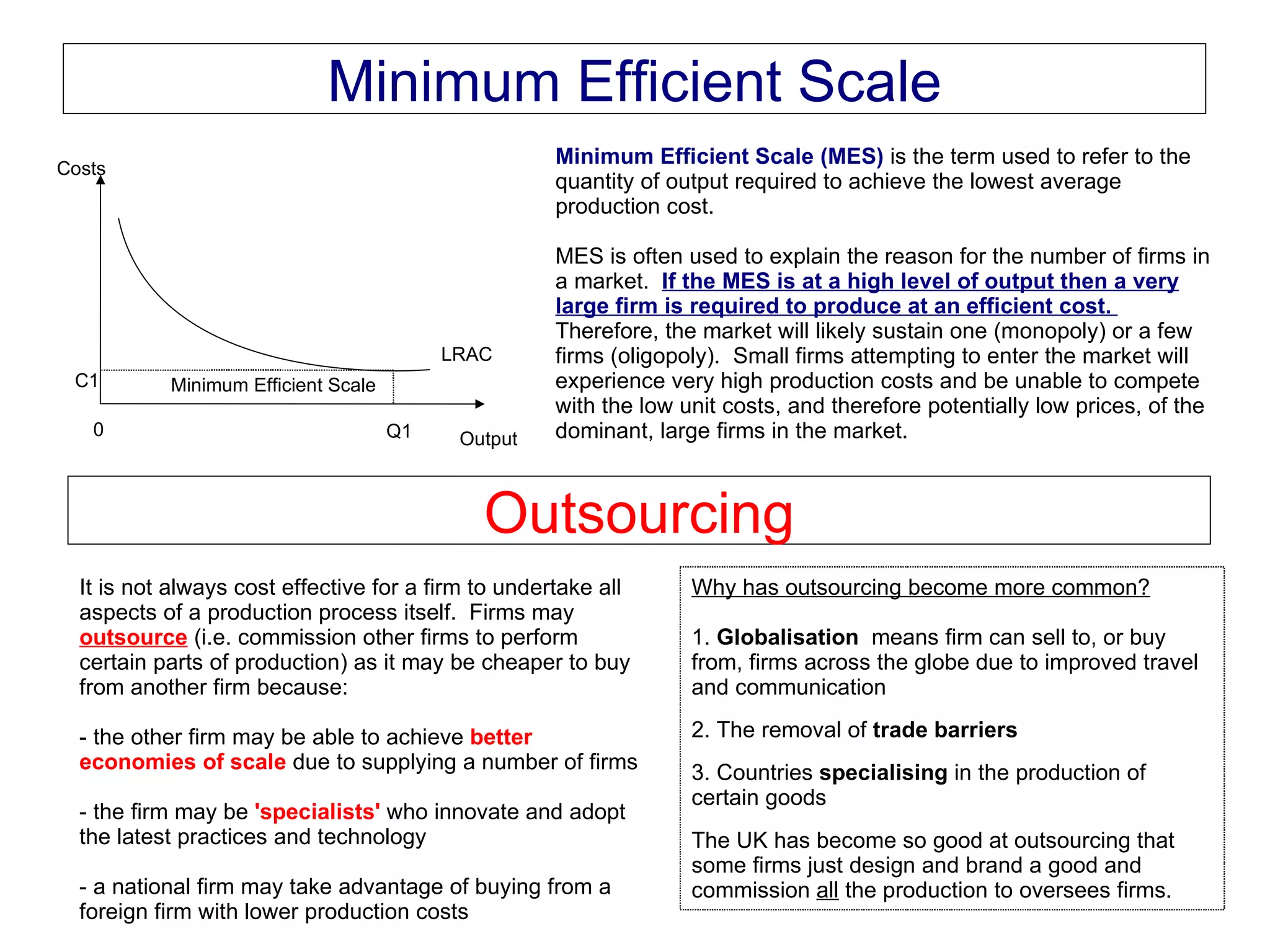
Minimum Efficient Scale
                                                    Minimum Efficient Scale (MES) is the term used to refer to the
Costs
                                                    quantity of output required to achieve the lowest average
                                                    production cost.

                                                    MES is often used to explain the reason for the number of firms in
                                                    a market. If the MES is at a high level of output then a very
                                                    large firm is required to produce at an efficient cost.
                                                    Therefore, the market will likely sustain one (monopoly) or a few
                                          LRAC      firms (oligopoly). Small firms attempting to enter the market will
 C1        Minimum Efficient Scale                  experience very high production costs and be unable to compete
                                                    with the low unit costs, and therefore potentially low prices, of the
   0                                 Q1    Output   dominant, large firms in the market.


                                             Outsourcing
  It is not always cost effective for a firm to undertake all     Why has outsourcing become more common?
  aspects of a production process itself. Firms may
  outsource (i.e. commission other firms to perform               1. Globalisation means firm can sell to, or buy
  certain parts of production) as it may be cheaper to buy        from, firms across the globe due to improved travel
  from another firm because:                                      and communication

  - the other firm may be able to achieve better                  2. The removal of trade barriers
  economies of scale due to supplying a number of firms           3. Countries specialising in the production of
                                                                  certain goods
  - the firm may be 'specialists' who innovate and adopt
  the latest practices and technology                             The UK has become so good at outsourcing that
                                                                  some firms just design and brand a good and
  - a national firm may take advantage of buying from a           commission all the production to oversees firms.
  foreign firm with lower production costs
10 point summary
 • In the short-run the level of production can be varied, and in the
long-run the scale of production changed

 • As the scale of operations increases firms may experience
increasing, constant or decreasing returns to scale

• Increasing returns to scale are associated with decreasing
average costs, known as economies of scale

4. Decreasing returns to scale are associated with increasing
average cost, known as dis-economies of scale

5. The particular type of economies of scale associated with the
LRAC curve are technical economies
10 point summary
6.The particular type of dis-economies of scale associated with the
LRAC curve is managerial dis-economies

7.The long-run average cost curve is often depicted as bowl-
shaped, with average costs falling due to economies, then
increasing due to dis-economies

8.The long-run average cost curve can also be drawn in different
ways to depict the conditions in specific industries e.g. L-shaped,
tick-shaped

9.The minimum efficient scale is the level of output at which the
minimum average cost of production is achieved in the long-run

10.It is not always most efficient for a firm to undertake every
stage of the production process; contracting out production is
known as outsourcing

Long run production and cost theory

  • 1.
  • 2.
    Changing the scaleof operations In the short-run, the level of production 1 small plant with can be changed within limits of the 60 workers can fixed factor/s of production (e.g. produce 300 capital). To break these limits, firms units per week. are able to increase the scale of their operations in the long-run by investing in fixed factors (e.g. building bigger factories). 1 medium sized plant with 80 workers can 1 large plant with produce 600 100 workers can units per week. produce 1000 units per week. Note how the output per worker increases as the plant size increases. This effect is known as increasing returns of scale.
  • 3.
    Returns to scale  Increasing returns to scale is when an increase in the scale of the factors of production leads to a more than proportionate increase in output  Constant returns to scale is when an increase in the scale of the factors of production leads to a proportionate increase in output  Decreasing returns to scale is when an increase in the scale of the factors of production leads to a less than proportionate increase in output
  • 4.
    A U-shaped long-runaverage cost curve and its related short- run average cost curves Long-run costs Costs The shape of the LRAC curve SRATC7 SRATC1 LRAC As firms increase the scale of production and experience SRATC2 SRATC6 increasing returns to scale, so the average cost of SRATC3 SRATC5 production falls. However, Economies SRATC4 Dis-economies when the scale reaches a of scale of scale certain level there can be C1 decreasing returns therefore increasing average costs. The long-run average cost curve therefore is often 0 drawn as U-shaped. Q1 Output Economies and dis-economies The falling LRAC is due to economies of scale and the rising LRAC at higher levels of output are due to dis-economies of scale. Short-run curves along the LRAC curve At each point along the LRAC curve the short-run rules of production apply; costs fall due to the division of labour and falling AFC, then rise as diminishing marginal returns kick in. As the scale of production increases the long-run costs fall or increase, but the short-run curve still applies at each scale. It is important not to confuse the short-run reasons for changing costs with the long-run reasons.
  • 5.
    Economies and Dis-economies Technicaleconomies of scale Dis-economies of scale Increasing returns to scale lead to economies of When the output of a firm increases it may scale when the effect is translated into cost experience rising unit costs. This is often due to theory. This reason for falling unit costs is known what are known as managerial dis-economies of as technical economies of scale. There are other scale. types of economies of scale apart from technical economies. Managerial dis-economies occur as the firm gets larger and it becomes more difficult to manage The main types of technical economies are: the complexity of the firm. Often, levels of hierarchy are introduced and different functional Indivisibilities whereby there is a minimum parts of the firm are divided into departments. efficient scale for a piece of equipment Communication problems may increasingly result, both from the top to bottom of the hierarchy, and Spreading of R&D costs over higher production between the departments. levels Volume economies which occur when the increasing dimensions lead to proportionally higher volume increases. For example, a factory of twice the height, width and length will have four times the volume. Economies of massed resources e.g. fewer spare parts need to be held if multiple identical machines are run.
  • 6.
    Other LRAC curves Costs Economies of small-scale production LRAC curves are not always U-shaped. Some firms experience the full economies of scale at LRAC quite a small scale. Personal services, such as hairdressing for instance, are typical examples. A wonky bowl-cut please Hairdressers benefit from bulk buying economies for things like shampoo at quite low 0 levels and experience managerial economies Output with a limited number of salons, perhaps as one manager oversees a few outlets. Chains of hairdressers will experience dis-economies early on as they need a 'head-office' to oversee operations. If they wish to build a national reputation they will also incur marketing costs which a small, local hairdressers wouldn't incur. It is for these reasons that hairdressers are often small, local, independently-owned businesses. The exception which proves the rule is 'Tony and Guys' which can only sustain its national operation by charging high prices as an 'up-market' brand
  • 7.
    Other LRAC curves Costs An L-shaped LRAC curve In some industries, such as manufacturing, there are significant economies of scale to be gained but not dis-economies (at least not at the scale of production required by the market). LRAC Driving down costs C1 Car manufacturing requires significant Minimum Efficient Scale investment in equipment and set-up costs are therefore very high. It is simply not cost- 0 Q1 Output effective to spend all that money to only produce a few cars. Large scale production is achievable through the use of technology, such as computer controlled robotics, and although expensive, the average cost falls rapidly as automation replaces labour and speeds up production. Economies can also be gained as firms source cheaper components internationally, or set up their own plants in countries where costs are low. Consumers also want cars which have a recognisable brand and large firms can benefit from mass- market advertising which, if the market is large, can be cost effective.
  • 8.
    Minimum Efficient Scale Minimum Efficient Scale (MES) is the term used to refer to the Costs quantity of output required to achieve the lowest average production cost. MES is often used to explain the reason for the number of firms in a market. If the MES is at a high level of output then a very large firm is required to produce at an efficient cost. Therefore, the market will likely sustain one (monopoly) or a few LRAC firms (oligopoly). Small firms attempting to enter the market will C1 Minimum Efficient Scale experience very high production costs and be unable to compete with the low unit costs, and therefore potentially low prices, of the 0 Q1 Output dominant, large firms in the market. Outsourcing It is not always cost effective for a firm to undertake all Why has outsourcing become more common? aspects of a production process itself. Firms may outsource (i.e. commission other firms to perform 1. Globalisation means firm can sell to, or buy certain parts of production) as it may be cheaper to buy from, firms across the globe due to improved travel from another firm because: and communication - the other firm may be able to achieve better 2. The removal of trade barriers economies of scale due to supplying a number of firms 3. Countries specialising in the production of certain goods - the firm may be 'specialists' who innovate and adopt the latest practices and technology The UK has become so good at outsourcing that some firms just design and brand a good and - a national firm may take advantage of buying from a commission all the production to oversees firms. foreign firm with lower production costs
  • 9.
    10 point summary • In the short-run the level of production can be varied, and in the long-run the scale of production changed • As the scale of operations increases firms may experience increasing, constant or decreasing returns to scale • Increasing returns to scale are associated with decreasing average costs, known as economies of scale 4. Decreasing returns to scale are associated with increasing average cost, known as dis-economies of scale 5. The particular type of economies of scale associated with the LRAC curve are technical economies
  • 10.
    10 point summary 6.Theparticular type of dis-economies of scale associated with the LRAC curve is managerial dis-economies 7.The long-run average cost curve is often depicted as bowl- shaped, with average costs falling due to economies, then increasing due to dis-economies 8.The long-run average cost curve can also be drawn in different ways to depict the conditions in specific industries e.g. L-shaped, tick-shaped 9.The minimum efficient scale is the level of output at which the minimum average cost of production is achieved in the long-run 10.It is not always most efficient for a firm to undertake every stage of the production process; contracting out production is known as outsourcing