
The Small-Firm Sector
Defining the Small-firm Sector EU definition of SMEs by number of employees micro enterprises small enterprises medium enterprises
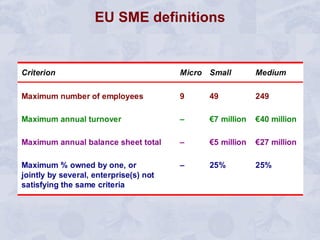
EU SME definitions
Defining the Small-firm Sector EU definition of SMEs by number of employees micro enterprises small enterprises medium enterprises use of EU definitions in the UK
Defining the Small-firm Sector EU definition of SMEs by number of employees micro enterprises small enterprises medium enterprises use of EU definitions in the UK Size of the small-firm sector in the UK
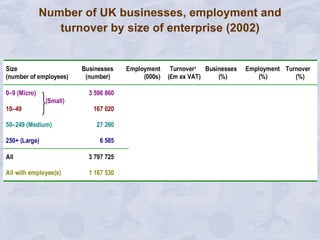
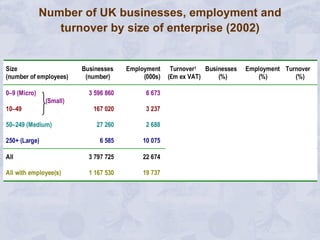
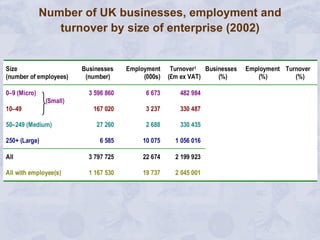
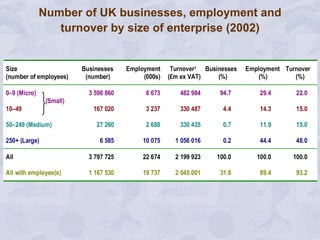
Number of UK businesses, employment and turnover by size of enterprise (2002)
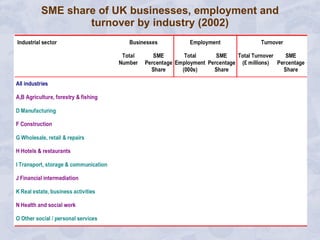
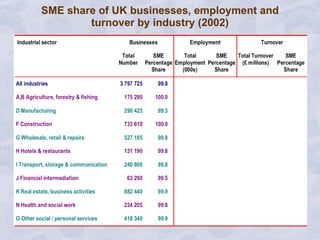
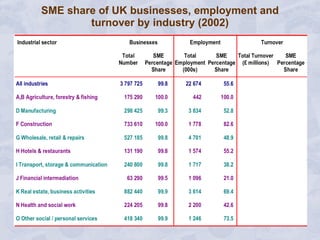
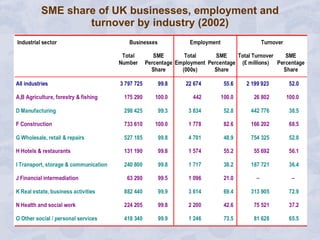
SME share of UK businesses, employment and turnover by industry (2002)
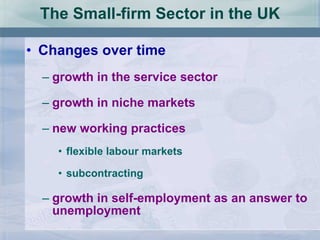
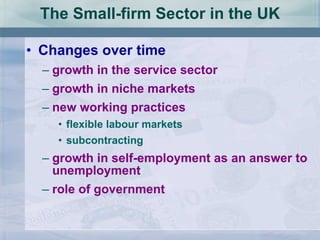
The Small-firm Sector in the UK Changes over time growth in the service sector growth in niche markets new working practices flexible labour markets subcontracting growth in self-employment as an answer to unemployment
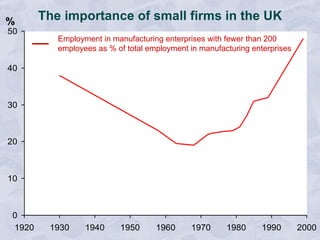
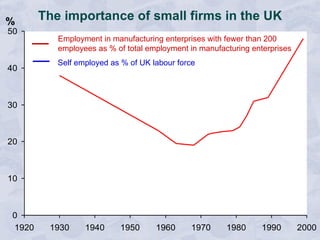
The importance of small firms in the UK Employment in manufacturing enterprises with fewer than 200 employees as % of total employment in manufacturing enterprises
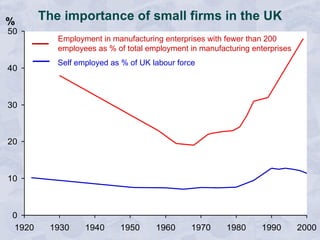
The importance of small firms in the UK Employment in manufacturing enterprises with fewer than 200 employees as % of total employment in manufacturing enterprises Self employed as % of UK labour force
The Small-firm Sector in the UK Changes over time growth in the service sector growth in niche markets new working practices flexible labour markets subcontracting growth in self-employment as an answer to unemployment role of government
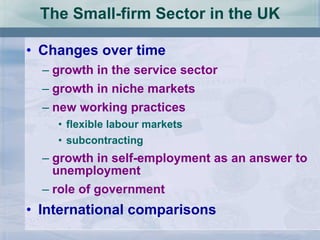
The Small-firm Sector in the UK Changes over time growth in the service sector growth in niche markets new working practices flexible labour markets subcontracting growth in self-employment as an answer to unemployment role of government International comparisons
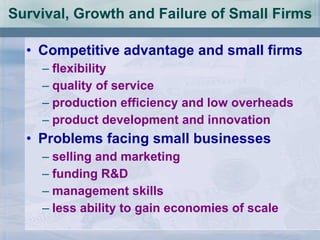
Survival, Growth and Failure of Small Firms Competitive advantage and small firms flexibility quality of service production efficiency and low overheads product development and innovation Problems facing small businesses selling and marketing funding R&D management skills less ability to gain economies of scale
The growth of small businesses the process of growth Survival, Growth and Failure of Small Firms
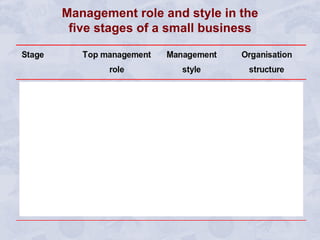
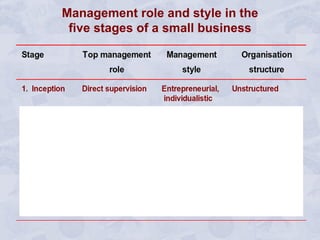
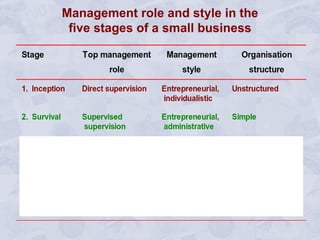
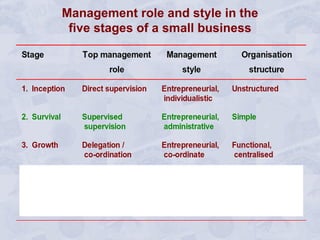
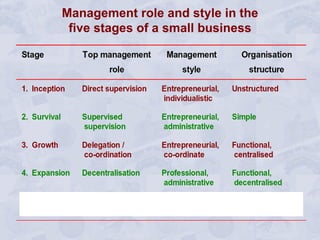
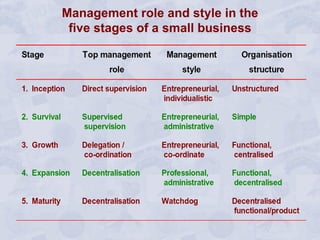
Management role and style in the five stages of a small business
Survival, Growth and Failure of Small Firms The growth of small businesses (cont.) the entrepreneur motivation and desire to succeed educational attainment management experience and business knowledge the firm the age of the business the sector of the economy legal forms location
Survival, Growth and Failure of Small Firms The growth of small businesses (cont.) strategy workforce and management training use of external finance product innovation export markets use of professional managers conditions for success of small businesses
Government Assistance to the Small Firm Small-firm policy in the UK small business start-up types of support financial assistance small business growth financial assistance corporate venturing national 'business angels' training programmes
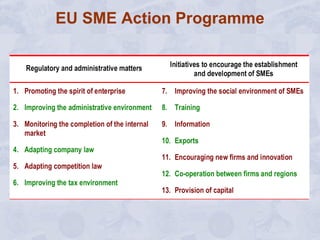
Government Assistance to the Small Firm Small-firm policy in the EU historical background SME Action Programme
EU SME Action Programme
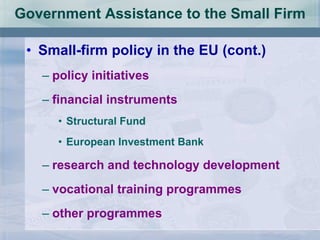
Government Assistance to the Small Firm Small-firm policy in the EU (cont.) policy initiatives financial instruments Structural Fund European Investment Bank research and technology development vocational training programmes other programmes

Small Firm Sector

  • 1.
  • 2.
    Defining the Small-firmSector EU definition of SMEs by number of employees micro enterprises small enterprises medium enterprises
  • 3.
  • 4.
    Defining the Small-firmSector EU definition of SMEs by number of employees micro enterprises small enterprises medium enterprises use of EU definitions in the UK
  • 5.
    Defining the Small-firmSector EU definition of SMEs by number of employees micro enterprises small enterprises medium enterprises use of EU definitions in the UK Size of the small-firm sector in the UK
  • 6.
    Number of UKbusinesses, employment and turnover by size of enterprise (2002)
  • 7.
    Number of UKbusinesses, employment and turnover by size of enterprise (2002)
  • 8.
    Number of UKbusinesses, employment and turnover by size of enterprise (2002)
  • 9.
    Number of UKbusinesses, employment and turnover by size of enterprise (2002)
  • 10.
    Number of UKbusinesses, employment and turnover by size of enterprise (2002)
  • 11.
    SME share ofUK businesses, employment and turnover by industry (2002)
  • 12.
    SME share ofUK businesses, employment and turnover by industry (2002)
  • 13.
    SME share ofUK businesses, employment and turnover by industry (2002)
  • 14.
    SME share ofUK businesses, employment and turnover by industry (2002)
  • 15.
    The Small-firm Sectorin the UK Changes over time growth in the service sector growth in niche markets new working practices flexible labour markets subcontracting growth in self-employment as an answer to unemployment
  • 16.
    The importance ofsmall firms in the UK Employment in manufacturing enterprises with fewer than 200 employees as % of total employment in manufacturing enterprises
  • 17.
    The importance ofsmall firms in the UK Employment in manufacturing enterprises with fewer than 200 employees as % of total employment in manufacturing enterprises
  • 18.
    The importance ofsmall firms in the UK Employment in manufacturing enterprises with fewer than 200 employees as % of total employment in manufacturing enterprises Self employed as % of UK labour force
  • 19.
    The importance ofsmall firms in the UK Employment in manufacturing enterprises with fewer than 200 employees as % of total employment in manufacturing enterprises Self employed as % of UK labour force
  • 20.
    The Small-firm Sectorin the UK Changes over time growth in the service sector growth in niche markets new working practices flexible labour markets subcontracting growth in self-employment as an answer to unemployment role of government
  • 21.
    The Small-firm Sectorin the UK Changes over time growth in the service sector growth in niche markets new working practices flexible labour markets subcontracting growth in self-employment as an answer to unemployment role of government International comparisons
  • 22.
    Survival, Growth andFailure of Small Firms Competitive advantage and small firms flexibility quality of service production efficiency and low overheads product development and innovation Problems facing small businesses selling and marketing funding R&D management skills less ability to gain economies of scale
  • 23.
    The growth ofsmall businesses the process of growth Survival, Growth and Failure of Small Firms
  • 24.
    Management role andstyle in the five stages of a small business
  • 25.
    Management role andstyle in the five stages of a small business
  • 26.
    Management role andstyle in the five stages of a small business
  • 27.
    Management role andstyle in the five stages of a small business
  • 28.
    Management role andstyle in the five stages of a small business
  • 29.
    Management role andstyle in the five stages of a small business
  • 30.
    Survival, Growth andFailure of Small Firms The growth of small businesses (cont.) the entrepreneur motivation and desire to succeed educational attainment management experience and business knowledge the firm the age of the business the sector of the economy legal forms location
  • 31.
    Survival, Growth andFailure of Small Firms The growth of small businesses (cont.) strategy workforce and management training use of external finance product innovation export markets use of professional managers conditions for success of small businesses
  • 32.
    Government Assistance tothe Small Firm Small-firm policy in the UK small business start-up types of support financial assistance small business growth financial assistance corporate venturing national 'business angels' training programmes
  • 33.
    Government Assistance tothe Small Firm Small-firm policy in the EU historical background SME Action Programme
  • 34.
    EU SME ActionProgramme
  • 35.
    Government Assistance tothe Small Firm Small-firm policy in the EU (cont.) policy initiatives financial instruments Structural Fund European Investment Bank research and technology development vocational training programmes other programmes