Submitted to: Submitted By:
Dr. Satish Pipralia Lavanya Devi Pampana(2020PAR5479)
Madhabattula Jaya Sailaja(2020PAR5681)
“The transfer of public assets, operations or activities to private enterprise”
MEANING
Privatization is the process of transferring ownership of a business, enterprise,
agency, public service or public property from the public sector to the private sector.
The business that operates for a profit or non- profit organization.
WHY PRIVATIZATION?
To reduce government involvement in commercially viable activities.
Increase efficiency in the delivery of programs and services.
Provides competition in market place which transfers the lower price and greater
choice for the consumers.
PRIVATIZATION IN
INDIA
 India is a mixed economy with both the private sector and the
public sector performing various activities in accordance with
regulations. But the public sector was affected by inefficiencies
and incompetence in a non-sustainable manner by 1991.
 The New Industrial Policy of 1991 contained several reform
measures for the public sector. Some of them are selling of loss
making units to the private sector, inviting private participation
in PSEs, and strategic sale.
 In India, hence privatization was in a unique form in
accordance with the priorities of our mixed economy and as
well as by considering operational aspects of the PSUs.
 Privatization in the country was launched mainly to enhance
the efficiency of the public sector enterprises as well as to
concentrate the operation of the public sector in priority areas.
METHODS OF PRIVATIZATION
MAIN METHODS:
1.Share issue privatization
» Selling shares on the stock market.
2.Asset sale privatization
» Selling entire organization to a strategic investor by auction.
3. Voucher privatization
» Distributing ownership to all for free or at lower cost.
SUB METHODS:
1. Contracting out:
» Production of service by private firm under a contract.
» Under this scenario, the private sector firm is paid directly by the government.
Example:
Collection of disposal waste
Other things include security services, data processing services
2.Franchising:
» Government awarding a rights to perform services within a specific geographic area to a
private firm
» The private firm generates revenue by collecting user fees.
Example:
Cable television, gas etc..
3. Open competition:
» Many private firms are allowed to compete for customers within a governmental jurisdiction.
» It is not appropriate for some services as it most likely would not be efficient to have
multiple suppliers of electricity, gas, or water service.
Example:
It typically seen telephone and internet provider
PRIVATIZATION OF COAL SECTOR
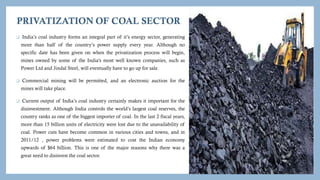
 India’s coal industry forms an integral part of it’s energy sector, generating
more than half of the country’s power supply every year. Although no
specific date has been given on when the privatization process will begin,
mines owned by some of the India's most well known companies, such as
Power Ltd and Jindal Steel, will eventually have to go up for sale.
 Commercial mining will be permitted, and an electronic auction for the
mines will take place.
 Current output of India’s coal industry certainly makes it important for the
disinvestment. Although India controls the world’s largest coal reserves, the
country ranks as one of the biggest importer of coal. In the last 2 fiscal years,
more than 15 billion units of electricity were lost due to the unavailability of
coal. Power cuts have become common in various cities and towns, and in
2011/12 , power problems were estimated to cost the Indian economy
upwards of $64 billion. This is one of the major reasons why there was a
great need to disinvest the coal sector.
PRIVATISATION OF TELECOM
SECTOR
 Bharat Sanchar Nigam Limited (BSNL) was previously
known as Department of Telecommunications and had
been a monopoly. MTNL was operating in Mumbai and
Delhi only. During that time, BSNL was inefficient & slow.
Subscribers had to wait for five years to get a telephone
connection. But, in 1991, everything changed as the
telecommunication system was privatized.
 Telecom commission, the highest decision making body in
the telecom ministry, is keen on disinvesting govt equity in
Telecommunications Consultants India Ltd(TCIL) and
forming a “finance corporation” for the telecom sector in
2013.
PRIVATISATION OF AIRPORTS
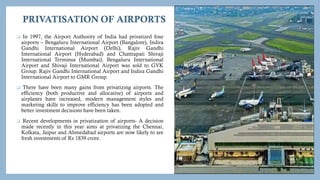
 In 1997, the Airport Authority of India had privatized four
airports – Bengaluru International Airport (Bangalore), Indira
Gandhi International Airport (Delhi), Rajiv Gandhi
International Airport (Hyderabad) and Chattrapati Shivaji
International Terminus (Mumbai). Bengaluru International
Airport and Shivaji International Airport was sold to GVK
Group. Rajiv Gandhi International Airport and Indira Gandhi
International Airport to GMR Group.
 There have been many gains from privatizing airports. The
efficiency (both productive and allocative) of airports and
airplanes have increased, modern management styles and
marketing skills to improve efficiency has been adopted and
better investment decisions have been taken.
 Recent developments in privatization of airports- A decision
made recently in this year aims at privatizing the Chennai,
Kolkata, Jaipur and Ahmedabad airports are now likely to see
fresh investments of Rs 1839 crore.
PRIVATISATION IN ENERGY, MINERALS
AND MINING BY MODI GOVERNMENT
 The disinvestment dept. is set to sell a 5% stake in SAIL. It is
estimated to fetch around US $ 330 million. In the crucial energy
sector the govt. has initiated the process of selling a 5% stake in
ONGC by inviting bids for the appointment of a merchant bank
to manage the sale process. This sale alone is expected to
generate US$ 3 billion in revenues and is awaiting cabinet
approval.
 In the metals and mineral sector, the pending residual stakes sale
in Bharat Aluminum Company Limited(BALCO) and Hindustan
Zinc Limited(HZL) are being expedited. This would raise an
additional US$ 2 billion
 Furthermore, the govt is also likely to sell it’s stakes in the
National Hydroelectric Power Corporation(NHPC), Power
Finance Corporation(PFC) and Rural Electrification
Corporation(REC)
 Lastly, the govt will probably also sell its shares in various state
owned banks to the public in line with a RBI panel
recommendation.
The Indian govt. has raised it’s fiscal year 2014-15
disinvestment goal by $2.5 billion to $10.5 billion,
while also setting an ambitious fiscal deficit target of
4.1% compared with an actual deficit of 4.7% in FY
13/14
Disinvestment has never been easy in India, but there
is optimism that this year’s disinvestment target is
achievable by Modi.
The party explains why, even after 3 decades of
privatization, the Indian govt continues to own 260
enterprises at the central level and thousands more at
the state level.
Barring successful enterprises categorized as “jewels”
such as ONGC,SAIL, BHEL, returns from the rest
are lower than the quantum of investments in them.
In 2012, there were 64 loss making central govt
owned enterprises, including National carrier, Air
India.
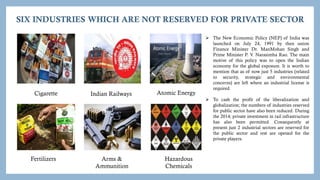
SIX INDUSTRIES WHICH ARE NOT RESERVED FOR PRIVATE SECTOR
Cigarette Atomic Energy
Indian Railways
Fertilizers Arms &
Ammunition
Hazardous
Chemicals
 The New Economic Policy (NEP) of India was
launched on July 24, 1991 by then union
Finance Minister Dr. ManMohan Singh and
Prime Minister P. V. Narasimha Rao. The main
motive of this policy was to open the Indian
economy for the global exposure. It is worth to
mention that as of now just 5 industries (related
to security, strategic and environmental
concerns) are left where an industrial license is
required.
 To cash the profit of the liberalization and
globalization; the numbers of industries reserved
for public sector have also been reduced. During
the 2014; private investment in rail infrastructure
has also been permitted. Consequently at
present just 2 industrial sectors are reserved for
the public sector and rest are opened for the
private players.
ADVANTAGES OF PRIVATIZATION
1. IMPROVED EFFICIENCY
 Private company have a profit incentives to cut costs and
be more efficient.
 Government run industry, managers do not usually share
in any profits, however, a private firm is interested in
making profit and so it is more likely to cut costs and be
efficient.
Example: British airways
2. LACK OF POLITICAL INTERFERENCE
 Government companies can be motivated by political
pressures rather than sound economic and business sense.
Example: a state enterprise may employ surplus workers
which is inefficient.
3. SHORT TERM VIEW
 A government many think only in terms of next election.
 They may be unwilling to invest in infrastructure
improvements which will benefit the firm in the long term
because they are more concerned about projects that give
a benefit before the election.
4. INCREASED COMPETITION
 Policies to allow more firms to enter the industry and
increase the competitiveness of the market.
 Increase in competition that can be the greatest spur to
improvements in efficiency.
 For example, there is now more competition in telecoms
and distribution of gas and electricity.
DISADVANTAGES OF PRIVATIZATION
 Investment in industries of comfort and luxurious products instead of necessary products
and problem of optimum use of capacity
 Aims at making profit which adversely affect the interest of the community.
 The private companies don’t like to have their branches in ruler cities.
 Their services remain confined to cities where sufficient clients are available.
 Problem of unemployment
Privatization.pdf

Privatization.pdf

  • 1.
    Submitted to: SubmittedBy: Dr. Satish Pipralia Lavanya Devi Pampana(2020PAR5479) Madhabattula Jaya Sailaja(2020PAR5681) “The transfer of public assets, operations or activities to private enterprise”
  • 2.
    MEANING Privatization is theprocess of transferring ownership of a business, enterprise, agency, public service or public property from the public sector to the private sector. The business that operates for a profit or non- profit organization. WHY PRIVATIZATION? To reduce government involvement in commercially viable activities. Increase efficiency in the delivery of programs and services. Provides competition in market place which transfers the lower price and greater choice for the consumers.
  • 3.
    PRIVATIZATION IN INDIA  Indiais a mixed economy with both the private sector and the public sector performing various activities in accordance with regulations. But the public sector was affected by inefficiencies and incompetence in a non-sustainable manner by 1991.  The New Industrial Policy of 1991 contained several reform measures for the public sector. Some of them are selling of loss making units to the private sector, inviting private participation in PSEs, and strategic sale.  In India, hence privatization was in a unique form in accordance with the priorities of our mixed economy and as well as by considering operational aspects of the PSUs.  Privatization in the country was launched mainly to enhance the efficiency of the public sector enterprises as well as to concentrate the operation of the public sector in priority areas.
  • 4.
    METHODS OF PRIVATIZATION MAINMETHODS: 1.Share issue privatization » Selling shares on the stock market. 2.Asset sale privatization » Selling entire organization to a strategic investor by auction. 3. Voucher privatization » Distributing ownership to all for free or at lower cost.
  • 5.
    SUB METHODS: 1. Contractingout: » Production of service by private firm under a contract. » Under this scenario, the private sector firm is paid directly by the government. Example: Collection of disposal waste Other things include security services, data processing services 2.Franchising: » Government awarding a rights to perform services within a specific geographic area to a private firm » The private firm generates revenue by collecting user fees. Example: Cable television, gas etc..
  • 6.
    3. Open competition: »Many private firms are allowed to compete for customers within a governmental jurisdiction. » It is not appropriate for some services as it most likely would not be efficient to have multiple suppliers of electricity, gas, or water service. Example: It typically seen telephone and internet provider
  • 7.
    PRIVATIZATION OF COALSECTOR  India’s coal industry forms an integral part of it’s energy sector, generating more than half of the country’s power supply every year. Although no specific date has been given on when the privatization process will begin, mines owned by some of the India's most well known companies, such as Power Ltd and Jindal Steel, will eventually have to go up for sale.  Commercial mining will be permitted, and an electronic auction for the mines will take place.  Current output of India’s coal industry certainly makes it important for the disinvestment. Although India controls the world’s largest coal reserves, the country ranks as one of the biggest importer of coal. In the last 2 fiscal years, more than 15 billion units of electricity were lost due to the unavailability of coal. Power cuts have become common in various cities and towns, and in 2011/12 , power problems were estimated to cost the Indian economy upwards of $64 billion. This is one of the major reasons why there was a great need to disinvest the coal sector.
  • 8.
    PRIVATISATION OF TELECOM SECTOR Bharat Sanchar Nigam Limited (BSNL) was previously known as Department of Telecommunications and had been a monopoly. MTNL was operating in Mumbai and Delhi only. During that time, BSNL was inefficient & slow. Subscribers had to wait for five years to get a telephone connection. But, in 1991, everything changed as the telecommunication system was privatized.  Telecom commission, the highest decision making body in the telecom ministry, is keen on disinvesting govt equity in Telecommunications Consultants India Ltd(TCIL) and forming a “finance corporation” for the telecom sector in 2013.
  • 9.
    PRIVATISATION OF AIRPORTS In 1997, the Airport Authority of India had privatized four airports – Bengaluru International Airport (Bangalore), Indira Gandhi International Airport (Delhi), Rajiv Gandhi International Airport (Hyderabad) and Chattrapati Shivaji International Terminus (Mumbai). Bengaluru International Airport and Shivaji International Airport was sold to GVK Group. Rajiv Gandhi International Airport and Indira Gandhi International Airport to GMR Group.  There have been many gains from privatizing airports. The efficiency (both productive and allocative) of airports and airplanes have increased, modern management styles and marketing skills to improve efficiency has been adopted and better investment decisions have been taken.  Recent developments in privatization of airports- A decision made recently in this year aims at privatizing the Chennai, Kolkata, Jaipur and Ahmedabad airports are now likely to see fresh investments of Rs 1839 crore.
  • 10.
    PRIVATISATION IN ENERGY,MINERALS AND MINING BY MODI GOVERNMENT  The disinvestment dept. is set to sell a 5% stake in SAIL. It is estimated to fetch around US $ 330 million. In the crucial energy sector the govt. has initiated the process of selling a 5% stake in ONGC by inviting bids for the appointment of a merchant bank to manage the sale process. This sale alone is expected to generate US$ 3 billion in revenues and is awaiting cabinet approval.  In the metals and mineral sector, the pending residual stakes sale in Bharat Aluminum Company Limited(BALCO) and Hindustan Zinc Limited(HZL) are being expedited. This would raise an additional US$ 2 billion  Furthermore, the govt is also likely to sell it’s stakes in the National Hydroelectric Power Corporation(NHPC), Power Finance Corporation(PFC) and Rural Electrification Corporation(REC)  Lastly, the govt will probably also sell its shares in various state owned banks to the public in line with a RBI panel recommendation.
  • 11.
    The Indian govt.has raised it’s fiscal year 2014-15 disinvestment goal by $2.5 billion to $10.5 billion, while also setting an ambitious fiscal deficit target of 4.1% compared with an actual deficit of 4.7% in FY 13/14 Disinvestment has never been easy in India, but there is optimism that this year’s disinvestment target is achievable by Modi. The party explains why, even after 3 decades of privatization, the Indian govt continues to own 260 enterprises at the central level and thousands more at the state level. Barring successful enterprises categorized as “jewels” such as ONGC,SAIL, BHEL, returns from the rest are lower than the quantum of investments in them. In 2012, there were 64 loss making central govt owned enterprises, including National carrier, Air India.
  • 12.
    SIX INDUSTRIES WHICHARE NOT RESERVED FOR PRIVATE SECTOR Cigarette Atomic Energy Indian Railways Fertilizers Arms & Ammunition Hazardous Chemicals  The New Economic Policy (NEP) of India was launched on July 24, 1991 by then union Finance Minister Dr. ManMohan Singh and Prime Minister P. V. Narasimha Rao. The main motive of this policy was to open the Indian economy for the global exposure. It is worth to mention that as of now just 5 industries (related to security, strategic and environmental concerns) are left where an industrial license is required.  To cash the profit of the liberalization and globalization; the numbers of industries reserved for public sector have also been reduced. During the 2014; private investment in rail infrastructure has also been permitted. Consequently at present just 2 industrial sectors are reserved for the public sector and rest are opened for the private players.
  • 13.
    ADVANTAGES OF PRIVATIZATION 1.IMPROVED EFFICIENCY  Private company have a profit incentives to cut costs and be more efficient.  Government run industry, managers do not usually share in any profits, however, a private firm is interested in making profit and so it is more likely to cut costs and be efficient. Example: British airways 2. LACK OF POLITICAL INTERFERENCE  Government companies can be motivated by political pressures rather than sound economic and business sense. Example: a state enterprise may employ surplus workers which is inefficient. 3. SHORT TERM VIEW  A government many think only in terms of next election.  They may be unwilling to invest in infrastructure improvements which will benefit the firm in the long term because they are more concerned about projects that give a benefit before the election. 4. INCREASED COMPETITION  Policies to allow more firms to enter the industry and increase the competitiveness of the market.  Increase in competition that can be the greatest spur to improvements in efficiency.  For example, there is now more competition in telecoms and distribution of gas and electricity.
  • 14.
    DISADVANTAGES OF PRIVATIZATION Investment in industries of comfort and luxurious products instead of necessary products and problem of optimum use of capacity  Aims at making profit which adversely affect the interest of the community.  The private companies don’t like to have their branches in ruler cities.  Their services remain confined to cities where sufficient clients are available.  Problem of unemployment