Concepts

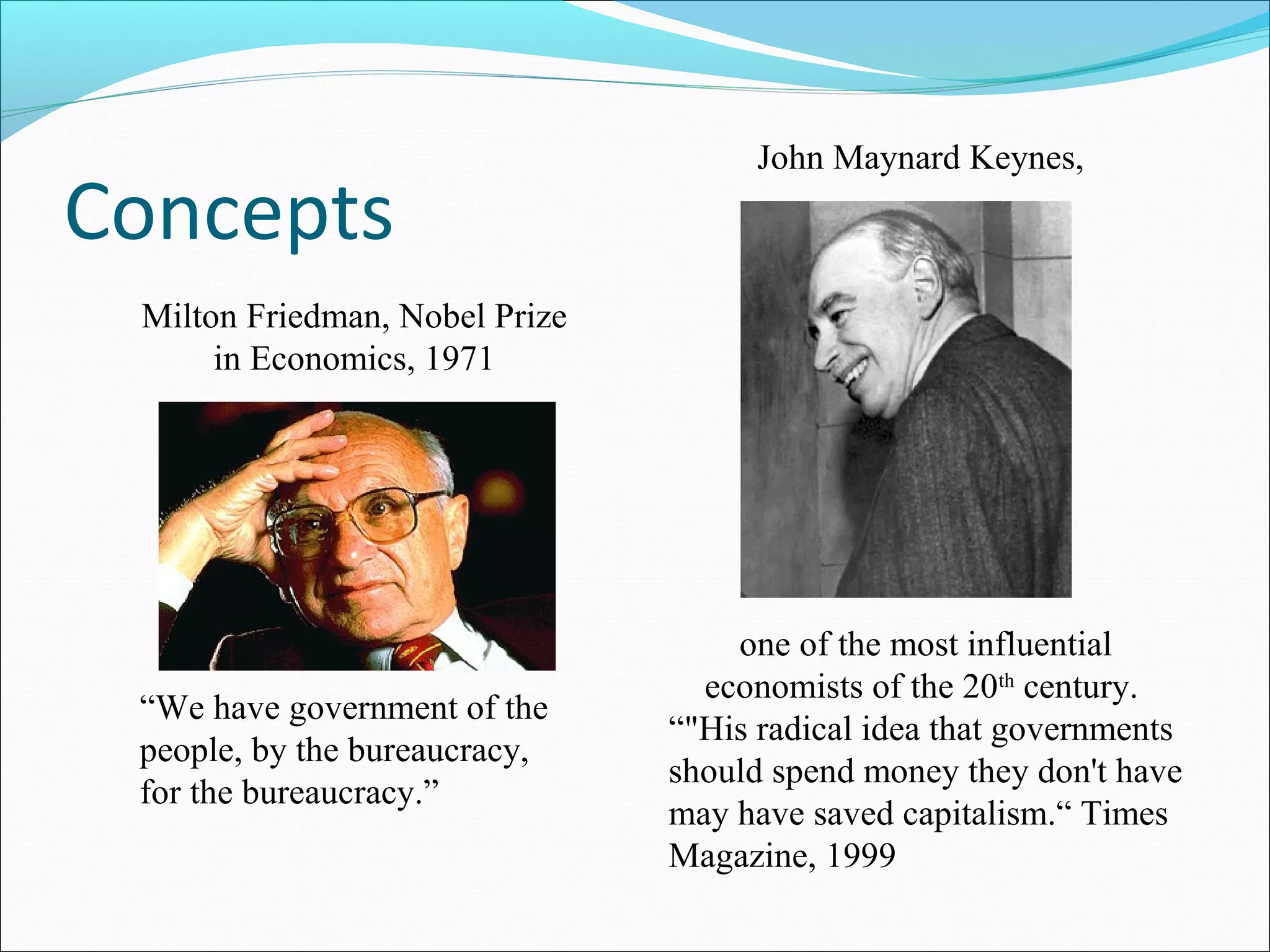
John Maynard Keynes,

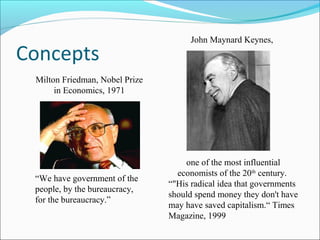
Milton Friedman, Nobel Prize
in Economics, 1971

“We have government of the
people, by the bureaucracy,
for the bureaucracy.”

one of the most influential
economists of the 20th century.
“"His radical idea that governments
should spend money they don't have
may have saved capitalism.“ Times
Magazine, 1999
Privatization
Purpose of Study
The purpose of this study is to identify policies and
parameters that should be considered when any
governmental entity is planning to undertake
some type of privatization process.
Scope of Privatization Study
The purpose of this study is to identify those

parameters and policy issues to be considered in
connection with proposals to transfer federal,
state, or local government services, assets, and/or
function to the private sector. It will review the
stated goals and the community impact of such
transfers and identify strategies to ensure
transparency, accountability, and preservation of
the common good.
Concepts
Privatization: The Public Policy Debate

Privatization is a movement to deregulate private
industry and/or transfer many government
services, assets and functions to the private sector.
Definition of Privatization
Classic
Total transfer of assets and authority from the

government sector to the for profit or nonprofit sector
Purposes: Shrink government; Reduce risk and cost
 Reason: Often a response to economic downturn; Ideology

Definition of Privatization
Modified
Private sector provision of a service once/also provided
by government along with private sector funding
(Proprietary colleges)
Private sector provision of a service with public sector
funding (Direct funding for a private college; Private
trash collection paid for by tax revenue)
Public sector provision of a service with private sector
funding (Student tuition at public colleges)
Definition
Deregulation

…the lessening of regulatory provisions
that govern individuals, entities, and
systems.
Definitions
Decentralization

Moving the authority for a function
from a central agency to an agency
closest to where the activity is actually
performed.
Privatizing Actions
•
•
•
•
•
•
•
•

deregulating – reducing regulations (often used as a defining
characteristic of privatization),
contracting with the private sector to purchase a service (road
construction),
establishing incentives to encourage the private sector to
provide a service,
abandoning or shedding of services,
reducing demand for a service,
establishing quasi-public organizations (government
enterprise, charters),
establishing separate corporations - profit and nonprofit
(authority),
supplying temporary help on the part of the private sector,
•
•
•
•
•
•
•
•
•
•
•

issuing vouchers (K-12 education),
issuing waivers,
selling or giving away government owned assets,
establishing franchises,
leasing,
subsidizing or making available grants to the private sector,
relying on user fees rather than tax dollars to fund a service
(hunting licenses),
discontinuing subsidies to public entities (almost doing this
with public higher education in Colorado),
providing joint funding,
establishing public/private partnerships, and
setting up consumer self-help processes, or using volunteers
History
Shift from central control to less central control – late

1960s/early 1970s
End of “regulatory capitalism” (Yergin 1998, 8) –
regulatory backlash
Reducing the size of government
Revitalizing entrepreneurial spirit
Restoring influence of market forces
Reducing taxes
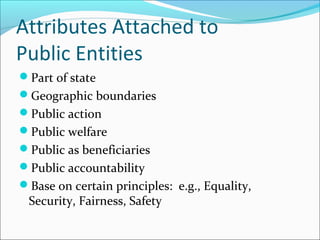
Attributes Attached to
Public Entities
Part of state
Geographic boundaries
Public action
Public welfare
Public as beneficiaries
Public accountability
Base on certain principles: e.g., Equality,

Security, Fairness, Safety
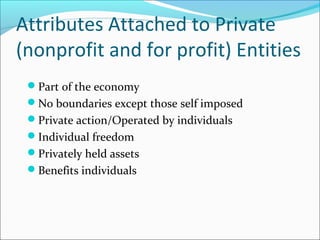
Attributes Attached to Private
(nonprofit and for profit) Entities
Part of the economy
No boundaries except those self imposed
Private action/Operated by individuals
Individual freedom
Privately held assets
Benefits individuals
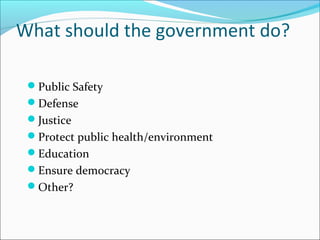
What should the government do?
Public Safety
Defense
Justice
Protect public health/environment
Education
Ensure democracy
Other?
David Begg, Stanley Fischer and Rudiger Dornbusch, Economics,
6th Edition, McGraw-Hill, 2000
Power Point presentation by Peter Smith
Nationalization and privatization
Nationalization
the acquisition of private companies by the public

sector

Privatization
the return of state enterprises to private ownership and

control

19.16
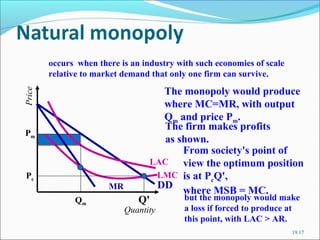
Price

occurs when there is an industry with such economies of scale
relative to market demand that only one firm can survive.

Pm

Pc

MR
Qm

The monopoly would produce
where MC=MR, with output
Qm and price Pm.
The firm makes profits
as shown.
From society's point of
LAC
view the optimum position
LMC is at PcQ',
DD
where MSB = MC.
but the monopoly would make
Q'

Quantity

a loss if forced to produce at
this point, with LAC > AR.

19.17
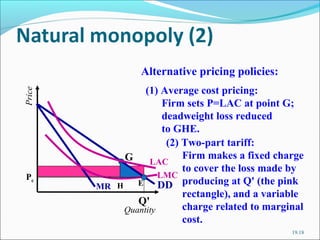
Price

Alternative pricing policies:

Pc

(1) Average cost pricing:
Firm sets P=LAC at point G;
deadweight loss reduced
to GHE.
(2) Two-part tariff:
Firm makes a fixed charge
G
LAC
to cover the loss made by
LMC
E
DD producing at Q' (the pink
MR H
rectangle), and a variable
Q'
charge related to marginal
Quantity
cost.
19.18
Nationalization
Another possibility is to nationalize the industry and

provide a subsidy to cover the loss

as was popular in Europe in 1945-80

If nationalized industries make losses, this does not

prove they are failing to minimize costs or produce at
the socially efficient output
but incentives may be a problem.

19.19
Reasons for nationalization
Natural monopoly
Externalities
e.g. subsidizing public transport (London
Underground) may be a second-best option to road
pricing.

Equity or distributional consequences
e.g. protecting transport in rural areas

Co-ordinating a network
e.g. British Rail could have an overview of the whole
rail system
19.20
Reasons for privatization
Improve incentives for production efficiency
makes managers accountable to shareholders.
but sheltered monopolies will be sleepy no matter who
owns them
so privatization will be most successful where there is
potential for competition.
Pre-commitment by government not to interfere for

political reasons

19.21
Privatization in practice
At 1997 prices, almost £67billion was raised in

revenue from privatization in 1980-97.
In terms of widening share ownership, effects
were limited
The Private Finance Initiative (PFI) is claimed as
an innovative way of drawing on private-sector
expertise to finance and manage public projects
such as roads and hospitals.

19.22
Regulation
Privatization does not remove the need for

regulation
In the UK, regulation has been through pricecapping
privatized industries are not permitted to raise

prices beyond RPI-X


I.e. real prices must fall.

Regulatory capture occurs when the regulating

body comes to identify with the interests of the
firm it regulates
eventually becoming its champion rather than its

watchdog.

19.23

Privatization and Pakistan

  • 1.
    Concepts John Maynard Keynes, MiltonFriedman, Nobel Prize in Economics, 1971 “We have government of the people, by the bureaucracy, for the bureaucracy.” one of the most influential economists of the 20th century. “"His radical idea that governments should spend money they don't have may have saved capitalism.“ Times Magazine, 1999
  • 2.
    Privatization Purpose of Study Thepurpose of this study is to identify policies and parameters that should be considered when any governmental entity is planning to undertake some type of privatization process.
  • 3.
    Scope of PrivatizationStudy The purpose of this study is to identify those parameters and policy issues to be considered in connection with proposals to transfer federal, state, or local government services, assets, and/or function to the private sector. It will review the stated goals and the community impact of such transfers and identify strategies to ensure transparency, accountability, and preservation of the common good.
  • 4.
    Concepts Privatization: The PublicPolicy Debate Privatization is a movement to deregulate private industry and/or transfer many government services, assets and functions to the private sector.
  • 5.
    Definition of Privatization Classic Totaltransfer of assets and authority from the government sector to the for profit or nonprofit sector Purposes: Shrink government; Reduce risk and cost  Reason: Often a response to economic downturn; Ideology 
  • 6.
    Definition of Privatization Modified Privatesector provision of a service once/also provided by government along with private sector funding (Proprietary colleges) Private sector provision of a service with public sector funding (Direct funding for a private college; Private trash collection paid for by tax revenue) Public sector provision of a service with private sector funding (Student tuition at public colleges)
  • 7.
    Definition Deregulation …the lessening ofregulatory provisions that govern individuals, entities, and systems.
  • 8.
    Definitions Decentralization Moving the authorityfor a function from a central agency to an agency closest to where the activity is actually performed.
  • 9.
    Privatizing Actions • • • • • • • • deregulating –reducing regulations (often used as a defining characteristic of privatization), contracting with the private sector to purchase a service (road construction), establishing incentives to encourage the private sector to provide a service, abandoning or shedding of services, reducing demand for a service, establishing quasi-public organizations (government enterprise, charters), establishing separate corporations - profit and nonprofit (authority), supplying temporary help on the part of the private sector,
  • 10.
    • • • • • • • • • • • issuing vouchers (K-12education), issuing waivers, selling or giving away government owned assets, establishing franchises, leasing, subsidizing or making available grants to the private sector, relying on user fees rather than tax dollars to fund a service (hunting licenses), discontinuing subsidies to public entities (almost doing this with public higher education in Colorado), providing joint funding, establishing public/private partnerships, and setting up consumer self-help processes, or using volunteers
  • 11.
    History Shift from centralcontrol to less central control – late 1960s/early 1970s End of “regulatory capitalism” (Yergin 1998, 8) – regulatory backlash Reducing the size of government Revitalizing entrepreneurial spirit Restoring influence of market forces Reducing taxes
  • 12.
    Attributes Attached to PublicEntities Part of state Geographic boundaries Public action Public welfare Public as beneficiaries Public accountability Base on certain principles: e.g., Equality, Security, Fairness, Safety
  • 13.
    Attributes Attached toPrivate (nonprofit and for profit) Entities Part of the economy No boundaries except those self imposed Private action/Operated by individuals Individual freedom Privately held assets Benefits individuals
  • 14.
    What should thegovernment do? Public Safety Defense Justice Protect public health/environment Education Ensure democracy Other?
  • 15.
    David Begg, StanleyFischer and Rudiger Dornbusch, Economics, 6th Edition, McGraw-Hill, 2000 Power Point presentation by Peter Smith
  • 16.
    Nationalization and privatization Nationalization theacquisition of private companies by the public sector Privatization the return of state enterprises to private ownership and control 19.16
  • 17.
    Price occurs when thereis an industry with such economies of scale relative to market demand that only one firm can survive. Pm Pc MR Qm The monopoly would produce where MC=MR, with output Qm and price Pm. The firm makes profits as shown. From society's point of LAC view the optimum position LMC is at PcQ', DD where MSB = MC. but the monopoly would make Q' Quantity a loss if forced to produce at this point, with LAC > AR. 19.17
  • 18.
    Price Alternative pricing policies: Pc (1)Average cost pricing: Firm sets P=LAC at point G; deadweight loss reduced to GHE. (2) Two-part tariff: Firm makes a fixed charge G LAC to cover the loss made by LMC E DD producing at Q' (the pink MR H rectangle), and a variable Q' charge related to marginal Quantity cost. 19.18
  • 19.
    Nationalization Another possibility isto nationalize the industry and provide a subsidy to cover the loss as was popular in Europe in 1945-80 If nationalized industries make losses, this does not prove they are failing to minimize costs or produce at the socially efficient output but incentives may be a problem. 19.19
  • 20.
    Reasons for nationalization Naturalmonopoly Externalities e.g. subsidizing public transport (London Underground) may be a second-best option to road pricing. Equity or distributional consequences e.g. protecting transport in rural areas Co-ordinating a network e.g. British Rail could have an overview of the whole rail system 19.20
  • 21.
    Reasons for privatization Improveincentives for production efficiency makes managers accountable to shareholders. but sheltered monopolies will be sleepy no matter who owns them so privatization will be most successful where there is potential for competition. Pre-commitment by government not to interfere for political reasons 19.21
  • 22.
    Privatization in practice At1997 prices, almost £67billion was raised in revenue from privatization in 1980-97. In terms of widening share ownership, effects were limited The Private Finance Initiative (PFI) is claimed as an innovative way of drawing on private-sector expertise to finance and manage public projects such as roads and hospitals. 19.22
  • 23.
    Regulation Privatization does notremove the need for regulation In the UK, regulation has been through pricecapping privatized industries are not permitted to raise prices beyond RPI-X  I.e. real prices must fall. Regulatory capture occurs when the regulating body comes to identify with the interests of the firm it regulates eventually becoming its champion rather than its watchdog. 19.23

Editor's Notes

  • #18 See Section 19-1 of the main text, and Figure 19-1.
  • #19 See Section 19-1 of the main text, and Figure 19-1 Notice also that two-part tariff pricing was also discussed in chapter 11 in the context of "the information economy".
  • #20 This in discussed in Section 19-1 of the main text.
  • #21 See Section 19-2 of the main text.
  • #22 See Section 19-3 in the main text.
  • #23 See Section 19-4 in the main text.
  • #24 See Section 19-5 of the main text. Regulatory capture is discussed in Section 19-1.