
Privatising
Education
Janardan Mishra
IGNOU B ED Trainee
Radhanath IASE, Cuttack
Government vs Private
2
The Concept
 Increasing role for private sector in educational :

provision

funding and/or

regulation
15/05/12
3
Why privatisation?
 Negative reasons
 failures of state education
 inequity of state provision
 Positive reasons
 Efficiency and cost-effectiveness
 Investment
 Innovation
 Self-help and community self-help
 Freedom/liberty
11/09/15 4
Why Privatisation? Innovation
and investment
Education companies are emerging, with chains of
schools and universities, which:
 benefit from economies of scale – can find finance
from financial institutions; can fund student loan
programmes
 invest in research and development – implications
for financial efficiency and educational effectiveness
 Potential to solve the ‘information problem’ through
brand names
11/09/15 5
Why privatisation? Innovation
and investment
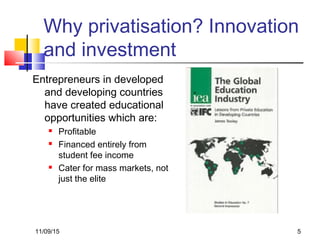
Entrepreneurs in developed
and developing countries
have created educational
opportunities which are:
 Profitable
 Financed entirely from
student fee income
 Cater for mass markets, not
just the elite
11/09/15 6
NIIT, India
1979 computer training
company
Now has 1,000 franchised
centres in India and has
expanded into 25
countries worldwide
Emphasis on R&D and
quality control
Student loan scheme with
Citibank
11/09/15 7
NIIT R&D
 The ‘hole in the wall’ programme
 Challenges the notion of what a teacher
is…
 Is it commercially viable?
11/09/15 8
Key questions
 Can the virtues of private education be
replicated in the state sector?
 Can access to the virtues of private
education be extended to those
currently within the state sector?
11/09/15 9
Solution to Privatisation
 Public-Private Partnerships (PPP)
11/09/15 10
Why? Breakdown in public
schools
 ‘plain negligence: …
casesof teacherskeeping
aschool closed for months
at atime; aheadteacher
who comesto school once
aweek’
 “this pattern is not
confined to a minority of
irresponsible teachers – it
has become a way of life
in theprofession.’

Privatisation of education

  • 1.
    Privatising Education Janardan Mishra IGNOU BED Trainee Radhanath IASE, Cuttack Government vs Private
  • 2.
    2 The Concept  Increasingrole for private sector in educational :  provision  funding and/or  regulation 15/05/12
  • 3.
    3 Why privatisation?  Negativereasons  failures of state education  inequity of state provision  Positive reasons  Efficiency and cost-effectiveness  Investment  Innovation  Self-help and community self-help  Freedom/liberty
  • 4.
    11/09/15 4 Why Privatisation?Innovation and investment Education companies are emerging, with chains of schools and universities, which:  benefit from economies of scale – can find finance from financial institutions; can fund student loan programmes  invest in research and development – implications for financial efficiency and educational effectiveness  Potential to solve the ‘information problem’ through brand names
  • 5.
    11/09/15 5 Why privatisation?Innovation and investment Entrepreneurs in developed and developing countries have created educational opportunities which are:  Profitable  Financed entirely from student fee income  Cater for mass markets, not just the elite
  • 6.
    11/09/15 6 NIIT, India 1979computer training company Now has 1,000 franchised centres in India and has expanded into 25 countries worldwide Emphasis on R&D and quality control Student loan scheme with Citibank
  • 7.
    11/09/15 7 NIIT R&D The ‘hole in the wall’ programme  Challenges the notion of what a teacher is…  Is it commercially viable?
  • 8.
    11/09/15 8 Key questions Can the virtues of private education be replicated in the state sector?  Can access to the virtues of private education be extended to those currently within the state sector?
  • 9.
    11/09/15 9 Solution toPrivatisation  Public-Private Partnerships (PPP)
  • 10.
    11/09/15 10 Why? Breakdownin public schools  ‘plain negligence: … casesof teacherskeeping aschool closed for months at atime; aheadteacher who comesto school once aweek’  “this pattern is not confined to a minority of irresponsible teachers – it has become a way of life in theprofession.’