To explain on the basis on “Porter’s Diamond”, why some nations succeed and others fail in International Competition! A case of the Korean Economy based on Porters Diamond…
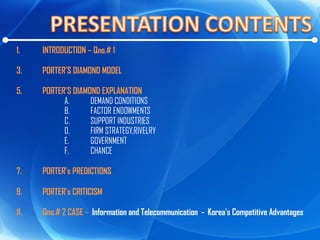
INTRODUCTION – Qno.# 1 PORTER’S DIAMOND MODEL PORTER’S DIAMOND EXPLANATION DEMAND CONDITIONS FACTOR ENDOWMENTS SUPPORT INDUSTRIES FIRM STRATEGY,RIVELRY GOVERNMENT CHANCE PORTER’s PREDICTIONS PORTER’s CRITICISM Qno.# 2 CASE  –  Information and Telecommunication  -  Korea's Competitive Advantages
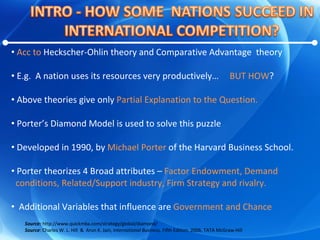
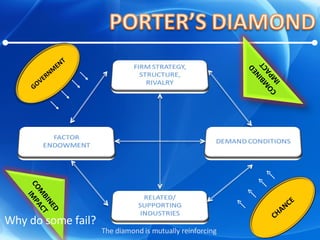
Acc to  Heckscher-Ohlin theory and Comparative Advantage  theory  E.g.  A nation uses its resources very productively…  BUT HOW ? Above theories give only  Partial Explanation to the Question. Porter’s Diamond Model is used to solve this puzzle Developed in 1990, by  Michael Porter  of the Harvard Business School. Porter theorizes 4 Broad attributes –  Factor Endowment, Demand  conditions, Related/Support industry, Firm Strategy and rivalry. Additional Variables that influence are  Government and Chance   Source:  http://www.quickmba.com/strategy/global/diamond/ Source : Charles W. L. Hill  &  Arun K. Jain,  International Business,  Fifth Edition, 2006, TATA McGraw-Hill
Why do some fail?  The diamond is mutually reinforcing GOVERNMENT CHANCE COMBINED  IMPACT COMBINED  IMPACT
Home country Demand plays an important role Enables better understand the needs and desires of the customers It shapes the attributes of domestic ally made products and creates pressure for innovation and quality E.g. 1 Italian ceramic Industry after the world war II There was a postwar housing BOOM !! Consumers wanted cool floors because of Hot climatic conditions Source : Charles W. L. Hill  &  Arun K. Jain,  International Business,  Fifth Edition, 2006, TATA McGraw-Hill Source:  John D. Daniels & LeeH. Radebaugh,  International Business,  Ninth Edition, 2003, Pearson Education
E.g. 2 Japan’s knowledgeable buyers of cameras made that industry to innovate and grow tremendously E.g. 3 Local demand for cellular phones in scandinavia made nokia and ericson to invest in that in other developing nations. E.g. 4 The French wine industry. The French are sophisticated wine consumers. These consumers force and help French wineries to produce high quality wines. Source:  http://www.quickmba.com/strategy/global/diamond/
BASIC FACTORS – Natural resources, climate, location and demographics ADVANCE FACTORS – Communication Infrastructure, skilled labour, Research facilities and so on. Basic factors can provide  only an initial advantage They must be supported by advanced factors to maintain success E.g. Choice of tile to meet customer Demand Choice of italy as production location Wood is less available and expensive than tiles Most of the Advanced factors were available within Italy Source:  John D. Daniels & LeeH. Radebaugh,  International Business,  Ninth Edition, 2003, Pearson Education
E.g. 2 Japan a country which lacks arable land and mineral deposits. Large pool of engineers - very vital for a manufacturing industry. Japan has high priced land and so its factory space is at a premium.  Source:  http://www.quickmba.com/strategy/global/diamond/ Source : Charles W. L. Hill  &  Arun K. Jain,  International Business,  Fifth Edition, 2006, TATA McGraw-Hill
Benefits of investment in advanced factors by Suppliers and related industries can spill over Creates clusters of supporting industries, thereby  achieving a strong competitive position internationally. E.g. The enamel production unit was available. The glazes production was also favourable. These two were the main composition of producing tiles. This reduces the Transportation cost. Source:  http://www.quickmba.com/strategy/global/diamond/ Source : Charles W. L. Hill  &  Arun K. Jain,  International Business,  Fifth Edition, 2006, TATA McGraw-Hill
E.g. 2 Switzerlands success in pharmaceutical industry is closely related to its international success in technical dye industry. E.g. 3 Swedish strength in fabricated steel industry is the reason for development in the Sweden's specialty steel industry Source:  http://online.sfsu.edu/~yywong/Porter1990HBR.pdf
Long term corporate vision (Strategy) is a determinant of success Ability of  the companies to develop and sustain a competitive advantage requires the 4 th  attribute. Presence of domestic rivalry improves a company’s competitiveness E.g. Low entry barriers to market in the tile industry Rivalry became very intense  Breakthroughs in both product and process technologies Source:  John D. Daniels & LeeH. Radebaugh,  International Business,  Ninth Edition, 2003, Pearson Education
E.g. 2 Germany tends to have hierarchical management structures composed of managers with strong technical backgrounds and Italy has smaller, family-run firms. E.g. 3 Japan has high priced land and so its factory space is at a premium This lead to just-in-time inventory techniques  (Japanese firms can’t have a lot of stock taking up space, so to cope with the potential of not have goods around when they need it They innovated traditional inventory techniques). Source:  http://online.sfsu.edu/~yywong/Porter1990HBR.pdf Source:  John D. Daniels & LeeH. Radebaugh,  International Business,  Ninth Edition, 2003, Pearson Education
Chance Events such as major innovations, can reshape industry structure Government – Policies – Can detract from or improve national advantage Regulation can alter home demand conditions Government investment in education can change factor endowment. E.g.  1991 – US Govt – Tariff on Japanese imports of LCD screens APPLE and IBM – Protested strongly Japan – The low cost LCD manufacturer Increase the LCD screens as well as Laptops in the global market – Reduce the Market Share. Source:  www.nsf.gov/sbe/srs/s4495/conten3d.htm
Countries should be exporting products from those industries where all four components of the diamond are favorable. while importing in those areas where the components are not favorable. Source:  John D. Daniels & LeeH. Radebaugh,  International Business,  Ninth Edition, 2003, Pearson Education
Government can influence on any four components of the diamond. Porter developed this paper based on case studies and these tend to only apply to developed economies. Source:  John D. Daniels & LeeH. Radebaugh,  International Business,  Ninth Edition, 2003, Pearson Education
Analysis of Korea’s Competitive Advantage with  Michael E. Porter's Diamond  Framework Korea  - New developed countries -  Information and Telecommunication .  Information and Telecommunication Korea's Competitive Advantages (2002)
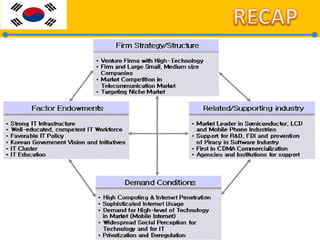
High computing and Internet  penetration rate since 1998 .  Large user  base of Internet - sophisticated internet usage IT effectively used -  individual level, Business  & government sectors The competitive market situation in online shopping malls and  rapid,  expansive development in wireless internet service  Forcing market players -  higher quality  service at  cheaper to users. Hence  Strategic use of IT is demanded  due to the intensified market  environment Source:  www.weforum.org/site/homepublic.nsf/Content/Global+Information+Technology+Report+2001-2002
Korean  government’s effort  to develop IT industry -  Privatization and Market Deregulation  in Telecommunication market Encouraged fair market competition in Telecommunication market Resulting in  lower price ,better quality, better service  and  created favorable business environments for business. E-commerce exceeded  45 billion USD  and  Projected a  growth rate of 9%  per year.) Source:  www.weforum.org/site/homepublic.nsf/Content/Global+Information+Technology+Report+2001-2002
Korean Government- continuous effort - Korean IT policies  - Improvement in IT infrastructure, - Facilitating the usage of information technology, - Favorable environment for development of IT industry Over 90% of nation area  is wired with broadband internet network IT workforce in Korea accounted for 447,000 ( 2.1% of total workforce ). Overall  level of education  in Korea is relatively high Korean government support educational institutions related to IT skills Supply of  quality of IT workforce  is expected to increased. Source:  http://www.ips.or.kr/ncr/index.asp Source:  www.outsourcing-service-india.com
DaeDeok Valley-  an important IT cluster - Attracts foreign  investment Several  joint research and development  projects with well-known  foreign companies and universities. The  geographical location of Korea  - Close to Central China can be  regarded another factor for IT advantages. Through  export of CDMA technology -  solid network among the  south Asian nations  is established. These factors will enhance the national IT competitiveness for sure. Conti.. Source:  http://www.ips.or.kr/ncr/index.asp Source:  www.outsourcing-service-india.com
Korea has secured leading position in semiconductor market  especially for  DRAM (Dynamic Random Access Memory) - DDR RAM  and SD RAM Korea is  United States  most significant trading partner Cheap and Quality Hardware production units available.  IT Enabled Services like BPOs and KPOs –  Yantram Solutions Korea ranks itself in top manufacture in LCD and Mobile phone,  example –  LG group, Samsung group, Doosan Group, DiaBell . Korea - the leading position in IT related production Source:  http://www.bsau.org/ Source:  http://corsairmemory.com/products/twinx10255.htm
Korea - the  leading position in all IT related production The proactive effort  - R&D and market expansion , as well as  government support are expected. Korean government plans to extend its  financial support  for R&D  especially in 10 core technologies Initiated several huge project with private sectors Source:  http://www.bsau.org/ Source:  http://corsairmemory.com/products/twinx10255.htm
Korea - favorable business environments  - for venture firm through -  Quick registration process, -  Lower entry barriers in IT industry,  -  Lower cost using telecommunication infrastructure,  -  Diverse capital resources  -  Government supports These activities result in huge number of small, medium-sized  venture company  in IT industry And Hence it leads  to severe domestic rivalry  because of market  competition. Encourages the continuous development of  Innovative technology  and improvement of business models in business sectors.  Source:  www.technology.gov/reports/korea/korea.pdf
 
"Competitive Advantage of Nations" Michael E.  Porter,  March~April, 1990 HBR Download available at  http://online.sfsu.edu/~yywong/Porter1990HBR.pdf    (2) "Global Information Technology Report 2001~2002" from World  Economic Forum at        www.weforum.org/site/homepublic.nsf/Content/Global+Informat ion+Technology+Report+2001-2002    (3) "Asia's New Tech Competitors" at  www.nsf.gov/sbe/srs/s4495/conten3d.htm    (4) "National Competitiveness Analysis " from the Institute of  Industrial Policy Studies  -  http://www.ips.or.kr/ncr/index.asp  (5)  www.outsourcing-service-india.com (6)  http://www.bsau.org/ (7)  http://corsairmemory.com/products/twinx10255.htm (8)  www.technology.gov/reports/korea/korea.pdf  (9)  http://www.quickmba.com/strategy/global/diamond/
(1) Charles W. L. Hill  &  Arun K. Jain,  International Business,   Fifth Edition, 2006, TATA McGraw-Hill (2)  John D. Daniels & LeeH. Radebaugh,  International Business,   Ninth Edition, 2003, Pearson Education


Porters Diamond

  • 1.
  • 2.
  • 3.
    To explain onthe basis on “Porter’s Diamond”, why some nations succeed and others fail in International Competition! A case of the Korean Economy based on Porters Diamond…
  • 4.
    INTRODUCTION – Qno.#1 PORTER’S DIAMOND MODEL PORTER’S DIAMOND EXPLANATION DEMAND CONDITIONS FACTOR ENDOWMENTS SUPPORT INDUSTRIES FIRM STRATEGY,RIVELRY GOVERNMENT CHANCE PORTER’s PREDICTIONS PORTER’s CRITICISM Qno.# 2 CASE – Information and Telecommunication - Korea's Competitive Advantages
  • 5.
    Acc to Heckscher-Ohlin theory and Comparative Advantage theory E.g. A nation uses its resources very productively… BUT HOW ? Above theories give only Partial Explanation to the Question. Porter’s Diamond Model is used to solve this puzzle Developed in 1990, by Michael Porter of the Harvard Business School. Porter theorizes 4 Broad attributes – Factor Endowment, Demand conditions, Related/Support industry, Firm Strategy and rivalry. Additional Variables that influence are Government and Chance Source: http://www.quickmba.com/strategy/global/diamond/ Source : Charles W. L. Hill & Arun K. Jain, International Business, Fifth Edition, 2006, TATA McGraw-Hill
  • 6.
    Why do somefail? The diamond is mutually reinforcing GOVERNMENT CHANCE COMBINED IMPACT COMBINED IMPACT
  • 7.
    Home country Demandplays an important role Enables better understand the needs and desires of the customers It shapes the attributes of domestic ally made products and creates pressure for innovation and quality E.g. 1 Italian ceramic Industry after the world war II There was a postwar housing BOOM !! Consumers wanted cool floors because of Hot climatic conditions Source : Charles W. L. Hill & Arun K. Jain, International Business, Fifth Edition, 2006, TATA McGraw-Hill Source: John D. Daniels & LeeH. Radebaugh, International Business, Ninth Edition, 2003, Pearson Education
  • 8.
    E.g. 2 Japan’sknowledgeable buyers of cameras made that industry to innovate and grow tremendously E.g. 3 Local demand for cellular phones in scandinavia made nokia and ericson to invest in that in other developing nations. E.g. 4 The French wine industry. The French are sophisticated wine consumers. These consumers force and help French wineries to produce high quality wines. Source: http://www.quickmba.com/strategy/global/diamond/
  • 9.
    BASIC FACTORS –Natural resources, climate, location and demographics ADVANCE FACTORS – Communication Infrastructure, skilled labour, Research facilities and so on. Basic factors can provide only an initial advantage They must be supported by advanced factors to maintain success E.g. Choice of tile to meet customer Demand Choice of italy as production location Wood is less available and expensive than tiles Most of the Advanced factors were available within Italy Source: John D. Daniels & LeeH. Radebaugh, International Business, Ninth Edition, 2003, Pearson Education
  • 10.
    E.g. 2 Japana country which lacks arable land and mineral deposits. Large pool of engineers - very vital for a manufacturing industry. Japan has high priced land and so its factory space is at a premium. Source: http://www.quickmba.com/strategy/global/diamond/ Source : Charles W. L. Hill & Arun K. Jain, International Business, Fifth Edition, 2006, TATA McGraw-Hill
  • 11.
    Benefits of investmentin advanced factors by Suppliers and related industries can spill over Creates clusters of supporting industries, thereby achieving a strong competitive position internationally. E.g. The enamel production unit was available. The glazes production was also favourable. These two were the main composition of producing tiles. This reduces the Transportation cost. Source: http://www.quickmba.com/strategy/global/diamond/ Source : Charles W. L. Hill & Arun K. Jain, International Business, Fifth Edition, 2006, TATA McGraw-Hill
  • 12.
    E.g. 2 Switzerlandssuccess in pharmaceutical industry is closely related to its international success in technical dye industry. E.g. 3 Swedish strength in fabricated steel industry is the reason for development in the Sweden's specialty steel industry Source: http://online.sfsu.edu/~yywong/Porter1990HBR.pdf
  • 13.
    Long term corporatevision (Strategy) is a determinant of success Ability of the companies to develop and sustain a competitive advantage requires the 4 th attribute. Presence of domestic rivalry improves a company’s competitiveness E.g. Low entry barriers to market in the tile industry Rivalry became very intense Breakthroughs in both product and process technologies Source: John D. Daniels & LeeH. Radebaugh, International Business, Ninth Edition, 2003, Pearson Education
  • 14.
    E.g. 2 Germanytends to have hierarchical management structures composed of managers with strong technical backgrounds and Italy has smaller, family-run firms. E.g. 3 Japan has high priced land and so its factory space is at a premium This lead to just-in-time inventory techniques (Japanese firms can’t have a lot of stock taking up space, so to cope with the potential of not have goods around when they need it They innovated traditional inventory techniques). Source: http://online.sfsu.edu/~yywong/Porter1990HBR.pdf Source: John D. Daniels & LeeH. Radebaugh, International Business, Ninth Edition, 2003, Pearson Education
  • 15.
    Chance Events suchas major innovations, can reshape industry structure Government – Policies – Can detract from or improve national advantage Regulation can alter home demand conditions Government investment in education can change factor endowment. E.g. 1991 – US Govt – Tariff on Japanese imports of LCD screens APPLE and IBM – Protested strongly Japan – The low cost LCD manufacturer Increase the LCD screens as well as Laptops in the global market – Reduce the Market Share. Source: www.nsf.gov/sbe/srs/s4495/conten3d.htm
  • 16.
    Countries should beexporting products from those industries where all four components of the diamond are favorable. while importing in those areas where the components are not favorable. Source: John D. Daniels & LeeH. Radebaugh, International Business, Ninth Edition, 2003, Pearson Education
  • 17.
    Government can influenceon any four components of the diamond. Porter developed this paper based on case studies and these tend to only apply to developed economies. Source: John D. Daniels & LeeH. Radebaugh, International Business, Ninth Edition, 2003, Pearson Education
  • 18.
    Analysis of Korea’sCompetitive Advantage with Michael E. Porter's Diamond Framework Korea - New developed countries - Information and Telecommunication . Information and Telecommunication Korea's Competitive Advantages (2002)
  • 19.
    High computing andInternet penetration rate since 1998 . Large user base of Internet - sophisticated internet usage IT effectively used - individual level, Business & government sectors The competitive market situation in online shopping malls and rapid, expansive development in wireless internet service Forcing market players - higher quality service at cheaper to users. Hence Strategic use of IT is demanded due to the intensified market environment Source: www.weforum.org/site/homepublic.nsf/Content/Global+Information+Technology+Report+2001-2002
  • 20.
    Korean government’seffort to develop IT industry - Privatization and Market Deregulation in Telecommunication market Encouraged fair market competition in Telecommunication market Resulting in lower price ,better quality, better service and created favorable business environments for business. E-commerce exceeded 45 billion USD and Projected a growth rate of 9% per year.) Source: www.weforum.org/site/homepublic.nsf/Content/Global+Information+Technology+Report+2001-2002
  • 21.
    Korean Government- continuouseffort - Korean IT policies - Improvement in IT infrastructure, - Facilitating the usage of information technology, - Favorable environment for development of IT industry Over 90% of nation area is wired with broadband internet network IT workforce in Korea accounted for 447,000 ( 2.1% of total workforce ). Overall level of education in Korea is relatively high Korean government support educational institutions related to IT skills Supply of quality of IT workforce is expected to increased. Source: http://www.ips.or.kr/ncr/index.asp Source: www.outsourcing-service-india.com
  • 22.
    DaeDeok Valley- an important IT cluster - Attracts foreign investment Several joint research and development projects with well-known foreign companies and universities. The geographical location of Korea - Close to Central China can be regarded another factor for IT advantages. Through export of CDMA technology - solid network among the south Asian nations is established. These factors will enhance the national IT competitiveness for sure. Conti.. Source: http://www.ips.or.kr/ncr/index.asp Source: www.outsourcing-service-india.com
  • 23.
    Korea has securedleading position in semiconductor market especially for DRAM (Dynamic Random Access Memory) - DDR RAM and SD RAM Korea is United States most significant trading partner Cheap and Quality Hardware production units available. IT Enabled Services like BPOs and KPOs – Yantram Solutions Korea ranks itself in top manufacture in LCD and Mobile phone, example – LG group, Samsung group, Doosan Group, DiaBell . Korea - the leading position in IT related production Source: http://www.bsau.org/ Source: http://corsairmemory.com/products/twinx10255.htm
  • 24.
    Korea - the leading position in all IT related production The proactive effort - R&D and market expansion , as well as government support are expected. Korean government plans to extend its financial support for R&D especially in 10 core technologies Initiated several huge project with private sectors Source: http://www.bsau.org/ Source: http://corsairmemory.com/products/twinx10255.htm
  • 25.
    Korea - favorablebusiness environments - for venture firm through - Quick registration process, - Lower entry barriers in IT industry, - Lower cost using telecommunication infrastructure, - Diverse capital resources - Government supports These activities result in huge number of small, medium-sized venture company in IT industry And Hence it leads to severe domestic rivalry because of market competition. Encourages the continuous development of Innovative technology and improvement of business models in business sectors. Source: www.technology.gov/reports/korea/korea.pdf
  • 26.
  • 27.
    "Competitive Advantage ofNations" Michael E. Porter,  March~April, 1990 HBR Download available at http://online.sfsu.edu/~yywong/Porter1990HBR.pdf   (2) "Global Information Technology Report 2001~2002" from World Economic Forum at      www.weforum.org/site/homepublic.nsf/Content/Global+Informat ion+Technology+Report+2001-2002   (3) "Asia's New Tech Competitors" at www.nsf.gov/sbe/srs/s4495/conten3d.htm   (4) "National Competitiveness Analysis " from the Institute of Industrial Policy Studies - http://www.ips.or.kr/ncr/index.asp (5) www.outsourcing-service-india.com (6) http://www.bsau.org/ (7) http://corsairmemory.com/products/twinx10255.htm (8) www.technology.gov/reports/korea/korea.pdf (9) http://www.quickmba.com/strategy/global/diamond/
  • 28.
    (1) Charles W.L. Hill & Arun K. Jain, International Business, Fifth Edition, 2006, TATA McGraw-Hill (2) John D. Daniels & LeeH. Radebaugh, International Business, Ninth Edition, 2003, Pearson Education
  • 29.
  • 30.