Download to read offline
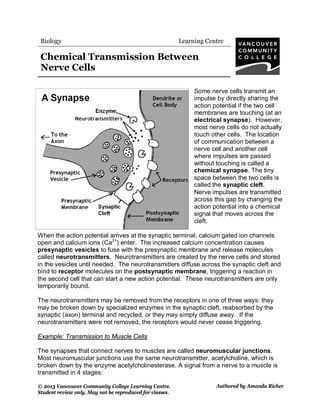


Chemical transmission between nerve cells occurs across synaptic clefts. When an action potential reaches the presynaptic terminal, vesicles containing neurotransmitters fuse with the membrane and release the neurotransmitters into the synaptic cleft. The neurotransmitters diffuse across and bind to receptors on the postsynaptic membrane, triggering a response. Neurotransmitters are then removed from receptors by breakdown, reabsorption, or diffusion to terminate the signal. Common examples use acetylcholine, which is broken down by acetylcholinesterase to allow rapid transmission of up to 1000 impulses per second at neuromuscular junctions.


