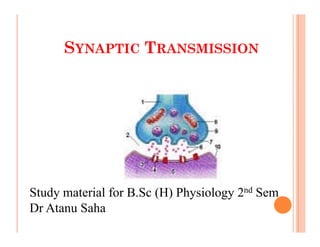
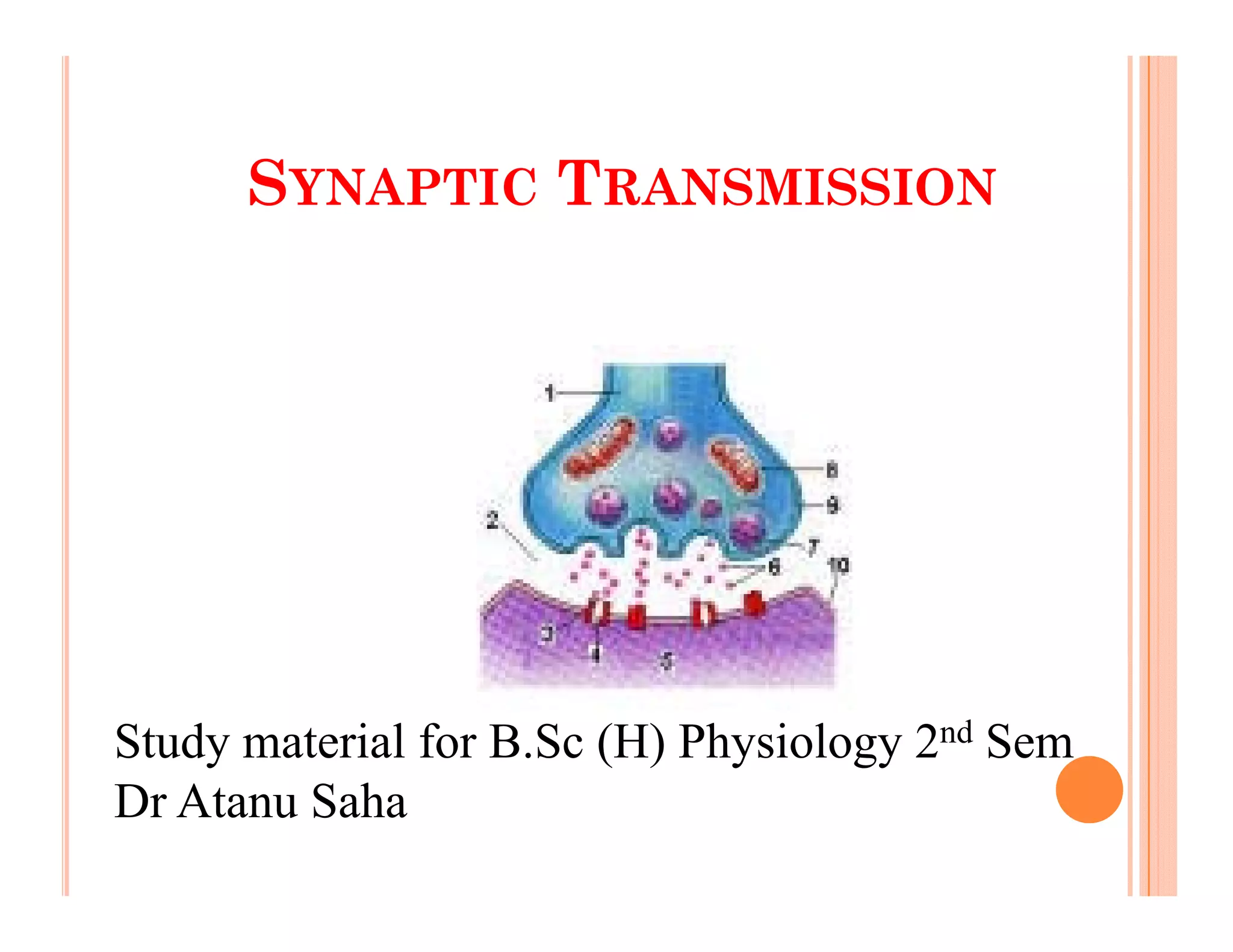
SYNAPTIC TRANSMISSION
Study material for B.Sc (H) Physiology 2nd Sem
Dr Atanu Saha
REVIEW ~ SETTING THE STAGE
 Information is digitized at the axon hillock
and a stream of action potentials carries the
output of a neuron down the axon to other
neurons
neurons.
 Neurons are the only class of cells that do not
touch neighboring cells.
 How is this output transferred to the next neuron
in the chain?
 The transfer of information from the end of
the axon of one neuron to the next neuron is
called synaptic transmission.
MOVING THE MESSAGE
MOVING THE MESSAGE
 Transmission of the signal between neurons
takes place across the synapse the space
takes place across the synapse, the space
between two neurons.
 In higher organisms this transmission is
chemical.
 Synaptic transmission then causes electrical
events in the next neuron
events in the next neuron.
 All the inputs coming into a particular
neuron are integrated to form the generator
potential at its a on hillock here a ne
potential at its axon hillock where a new
stream of action potentials is generated.
SYNAPTIC CONNECTIONS
 Neurons are the only cells that can
communicate with one another rapidly over
great distance
 Synaptic connections are specific.
 Underlie perception, emotion, behavior
 The average neuron makes 1000 synaptic connections
- receives more
 The human brain contains 1011 neurons & forms 1014
connections
 Neural processing occurs from the integration
of the various synaptic inputs on a neuron into
the generator potential of that neuron.
SPECIAL CHANNELS
SPECIAL CHANNELS
 Recall the 2 classes of channels for
signaling within cells:
 Resting channels that generate resting potential
Voltage gated channels that produce an action
 Voltage-gated channels that produce an action
potential
 Synaptic transmission uses 2 additional
l f h l
classes of channels:
 Gap-junction channels
 Ligand-gated channels
Ligand gated channels
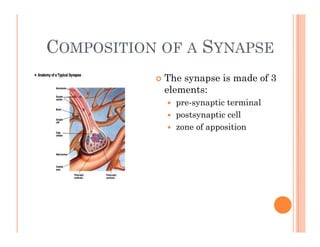
COMPOSITION OF A SYNAPSE
 The s napse is made of 3
 The synapse is made of 3
elements:
 pre-synaptic terminal
 postsynaptic cell
 zone of apposition
TYPES OF SYNAPSES
TYPES OF SYNAPSES
 Synapses are divided into 2 groups based on
y p g p
zones of apposition:
 Electrical
 Chemical
 Fast Chemical
 Modulating (slow) Chemical
ELECTRICAL SYNAPSES
ELECTRICAL SYNAPSES
 Common in invertebrate neurons involved
ith i t t fl i it
with important reflex circuits.
 Less common in adult mammalian neurons,
but common in many other body tissues
such as heart muscle cells.
 Current generated by the action potential in
g y p
pre-synaptic neuron flows through the gap
junction channel into the next neuron
S d i l d l i i i l
 Send simple depolarizing signals
 May transmit metabolic signals between
cells
cells
PROPERTIES OF THE ELECTRICAL
SYNAPSE
 Two cell membranes are aligned parallel
g p
 The synaptic cleft is small ~3.5 nm
 Usually between large presynaptic neuron
y g p y p
& small postsynaptic neuron
 takes a lot of current to depolarize a cell
S i li d t i ll d
 Specialized proteins called connexons span
the pair of membranes to make a very
large pore (the Gap Junction Channel)
g p ( p )
 Signal can be bi-directional
GAP-JUNCTION CHANNELS
GAP JUNCTION CHANNELS
 Connect communicating cells at an electrical
synapse
synapse
 Consist of a pair of cylinders (connexons)
 one in presynaptic cell one in post
 one in presynaptic cell, one in post
 each cylinder made of 6 protein subunits
 cylinders meet in the gap between the two cell
b
membranes
 Always open
 All ions and many small organic molecules are free
to pass through the pore
 Gap junctions serve to synchronize the activity
of a set of neurons
SYNCHRONIZING CELLS
SYNCHRONIZING CELLS
 Electrical transmission allows rapid,
synchronous firing of interconnected cells
 Can interconnect groups of neurons
 Very fast; virtually no delay
 Speed important for certain responses - defense
El i ll l d ll i
 Electrically coupled cells can trigger
explosive, all or none behavior
Ad ti d t ( ldfi h t il id
 Adaptive advantage (e.g. goldfish tail, squid
ink)
MODULATING CONDUCTANCE
 Gap junctions close in response to lower
cytoplasmic pH or increased Ca+2
cytoplasmic pH or increased Ca
 Some act as rectifiers
 channels are sensitive to voltage
h f i i idi i l
 therefore transmission unidirectional
 Linkage to chemical synapses
 neurotransmitters released from nearby chemical
y
synapses can activate 2nd messenger dependent
enzymes that alter gating of gap junction channels
CHEMICAL SYNAPSES
CHEMICAL SYNAPSES
 Synaptic cleft is larger
 There is no structural continuity between
presynaptic & postsynaptic cells
p y p p y p
 A chemical molecule, a
neurotransmitter, is released from the
presynaptic neuron
 diffuses across the synaptic cleft (20-50 nm)
 binds with a receptor on the postsynaptic
membrane.
CATEGORIES OF CHEMICAL
SYNAPSES
SYNAPSES
 Fast chemical synapses:
H t itt t d i h l
 Have transmitter-gated ion channels
 Fast, electrical response to arrival of presynaptic
action potential
 Use amino acids and amines as
neurotransmitters
 Slow modulatory chemical synapses:
 Slow, modulatory chemical synapses:
 Have G-protein-coupled ion channels
 Slow response to arrival of presynaptic action
p p y p
potential
 activate second messenger system; not always a
direct electrical effect
 May use amino acids, amines, or peptides
STRUCTURE OF THE CHEMICAL
SYNAPSE
 Presynaptic structures:
y p
 Vesicles - contain amino acids or amines,
released at synapse
S t l (d d i l )
 Secretory granules (dense-cored vesicles) -
contain peptides
 Presynaptic densities - serve to organize
vesicles and prepare them for release
 Postsynaptic structures:
 Postsynaptic densities loaded with receptors
 Postsynaptic densities - loaded with receptors
and ion channels, bind neurotransmitters and
establish ionic currents
WIRING PATTERNS OF CHEMICAL
SYNAPSES
 Axosomatic synapse - Axon terminal ends on a
y p
cell body
 Axodendritic synapse - Axon terminal ends on a
dendrite
dendrite
 Axoaxonic synapse - Axon terminal ends on
another axon
D d d d i i D d it k
 Dendrodendritic synapse - Dendrite makes
synapse with another dendrite
RELEASE OF
N
NEUROTRANSMITTERS
 Occurs in response to Ca+2 influx that
occurs with the action potential
 Change in membrane potential in
e a tic e o lead to elea e of
presynaptic neuron leads to release of
chemical transmitter from terminals
 transmitter diffuses across cleft
 binds to receptor molecules on the postsynaptic cell
membrane
 binding receptor causes ion channels to open or close,
g p p ,
altering potential
TRANSMITTER BINDING
TRANSMITTER BINDING
 Binding receptor is specific - lock & key
 Action determined by properties of receptor
 Action determined by properties of receptor,
not chemical properties of the transmitter
 receptor determines if response is excitatory or
i hibi
inhibitory
 All neurotransmitter receptors have 2
biochemical features in common:
 they are membrane spanning proteins that
recognize & bind transmitter
 they carry out effector function with a target cell,
usually by influencing opening or closing of ion
channels
SYNAPTIC RELEASE
SYNAPTIC RELEASE
FAST CHEMICAL SYNAPSES
 Action potential invades axon terminal
 Voltage-gated calcium channels pop open
 Calcium ions flood presynaptic terminal in region of
i l l
vesicle release
 Synaptic vesicles fuse with presynaptic membrane
– exocytosis
y
 Neurotransmitter molecules diffuse into and across
synaptic cleft
TRANSMITTER-GATED ION
CHANNELS
 Neurotransmitter molecules bind to the
receptor site on transmitter-gated ion channels
ecepto s te o t a s tte gated o c a e s
embedded in the postsynaptic membrane
 Ionic currents flow into or out of the
i ll
postsynaptic cell
 If Na+ ions are the carrier, the membrane
potential of the postsynaptic cell is depolarized
 EPSP -Excitatory Post-Synaptic Potential
 If Cl- ions or K+ ions are the carrier, the
C o s o o s a e e ca e , e
membrane potential of the postsynaptic cell is
hyperpolarized
IPSP I hibi P S i P i l
 IPSP - Inhibitory Post-Synaptic Potential
REMOVAL OF
NEUROTRANSMITTER
NEUROTRANSMITTER
 The neurotransmitter is inactivated or
removed from the synaptic cleft
 For acetylcholine, there is an enzyme,
y , y ,
acetylcholine esterase (AChE) that does
this
 For other amino acids and amines, the
presynaptic membrane actively sucks up
h i d i hb i li l ll
the transmitter and neighboring glial cells
may do likewise
SYNAPTIC RELEASE
NEUROMODULATORY SYNAPSES
 Action potential invades axon terminal
 Voltage-gated calcium channels pop open
 Calcium ions flood presynaptic terminal in
i f i l l
region of vesicle release
 Synaptic vesicles fuse with presynaptic
membrane exocytosis
membrane – exocytosis
 Neurotransmitter molecules diffuse into
and across synaptic cleft
y p
 Neurotransmitter molecules bind to
receptor proteins in the postsynaptic
b
membrane
G-PROTEIN-COUPLED RECEPTORS
 G-proteins in the membrane are activated and
p
move along inner face
 Activated G-proteins activate effector proteins
 May act directly or indirectly (2nd messenger)
 The neurotransmitter is inactivated or removed
from the synaptic cleft
DIRECT RECEPTORS
DIRECT RECEPTORS
 Ionotropic
p
 Are membrane spanning
 Made of several peptide subunits
O bi di t itt d
 On binding neurotransmitter, undergo
conformational change that opens a G-protein
gated ion channel
 Example - acetylcholine receptor on muscle
INDIRECT RECEPTORS
 Are macromolecules that are separate from
the ion channels on which they act
2 f ilil
 2 famililes:
 Metabotropic
 membrane spanning proteins
 a single polypeptide chain coupled to GTP-
binding proteins, which activate enzymes that
d 2 d h li AMP
produce 2nd messenger such as cyclic AMP
 2nd messenger either acts on channel directly or
thru enzyme
y
 Tyrosine kinase family
 add a phosphate group to tyrosine of substrate
t i d l ti h l
proteins, modulating channel
SYNAPTIC INTEGRATION:
FAST CHEMICAL SYNAPSES~ GATED ION
CHANNELS
 Synaptic transmitter release is quantal
 Each vesicle or secretory granule contains the
same number of neurotransmitter molecules
 The EPSP or IPSP that results is one of a set of
consistent sizes - one vesicle, two vesicles, three
vesicles, etc.
T i ll t l j ti 200
 Typically at a neuromuscular junction 200
vesicles are released from one action potential -
fail safe contraction of the muscle
 At a synapse in the CNS, typically only one
vesicle is released - input for processing in the
dendrite
 Not every synaptic release causes an action
potential in the postsynaptic neuron
SPATIAL SUMMATION
SPATIAL SUMMATION
 The dendrites of each neuron receive many
y
synaptic inputs from a variety of neurons.
 The combining of the EPSPs and IPSPs across
th d d it f th i lt i l f
the dendrite from the simultaneous arrival of
action potentials at various synapses is called
spatial summation
LENGTH CONSTANT
G CO S
 The measure of how effective a given synapse is
in contributing to spatial summation
 The length constant gives the distance (in µm)
that it take a EPSP o IPSP to dec ea e to
that it takes an EPSP or IPSP to decrease to
37% of its original value at the synapse:
 The length constant is directly proportional to
the membrane resistance and inversely
proportional to the longitudinal resistance
f th t l
of the cytoplasm
 The leakier the membrane, the shorter the length
constant
 The narrower the dendrite, the shorter the length
constant
TEMPORAL SUMMATION
TEMPORAL SUMMATION
 The combining of EPSPs or IPSPs from repeated
action potentials arriving at a single synapse is
called temporal summation
 The measure of how effective a given synapse is
in contributing to temporal summation is the
time constant, t
 The time constant gives the time (in
milliseconds) that it takes an EPSP or IPSP to
decrease to 37% of its original value at the
synapse
 In most cases, the effects of spatial summation
and temporal summation must both be taken
into account
NEUROMODULATION
 With a G-protein-coupled receptor, a chain of events is
triggered that usually ends with the phosphorylation of a
protein.
protein.
 For example:
 When a receptor for norepinephrine is activated,
 a G-protein is activated.
 Adenyl cyclase (an enzyme) is activated, which
 uses ATP to produce cyclic AMP a second messenger
 uses ATP to produce cyclic AMP, a second messenger.
 cAMP activates a protein kinase.
 The protein kinase phosphorylates a potassium channel,
 Which causes it to close
 This increases l and t, thereby making synapses more
potent for a period of time
 hence the term modulation
W C T ?
WHY CHEMICAL TRANSMISSION?
 More flexible; produces more complex behaviors
; p p
 Plasticity
 Can amplify neuronal signals
Di tl t d ti l f t
 Directly gated are comparatively fast
 mediate behavior
 Indirect are slower
 important in memory, learning
F C T
FLEXIBILITY OF CHEMICAL TRANSMISSION
 Produces more complex behaviors
p
 Same neurotransmitter can have several
functions
 at one terminal can be released at the active zone &
serve as a direct transmitter, acting on neighboring
cells
 at another site can serve as a modulator
at another site can serve as a modulator
 at a third site released into bloodstream as
neurohormone
PLASTICITY OF CHEMICAL TRANSMISSION
 Chemical Transmission has plasticity plasticity
because it is multistep
I f & h hi h f i
 Important for memory & other higher functions
 Modifiability of chemical synapses is an important
mechanism in behavioral learning
AMPLIFYING NEURONAL
SIGNALS
SIGNALS
 Chemical transmission can amplify neuronal
signals
 A small nerve terminal can alter the potential of a
large postsynaptic cell
 The action of just one synaptic vesicle leads to
j y p
opening of thousands of ion channels

synaptictransmission-091111081952-phpapp02-Compatibility-Mode.pdf

  • 1.
    SYNAPTIC TRANSMISSION SYNAPTIC TRANSMISSION Studymaterial for B.Sc (H) Physiology 2nd Sem Dr Atanu Saha
  • 2.
    REVIEW ~ SETTINGTHE STAGE  Information is digitized at the axon hillock  Information is digitized at the axon hillock and a stream of action potentials carries the output of a neuron down the axon to other neurons neurons.  Neurons are the only class of cells that do not touch neighboring cells.  How is this output transferred to the next neuron in the chain?  The transfer of information from the end of  The transfer of information from the end of the axon of one neuron to the next neuron is called synaptic transmission.
  • 3.
    MOVING THE MESSAGE MOVINGTHE MESSAGE  Transmission of the signal between neurons takes place across the synapse the space takes place across the synapse, the space between two neurons.  In higher organisms this transmission is chemical.  Synaptic transmission then causes electrical events in the next neuron events in the next neuron.  All the inputs coming into a particular neuron are integrated to form the generator potential at its a on hillock here a ne potential at its axon hillock where a new stream of action potentials is generated.
  • 4.
    SYNAPTIC CONNECTIONS  Neuronsare the only cells that can communicate with one another rapidly over communicate with one another rapidly over great distance  Synaptic connections are specific.  Underlie perception, emotion, behavior  The average neuron makes 1000 synaptic connections - receives more  The human brain contains 1011 neurons & forms 1014 connections  Neural processing occurs from the integration  Neural processing occurs from the integration of the various synaptic inputs on a neuron into the generator potential of that neuron.
  • 5.
    SPECIAL CHANNELS SPECIAL CHANNELS Recall the 2 classes of channels for signaling within cells:  Resting channels that generate resting potential Voltage gated channels that produce an action  Voltage-gated channels that produce an action potential  Synaptic transmission uses 2 additional l f h l classes of channels:  Gap-junction channels  Ligand-gated channels Ligand gated channels
  • 6.
    COMPOSITION OF ASYNAPSE COMPOSITION OF A SYNAPSE  The s napse is made of 3  The synapse is made of 3 elements:  pre-synaptic terminal  postsynaptic cell  zone of apposition
  • 7.
    TYPES OF SYNAPSES TYPESOF SYNAPSES  Synapses are divided into 2 groups based on y p g p zones of apposition:  Electrical  Chemical  Fast Chemical  Modulating (slow) Chemical  Modulating (slow) Chemical
  • 8.
    ELECTRICAL SYNAPSES ELECTRICAL SYNAPSES Common in invertebrate neurons involved ith i t t fl i it with important reflex circuits.  Less common in adult mammalian neurons, but common in many other body tissues but common in many other body tissues such as heart muscle cells.  Current generated by the action potential in g y p pre-synaptic neuron flows through the gap junction channel into the next neuron S d i l d l i i i l  Send simple depolarizing signals  May transmit metabolic signals between cells cells
  • 9.
    PROPERTIES OF THEELECTRICAL SYNAPSE  Two cell membranes are aligned parallel g p  The synaptic cleft is small ~3.5 nm  Usually between large presynaptic neuron y g p y p & small postsynaptic neuron  takes a lot of current to depolarize a cell S i li d t i ll d  Specialized proteins called connexons span the pair of membranes to make a very large pore (the Gap Junction Channel) g p ( p )  Signal can be bi-directional
  • 10.
    GAP-JUNCTION CHANNELS GAP JUNCTIONCHANNELS  Connect communicating cells at an electrical synapse synapse  Consist of a pair of cylinders (connexons)  one in presynaptic cell one in post  one in presynaptic cell, one in post  each cylinder made of 6 protein subunits  cylinders meet in the gap between the two cell b membranes  Always open  All ions and many small organic molecules are free  All ions and many small organic molecules are free to pass through the pore  Gap junctions serve to synchronize the activity of a set of neurons
  • 11.
    SYNCHRONIZING CELLS SYNCHRONIZING CELLS Electrical transmission allows rapid, synchronous firing of interconnected cells  Can interconnect groups of neurons  Very fast; virtually no delay  Speed important for certain responses - defense El i ll l d ll i  Electrically coupled cells can trigger explosive, all or none behavior Ad ti d t ( ldfi h t il id  Adaptive advantage (e.g. goldfish tail, squid ink)
  • 12.
    MODULATING CONDUCTANCE MODULATING CONDUCTANCE Gap junctions close in response to lower cytoplasmic pH or increased Ca+2 cytoplasmic pH or increased Ca  Some act as rectifiers  channels are sensitive to voltage h f i i idi i l  therefore transmission unidirectional  Linkage to chemical synapses  neurotransmitters released from nearby chemical y synapses can activate 2nd messenger dependent enzymes that alter gating of gap junction channels
  • 13.
    CHEMICAL SYNAPSES CHEMICAL SYNAPSES Synaptic cleft is larger  Synaptic cleft is larger  There is no structural continuity between presynaptic & postsynaptic cells p y p p y p  A chemical molecule, a neurotransmitter, is released from the presynaptic neuron  diffuses across the synaptic cleft (20-50 nm)  binds with a receptor on the postsynaptic membrane.
  • 14.
    CATEGORIES OF CHEMICAL SYNAPSES SYNAPSES Fast chemical synapses: H t itt t d i h l  Have transmitter-gated ion channels  Fast, electrical response to arrival of presynaptic action potential  Use amino acids and amines as neurotransmitters  Slow modulatory chemical synapses:  Slow, modulatory chemical synapses:  Have G-protein-coupled ion channels  Slow response to arrival of presynaptic action p p y p potential  activate second messenger system; not always a direct electrical effect direct electrical effect  May use amino acids, amines, or peptides
  • 15.
    STRUCTURE OF THECHEMICAL SYNAPSE  Presynaptic structures: y p  Vesicles - contain amino acids or amines, released at synapse S t l (d d i l )  Secretory granules (dense-cored vesicles) - contain peptides  Presynaptic densities - serve to organize vesicles and prepare them for release  Postsynaptic structures:  Postsynaptic densities loaded with receptors  Postsynaptic densities - loaded with receptors and ion channels, bind neurotransmitters and establish ionic currents
  • 16.
    WIRING PATTERNS OFCHEMICAL SYNAPSES  Axosomatic synapse - Axon terminal ends on a y p cell body  Axodendritic synapse - Axon terminal ends on a dendrite dendrite  Axoaxonic synapse - Axon terminal ends on another axon D d d d i i D d it k  Dendrodendritic synapse - Dendrite makes synapse with another dendrite
  • 17.
    RELEASE OF N NEUROTRANSMITTERS  Occursin response to Ca+2 influx that occurs with the action potential  Change in membrane potential in e a tic e o lead to elea e of presynaptic neuron leads to release of chemical transmitter from terminals  transmitter diffuses across cleft  binds to receptor molecules on the postsynaptic cell membrane  binding receptor causes ion channels to open or close, g p p , altering potential
  • 18.
    TRANSMITTER BINDING TRANSMITTER BINDING Binding receptor is specific - lock & key  Action determined by properties of receptor  Action determined by properties of receptor, not chemical properties of the transmitter  receptor determines if response is excitatory or i hibi inhibitory  All neurotransmitter receptors have 2 biochemical features in common: biochemical features in common:  they are membrane spanning proteins that recognize & bind transmitter  they carry out effector function with a target cell, usually by influencing opening or closing of ion channels
  • 19.
    SYNAPTIC RELEASE SYNAPTIC RELEASE FASTCHEMICAL SYNAPSES  Action potential invades axon terminal  Action potential invades axon terminal  Voltage-gated calcium channels pop open  Calcium ions flood presynaptic terminal in region of i l l vesicle release  Synaptic vesicles fuse with presynaptic membrane – exocytosis y  Neurotransmitter molecules diffuse into and across synaptic cleft
  • 20.
    TRANSMITTER-GATED ION CHANNELS  Neurotransmittermolecules bind to the receptor site on transmitter-gated ion channels ecepto s te o t a s tte gated o c a e s embedded in the postsynaptic membrane  Ionic currents flow into or out of the i ll postsynaptic cell  If Na+ ions are the carrier, the membrane potential of the postsynaptic cell is depolarized potential of the postsynaptic cell is depolarized  EPSP -Excitatory Post-Synaptic Potential  If Cl- ions or K+ ions are the carrier, the C o s o o s a e e ca e , e membrane potential of the postsynaptic cell is hyperpolarized IPSP I hibi P S i P i l  IPSP - Inhibitory Post-Synaptic Potential
  • 21.
    REMOVAL OF NEUROTRANSMITTER NEUROTRANSMITTER  Theneurotransmitter is inactivated or  The neurotransmitter is inactivated or removed from the synaptic cleft  For acetylcholine, there is an enzyme, y , y , acetylcholine esterase (AChE) that does this  For other amino acids and amines, the presynaptic membrane actively sucks up h i d i hb i li l ll the transmitter and neighboring glial cells may do likewise
  • 22.
    SYNAPTIC RELEASE NEUROMODULATORY SYNAPSES Action potential invades axon terminal  Voltage-gated calcium channels pop open  Calcium ions flood presynaptic terminal in i f i l l region of vesicle release  Synaptic vesicles fuse with presynaptic membrane exocytosis membrane – exocytosis  Neurotransmitter molecules diffuse into and across synaptic cleft y p  Neurotransmitter molecules bind to receptor proteins in the postsynaptic b membrane
  • 23.
    G-PROTEIN-COUPLED RECEPTORS  G-proteinsin the membrane are activated and p move along inner face  Activated G-proteins activate effector proteins  May act directly or indirectly (2nd messenger)  May act directly or indirectly (2nd messenger)  The neurotransmitter is inactivated or removed from the synaptic cleft
  • 24.
    DIRECT RECEPTORS DIRECT RECEPTORS Ionotropic p  Are membrane spanning  Made of several peptide subunits O bi di t itt d  On binding neurotransmitter, undergo conformational change that opens a G-protein gated ion channel  Example - acetylcholine receptor on muscle
  • 25.
    INDIRECT RECEPTORS  Aremacromolecules that are separate from the ion channels on which they act 2 f ilil  2 famililes:  Metabotropic  membrane spanning proteins  membrane spanning proteins  a single polypeptide chain coupled to GTP- binding proteins, which activate enzymes that d 2 d h li AMP produce 2nd messenger such as cyclic AMP  2nd messenger either acts on channel directly or thru enzyme y  Tyrosine kinase family  add a phosphate group to tyrosine of substrate t i d l ti h l proteins, modulating channel
  • 26.
    SYNAPTIC INTEGRATION: FAST CHEMICALSYNAPSES~ GATED ION CHANNELS  Synaptic transmitter release is quantal  Each vesicle or secretory granule contains the same number of neurotransmitter molecules  The EPSP or IPSP that results is one of a set of  The EPSP or IPSP that results is one of a set of consistent sizes - one vesicle, two vesicles, three vesicles, etc. T i ll t l j ti 200  Typically at a neuromuscular junction 200 vesicles are released from one action potential - fail safe contraction of the muscle  At a synapse in the CNS, typically only one vesicle is released - input for processing in the dendrite  Not every synaptic release causes an action potential in the postsynaptic neuron
  • 27.
    SPATIAL SUMMATION SPATIAL SUMMATION The dendrites of each neuron receive many y synaptic inputs from a variety of neurons.  The combining of the EPSPs and IPSPs across th d d it f th i lt i l f the dendrite from the simultaneous arrival of action potentials at various synapses is called spatial summation
  • 28.
    LENGTH CONSTANT G COS  The measure of how effective a given synapse is in contributing to spatial summation  The length constant gives the distance (in µm) that it take a EPSP o IPSP to dec ea e to that it takes an EPSP or IPSP to decrease to 37% of its original value at the synapse:  The length constant is directly proportional to  The length constant is directly proportional to the membrane resistance and inversely proportional to the longitudinal resistance f th t l of the cytoplasm  The leakier the membrane, the shorter the length constant  The narrower the dendrite, the shorter the length constant
  • 29.
    TEMPORAL SUMMATION TEMPORAL SUMMATION The combining of EPSPs or IPSPs from repeated action potentials arriving at a single synapse is action potentials arriving at a single synapse is called temporal summation  The measure of how effective a given synapse is  The measure of how effective a given synapse is in contributing to temporal summation is the time constant, t  The time constant gives the time (in milliseconds) that it takes an EPSP or IPSP to decrease to 37% of its original value at the decrease to 37% of its original value at the synapse  In most cases, the effects of spatial summation and temporal summation must both be taken into account
  • 30.
    NEUROMODULATION  With aG-protein-coupled receptor, a chain of events is triggered that usually ends with the phosphorylation of a protein. protein.  For example:  When a receptor for norepinephrine is activated,  a G-protein is activated.  Adenyl cyclase (an enzyme) is activated, which  uses ATP to produce cyclic AMP a second messenger  uses ATP to produce cyclic AMP, a second messenger.  cAMP activates a protein kinase.  The protein kinase phosphorylates a potassium channel,  Which causes it to close  This increases l and t, thereby making synapses more potent for a period of time potent for a period of time  hence the term modulation
  • 31.
    W C T? WHY CHEMICAL TRANSMISSION?  More flexible; produces more complex behaviors ; p p  Plasticity  Can amplify neuronal signals Di tl t d ti l f t  Directly gated are comparatively fast  mediate behavior  Indirect are slower  important in memory, learning
  • 32.
    F C T FLEXIBILITYOF CHEMICAL TRANSMISSION  Produces more complex behaviors p  Same neurotransmitter can have several functions  at one terminal can be released at the active zone &  at one terminal can be released at the active zone & serve as a direct transmitter, acting on neighboring cells  at another site can serve as a modulator at another site can serve as a modulator  at a third site released into bloodstream as neurohormone
  • 33.
    PLASTICITY OF CHEMICALTRANSMISSION  Chemical Transmission has plasticity plasticity because it is multistep I f & h hi h f i  Important for memory & other higher functions  Modifiability of chemical synapses is an important mechanism in behavioral learning mechanism in behavioral learning
  • 34.
    AMPLIFYING NEURONAL SIGNALS SIGNALS  Chemicaltransmission can amplify neuronal signals  A small nerve terminal can alter the potential of a  A small nerve terminal can alter the potential of a large postsynaptic cell  The action of just one synaptic vesicle leads to j y p opening of thousands of ion channels