7/9/2013
AP BiologyWeek 5
Name an organelle (or cell part):
 That is found only in plants
 That contains DNA
 That secretes proteins
 That modifies proteins
 That has a double membrane
 That helps the cell move
 That is found in prokaryotic cells
 That contains acids and enzymes
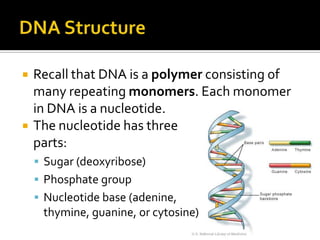
 Recall that DNA is a polymer consisting of
many repeating monomers. Each monomer
in DNA is a nucleotide.
 The nucleotide has three
parts:
 Sugar (deoxyribose)
 Phosphate group
 Nucleotide base (adenine,
thymine, guanine, or cytosine)
 Every nucleotide base
“pairs” with a different
specific base: adenine
pairs with thymine,
guanine with cytosine
 They attach with hydrogen
bonds like a zipper.
 The sugar-phosphate
background causes the
zipper to curl or spiral into a
double helix shape.
DNA’s
double helix
keeps a
double copy
of its
information,
one copy on
each side of
helix, coded
in opposite
base pairs.
This comes
in handy for
replication.
Note that you only need one
strand of DNA to recreate the
other half.Try here:
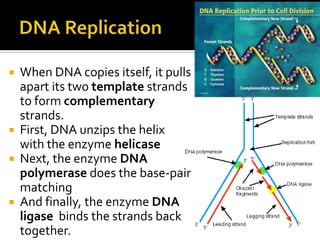
 When DNA copies itself, it pulls
apart its two template strands
to form complementary
strands.
 First, DNA unzips the helix
with the enzyme helicase
 Next, the enzyme DNA
polymerase does the base-pair
matching
 And finally, the enzyme DNA
ligase binds the strands back
together.
 Because deoxyribose sugars
are pentagons, they are
asymmetrical, with a 5’ and 3’
end.
 Enzymes (polymerase, ligase)
move smoothly in the 5’3’
direction, called the leading
strand
 The lagging strand in the
3’5’ direction must be
synthesized in pieces, called
“Okazaki fragments” and then
tied together later with ligase.
1. What would be the sequence of bases of the
complementary DNA strand to the template
below? (1990:40)
GTAGTAGGT
a) GTAGTAGGT
b) CAUCAUCCA
c) AUGAUGAAU
d) UCGUCGUUC
e) CATCATCCA
2. DNA replication can be best be described as
semiconservative because:
a) The nucleotide bases are conserved to use over and
over again in different molecules.
b) DNA is the common genetic code that is conserved
between all living organisms
c) DNA replicates by unzipping, replicating
complementary strands, and rezipping the templates
to conserve for later.
d) Each new DNA strand conserves one template
strand and one new complementary strand.
3. Describe in 2-3 sentences what is meant by
the “five prime” and “three prime” end of a
DNA strand, explaining how this affects the
DNA replication process.
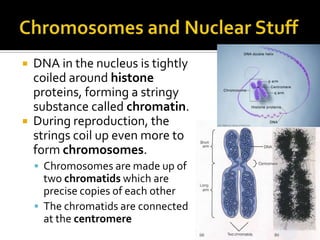
 DNA in the nucleus is tightly
coiled around histone
proteins, forming a stringy
substance called chromatin.
 During reproduction, the
strings coil up even more to
form chromosomes.
 Chromosomes are made up of
two chromatids which are
precise copies of each other
 The chromatids are connected
at the centromere
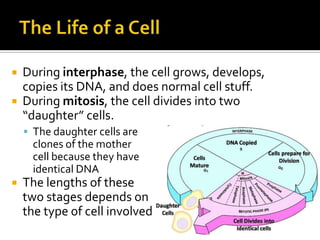
 During interphase, the cell grows, develops,
copies its DNA, and does normal cell stuff.
 During mitosis, the cell divides into two
“daughter” cells.
 The daughter cells are
clones of the mother
cell because they have
identical DNA
 The lengths of these
two stages depends on
the type of cell involved
 G1 – “first gap” phase
 Cell grows and makes proteins
 DNA is uncoiled in loose chromatin
 Restriction point: checkpoint before continuing
 G0 phase – dormant cells get the signal to pause
 S – “synthesis” phase
 Cell copies (synthesizes) its DNA, doubling it
 G2 – “second gap” phase
 Cell continues growth, doubling its organelles to
prepare for division
 Prophase – “P” for “prepare”
 Chromosomes condense in the
nucleus
 Nuclear membrane dissolves
 Spindle apparatus forms
 Metaphase – “M” for “middle”
 Chromosomes align at
metaphase plate (the middle of
the cell)
 Spindle fibers attach to
centromeres.
 Anaphase – “A” for “apart”
 Chromosomes pull apart,
breaking centromeres
 Sister chromatids pull to opposite
poles of the cell
 Spindle fibers contract
 Telophase – “T” for “twin”
 Nuclear membranes re-form
 Chromosomes disentangle into
chromatin
 Cytokinesis, division of the
cytoplasm
 The cell cycle (interphase and
division) is highly regulated,
occurring at different paces.
 Fast cell division: stomach cells,
hair, skin, blood
 Slow cell division: liver, brain
(no division)
 Restriction points, especially
at the end of G1, let your body
signal to a cell whether to halt
 Disorders of the cell cycle can
cause cancer—uncontrolled
cellular reproduction
 Skip to “ploidies” presentation for details.
AP Biology Week 4 - DNA and Cell Division

AP Biology Week 4 - DNA and Cell Division

  • 1.
  • 2.
    Name an organelle(or cell part):  That is found only in plants  That contains DNA  That secretes proteins  That modifies proteins  That has a double membrane  That helps the cell move  That is found in prokaryotic cells  That contains acids and enzymes
  • 3.
     Recall thatDNA is a polymer consisting of many repeating monomers. Each monomer in DNA is a nucleotide.  The nucleotide has three parts:  Sugar (deoxyribose)  Phosphate group  Nucleotide base (adenine, thymine, guanine, or cytosine)
  • 4.
     Every nucleotidebase “pairs” with a different specific base: adenine pairs with thymine, guanine with cytosine  They attach with hydrogen bonds like a zipper.  The sugar-phosphate background causes the zipper to curl or spiral into a double helix shape.
  • 5.
    DNA’s double helix keeps a doublecopy of its information, one copy on each side of helix, coded in opposite base pairs. This comes in handy for replication. Note that you only need one strand of DNA to recreate the other half.Try here:
  • 6.
     When DNAcopies itself, it pulls apart its two template strands to form complementary strands.  First, DNA unzips the helix with the enzyme helicase  Next, the enzyme DNA polymerase does the base-pair matching  And finally, the enzyme DNA ligase binds the strands back together.
  • 7.
     Because deoxyribosesugars are pentagons, they are asymmetrical, with a 5’ and 3’ end.  Enzymes (polymerase, ligase) move smoothly in the 5’3’ direction, called the leading strand  The lagging strand in the 3’5’ direction must be synthesized in pieces, called “Okazaki fragments” and then tied together later with ligase.
  • 8.
    1. What wouldbe the sequence of bases of the complementary DNA strand to the template below? (1990:40) GTAGTAGGT a) GTAGTAGGT b) CAUCAUCCA c) AUGAUGAAU d) UCGUCGUUC e) CATCATCCA
  • 9.
    2. DNA replicationcan be best be described as semiconservative because: a) The nucleotide bases are conserved to use over and over again in different molecules. b) DNA is the common genetic code that is conserved between all living organisms c) DNA replicates by unzipping, replicating complementary strands, and rezipping the templates to conserve for later. d) Each new DNA strand conserves one template strand and one new complementary strand.
  • 10.
    3. Describe in2-3 sentences what is meant by the “five prime” and “three prime” end of a DNA strand, explaining how this affects the DNA replication process.
  • 11.
     DNA inthe nucleus is tightly coiled around histone proteins, forming a stringy substance called chromatin.  During reproduction, the strings coil up even more to form chromosomes.  Chromosomes are made up of two chromatids which are precise copies of each other  The chromatids are connected at the centromere
  • 12.
     During interphase,the cell grows, develops, copies its DNA, and does normal cell stuff.  During mitosis, the cell divides into two “daughter” cells.  The daughter cells are clones of the mother cell because they have identical DNA  The lengths of these two stages depends on the type of cell involved
  • 13.
     G1 –“first gap” phase  Cell grows and makes proteins  DNA is uncoiled in loose chromatin  Restriction point: checkpoint before continuing  G0 phase – dormant cells get the signal to pause  S – “synthesis” phase  Cell copies (synthesizes) its DNA, doubling it  G2 – “second gap” phase  Cell continues growth, doubling its organelles to prepare for division
  • 14.
     Prophase –“P” for “prepare”  Chromosomes condense in the nucleus  Nuclear membrane dissolves  Spindle apparatus forms  Metaphase – “M” for “middle”  Chromosomes align at metaphase plate (the middle of the cell)  Spindle fibers attach to centromeres.
  • 15.
     Anaphase –“A” for “apart”  Chromosomes pull apart, breaking centromeres  Sister chromatids pull to opposite poles of the cell  Spindle fibers contract  Telophase – “T” for “twin”  Nuclear membranes re-form  Chromosomes disentangle into chromatin  Cytokinesis, division of the cytoplasm
  • 16.
     The cellcycle (interphase and division) is highly regulated, occurring at different paces.  Fast cell division: stomach cells, hair, skin, blood  Slow cell division: liver, brain (no division)  Restriction points, especially at the end of G1, let your body signal to a cell whether to halt  Disorders of the cell cycle can cause cancer—uncontrolled cellular reproduction
  • 17.
     Skip to“ploidies” presentation for details.

Editor's Notes

  • #4 http://learn.genetics.utah.edu/content/begin/cells/scale/
  • #8 http://www.youtube.com/watch?v=4jtmOZaIvS0 – dna replication video