INDEX
General introduction
Neurone classification – Myelinated
and Non – Myelinated
 Special features of a neurone
Resting Membrane Potential
Action Potential
Nerst Equation
Ionic distribution
Synaptic transmission
Conclusion
General Introduction
An impulse is initiated by stimulation of
sensory nerve endings or by the passage of an
impulse from another nerve.
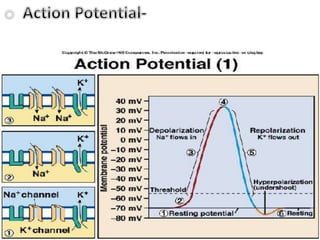
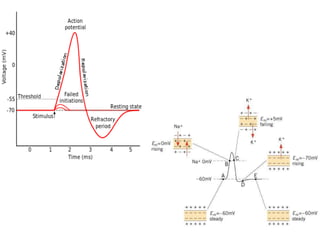
Transmission of the impulse, or action potential
is due to movement of ions across the nerve
cell membrane.
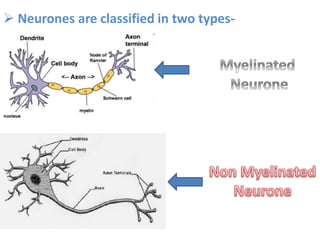
 Neurones are classified in two types-
Special Properties of Neurons-
Excitability--Action Potential in Axons.
Conduction--Action Potential in Axons.
Transmission--Synapses, Electrical & Chemical.
Integration--Postsynaptic Cell.
Plasticity--Presynaptic Terminal and Postsynaptic
Membrane.
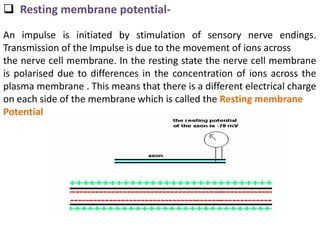
 Resting membrane potential-
An impulse is initiated by stimulation of sensory nerve endings.
Transmission of the Impulse is due to the movement of ions across
the nerve cell membrane. In the resting state the nerve cell membrane
is polarised due to differences in the concentration of ions across the
plasma membrane . This means that there is a different electrical charge
on each side of the membrane which is called the Resting membrane
Potential
Nernst Equation
• Eion = 2.303 RT/ZF log [ion]o/[ion]in
• Eion = ionic equilibrium potential
• Z= charge of ion
• F= Faraday’s constant
• T= absolute temperature (0Kelvin/-273°C)
• R=Universal gas constant
The Nerst Equation relates the voltage across the
membrane which is in equilibrium with the
concentration of ions inside and outside the cell
membrane.
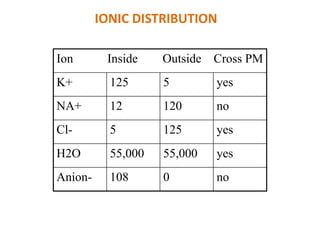
Ion Inside Outside Cross PM
K+ 125 5 yes
NA+ 12 120 no
Cl- 5 125 yes
H2O 55,000 55,000 yes
Anion- 108 0 no
IONIC DISTRIBUTION
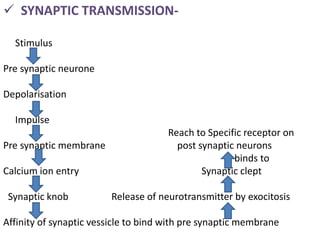
 SYNAPTIC TRANSMISSION-
Stimulus
Pre synaptic neurone
Depolarisation
Impulse
Reach to Specific receptor on
Pre synaptic membrane post synaptic neurons
binds to
Calcium ion entry Synaptic clept
Synaptic knob Release of neurotransmitter by exocitosis
Affinity of synaptic vessicle to bind with pre synaptic membrane
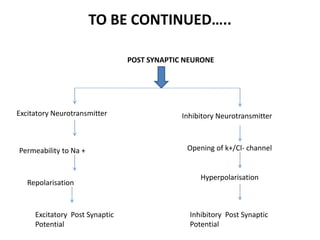
TO BE CONTINUED…..
POST SYNAPTIC NEURONE
Excitatory Neurotransmitter Inhibitory Neurotransmitter
Permeability to Na +
Repolarisation
Excitatory Post Synaptic
Potential
Opening of k+/Cl- channel
Hyperpolarisation
Inhibitory Post Synaptic
Potential
 CONCLUSION-
The nervous system detects and responds to changes
inside and outside the body. Together with the
endocrine system, it controls many vital aspects of the
body functions.
The nervous system consists of the
brain , spinal cord, and peripheral nerves. The
structure and organisation of the tissues that form
these components enables rapid communication
between different parts of the body.
Anne Waugh and Allison Grant, The Nervous
System,139 – 183 ,Textbook of medical physiology,11th
edition, Elsevier publishers,2007
www.slideshare.net
www.pharmainfo.net/impulse
Action potential

Action potential

  • 2.
    INDEX General introduction Neurone classification– Myelinated and Non – Myelinated  Special features of a neurone Resting Membrane Potential Action Potential Nerst Equation Ionic distribution Synaptic transmission Conclusion
  • 3.
    General Introduction An impulseis initiated by stimulation of sensory nerve endings or by the passage of an impulse from another nerve. Transmission of the impulse, or action potential is due to movement of ions across the nerve cell membrane.
  • 4.
     Neurones areclassified in two types-
  • 5.
    Special Properties ofNeurons- Excitability--Action Potential in Axons. Conduction--Action Potential in Axons. Transmission--Synapses, Electrical & Chemical. Integration--Postsynaptic Cell. Plasticity--Presynaptic Terminal and Postsynaptic Membrane.
  • 6.
     Resting membranepotential- An impulse is initiated by stimulation of sensory nerve endings. Transmission of the Impulse is due to the movement of ions across the nerve cell membrane. In the resting state the nerve cell membrane is polarised due to differences in the concentration of ions across the plasma membrane . This means that there is a different electrical charge on each side of the membrane which is called the Resting membrane Potential
  • 9.
    Nernst Equation • Eion= 2.303 RT/ZF log [ion]o/[ion]in • Eion = ionic equilibrium potential • Z= charge of ion • F= Faraday’s constant • T= absolute temperature (0Kelvin/-273°C) • R=Universal gas constant The Nerst Equation relates the voltage across the membrane which is in equilibrium with the concentration of ions inside and outside the cell membrane.
  • 10.
    Ion Inside OutsideCross PM K+ 125 5 yes NA+ 12 120 no Cl- 5 125 yes H2O 55,000 55,000 yes Anion- 108 0 no IONIC DISTRIBUTION
  • 11.
     SYNAPTIC TRANSMISSION- Stimulus Presynaptic neurone Depolarisation Impulse Reach to Specific receptor on Pre synaptic membrane post synaptic neurons binds to Calcium ion entry Synaptic clept Synaptic knob Release of neurotransmitter by exocitosis Affinity of synaptic vessicle to bind with pre synaptic membrane
  • 12.
    TO BE CONTINUED….. POSTSYNAPTIC NEURONE Excitatory Neurotransmitter Inhibitory Neurotransmitter Permeability to Na + Repolarisation Excitatory Post Synaptic Potential Opening of k+/Cl- channel Hyperpolarisation Inhibitory Post Synaptic Potential
  • 13.
     CONCLUSION- The nervoussystem detects and responds to changes inside and outside the body. Together with the endocrine system, it controls many vital aspects of the body functions. The nervous system consists of the brain , spinal cord, and peripheral nerves. The structure and organisation of the tissues that form these components enables rapid communication between different parts of the body.
  • 14.
    Anne Waugh andAllison Grant, The Nervous System,139 – 183 ,Textbook of medical physiology,11th edition, Elsevier publishers,2007 www.slideshare.net www.pharmainfo.net/impulse