By Javid Jones and Kaydean Forbes
What is the Solar System?
The collection of eight planets and their moons in orbit
around the sun, together with smaller bodies in the form of
asteroids, meteoroids, and comets. The 8 planets are
Mercury, Venus, Earth, Mars, Jupiter, Saturn,
Uranus and Neptune.
The Solar System
Asteroids are rocky and metallic objects too small to
be considered planets. They are sometimes called
minor planets.
A meteor is a bright streak of light in the sky (a
"shooting star" or a "falling star").
Comets are small celestial bodies that orbit the Sun.
They are primarily made of dust and ice.
The Sun
The sun is the star that our solar system revolves
around.
The earth could fit into the sun 1.3 million times.
 The sun is the largest object in the solar system.
 It is mostly made up of hydrogen, the lightest gas
ever found. Hydrogen has no color, no smell and no
taste.
What is a moon?
A moon is a body that circles a larger planet or body.
The natural satellite of the earth, visible by reflected
light from the sun.
What is a star?
A Star is a big exploding balls of gas, mostly hydrogen
and helium. In simpler terms a star can be defined as
a ball of fire or gas.
What is a planet?
Define as an object that orbits a star, is large enough
to have settled into a round shape and, crucially, has
cleared the neighborhood around its orbit.
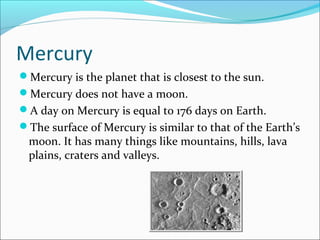
Mercury
Mercury is the planet that is closest to the sun.
Mercury does not have a moon.
A day on Mercury is equal to 176 days on Earth.
The surface of Mercury is similar to that of the Earth’s
moon. It has many things like mountains, hills, lava
plains, craters and valleys.
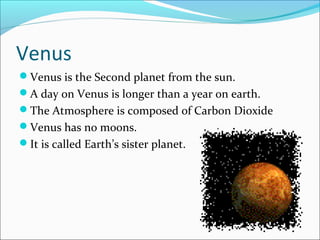
Venus
Venus is the Second planet from the sun.
A day on Venus is longer than a year on earth.
The Atmosphere is composed of Carbon Dioxide
Venus has no moons.
It is called Earth’s sister planet.
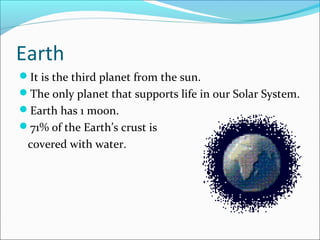
Earth
It is the third planet from the sun.
The only planet that supports life in our Solar System.
Earth has 1 moon.
71% of the Earth’s crust is
covered with water.
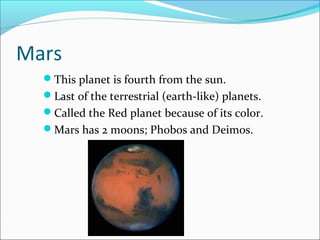
Mars
This planet is fourth from the sun.
Last of the terrestrial (earth-like) planets.
Called the Red planet because of its color.
Mars has 2 moons; Phobos and Deimos.
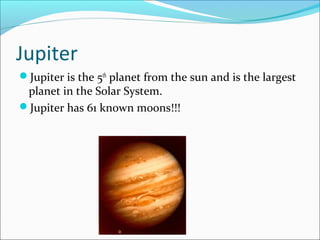
Jupiter
Jupiter is the 5th
planet from the sun and is the largest
planet in the Solar System.
Jupiter has 61 known moons!!!
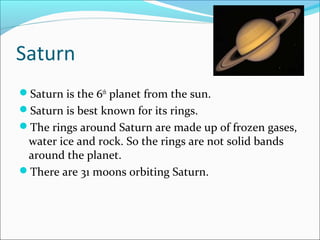
Saturn
Saturn is the 6th
planet from the sun.
Saturn is best known for its rings.
The rings around Saturn are made up of frozen gases,
water ice and rock. So the rings are not solid bands
around the planet.
There are 31 moons orbiting Saturn.
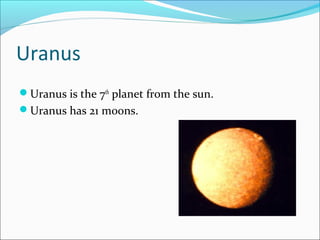
Uranus
Uranus is the 7th
planet from the sun.
Uranus has 21 moons.
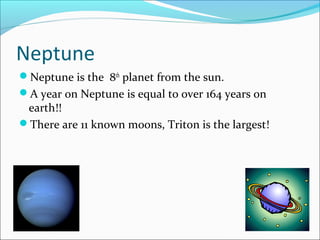
Neptune
Neptune is the 8th
planet from the sun.
A year on Neptune is equal to over 164 years on
earth!!
There are 11 known moons, Triton is the largest!
Assessment
How many moon does earth have?
 Which is the ring planet?
Which planet is known as Earth’s sister?
The sun is a ____________, not a planet.
 Which planet is the largest?
 How many planet are there in the solar system?

The solar system powerpoint

  • 1.
    By Javid Jonesand Kaydean Forbes
  • 2.
    What is theSolar System? The collection of eight planets and their moons in orbit around the sun, together with smaller bodies in the form of asteroids, meteoroids, and comets. The 8 planets are Mercury, Venus, Earth, Mars, Jupiter, Saturn, Uranus and Neptune.
  • 3.
    The Solar System Asteroidsare rocky and metallic objects too small to be considered planets. They are sometimes called minor planets. A meteor is a bright streak of light in the sky (a "shooting star" or a "falling star"). Comets are small celestial bodies that orbit the Sun. They are primarily made of dust and ice.
  • 4.
    The Sun The sunis the star that our solar system revolves around. The earth could fit into the sun 1.3 million times.  The sun is the largest object in the solar system.  It is mostly made up of hydrogen, the lightest gas ever found. Hydrogen has no color, no smell and no taste.
  • 5.
    What is amoon? A moon is a body that circles a larger planet or body. The natural satellite of the earth, visible by reflected light from the sun.
  • 6.
    What is astar? A Star is a big exploding balls of gas, mostly hydrogen and helium. In simpler terms a star can be defined as a ball of fire or gas.
  • 7.
    What is aplanet? Define as an object that orbits a star, is large enough to have settled into a round shape and, crucially, has cleared the neighborhood around its orbit.
  • 8.
    Mercury Mercury is theplanet that is closest to the sun. Mercury does not have a moon. A day on Mercury is equal to 176 days on Earth. The surface of Mercury is similar to that of the Earth’s moon. It has many things like mountains, hills, lava plains, craters and valleys.
  • 9.
    Venus Venus is theSecond planet from the sun. A day on Venus is longer than a year on earth. The Atmosphere is composed of Carbon Dioxide Venus has no moons. It is called Earth’s sister planet.
  • 10.
    Earth It is thethird planet from the sun. The only planet that supports life in our Solar System. Earth has 1 moon. 71% of the Earth’s crust is covered with water.
  • 11.
    Mars This planet isfourth from the sun. Last of the terrestrial (earth-like) planets. Called the Red planet because of its color. Mars has 2 moons; Phobos and Deimos.
  • 12.
    Jupiter Jupiter is the5th planet from the sun and is the largest planet in the Solar System. Jupiter has 61 known moons!!!
  • 13.
    Saturn Saturn is the6th planet from the sun. Saturn is best known for its rings. The rings around Saturn are made up of frozen gases, water ice and rock. So the rings are not solid bands around the planet. There are 31 moons orbiting Saturn.
  • 14.
    Uranus Uranus is the7th planet from the sun. Uranus has 21 moons.
  • 15.
    Neptune Neptune is the8th planet from the sun. A year on Neptune is equal to over 164 years on earth!! There are 11 known moons, Triton is the largest!
  • 16.
    Assessment How many moondoes earth have?  Which is the ring planet? Which planet is known as Earth’s sister? The sun is a ____________, not a planet.  Which planet is the largest?  How many planet are there in the solar system?