

THE SOLAR
SYSTEM


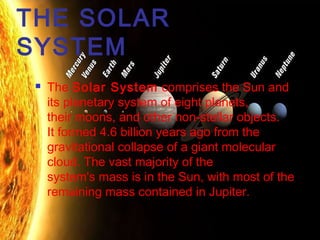
The Solar System comprises the Sun and
its planetary system of eight planets,
their moons, and other non-stellar objects.
It formed 4.6 billion years ago from the
gravitational collapse of a giant molecular
cloud. The vast majority of the
system's mass is in the Sun, with most of the
remaining mass contained in Jupiter.
Our Solar System
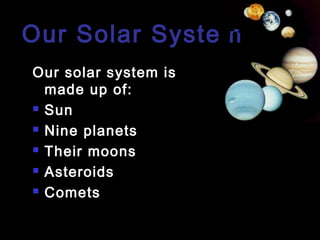
Our solar system is
made up of:
 Sun
 Nine planets
 Their moons
 Asteroids
 Comets
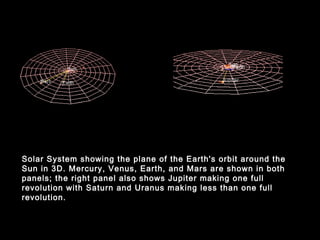
Solar System showing the plane of the Earth's orbit around the
Sun in 3D. Mercury, Venus, Earth, and Mars are shown in both
panels; the right panel also shows Jupiter making one full
revolution with Saturn and Uranus making less than one full
revolution.
Inner Planets
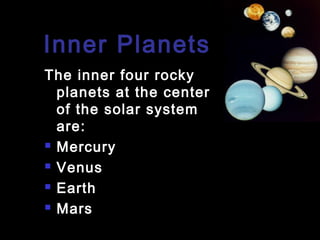
The inner four rocky
planets at the center
of the solar system
are:
 Mercury
 Venus
 Earth
 Mars
Mercury






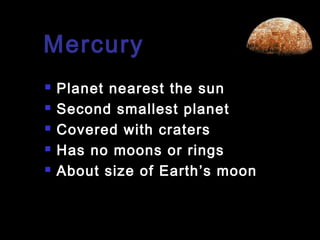
Planet nearest the sun
Second smallest planet
Covered with craters
Has no moons or rings
About size of Earth’s moon
Venus







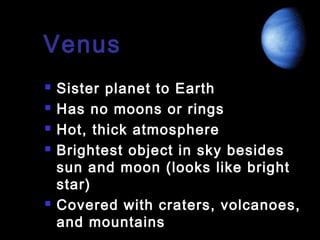
Sister planet to Earth
Has no moons or rings
Hot, thick atmosphere
Brightest object in sky besides
sun and moon (looks like bright
star)
Covered with craters, volcanoes,
and mountains
Earth





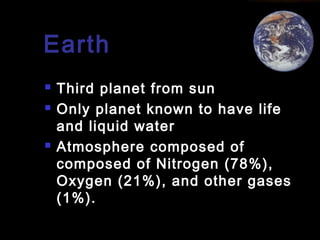
Third planet from sun
Only planet known to have life
and liquid water
Atmosphere composed of
composed of Nitrogen (78%),
Oxygen (21%), and other gases
(1%).
Mars







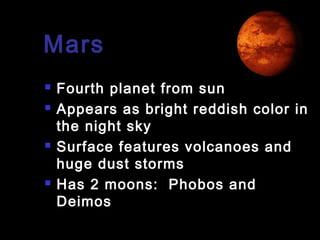
Fourth planet from sun
Appears as bright reddish color in
the night sky
Surface features volcanoes and
huge dust storms
Has 2 moons: Phobos and
Deimos
Outer Planets
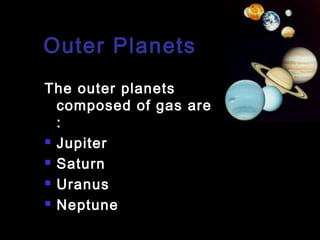
The outer planets
composed of gas are
:
 Jupiter
 Saturn
 Uranus
 Neptune
Jupiter









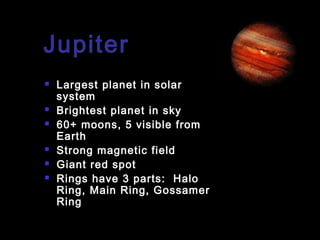
Largest planet in solar
system
Brightest planet in sky
60+ moons, 5 visible from
Earth
Strong magnetic field
Giant red spot
Rings have 3 parts: Halo
Ring, Main Ring, Gossamer
Ring
Saturn








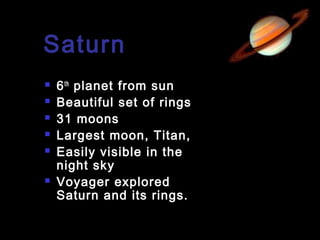
6 th planet from sun
Beautiful set of rings
31 moons
Largest moon, Titan,
Easily visible in the
night sky
Voyager explored
Saturn and its rings.
Uranus






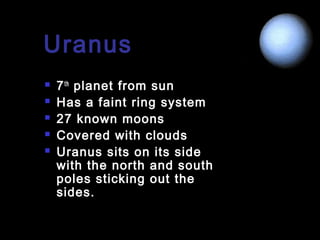
7 th planet from sun
Has a faint ring system
27 known moons
Covered with clouds
Uranus sits on its side
with the north and south
poles sticking out the
sides.
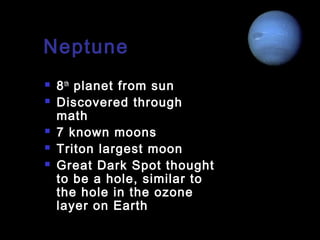
Neptune







8 th planet from sun
Discovered through
math
7 known moons
Triton largest moon
Great Dark Spot thought
to be a hole, similar to
the hole in the ozone
layer on Earth
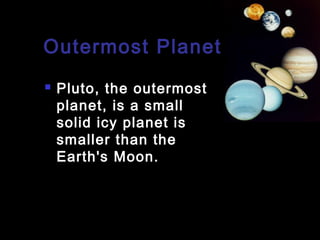
Outermost Planet


Pluto, the outermost
planet, is a small
solid icy planet is
smaller than the
Earth's Moon.
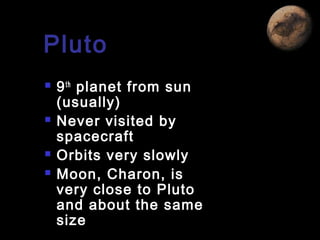
Pluto







9 th planet from sun
(usually)
Never visited by
spacecraft
Orbits very slowly
Moon, Charon, is
very close to Pluto
and about the same
size
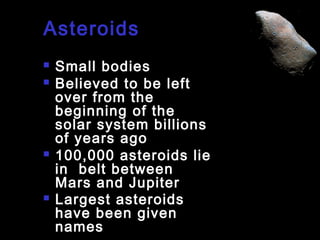
Asteroids







Small bodies
Believed to be left
over from the
beginning of the
solar system billions
of years ago
100,000 asteroids lie
in belt between
Mars and Jupiter
Largest asteroids
have been given
names
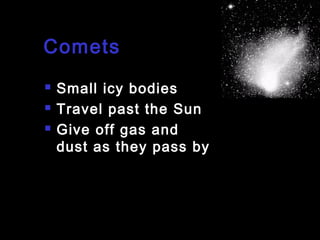
Comets




Small icy bodies
Travel past the Sun
Give off gas and
dust as they pass by
Solar System
Solar System

Solar System