1
Sociology
Chapter One The Nature of
Sociology
1.1 What is Sociology?
2
Sociology is the systematic study of social
behaviour and human groups. It focuses
primarily on the influence of social
relationships upon people’s attitudes
and behaviour and on how societies are
established and change. As a field of
study, sociology has an extremely broad
scope.
3
The Sociological Imagination
In attempting to understand social behaviour,
sociologists rely on an unusual type of creative
thinking.
4
C. Wright Mills (1959)
described such
thinking as the
Sociological
Imagination, an
awareness of the
relationship between
an individual and the
wider society.
5
This awareness allows people (not simply
sociologists) to comprehend the links
between their immediate, personal
social settings and the remote,
impersonal social world that surrounds
them and helps to shape them.
6
A key element in the sociological
imagination is the ability to view one’s
own society as an outsider would, rather
than from the limited perspective of
personal experiences and cultural biases.
7
Sociological imagination can bring new
understanding to daily life around us or
even to our view of the past. For
example, Claude Fischer (1988) studied
gender differences in telephone use
during the half century before World
War II and the social meanings of these
differences.
8
During the period of 1890-1940,
telephones became popular in middle-
class urban homes as well as on many
farms. Fischer observes that, in the
period under study, North American
women seemed to have a special
affinity for the household telephone and
that affinity seemed to involve sociability.
9
He offers a number of possible
explanations for this gender difference,
among them:
 Women, especially homemakers, were
typically more isolated from daily adult
contact than men were. Therefore
telephone calls allowed many women to
experience some of the social contact
that their husbands found in the work
place.
10
 Women’s traditional role as ‘social
managers’ for their families led to
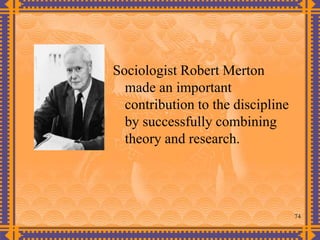
extensive telephone responsibilities in
service to the household, the extended
family, the friendship circle, and the
community.
11
Fischer concludes that, like the bicycle and
the automobile, the telephone served as
“technology of sociability” that allowed
women to increase their social interactions.
12
Sociology and the Social
Sciences
In a general sense, sociology can be
considered a science. The term “science”
refers to the body of knowledge obtained
by methods based upon systematic
observation.
13
Like other scientific disciplines, sociology
engages in organized, systematic study of
phenomena (in this case, human behaviour)
in order to enhance understanding.
14
All sciences attempt to collect precise
information through methods of study
which are as objective as possible. They
rely on careful recording of observations
and accumulation of data.
15
Social science is the study of various
aspects of human society. The social
sciences include sociology,
anthropology, economics, history,
psychology and political science. These
academic disciplines have a common
focus on the social behaviour of people,
yet each has a particular orientation in
studying such behaviour.
16
Sociology emphasizes the influence that
society has on people’s attitudes and
behaviour and the ways in which people
shape society. Humans are social
animals; therefore sociologists
scientifically examine our social
relationships with people.
17
1.2 Origins of Sociology
People have always been curious about
how we get along, what we do, and
whom we select as our leaders.
Philosophers and religious authorities
of ancient and medieval societies
made countless observations about
human behaviour.
18
These observations were not tested or
verified scientifically; nevertheless,
they often became the foundation of
moral codes.
19
Several of the early social philosophers
predicted that a systematic study of
human behaviour would one day
emerge. Beginning in the nineteenth
century, European theorists made
pioneering contributions to the
development of a science of human
behaviour.
20
Early Thinkers: Comte,
Martineau, and Spencer
In France, the nineteenth century
was an unsettling time for that
nation’s intellectuals. The French
monarchy had been deposed earlier
in the revolution of 1789, and
Napoleon had subsequently been
defeated in his effort to conquer
Europe.
21
Amidst this chaos, philosophers
considered how societies might be
improved. Auguste Comte (1798-
1857) , credited with being the most
influential of these philosophers of
the early 1800s, believed that a
theoretical science of society and
systematic investigation of
behaviour were needed to improve
society.
22
Comte coined the word “sociology” to
apply to the science of human
behaviour and insisted that
sociology could make a critical
contribution to a new and improved
human community.
23
Writing in the 1800s, Comte feared
that France’s stability had been
permanently impaired by the
excesses of the French Revolution.
Yet he hoped that the study of
social behaviour in a systematic
way would eventually lead to more
rational human interactions.
24
In Comte’s hierarchy of sciences, sociology
was at the top. He did not simply give its
name but also presented a rather
ambitious challenge to the fledgling
discipline.
25
Scholars were able to learn
of Comte’s works largely
through translations by
the English sociologist
Harriet Martineau (1802-
1876).
26
But Martineau was a path breaker in her
own right as a sociologist; she offered
insightful observations of the customs
and social practices of both her native
Britain and the United States.
27
Martineau’ s book “Society in America”
examines religion, politics, child
rearing, and immigration in the young
nation. Martineau gives special
attention to status distinctions and to
such factors as gender and race.
28
Another important contributor to the
discipline of sociology was Herbert
Spencer (1820-1903). Writing
from the vantage point of
relatively prosperous Victorian
England, Spencer did not feel
compelled to correct or improve
society; instead, he hoped to
describe it better.
29
Spencer was familiar with Comte’s
work but seemed more influenced
by Charles Darwin’s study “On the
Origin of Species”. Drawing on
Darwin’s insights, Spencer used the
concept of evolution of animals to
explain how societies change over
time.
30
Similarly, he adapted Darwin’s
evolutionary view of the “survival of
the fittest” by arguing that it is
“natural” that some people are rich
while others are poor.
31
Spencer’s approach to societal change
was extremely popular in his own
lifetime. Indeed, he dominated
scholarly thinking more than Comte
did. Unlike Comte, Spencer suggested
that societies are bound to change;
therefore, one need not be highly
critical of present social arrangements
or work actively for social change.
32
This viewpoint appealed to many
influential people in Great Britain and
the United States who had a vested
interest in the status quo and were
suspicious of social thinkers who
endorsed change.
33
Emile Durkheim
Emile Durkheim (1858-
1917) ’s important
theoretical work on
suicide was but one of his
many pioneering
contributions to sociology.
34
Durkheim will be remembered for his
insistence that behaviour cannot be fully
understood in individualistic terms, that it
must be understood within a larger social
context.
35
One of Durkheim’s main interests
was the consequences of work in
modern societies. In his view, the
growing division of labour found in
industrial societies as workers
became much more specialized in
their tasks led to what he called
anomie.
36
Anomie refers to a loss of direction that is
felt in a society when social control of
individual behaviour has become
ineffective.
37
The state of anomie occurs when people have
lost their sense of purpose or direction,
often during a time of profound social
change. In a period of anomie, people are
so confused and unable to cope with the
new social environment that they may
resort to taking their own lives.
38
Durkheim was concerned about the
dangers that such alienation,
loneliness, and isolation might pose
for modern industrial societies. He
shared Comte’s belief that sociology
should provide direction for social
change.
39
As a result, he advocated the creation
of new social groups—between the
individual’s family and the state—
which would ideally provide a sense
of belonging for members of huge,
impersonal societies.
40
Max Weber
Another important theorist who
contributed to the scientific study of
society was Max Weber. Born in
Germany in 1864, Weber took his early
academic training in legal and economic
history, but he gradually developed an
interest in sociology.
41
He pointed out that much of our social
behaviour cannot be analyzed by the
kinds of objective criteria we use to
measure weight or temperature. To fully
comprehend behaviour, we must learn
the subjective meanings people attach
to their actions—how they themselves
view and explain their behaviour.
42
For example, suppose that sociologists
were studying the social ranking of
individuals within an electricians’
union. Weber would expect
researchers to employ Verstehen in
order to determine the significance of
the union’s hierarchy for its members.
43
Sociologists would seek to learn how
these electricians relate to union
members of higher or lower status;
they might examine the effects of
seniority on standing within the union.
While investigating these questions,
researchers would take into account
people’s emotions, thoughts, beliefs,
and attitudes.
44
We also owe credit to Weber for a
key conceptual tool: the ideal type.
An ideal type is a construct, a
model that serves as a measuring
rod against which actual cases can
be evaluated. In his own works,
Weber identified various
characteristics of bureaucracy as
an ideal type.
45
In presenting this model of bureaucracy,
Weber was not describing any
particular business, nor was he using
the term ideal in a way that
suggested a positive evaluation.
Instead, his purpose was to provide a
useful standard for measuring how
bureaucratic an actual organization is.
46
Although their professional careers come at
the same time, Emile Durkheim and Max
Weber never met and probably were
unaware of each other’s existence, let
alone ideas. This was certainly not true of
the work of Karl Marx.
47
Durkheim’ s thinking about anomie was
related to Marx’s writings, while
Weber’s concern for a value-free,
objective sociology was a direct
response to Marx’s deeply held
convictions. Thus it is no surprise that
Karl Marx is viewed as a major figure in
the development of several social
sciences, among them sociology.
48
Karl Marx
Karl Marx (1818-1883)
shared with
Durkheim and Weber
a dual interest in
abstract philosophical
issues and in the
concrete reality of
everyday life.
49
Unlike the others, Marx was so
critical of existing institutions
that a conventional academic
career was impossible, and
although he was born and
educated in Germany, most of his
life was spent in exile.
50
Marx’s personal life was a difficult
struggle. When a paper that he had
written was suppressed, he fled his
native land and went to France. In
Paris, he met Friedrich Engels (1820-
1893), with whom he formed a
lifelong friendship.
51
They lived during a time when
European and North American
economic life was increasingly being
dominated by the factory rather
than the farm. In 1847, Marx and
Engels attended secret meetings in
London of an illegal coalition of
labour unions, the Communist
League.
52
The following year, they finished
preparing a platform called The
Communist Manifesto, in which they
agreed that the masses of people
who have no resources other than
their labour (whom they referred to
as the proletariat) should unite to
fight for the overthrow of capitalist
societies.
In the words of Marx and
Engels:
The history of all hitherto society
is the history of class
struggles…. The proletarians
have nothing to lose but their
chains. They have a world to
win. WORKING MEN OF ALL
COUNTRIES, UNITE!
54
After completing The Communist
Manifesto, Marx returned to Germany,
only to be expelled. He then moved to
England, where he continued to write
books and essays. Marx’s life there was
one of extreme poverty. He pawned
most of his possessions, and several of
his children died of malnutrition and
disease.
55
Marx clearly was an outsider in British
society, a fact which may well have
affected his view of western cultures.
Marx’s thinking was strongly influenced
by the work of a German philosopher,
Georg Hegel.
56
Hegel saw history as a dialectical process—
a series of clashes between conflicting
ideas and forces. At the end of each clash,
a new and improved set of ideas was
expected to emerge. In Hegel’s view,
conflict was an essential element in
progress.
57
In applying Hegel’s theories, Marx
focused on conflict between social
classes, as represented by industrial
workers and the owners of factories and
businesses. Under Marx’s analysis,
society was fundamentally divided
between classes who clash in pursuit of
their own class interests.
58
He argued that history could be understood
in dialectical terms as a record of the
inevitable conflicts between economic
groups. This view forms the basis for the
contemporary sociological perspective of
conflict theory.
59
When Marx examined the industrial
societies of his time, such as Germany,
England, and the United States, he saw
the factory as the centre of conflict
between the exploiters (the owners of
the means of production) and the
exploited (the workers).
60
Marx believed that an entire system of
economic, social and political relationships
had been established to maintain the power
and dominance of the owners over the
workers.
61
Consequently, Marx and Engels argued
that the working class needed to
overthrow the existing class system.
Marx’s writings inspired those who
were subsequently to lead communist
revolutions in Russia, China, Cuba,
Vietnam and elsewhere.
62
Even apart from the political revolutions that
his work helped to foster, Marx’s influence
on contemporary thinking has been
dramatic. Although he certainly did not
view himself as a sociologist, Marx
nevertheless made a critical contribution to
the development of sociology and other
social sciences.
63
Partly this reflected Marx’s emphasis on
carefully researching the actual, measurable
conditions of people’s lives, a practice
which foreshadowed the scientific nature of
today’s social sciences.
64
Twentieth-Century Sociology
Sociology, as we know it in the 20th
century, draws upon the firm
foundation developed by Emile
Durkheim, Max Weber, and Karl
Marx.
65
However, the discipline has certainly not
remained stagnant over the last century.
Sociologists have gained new insights
which have helped them to better
understand the workings of society.
66
Charles Horton Cooley (1864-1929) was
typical of the sociologists who became
prominent in the early 1900s. Cooley
shared the desire of Durkheim, Weber,
and Marx to learn more about society,
but preferred to use the sociological
perspective to look first at smaller units—
intimate face-to-face groups such as
families, gangs, and friendship networks.
67
He saw these groups as the seedbeds of
society in the sense that they shape
people’s ideals, beliefs, values and
social nature. Cooley’s work brought new
understanding to groups of relatively
small size.
68
Many of the leading American sociologists of
the early 1900s saw themselves as social
reformers dedicated to systematically
studying and then improving a corrupt
society.
69
They were genuinely concerned about the
lives of immigrants in the nation’s growing
cities, whether these immigrants came from
Europe or from the American south.
70
Early female sociologists, in particular,
were often active in poor urban areas
as leaders of community centres known
as settlement houses. For example,
Jane Addams (1860-1935), a member
of and speaker before the American
Sociological Society, cofounded the
famous Chicago settlement, Hull House.
71
Addams and other pioneering female
sociologists commonly combined
intellectual inquiry, social service work, and
political activism—all the goal of assisting
the underprivileged and creating a more
egalitarian society.
Egality, Fraternity, Liberty
72
By the middle of the twentieth
century, however, the focus of the
discipline has shifted. Sociologists
restricted themselves to theorizing
and gathering information, while
the aim of transforming society was
left to social workers and others.
73
This shift away from social reform was
accompanied by a growing commitment to
scientific methods of research and to value-
free interpretation of data.
74
Sociologist Robert Merton
made an important
contribution to the discipline
by successfully combining
theory and research.
75
Merton has produced a theory that is one of the
most frequently cited explanations of deviant
behaviour. He noted different ways in which
people attempt to achieve success in life. In
his view, some may not share the socially
agreed-upon goal of accumulating material
goods or the accepted means of achieving
this goal.
76
For example, in Merton’s
classification scheme, “innovators”
are people who accept the goal of
pursuing material wealth but use
illegal means to do so, including
robbery, burglary, and extortion.
77
Merton’s explanation of crime is based
on individual behaviour—influenced by
society’s approved goals and means—
yet it has wider applications. It helps
to account for the high crime rates
among the nation’s poor, who may see
no hope of advancing themselves
through traditional roads to success.
78
1.3 Perspectives of Sociology
Sociologists view society in different ways.
Some see the world basically as a stable
and ongoing entity. They are impressed
with the endurance of the family,
organized religion, and other social
institutions.
79
Some sociologists see society as
composed of many groups in
conflict, competing for scarce
resources. To other sociologists,
the most fascinating aspects of the
social world are the everyday,
routine interactions among
individuals that we sometimes take
for granted.
80
These differing perspectives of society
are all ways of examining the same
phenomena. Sociological imagination
may employ any of a number of
theoretical approaches in order to
study human behaviour.
81
From these approaches, sociologists
develop theories to explain specific types
of behaviour. The three perspectives
most widely used by sociologists are the
functionalist, conflict, and interactionist
perspectives.
82
Functionalist Perspective
In the view of functionalists, society is like a
living organism in which each part of the
organism contributes to its survival.
Therefore, the Functionalist Perspective
emphasizes the way that parts of a society
are structured to maintain its stability.
83
The work of Durkheim, Max Weber, and
other European sociologists greatly
influenced Talcott Parsons (1902-
1979), a Harvard University
sociologist. Unlike most of his
American contemporaries, Parsons
was anxious to study in Europe; he
went first to the London School of
Economics and then to the
University of Heidelberg.
84
For over four decades, Parsons
dominated American sociology with
his advocacy of functionalism. He
saw any society as a vast network
of connected parts, each of which
contributes to the maintenance of
the system as a whole.
85
Under the functionalist approach, if an
aspect of social life does not contribute to
society’s stability or survival—if it does not
serve some identifiable useful function or
promote value consensus among
members of a society—it will not be
passed on from one generation to the next.
86
Manifest and Latent Functions
A university catalog typically presents various
stated functions of the institution, e.g. to
offer each student a broad education in
classical and contemporary thoughts, in the
humanities, in the sciences, and in the arts.
87
However, it would be quite a surprise
if we came across a catalog which
declared: “This university was
founded in 1895 to keep people
between the ages of 18 and 22 out
of the job market, thus reducing
unemployment.”
88
No college catalog will declare that this is
the purpose of the university. Yet social
institutions serve many functions, some of
them quite subtle. The university, in fact,
does delay people’s entry into the job
market.
89
In order to better examine the functions of
institutions, Robert Merton made an
important distinction between manifest
and latent functions. Manifest functions
of institutions are open, stated,
conscious functions. They involve the
intended, recognized consequences of
an aspect of society.
90
By contrast, latent functions are
unconscious or covert functions and
may reflect hidden purposes of an
institution. One latent function of
universities is to serve as a meeting
ground for people seeking marital
partners.
91
Conflict Perspective
In contrast to functionalists’ emphasis
on stability and consensus, conflict
sociologists see the social world in
continual struggle. The conflict
perspective assumes that social
behaviour is best understood in terms
of conflict or tension among
competing groups.
92
Such conflict need not be violent; it can
take the form of labour negotiations,
party politics, competition among
religious groups for members, or
disputes over cuts in the federal budget.
93
As we saw earlier, Karl Marx viewed
struggle between social classes as
inevitable, given the exploitation of
workers under capitalism. Expanding on
Marx’s work, sociologists and other
social scientists have come to see
conflict not merely as a class
phenomenon but as a part of everyday
life in all societies.
94
Thus, in studying any culture,
organization, or social group,
sociologists want to know who
benefits, who suffers, and who
dominates at the expense of
others.
95
In studying such questions, conflict
theorists are interested in how society’s
institutions—including the family,
government, religion, education, and the
media—may help to maintain the
privileges of some groups and keep
others in a subservient position.
96
Although contemporary conflict theory
was clearly inspired by Karl Marx’s
analysis, there are important
differences between Marxist
theories and the conflict perspective.
97
Whereas Marx foretold an end to conflict
through the emergence of a classless
communist society, current conflict
theorists view conflict as unavoidable.
They are less likely to anticipate, much less
predict, that the social tensions arising from
inequality will be entirely resolved.
98
Moreover, while Marx viewed a total
restructuring of society as fundamentally
necessary to resolve social problems,
contemporary conflict theorists believe that
poverty, racism, sexism, inadequate
housing, and other problems can be
understood and attacked somewhat
independently.
99
Conflict theorists are primarily
concerned with the kinds of
changes that conflict can bring
about, whereas functionalists
look for stability and consensus.
100
The conflict model is viewed as more
“radical” and “activist” because of
its emphasis on social change and
redistribution of resources. On the
other hand, the functionalist
perspective, because of its focus
on the stability of society, is
generally seen as more
“conservative”.
101
Throughout most of the 1900s, American
sociology was more influenced by the
functionalist perspective. However, the
conflict approach has become increasingly
persuasive since the late 1960s.
102
The widespread social unrest resulting from
civil rights battles, urban riots, bitter
divisions over the war in Vietnam, the rise of
the feminist and gay liberation movements,
and the Watergate scandal offered support
for the conflict perspective.
103
Interactionist perspective
The functionalist and conflict perspectives
both attempt to explain societywide patterns
of behaviour. However, many contemporary
sociologists are more interested in
understanding society as a whole through
an examination of social interactions.
104
The interactionist perspective
generalizes about fundamental or
everyday forms of social interactions.
From these generalizations,
interactionists seek to explain human
behaviour.
105
George Herbert Mead (1863-1931) is widely
regarded as the founder of the interactionist
perspective. His sociological analysis, like
that of Charles Horton Cooley, often
focused on human interactions within one-
to-one situations and small groups.
106
Mead was interested in observing the most
minute forms of communication–smiles,
frowns, nodding of one’s head, and in
understanding how such individual
behaviour was influenced by the larger
context of a group or society.
107
Interactionists see symbols as an especially
important part of human communication. In
fact, the interactionist perspective is
sometimes referred to as the symbolic
interactionist perspective.
108
Interactionists realize the importance of non-
verbal communication as a form of human
behaviour. Indeed, in certain situations,
observing non-verbal communication can
be even more illustrating than listening to
verbal exchanges.
109
The Sociological Approach
Which perspective should a sociologist
use in studying human behaviour, the
functionalist, the conflict or the
interactionist?
All three, since each offers unique
insights into the same problem.
110
For example, in studying the continued
high levels of unemployment in the
United States, the functionalist might
wish to study how unemployment
reduces the demand for goods but
increases the need for public services,
thereby leading to new jobs in the
government sector.
111
The interactionist might encourage us to
focus on the impact of unemployment on
family life, as manifested in divorce,
domestic violence, and dependence on
drugs and alcohol.
112
Researchers with a conflict perspective
might draw our attention to the uneven
distribution of unemployment within the
labour force and how it is particularly
likely to affect women and racial and
ethnic minority—those groups least
likely to influence decision making about
economic and social policy.
113
Chapter Two
Methods of Sociological
Research
2.1 What is the Scientific Method?
114
The scientific method is a systematic,
organized series of steps that
ensures maximum objectivity and
consistency in researching a
problem.
A key element in the scientific
method is planning. When
sociologists wish to learn more
about human behaviour, they
make careful preparations before
carrying out their research.
115
There are five basic steps in the
scientific method that sociologists and
other researchers follow. These are:
 Defining the problem
 Reviewing the literature
 Formulating the hypothesis
 Selecting the research design and
then collecting and analyzing data
 Developing the conclusion
116
Defining the Problem
The first step in any sociological
research project is to state as
clearly as possible what you hope to
investigate.
117
Early in their research, sociologists face the
task of developing an operational definition
of each concept being studied. An
operational definition is an explanation of an
abstract concept that is specific enough to
allow a researcher to measure the concept.
118
For example, a sociologist interested in
status might use membership in
exclusive social clubs or professional
organizations as an operational
definition of high status. A sociologist
who intended to examine prejudice
might rely on responses to a series of
questions concerning willingness to hire
or work alongside members of racial
and ethnic minority groups.
119
Whenever researchers wish to study an
abstract concept--such as intelligence,
sexuality, prejudice, love, or liberalism—
they must develop workable and valid
operational definitions. Even when
studying a particular group of people, it is
necessary to decide how the group will
be distinguished.
120
Reviewing the Literature
By conducting a review of the
literature—the relevant scholarly
studies and information—
researchers refine the problem
under study, clarify possible
techniques to be used in collecting
data, and eliminate or reduce the
number of avoidable mistakes they
make.
121
Formulating the Hypothesis
A speculative statement about the
relationship between two or more
factors is called a hypothesis. It tells
us what we are looking for in our
research. A hypothesis must be
testable; that is, it must be capable
of being evaluated.
122
In formulating a hypothesis, we do not
imply that it is correct. We merely
suggest that it is worthy of study, that the
hypothesis should be scientifically tested
and confirmed, refuted or revised,
depending on the outcome of the study.
123
A hypothesis usually states how one
aspect of human behaviour influences
or affects another. These aspects or
factors are called variables. A variable is
a measurable trait or characteristic that
is subject to change under different
conditions. Income, religion, occupation,
and gender can all be variables in a
study.
124
In developing hypotheses, sociologists
attempt to explain or account for the
relationship between the two or more
variables. If one variable is hypothesized to
cause or influence another one, social
scientists call the first variable the
independent variable. The second is termed
the dependent variable because it is
believed to be influenced by the
independent variable.
125
Causal logic involves the relationship
between a condition or variable and a
particular consequence, with one event
leading to the other. For example,
parents who attend church regularly
are more likely to have children who
are regular churchgoers.
126
A correlation exists when a
change in one variable
coincides with a change in the
other. Correlations are an
indication that causality may be
present; they do not necessarily
indicate causation.
127
For example, data indicate that
working mothers are more likely to
have delinquent children than are
mothers who do not work outside
the home. This correlation is
actually caused by a third variable:
family income.
128
Lower-class households are more likely to
have a full-time working mother; at the
same time, delinquency rates are higher
in this class than in other economic
levels. Consequently, while having a
mother who works outside the home is
correlated with delinquency, it does not
cause delinquency.
129
Collecting and Analyzing Data
In order to test a hypothesis and
determine if it is supported or
refuted, researchers need to collect
information. To do so, they must
employ a research design that guides
them in collecting and analyzing data.
130
 Selecting the Sample
In most studies, social scientists must
carefully select what is known as a
sample. A representative sample is a
selection from a larger population that is
statistically found to be typical of that
population.
131
There are many kinds of samples, of
which the random sample is
frequently used by social scientists.
For a random sample, every
member of an entire population
being studied has the same chance
of being selected.
132
By using specialized sampling techniques,
sociologists do not need to question
everyone in a population. Thus, if
researchers wanted to examine the
opinions of persons listed in a city
directory(a book that lists all households),
they might call every tenth or fifteenth or
hundredth name listed. This would
constitute a random sample.
133
 Creating Scales and Indices
It is relatively simple to measure certain
characteristics statistically, such as level
of education, income, and size of
community. However, it is far more
difficult to measure attitudes and beliefs
such as patriotism, respect, and
tolerance.
134
Sociologists create scales in order to
assess aspects of social behaviour that
require judgments or subjective
evaluations. The scale and index are
indicators of attitudes, behaviour, and
characteristics of people or organizations.
A scale or index typically uses a
series of questions to measure
attitudes, knowledge of facts,
events, objects, or behaviour.
136
 Ensuring Validity and Reliability
The scientific method requires that
research results be both valid and
reliable. Validity refers to the degree to
which a measure or scale truly reflects
the phenomenon under study. Reliability
refers to the extent to which a measure
provides consistent results.
137
Developing the Conclusion
Scientific studies, including those
conducted by sociologists, do not aim
to answer all the questions that can
be raised about a particular subject.
138
Therefore, the conclusion of a
research represents both an end
and a beginning. It terminates a
specific phase of the
investigation, but it should also
generate ideas for future study.
139
 Confirming Hypotheses
Sociological studies do not always generate
data that confirm the original hypothesis. In
many instances, a hypothesis is refuted, and
researchers must reformulate their
conclusions. Unexpected results may also
lead sociologists to reexamine their
methodology and make changes in the
research design.
140
 Controlling for Other Factors
A control variable is a factor held constant
to test the relative impact of the
independent variable. Earlier we noted
that family income has an important
influence on the relationship between
mothers working outside the home and
the likelihood that their children will
come to be viewed as delinquents.
141
If researchers had not introduced the
control variable of “family income,”
they might have reached a misleading
conclusion concerning the effects of
mothers’ working outside the home.
142
2.2 Research Designs for
Collecting Data
An important aspect of sociological research
is deciding how data should be collected. A
research design is a detailed plan or method
for obtaining data scientifically.
143
Selection of a research design is a critical step
for sociologists and requires creativity and
ingenuity. This choice will directly influence
both the cost of the project and the amount
of time needed to collect the results of the
research.
144
Sociologists regularly use experiments,
participant observations, surveys, and
unobtrusive techniques to generate
data for their research.
145
 Experiments
When sociologists want to study a
possible cause-and-effect
relationship, they may conduct
experiments. An experiment is an
artificially created situation which
allows the researcher to manipulate
variables and introduce control
variables.
146
In the classic method of conducting an
experiment, two groups of people are
selected and compared for similar
characteristics such as age or education.
The subjects are then assigned to one of
two groups—the experimental or control
group.
147
The experimental group is exposed to an
independent variable; the control group is
not. Thus, if scientists were testing a new
type of antibiotic drug, they would
administer injections of that drug to an
experimental group but not to a control
group.
148
 Participant Observation
Participant observation is a research
technique in which an investigator
collects information through direct
participation in and observation of a
group, tribe, or community under
study.
149
This method allows sociologists to
examine certain behaviours and
communities that could not be
investigated through other research
techniques. In some cases, the
sociologist actually “joins” a group for a
period of time to get an accurate sense
of how it operates.
150
The first challenge a participant observer
encounters is to gain acceptance into an
unfamiliar group. It requires a great deal of
patience and an accepting, nonthreatening
type of person.
151
Observation research poses other
complex challenges for the investigator.
Sociologists must be able to understand
what they are observing. They must
learn to see the world as the group sees
it in order to fully comprehend the
events taking place around them.
152
This raises a delicate question regarding the
effect of the group on the observer—and
the observer on the group. Sociologists
must retain a certain level of detachment
from the group under study, even as (s)he
tries to understand how members feel.
If the research is to be successful,
the observer cannot allow the
close associations or even
friendships that inevitably
develop to influence the
conclusions of the study.
154
In using participant-observation studies,
sociologists are well aware that the
presence of such an observer may affect the
behaviour of the people being studied.
155
The recognition of this phenomenon
grew out of research conducted
during the 1920s and 1930s at the
Hawthorne plant of the Western
Electric Company.
hawthorn
156
A group of researchers headed by Elton
Mayo set out to determine how the
productivity of workers at this plant could
be improved. Investigators examined the
impact of variations in the intensity of light
and variations in working hours on
productivity.
157
To their surprise, even measures that seemed
likely to have the opposite effect, such as
reducing the amount of lighting in the plant,
led to higher productivity.
158
Why did the plant’s employees work
harder even under less favourable
conditions? Apparently their behaviour
was influenced by the greater
attention being paid to workers in the
course of the research.
159
Since that time, sociologists have used the
term Hawthorne effect when subjects of
research perform in a manner different from
their typical behaviour because they realize
that they are under observation.
160
 Surveys
Almost all of us have responded to
surveys of one kind or another. We
may have been asked what we think
of internet or TV and radio
programmes.
http://www.youtube.com/watch?v=kRSDJWrUMxs
161
A survey is a study, generally in the form of an
interview or questionnaire, which provides
sociologists with information concerning how
people think and act.
162
An interviewer can obtain a high
response rate because people find it
more difficult to turn down a personal
request for an interview than to throw
away a written questionnaire. In
addition, a skillful interviewer can go
beyond written questions and “probe”
for a subject’s underlying feelings and
reasons.
163
On the other hand, questionnaires have the
advantage of being cheaper, especially
when large samples are used. Also, since
the questions are written, the researcher
knows that there are some guarantee of
consistency, whereas five interviewers
can ask the same question in five
different ways.
164
 Unobtrusive Measures
Unobtrusive measures include a variety
of research techniques that have no
impact on who or what is being
studied. These are designed as
nonreactive, since people’s
behaviour is not influenced.
165
Whereas subjects of an experiment are
often aware that they are being watched,
this is not the case when unobtrusive
measures are used. Consequently,
sociologists can avoid the Hawthorne
effect by employing unobtrusive methods.
166
One basic technique of unobtrusive
measurement is the use of statistics.
Census data, budgets of public agencies,
and other archival data are all readily
available to sociologists and other social
scientists. However, researchers may not
find what they need in data collected by
someone else.
167
Many social scientists find it useful to
study cultural, economic, and political
documents, including newspapers,
periodicals, radio and television tapes,
scripts, diaries, songs, folklore, and
legal papers, to name a few examples.
In examining these resources,
researchers employ a technique known
as content analysis.
168
Content analysis is the systematic coding
and objective recording of data, guided
by some rationale. It is typically viewed
as useful in studying print media such
as newspapers, magazines, and books.
It can also be used to study the content
of movies, television programmes, and
videos.
169
Unobtrusive measures are valuable as a
supplement to other research methods.
For example, one investigator wished to
examine the relationship between
reported and actual beer consumption.
He obtained a “front door” measure of
consumption by asking residents of
houses how much beer they drank each
week.
170
At the same time, a “back door” measure
was developed by counting the number of
beer cans in their garbage. This back door
measure produced a considerably higher
estimate of beer consumption.
171
It is important to realize that research designs
need not be viewed as mutually exclusive.
As was illustrated in the previous example,
two or more methods used together may be
especially informative.
172
Moreover, researchers do not need to
devise a totally new research design in all
cases. The term replication refers to the
repetition of a given investigation in
substantially the same way it was
originally conducted, either by the original
scientist or by other scientists.
173
2.3 Ethics of Research
Sociologists abide by a code of ethics in
conducting research. The American
Sociological Association puts forth the
following basic principles:
174
1 Maintain objectivity and integrity in
research.
2 Respect the subject’s right to privacy and
dignity.
3 Protect subjects from personal harm.
4 Preserve confidentiality.
175
5 Acknowledge research collaboration
and assistance.
6 Disclose all sources of financial
support.
On the surface, the basic principles seem
quite clear-cut, however, many
delicate ethical questions cannot be
resolved simply by reading the six
points above.
176
A Case Study of Ethical Controversy
Most sociological research uses people
as sources of information—as
respondents to survey questions,
participants in experiments, or
subjects of observation.
177
In all cases, sociologists need to be certain
that they are not invading the privacy of
their subjects. Generally this is handled by
assuring those involved of anonymity and
by guaranteeing that personal information
disclosed will remain confidential.
178
However, a study by Laud Humphreys raised
important questions about the extent to
which sociologists could threaten people’s
right to privacy.
179
 Tearoom trade
Sociologist Laud Humphreys published a
pioneering and controversial study of
homosexual behaviour in which he
described the casual homosexual
encounters between males meeting in
public restrooms in parks.
180
As one consequence of this provocative
research, the chancellor of the university
where Humphreys was employed
terminated his research grant and teaching
contract.
181
In order to study the lifestyle of homosexual
males in tearooms, Humphreys acted as a
participant observer by serving as a
“lookout,” warning patrons when police or
other strangers approached.
182
While he was primarily interested in the
behaviour of these men, Humphreys also
wanted to learn more about who they were
and why they took such risks.
183
Yet how could he obtain such information?
Secrecy and silence were the norms of
this sexual environment. Most of the men
under study were unaware of Humphreys’
identity and would not have consented to
standard sociological interviews.
184
As a result, Humphreys decided on a
research technique that some social
scientists later saw as a violation of
professional ethics. He recorded the
license plate numbers of tearoom patrons,
waited a year, changed his appearance,
and then interviewed them in their homes.
185
The interviews were conducted as part of
a larger survey, but they did provide
information that Humphreys felt
necessary for his work. While
Humphreys’ subjects consented to be
interviewed, their agreement fell short of
informed consent, since they were
unaware of the true purpose of the
study.
186
Although Humphreys recognized each of the
men interviewed from his observations in
the restrooms, there was no indication that
they recognized him.
187
Humphreys learned that most of his
subjects were in their middle thirties and
married. They had an average of two
children and tended to have at least
some years of college education. Family
members appeared to be unaware of
the men’s visits to park restrooms for
casual homosexual encounters.
188
Even before the public outcry over his
research began, Humphreys was aware
of the ethical questions that his study
would raise. He exerted great care in
maintaining the confidentiality of his
subjects. Their real identities were
recorded only on a master list kept in a
safe-deposit box. The list was destroyed
by Humphreys after the research was
conducted.
189
For social scientists, the ethical problem in
this research was not Humphreys’s
choice of subject matter, but rather the
deception involved. Patrons of the
tearoom were not aware of Humphreys’s
purposes and were further misled about
the real reasons for the household
interviews.
190
However, in the researcher’s judgement,
the value of his study justified the
questionable means involved. Humphreys
believed that without the follow-up
interviews, we would know little about the
kinds of men who engage in tearoom sex
and would be left with false stereotypes.
191
In addition, Humphreys believed that by
describing such sexual interactions
accurately, he would be able to dispel the
myth that child molestation is a frequent
practice in restrooms.
192
One unintended consequence of the
research was that it has been
increasingly cited by attorneys seeking
acquittal for clients arrested in public
bathrooms. These lawyers have used the
study to establish that such behaviour is
not unusual and typically involves
consenting adults.
193
In reflecting on the study, we are left with
a conflict between the right to know and
the right to privacy. There is no easy
resolution of this clash of principles. Yet
we can certainly ask that sociologists be
fully aware of the ethical implications of
any such research techniques.
194
Neutrality and Politics in Research
The ethical considerations of sociologists
lie not only in the methods used, but in
the way that results are interpreted.
195
Max Weber recognized that sociologists
would be influenced by their own
personal values in selecting questions
for research. In his view, that was
perfectly acceptable, but under no
conditions could a researcher allow his
or her personal feelings to influence the
interpretation of data.
196
In Weber’s phrase, sociologists must
practice value neutrality in their
research. As part of this neutrality,
investigators have an ethical obligation
to accept research findings even when
the data run counter to their own
personal views, to theoretically based
explanations, or to widely accepted
beliefs.
197
Durkheim countered popular conceptions
when he reported that social (rather
than supernatural) forces were an
important factor in suicide. Similarly,
Humphreys challenged traditional
American suspicions when he found
that users of tearooms were not preying
on heterosexual adolescents or younger
boys.
198
Some sociologists believe that it is
impossible for scholars to prevent their
personal values from influencing their
work. As a result, Weber’s call for a
value-free sociology has been criticized
on the grounds that it leads the public to
accept sociological conclusions without
exploring the biases of the researchers.
199
The issue of value neutrality becomes
especially delicate when one considers
the relationship of sociology to
government. Max Weber urged that
sociology remain an autonomous
discipline and not become unduly
influenced by any one segment of society.
200
According to his ideal of value neutrality,
sociologists must remain free to reveal
information that is embarrassing to
government, or, for that matter, supportive of
existing institutions.
201
Thus researchers investigating a prison riot
must be ready to examine objectively not
only the behaviour of inmates but also the
conduct of prison officials before and during
the outbreak.
202
This may be more difficult if sociologists
fear that findings critical of
governmental institutions will jeopardize
their chances of getting federal support
for new research projects. The
importance of government funding for
sociological studies raises troubling
questions for those who cherish
Weber’s ideal of value neutrality in
research.
203
Chapter Three Culture
3.1 Culture and Society
Culture is a totality of learned, socially
transmitted behaviour. It includes the
ideas, values, and customs of groups of
people.
204
Sometimes people refer to a particular
person as “very cultured” or to a city
having “lots of culture.” That use of the
term culture is different from our use
here. In sociological terms, culture does
not refer solely to the fine arts and
refined intellectual taste. It consists of
all objects and ideas within a society.
205
Sociologists consider both a portrait by
Rembrandt and a portrait by a billboard
painter to be aspects of a culture. A tribe
that cultivates soil by hand has just as
much of a culture as a people that relies
on diesel-operated machinery.
206
Thus, each people has a distinctive culture
with its own characteristic ways of gathering
and preparing food, constructing homes,
and promoting standards of right and wrong.
207
Sharing a similar culture helps to define the
group to which we belong. A fairly large
number of people are said to constitute a
society when they live in the same territory,
are relatively independent of people
outside their area, and participate in a
common culture.
208
A society is the largest form of human group.
It consists of people who share a common
heritage, which sociologists refer to as a
culture. Members of the society learn this
culture and transmit it from one generation
to the next.
209
3.2 Development of Culture
The first archeological evidence of
humanlike primates places our
ancestors back many millions of years.
From 35,000 years ago we have
evidence of paintings, jewelry, and
statues. By that time, elaborate
ceremonies have already been
developed for marriages, births, and
deaths.
210
 Cultural Universals
In meeting basic human needs, all societies
have developed aspects of shared,
learned behaviour known as cultural
universals.
211
Anthropologist George Murdock compiled
a list of such universals which includes
athletic sports, attempts to influence
weather, bodily adornment, calendar,
cooking, courtship, dancing, decorative
art, dream interpretation, family, folklore,
food habits, food taboos, funeral
ceremonies, games, gestures,
http://www.youtube.com/watch?v=YQnUjnUg_1
8
212
gift giving, hairstyles, housing, language,
laws, marriage, medicine, music, myths,
numerals, personal names, property rights,
religion, sexual restrictions, surgery,
toolmaking, trade, and visiting.
213
Although the cultural practices may be
universal, the manner in which they are
expressed will vary from culture to
culture. The expression of cultural
universals within a society may also
change dramatically over time. Each
generation, and each year, most human
cultures change and expand through
the process of innovation and diffusion.
I
n
n
o
v
a
t
i
o
n
The process of introducing an idea
or subject that is new to culture
is known as innovation. There
are two forms of innovation:
discovery and invention.
215
A discovery involves making known or sharing
the existence of an aspect of reality. By
contrast, an invention results when existing
cultural items are combined into a form that
did not exist before.
216
Diffusion
Sociologists use the term diffusion to refer to
the process by which a cultural item is
spread from group to group or society to
society.
217
Diffusion can occur through a variety of
means, among them exploration, military
conquest, missionary work, the influence of
the mass media, and tourism.
218
Sociologist William F. Ogburn made a useful
distinction between elements of material
and nonmaterial culture. Material culture
refers to the physical or technological
aspects of our daily lives, including food
items, houses, factories, and raw materials.
219
Nonmaterial culture refers to ways of using
material objects and to customs, beliefs,
philosophies, governments, and patterns
of communication. Generally the
nonmaterial culture is more resistant to
change than material culture is.
220
Therefore, as we have seen, foreign ideas
are viewed as more threatening to a
culture than foreign products are. We are
more willing to use technological
innovations that make our lives easier than
we are ideologies that change our way of
seeing the world.
221
3.3 Elements of Culture
 Language
Language is the foundation of every culture,
though particular languages differ in striking
ways.
222
Language is an abstract system of word
meanings and symbols for all aspects of
culture. It includes speech, written
characters, numerals, symbols, and
gestures of nonverbal communication.
In contrast to some other element of
culture, language permeates all parts of
society.
223
Certain cultural skills such as cooking or
carpentry, can be learned without the use
of language through the process of
imitation. However, it is impossible to
transmit complex legal and religious
systems to the next generation by
watching to see how they are performed.
224
While language is a cultural universal,
differences in the use of language are
evident around the world. This is the case
even when two countries use the same
spoken language.
225
Sapir-Whorf Hypothesis
Language does more than simply
describe reality; it also serves to
shape the reality of a culture. The
role of language in interpreting the
world for us has been advanced in
the Sapir-Whorf hypothesis, which
is named for two linguists.
226
According to Sapir and Whorf, since people
can conceptualize the world only through
language, language precedes thought. Thus
the word symbols and grammar of a
language organize the world for us.
227
The Sapir-Whorf hypothesis also holds that
language is not a “given.” Rather, it is
culturally determined and leads to different
interpretations of reality by focusing our
attention on certain phenomena.
228
However, many social scientists challenge
the Sapir-Whorf hypothesis and argue
that language does not determine
human thought and behaviour patterns.
As a result, the hypothesis has been
moderated somewhat to suggest that
language may influence behaviour and
interpretations of social reality.
229
Language is of interest to all three
sociological perspectives. Functionalists
emphasize the important role of language
in unifying members of a society. By
contrast, conflict theorists focus on the
use of language to perpetuate divisions
between groups and societies.
230
Interactionists study how people rely on
shared definitions of phrases and
expressions in both formal speech and
everyday conversation.
231
Language can shape how we see, taste,
smell, feel, and hear. It also influences
the way we think about the people, ideas,
and objects around us. It is for these
reasons that introduction of new
languages into a society is such a
sensitive issue in many parts of the world.
232
Norms
All societies have ways of
encouraging and enforcing what
they view as appropriate behaviour
while discouraging and punishing
what they consider to be improper
conduct. Norms are established
standards of behaviour maintained
by a society.
233
Sociologists distinguish between norms in
two ways. First, norms are classified as
either formal or informal. Formal norms
have generally been written down and
involve strict rules for punishment of
violators. Laws are an example of formal
norms.
234
Informal norms are generally understood but
are not precisely recorded. Standards of
proper dress are a common example of
informal norms.
235
Sanctions
What happens when people violate a
widely shared and understood
norm? They will receive sanctions.
Sanctions are penalties and
rewards for conduct concerning a
social norm.
236
Conformity to a norm can lead to positive
sanctions such as a pay rise, a medal, or a
word of gratitude. Negative sanctions
include fines, threats, imprisonment, or
stares of contempt.
237
Implicit in the application of sanctions is the
detection of norm violation or obedience. A
person cannot be penalized or rewarded
unless someone with the power to provide
sanctions is aware of the person’s actions.
238
The entire fabric of norms and sanctions in a
culture reflects that culture’s values and
priorities. The most cherished values will
be most heavily sanctioned; matters
regarded as less critical, on the other hand,
will carry light and informal sanctions.
239
 Values
Each individual develops his or her own
personal goals and ambitions, yet
culture provides a general set of
objectives for members. Values are
these collective conceptions of what is
considered good, desirable, and
proper—or bad, undesirable, and
improper—in a culture.
240
Values influence people’s behaviour and serve
as criteria for evaluating the actions of
others. There is often a direct relationship
between the values, norms, and sanctions
of a culture.
241
For example, if a culture highly values the
institution of marriage, it may have norms
(and strict sanctions) which prohibit the act
of adultery. If a culture views private
property as a basic value, it will probably
have laws against theft and vandalism.
242
3.4 Cultural Integration
The values and norms of every culture
sometimes conflict with each other. Cultural
integration refers to the bringing together of
conflicting cultural elements, resulting in a
harmonious and cohesive whole.
243
Traditionally, the Lapp people of Finland
used the dogsled as a basic vehicle for
transportation as well as a means of
hunting and herding deer. However, in the
early 1960s, snowmobiles became
integrated into Lapp culture and to some
extent, reshaped the culture.
244
These machines were not useful in
hunting, but they were used to haul
goods and escort tourists through the
countryside.
This change in one element of material
culture—the introduction of new
technology—has had far-reaching
consequences on both material and
nonmaterial culture.
245
New lines of work have emerged because of
the need for fuel, for spare parts, and for
mechanical servicing. The Lapps have
quickly become more dependent on their
neighbours and the outside world.
246
While the Lapps have successfully integrated
the snowmobile into the rest of their culture,
it has nevertheless transformed their culture
in certain ways.
247
Social rank has become more important
among the Lapps than it was in the
days when almost everyone owned
reindeer herds of approximately equal
size. The need to buy and maintain
snowmobiles has caused some poor
families to lose most of their herds and
turn to government assistance.
248
At the same time, those with greater
wealth or mechanical ability have been
able to keep their machines operating
efficiently and to substantially enlarge
their herds. Thus, while the coming of
snowmobile has brought Lapps together
and into the larger social world, it has
simultaneously created new social
boundaries within the Lapp culture.
249
Cultural integration is not always the result
of agreement by all members of a culture.
Often this process is enforced from the top;
less powerful members of society have
little choice but to accept the dictates and
values of those in control.
250
Conflict theorists emphasize that while cultural
integration may exist in certain societies, the
norms and values perpetuated are those
favourable to the elite and the powerful.
251
3.5 Cultural Variation
Each culture has a unique character.
Cultures adapt to meet specific sets
of circumstances, such as climate,
level of technology, population, and
geography. This adaptation is evident
in differences in all elements of
culture, including norms, sanctions,
values, and language.
252
Thus, despite the presence of cultural
universals such as courtship and
religion, there is still great diversity
among the world’s many cultures.
Moreover, even within a single nation,
certain segments of the populace will
develop cultural patterns which differ
from those of the dominant society.
253
 Aspects of Cultural Variation
Subcultures
A subculture is a segment of society
which shares a distinctive pattern of
values which differ from the pattern of
the larger society.
254
The existence of many subcultures is
characteristic of complex societies.
Conflict theorists argue that subcultures
often emerge because the dominant
society has unsuccessfully attempted to
suppress a practice regarded as
improper, such as use of illegal drugs.
255
Members of a subculture participate in the
dominant culture, while at the same time
engaging in unique and distinctive forms of
behaviour. Frequently, a subculture will
develop an argot, or specialized language,
which distinguishes it from the wider
society.
256
Argot allows “insiders,” the members of the
subculture, to understand words with special
meanings. It also establishes patterns of
communication which cannot be understood
by “outsiders.”
257
Sociologists associated with the
interactionist perspective emphasize
that language and symbols offer a
powerful way for a subculture to
maintain its identity. The particular argot
of a given subculture, therefore,
provides a feeling of cohesion for
members and contributes to the
development of a group identity.
258
Often a subculture emerges because a
segment of society faces problems or
even privileges unique to its position.
Subcultures may be based on common
age, region, shared interest, ethnic
heritage, beliefs, or occupations.
259
Generally, members of a subculture are
viewed as outsiders or deviants, though
individuals may move from the subculture to
the larger culture and back again.
260
Countercultures
Some subcultures conspicuously
challenge the central norms and values
of the prevailing culture. A
counterculture is a subculture that
rejects societal norms and values and
seeks alternative lifestyles.
Countercultures are typically popular
among the young who have the least
investment in the existing culture.
261
Culture shock
All of us, to some extent, take for granted
the cultural practices of our society. As a
result, it can be surprising and
disturbing to realize that other cultures
do not follow our way of life. Customs
that seem strange to us are considered
normal and proper in other cultures,
which may see our customs as odd.
262
We can experience culture shock in our own
society. A conservative churchgoing older
person might feel bewildered or horrified at
a punk rock concert.
http://www.youtube.com/watch?v=fqscuZ0_3SU
263
People experience anxiety when they
leave a familiar culture for an “alien”
environment. When you are in a new
and puzzling society, you can never be
sure how others will react to your
actions. It is genuinely shocking to lose
one’s cultural bearings, though such an
experience can educate us by clarifying
our unquestioned assumptions.
264
 Attitudes toward Cultural Variation
Ethnocentrism
Many everyday statements reflect our
attitude that our culture is best.
Sociologist William Graham Sumner
coined the term ethnocentrism to refer to
the tendency to assume that one’s
culture and way of life are superior to all
others.
265
The ethnocentric person sees his or her
own group as the centre or defining
point of culture and views all other
cultures as deviations from what is
“normal.” As one manifestation of
ethnocentrism, map exercises reveal
that students in many nations draw
maps in which their homelands are in
the centre of the world.
266
The conflict approach to social behaviour
points out that the ethnocentric value
judgements serve to devalue groups and
contribute to denial of equal opportunities.
267
Functionalists note that ethnocentrism
serves to maintain a sense of solidarity
by promoting group pride. Yet this type
of social stability is established at the
expense of other peoples. Denigrating
other nations and cultures can enhance
our own patriotic feelings and belief that
our way of life is superior.
268
Cultural Relativism
It is not necessary to view all cultural
variations with an assumption that
one’s own culture is more humane,
more “civilized,” and more advanced
than others. While ethnocentrism
evaluates foreign cultures using the
familiar culture of the observer as a
standard of correct behaviour, cultural
relativism views people’s behaviour
from the perspective of their own
culture.
269
It places a priority on understanding other
cultures, rather than dismissing them as
“strange” or ”exotic.” Unlike ethnocentrism,
cultural relativism employs the kind of
value neutrality in scientific study that Max
Weber saw as so important.
270
Cultural relativism stresses that different
social contexts give rise to different norms
and values. Practices such as polygamy,
bullfighting, and monarchy are examined
within the particular contexts of the
cultures in which they are found.
271
While cultural relativism does not suggest
that we must unquestionably accept every
form of behaviour characteristic of a
culture, it does require a serious and
unbiased effort to evaluate norms, values,
and customs in light of the distinctive
culture of which they are a part.
272
There is an interesting extension of cultural
relativism, referred to as xenocentrism.
Xenocentrism is the belief that the
products, styles, or ideas of one’s society
are inferior to those that originate
elsewhere. In a sense, it is a reverse
ethnocentrism.
273
For example, people in the United States
often assume that French fashions or
Japanese electronic devices are superior
to their own. Some companies have
responded by creating products that sound
European like Haagen-Daz ice-cream or
Nike shoes.
274
Conflict theorists are most likely to be
troubled by the economic impact of
xenocentrism in the developing world.
Consumers in developing nations
frequently turn their backs on locally
produced goods and instead purchase
items imported from Europe or North
America.
275
3.6 Culture and Sociological
Perspectives
As is readily apparent, sociologists regard
culture as a highly significant concept,
since it embraces all learned and shared
behaviour. Nevertheless, there are
important differences in the ways in which
functionalists and conflict theorists view
culture.
276
Functionalists emphasize the role of
language in unifying members of a
society while conflict theorists focus on
the use of language to perpetuate
divisions between groups and societies.
Similarly, functionalists stress that
cultural integration reflects agreement
among members of a society; conflict
theorists counter that the norms and
values perpetuated are those
favourable to the elites and the powerful.
277
Both sociological perspectives agree that
culture and society are in harmony with
each other, but for different reasons.
Functionalists maintain that stability
requires a consensus and the support of
society’s members; consequently, there
are strong central values and common
norms.
278
This view of culture became popular in
sociology beginning in the 1950’s,
having been borrowed from British
anthropologists who saw cultural traits
as all working toward stabilizing a
culture. From a functionalist perspective,
a cultural trait or practice will persist if it
performs functions that society seems
to need or contributes to overall social
stability and consensus.
279
The term “dominant ideology” is used to
describe a set of cultural beliefs and
practices that help to maintain powerful
social, economic, and political interests.
In Karl Marx’s view, a capitalist society
has a dominant ideology which serves the
interests of the ruling class.
280
From a conflict perspective, the social
significance of the dominant ideology is
that a society’s most powerful groups and
institutions not only control wealth and
property; even more important, they
control the means of producing beliefs
about reality through religion, education,
and the media.
281
Functionalist and conflict theorists agree
that variation exists within a culture.
Functionalists view subcultures as
variations of particular social
environments and as evidence that
differences can exist within a common
culture. However, conflict theorists
suggest that variation often reflects the
inequality of social arrangements within
a society.
282
Chapter Four
Socialization
Socialization is the process
whereby people learn the
attitudes, values, and actions
appropriate to individuals as
members of a particular culture.
283
Socialization occurs through human interactions.
We learn a great deal from those people most
important in our lives—immediate family
members, best friends, and teachers. We also
learn from people we see on the street, on
television, and in films and magazines.
http://www.youtube.com/watch?v=d7VfTtsnh44
284
Socialization helps us to discover how to
behave ”properly” and what to expect from
others if we follow (or challenge) society’s
norms and values. It provides for the
passing on of a culture and thereby for the
long-term continuance of a society.
285
4.1 The Role of Socialization
Researchers have traditionally clashed over
the relative importance of biological
inheritance and environmental factors in
human development. This conflict has
been called the nature versus nurture (or
heredity versus environment) debate.
286
Today, most social scientists have
moved beyond this debate,
acknowledging instead the interaction
of these variables in shaping human
development.
287
 Sociobiology
There has been renewed interest in
sociobiology in recent years.
Sociobiology is the systematic study of
the biological bases of social behaviour.
288
Sociobiologists apply naturalist Charles
Darwin’s principles of natural selection to
the study of social behaviour. They
assume that particular forms of behaviour
become genetically linked to a species if
they contribute to its fitness to survive.
289
Sociobiology does not seek to describe
individual behaviour but focus on how
human nature is affected by the genetic
composition of a group of people who share
certain characteristics.
290
In general, sociobiologists have stressed the
basic genetic heritage that is shared by all
humans and have shown little interest in
speculating about alleged differences
between racial groups or nationalities.
291
4.2 The Self and Socialization
We all have various perceptions, feelings, and
beliefs about who we are and what we are
like. How do we come to develop these? Do
they change as we age?
292
Building on the work of George Herbert
Mead, sociobiologists recognize that we
create our own designation: the self.
The self represents the sum total of
people’s conscious perception of their
own identity as distinct from others. It is
not a static phenomenon, but continues
to develop and change throughout our
lives.
293
Sociologists and psychologists alike have
expressed interest in how the individual
develops and modifies a sense of self
because of social interaction. The work
of sociologists Charles Horton Cooley
and George Herbert Mead has been
especially useful in furthering our
understanding of these important issues.
294
 Sociological Approaches to the Self
Cooley: Looking-Glass Self In the early
1900’s, Charles Horton Cooley advanced
the belief that we learn who we are by
interacting with others. Our view of
ourselves, then, comes not only from
direct contemplation of our personal
qualities, but also from our impressions
of how others perceive us.
295
Mead: Stages of the Self George Herbert
Mead developed a useful model of the
process by which the self emerges, defined
by three distinct stages.
296
During the preparatory stage, children
merely imitate the people around them,
especially family members with whom they
continually interact. As they grow older,
children become more adept at using
symbols to communicate with others.
297
Symbols are gestures, objects, and
language which form the basis of human
communication. By interacting with
relatives and friends, as well as by
watching cartoons on TV and reading
picture books, children begin to
understand the use of symbols.
298
Like spoken languages, symbols vary from
culture to culture and between subcultures.
As part of the socialization process, children
learn the symbols of their particular culture.
299
During the play stage, children become able
to imitate the actions of others. Mead
noted that an important aspect of play
stage is role taking. Role taking is the
process of mentally assuming the
perspective of another, thereby enabling
one to respond from that imagined
viewpoint.
300
In Mead’s third stage, the game stage,
children of about 8 or 9 years old begin to
consider several tasks and relationships
simultaneously. At this point in
development, children grasp not only their
own social positions, but also those of
others around them.
301
Mead uses the term “generalized others” to
refer to children’s awareness of the
attitudes, viewpoints, and expectations of
society as a whole. Simply put, this
concept suggests that when an individual
acts, (s)he takes into account an entire
group of people.
302
According to Mead, the self begins as a
privileged, central position in a person’s
world. Young children picture themselves
as the focus of everything around them
and find it difficult to consider the
perspective of others.
303
As people mature, the self changes and
begins to reflect greater concern about
the reaction of others. Parents, friends,
coworkers, coaches, and teachers are
often among those who play a major
role in shaping a person’s self. Mead
uses the term “significant others” to
refer to those individuals who are most
important in the development of the self.
304
4.3 Socialization and the Life Cycle
 Stages of Socialization
The socialization process continues throughout
all stages of the human life cycle. Many
societies have definite rites of passages that
validate changes in a person’s life.
305
 Anticipatory Socialization and
Resocialization
The development of a social self is literally a
lifelong transformation. Two types of
socialization occur at many points
throughout the life cycle: anticipatory
socialization and resocialization.
306
Preparation for many parts of adult life
begins with anticipatory socialization
during childhood and adolescence and
continues throughout our lives as we
prepare for new responsibilities.
Anticipatory socialization refers to the
processes of socialization in which a
person “rehearses” for future positions,
occupations and social relationships.
307
Occasionally, as we assume new social
and occupational positions, we find it
necessary to unlearn our previous
orientation. Resocialization refers to the
process of discarding former behaviour
patterns and accepting new ones as
part of a transition in one’s life. Such
resocialization occurs throughout the
human life cycle.
308
4.4 Agents of Socialization
The lifelong socialization process involves
many different social forces which
influence our lives and alter our self-
images. The family, the school, the peer
group, the mass media, the workplace,
and the state are important agents of
socialization.
309
Family
The family is the institution most closely
associated with the process of
socialization. Obviously, one of its
primary functions is the care and rearing
of children. We experience socialization
first as babies and infants living in
families; it is here that we develop an
initial sense of self.
310
Most parents seek to help their children
become competent adolescents and
self-sufficient adults, which means
socializing them into the norms and
values of both the family and the larger
society. In this process, adults
themselves experience socialization as
they adjust to becoming spouses,
parents, and in-laws.
311
The lifelong process of learning begins
shortly after birth. Since newborns can
hear, see, smell, taste and feel heat, cold,
and pain, they orient themselves to the
surrounding world. Human beings,
especially family members, constitute an
important part of the social environment of
the newborn.
312
As noted earlier, children function within the
family as agents of socialization
themselves. The term “reverse
socialization” refers to the process
whereby people normally being socialized
are at the same time socializing their
socializers.
313
For example, young people may affect the
way their parents dress, eat and even
think. Anthropologist Margaret Mead has
suggested that reverse socialization is
greatest in societies undergoing rapid
social change; in such societies, the
young socialize the old to new customs
and values.
314
 Schools
Schools have an explicit mandate to
socialize people, especially children, into
the norms and values of our culture.
315
Functionalists point out that, as agents of
socialization, schools fulfill the function of
teaching recruits the values and customs
of the larger society. Conflict theorists
concur with this observation, but add that
schools can reinforce the divisive aspects
of society, especially those of social class.
316
For example, American higher education
is quite costly despite the existence of
financial aid programs. Students from
affluent backgrounds thus have an
advantage in gaining access to
universities and professional training. At
the same time, less affluent young
people may never qualify for our
society’s best-paying and most
prestigious jobs.
317
• Peer Group
As a child grows older, the family
becomes somewhat less important
in his or her social development.
Instead, peer groups increasingly
assume the role of significant
others.
318
Within the peer group, young people
associate with others who are
approximately their own age and who
often enjoy a similar social status. Peer
groups assist adolescents in gaining some
degree of independence from parents and
other authority figures.
319
Teenagers imitate their friends in part
because the peer group maintains a
meaningful system of rewards and
punishments. The group may encourage a
young person to follow pursuits that
society considers admirable or to violate
the culture’s norms and values.
320
Peer groups serve a valuable function by
assisting the transition to adult
responsibilities. At home, parents tend
to dominate; at school, the teenager
must contend with teachers and
administrators. But, within the peer
group, each member can assert himself
or herself in a way that may not be
possible elsewhere.
321
 Mass Media
In the past century, such technological
innovations as radio, motion pictures,
recorded music, and television have
become important agents of socialization.
322
Relative to other agents of socialization
discussed earlier, television has certain
distinctive characteristics. It permits
imitation and role playing but does not
encourage more complex forms of
learning. Sociologists have expressed
concern about the insidious influence of
television in encouraging children to
forsake human interaction for passive
viewing.
323
Even critics of the medium generally
concede that television is not always a
negative socializing influence. Creative
programming such as Sesame Street
can assist children in developing basic
skills for schooling. In addition,
television programmes and even
commercials expose young people to
lifestyles and cultures of which they are
unaware.
324
It is important to note that similar concerns
have been raised regarding the content of
popular music (especially rock music and
“rap”), music videos, and motion pictures.
These forms of entertainment, like
television, serve as powerful agents of
socialization for young people.
325
There has been continuing controversy
about the content of music, music
videos, and films—sometimes leading
to celebrated court battles—as certain
parents’ organizations and religious
groups challenge the intrusion of these
media into the lives of children and
adolescents. These controversies have
often raised the danger of censorship.
326
 Workplace
A fundamental aspect of human
socialization involves learning to
behave appropriately within an
occupation.
327
Occupational socialization cannot be
separated from socialization
experiences that occurred during
childhood and adolescence. We are
most fully exposed to occupational roles
through observing the work of our
parents, of people whom we meet while
they are performing their duties, and of
people portrayed in the media.
328
These observations, along with the subtle
messages we receive within a culture, help
to shape—and often limit—the type of work
we may consider.
329
Wilbert Moore has divided occupational
socialization into four phases. The first
phase is career choice, which involves
selection of academic or vocational
training appropriate for the desired job.
The next phase is anticipatory
socialization, which may last a few
months or extend for a period of years.
330
The third phase—conditioning and
commitment—occurs while one actually
occupies the work-related role.
Conditioning consists of reluctantly
adjusting to the more unpleasant
aspects of one’s job. Most people find
that the novelty of a new daily schedule
quickly wears off and then realize that
parts of the work experience are rather
tedious.
331
Moore uses the term “commitment” to refer to
the enthusiastic acceptance of pleasurable
duties that comes as the recruit identifies
the positive tasks of an occupation.
332
In Moore’s view, if a job proves to be
satisfactory, the person will enter a fourth
stage of socialization, which he calls
continuous commitment. At this point, the
job becomes an indistinguishable part of
a person’s self-identity. Violation of proper
conduct becomes unthinkable.
333
Occupational socialization can be most
intense immediately after one makes
the transition from school to the job, but
it continues through one’s work history.
Technological advances may alter the
position and necessitate some degree
of resocialization. In addition, many
people change occupations, employers,
or places of work during their adult
years.
334
 The State
Social scientists have increasingly
recognized the importance of the state as
an agent of socialization because of its
growing impact on the life cycle.
335
Traditionally, family members have served
as the primary caregivers, but in the 20th
century the family’s protective function has
steadily been transferred to outside
agencies such as hospitals, mental health
clinics, and insurance companies.
336
The state has had a noteworthy impact on
the life cycle by reinstituting the rites of
passage that had disappeared in
agricultural societies and in periods of
early industrialization. For example,
government regulations stipulate the
ages at which a person may drive a car,
drink alcohol, vote in elections, marry
without parental permission, work
overtime, and retire.
337
These regulations do not constitute strict rites
of passage, still, by regulating the life cycle
to some degree, the state shapes the
socialization process by influencing our
views of appropriate behaviour at particular
ages.
338
Chapter Five Social
Interaction
5.1 Face, Body, and Speech in Interaction
5.2 Interaction in Time and Space
5.3 Impact of Electronic Interaction on
Everyday Social Life
5.4 Linking Microsociology and
Macrosociology
339
5.1 Face, Body, and Speech in
Interaction
Face, body, and speech are used in
combination to convey certain meanings
and to hide others. Mostly without realizing
it, each of us keep a tight and continuous
control over facial expression, bodily
posture and movement in the course of
our daily interaction with others.
340
Sociologists like to distinguish between
ascribed status and achieved status. An
ascribed status is one “assigned” to you
on the basis of biological factors such
as race, sex or age. Thus your ascribed
status could be “white”, “female” and
“teenager”. An achieved status is one
that is earned through an individual’s
own effort. Your achieved status could
be “graduate”, “athlete” or “employee”.
341
While we may like to believe that it is our
achieved statuses that are the most
important, society may not agree. In any
society, some statuses have priority over
all other statuses and generally determine
a person’s overall position in society.
Sociologists refer to this as a master
status.
342
The most common master statuses are those
based on gender and race. Sociologists
have shown that in an encounter, one of the
first things that people notice about one
another is gender and race.
343
There are cultural differences in the
definition of personal space. In Western
culture, people usually maintain a distance
of at least three feet when talking to
strangers; in the Middle East, however,
people stand within one and half feet from
each other.
344
5.2 Interaction in Time and
Space
Understanding how activities are distributed
in time and space is fundamental to
analyzing encounters, and also to
understanding social life in general.
345
All interaction is situated—it occurs in a
particular place and has a specific
duration in time. Our actions over the
course of a day tend to be “zoned” in
time as well as in space. Thus, for
example, most people spend a zone –
say, from 9 am to 5 pm – of their daily
time working. Their weekly time is also
zoned: they are likely to work on
weekdays and spend weekends at
home.
346
As we move through the temporal zones
of the day, we are also often moving
across space: to get to work, we may
take a bus from one area of a city to
another, or perhaps commute in from
the suburbs. When we analyze the
contexts of social interaction, therefore,
it is often useful to look at people’s
movements, and to recognize this time-
space convergence.
347
In modern societies, the zoning of our
activities is strongly influenced by clock time.
Without clocks and the precise timing of
activities, and thereby their coordination
across space, industrialized societies could
not exist.
http://www.youtube.com/watch?v=NgiAeyHj-00
348
The measuring of time by clocks is today
standardized across the globe, making
possible the complex international
transport systems and communications
we now depend on. For any organization
or business, the more people and
resources involved, the more precise the
scheduling must be.
349
5.3 Impact of Electronic Interaction
on Everyday Social Life
The internet provides another example of
how closely forms of social life are bound
up with our control of space and time. New
forms of technology have made it possible
for us to interact with people we never see
or meet.
350
Such technological change has
rearranged space – we can interact with
anyone without moving from our chair. It
is also altering our experience of time,
because communication is almost
immediate. We are so used to being
able to switch on the TV and watch the
news or make a phone call or send an
email message to a friend that it is hard
to imagine what life would be like
otherwise.
351
How far can electronic communication
substitute for face-to-face interaction?
There is little question that new media
forms are revolutionizing the way
people communicate, but even at times
when it is more expedient to interact
indirectly, humans still value direct
contact – possibly even more highly
than before.
352
An explanation for this is what has been
called the compulsion of proximity, the
tendency to want to meet in person
whenever possible. Situations of co-
presence supply much richer
information about how other people
think and feel, and about their sincerity,
than indirect forms of communication.
353
Only by actually being in the presence of
people who make decisions affecting us
in important ways do we feel able to
learn what is going on, and confident
that we can get across our own views
and convince them of our own sincerity.
Co-presence effects access to the body
part that never lies, the eyes.
354
5.4 Linking Microsociology
and Macrosociology
The study of face-to-face interaction is
usually called Microsociology – which is
contrasted to Macrosociology, which
studies large groups, institutions and
social systems. Micro and macro analysis
are in fact very closely related, and each
complements the other.
355
Macro analysis is essential if we are to
understand the institutional background
of daily life. Micro studies are in their
turn necessary for illuminating broad
institutional patterns. Interaction in
micro contexts affects larger social
processes and macro systems influence
more confined settings of social life.
356
Chapter Six Deviance and
Social Control
6.1 Social Control
Every culture, subculture, and group has
distinctive norms governing what it deems
appropriate behaviour.
357
Laws, dress codes, bylaws of
organizations, course requirements, and
rules of sports and games all express
social norms. Functionalists contend
that people must respect such norms if
any group or society is to survive. In
their view, societies literally could not
function if massive numbers of people
defied standards of appropriate conduct.
358
By contrast, conflict theorists are concerned
that “successful functioning” of a society will
consistently benefit the powerful and work to
the disadvantage of other groups.
359
How does a society bring about acceptance of
basic norms? The term “social control”
refers to the techniques and strategies for
regulating human behaviour in any society.
Social control occurs on all levels of society.
360
In the family, we are socialized to obey
our parents simply because they are our
parents. In peer groups, we are
introduced to informal norms such as
dress codes that govern the behaviour
of members. In bureaucratic
organizations, workers must cope with a
formal system of rules and regulations.
Finally, the government of every society
legislates and enforces social norms.
361
 Conformity and Obedience
Techniques for social control can be viewed
on both the group level and the societal
level. People whom we regard as our peers
or as our equals influence us to act in
particular ways; the same is true of people
who hold authority over us or occupy
positions which we view with some awe.
362
Stanley Milgram made a useful distinction
between these two important levels of
social control. Milgram defined
conformity as going along with one’s
peers—individuals of a person’s own
status, who have no special right to
direct that person’s behaviour. By
contrast, obedience is defined as
compliance with higher authorities in a
hierarchical structure.
363
Milgram pointed out that in the modern
industrial world we are accustomed to
submitting to impersonal authority
figures whose status is indicated by a
title (professor, lieutenant, doctor) or by
a uniform. The authority is viewed as
larger and more important than the
individual; consequently, the obedient
individual shifts responsibility for his or
her behaviour to the authority figure.
364
 Informal and Formal Social Control
The sanctions used to encourage
conformity and discourage violation of
social norms are carried out through
informal and formal social control.
365
Informal social control is used by people
casually. Norms are enforced through the
use of the informal sanctions. Examples of
informal social control include smile,
laughter, raising of an eyebrow, and ridicule.
366
Techniques of informal control are
typically employed within primary
groups such as families. Individuals
learn such techniques early in their
childhood socialization to cultural norms.
Since these mechanisms of social
control are not formalized, there can be
great variation in their use even within
the same society.
367
Formal social control is carried out by
authorized agents, such as police
officers, physicians, school
administrators, employers, military
officers, and managers of movie
theatres. It can serve as a last resort
when socialization and informal
sanctions do not bring about desired
behaviour.
368
It is important to emphasize that formal
social control is not always carried out by
government officials in response to
violations of the law. Certain subcultures
within a society exercise formal social
control to maintain adherence to their
distinctive social norms.
369
 Law and Society
Some norms are considered so important by a
society that they are formalized into laws
controlling people’s behaviour. In a political
sense, law is the body of rules made by
government for society, interpreted by the
courts, and backed by the power of the state.
370
Sociologists have become increasingly
interested in the creation of laws as a
social process. Laws are created in
response to perceived needs for formal
social control. Sociologists have sought to
explain how and why such perceptions are
manifested.
371
In their view, law is not merely a static body
of rules handed down from generation to
generation. Rather, it reflects continually
changing standards of what is right and
wrong, of how violations are to be
determined, and of what sanctions are to
be applied.
372
It is important to underscore the fact that
socialization is the primary source of
conforming and obedient behaviour,
including obedience to law. Generally, it
is not external pressure from a peer
group or authority figure that makes us
go along with social norms. Rather, we
have internalized such norms as valid
and desirable and are committed to
observing them.
373
6.2 Deviance
Deviance is behaviour that violates the
standards of conduct or expectations of a
group or society. It is a comprehensive
concept that includes not only criminal
behaviour but also many actions not subject
to prosecution.
374
 Explaining Deviance
Early explanations for deviance identified
supernatural causes or genetic factors. By
the 1800s, there were substantial research
efforts to identify biological factors that
lead to deviance and especially to criminal
activity.
375
While such research has been discredited in
the 20th century, contemporary studies,
primarily by biochemists, have sought to
isolate genetic factors leading to a
likelihood of certain personality traits that
might lead to crime, such as aggression.
376
According to functionalists, deviance is a
normal part of human existence, with
positive (as well as negative) consequences
for social stability. Deviance helps to define
the limits of proper behaviour.
377
The theory of cultural transmission draws
upon the interactionist perspective to
explain how a given person comes to
commit a deviant act. There is no natural,
innate manner in which people interact
with one another. Rather, humans learn
how to behave in social situations.
378
Sociologist Edwin Sutherland advanced
the argument that an individual
undergoes the same basic socialization
process whether learning conforming or
deviant acts. Criminal behaviour is
learned through interactions with others.
Such learning includes not only
techniques of lawbreaking but also the
motives, drives, and rationalizations of
criminals.
379
Reflecting the contribution of interactionist
theorists, labelling theory emphasizes
how a person comes to be labelled as
deviant or to accept that label. Labelling
theory is also called the societal-
reaction approach, reminding us that it
is the response to an act and not the
behaviour that determines deviance.
380
Traditionally, research on deviance has
focused on those individuals who violate
social norms. In contrast, labelling theory
focuses on police, probation officers,
psychiatrists, judges, teachers, employers,
school officials, and other regulators of
social control.
381
These agents play a significant role in
creating the deviant identity by
designating certain persons (and not
others) as” deviant ”. An important aspect
of labelling theory is the recognition that
some individuals or groups have the
power to define labels and apply them to
others.
382
Why is certain behaviour evaluated as deviant
while other behaviour is not? According to
conflict theorists, it is because people with
power protect their own interests and define
deviance to suit their own needs.
383
This helps to explain why there are laws
against gambling, drug usage and
prostitution which are violated on a
massive scale. According to the conflict
school, criminal law does not represent a
consistent application of societal values,
but instead reflects competing values and
interests.
384
The perspective advanced by labelling
and conflict theorists forms quite a
contrast to the functionalist approach to
deviance. Functionalists view standards
of deviant behaviour as merely
reflecting cultural norms, whereas
conflict and labelling theorists point out
that the most powerful groups in a
society can shape laws and standards
and determine who is (or is not)
prosecuted as a criminal.
385
6.3 Crime
Crime is a violation of criminal law for which
formal penalties are applied by some
governmental authority.
386
Crimes are divided by law into various
categories, depending on the severity of the
offense, the age of the offender, the
potential punishment that can be levied, and
the court which holds jurisdiction over the
case.
387
Types of Crime
Sociologists classify crimes in terms of
how they are committed and how the
offenses are viewed by society. Four
types of crime are differentiated:
professional crime, organized crime,
white-collar crime, and “victimless
crime.”
388
A professional criminal is a person who
pursues crime as a day-to-day occupation,
developing skilled techniques and
enjoying a certain degree of status
among other criminals. Such persons can
reduce the likelihood of arrest, conviction,
and imprisonment through their skill.
389
Learning technical skills is an important
aspect of working as a professional
criminal. It is a norm among
professional criminals that the chief
areas for the exchange of criminal skills
are the streets and prisons. Although
such skills are not systematically taught
in either place, they are nonetheless
communicated effectively.
390
Organized crime is the work of a group
that regulates relations between various
criminal enterprises involved in
smuggling and sale of drugs,
prostitution, gambling, and other
activities. Organized crime dominates
the world of illegal business just as
large corporations dominate the
conventional business world.
391
White-collar crime refers to crime committed
by affluent, “respectable” people in the
course of their daily business activities.
More recently, the term has been
broadened to include offenses by
businesses and corporations as well as by
individuals.
392
A wide variety of offenses are now classified
as white-collar crimes, such as income tax
evasion, stock manipulation, consumer
fraud, bribery and extraction of “kickbacks,”
embezzlement, and misrepresentation in
advertizing.
393
The criminal justice system largely disregards
white-collar crimes. If a person hold a
position of status and influence, his or her
crime is treated as less serious and the
sanction is much more lenient.
394
Sociologists use the term victimless crime
to describe the willing exchange among
adults of widely desired, but illegal,
goods and services. Gambling,
prostitution, public drunkenness, and
use of marijuana are viewed as
victimless crimes by some people. But
others insist that such offenses do harm
innocent victims.
395
Chapter Seven Gender
Inequality
7.1 Forms of Gender Inequality
7.2 Analyzing Gender Inequality
396
Sociologists use the term sex to refer to
the anatomical and physiological
differences that define male and female
bodies. Gender, by contrast, concerns
the psychological, social and cultural
differences between males and females.
The distinction between sex and gender
is a fundamental one, since many
differences between males and females
are not biological in origin.
397
In almost all human societies, men and
women have been treated differently,
with men usually being labeled as the
higher being and women being
discriminated against. The difference in
status, power and prestige men and
women have in groups, collectivities
and societies is called gender inequality.
398
7.1 Forms of Gender Inequality
 Gender and health
Disparities in health between men and women
have been noted in research. On the whole,
women enjoy a longer life expectancy than
men. At the same time women also suffer
from a higher incidence of illness than men do.
399
While it is possible that biological factors
contribute to certain health discrepancies,
it is unlikely that they can explain the full
range of differences. Rather, it is likely that
health patterns between men and women
are caused by social factors and differing
material conditions.
400
Men’s work patterns and overall lifestyles
may be more risky than women’s, helping
to explain the higher mortality rates from
violence and accidents. Women on the
whole are more economically
disadvantaged than men and suffer more
from the effects of poverty.
401
 Gender and social mobility
Women today are experiencing much greater
opportunity than before. Their confidence
and sense of self-esteem are also
heightened. Women’s chances of entering a
good career are improving, but two major
obstacles remain.
402
Male managers and employers still
discriminate against female applicants.
Having children has a substantial effect
on the career chances of women. This
is less because they are uninterested in
a career than because they are often
effectively forced to choose between
advancement at work and having
children.
403
 Gender and organizations
Until recently organizational studies have
not devoted much attention to the
question of gender. The rise of feminist
scholarship in the 1970s led to
examinations of gender relations in all
the main institutions in society.
404
Feminists argue that the emergence of the
modern organization and the bureaucratic
career was dependent on a particular
gender configuration. Women entered
occupations that were low-paying and
involved routine work.
405
As more women have entered
professional occupations in recent
decades, many scholars are starting to
assess the impact of women leaders
and managers on the organizations in
which they work. One of the questions
is whether women managers are
making a difference in their
organizations by introducing a female
style of management.
406
All organizations are confronted with the
need to become more flexible, efficient
and competitive in today’s global
economy. Rather than relying on top-
down rigid management styles,
organizations are encouraged to adopt
policies which ensure employee
commitment, collective enthusiasm for
organizational goals, shared
responsibility and a focus on people.
407
Communication, consensus and teamwork
are cited by management theorists as key
approaches which will distinguish
successful organizations in the new global
age. These so-called soft management
skills are ones traditionally associated with
women.
408
Gender and work
Women workers have traditionally been
concentrated in poorly paid, routine
occupations. Many of these jobs are
highly gendered. Secretarial and
caring jobs are commonly seen as
feminine occupations.
409
Although there has been a sizable increase in
the number of women entering professional
and managerial positions, many more of
them work in the low-paying service sector.
410
 Gender and education
School textbooks often help to perpetuate
gender images. Story books in primary
schools often portray boys as showing
initiative and independence, while girls
are more passive and watch their
brothers. Stories written especially for
girls often have an element of adventure
in them, but this usually takes the form of
intrigues or mysteries in a domestic or
school setting.
411
Girls are often regarded as better
organized and more motivated than
boys; they are also seen as maturing
earlier. Girls are less likely than boys to
choose subjects in school leading to
careers in technology, science and
engineering. In subjects such as
chemistry and computer science, which
are central to economic growth in the
present economy, boys continue to
dominate.
412
Although women may be entering higher
education in greater numbers, they continue
to be disadvantaged in the job market in
comparison with men who hold the same
levels of qualification.
413
 Gender and religion
Churches and denominations are religious
organizations with defined systems of
authority. In these hierarchies, women are
mostly excluded from power.
414
The Christian religion is a resolutely male
affair in its symbolism as well as its
hierarchy. While Mary, the mother of Jesus,
may sometimes be treated as if she had
divine qualities, God is the Father, a male
figure, and Jesus took the human shape of
a man.
415
Woman is portrayed as created from a rib
taken from man. There are many female
characters in the biblical texts, and some
are portrayed as acting charitably or bravely,
but the prime parts are reserved for males.
416
Some of the major Christian churches are
among the most conservative
organizations in modern societies.
Women ministers have long been
accepted in some sects and
denominations, but the Catholic church
has persisted in formally supporting
inequalities of gender.
417
Church teachings encourage women to recall
their traditional roles as wives and mothers,
while policies prohibiting abortion and the
use of contraception place further limitations
on women’s freedom.
418
7.2 Analyzing Gender Inequality
The feminist movement has given rise to a
large body of theory which attempts to
explain gender inequalities and set forth
agendas for overcoming those inequalities.
419
Some feminists believe that men are
responsible for and benefit from the
exploitation of women. Men exploit
women by relying on the free domestic
labour that women provide in the home.
As a group, men also deny women
access to positions of power and
influence in society.
420
Male violence against women is central to
male supremacy. Domestic violence, rape
and sexual harassment are all part of the
systematic oppression of women, rather
than isolated cases with their own
psychological or criminal roots.
421
Popular conceptions of beauty and
sexuality are imposed by men on
women in order to produce a certain
type of femininity. For example, social
and cultural norms emphasizing a slim
body and a caring, nurturing attitude
towards men help to perpetuate
women’s subordination. The
objectification of women through the
media, fashion and advertising turns
women into sexual objects whose main
role is to please men.
422
Feminists have focused their energies on
establishing and protecting equal
opportunities for women through legislation
and other means which has contributed
greatly to the advancement of women over
the past century.
423
Chapter Eight The Family and
Intimate Relationships
A family can be defined as a set of people
related by blood, marriage, or adoption who
share the primary responsibility for
reproduction and caring for members of
society.
424
8.1 The Family: Universal but
Varied
The family as a social institution is present in all
cultures. Although the organization of the
family can vary greatly, there are certain general
principles concerning its composition, descent
patterns, residence patterns, and authority
patterns.
425
Composition: What Is the Family?
A family made up of a married
couple and their unmarried
children living together is called
nuclear family. A family in which
relatives in addition to parents and
children—such as grandparents,
aunts, or uncles—live in the same
home is known as an extended
family.
426
The structure of the extended family
offers certain advantages over that of
the nuclear family. Crises such as death,
divorce, and illness involve less strain
for family members, since there are
more people who can provide
assistance and emotional support. In
addition, the extended family constitutes
a larger economic unit than the nuclear
family.
427
The term monogamy describes a form of
marriage in which one woman and one
man are married only to each other. The
form of marriage that allows an individual
to have several husbands or wives
simultaneously is known as polygamy.
428
There are two basic types of polygamy.
Polygyny refers to the marriage of a man
to more than one women at the same time.
Polyandry, under which a woman can
have several husbands at the same time,
tends to be exceedingly rare.
429
Authority Patterns: Who Rules?
Imagine that you have recently married
and must begin to make decisions
about the future of your new family.
Each time a decision must be made, an
issue is raised: “Who has the power to
make the decision?” In simple terms,
who rules the family?
430
From a conflict perspective, these questions
must be examined in light of traditional
gender stratification, under which men have
held a dominant position over women.
431
If a society expects males to dominate in
all family decision making, it is termed a
patriarchy. Frequently, in patriarchal
societies, the eldest male wields the
greatest power. Women hold low status
in such societies. By contrast, in a
matriarchy, women have greater
authority than men.
432
Some marital relationships may be neither
male- dominated nor female- dominated.
The third type of authority pattern, the
egalitarian family, is one in which spouses
are regarded as equals. In the view of
many sociologists, the egalitarian family
has begun to replace the patriarchal
family as the social norm.
433
8.2 Functions of the Family
Do we really need the family? Over a
century ago, Friedrich Engels, a colleague
of Karl Marx, described the family as the
ultimate source of social inequality
because of its role in the transfer of power,
property, and privilege.
434
In order to evaluate such issues, it is helpful
to use the tools provided by the
functionalist perspective, which
encourages us to examine the ways in
which an institution gratifies the needs of
its members and contributes to the stability
of society.
435
The family fulfills a number of functions,
six of which were outlined by
sociologist William F. Ogburn.
1. Reproduction.
2. Protection. In all cultures, The family
assumes ultimate responsibility for the
protection and upbringing of children.
436
3. Socialization. Parents and other kin
monitor a child’s behaviour and transmit
the norms, values, and language of a
culture to the child.
4. Regulation of sexual behaviour. Sexual
norms are subject to change over time
and across cultures. However,
standards of sexual behaviour are most
clearly defined within the family circle.
437
5. Affection and companionship. Ideally, the
family provides members with warm and
intimate relationships and helps them feel
safe and secure. We expect our relatives
to understand us, to care for us, and to be
there for us when we need them.
438
6. Providing of social status. We inherit a
social position because of the “family
background” and reputation of our
parents and siblings. The family unit
presents the newborn child with an
ascribed status of race and ethnicity
that helps to determine his or her place
within a society’s stratification.
439
8.3 Marriage and Family
Theories of Mate Selection
Many societies have explicit or unstated
rules which define potential mates as
socially acceptable.
440
These norms can be distinguished in
terms of endogamy and exogamy.
Endogamy specifies the groups within
which a spouse must be found and
prohibits marriage with others.
Endogamy is intended to reinforce the
cohesiveness of the group by
suggesting to the young that they
should marry someone “of our own kind.”
441
By contrast, exogamy requires mate
selection outside certain groups, usually
one’s own family or certain kinfolk. The
incest taboo, a social norm common to
virtually all societies, prohibits sexual
relationships between certain culturally
specified relatives.
442
Mate selection has been likened to a
filtering process. We select a future
spouse by passing him or her through a
series of filters. Rules of endogamy and
exogamy initially define the field of
eligible candidates. Proximity or
propinquity—that is, nearness to a
person—narrows the field even more.
The end result of this filtering process
maybe marriage or cohabitation outside
of marriage.
443
 Family Patterns
One of the most dramatic trends in recent
years has been the tremendous
increase in male-female couples who
choose to live together without marrying,
thereby engaging in what is commonly
called cohabitation.
444
The dramatic rise in cohabitation has
been linked to greater acceptance of
premarital sex and delayed entry into
marriage. One report notes that in
Sweden it is almost universal for
couples to live together before marriage.
Demographers in Denmark call the
practice of living together marriage
without papers.
445
 Remaining Single
The trend toward maintaining an
unmarried lifestyle is related to the
growing economic independence of
young people. This is especially
significant for women. From a
financial point of view, it is often
no longer necessary for a woman
to marry in order to enjoy a
satisfying life.
446
There are many reasons why a person
may choose not to marry. Singleness is
an attractive option for those who do not
want to limit their sexual intimacy to one
lifetime partner. In a society which
values individuality and personal self-
fulfillment, the single lifestyle can offer
certain freedoms that married couples
may not savour.
447
Childlessness within marriage has
generally been viewed as a problem
that can be solved through such means
as adoption and artificial insemination.
Some couples, however, choose not to
have children and regard themselves as
child-free, not childless.
448
They do not believe that having children
automatically follows from marriage, nor
do they feel that reproduction is the duty
of all married couples. Economic
considerations have contributed to this
shift in attitudes; having children has
become so expensive that some
couples are weighing the advantages of
a child-free marriage.
449
In a legal sense, adoption is a process that
allows for the transfer of the legal rights,
responsibilities, and privileges of
parenting from legal parents to new legal
parents. In many cases, these rights are
transferred from biological parents to
adoptive parents.
450
Viewed from a functionalist perspective,
government has a strong interest in
encouraging adoption. It is a solution to
three of society’s vexing problems:
unplanned pregnancy outside of
marriage, children in need of families to
rear them, and infertile couples unable
to have children.
451
In theory, adoption offers a stable family
environment for children who otherwise
might not receive satisfactory care.
Moreover, government data show that
unwed mothers who keep their babies
tend to be of lower socioeconomic
status and often require public
assistance to support their children.
452
Consequently, various levels of
government may lower their social
welfare expenses if children are
transferred to economically self-
sufficient families. From a conflict
perspective, adoption serves as a
means whereby affluent (often infertile)
couples are allowed to “buy” the
children of the poor.
453
8.4 Divorce
Divorce is a complex and difficult
experience for all family members.
Anthropologist Paul Bohannan has
identified six overlapping
experiences which arise from divorce.
454
1. Emotional divorce, which represents
the problem of the deteriorating
marriage
2. Legal divorce, based upon the
grounds on which the marriage will be
dissolved
3. Economic divorce, which deals with
the division of money and property
455
4. Coparental divorce, which includes
decisions regarding child custody and
visitation rights.
5. Community divorce, or changes in
friendships and institutional ties that a
divorced person experiences
6. Psychic divorce, focused on the
person’s attempt to regain autonomy
and self-esteem.
456
Perhaps the most important factor in the
increase of divorce throughout the
twentieth century has been the greater
social acceptance of divorce. Shrinking
size of families and more opportunities
for women make wives less dependent
on their husbands. Women may feel
more able to leave if their marriage
seems hopeless.
457
No-fault divorce is a process whereby
divorce is granted without proving one of
the parties guilty of marital misconduct.
No-fault divorce legislation represents a
radical departure from traditional fault-
based divorce law.
458
Under the adversary system of divorce,
courts carefully assess the past
behaviour of each spouse to determine
who is at fault. Ideally, courts will deliver
moral justice to the “good spouse” while
assigning punishment (often in financial
terms) to the “bad spouse.”
459
By contrast, no-fault laws ignore the
couple’s moral history as a basis for
divorce awards. Such laws instead
attempt to provide an equitable dissolution
based upon the needs of the two parties
and any dependent children.
460
Chapter Nine
Government and the
Economy
9.1 Economic Systems
The term economic system refers to the
social institution through which goods and
services are produced, distributed, and
consumed.
461
The term political system refers to the social
institution which relies on a recognized set
of procedures for implementing and
achieving the goals of a group. A society’s
economic system is deeply intertwined
with its political system.
462
Capitalism is an economic system in
which the means of production are
largely in private hands and the main
incentive for economic activity is the
accumulation of profits. In practice,
capitalist systems vary in the degree to
which private ownership and economic
activity are regulated by government.
463
As an ideal type, a socialist economic
system represents an attempt to
eliminate economic exploitation of the
working class. Under socialism, the
means of production and distribution in
a society are collectively rather than
privately owned.
464
The basic objective of the economic
system is to meet people’s needs rather
than to maximize profits. Socialists
believe that basic economic decisions
should be made by the central
government, which acts as the
representative of the people. Therefore,
government ownership of all major
industries is a feature of socialism.
465
The significant changes in the occupational
structure of industrial societies as their
focus shifts from manufacturing to service
industries have led social scientists to call
technically advanced nations
postindustrial societies.
466
Sociologist Daniel Bell defines
postindustrial society as a society
whose economic system is based on
the production of information rather than
of goods. Large numbers of people
become involved in occupations
devoted to the teaching, generation, or
dissemination of ideas.
467
Taking a functionalist perspective, Bell
views the transition from industrial to
postindustrial society as a positive
development. Organizations and
interest groups will engage in an open
and competitive process of decision
making. The level of conflict between
diverse groups will diminish, and there
will be much greater social stability.
468
Conflict theorists take issue with Bell’s
analysis of postindustrial society. They
argue that conflict between social
classes will continue in postindustrial
society. The common interests of
workers in service industries will provide
the basis for a new type of working-
class movement and class-related
antagonisms will increase in the future.
469
9.2 Politics and Government
A cultural universal common to all economic
systems is the exercise of power and
authority.
470
The struggle for power and authority
inevitably involves politics. In their study
of politics and government, sociologists
are concerned with social interactions
among individuals and groups and their
impact on the larger political and
economic order.
471
Power is the ability to exercise one’s will
over others. To put it another way, if one
party in a relationship can control the
behaviour of the other, that individual or
group is exercising power. Power
relations can involve large organizations,
small groups, or even people in an
intimate association.
472
There are three basic sources of power
within any political system—force,
influence, and authority. Force is the
actual or threatened use of coercion to
impose one’s will on others. Influence
refers to the exercise of power through a
process of persuasion.
473
The term authority refers to power that
has been institutionalized and is
recognized by the people over whom it
is exercised. Sociologists commonly
use the term in connection with those
who hold legitimate power through
elected or publicly acknowledged
positions.
474
Max Weber developed a classification
system regarding authority that has
become one of the most useful and
frequently cited contributions of early
sociology. He identified three types of
authority: traditional, legal-rational, and
charismatic.
475
In a political system based on traditional
authority, legitimate power is conferred
by custom and accepted practice. For
example, a king or queen is accepted
as ruler of a nation simply by virtue of
inheriting the crown. Traditional
authority is absolute in many instances
because the ruler has the ability to
determine laws and policies.
476
Power made legitimate by law is known as
legal-rational authority. Leaders derive
their legal-rational authority from the
written rules and regulations of political
systems and are conceived of as having
specific areas of competence and authority.
477
The term charismatic authority refers to
power made legitimate by a leader’s
exceptional personal or emotional appeal
to his or her followers. Charisma allows a
person to lead or inspire without relying on
set rules or traditions.
478
Interestingly, charismatic authority is
derived more from the beliefs of the
loyal followers than from the actual
qualities of the leaders. So long as
people perceive a leader as possessing
qualities that set him or her apart from
ordinary citizens, that leader’s authority
will remain secure and often
unquestioned.
479
Unlike traditional rulers, charismatic leaders
often become well known by breaking with
established institutions and advocating
dramatic changes in the social structure and
the economic system.
480
The strong hold that such individuals have
over their followers makes it easier to build
protest movements which challenge the
dominant norms and values of a society.
481
Thus, charismatic leaders such as Jesus,
Joan of Arc, Mahatma Gandhi, and
Martin Luther King all used their power
to press for changes in accepted social
behaviour. But so did Adolf Hitler, whose
charismatic appeal turned people
toward violent and destructive ends.
482
9.3 Aspects of the Economy
 Occupations and Professions
Occupation is what we do for pay. The
labour for which we are financially
rewarded relates to our social
behaviour in a number of ways.
483
Preparation for work is a critical aspect of
the socialization process. Our work
defines who we are for other and for
ourselves. Our positions in the
stratification system are determined in
good part by our occupations or those
of the primary wage earners in our
families.
484
In contemporary societies, the majority of
the paid labour force is involved in the
service sector of the economy. Along with
the shift toward service industries, there
has been a rise in the number of
occupations viewed as professions.
485
There is no single characteristic that defines
a profession. In popular usage, the term
profession is frequently used to convey a
positive evaluation of work or to denote
full-time paid performance in a vocation.
486
Sociologists use the term profession to
describe an occupation requiring
extensive knowledge which is governed
by a code of ethics. Professionals tend to
have a greater degree of autonomy; they
are not responsible to a supervisor for
every action, nor do they have to respond
to their customer’s wishes.
487
It is widely agreed that medicine and law
are professions, whereas driving a taxi is
an occupation. In recent decades, a
growing number of occupational groups
have claimed and even demanded
professional status--often in an attempt to
gain greater prestige and financial
rewards.
488
Since autonomy is an important characteristic
of professions, there is an inherent conflict
in serving as a professional within a
bureaucracy, such as being a scientist in a
corporation.
489
The organization follows the principle of
hierarchy and expects loyalty and
obedience. Yet professionalism
demands the individual responsibility of
the practitioner. Bureaucracy fosters
impersonality, yet professions
emphasize close relations with one’s
professional colleagues.
490
Consequently, working in a large
organization represents a kind of trade-
off for most professionals. While they
resent limitations on their freedom and
individual initiative, they appreciate the
security that the organization provides.
491
 Work and Alienation
All the pioneers of sociological thought
were concerned that changes in the
workplace resulting from the industrial
revolution would have a negative impact
on workers.
492
Emile Durkheim argued that as labor
becomes more and more differentiated,
individuals experience anomie, or a loss
of direction. Workers cannot feel the
same fulfillment from performing one
specialized task in a factory as they did
when they were totally responsible for
creating a product.
493
Karl Marx believed that as the process of
industrialization advanced within capitalist
societies, people’s lives became
increasingly devoid of meaning. For Marx,
the emphasis of the industrial revolution
on specialization of factory tasks
contributed to a growing sense of
alienation among industrial workers.
494
The term alienation refers to the situation of
being estranged or disassociated from the
surrounding society. The division of labour
increased alienation because workers
were channeled into monotonous,
meaningless repetition of the same tasks.
495
However, in Marx’s view, an even deeper
cause of alienation is the powerlessness
of workers in a capitalist economic system.
Workers have no control over their
occupational duties, the products of their
labour, or the distribution of profits.
496
The solution to the problem of worker’s
alienation, according to Marx, is to give
workers greater control over the
workplace and the products of their
labour. Of course, Marx did not focus on
limited reforms of factory life within the
general framework of capitalist
economic systems.
497
Rather, he envisioned a revolutionary
overthrow of capitalist oppression and a
transition to collective ownership of the
means of production (socialism) and
eventually to the ideal of communism.
498
Chapter Eleven Education
Education is an important aspect of
socialization—the lifelong process of
learning the attitudes, values, and
behaviour appropriate to individuals as
members of a particular culture.
499
Socialization may occur in a classroom,
through interactions with parents, friends,
and even strangers. Socialization results as
well from exposure to books, films,
television, and other forms of
communication.
500
When such learning is explicit and
formalized—when people consciously
teach while others adopt the social role of
learner—this process is called education.
Worldwide education has become a vast
and complex social institution. It prepares
citizens for the various roles demanded
by other social institutions.
501
Sociological Perspectives on
Education
 Functionalist View
Like other social institutions, education has
both manifest (open, stated) and latent
(hidden) functions.
502
The most basic manifest function of
education is the transmission of
knowledge. Education also has another
important manifest function: bestowing
status. The latent functions education
has include transmitting culture,
promoting social and political integration,
maintaining social control, and serving
as agents of change.
503
 Transmitting Culture
Education performs a rather conservative
function-- transmitting the dominant
culture. Through schooling, each
generation of young people is exposed
to the existing beliefs, norms, and
values of our culture.
504
 Promoting Social and Political Integration
Education transforms a population composed
of diverse racial, ethnic, and religious
groups into a society whose members
share-to some extent at least-a common
identity.
505
 Maintaining Social Control
In performing the manifest function of
transmitting knowledge, schools go far
beyond teaching such skills as reading,
writing, and mathematics.
Schoolchildren are introduced to
standards of proper conduct in public
life which are quite different from the
rules of behaviour in their families.
506
Through the exercise of social control,
students are taught various skills and
values which will be essential in their
future positions within the labour force. In
effect, schools serve as a transitional
agent of social control-between parents
and employers in the life cycle of most
individuals.
507
Schools are highly bureaucratic
organizations. Many teachers rely on the
rules and regulations of schools in order to
maintain order. Unfortunately, the need for
control and discipline can take precedence
over the learning process. Teachers may
focus on obedience to the rules as an end
in itself.
508
In a classroom overly focused on
obedience, value is placed on pleasing
the teacher and remaining quiet-rather
than creative thought and academic
learning. The social-control function of
education is reflected also in that
schools direct and even restrict students’
aspirations in a manner that reflects
societal values and prejudices.
509
 Education as an Agent of Change
Education can stimulate or bring about
desired social change. Numerous
sociological studies have revealed that
increased years of formal schooling are
associated with openness to new ideas
and more liberal social and political
viewpoints.
510
Better-educated people tend to have
greater access to factual information, a
diversity of opinions, and subtle
distinctions of analysis. The questioning
spirit of modern education can make
one less likely to champion outmoded
beliefs and prejudices and more likely to
promote and accept social change.
511
Conflict View
The functionalist perspective portrays the
major features of contemporary
education in fundamentally benign
terms. By contrast, the conflict
perspective views education as an
instrument of elite domination.
512
Functionalists argue that schools rationally
sort and select students for future high-
status jobs, thereby meeting society’s need
for talented and expert personnel.
513
Conflict theorists insist that the
educational system socializes students
into value dictated by the powerful, that
schools stifle individualism and
creativity in the name of maintaining
order, and that the level of change
promoted by education is relatively
insignificant.
514
 Bestowal of Status
Both functionalist and conflict theorists agree
that education performs the important function
of bestowing status.
515
Society must distribute its members
among a variety of social positions.
From a functionalist perspective,
education can contribute to this process
by sorting people into appropriate levels
and courses of study that will prepare
them for appropriate positions within the
labour force.
516
Conflict sociologists stress that schools
sort pupils according to social class
background. Although the educational
system helps certain poor children to
move into middle-class professional
positions, it denies most disadvantaged
children the same educational
opportunities afforded children of the
more affluent.
517
• Interactionist View
Interactionist researchers suggest that if we
treat people in particular ways, they may fulfill
our expectations. For example, children
labelled as “troublemakers” come to view
themselves as delinquents.
518
A teacher’s expectations about a
student’s performance may have great
impact on the student’s actual
achievements. Studies have revealed
that teachers wait longer for an answer
from a student believed to be a high
achiever and are more likely to give
such children a second chance.
519
 Schools as Formal Organizations
The bureaucratization of schools
has resulted not only from the
growing number of students
being served by individual
schools and school systems but
also from the greater degree of
specialization required within a
technologically complex society.
520
Specialized experts are employed to
teach particular age levels of students
and specific subjects. Each employee of
a school system is responsible to a
higher authority. Teachers must report to
principals and assistant principals and
may also be supervised by department
heads. Teachers and administrators
must conform to numerous rules and
regulations in the performance of their
duties.
521
As class sizes have increased at schools and
universities, it has become more difficult for
teachers to give personal attention to each
student. In fact, bureaucratic norms may
actually encourage teachers to treat all
students in the same way despite the fact
that students have distinct personalities and
learning needs.
522
Functionalists take a generally positive
view of the bureaucratization of
education. Teachers can master the
skills needed to work with a specialized
clientele. Students are presumably
treated in an unbiased fashion because
of uniformly applied rules.
523
By contrast, conflict theorists argue that
the trend toward more centralized
education has harmful consequences
for disadvantaged people. The
standardization of educational curricula,
including textbooks, will generally reflect
the values, interests, and lifestyles of
the most powerful groups in our society.
524
The Student Subculture
An additional latent function
which relates directly to
student life can be identified:
schools provide for
students’social and
recreational needs.
Education helps young
people develop
interpersonal skills that are
essential for their future.
525
When people observe high schools,
colleges, or universities from the outside,
students appear to constitute a cohesive,
uniform group. However, the student
subculture is actually more complex and
diverse.
526
Sociologists have identified four types of
subcultures among college students.
The collegiate subculture focuses on
having fun and socializing. These
students define what constitutes a
reasonable amount of academic work.
Members of the collegiate subculture
have no commitment to academic
pursuits.
527
By contrast, the academic subculture
identifies with the intellectual concerns
of the faculty and values knowledge for
its own sake. The vocational subculture
is primarily interested in career
prospects and views college as a
means of obtaining degrees which are
essential for advancement.
528
Finally, the nonconformist subculture is
hostile to the college environment and
seeks out ideas that may or may not
relate to studies. Each college student
is eventually exposed to these
competing subcultures and must
determine which seem most in line with
his or her feelings and interests.
529
Adult Education
Picture a ‘college student.’ Most likely, you
will imagine someone under 25 years of
age. However, many colleges and
universities have witnessed a dramatic
increase in the number of older students
who miss out on higher education in
their earlier years. Some workers are
going back to school to adapt to the
new demands of their jobs.

10320554.ppt

  • 1.
    1 Sociology Chapter One TheNature of Sociology 1.1 What is Sociology?
  • 2.
    2 Sociology is thesystematic study of social behaviour and human groups. It focuses primarily on the influence of social relationships upon people’s attitudes and behaviour and on how societies are established and change. As a field of study, sociology has an extremely broad scope.
  • 3.
    3 The Sociological Imagination Inattempting to understand social behaviour, sociologists rely on an unusual type of creative thinking.
  • 4.
    4 C. Wright Mills(1959) described such thinking as the Sociological Imagination, an awareness of the relationship between an individual and the wider society.
  • 5.
    5 This awareness allowspeople (not simply sociologists) to comprehend the links between their immediate, personal social settings and the remote, impersonal social world that surrounds them and helps to shape them.
  • 6.
    6 A key elementin the sociological imagination is the ability to view one’s own society as an outsider would, rather than from the limited perspective of personal experiences and cultural biases.
  • 7.
    7 Sociological imagination canbring new understanding to daily life around us or even to our view of the past. For example, Claude Fischer (1988) studied gender differences in telephone use during the half century before World War II and the social meanings of these differences.
  • 8.
    8 During the periodof 1890-1940, telephones became popular in middle- class urban homes as well as on many farms. Fischer observes that, in the period under study, North American women seemed to have a special affinity for the household telephone and that affinity seemed to involve sociability.
  • 9.
    9 He offers anumber of possible explanations for this gender difference, among them:  Women, especially homemakers, were typically more isolated from daily adult contact than men were. Therefore telephone calls allowed many women to experience some of the social contact that their husbands found in the work place.
  • 10.
    10  Women’s traditionalrole as ‘social managers’ for their families led to extensive telephone responsibilities in service to the household, the extended family, the friendship circle, and the community.
  • 11.
    11 Fischer concludes that,like the bicycle and the automobile, the telephone served as “technology of sociability” that allowed women to increase their social interactions.
  • 12.
    12 Sociology and theSocial Sciences In a general sense, sociology can be considered a science. The term “science” refers to the body of knowledge obtained by methods based upon systematic observation.
  • 13.
    13 Like other scientificdisciplines, sociology engages in organized, systematic study of phenomena (in this case, human behaviour) in order to enhance understanding.
  • 14.
    14 All sciences attemptto collect precise information through methods of study which are as objective as possible. They rely on careful recording of observations and accumulation of data.
  • 15.
    15 Social science isthe study of various aspects of human society. The social sciences include sociology, anthropology, economics, history, psychology and political science. These academic disciplines have a common focus on the social behaviour of people, yet each has a particular orientation in studying such behaviour.
  • 16.
    16 Sociology emphasizes theinfluence that society has on people’s attitudes and behaviour and the ways in which people shape society. Humans are social animals; therefore sociologists scientifically examine our social relationships with people.
  • 17.
    17 1.2 Origins ofSociology People have always been curious about how we get along, what we do, and whom we select as our leaders. Philosophers and religious authorities of ancient and medieval societies made countless observations about human behaviour.
  • 18.
    18 These observations werenot tested or verified scientifically; nevertheless, they often became the foundation of moral codes.
  • 19.
    19 Several of theearly social philosophers predicted that a systematic study of human behaviour would one day emerge. Beginning in the nineteenth century, European theorists made pioneering contributions to the development of a science of human behaviour.
  • 20.
    20 Early Thinkers: Comte, Martineau,and Spencer In France, the nineteenth century was an unsettling time for that nation’s intellectuals. The French monarchy had been deposed earlier in the revolution of 1789, and Napoleon had subsequently been defeated in his effort to conquer Europe.
  • 21.
    21 Amidst this chaos,philosophers considered how societies might be improved. Auguste Comte (1798- 1857) , credited with being the most influential of these philosophers of the early 1800s, believed that a theoretical science of society and systematic investigation of behaviour were needed to improve society.
  • 22.
    22 Comte coined theword “sociology” to apply to the science of human behaviour and insisted that sociology could make a critical contribution to a new and improved human community.
  • 23.
    23 Writing in the1800s, Comte feared that France’s stability had been permanently impaired by the excesses of the French Revolution. Yet he hoped that the study of social behaviour in a systematic way would eventually lead to more rational human interactions.
  • 24.
    24 In Comte’s hierarchyof sciences, sociology was at the top. He did not simply give its name but also presented a rather ambitious challenge to the fledgling discipline.
  • 25.
    25 Scholars were ableto learn of Comte’s works largely through translations by the English sociologist Harriet Martineau (1802- 1876).
  • 26.
    26 But Martineau wasa path breaker in her own right as a sociologist; she offered insightful observations of the customs and social practices of both her native Britain and the United States.
  • 27.
    27 Martineau’ s book“Society in America” examines religion, politics, child rearing, and immigration in the young nation. Martineau gives special attention to status distinctions and to such factors as gender and race.
  • 28.
    28 Another important contributorto the discipline of sociology was Herbert Spencer (1820-1903). Writing from the vantage point of relatively prosperous Victorian England, Spencer did not feel compelled to correct or improve society; instead, he hoped to describe it better.
  • 29.
    29 Spencer was familiarwith Comte’s work but seemed more influenced by Charles Darwin’s study “On the Origin of Species”. Drawing on Darwin’s insights, Spencer used the concept of evolution of animals to explain how societies change over time.
  • 30.
    30 Similarly, he adaptedDarwin’s evolutionary view of the “survival of the fittest” by arguing that it is “natural” that some people are rich while others are poor.
  • 31.
    31 Spencer’s approach tosocietal change was extremely popular in his own lifetime. Indeed, he dominated scholarly thinking more than Comte did. Unlike Comte, Spencer suggested that societies are bound to change; therefore, one need not be highly critical of present social arrangements or work actively for social change.
  • 32.
    32 This viewpoint appealedto many influential people in Great Britain and the United States who had a vested interest in the status quo and were suspicious of social thinkers who endorsed change.
  • 33.
    33 Emile Durkheim Emile Durkheim(1858- 1917) ’s important theoretical work on suicide was but one of his many pioneering contributions to sociology.
  • 34.
    34 Durkheim will beremembered for his insistence that behaviour cannot be fully understood in individualistic terms, that it must be understood within a larger social context.
  • 35.
    35 One of Durkheim’smain interests was the consequences of work in modern societies. In his view, the growing division of labour found in industrial societies as workers became much more specialized in their tasks led to what he called anomie.
  • 36.
    36 Anomie refers toa loss of direction that is felt in a society when social control of individual behaviour has become ineffective.
  • 37.
    37 The state ofanomie occurs when people have lost their sense of purpose or direction, often during a time of profound social change. In a period of anomie, people are so confused and unable to cope with the new social environment that they may resort to taking their own lives.
  • 38.
    38 Durkheim was concernedabout the dangers that such alienation, loneliness, and isolation might pose for modern industrial societies. He shared Comte’s belief that sociology should provide direction for social change.
  • 39.
    39 As a result,he advocated the creation of new social groups—between the individual’s family and the state— which would ideally provide a sense of belonging for members of huge, impersonal societies.
  • 40.
    40 Max Weber Another importanttheorist who contributed to the scientific study of society was Max Weber. Born in Germany in 1864, Weber took his early academic training in legal and economic history, but he gradually developed an interest in sociology.
  • 41.
    41 He pointed outthat much of our social behaviour cannot be analyzed by the kinds of objective criteria we use to measure weight or temperature. To fully comprehend behaviour, we must learn the subjective meanings people attach to their actions—how they themselves view and explain their behaviour.
  • 42.
    42 For example, supposethat sociologists were studying the social ranking of individuals within an electricians’ union. Weber would expect researchers to employ Verstehen in order to determine the significance of the union’s hierarchy for its members.
  • 43.
    43 Sociologists would seekto learn how these electricians relate to union members of higher or lower status; they might examine the effects of seniority on standing within the union. While investigating these questions, researchers would take into account people’s emotions, thoughts, beliefs, and attitudes.
  • 44.
    44 We also owecredit to Weber for a key conceptual tool: the ideal type. An ideal type is a construct, a model that serves as a measuring rod against which actual cases can be evaluated. In his own works, Weber identified various characteristics of bureaucracy as an ideal type.
  • 45.
    45 In presenting thismodel of bureaucracy, Weber was not describing any particular business, nor was he using the term ideal in a way that suggested a positive evaluation. Instead, his purpose was to provide a useful standard for measuring how bureaucratic an actual organization is.
  • 46.
    46 Although their professionalcareers come at the same time, Emile Durkheim and Max Weber never met and probably were unaware of each other’s existence, let alone ideas. This was certainly not true of the work of Karl Marx.
  • 47.
    47 Durkheim’ s thinkingabout anomie was related to Marx’s writings, while Weber’s concern for a value-free, objective sociology was a direct response to Marx’s deeply held convictions. Thus it is no surprise that Karl Marx is viewed as a major figure in the development of several social sciences, among them sociology.
  • 48.
    48 Karl Marx Karl Marx(1818-1883) shared with Durkheim and Weber a dual interest in abstract philosophical issues and in the concrete reality of everyday life.
  • 49.
    49 Unlike the others,Marx was so critical of existing institutions that a conventional academic career was impossible, and although he was born and educated in Germany, most of his life was spent in exile.
  • 50.
    50 Marx’s personal lifewas a difficult struggle. When a paper that he had written was suppressed, he fled his native land and went to France. In Paris, he met Friedrich Engels (1820- 1893), with whom he formed a lifelong friendship.
  • 51.
    51 They lived duringa time when European and North American economic life was increasingly being dominated by the factory rather than the farm. In 1847, Marx and Engels attended secret meetings in London of an illegal coalition of labour unions, the Communist League.
  • 52.
    52 The following year,they finished preparing a platform called The Communist Manifesto, in which they agreed that the masses of people who have no resources other than their labour (whom they referred to as the proletariat) should unite to fight for the overthrow of capitalist societies.
  • 53.
    In the wordsof Marx and Engels: The history of all hitherto society is the history of class struggles…. The proletarians have nothing to lose but their chains. They have a world to win. WORKING MEN OF ALL COUNTRIES, UNITE!
  • 54.
    54 After completing TheCommunist Manifesto, Marx returned to Germany, only to be expelled. He then moved to England, where he continued to write books and essays. Marx’s life there was one of extreme poverty. He pawned most of his possessions, and several of his children died of malnutrition and disease.
  • 55.
    55 Marx clearly wasan outsider in British society, a fact which may well have affected his view of western cultures. Marx’s thinking was strongly influenced by the work of a German philosopher, Georg Hegel.
  • 56.
    56 Hegel saw historyas a dialectical process— a series of clashes between conflicting ideas and forces. At the end of each clash, a new and improved set of ideas was expected to emerge. In Hegel’s view, conflict was an essential element in progress.
  • 57.
    57 In applying Hegel’stheories, Marx focused on conflict between social classes, as represented by industrial workers and the owners of factories and businesses. Under Marx’s analysis, society was fundamentally divided between classes who clash in pursuit of their own class interests.
  • 58.
    58 He argued thathistory could be understood in dialectical terms as a record of the inevitable conflicts between economic groups. This view forms the basis for the contemporary sociological perspective of conflict theory.
  • 59.
    59 When Marx examinedthe industrial societies of his time, such as Germany, England, and the United States, he saw the factory as the centre of conflict between the exploiters (the owners of the means of production) and the exploited (the workers).
  • 60.
    60 Marx believed thatan entire system of economic, social and political relationships had been established to maintain the power and dominance of the owners over the workers.
  • 61.
    61 Consequently, Marx andEngels argued that the working class needed to overthrow the existing class system. Marx’s writings inspired those who were subsequently to lead communist revolutions in Russia, China, Cuba, Vietnam and elsewhere.
  • 62.
    62 Even apart fromthe political revolutions that his work helped to foster, Marx’s influence on contemporary thinking has been dramatic. Although he certainly did not view himself as a sociologist, Marx nevertheless made a critical contribution to the development of sociology and other social sciences.
  • 63.
    63 Partly this reflectedMarx’s emphasis on carefully researching the actual, measurable conditions of people’s lives, a practice which foreshadowed the scientific nature of today’s social sciences.
  • 64.
    64 Twentieth-Century Sociology Sociology, aswe know it in the 20th century, draws upon the firm foundation developed by Emile Durkheim, Max Weber, and Karl Marx.
  • 65.
    65 However, the disciplinehas certainly not remained stagnant over the last century. Sociologists have gained new insights which have helped them to better understand the workings of society.
  • 66.
    66 Charles Horton Cooley(1864-1929) was typical of the sociologists who became prominent in the early 1900s. Cooley shared the desire of Durkheim, Weber, and Marx to learn more about society, but preferred to use the sociological perspective to look first at smaller units— intimate face-to-face groups such as families, gangs, and friendship networks.
  • 67.
    67 He saw thesegroups as the seedbeds of society in the sense that they shape people’s ideals, beliefs, values and social nature. Cooley’s work brought new understanding to groups of relatively small size.
  • 68.
    68 Many of theleading American sociologists of the early 1900s saw themselves as social reformers dedicated to systematically studying and then improving a corrupt society.
  • 69.
    69 They were genuinelyconcerned about the lives of immigrants in the nation’s growing cities, whether these immigrants came from Europe or from the American south.
  • 70.
    70 Early female sociologists,in particular, were often active in poor urban areas as leaders of community centres known as settlement houses. For example, Jane Addams (1860-1935), a member of and speaker before the American Sociological Society, cofounded the famous Chicago settlement, Hull House.
  • 71.
    71 Addams and otherpioneering female sociologists commonly combined intellectual inquiry, social service work, and political activism—all the goal of assisting the underprivileged and creating a more egalitarian society. Egality, Fraternity, Liberty
  • 72.
    72 By the middleof the twentieth century, however, the focus of the discipline has shifted. Sociologists restricted themselves to theorizing and gathering information, while the aim of transforming society was left to social workers and others.
  • 73.
    73 This shift awayfrom social reform was accompanied by a growing commitment to scientific methods of research and to value- free interpretation of data.
  • 74.
    74 Sociologist Robert Merton madean important contribution to the discipline by successfully combining theory and research.
  • 75.
    75 Merton has produceda theory that is one of the most frequently cited explanations of deviant behaviour. He noted different ways in which people attempt to achieve success in life. In his view, some may not share the socially agreed-upon goal of accumulating material goods or the accepted means of achieving this goal.
  • 76.
    76 For example, inMerton’s classification scheme, “innovators” are people who accept the goal of pursuing material wealth but use illegal means to do so, including robbery, burglary, and extortion.
  • 77.
    77 Merton’s explanation ofcrime is based on individual behaviour—influenced by society’s approved goals and means— yet it has wider applications. It helps to account for the high crime rates among the nation’s poor, who may see no hope of advancing themselves through traditional roads to success.
  • 78.
    78 1.3 Perspectives ofSociology Sociologists view society in different ways. Some see the world basically as a stable and ongoing entity. They are impressed with the endurance of the family, organized religion, and other social institutions.
  • 79.
    79 Some sociologists seesociety as composed of many groups in conflict, competing for scarce resources. To other sociologists, the most fascinating aspects of the social world are the everyday, routine interactions among individuals that we sometimes take for granted.
  • 80.
    80 These differing perspectivesof society are all ways of examining the same phenomena. Sociological imagination may employ any of a number of theoretical approaches in order to study human behaviour.
  • 81.
    81 From these approaches,sociologists develop theories to explain specific types of behaviour. The three perspectives most widely used by sociologists are the functionalist, conflict, and interactionist perspectives.
  • 82.
    82 Functionalist Perspective In theview of functionalists, society is like a living organism in which each part of the organism contributes to its survival. Therefore, the Functionalist Perspective emphasizes the way that parts of a society are structured to maintain its stability.
  • 83.
    83 The work ofDurkheim, Max Weber, and other European sociologists greatly influenced Talcott Parsons (1902- 1979), a Harvard University sociologist. Unlike most of his American contemporaries, Parsons was anxious to study in Europe; he went first to the London School of Economics and then to the University of Heidelberg.
  • 84.
    84 For over fourdecades, Parsons dominated American sociology with his advocacy of functionalism. He saw any society as a vast network of connected parts, each of which contributes to the maintenance of the system as a whole.
  • 85.
    85 Under the functionalistapproach, if an aspect of social life does not contribute to society’s stability or survival—if it does not serve some identifiable useful function or promote value consensus among members of a society—it will not be passed on from one generation to the next.
  • 86.
    86 Manifest and LatentFunctions A university catalog typically presents various stated functions of the institution, e.g. to offer each student a broad education in classical and contemporary thoughts, in the humanities, in the sciences, and in the arts.
  • 87.
    87 However, it wouldbe quite a surprise if we came across a catalog which declared: “This university was founded in 1895 to keep people between the ages of 18 and 22 out of the job market, thus reducing unemployment.”
  • 88.
    88 No college catalogwill declare that this is the purpose of the university. Yet social institutions serve many functions, some of them quite subtle. The university, in fact, does delay people’s entry into the job market.
  • 89.
    89 In order tobetter examine the functions of institutions, Robert Merton made an important distinction between manifest and latent functions. Manifest functions of institutions are open, stated, conscious functions. They involve the intended, recognized consequences of an aspect of society.
  • 90.
    90 By contrast, latentfunctions are unconscious or covert functions and may reflect hidden purposes of an institution. One latent function of universities is to serve as a meeting ground for people seeking marital partners.
  • 91.
    91 Conflict Perspective In contrastto functionalists’ emphasis on stability and consensus, conflict sociologists see the social world in continual struggle. The conflict perspective assumes that social behaviour is best understood in terms of conflict or tension among competing groups.
  • 92.
    92 Such conflict neednot be violent; it can take the form of labour negotiations, party politics, competition among religious groups for members, or disputes over cuts in the federal budget.
  • 93.
    93 As we sawearlier, Karl Marx viewed struggle between social classes as inevitable, given the exploitation of workers under capitalism. Expanding on Marx’s work, sociologists and other social scientists have come to see conflict not merely as a class phenomenon but as a part of everyday life in all societies.
  • 94.
    94 Thus, in studyingany culture, organization, or social group, sociologists want to know who benefits, who suffers, and who dominates at the expense of others.
  • 95.
    95 In studying suchquestions, conflict theorists are interested in how society’s institutions—including the family, government, religion, education, and the media—may help to maintain the privileges of some groups and keep others in a subservient position.
  • 96.
    96 Although contemporary conflicttheory was clearly inspired by Karl Marx’s analysis, there are important differences between Marxist theories and the conflict perspective.
  • 97.
    97 Whereas Marx foretoldan end to conflict through the emergence of a classless communist society, current conflict theorists view conflict as unavoidable. They are less likely to anticipate, much less predict, that the social tensions arising from inequality will be entirely resolved.
  • 98.
    98 Moreover, while Marxviewed a total restructuring of society as fundamentally necessary to resolve social problems, contemporary conflict theorists believe that poverty, racism, sexism, inadequate housing, and other problems can be understood and attacked somewhat independently.
  • 99.
    99 Conflict theorists areprimarily concerned with the kinds of changes that conflict can bring about, whereas functionalists look for stability and consensus.
  • 100.
    100 The conflict modelis viewed as more “radical” and “activist” because of its emphasis on social change and redistribution of resources. On the other hand, the functionalist perspective, because of its focus on the stability of society, is generally seen as more “conservative”.
  • 101.
    101 Throughout most ofthe 1900s, American sociology was more influenced by the functionalist perspective. However, the conflict approach has become increasingly persuasive since the late 1960s.
  • 102.
    102 The widespread socialunrest resulting from civil rights battles, urban riots, bitter divisions over the war in Vietnam, the rise of the feminist and gay liberation movements, and the Watergate scandal offered support for the conflict perspective.
  • 103.
    103 Interactionist perspective The functionalistand conflict perspectives both attempt to explain societywide patterns of behaviour. However, many contemporary sociologists are more interested in understanding society as a whole through an examination of social interactions.
  • 104.
    104 The interactionist perspective generalizesabout fundamental or everyday forms of social interactions. From these generalizations, interactionists seek to explain human behaviour.
  • 105.
    105 George Herbert Mead(1863-1931) is widely regarded as the founder of the interactionist perspective. His sociological analysis, like that of Charles Horton Cooley, often focused on human interactions within one- to-one situations and small groups.
  • 106.
    106 Mead was interestedin observing the most minute forms of communication–smiles, frowns, nodding of one’s head, and in understanding how such individual behaviour was influenced by the larger context of a group or society.
  • 107.
    107 Interactionists see symbolsas an especially important part of human communication. In fact, the interactionist perspective is sometimes referred to as the symbolic interactionist perspective.
  • 108.
    108 Interactionists realize theimportance of non- verbal communication as a form of human behaviour. Indeed, in certain situations, observing non-verbal communication can be even more illustrating than listening to verbal exchanges.
  • 109.
    109 The Sociological Approach Whichperspective should a sociologist use in studying human behaviour, the functionalist, the conflict or the interactionist? All three, since each offers unique insights into the same problem.
  • 110.
    110 For example, instudying the continued high levels of unemployment in the United States, the functionalist might wish to study how unemployment reduces the demand for goods but increases the need for public services, thereby leading to new jobs in the government sector.
  • 111.
    111 The interactionist mightencourage us to focus on the impact of unemployment on family life, as manifested in divorce, domestic violence, and dependence on drugs and alcohol.
  • 112.
    112 Researchers with aconflict perspective might draw our attention to the uneven distribution of unemployment within the labour force and how it is particularly likely to affect women and racial and ethnic minority—those groups least likely to influence decision making about economic and social policy.
  • 113.
    113 Chapter Two Methods ofSociological Research 2.1 What is the Scientific Method?
  • 114.
    114 The scientific methodis a systematic, organized series of steps that ensures maximum objectivity and consistency in researching a problem. A key element in the scientific method is planning. When sociologists wish to learn more about human behaviour, they make careful preparations before carrying out their research.
  • 115.
    115 There are fivebasic steps in the scientific method that sociologists and other researchers follow. These are:  Defining the problem  Reviewing the literature  Formulating the hypothesis  Selecting the research design and then collecting and analyzing data  Developing the conclusion
  • 116.
    116 Defining the Problem Thefirst step in any sociological research project is to state as clearly as possible what you hope to investigate.
  • 117.
    117 Early in theirresearch, sociologists face the task of developing an operational definition of each concept being studied. An operational definition is an explanation of an abstract concept that is specific enough to allow a researcher to measure the concept.
  • 118.
    118 For example, asociologist interested in status might use membership in exclusive social clubs or professional organizations as an operational definition of high status. A sociologist who intended to examine prejudice might rely on responses to a series of questions concerning willingness to hire or work alongside members of racial and ethnic minority groups.
  • 119.
    119 Whenever researchers wishto study an abstract concept--such as intelligence, sexuality, prejudice, love, or liberalism— they must develop workable and valid operational definitions. Even when studying a particular group of people, it is necessary to decide how the group will be distinguished.
  • 120.
    120 Reviewing the Literature Byconducting a review of the literature—the relevant scholarly studies and information— researchers refine the problem under study, clarify possible techniques to be used in collecting data, and eliminate or reduce the number of avoidable mistakes they make.
  • 121.
    121 Formulating the Hypothesis Aspeculative statement about the relationship between two or more factors is called a hypothesis. It tells us what we are looking for in our research. A hypothesis must be testable; that is, it must be capable of being evaluated.
  • 122.
    122 In formulating ahypothesis, we do not imply that it is correct. We merely suggest that it is worthy of study, that the hypothesis should be scientifically tested and confirmed, refuted or revised, depending on the outcome of the study.
  • 123.
    123 A hypothesis usuallystates how one aspect of human behaviour influences or affects another. These aspects or factors are called variables. A variable is a measurable trait or characteristic that is subject to change under different conditions. Income, religion, occupation, and gender can all be variables in a study.
  • 124.
    124 In developing hypotheses,sociologists attempt to explain or account for the relationship between the two or more variables. If one variable is hypothesized to cause or influence another one, social scientists call the first variable the independent variable. The second is termed the dependent variable because it is believed to be influenced by the independent variable.
  • 125.
    125 Causal logic involvesthe relationship between a condition or variable and a particular consequence, with one event leading to the other. For example, parents who attend church regularly are more likely to have children who are regular churchgoers.
  • 126.
    126 A correlation existswhen a change in one variable coincides with a change in the other. Correlations are an indication that causality may be present; they do not necessarily indicate causation.
  • 127.
    127 For example, dataindicate that working mothers are more likely to have delinquent children than are mothers who do not work outside the home. This correlation is actually caused by a third variable: family income.
  • 128.
    128 Lower-class households aremore likely to have a full-time working mother; at the same time, delinquency rates are higher in this class than in other economic levels. Consequently, while having a mother who works outside the home is correlated with delinquency, it does not cause delinquency.
  • 129.
    129 Collecting and AnalyzingData In order to test a hypothesis and determine if it is supported or refuted, researchers need to collect information. To do so, they must employ a research design that guides them in collecting and analyzing data.
  • 130.
    130  Selecting theSample In most studies, social scientists must carefully select what is known as a sample. A representative sample is a selection from a larger population that is statistically found to be typical of that population.
  • 131.
    131 There are manykinds of samples, of which the random sample is frequently used by social scientists. For a random sample, every member of an entire population being studied has the same chance of being selected.
  • 132.
    132 By using specializedsampling techniques, sociologists do not need to question everyone in a population. Thus, if researchers wanted to examine the opinions of persons listed in a city directory(a book that lists all households), they might call every tenth or fifteenth or hundredth name listed. This would constitute a random sample.
  • 133.
    133  Creating Scalesand Indices It is relatively simple to measure certain characteristics statistically, such as level of education, income, and size of community. However, it is far more difficult to measure attitudes and beliefs such as patriotism, respect, and tolerance.
  • 134.
    134 Sociologists create scalesin order to assess aspects of social behaviour that require judgments or subjective evaluations. The scale and index are indicators of attitudes, behaviour, and characteristics of people or organizations.
  • 135.
    A scale orindex typically uses a series of questions to measure attitudes, knowledge of facts, events, objects, or behaviour.
  • 136.
    136  Ensuring Validityand Reliability The scientific method requires that research results be both valid and reliable. Validity refers to the degree to which a measure or scale truly reflects the phenomenon under study. Reliability refers to the extent to which a measure provides consistent results.
  • 137.
    137 Developing the Conclusion Scientificstudies, including those conducted by sociologists, do not aim to answer all the questions that can be raised about a particular subject.
  • 138.
    138 Therefore, the conclusionof a research represents both an end and a beginning. It terminates a specific phase of the investigation, but it should also generate ideas for future study.
  • 139.
    139  Confirming Hypotheses Sociologicalstudies do not always generate data that confirm the original hypothesis. In many instances, a hypothesis is refuted, and researchers must reformulate their conclusions. Unexpected results may also lead sociologists to reexamine their methodology and make changes in the research design.
  • 140.
    140  Controlling forOther Factors A control variable is a factor held constant to test the relative impact of the independent variable. Earlier we noted that family income has an important influence on the relationship between mothers working outside the home and the likelihood that their children will come to be viewed as delinquents.
  • 141.
    141 If researchers hadnot introduced the control variable of “family income,” they might have reached a misleading conclusion concerning the effects of mothers’ working outside the home.
  • 142.
    142 2.2 Research Designsfor Collecting Data An important aspect of sociological research is deciding how data should be collected. A research design is a detailed plan or method for obtaining data scientifically.
  • 143.
    143 Selection of aresearch design is a critical step for sociologists and requires creativity and ingenuity. This choice will directly influence both the cost of the project and the amount of time needed to collect the results of the research.
  • 144.
    144 Sociologists regularly useexperiments, participant observations, surveys, and unobtrusive techniques to generate data for their research.
  • 145.
    145  Experiments When sociologistswant to study a possible cause-and-effect relationship, they may conduct experiments. An experiment is an artificially created situation which allows the researcher to manipulate variables and introduce control variables.
  • 146.
    146 In the classicmethod of conducting an experiment, two groups of people are selected and compared for similar characteristics such as age or education. The subjects are then assigned to one of two groups—the experimental or control group.
  • 147.
    147 The experimental groupis exposed to an independent variable; the control group is not. Thus, if scientists were testing a new type of antibiotic drug, they would administer injections of that drug to an experimental group but not to a control group.
  • 148.
    148  Participant Observation Participantobservation is a research technique in which an investigator collects information through direct participation in and observation of a group, tribe, or community under study.
  • 149.
    149 This method allowssociologists to examine certain behaviours and communities that could not be investigated through other research techniques. In some cases, the sociologist actually “joins” a group for a period of time to get an accurate sense of how it operates.
  • 150.
    150 The first challengea participant observer encounters is to gain acceptance into an unfamiliar group. It requires a great deal of patience and an accepting, nonthreatening type of person.
  • 151.
    151 Observation research posesother complex challenges for the investigator. Sociologists must be able to understand what they are observing. They must learn to see the world as the group sees it in order to fully comprehend the events taking place around them.
  • 152.
    152 This raises adelicate question regarding the effect of the group on the observer—and the observer on the group. Sociologists must retain a certain level of detachment from the group under study, even as (s)he tries to understand how members feel.
  • 153.
    If the researchis to be successful, the observer cannot allow the close associations or even friendships that inevitably develop to influence the conclusions of the study.
  • 154.
    154 In using participant-observationstudies, sociologists are well aware that the presence of such an observer may affect the behaviour of the people being studied.
  • 155.
    155 The recognition ofthis phenomenon grew out of research conducted during the 1920s and 1930s at the Hawthorne plant of the Western Electric Company. hawthorn
  • 156.
    156 A group ofresearchers headed by Elton Mayo set out to determine how the productivity of workers at this plant could be improved. Investigators examined the impact of variations in the intensity of light and variations in working hours on productivity.
  • 157.
    157 To their surprise,even measures that seemed likely to have the opposite effect, such as reducing the amount of lighting in the plant, led to higher productivity.
  • 158.
    158 Why did theplant’s employees work harder even under less favourable conditions? Apparently their behaviour was influenced by the greater attention being paid to workers in the course of the research.
  • 159.
    159 Since that time,sociologists have used the term Hawthorne effect when subjects of research perform in a manner different from their typical behaviour because they realize that they are under observation.
  • 160.
    160  Surveys Almost allof us have responded to surveys of one kind or another. We may have been asked what we think of internet or TV and radio programmes. http://www.youtube.com/watch?v=kRSDJWrUMxs
  • 161.
    161 A survey isa study, generally in the form of an interview or questionnaire, which provides sociologists with information concerning how people think and act.
  • 162.
    162 An interviewer canobtain a high response rate because people find it more difficult to turn down a personal request for an interview than to throw away a written questionnaire. In addition, a skillful interviewer can go beyond written questions and “probe” for a subject’s underlying feelings and reasons.
  • 163.
    163 On the otherhand, questionnaires have the advantage of being cheaper, especially when large samples are used. Also, since the questions are written, the researcher knows that there are some guarantee of consistency, whereas five interviewers can ask the same question in five different ways.
  • 164.
    164  Unobtrusive Measures Unobtrusivemeasures include a variety of research techniques that have no impact on who or what is being studied. These are designed as nonreactive, since people’s behaviour is not influenced.
  • 165.
    165 Whereas subjects ofan experiment are often aware that they are being watched, this is not the case when unobtrusive measures are used. Consequently, sociologists can avoid the Hawthorne effect by employing unobtrusive methods.
  • 166.
    166 One basic techniqueof unobtrusive measurement is the use of statistics. Census data, budgets of public agencies, and other archival data are all readily available to sociologists and other social scientists. However, researchers may not find what they need in data collected by someone else.
  • 167.
    167 Many social scientistsfind it useful to study cultural, economic, and political documents, including newspapers, periodicals, radio and television tapes, scripts, diaries, songs, folklore, and legal papers, to name a few examples. In examining these resources, researchers employ a technique known as content analysis.
  • 168.
    168 Content analysis isthe systematic coding and objective recording of data, guided by some rationale. It is typically viewed as useful in studying print media such as newspapers, magazines, and books. It can also be used to study the content of movies, television programmes, and videos.
  • 169.
    169 Unobtrusive measures arevaluable as a supplement to other research methods. For example, one investigator wished to examine the relationship between reported and actual beer consumption. He obtained a “front door” measure of consumption by asking residents of houses how much beer they drank each week.
  • 170.
    170 At the sametime, a “back door” measure was developed by counting the number of beer cans in their garbage. This back door measure produced a considerably higher estimate of beer consumption.
  • 171.
    171 It is importantto realize that research designs need not be viewed as mutually exclusive. As was illustrated in the previous example, two or more methods used together may be especially informative.
  • 172.
    172 Moreover, researchers donot need to devise a totally new research design in all cases. The term replication refers to the repetition of a given investigation in substantially the same way it was originally conducted, either by the original scientist or by other scientists.
  • 173.
    173 2.3 Ethics ofResearch Sociologists abide by a code of ethics in conducting research. The American Sociological Association puts forth the following basic principles:
  • 174.
    174 1 Maintain objectivityand integrity in research. 2 Respect the subject’s right to privacy and dignity. 3 Protect subjects from personal harm. 4 Preserve confidentiality.
  • 175.
    175 5 Acknowledge researchcollaboration and assistance. 6 Disclose all sources of financial support. On the surface, the basic principles seem quite clear-cut, however, many delicate ethical questions cannot be resolved simply by reading the six points above.
  • 176.
    176 A Case Studyof Ethical Controversy Most sociological research uses people as sources of information—as respondents to survey questions, participants in experiments, or subjects of observation.
  • 177.
    177 In all cases,sociologists need to be certain that they are not invading the privacy of their subjects. Generally this is handled by assuring those involved of anonymity and by guaranteeing that personal information disclosed will remain confidential.
  • 178.
    178 However, a studyby Laud Humphreys raised important questions about the extent to which sociologists could threaten people’s right to privacy.
  • 179.
    179  Tearoom trade SociologistLaud Humphreys published a pioneering and controversial study of homosexual behaviour in which he described the casual homosexual encounters between males meeting in public restrooms in parks.
  • 180.
    180 As one consequenceof this provocative research, the chancellor of the university where Humphreys was employed terminated his research grant and teaching contract.
  • 181.
    181 In order tostudy the lifestyle of homosexual males in tearooms, Humphreys acted as a participant observer by serving as a “lookout,” warning patrons when police or other strangers approached.
  • 182.
    182 While he wasprimarily interested in the behaviour of these men, Humphreys also wanted to learn more about who they were and why they took such risks.
  • 183.
    183 Yet how couldhe obtain such information? Secrecy and silence were the norms of this sexual environment. Most of the men under study were unaware of Humphreys’ identity and would not have consented to standard sociological interviews.
  • 184.
    184 As a result,Humphreys decided on a research technique that some social scientists later saw as a violation of professional ethics. He recorded the license plate numbers of tearoom patrons, waited a year, changed his appearance, and then interviewed them in their homes.
  • 185.
    185 The interviews wereconducted as part of a larger survey, but they did provide information that Humphreys felt necessary for his work. While Humphreys’ subjects consented to be interviewed, their agreement fell short of informed consent, since they were unaware of the true purpose of the study.
  • 186.
    186 Although Humphreys recognizedeach of the men interviewed from his observations in the restrooms, there was no indication that they recognized him.
  • 187.
    187 Humphreys learned thatmost of his subjects were in their middle thirties and married. They had an average of two children and tended to have at least some years of college education. Family members appeared to be unaware of the men’s visits to park restrooms for casual homosexual encounters.
  • 188.
    188 Even before thepublic outcry over his research began, Humphreys was aware of the ethical questions that his study would raise. He exerted great care in maintaining the confidentiality of his subjects. Their real identities were recorded only on a master list kept in a safe-deposit box. The list was destroyed by Humphreys after the research was conducted.
  • 189.
    189 For social scientists,the ethical problem in this research was not Humphreys’s choice of subject matter, but rather the deception involved. Patrons of the tearoom were not aware of Humphreys’s purposes and were further misled about the real reasons for the household interviews.
  • 190.
    190 However, in theresearcher’s judgement, the value of his study justified the questionable means involved. Humphreys believed that without the follow-up interviews, we would know little about the kinds of men who engage in tearoom sex and would be left with false stereotypes.
  • 191.
    191 In addition, Humphreysbelieved that by describing such sexual interactions accurately, he would be able to dispel the myth that child molestation is a frequent practice in restrooms.
  • 192.
    192 One unintended consequenceof the research was that it has been increasingly cited by attorneys seeking acquittal for clients arrested in public bathrooms. These lawyers have used the study to establish that such behaviour is not unusual and typically involves consenting adults.
  • 193.
    193 In reflecting onthe study, we are left with a conflict between the right to know and the right to privacy. There is no easy resolution of this clash of principles. Yet we can certainly ask that sociologists be fully aware of the ethical implications of any such research techniques.
  • 194.
    194 Neutrality and Politicsin Research The ethical considerations of sociologists lie not only in the methods used, but in the way that results are interpreted.
  • 195.
    195 Max Weber recognizedthat sociologists would be influenced by their own personal values in selecting questions for research. In his view, that was perfectly acceptable, but under no conditions could a researcher allow his or her personal feelings to influence the interpretation of data.
  • 196.
    196 In Weber’s phrase,sociologists must practice value neutrality in their research. As part of this neutrality, investigators have an ethical obligation to accept research findings even when the data run counter to their own personal views, to theoretically based explanations, or to widely accepted beliefs.
  • 197.
    197 Durkheim countered popularconceptions when he reported that social (rather than supernatural) forces were an important factor in suicide. Similarly, Humphreys challenged traditional American suspicions when he found that users of tearooms were not preying on heterosexual adolescents or younger boys.
  • 198.
    198 Some sociologists believethat it is impossible for scholars to prevent their personal values from influencing their work. As a result, Weber’s call for a value-free sociology has been criticized on the grounds that it leads the public to accept sociological conclusions without exploring the biases of the researchers.
  • 199.
    199 The issue ofvalue neutrality becomes especially delicate when one considers the relationship of sociology to government. Max Weber urged that sociology remain an autonomous discipline and not become unduly influenced by any one segment of society.
  • 200.
    200 According to hisideal of value neutrality, sociologists must remain free to reveal information that is embarrassing to government, or, for that matter, supportive of existing institutions.
  • 201.
    201 Thus researchers investigatinga prison riot must be ready to examine objectively not only the behaviour of inmates but also the conduct of prison officials before and during the outbreak.
  • 202.
    202 This may bemore difficult if sociologists fear that findings critical of governmental institutions will jeopardize their chances of getting federal support for new research projects. The importance of government funding for sociological studies raises troubling questions for those who cherish Weber’s ideal of value neutrality in research.
  • 203.
    203 Chapter Three Culture 3.1Culture and Society Culture is a totality of learned, socially transmitted behaviour. It includes the ideas, values, and customs of groups of people.
  • 204.
    204 Sometimes people referto a particular person as “very cultured” or to a city having “lots of culture.” That use of the term culture is different from our use here. In sociological terms, culture does not refer solely to the fine arts and refined intellectual taste. It consists of all objects and ideas within a society.
  • 205.
    205 Sociologists consider botha portrait by Rembrandt and a portrait by a billboard painter to be aspects of a culture. A tribe that cultivates soil by hand has just as much of a culture as a people that relies on diesel-operated machinery.
  • 206.
    206 Thus, each peoplehas a distinctive culture with its own characteristic ways of gathering and preparing food, constructing homes, and promoting standards of right and wrong.
  • 207.
    207 Sharing a similarculture helps to define the group to which we belong. A fairly large number of people are said to constitute a society when they live in the same territory, are relatively independent of people outside their area, and participate in a common culture.
  • 208.
    208 A society isthe largest form of human group. It consists of people who share a common heritage, which sociologists refer to as a culture. Members of the society learn this culture and transmit it from one generation to the next.
  • 209.
    209 3.2 Development ofCulture The first archeological evidence of humanlike primates places our ancestors back many millions of years. From 35,000 years ago we have evidence of paintings, jewelry, and statues. By that time, elaborate ceremonies have already been developed for marriages, births, and deaths.
  • 210.
    210  Cultural Universals Inmeeting basic human needs, all societies have developed aspects of shared, learned behaviour known as cultural universals.
  • 211.
    211 Anthropologist George Murdockcompiled a list of such universals which includes athletic sports, attempts to influence weather, bodily adornment, calendar, cooking, courtship, dancing, decorative art, dream interpretation, family, folklore, food habits, food taboos, funeral ceremonies, games, gestures, http://www.youtube.com/watch?v=YQnUjnUg_1 8
  • 212.
    212 gift giving, hairstyles,housing, language, laws, marriage, medicine, music, myths, numerals, personal names, property rights, religion, sexual restrictions, surgery, toolmaking, trade, and visiting.
  • 213.
    213 Although the culturalpractices may be universal, the manner in which they are expressed will vary from culture to culture. The expression of cultural universals within a society may also change dramatically over time. Each generation, and each year, most human cultures change and expand through the process of innovation and diffusion.
  • 214.
    I n n o v a t i o n The process ofintroducing an idea or subject that is new to culture is known as innovation. There are two forms of innovation: discovery and invention.
  • 215.
    215 A discovery involvesmaking known or sharing the existence of an aspect of reality. By contrast, an invention results when existing cultural items are combined into a form that did not exist before.
  • 216.
    216 Diffusion Sociologists use theterm diffusion to refer to the process by which a cultural item is spread from group to group or society to society.
  • 217.
    217 Diffusion can occurthrough a variety of means, among them exploration, military conquest, missionary work, the influence of the mass media, and tourism.
  • 218.
    218 Sociologist William F.Ogburn made a useful distinction between elements of material and nonmaterial culture. Material culture refers to the physical or technological aspects of our daily lives, including food items, houses, factories, and raw materials.
  • 219.
    219 Nonmaterial culture refersto ways of using material objects and to customs, beliefs, philosophies, governments, and patterns of communication. Generally the nonmaterial culture is more resistant to change than material culture is.
  • 220.
    220 Therefore, as wehave seen, foreign ideas are viewed as more threatening to a culture than foreign products are. We are more willing to use technological innovations that make our lives easier than we are ideologies that change our way of seeing the world.
  • 221.
    221 3.3 Elements ofCulture  Language Language is the foundation of every culture, though particular languages differ in striking ways.
  • 222.
    222 Language is anabstract system of word meanings and symbols for all aspects of culture. It includes speech, written characters, numerals, symbols, and gestures of nonverbal communication. In contrast to some other element of culture, language permeates all parts of society.
  • 223.
    223 Certain cultural skillssuch as cooking or carpentry, can be learned without the use of language through the process of imitation. However, it is impossible to transmit complex legal and religious systems to the next generation by watching to see how they are performed.
  • 224.
    224 While language isa cultural universal, differences in the use of language are evident around the world. This is the case even when two countries use the same spoken language.
  • 225.
    225 Sapir-Whorf Hypothesis Language doesmore than simply describe reality; it also serves to shape the reality of a culture. The role of language in interpreting the world for us has been advanced in the Sapir-Whorf hypothesis, which is named for two linguists.
  • 226.
    226 According to Sapirand Whorf, since people can conceptualize the world only through language, language precedes thought. Thus the word symbols and grammar of a language organize the world for us.
  • 227.
    227 The Sapir-Whorf hypothesisalso holds that language is not a “given.” Rather, it is culturally determined and leads to different interpretations of reality by focusing our attention on certain phenomena.
  • 228.
    228 However, many socialscientists challenge the Sapir-Whorf hypothesis and argue that language does not determine human thought and behaviour patterns. As a result, the hypothesis has been moderated somewhat to suggest that language may influence behaviour and interpretations of social reality.
  • 229.
    229 Language is ofinterest to all three sociological perspectives. Functionalists emphasize the important role of language in unifying members of a society. By contrast, conflict theorists focus on the use of language to perpetuate divisions between groups and societies.
  • 230.
    230 Interactionists study howpeople rely on shared definitions of phrases and expressions in both formal speech and everyday conversation.
  • 231.
    231 Language can shapehow we see, taste, smell, feel, and hear. It also influences the way we think about the people, ideas, and objects around us. It is for these reasons that introduction of new languages into a society is such a sensitive issue in many parts of the world.
  • 232.
    232 Norms All societies haveways of encouraging and enforcing what they view as appropriate behaviour while discouraging and punishing what they consider to be improper conduct. Norms are established standards of behaviour maintained by a society.
  • 233.
    233 Sociologists distinguish betweennorms in two ways. First, norms are classified as either formal or informal. Formal norms have generally been written down and involve strict rules for punishment of violators. Laws are an example of formal norms.
  • 234.
    234 Informal norms aregenerally understood but are not precisely recorded. Standards of proper dress are a common example of informal norms.
  • 235.
    235 Sanctions What happens whenpeople violate a widely shared and understood norm? They will receive sanctions. Sanctions are penalties and rewards for conduct concerning a social norm.
  • 236.
    236 Conformity to anorm can lead to positive sanctions such as a pay rise, a medal, or a word of gratitude. Negative sanctions include fines, threats, imprisonment, or stares of contempt.
  • 237.
    237 Implicit in theapplication of sanctions is the detection of norm violation or obedience. A person cannot be penalized or rewarded unless someone with the power to provide sanctions is aware of the person’s actions.
  • 238.
    238 The entire fabricof norms and sanctions in a culture reflects that culture’s values and priorities. The most cherished values will be most heavily sanctioned; matters regarded as less critical, on the other hand, will carry light and informal sanctions.
  • 239.
    239  Values Each individualdevelops his or her own personal goals and ambitions, yet culture provides a general set of objectives for members. Values are these collective conceptions of what is considered good, desirable, and proper—or bad, undesirable, and improper—in a culture.
  • 240.
    240 Values influence people’sbehaviour and serve as criteria for evaluating the actions of others. There is often a direct relationship between the values, norms, and sanctions of a culture.
  • 241.
    241 For example, ifa culture highly values the institution of marriage, it may have norms (and strict sanctions) which prohibit the act of adultery. If a culture views private property as a basic value, it will probably have laws against theft and vandalism.
  • 242.
    242 3.4 Cultural Integration Thevalues and norms of every culture sometimes conflict with each other. Cultural integration refers to the bringing together of conflicting cultural elements, resulting in a harmonious and cohesive whole.
  • 243.
    243 Traditionally, the Lapppeople of Finland used the dogsled as a basic vehicle for transportation as well as a means of hunting and herding deer. However, in the early 1960s, snowmobiles became integrated into Lapp culture and to some extent, reshaped the culture.
  • 244.
    244 These machines werenot useful in hunting, but they were used to haul goods and escort tourists through the countryside. This change in one element of material culture—the introduction of new technology—has had far-reaching consequences on both material and nonmaterial culture.
  • 245.
    245 New lines ofwork have emerged because of the need for fuel, for spare parts, and for mechanical servicing. The Lapps have quickly become more dependent on their neighbours and the outside world.
  • 246.
    246 While the Lappshave successfully integrated the snowmobile into the rest of their culture, it has nevertheless transformed their culture in certain ways.
  • 247.
    247 Social rank hasbecome more important among the Lapps than it was in the days when almost everyone owned reindeer herds of approximately equal size. The need to buy and maintain snowmobiles has caused some poor families to lose most of their herds and turn to government assistance.
  • 248.
    248 At the sametime, those with greater wealth or mechanical ability have been able to keep their machines operating efficiently and to substantially enlarge their herds. Thus, while the coming of snowmobile has brought Lapps together and into the larger social world, it has simultaneously created new social boundaries within the Lapp culture.
  • 249.
    249 Cultural integration isnot always the result of agreement by all members of a culture. Often this process is enforced from the top; less powerful members of society have little choice but to accept the dictates and values of those in control.
  • 250.
    250 Conflict theorists emphasizethat while cultural integration may exist in certain societies, the norms and values perpetuated are those favourable to the elite and the powerful.
  • 251.
    251 3.5 Cultural Variation Eachculture has a unique character. Cultures adapt to meet specific sets of circumstances, such as climate, level of technology, population, and geography. This adaptation is evident in differences in all elements of culture, including norms, sanctions, values, and language.
  • 252.
    252 Thus, despite thepresence of cultural universals such as courtship and religion, there is still great diversity among the world’s many cultures. Moreover, even within a single nation, certain segments of the populace will develop cultural patterns which differ from those of the dominant society.
  • 253.
    253  Aspects ofCultural Variation Subcultures A subculture is a segment of society which shares a distinctive pattern of values which differ from the pattern of the larger society.
  • 254.
    254 The existence ofmany subcultures is characteristic of complex societies. Conflict theorists argue that subcultures often emerge because the dominant society has unsuccessfully attempted to suppress a practice regarded as improper, such as use of illegal drugs.
  • 255.
    255 Members of asubculture participate in the dominant culture, while at the same time engaging in unique and distinctive forms of behaviour. Frequently, a subculture will develop an argot, or specialized language, which distinguishes it from the wider society.
  • 256.
    256 Argot allows “insiders,”the members of the subculture, to understand words with special meanings. It also establishes patterns of communication which cannot be understood by “outsiders.”
  • 257.
    257 Sociologists associated withthe interactionist perspective emphasize that language and symbols offer a powerful way for a subculture to maintain its identity. The particular argot of a given subculture, therefore, provides a feeling of cohesion for members and contributes to the development of a group identity.
  • 258.
    258 Often a subcultureemerges because a segment of society faces problems or even privileges unique to its position. Subcultures may be based on common age, region, shared interest, ethnic heritage, beliefs, or occupations.
  • 259.
    259 Generally, members ofa subculture are viewed as outsiders or deviants, though individuals may move from the subculture to the larger culture and back again.
  • 260.
    260 Countercultures Some subcultures conspicuously challengethe central norms and values of the prevailing culture. A counterculture is a subculture that rejects societal norms and values and seeks alternative lifestyles. Countercultures are typically popular among the young who have the least investment in the existing culture.
  • 261.
    261 Culture shock All ofus, to some extent, take for granted the cultural practices of our society. As a result, it can be surprising and disturbing to realize that other cultures do not follow our way of life. Customs that seem strange to us are considered normal and proper in other cultures, which may see our customs as odd.
  • 262.
    262 We can experienceculture shock in our own society. A conservative churchgoing older person might feel bewildered or horrified at a punk rock concert. http://www.youtube.com/watch?v=fqscuZ0_3SU
  • 263.
    263 People experience anxietywhen they leave a familiar culture for an “alien” environment. When you are in a new and puzzling society, you can never be sure how others will react to your actions. It is genuinely shocking to lose one’s cultural bearings, though such an experience can educate us by clarifying our unquestioned assumptions.
  • 264.
    264  Attitudes towardCultural Variation Ethnocentrism Many everyday statements reflect our attitude that our culture is best. Sociologist William Graham Sumner coined the term ethnocentrism to refer to the tendency to assume that one’s culture and way of life are superior to all others.
  • 265.
    265 The ethnocentric personsees his or her own group as the centre or defining point of culture and views all other cultures as deviations from what is “normal.” As one manifestation of ethnocentrism, map exercises reveal that students in many nations draw maps in which their homelands are in the centre of the world.
  • 266.
    266 The conflict approachto social behaviour points out that the ethnocentric value judgements serve to devalue groups and contribute to denial of equal opportunities.
  • 267.
    267 Functionalists note thatethnocentrism serves to maintain a sense of solidarity by promoting group pride. Yet this type of social stability is established at the expense of other peoples. Denigrating other nations and cultures can enhance our own patriotic feelings and belief that our way of life is superior.
  • 268.
    268 Cultural Relativism It isnot necessary to view all cultural variations with an assumption that one’s own culture is more humane, more “civilized,” and more advanced than others. While ethnocentrism evaluates foreign cultures using the familiar culture of the observer as a standard of correct behaviour, cultural relativism views people’s behaviour from the perspective of their own culture.
  • 269.
    269 It places apriority on understanding other cultures, rather than dismissing them as “strange” or ”exotic.” Unlike ethnocentrism, cultural relativism employs the kind of value neutrality in scientific study that Max Weber saw as so important.
  • 270.
    270 Cultural relativism stressesthat different social contexts give rise to different norms and values. Practices such as polygamy, bullfighting, and monarchy are examined within the particular contexts of the cultures in which they are found.
  • 271.
    271 While cultural relativismdoes not suggest that we must unquestionably accept every form of behaviour characteristic of a culture, it does require a serious and unbiased effort to evaluate norms, values, and customs in light of the distinctive culture of which they are a part.
  • 272.
    272 There is aninteresting extension of cultural relativism, referred to as xenocentrism. Xenocentrism is the belief that the products, styles, or ideas of one’s society are inferior to those that originate elsewhere. In a sense, it is a reverse ethnocentrism.
  • 273.
    273 For example, peoplein the United States often assume that French fashions or Japanese electronic devices are superior to their own. Some companies have responded by creating products that sound European like Haagen-Daz ice-cream or Nike shoes.
  • 274.
    274 Conflict theorists aremost likely to be troubled by the economic impact of xenocentrism in the developing world. Consumers in developing nations frequently turn their backs on locally produced goods and instead purchase items imported from Europe or North America.
  • 275.
    275 3.6 Culture andSociological Perspectives As is readily apparent, sociologists regard culture as a highly significant concept, since it embraces all learned and shared behaviour. Nevertheless, there are important differences in the ways in which functionalists and conflict theorists view culture.
  • 276.
    276 Functionalists emphasize therole of language in unifying members of a society while conflict theorists focus on the use of language to perpetuate divisions between groups and societies. Similarly, functionalists stress that cultural integration reflects agreement among members of a society; conflict theorists counter that the norms and values perpetuated are those favourable to the elites and the powerful.
  • 277.
    277 Both sociological perspectivesagree that culture and society are in harmony with each other, but for different reasons. Functionalists maintain that stability requires a consensus and the support of society’s members; consequently, there are strong central values and common norms.
  • 278.
    278 This view ofculture became popular in sociology beginning in the 1950’s, having been borrowed from British anthropologists who saw cultural traits as all working toward stabilizing a culture. From a functionalist perspective, a cultural trait or practice will persist if it performs functions that society seems to need or contributes to overall social stability and consensus.
  • 279.
    279 The term “dominantideology” is used to describe a set of cultural beliefs and practices that help to maintain powerful social, economic, and political interests. In Karl Marx’s view, a capitalist society has a dominant ideology which serves the interests of the ruling class.
  • 280.
    280 From a conflictperspective, the social significance of the dominant ideology is that a society’s most powerful groups and institutions not only control wealth and property; even more important, they control the means of producing beliefs about reality through religion, education, and the media.
  • 281.
    281 Functionalist and conflicttheorists agree that variation exists within a culture. Functionalists view subcultures as variations of particular social environments and as evidence that differences can exist within a common culture. However, conflict theorists suggest that variation often reflects the inequality of social arrangements within a society.
  • 282.
    282 Chapter Four Socialization Socialization isthe process whereby people learn the attitudes, values, and actions appropriate to individuals as members of a particular culture.
  • 283.
    283 Socialization occurs throughhuman interactions. We learn a great deal from those people most important in our lives—immediate family members, best friends, and teachers. We also learn from people we see on the street, on television, and in films and magazines. http://www.youtube.com/watch?v=d7VfTtsnh44
  • 284.
    284 Socialization helps usto discover how to behave ”properly” and what to expect from others if we follow (or challenge) society’s norms and values. It provides for the passing on of a culture and thereby for the long-term continuance of a society.
  • 285.
    285 4.1 The Roleof Socialization Researchers have traditionally clashed over the relative importance of biological inheritance and environmental factors in human development. This conflict has been called the nature versus nurture (or heredity versus environment) debate.
  • 286.
    286 Today, most socialscientists have moved beyond this debate, acknowledging instead the interaction of these variables in shaping human development.
  • 287.
    287  Sociobiology There hasbeen renewed interest in sociobiology in recent years. Sociobiology is the systematic study of the biological bases of social behaviour.
  • 288.
    288 Sociobiologists apply naturalistCharles Darwin’s principles of natural selection to the study of social behaviour. They assume that particular forms of behaviour become genetically linked to a species if they contribute to its fitness to survive.
  • 289.
    289 Sociobiology does notseek to describe individual behaviour but focus on how human nature is affected by the genetic composition of a group of people who share certain characteristics.
  • 290.
    290 In general, sociobiologistshave stressed the basic genetic heritage that is shared by all humans and have shown little interest in speculating about alleged differences between racial groups or nationalities.
  • 291.
    291 4.2 The Selfand Socialization We all have various perceptions, feelings, and beliefs about who we are and what we are like. How do we come to develop these? Do they change as we age?
  • 292.
    292 Building on thework of George Herbert Mead, sociobiologists recognize that we create our own designation: the self. The self represents the sum total of people’s conscious perception of their own identity as distinct from others. It is not a static phenomenon, but continues to develop and change throughout our lives.
  • 293.
    293 Sociologists and psychologistsalike have expressed interest in how the individual develops and modifies a sense of self because of social interaction. The work of sociologists Charles Horton Cooley and George Herbert Mead has been especially useful in furthering our understanding of these important issues.
  • 294.
    294  Sociological Approachesto the Self Cooley: Looking-Glass Self In the early 1900’s, Charles Horton Cooley advanced the belief that we learn who we are by interacting with others. Our view of ourselves, then, comes not only from direct contemplation of our personal qualities, but also from our impressions of how others perceive us.
  • 295.
    295 Mead: Stages ofthe Self George Herbert Mead developed a useful model of the process by which the self emerges, defined by three distinct stages.
  • 296.
    296 During the preparatorystage, children merely imitate the people around them, especially family members with whom they continually interact. As they grow older, children become more adept at using symbols to communicate with others.
  • 297.
    297 Symbols are gestures,objects, and language which form the basis of human communication. By interacting with relatives and friends, as well as by watching cartoons on TV and reading picture books, children begin to understand the use of symbols.
  • 298.
    298 Like spoken languages,symbols vary from culture to culture and between subcultures. As part of the socialization process, children learn the symbols of their particular culture.
  • 299.
    299 During the playstage, children become able to imitate the actions of others. Mead noted that an important aspect of play stage is role taking. Role taking is the process of mentally assuming the perspective of another, thereby enabling one to respond from that imagined viewpoint.
  • 300.
    300 In Mead’s thirdstage, the game stage, children of about 8 or 9 years old begin to consider several tasks and relationships simultaneously. At this point in development, children grasp not only their own social positions, but also those of others around them.
  • 301.
    301 Mead uses theterm “generalized others” to refer to children’s awareness of the attitudes, viewpoints, and expectations of society as a whole. Simply put, this concept suggests that when an individual acts, (s)he takes into account an entire group of people.
  • 302.
    302 According to Mead,the self begins as a privileged, central position in a person’s world. Young children picture themselves as the focus of everything around them and find it difficult to consider the perspective of others.
  • 303.
    303 As people mature,the self changes and begins to reflect greater concern about the reaction of others. Parents, friends, coworkers, coaches, and teachers are often among those who play a major role in shaping a person’s self. Mead uses the term “significant others” to refer to those individuals who are most important in the development of the self.
  • 304.
    304 4.3 Socialization andthe Life Cycle  Stages of Socialization The socialization process continues throughout all stages of the human life cycle. Many societies have definite rites of passages that validate changes in a person’s life.
  • 305.
    305  Anticipatory Socializationand Resocialization The development of a social self is literally a lifelong transformation. Two types of socialization occur at many points throughout the life cycle: anticipatory socialization and resocialization.
  • 306.
    306 Preparation for manyparts of adult life begins with anticipatory socialization during childhood and adolescence and continues throughout our lives as we prepare for new responsibilities. Anticipatory socialization refers to the processes of socialization in which a person “rehearses” for future positions, occupations and social relationships.
  • 307.
    307 Occasionally, as weassume new social and occupational positions, we find it necessary to unlearn our previous orientation. Resocialization refers to the process of discarding former behaviour patterns and accepting new ones as part of a transition in one’s life. Such resocialization occurs throughout the human life cycle.
  • 308.
    308 4.4 Agents ofSocialization The lifelong socialization process involves many different social forces which influence our lives and alter our self- images. The family, the school, the peer group, the mass media, the workplace, and the state are important agents of socialization.
  • 309.
    309 Family The family isthe institution most closely associated with the process of socialization. Obviously, one of its primary functions is the care and rearing of children. We experience socialization first as babies and infants living in families; it is here that we develop an initial sense of self.
  • 310.
    310 Most parents seekto help their children become competent adolescents and self-sufficient adults, which means socializing them into the norms and values of both the family and the larger society. In this process, adults themselves experience socialization as they adjust to becoming spouses, parents, and in-laws.
  • 311.
    311 The lifelong processof learning begins shortly after birth. Since newborns can hear, see, smell, taste and feel heat, cold, and pain, they orient themselves to the surrounding world. Human beings, especially family members, constitute an important part of the social environment of the newborn.
  • 312.
    312 As noted earlier,children function within the family as agents of socialization themselves. The term “reverse socialization” refers to the process whereby people normally being socialized are at the same time socializing their socializers.
  • 313.
    313 For example, youngpeople may affect the way their parents dress, eat and even think. Anthropologist Margaret Mead has suggested that reverse socialization is greatest in societies undergoing rapid social change; in such societies, the young socialize the old to new customs and values.
  • 314.
    314  Schools Schools havean explicit mandate to socialize people, especially children, into the norms and values of our culture.
  • 315.
    315 Functionalists point outthat, as agents of socialization, schools fulfill the function of teaching recruits the values and customs of the larger society. Conflict theorists concur with this observation, but add that schools can reinforce the divisive aspects of society, especially those of social class.
  • 316.
    316 For example, Americanhigher education is quite costly despite the existence of financial aid programs. Students from affluent backgrounds thus have an advantage in gaining access to universities and professional training. At the same time, less affluent young people may never qualify for our society’s best-paying and most prestigious jobs.
  • 317.
    317 • Peer Group Asa child grows older, the family becomes somewhat less important in his or her social development. Instead, peer groups increasingly assume the role of significant others.
  • 318.
    318 Within the peergroup, young people associate with others who are approximately their own age and who often enjoy a similar social status. Peer groups assist adolescents in gaining some degree of independence from parents and other authority figures.
  • 319.
    319 Teenagers imitate theirfriends in part because the peer group maintains a meaningful system of rewards and punishments. The group may encourage a young person to follow pursuits that society considers admirable or to violate the culture’s norms and values.
  • 320.
    320 Peer groups servea valuable function by assisting the transition to adult responsibilities. At home, parents tend to dominate; at school, the teenager must contend with teachers and administrators. But, within the peer group, each member can assert himself or herself in a way that may not be possible elsewhere.
  • 321.
    321  Mass Media Inthe past century, such technological innovations as radio, motion pictures, recorded music, and television have become important agents of socialization.
  • 322.
    322 Relative to otheragents of socialization discussed earlier, television has certain distinctive characteristics. It permits imitation and role playing but does not encourage more complex forms of learning. Sociologists have expressed concern about the insidious influence of television in encouraging children to forsake human interaction for passive viewing.
  • 323.
    323 Even critics ofthe medium generally concede that television is not always a negative socializing influence. Creative programming such as Sesame Street can assist children in developing basic skills for schooling. In addition, television programmes and even commercials expose young people to lifestyles and cultures of which they are unaware.
  • 324.
    324 It is importantto note that similar concerns have been raised regarding the content of popular music (especially rock music and “rap”), music videos, and motion pictures. These forms of entertainment, like television, serve as powerful agents of socialization for young people.
  • 325.
    325 There has beencontinuing controversy about the content of music, music videos, and films—sometimes leading to celebrated court battles—as certain parents’ organizations and religious groups challenge the intrusion of these media into the lives of children and adolescents. These controversies have often raised the danger of censorship.
  • 326.
    326  Workplace A fundamentalaspect of human socialization involves learning to behave appropriately within an occupation.
  • 327.
    327 Occupational socialization cannotbe separated from socialization experiences that occurred during childhood and adolescence. We are most fully exposed to occupational roles through observing the work of our parents, of people whom we meet while they are performing their duties, and of people portrayed in the media.
  • 328.
    328 These observations, alongwith the subtle messages we receive within a culture, help to shape—and often limit—the type of work we may consider.
  • 329.
    329 Wilbert Moore hasdivided occupational socialization into four phases. The first phase is career choice, which involves selection of academic or vocational training appropriate for the desired job. The next phase is anticipatory socialization, which may last a few months or extend for a period of years.
  • 330.
    330 The third phase—conditioningand commitment—occurs while one actually occupies the work-related role. Conditioning consists of reluctantly adjusting to the more unpleasant aspects of one’s job. Most people find that the novelty of a new daily schedule quickly wears off and then realize that parts of the work experience are rather tedious.
  • 331.
    331 Moore uses theterm “commitment” to refer to the enthusiastic acceptance of pleasurable duties that comes as the recruit identifies the positive tasks of an occupation.
  • 332.
    332 In Moore’s view,if a job proves to be satisfactory, the person will enter a fourth stage of socialization, which he calls continuous commitment. At this point, the job becomes an indistinguishable part of a person’s self-identity. Violation of proper conduct becomes unthinkable.
  • 333.
    333 Occupational socialization canbe most intense immediately after one makes the transition from school to the job, but it continues through one’s work history. Technological advances may alter the position and necessitate some degree of resocialization. In addition, many people change occupations, employers, or places of work during their adult years.
  • 334.
    334  The State Socialscientists have increasingly recognized the importance of the state as an agent of socialization because of its growing impact on the life cycle.
  • 335.
    335 Traditionally, family membershave served as the primary caregivers, but in the 20th century the family’s protective function has steadily been transferred to outside agencies such as hospitals, mental health clinics, and insurance companies.
  • 336.
    336 The state hashad a noteworthy impact on the life cycle by reinstituting the rites of passage that had disappeared in agricultural societies and in periods of early industrialization. For example, government regulations stipulate the ages at which a person may drive a car, drink alcohol, vote in elections, marry without parental permission, work overtime, and retire.
  • 337.
    337 These regulations donot constitute strict rites of passage, still, by regulating the life cycle to some degree, the state shapes the socialization process by influencing our views of appropriate behaviour at particular ages.
  • 338.
    338 Chapter Five Social Interaction 5.1Face, Body, and Speech in Interaction 5.2 Interaction in Time and Space 5.3 Impact of Electronic Interaction on Everyday Social Life 5.4 Linking Microsociology and Macrosociology
  • 339.
    339 5.1 Face, Body,and Speech in Interaction Face, body, and speech are used in combination to convey certain meanings and to hide others. Mostly without realizing it, each of us keep a tight and continuous control over facial expression, bodily posture and movement in the course of our daily interaction with others.
  • 340.
    340 Sociologists like todistinguish between ascribed status and achieved status. An ascribed status is one “assigned” to you on the basis of biological factors such as race, sex or age. Thus your ascribed status could be “white”, “female” and “teenager”. An achieved status is one that is earned through an individual’s own effort. Your achieved status could be “graduate”, “athlete” or “employee”.
  • 341.
    341 While we maylike to believe that it is our achieved statuses that are the most important, society may not agree. In any society, some statuses have priority over all other statuses and generally determine a person’s overall position in society. Sociologists refer to this as a master status.
  • 342.
    342 The most commonmaster statuses are those based on gender and race. Sociologists have shown that in an encounter, one of the first things that people notice about one another is gender and race.
  • 343.
    343 There are culturaldifferences in the definition of personal space. In Western culture, people usually maintain a distance of at least three feet when talking to strangers; in the Middle East, however, people stand within one and half feet from each other.
  • 344.
    344 5.2 Interaction inTime and Space Understanding how activities are distributed in time and space is fundamental to analyzing encounters, and also to understanding social life in general.
  • 345.
    345 All interaction issituated—it occurs in a particular place and has a specific duration in time. Our actions over the course of a day tend to be “zoned” in time as well as in space. Thus, for example, most people spend a zone – say, from 9 am to 5 pm – of their daily time working. Their weekly time is also zoned: they are likely to work on weekdays and spend weekends at home.
  • 346.
    346 As we movethrough the temporal zones of the day, we are also often moving across space: to get to work, we may take a bus from one area of a city to another, or perhaps commute in from the suburbs. When we analyze the contexts of social interaction, therefore, it is often useful to look at people’s movements, and to recognize this time- space convergence.
  • 347.
    347 In modern societies,the zoning of our activities is strongly influenced by clock time. Without clocks and the precise timing of activities, and thereby their coordination across space, industrialized societies could not exist. http://www.youtube.com/watch?v=NgiAeyHj-00
  • 348.
    348 The measuring oftime by clocks is today standardized across the globe, making possible the complex international transport systems and communications we now depend on. For any organization or business, the more people and resources involved, the more precise the scheduling must be.
  • 349.
    349 5.3 Impact ofElectronic Interaction on Everyday Social Life The internet provides another example of how closely forms of social life are bound up with our control of space and time. New forms of technology have made it possible for us to interact with people we never see or meet.
  • 350.
    350 Such technological changehas rearranged space – we can interact with anyone without moving from our chair. It is also altering our experience of time, because communication is almost immediate. We are so used to being able to switch on the TV and watch the news or make a phone call or send an email message to a friend that it is hard to imagine what life would be like otherwise.
  • 351.
    351 How far canelectronic communication substitute for face-to-face interaction? There is little question that new media forms are revolutionizing the way people communicate, but even at times when it is more expedient to interact indirectly, humans still value direct contact – possibly even more highly than before.
  • 352.
    352 An explanation forthis is what has been called the compulsion of proximity, the tendency to want to meet in person whenever possible. Situations of co- presence supply much richer information about how other people think and feel, and about their sincerity, than indirect forms of communication.
  • 353.
    353 Only by actuallybeing in the presence of people who make decisions affecting us in important ways do we feel able to learn what is going on, and confident that we can get across our own views and convince them of our own sincerity. Co-presence effects access to the body part that never lies, the eyes.
  • 354.
    354 5.4 Linking Microsociology andMacrosociology The study of face-to-face interaction is usually called Microsociology – which is contrasted to Macrosociology, which studies large groups, institutions and social systems. Micro and macro analysis are in fact very closely related, and each complements the other.
  • 355.
    355 Macro analysis isessential if we are to understand the institutional background of daily life. Micro studies are in their turn necessary for illuminating broad institutional patterns. Interaction in micro contexts affects larger social processes and macro systems influence more confined settings of social life.
  • 356.
    356 Chapter Six Devianceand Social Control 6.1 Social Control Every culture, subculture, and group has distinctive norms governing what it deems appropriate behaviour.
  • 357.
    357 Laws, dress codes,bylaws of organizations, course requirements, and rules of sports and games all express social norms. Functionalists contend that people must respect such norms if any group or society is to survive. In their view, societies literally could not function if massive numbers of people defied standards of appropriate conduct.
  • 358.
    358 By contrast, conflicttheorists are concerned that “successful functioning” of a society will consistently benefit the powerful and work to the disadvantage of other groups.
  • 359.
    359 How does asociety bring about acceptance of basic norms? The term “social control” refers to the techniques and strategies for regulating human behaviour in any society. Social control occurs on all levels of society.
  • 360.
    360 In the family,we are socialized to obey our parents simply because they are our parents. In peer groups, we are introduced to informal norms such as dress codes that govern the behaviour of members. In bureaucratic organizations, workers must cope with a formal system of rules and regulations. Finally, the government of every society legislates and enforces social norms.
  • 361.
    361  Conformity andObedience Techniques for social control can be viewed on both the group level and the societal level. People whom we regard as our peers or as our equals influence us to act in particular ways; the same is true of people who hold authority over us or occupy positions which we view with some awe.
  • 362.
    362 Stanley Milgram madea useful distinction between these two important levels of social control. Milgram defined conformity as going along with one’s peers—individuals of a person’s own status, who have no special right to direct that person’s behaviour. By contrast, obedience is defined as compliance with higher authorities in a hierarchical structure.
  • 363.
    363 Milgram pointed outthat in the modern industrial world we are accustomed to submitting to impersonal authority figures whose status is indicated by a title (professor, lieutenant, doctor) or by a uniform. The authority is viewed as larger and more important than the individual; consequently, the obedient individual shifts responsibility for his or her behaviour to the authority figure.
  • 364.
    364  Informal andFormal Social Control The sanctions used to encourage conformity and discourage violation of social norms are carried out through informal and formal social control.
  • 365.
    365 Informal social controlis used by people casually. Norms are enforced through the use of the informal sanctions. Examples of informal social control include smile, laughter, raising of an eyebrow, and ridicule.
  • 366.
    366 Techniques of informalcontrol are typically employed within primary groups such as families. Individuals learn such techniques early in their childhood socialization to cultural norms. Since these mechanisms of social control are not formalized, there can be great variation in their use even within the same society.
  • 367.
    367 Formal social controlis carried out by authorized agents, such as police officers, physicians, school administrators, employers, military officers, and managers of movie theatres. It can serve as a last resort when socialization and informal sanctions do not bring about desired behaviour.
  • 368.
    368 It is importantto emphasize that formal social control is not always carried out by government officials in response to violations of the law. Certain subcultures within a society exercise formal social control to maintain adherence to their distinctive social norms.
  • 369.
    369  Law andSociety Some norms are considered so important by a society that they are formalized into laws controlling people’s behaviour. In a political sense, law is the body of rules made by government for society, interpreted by the courts, and backed by the power of the state.
  • 370.
    370 Sociologists have becomeincreasingly interested in the creation of laws as a social process. Laws are created in response to perceived needs for formal social control. Sociologists have sought to explain how and why such perceptions are manifested.
  • 371.
    371 In their view,law is not merely a static body of rules handed down from generation to generation. Rather, it reflects continually changing standards of what is right and wrong, of how violations are to be determined, and of what sanctions are to be applied.
  • 372.
    372 It is importantto underscore the fact that socialization is the primary source of conforming and obedient behaviour, including obedience to law. Generally, it is not external pressure from a peer group or authority figure that makes us go along with social norms. Rather, we have internalized such norms as valid and desirable and are committed to observing them.
  • 373.
    373 6.2 Deviance Deviance isbehaviour that violates the standards of conduct or expectations of a group or society. It is a comprehensive concept that includes not only criminal behaviour but also many actions not subject to prosecution.
  • 374.
    374  Explaining Deviance Earlyexplanations for deviance identified supernatural causes or genetic factors. By the 1800s, there were substantial research efforts to identify biological factors that lead to deviance and especially to criminal activity.
  • 375.
    375 While such researchhas been discredited in the 20th century, contemporary studies, primarily by biochemists, have sought to isolate genetic factors leading to a likelihood of certain personality traits that might lead to crime, such as aggression.
  • 376.
    376 According to functionalists,deviance is a normal part of human existence, with positive (as well as negative) consequences for social stability. Deviance helps to define the limits of proper behaviour.
  • 377.
    377 The theory ofcultural transmission draws upon the interactionist perspective to explain how a given person comes to commit a deviant act. There is no natural, innate manner in which people interact with one another. Rather, humans learn how to behave in social situations.
  • 378.
    378 Sociologist Edwin Sutherlandadvanced the argument that an individual undergoes the same basic socialization process whether learning conforming or deviant acts. Criminal behaviour is learned through interactions with others. Such learning includes not only techniques of lawbreaking but also the motives, drives, and rationalizations of criminals.
  • 379.
    379 Reflecting the contributionof interactionist theorists, labelling theory emphasizes how a person comes to be labelled as deviant or to accept that label. Labelling theory is also called the societal- reaction approach, reminding us that it is the response to an act and not the behaviour that determines deviance.
  • 380.
    380 Traditionally, research ondeviance has focused on those individuals who violate social norms. In contrast, labelling theory focuses on police, probation officers, psychiatrists, judges, teachers, employers, school officials, and other regulators of social control.
  • 381.
    381 These agents playa significant role in creating the deviant identity by designating certain persons (and not others) as” deviant ”. An important aspect of labelling theory is the recognition that some individuals or groups have the power to define labels and apply them to others.
  • 382.
    382 Why is certainbehaviour evaluated as deviant while other behaviour is not? According to conflict theorists, it is because people with power protect their own interests and define deviance to suit their own needs.
  • 383.
    383 This helps toexplain why there are laws against gambling, drug usage and prostitution which are violated on a massive scale. According to the conflict school, criminal law does not represent a consistent application of societal values, but instead reflects competing values and interests.
  • 384.
    384 The perspective advancedby labelling and conflict theorists forms quite a contrast to the functionalist approach to deviance. Functionalists view standards of deviant behaviour as merely reflecting cultural norms, whereas conflict and labelling theorists point out that the most powerful groups in a society can shape laws and standards and determine who is (or is not) prosecuted as a criminal.
  • 385.
    385 6.3 Crime Crime isa violation of criminal law for which formal penalties are applied by some governmental authority.
  • 386.
    386 Crimes are dividedby law into various categories, depending on the severity of the offense, the age of the offender, the potential punishment that can be levied, and the court which holds jurisdiction over the case.
  • 387.
    387 Types of Crime Sociologistsclassify crimes in terms of how they are committed and how the offenses are viewed by society. Four types of crime are differentiated: professional crime, organized crime, white-collar crime, and “victimless crime.”
  • 388.
    388 A professional criminalis a person who pursues crime as a day-to-day occupation, developing skilled techniques and enjoying a certain degree of status among other criminals. Such persons can reduce the likelihood of arrest, conviction, and imprisonment through their skill.
  • 389.
    389 Learning technical skillsis an important aspect of working as a professional criminal. It is a norm among professional criminals that the chief areas for the exchange of criminal skills are the streets and prisons. Although such skills are not systematically taught in either place, they are nonetheless communicated effectively.
  • 390.
    390 Organized crime isthe work of a group that regulates relations between various criminal enterprises involved in smuggling and sale of drugs, prostitution, gambling, and other activities. Organized crime dominates the world of illegal business just as large corporations dominate the conventional business world.
  • 391.
    391 White-collar crime refersto crime committed by affluent, “respectable” people in the course of their daily business activities. More recently, the term has been broadened to include offenses by businesses and corporations as well as by individuals.
  • 392.
    392 A wide varietyof offenses are now classified as white-collar crimes, such as income tax evasion, stock manipulation, consumer fraud, bribery and extraction of “kickbacks,” embezzlement, and misrepresentation in advertizing.
  • 393.
    393 The criminal justicesystem largely disregards white-collar crimes. If a person hold a position of status and influence, his or her crime is treated as less serious and the sanction is much more lenient.
  • 394.
    394 Sociologists use theterm victimless crime to describe the willing exchange among adults of widely desired, but illegal, goods and services. Gambling, prostitution, public drunkenness, and use of marijuana are viewed as victimless crimes by some people. But others insist that such offenses do harm innocent victims.
  • 395.
    395 Chapter Seven Gender Inequality 7.1Forms of Gender Inequality 7.2 Analyzing Gender Inequality
  • 396.
    396 Sociologists use theterm sex to refer to the anatomical and physiological differences that define male and female bodies. Gender, by contrast, concerns the psychological, social and cultural differences between males and females. The distinction between sex and gender is a fundamental one, since many differences between males and females are not biological in origin.
  • 397.
    397 In almost allhuman societies, men and women have been treated differently, with men usually being labeled as the higher being and women being discriminated against. The difference in status, power and prestige men and women have in groups, collectivities and societies is called gender inequality.
  • 398.
    398 7.1 Forms ofGender Inequality  Gender and health Disparities in health between men and women have been noted in research. On the whole, women enjoy a longer life expectancy than men. At the same time women also suffer from a higher incidence of illness than men do.
  • 399.
    399 While it ispossible that biological factors contribute to certain health discrepancies, it is unlikely that they can explain the full range of differences. Rather, it is likely that health patterns between men and women are caused by social factors and differing material conditions.
  • 400.
    400 Men’s work patternsand overall lifestyles may be more risky than women’s, helping to explain the higher mortality rates from violence and accidents. Women on the whole are more economically disadvantaged than men and suffer more from the effects of poverty.
  • 401.
    401  Gender andsocial mobility Women today are experiencing much greater opportunity than before. Their confidence and sense of self-esteem are also heightened. Women’s chances of entering a good career are improving, but two major obstacles remain.
  • 402.
    402 Male managers andemployers still discriminate against female applicants. Having children has a substantial effect on the career chances of women. This is less because they are uninterested in a career than because they are often effectively forced to choose between advancement at work and having children.
  • 403.
    403  Gender andorganizations Until recently organizational studies have not devoted much attention to the question of gender. The rise of feminist scholarship in the 1970s led to examinations of gender relations in all the main institutions in society.
  • 404.
    404 Feminists argue thatthe emergence of the modern organization and the bureaucratic career was dependent on a particular gender configuration. Women entered occupations that were low-paying and involved routine work.
  • 405.
    405 As more womenhave entered professional occupations in recent decades, many scholars are starting to assess the impact of women leaders and managers on the organizations in which they work. One of the questions is whether women managers are making a difference in their organizations by introducing a female style of management.
  • 406.
    406 All organizations areconfronted with the need to become more flexible, efficient and competitive in today’s global economy. Rather than relying on top- down rigid management styles, organizations are encouraged to adopt policies which ensure employee commitment, collective enthusiasm for organizational goals, shared responsibility and a focus on people.
  • 407.
    407 Communication, consensus andteamwork are cited by management theorists as key approaches which will distinguish successful organizations in the new global age. These so-called soft management skills are ones traditionally associated with women.
  • 408.
    408 Gender and work Womenworkers have traditionally been concentrated in poorly paid, routine occupations. Many of these jobs are highly gendered. Secretarial and caring jobs are commonly seen as feminine occupations.
  • 409.
    409 Although there hasbeen a sizable increase in the number of women entering professional and managerial positions, many more of them work in the low-paying service sector.
  • 410.
    410  Gender andeducation School textbooks often help to perpetuate gender images. Story books in primary schools often portray boys as showing initiative and independence, while girls are more passive and watch their brothers. Stories written especially for girls often have an element of adventure in them, but this usually takes the form of intrigues or mysteries in a domestic or school setting.
  • 411.
    411 Girls are oftenregarded as better organized and more motivated than boys; they are also seen as maturing earlier. Girls are less likely than boys to choose subjects in school leading to careers in technology, science and engineering. In subjects such as chemistry and computer science, which are central to economic growth in the present economy, boys continue to dominate.
  • 412.
    412 Although women maybe entering higher education in greater numbers, they continue to be disadvantaged in the job market in comparison with men who hold the same levels of qualification.
  • 413.
    413  Gender andreligion Churches and denominations are religious organizations with defined systems of authority. In these hierarchies, women are mostly excluded from power.
  • 414.
    414 The Christian religionis a resolutely male affair in its symbolism as well as its hierarchy. While Mary, the mother of Jesus, may sometimes be treated as if she had divine qualities, God is the Father, a male figure, and Jesus took the human shape of a man.
  • 415.
    415 Woman is portrayedas created from a rib taken from man. There are many female characters in the biblical texts, and some are portrayed as acting charitably or bravely, but the prime parts are reserved for males.
  • 416.
    416 Some of themajor Christian churches are among the most conservative organizations in modern societies. Women ministers have long been accepted in some sects and denominations, but the Catholic church has persisted in formally supporting inequalities of gender.
  • 417.
    417 Church teachings encouragewomen to recall their traditional roles as wives and mothers, while policies prohibiting abortion and the use of contraception place further limitations on women’s freedom.
  • 418.
    418 7.2 Analyzing GenderInequality The feminist movement has given rise to a large body of theory which attempts to explain gender inequalities and set forth agendas for overcoming those inequalities.
  • 419.
    419 Some feminists believethat men are responsible for and benefit from the exploitation of women. Men exploit women by relying on the free domestic labour that women provide in the home. As a group, men also deny women access to positions of power and influence in society.
  • 420.
    420 Male violence againstwomen is central to male supremacy. Domestic violence, rape and sexual harassment are all part of the systematic oppression of women, rather than isolated cases with their own psychological or criminal roots.
  • 421.
    421 Popular conceptions ofbeauty and sexuality are imposed by men on women in order to produce a certain type of femininity. For example, social and cultural norms emphasizing a slim body and a caring, nurturing attitude towards men help to perpetuate women’s subordination. The objectification of women through the media, fashion and advertising turns women into sexual objects whose main role is to please men.
  • 422.
    422 Feminists have focusedtheir energies on establishing and protecting equal opportunities for women through legislation and other means which has contributed greatly to the advancement of women over the past century.
  • 423.
    423 Chapter Eight TheFamily and Intimate Relationships A family can be defined as a set of people related by blood, marriage, or adoption who share the primary responsibility for reproduction and caring for members of society.
  • 424.
    424 8.1 The Family:Universal but Varied The family as a social institution is present in all cultures. Although the organization of the family can vary greatly, there are certain general principles concerning its composition, descent patterns, residence patterns, and authority patterns.
  • 425.
    425 Composition: What Isthe Family? A family made up of a married couple and their unmarried children living together is called nuclear family. A family in which relatives in addition to parents and children—such as grandparents, aunts, or uncles—live in the same home is known as an extended family.
  • 426.
    426 The structure ofthe extended family offers certain advantages over that of the nuclear family. Crises such as death, divorce, and illness involve less strain for family members, since there are more people who can provide assistance and emotional support. In addition, the extended family constitutes a larger economic unit than the nuclear family.
  • 427.
    427 The term monogamydescribes a form of marriage in which one woman and one man are married only to each other. The form of marriage that allows an individual to have several husbands or wives simultaneously is known as polygamy.
  • 428.
    428 There are twobasic types of polygamy. Polygyny refers to the marriage of a man to more than one women at the same time. Polyandry, under which a woman can have several husbands at the same time, tends to be exceedingly rare.
  • 429.
    429 Authority Patterns: WhoRules? Imagine that you have recently married and must begin to make decisions about the future of your new family. Each time a decision must be made, an issue is raised: “Who has the power to make the decision?” In simple terms, who rules the family?
  • 430.
    430 From a conflictperspective, these questions must be examined in light of traditional gender stratification, under which men have held a dominant position over women.
  • 431.
    431 If a societyexpects males to dominate in all family decision making, it is termed a patriarchy. Frequently, in patriarchal societies, the eldest male wields the greatest power. Women hold low status in such societies. By contrast, in a matriarchy, women have greater authority than men.
  • 432.
    432 Some marital relationshipsmay be neither male- dominated nor female- dominated. The third type of authority pattern, the egalitarian family, is one in which spouses are regarded as equals. In the view of many sociologists, the egalitarian family has begun to replace the patriarchal family as the social norm.
  • 433.
    433 8.2 Functions ofthe Family Do we really need the family? Over a century ago, Friedrich Engels, a colleague of Karl Marx, described the family as the ultimate source of social inequality because of its role in the transfer of power, property, and privilege.
  • 434.
    434 In order toevaluate such issues, it is helpful to use the tools provided by the functionalist perspective, which encourages us to examine the ways in which an institution gratifies the needs of its members and contributes to the stability of society.
  • 435.
    435 The family fulfillsa number of functions, six of which were outlined by sociologist William F. Ogburn. 1. Reproduction. 2. Protection. In all cultures, The family assumes ultimate responsibility for the protection and upbringing of children.
  • 436.
    436 3. Socialization. Parentsand other kin monitor a child’s behaviour and transmit the norms, values, and language of a culture to the child. 4. Regulation of sexual behaviour. Sexual norms are subject to change over time and across cultures. However, standards of sexual behaviour are most clearly defined within the family circle.
  • 437.
    437 5. Affection andcompanionship. Ideally, the family provides members with warm and intimate relationships and helps them feel safe and secure. We expect our relatives to understand us, to care for us, and to be there for us when we need them.
  • 438.
    438 6. Providing ofsocial status. We inherit a social position because of the “family background” and reputation of our parents and siblings. The family unit presents the newborn child with an ascribed status of race and ethnicity that helps to determine his or her place within a society’s stratification.
  • 439.
    439 8.3 Marriage andFamily Theories of Mate Selection Many societies have explicit or unstated rules which define potential mates as socially acceptable.
  • 440.
    440 These norms canbe distinguished in terms of endogamy and exogamy. Endogamy specifies the groups within which a spouse must be found and prohibits marriage with others. Endogamy is intended to reinforce the cohesiveness of the group by suggesting to the young that they should marry someone “of our own kind.”
  • 441.
    441 By contrast, exogamyrequires mate selection outside certain groups, usually one’s own family or certain kinfolk. The incest taboo, a social norm common to virtually all societies, prohibits sexual relationships between certain culturally specified relatives.
  • 442.
    442 Mate selection hasbeen likened to a filtering process. We select a future spouse by passing him or her through a series of filters. Rules of endogamy and exogamy initially define the field of eligible candidates. Proximity or propinquity—that is, nearness to a person—narrows the field even more. The end result of this filtering process maybe marriage or cohabitation outside of marriage.
  • 443.
    443  Family Patterns Oneof the most dramatic trends in recent years has been the tremendous increase in male-female couples who choose to live together without marrying, thereby engaging in what is commonly called cohabitation.
  • 444.
    444 The dramatic risein cohabitation has been linked to greater acceptance of premarital sex and delayed entry into marriage. One report notes that in Sweden it is almost universal for couples to live together before marriage. Demographers in Denmark call the practice of living together marriage without papers.
  • 445.
    445  Remaining Single Thetrend toward maintaining an unmarried lifestyle is related to the growing economic independence of young people. This is especially significant for women. From a financial point of view, it is often no longer necessary for a woman to marry in order to enjoy a satisfying life.
  • 446.
    446 There are manyreasons why a person may choose not to marry. Singleness is an attractive option for those who do not want to limit their sexual intimacy to one lifetime partner. In a society which values individuality and personal self- fulfillment, the single lifestyle can offer certain freedoms that married couples may not savour.
  • 447.
    447 Childlessness within marriagehas generally been viewed as a problem that can be solved through such means as adoption and artificial insemination. Some couples, however, choose not to have children and regard themselves as child-free, not childless.
  • 448.
    448 They do notbelieve that having children automatically follows from marriage, nor do they feel that reproduction is the duty of all married couples. Economic considerations have contributed to this shift in attitudes; having children has become so expensive that some couples are weighing the advantages of a child-free marriage.
  • 449.
    449 In a legalsense, adoption is a process that allows for the transfer of the legal rights, responsibilities, and privileges of parenting from legal parents to new legal parents. In many cases, these rights are transferred from biological parents to adoptive parents.
  • 450.
    450 Viewed from afunctionalist perspective, government has a strong interest in encouraging adoption. It is a solution to three of society’s vexing problems: unplanned pregnancy outside of marriage, children in need of families to rear them, and infertile couples unable to have children.
  • 451.
    451 In theory, adoptionoffers a stable family environment for children who otherwise might not receive satisfactory care. Moreover, government data show that unwed mothers who keep their babies tend to be of lower socioeconomic status and often require public assistance to support their children.
  • 452.
    452 Consequently, various levelsof government may lower their social welfare expenses if children are transferred to economically self- sufficient families. From a conflict perspective, adoption serves as a means whereby affluent (often infertile) couples are allowed to “buy” the children of the poor.
  • 453.
    453 8.4 Divorce Divorce isa complex and difficult experience for all family members. Anthropologist Paul Bohannan has identified six overlapping experiences which arise from divorce.
  • 454.
    454 1. Emotional divorce,which represents the problem of the deteriorating marriage 2. Legal divorce, based upon the grounds on which the marriage will be dissolved 3. Economic divorce, which deals with the division of money and property
  • 455.
    455 4. Coparental divorce,which includes decisions regarding child custody and visitation rights. 5. Community divorce, or changes in friendships and institutional ties that a divorced person experiences 6. Psychic divorce, focused on the person’s attempt to regain autonomy and self-esteem.
  • 456.
    456 Perhaps the mostimportant factor in the increase of divorce throughout the twentieth century has been the greater social acceptance of divorce. Shrinking size of families and more opportunities for women make wives less dependent on their husbands. Women may feel more able to leave if their marriage seems hopeless.
  • 457.
    457 No-fault divorce isa process whereby divorce is granted without proving one of the parties guilty of marital misconduct. No-fault divorce legislation represents a radical departure from traditional fault- based divorce law.
  • 458.
    458 Under the adversarysystem of divorce, courts carefully assess the past behaviour of each spouse to determine who is at fault. Ideally, courts will deliver moral justice to the “good spouse” while assigning punishment (often in financial terms) to the “bad spouse.”
  • 459.
    459 By contrast, no-faultlaws ignore the couple’s moral history as a basis for divorce awards. Such laws instead attempt to provide an equitable dissolution based upon the needs of the two parties and any dependent children.
  • 460.
    460 Chapter Nine Government andthe Economy 9.1 Economic Systems The term economic system refers to the social institution through which goods and services are produced, distributed, and consumed.
  • 461.
    461 The term politicalsystem refers to the social institution which relies on a recognized set of procedures for implementing and achieving the goals of a group. A society’s economic system is deeply intertwined with its political system.
  • 462.
    462 Capitalism is aneconomic system in which the means of production are largely in private hands and the main incentive for economic activity is the accumulation of profits. In practice, capitalist systems vary in the degree to which private ownership and economic activity are regulated by government.
  • 463.
    463 As an idealtype, a socialist economic system represents an attempt to eliminate economic exploitation of the working class. Under socialism, the means of production and distribution in a society are collectively rather than privately owned.
  • 464.
    464 The basic objectiveof the economic system is to meet people’s needs rather than to maximize profits. Socialists believe that basic economic decisions should be made by the central government, which acts as the representative of the people. Therefore, government ownership of all major industries is a feature of socialism.
  • 465.
    465 The significant changesin the occupational structure of industrial societies as their focus shifts from manufacturing to service industries have led social scientists to call technically advanced nations postindustrial societies.
  • 466.
    466 Sociologist Daniel Belldefines postindustrial society as a society whose economic system is based on the production of information rather than of goods. Large numbers of people become involved in occupations devoted to the teaching, generation, or dissemination of ideas.
  • 467.
    467 Taking a functionalistperspective, Bell views the transition from industrial to postindustrial society as a positive development. Organizations and interest groups will engage in an open and competitive process of decision making. The level of conflict between diverse groups will diminish, and there will be much greater social stability.
  • 468.
    468 Conflict theorists takeissue with Bell’s analysis of postindustrial society. They argue that conflict between social classes will continue in postindustrial society. The common interests of workers in service industries will provide the basis for a new type of working- class movement and class-related antagonisms will increase in the future.
  • 469.
    469 9.2 Politics andGovernment A cultural universal common to all economic systems is the exercise of power and authority.
  • 470.
    470 The struggle forpower and authority inevitably involves politics. In their study of politics and government, sociologists are concerned with social interactions among individuals and groups and their impact on the larger political and economic order.
  • 471.
    471 Power is theability to exercise one’s will over others. To put it another way, if one party in a relationship can control the behaviour of the other, that individual or group is exercising power. Power relations can involve large organizations, small groups, or even people in an intimate association.
  • 472.
    472 There are threebasic sources of power within any political system—force, influence, and authority. Force is the actual or threatened use of coercion to impose one’s will on others. Influence refers to the exercise of power through a process of persuasion.
  • 473.
    473 The term authorityrefers to power that has been institutionalized and is recognized by the people over whom it is exercised. Sociologists commonly use the term in connection with those who hold legitimate power through elected or publicly acknowledged positions.
  • 474.
    474 Max Weber developeda classification system regarding authority that has become one of the most useful and frequently cited contributions of early sociology. He identified three types of authority: traditional, legal-rational, and charismatic.
  • 475.
    475 In a politicalsystem based on traditional authority, legitimate power is conferred by custom and accepted practice. For example, a king or queen is accepted as ruler of a nation simply by virtue of inheriting the crown. Traditional authority is absolute in many instances because the ruler has the ability to determine laws and policies.
  • 476.
    476 Power made legitimateby law is known as legal-rational authority. Leaders derive their legal-rational authority from the written rules and regulations of political systems and are conceived of as having specific areas of competence and authority.
  • 477.
    477 The term charismaticauthority refers to power made legitimate by a leader’s exceptional personal or emotional appeal to his or her followers. Charisma allows a person to lead or inspire without relying on set rules or traditions.
  • 478.
    478 Interestingly, charismatic authorityis derived more from the beliefs of the loyal followers than from the actual qualities of the leaders. So long as people perceive a leader as possessing qualities that set him or her apart from ordinary citizens, that leader’s authority will remain secure and often unquestioned.
  • 479.
    479 Unlike traditional rulers,charismatic leaders often become well known by breaking with established institutions and advocating dramatic changes in the social structure and the economic system.
  • 480.
    480 The strong holdthat such individuals have over their followers makes it easier to build protest movements which challenge the dominant norms and values of a society.
  • 481.
    481 Thus, charismatic leaderssuch as Jesus, Joan of Arc, Mahatma Gandhi, and Martin Luther King all used their power to press for changes in accepted social behaviour. But so did Adolf Hitler, whose charismatic appeal turned people toward violent and destructive ends.
  • 482.
    482 9.3 Aspects ofthe Economy  Occupations and Professions Occupation is what we do for pay. The labour for which we are financially rewarded relates to our social behaviour in a number of ways.
  • 483.
    483 Preparation for workis a critical aspect of the socialization process. Our work defines who we are for other and for ourselves. Our positions in the stratification system are determined in good part by our occupations or those of the primary wage earners in our families.
  • 484.
    484 In contemporary societies,the majority of the paid labour force is involved in the service sector of the economy. Along with the shift toward service industries, there has been a rise in the number of occupations viewed as professions.
  • 485.
    485 There is nosingle characteristic that defines a profession. In popular usage, the term profession is frequently used to convey a positive evaluation of work or to denote full-time paid performance in a vocation.
  • 486.
    486 Sociologists use theterm profession to describe an occupation requiring extensive knowledge which is governed by a code of ethics. Professionals tend to have a greater degree of autonomy; they are not responsible to a supervisor for every action, nor do they have to respond to their customer’s wishes.
  • 487.
    487 It is widelyagreed that medicine and law are professions, whereas driving a taxi is an occupation. In recent decades, a growing number of occupational groups have claimed and even demanded professional status--often in an attempt to gain greater prestige and financial rewards.
  • 488.
    488 Since autonomy isan important characteristic of professions, there is an inherent conflict in serving as a professional within a bureaucracy, such as being a scientist in a corporation.
  • 489.
    489 The organization followsthe principle of hierarchy and expects loyalty and obedience. Yet professionalism demands the individual responsibility of the practitioner. Bureaucracy fosters impersonality, yet professions emphasize close relations with one’s professional colleagues.
  • 490.
    490 Consequently, working ina large organization represents a kind of trade- off for most professionals. While they resent limitations on their freedom and individual initiative, they appreciate the security that the organization provides.
  • 491.
    491  Work andAlienation All the pioneers of sociological thought were concerned that changes in the workplace resulting from the industrial revolution would have a negative impact on workers.
  • 492.
    492 Emile Durkheim arguedthat as labor becomes more and more differentiated, individuals experience anomie, or a loss of direction. Workers cannot feel the same fulfillment from performing one specialized task in a factory as they did when they were totally responsible for creating a product.
  • 493.
    493 Karl Marx believedthat as the process of industrialization advanced within capitalist societies, people’s lives became increasingly devoid of meaning. For Marx, the emphasis of the industrial revolution on specialization of factory tasks contributed to a growing sense of alienation among industrial workers.
  • 494.
    494 The term alienationrefers to the situation of being estranged or disassociated from the surrounding society. The division of labour increased alienation because workers were channeled into monotonous, meaningless repetition of the same tasks.
  • 495.
    495 However, in Marx’sview, an even deeper cause of alienation is the powerlessness of workers in a capitalist economic system. Workers have no control over their occupational duties, the products of their labour, or the distribution of profits.
  • 496.
    496 The solution tothe problem of worker’s alienation, according to Marx, is to give workers greater control over the workplace and the products of their labour. Of course, Marx did not focus on limited reforms of factory life within the general framework of capitalist economic systems.
  • 497.
    497 Rather, he envisioneda revolutionary overthrow of capitalist oppression and a transition to collective ownership of the means of production (socialism) and eventually to the ideal of communism.
  • 498.
    498 Chapter Eleven Education Educationis an important aspect of socialization—the lifelong process of learning the attitudes, values, and behaviour appropriate to individuals as members of a particular culture.
  • 499.
    499 Socialization may occurin a classroom, through interactions with parents, friends, and even strangers. Socialization results as well from exposure to books, films, television, and other forms of communication.
  • 500.
    500 When such learningis explicit and formalized—when people consciously teach while others adopt the social role of learner—this process is called education. Worldwide education has become a vast and complex social institution. It prepares citizens for the various roles demanded by other social institutions.
  • 501.
    501 Sociological Perspectives on Education Functionalist View Like other social institutions, education has both manifest (open, stated) and latent (hidden) functions.
  • 502.
    502 The most basicmanifest function of education is the transmission of knowledge. Education also has another important manifest function: bestowing status. The latent functions education has include transmitting culture, promoting social and political integration, maintaining social control, and serving as agents of change.
  • 503.
    503  Transmitting Culture Educationperforms a rather conservative function-- transmitting the dominant culture. Through schooling, each generation of young people is exposed to the existing beliefs, norms, and values of our culture.
  • 504.
    504  Promoting Socialand Political Integration Education transforms a population composed of diverse racial, ethnic, and religious groups into a society whose members share-to some extent at least-a common identity.
  • 505.
    505  Maintaining SocialControl In performing the manifest function of transmitting knowledge, schools go far beyond teaching such skills as reading, writing, and mathematics. Schoolchildren are introduced to standards of proper conduct in public life which are quite different from the rules of behaviour in their families.
  • 506.
    506 Through the exerciseof social control, students are taught various skills and values which will be essential in their future positions within the labour force. In effect, schools serve as a transitional agent of social control-between parents and employers in the life cycle of most individuals.
  • 507.
    507 Schools are highlybureaucratic organizations. Many teachers rely on the rules and regulations of schools in order to maintain order. Unfortunately, the need for control and discipline can take precedence over the learning process. Teachers may focus on obedience to the rules as an end in itself.
  • 508.
    508 In a classroomoverly focused on obedience, value is placed on pleasing the teacher and remaining quiet-rather than creative thought and academic learning. The social-control function of education is reflected also in that schools direct and even restrict students’ aspirations in a manner that reflects societal values and prejudices.
  • 509.
    509  Education asan Agent of Change Education can stimulate or bring about desired social change. Numerous sociological studies have revealed that increased years of formal schooling are associated with openness to new ideas and more liberal social and political viewpoints.
  • 510.
    510 Better-educated people tendto have greater access to factual information, a diversity of opinions, and subtle distinctions of analysis. The questioning spirit of modern education can make one less likely to champion outmoded beliefs and prejudices and more likely to promote and accept social change.
  • 511.
    511 Conflict View The functionalistperspective portrays the major features of contemporary education in fundamentally benign terms. By contrast, the conflict perspective views education as an instrument of elite domination.
  • 512.
    512 Functionalists argue thatschools rationally sort and select students for future high- status jobs, thereby meeting society’s need for talented and expert personnel.
  • 513.
    513 Conflict theorists insistthat the educational system socializes students into value dictated by the powerful, that schools stifle individualism and creativity in the name of maintaining order, and that the level of change promoted by education is relatively insignificant.
  • 514.
    514  Bestowal ofStatus Both functionalist and conflict theorists agree that education performs the important function of bestowing status.
  • 515.

    515 Society must distributeits members among a variety of social positions. From a functionalist perspective, education can contribute to this process by sorting people into appropriate levels and courses of study that will prepare them for appropriate positions within the labour force.
  • 516.
    516 Conflict sociologists stressthat schools sort pupils according to social class background. Although the educational system helps certain poor children to move into middle-class professional positions, it denies most disadvantaged children the same educational opportunities afforded children of the more affluent.
  • 517.
    517 • Interactionist View Interactionistresearchers suggest that if we treat people in particular ways, they may fulfill our expectations. For example, children labelled as “troublemakers” come to view themselves as delinquents.
  • 518.
    518 A teacher’s expectationsabout a student’s performance may have great impact on the student’s actual achievements. Studies have revealed that teachers wait longer for an answer from a student believed to be a high achiever and are more likely to give such children a second chance.
  • 519.
    519  Schools asFormal Organizations The bureaucratization of schools has resulted not only from the growing number of students being served by individual schools and school systems but also from the greater degree of specialization required within a technologically complex society.
  • 520.
    520 Specialized experts areemployed to teach particular age levels of students and specific subjects. Each employee of a school system is responsible to a higher authority. Teachers must report to principals and assistant principals and may also be supervised by department heads. Teachers and administrators must conform to numerous rules and regulations in the performance of their duties.
  • 521.
    521 As class sizeshave increased at schools and universities, it has become more difficult for teachers to give personal attention to each student. In fact, bureaucratic norms may actually encourage teachers to treat all students in the same way despite the fact that students have distinct personalities and learning needs.
  • 522.
    522 Functionalists take agenerally positive view of the bureaucratization of education. Teachers can master the skills needed to work with a specialized clientele. Students are presumably treated in an unbiased fashion because of uniformly applied rules.
  • 523.
    523 By contrast, conflicttheorists argue that the trend toward more centralized education has harmful consequences for disadvantaged people. The standardization of educational curricula, including textbooks, will generally reflect the values, interests, and lifestyles of the most powerful groups in our society.
  • 524.
    524 The Student Subculture Anadditional latent function which relates directly to student life can be identified: schools provide for students’social and recreational needs. Education helps young people develop interpersonal skills that are essential for their future.
  • 525.
    525 When people observehigh schools, colleges, or universities from the outside, students appear to constitute a cohesive, uniform group. However, the student subculture is actually more complex and diverse.
  • 526.
    526 Sociologists have identifiedfour types of subcultures among college students. The collegiate subculture focuses on having fun and socializing. These students define what constitutes a reasonable amount of academic work. Members of the collegiate subculture have no commitment to academic pursuits.
  • 527.
    527 By contrast, theacademic subculture identifies with the intellectual concerns of the faculty and values knowledge for its own sake. The vocational subculture is primarily interested in career prospects and views college as a means of obtaining degrees which are essential for advancement.
  • 528.
    528 Finally, the nonconformistsubculture is hostile to the college environment and seeks out ideas that may or may not relate to studies. Each college student is eventually exposed to these competing subcultures and must determine which seem most in line with his or her feelings and interests.
  • 529.
    529 Adult Education Picture a‘college student.’ Most likely, you will imagine someone under 25 years of age. However, many colleges and universities have witnessed a dramatic increase in the number of older students who miss out on higher education in their earlier years. Some workers are going back to school to adapt to the new demands of their jobs.