DESCRIPTIVE TEXT
Part One
Instructional
Objectives
Peserta didik dapat:
• Menyebutkan fungsi sosial sebuah teks
deskriptif dengan benar
• Menyimpulkan generic structure sebuah
teks deskriptif dengan tepat
• Merinci unsur kebahasaan sebuah teks
deskriptif dengan lancar
WHAT IS DESCRIPTIVE TEXT?
A descriptive text is a text that
describes a particular person,
animal, place or thing
SOCIAL FUNCTION
• to introduce / to identify a particular
person
• to make a particular person stand out
• to make people love about a particular
person
• to show someone’s pride of a particular
person
• to inspire other to be like a particular
person.
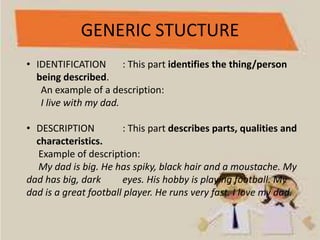
GENERIC STUCTURE
• IDENTIFICATION : This part identifies the thing/person
being described.
An example of a description:
I live with my dad.
• DESCRIPTION : This part describes parts, qualities and
characteristics.
Example of description:
My dad is big. He has spiky, black hair and a moustache. My
dad has big, dark eyes. His hobby is playing football. My
dad is a great football player. He runs very fast. I love my dad.
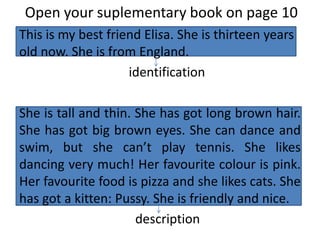
Open your suplementary book on page 10
This is my best friend Elisa. She is thirteen years
old now. She is from England.
identification
She is tall and thin. She has got long brown hair.
She has got big brown eyes. She can dance and
swim, but she can’t play tennis. She likes
dancing very much! Her favourite colour is pink.
Her favourite food is pizza and she likes cats. She
has got a kitten: Pussy. She is friendly and nice.
description
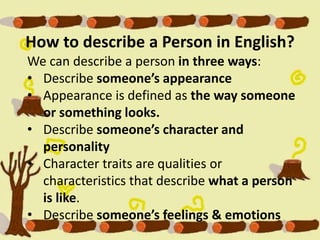
How to describe a Person in English?
We can describe a person in three ways:
• Describe someone’s appearance
• Appearance is defined as the way someone
or something looks.
• Describe someone’s character and
personality
• Character traits are qualities or
characteristics that describe what a person
is like.
• Describe someone’s feelings & emotions
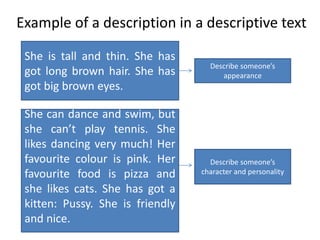
Example of a description in a descriptive text
She is tall and thin. She has
got long brown hair. She has
got big brown eyes.
Describe someone’s
appearance
She can dance and swim, but
she can’t play tennis. She
likes dancing very much! Her
favourite colour is pink. Her
favourite food is pizza and
she likes cats. She has got a
kitten: Pussy. She is friendly
and nice.
Describe someone’s
character and personality
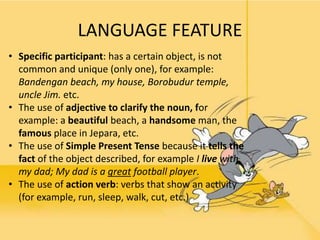
LANGUAGE FEATURE
• Specific participant: has a certain object, is not
common and unique (only one), for example:
Bandengan beach, my house, Borobudur temple,
uncle Jim. etc.
• The use of adjective to clarify the noun, for
example: a beautiful beach, a handsome man, the
famous place in Jepara, etc.
• The use of Simple Present Tense because it tells the
fact of the object described, for example I live with
my dad; My dad is a great football player.
• The use of action verb: verbs that show an activity
(for example, run, sleep, walk, cut, etc.)
SIMPLE PRESENT TENSE
THE PURPOSES OF SIMPLE PRESENT TENSE
a. To describe a person/ place/ thing at the present time
example : she works in a hospital, he has spiky hair
b. To talk about activities someone does regularly
example : I usually go to bed at about 09.00,
she never eats meat, I rarely go swimming
c. To express habits, general truths
example : the sun shines brightly
THE PATTERN
a) POSITIVE SENTENCE
b) NEGATIVE SENTENCE
c) INTERROGATIVE SENTENCE
d) INFORMATION QUESTION
A. POSITIVE
1. VERBAL
• THEY/ WE/ I/ YOU + VERB 1 + O
example : they eat fruits
• SHE/ HE/ IT + VERB (s/es/ies)
example : he eats fruits
2. NOMINAL
• I + am + adjective/ adverb/ noun
example : I am at home
• THEY/WE/YOU+ ARE + adjective/adverb/ noun
example : we are at home
• SHE/ HE/ IT + IS + adjective/adverb/ noun
example : he is at home
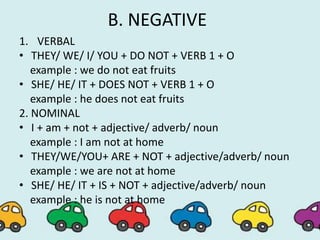
B. NEGATIVE
1. VERBAL
• THEY/ WE/ I/ YOU + DO NOT + VERB 1 + O
example : we do not eat fruits
• SHE/ HE/ IT + DOES NOT + VERB 1 + O
example : he does not eat fruits
2. NOMINAL
• I + am + not + adjective/ adverb/ noun
example : I am not at home
• THEY/WE/YOU+ ARE + NOT + adjective/adverb/ noun
example : we are not at home
• SHE/ HE/ IT + IS + NOT + adjective/adverb/ noun
example : he is not at home
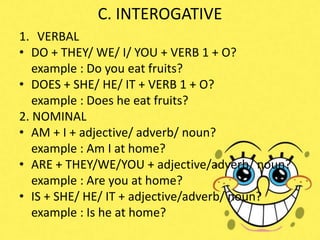
C. INTEROGATIVE
1. VERBAL
• DO + THEY/ WE/ I/ YOU + VERB 1 + O?
example : Do you eat fruits?
• DOES + SHE/ HE/ IT + VERB 1 + O?
example : Does he eat fruits?
2. NOMINAL
• AM + I + adjective/ adverb/ noun?
example : Am I at home?
• ARE + THEY/WE/YOU + adjective/adverb/ noun?
example : Are you at home?
• IS + SHE/ HE/ IT + adjective/adverb/ noun?
example : Is he at home?
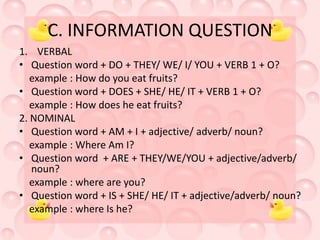
C. INFORMATION QUESTION
1. VERBAL
• Question word + DO + THEY/ WE/ I/ YOU + VERB 1 + O?
example : How do you eat fruits?
• Question word + DOES + SHE/ HE/ IT + VERB 1 + O?
example : How does he eat fruits?
2. NOMINAL
• Question word + AM + I + adjective/ adverb/ noun?
example : Where Am I?
• Question word + ARE + THEY/WE/YOU + adjective/adverb/
noun?
example : where are you?
• Question word + IS + SHE/ HE/ IT + adjective/adverb/ noun?
example : where Is he?
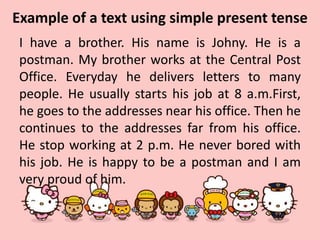
Example of a text using simple present tense
I have a brother. His name is Johny. He is a
postman. My brother works at the Central Post
Office. Everyday he delivers letters to many
people. He usually starts his job at 8 a.m.First,
he goes to the addresses near his office. Then he
continues to the addresses far from his office.
He stop working at 2 p.m. He never bored with
his job. He is happy to be a postman and I am
very proud of him.
THE SOCIAL FUNCTION OF DESCRIPTIVE TEXT.pptx

THE SOCIAL FUNCTION OF DESCRIPTIVE TEXT.pptx

  • 1.
  • 2.
    Instructional Objectives Peserta didik dapat: •Menyebutkan fungsi sosial sebuah teks deskriptif dengan benar • Menyimpulkan generic structure sebuah teks deskriptif dengan tepat • Merinci unsur kebahasaan sebuah teks deskriptif dengan lancar
  • 3.
    WHAT IS DESCRIPTIVETEXT? A descriptive text is a text that describes a particular person, animal, place or thing
  • 4.
    SOCIAL FUNCTION • tointroduce / to identify a particular person • to make a particular person stand out • to make people love about a particular person • to show someone’s pride of a particular person • to inspire other to be like a particular person.
  • 5.
    GENERIC STUCTURE • IDENTIFICATION: This part identifies the thing/person being described. An example of a description: I live with my dad. • DESCRIPTION : This part describes parts, qualities and characteristics. Example of description: My dad is big. He has spiky, black hair and a moustache. My dad has big, dark eyes. His hobby is playing football. My dad is a great football player. He runs very fast. I love my dad.
  • 6.
    Open your suplementarybook on page 10 This is my best friend Elisa. She is thirteen years old now. She is from England. identification She is tall and thin. She has got long brown hair. She has got big brown eyes. She can dance and swim, but she can’t play tennis. She likes dancing very much! Her favourite colour is pink. Her favourite food is pizza and she likes cats. She has got a kitten: Pussy. She is friendly and nice. description
  • 7.
    How to describea Person in English? We can describe a person in three ways: • Describe someone’s appearance • Appearance is defined as the way someone or something looks. • Describe someone’s character and personality • Character traits are qualities or characteristics that describe what a person is like. • Describe someone’s feelings & emotions
  • 8.
    Example of adescription in a descriptive text She is tall and thin. She has got long brown hair. She has got big brown eyes. Describe someone’s appearance She can dance and swim, but she can’t play tennis. She likes dancing very much! Her favourite colour is pink. Her favourite food is pizza and she likes cats. She has got a kitten: Pussy. She is friendly and nice. Describe someone’s character and personality
  • 9.
    LANGUAGE FEATURE • Specificparticipant: has a certain object, is not common and unique (only one), for example: Bandengan beach, my house, Borobudur temple, uncle Jim. etc. • The use of adjective to clarify the noun, for example: a beautiful beach, a handsome man, the famous place in Jepara, etc. • The use of Simple Present Tense because it tells the fact of the object described, for example I live with my dad; My dad is a great football player. • The use of action verb: verbs that show an activity (for example, run, sleep, walk, cut, etc.)
  • 10.
  • 11.
    THE PURPOSES OFSIMPLE PRESENT TENSE a. To describe a person/ place/ thing at the present time example : she works in a hospital, he has spiky hair b. To talk about activities someone does regularly example : I usually go to bed at about 09.00, she never eats meat, I rarely go swimming c. To express habits, general truths example : the sun shines brightly
  • 12.
    THE PATTERN a) POSITIVESENTENCE b) NEGATIVE SENTENCE c) INTERROGATIVE SENTENCE d) INFORMATION QUESTION
  • 13.
    A. POSITIVE 1. VERBAL •THEY/ WE/ I/ YOU + VERB 1 + O example : they eat fruits • SHE/ HE/ IT + VERB (s/es/ies) example : he eats fruits 2. NOMINAL • I + am + adjective/ adverb/ noun example : I am at home • THEY/WE/YOU+ ARE + adjective/adverb/ noun example : we are at home • SHE/ HE/ IT + IS + adjective/adverb/ noun example : he is at home
  • 14.
    B. NEGATIVE 1. VERBAL •THEY/ WE/ I/ YOU + DO NOT + VERB 1 + O example : we do not eat fruits • SHE/ HE/ IT + DOES NOT + VERB 1 + O example : he does not eat fruits 2. NOMINAL • I + am + not + adjective/ adverb/ noun example : I am not at home • THEY/WE/YOU+ ARE + NOT + adjective/adverb/ noun example : we are not at home • SHE/ HE/ IT + IS + NOT + adjective/adverb/ noun example : he is not at home
  • 15.
    C. INTEROGATIVE 1. VERBAL •DO + THEY/ WE/ I/ YOU + VERB 1 + O? example : Do you eat fruits? • DOES + SHE/ HE/ IT + VERB 1 + O? example : Does he eat fruits? 2. NOMINAL • AM + I + adjective/ adverb/ noun? example : Am I at home? • ARE + THEY/WE/YOU + adjective/adverb/ noun? example : Are you at home? • IS + SHE/ HE/ IT + adjective/adverb/ noun? example : Is he at home?
  • 16.
    C. INFORMATION QUESTION 1.VERBAL • Question word + DO + THEY/ WE/ I/ YOU + VERB 1 + O? example : How do you eat fruits? • Question word + DOES + SHE/ HE/ IT + VERB 1 + O? example : How does he eat fruits? 2. NOMINAL • Question word + AM + I + adjective/ adverb/ noun? example : Where Am I? • Question word + ARE + THEY/WE/YOU + adjective/adverb/ noun? example : where are you? • Question word + IS + SHE/ HE/ IT + adjective/adverb/ noun? example : where Is he?
  • 17.
    Example of atext using simple present tense I have a brother. His name is Johny. He is a postman. My brother works at the Central Post Office. Everyday he delivers letters to many people. He usually starts his job at 8 a.m.First, he goes to the addresses near his office. Then he continues to the addresses far from his office. He stop working at 2 p.m. He never bored with his job. He is happy to be a postman and I am very proud of him.