Talking about an Idol
What is recount
text?
Recount is a text which retells events or
experiences in the past. Its purpose is either to
inform or entertain the audience.
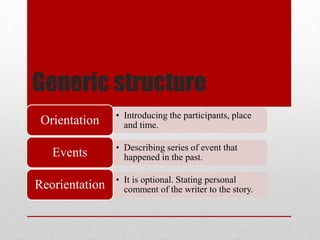
Generic structure
• Introducing the participants, place
and time.Orientation
• Describing series of event that
happened in the past.Events
• It is optional. Stating personal
comment of the writer to the story.Reorientation
Language features
Introducing personal participant: I, my group, etc.
Using chronogical connection: first, then, finally, etc.
Using linking verb: was, were, etc.
Using action verb: look, go, change, etc.
Using simple past tense.
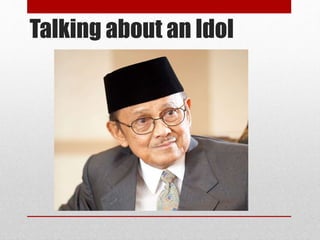
B.J. Habibie
Bacharuddin Jusuf Habibie known as BJ. Habibie was
born on 25 June 1936. He was the Third President of the
Republic of Indonesia (1998–1999). Habibie was born in
Parepare, South Sulawesi Province to Alwi Abdul Jalil Habibie
and R.A. Tuti Marini Puspowardojo. His father was an
agriculturist from Gorontalo of Bugis descent and his mother
was a Javanese noblewoman from Yogyakarta. His parents met
while studying in Bogor. When he was 14 years old, Habibie’s
father died.
O
R
I
E
N
T
A
T
I
O
N
Following his father’s death, Habibie continued his studies in
Jakarta and then in 1955 moved to Germany. In 1960, Habibie
received a degree in engineering in Germany, giving him the title
Diplom-Ingenieur.
He remained in Germany as a research assistant under Hans
Ebner at the Lehrstuhl und Institut für Leichtbau, RWTH Aachen to
conduct research for his doctoral degree.
In 1962, Habibie returned to Indonesia for three months on
sick leave. During this time, he was reacquainted with Hasri Ainun,
the daughter of R. Mohamad Besari. The two married on 12 May
1962, returning to Germany shortly afterwards. Habibie and his wife
settled in Aachen for a short period before moving to Oberforstbach.
In May 1963 they had their first son, Ilham Akbar Habibie, and later
another son, Thareq Kemal Habibie.
When Habibie’s minimum wage salary forced him into part-
time work, he found employment with the Automotive Marque
Talbot, where he became an advisor. Habibie worked on two projects
which received funding from Deutsche Bundesbahn. Due to his work
with Makosh, the head of train constructions offered his position to
Habibie upon his retirement three years later, but Habibie refused.
E
V
E
N
T
S
Habibie did accept a position with Messerschmitt-Bölkow-
Blohm in Hamburg. There, he developed theories on
thermodynamics, construction, and aerodynamics known as the
Habibie Factor, Habibie Theorem, and Habibie Method,
respectively. He worked for Messerschmit on the development of
the Airbus A-300B aircraft. In 1974, he was promoted to vice
president of the company.
In 1974, Suharto requested Habibie to return to Indonesia as
part of Suharto’s drive to develop the country. Habibie initially
served as a special assistant to Ibnu Sutowo, the CEO of the state oil
company Pertamina. Two years later, in 1976, Habibie was made
Chief Executive Officer of the new state-owned enterprise Industri
Pesawat Terbang Nusantara (IPTN). In 1978, he was appointed as
Minister of Research and Technology. Habibie was elected vice
president in March 1998. On 21 May 1998, Suharto publicly
announced his resignation and Habibie was immediately sworn in as
president. Habibie’s government stabilized the economy in the face
of the Asian financial crisis and the chaos of the last few months of
Suharto’s presidency.
E
V
E
N
T
S
Since relinquishing the presidency, Habibie has spent
more time in Germany than in Indonesia. However, he has also
been active as a presidential adviser during Susilo Bambang
Yudoyono’s presidency. In September 2006, he released a book
called Detik- Detik Yang Menentukan: Jalan Panjang
Indonesia Menuju Demokrasi (Decisive Moments: Indonesia’s
Long Road Towards Democracy). The book recalled the events
of May 1998.
R
E
O
R
I
E
N
T
A
T
I
O
N
Recount ppt

Recount ppt

  • 1.
  • 2.
    What is recount text? Recountis a text which retells events or experiences in the past. Its purpose is either to inform or entertain the audience.
  • 3.
    Generic structure • Introducingthe participants, place and time.Orientation • Describing series of event that happened in the past.Events • It is optional. Stating personal comment of the writer to the story.Reorientation
  • 4.
    Language features Introducing personalparticipant: I, my group, etc. Using chronogical connection: first, then, finally, etc. Using linking verb: was, were, etc. Using action verb: look, go, change, etc. Using simple past tense.
  • 5.
    B.J. Habibie Bacharuddin JusufHabibie known as BJ. Habibie was born on 25 June 1936. He was the Third President of the Republic of Indonesia (1998–1999). Habibie was born in Parepare, South Sulawesi Province to Alwi Abdul Jalil Habibie and R.A. Tuti Marini Puspowardojo. His father was an agriculturist from Gorontalo of Bugis descent and his mother was a Javanese noblewoman from Yogyakarta. His parents met while studying in Bogor. When he was 14 years old, Habibie’s father died. O R I E N T A T I O N
  • 6.
    Following his father’sdeath, Habibie continued his studies in Jakarta and then in 1955 moved to Germany. In 1960, Habibie received a degree in engineering in Germany, giving him the title Diplom-Ingenieur. He remained in Germany as a research assistant under Hans Ebner at the Lehrstuhl und Institut für Leichtbau, RWTH Aachen to conduct research for his doctoral degree. In 1962, Habibie returned to Indonesia for three months on sick leave. During this time, he was reacquainted with Hasri Ainun, the daughter of R. Mohamad Besari. The two married on 12 May 1962, returning to Germany shortly afterwards. Habibie and his wife settled in Aachen for a short period before moving to Oberforstbach. In May 1963 they had their first son, Ilham Akbar Habibie, and later another son, Thareq Kemal Habibie. When Habibie’s minimum wage salary forced him into part- time work, he found employment with the Automotive Marque Talbot, where he became an advisor. Habibie worked on two projects which received funding from Deutsche Bundesbahn. Due to his work with Makosh, the head of train constructions offered his position to Habibie upon his retirement three years later, but Habibie refused. E V E N T S
  • 7.
    Habibie did accepta position with Messerschmitt-Bölkow- Blohm in Hamburg. There, he developed theories on thermodynamics, construction, and aerodynamics known as the Habibie Factor, Habibie Theorem, and Habibie Method, respectively. He worked for Messerschmit on the development of the Airbus A-300B aircraft. In 1974, he was promoted to vice president of the company. In 1974, Suharto requested Habibie to return to Indonesia as part of Suharto’s drive to develop the country. Habibie initially served as a special assistant to Ibnu Sutowo, the CEO of the state oil company Pertamina. Two years later, in 1976, Habibie was made Chief Executive Officer of the new state-owned enterprise Industri Pesawat Terbang Nusantara (IPTN). In 1978, he was appointed as Minister of Research and Technology. Habibie was elected vice president in March 1998. On 21 May 1998, Suharto publicly announced his resignation and Habibie was immediately sworn in as president. Habibie’s government stabilized the economy in the face of the Asian financial crisis and the chaos of the last few months of Suharto’s presidency. E V E N T S
  • 8.
    Since relinquishing thepresidency, Habibie has spent more time in Germany than in Indonesia. However, he has also been active as a presidential adviser during Susilo Bambang Yudoyono’s presidency. In September 2006, he released a book called Detik- Detik Yang Menentukan: Jalan Panjang Indonesia Menuju Demokrasi (Decisive Moments: Indonesia’s Long Road Towards Democracy). The book recalled the events of May 1998. R E O R I E N T A T I O N