S E C T I O N 1 4 . 1
THE SEARCH FOR SPICES
MOTIVATIONS
Why did Europeans desire a direct route to “the
Indies”?
1. To eliminate Muslim and Italian merchants who
boost the prices and increase their profits.
2. The Spirit of the Crusades inspired others to bring
Christianity to the rest of the world.
TECHNOLOGIES
What new technologies made sea
exploration possible?
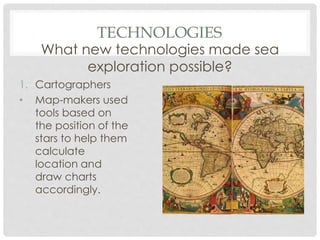
1. Cartographers
• Map-makers used
tools based on
the position of the
stars to help them
calculate
location and
draw charts
accordingly.
TECHNOLOGIES
What new technologies made sea
exploration possible?
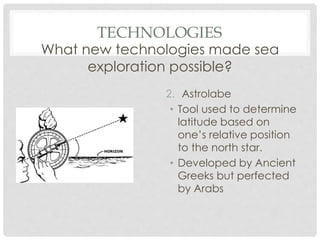
2. Astrolabe
• Tool used to determine
latitude based on
one’s relative position
to the north star.
• Developed by Ancient
Greeks but perfected
by Arabs
TECHNOLOGIES
What new technologies made sea
exploration possible?
3. Caravel
New type of boat, larger with a combination of sails
• Square sail for catching more wind to increase
speed
• Triangle lateen sail to help steer a ship in a
direction other than the direction of the wind
• Deeper keel to maintain stability balancing the
force of the wind in the sails
• Rudders allowed the ship to be steered despite the
direction of the wind
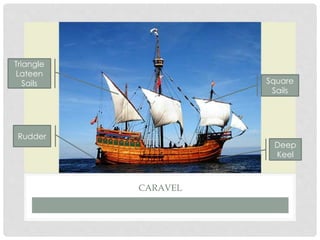
CARAVEL
Square
Sails
Triangle
Lateen
Sails
Deep
Keel
Rudder
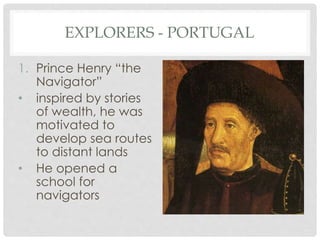
EXPLORERS - PORTUGAL
1. Prince Henry “the
Navigator”
• inspired by stories
of wealth, he was
motivated to
develop sea routes
to distant lands
• He opened a
school for
navigators
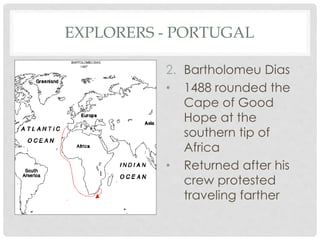
EXPLORERS - PORTUGAL
2. Bartholomeu Dias
• 1488 rounded the
Cape of Good
Hope at the
southern tip of
Africa
• Returned after his
crew protested
traveling farther
EXPLORERS - PORTUGAL
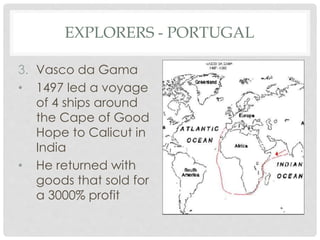
3. Vasco da Gama
• 1497 led a voyage
of 4 ships around
the Cape of Good
Hope to Calicut in
India
• He returned with
goods that sold for
a 3000% profit
EXPLORERS - PORTUGAL
hegemony: influence or authority over others
• Portuguese sailors seized key ports around the
Indian Ocean to create a vast trading empire
EXPLORERS - SPAIN
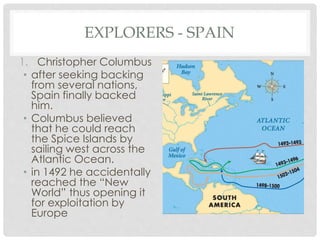
1. Christopher Columbus
• after seeking backing
from several nations,
Spain finally backed
him.
• Columbus believed
that he could reach
the Spice Islands by
sailing west across the
Atlantic Ocean.
• in 1492 he accidentally
reached the “New
World” thus opening it
for exploitation by
Europe
EXPLORERS - SPAIN
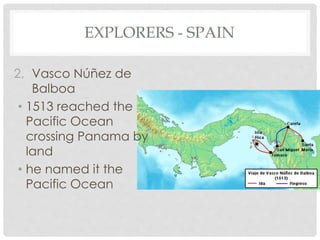
2. Vasco Núñez de
Balboa
• 1513 reached the
Pacific Ocean
crossing Panama by
land
• he named it the
Pacific Ocean
EXPLORERS - SPAIN
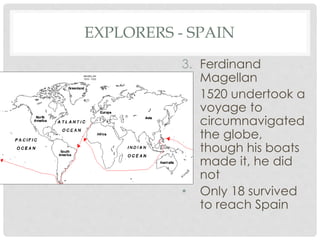
3. Ferdinand
Magellan
• 1520 undertook a
voyage to
circumnavigated
the globe,
though his boats
made it, he did
not
• Only 18 survived
to reach Spain
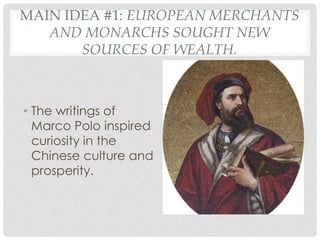
MAIN IDEA #1: EUROPEAN MERCHANTS
AND MONARCHS SOUGHT NEW
SOURCES OF WEALTH.
• The writings of
Marco Polo inspired
curiosity in the
Chinese culture and
prosperity.
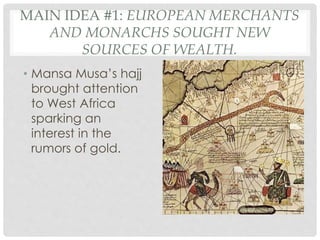
MAIN IDEA #1: EUROPEAN MERCHANTS
AND MONARCHS SOUGHT NEW
SOURCES OF WEALTH.
• Mansa Musa’s hajj
brought attention
to West Africa
sparking an
interest in the
rumors of gold.
MAIN IDEA #1: EUROPEAN MERCHANTS
AND MONARCHS SOUGHT NEW
SOURCES OF WEALTH.
• A direct route to “the Indies” would eliminate the
price mark-up by the Italian merchants and Muslim
traders.
• Ever since the Crusades, European interest in Asian
trade had been growing.
• The fall of feudalism saw a rebound in population as
well as increased size and wealth of a new middle
that demanded more Asian luxuries (such as
porcelain, silk and spices).
MAIN IDEA #2: EUROPEAN NATIONS BELIEVED THAT
THEY HAD A SACRED DUTY TO CONVERT NON-
CHRISTIANS THROUGHOUT THE WORLD.
• Spain, on the heels of the Reconquista (Spanish
Crusade), set out to bring God to the world.
• Competing denominations of Christianity felt the
need to sway people around the world to their
individual religion as competition in Europe
“heated-up.”
• The Catholic Reformation gave Catholics a
mandate from the pope to convert and teach
people around the world.
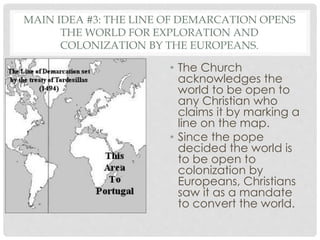
MAIN IDEA #3: THE LINE OF DEMARCATION OPENS
THE WORLD FOR EXPLORATION AND
COLONIZATION BY THE EUROPEANS.
• The Church
acknowledges the
world to be open to
any Christian who
claims it by marking a
line on the map.
• Since the pope
decided the world is
to be open to
colonization by
Europeans, Christians
saw it as a mandate
to convert the world.
MAIN IDEA #4: TRADE AND
EXPLORATION LEADS TO
WARFARE AND CONQUEST.
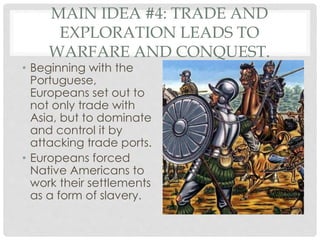
• Beginning with the
Portuguese,
Europeans set out to
not only trade with
Asia, but to dominate
and control it by
attacking trade ports.
• Europeans forced
Native Americans to
work their settlements
as a form of slavery.
MAIN IDEA #4: TRADE AND
EXPLORATION LEADS TO
WARFARE AND CONQUEST.
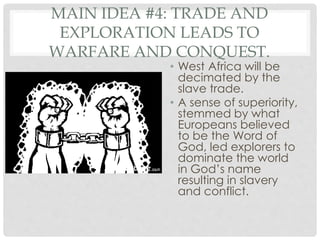
• West Africa will be
decimated by the
slave trade.
• A sense of superiority,
stemmed by what
Europeans believed
to be the Word of
God, led explorers to
dominate the world
in God’s name
resulting in slavery
and conflict.

The Search for Spices

  • 1.
    S E CT I O N 1 4 . 1 THE SEARCH FOR SPICES
  • 2.
    MOTIVATIONS Why did Europeansdesire a direct route to “the Indies”? 1. To eliminate Muslim and Italian merchants who boost the prices and increase their profits. 2. The Spirit of the Crusades inspired others to bring Christianity to the rest of the world.
  • 3.
    TECHNOLOGIES What new technologiesmade sea exploration possible? 1. Cartographers • Map-makers used tools based on the position of the stars to help them calculate location and draw charts accordingly.
  • 4.
    TECHNOLOGIES What new technologiesmade sea exploration possible? 2. Astrolabe • Tool used to determine latitude based on one’s relative position to the north star. • Developed by Ancient Greeks but perfected by Arabs
  • 5.
    TECHNOLOGIES What new technologiesmade sea exploration possible? 3. Caravel New type of boat, larger with a combination of sails • Square sail for catching more wind to increase speed • Triangle lateen sail to help steer a ship in a direction other than the direction of the wind • Deeper keel to maintain stability balancing the force of the wind in the sails • Rudders allowed the ship to be steered despite the direction of the wind
  • 6.
  • 7.
    EXPLORERS - PORTUGAL 1.Prince Henry “the Navigator” • inspired by stories of wealth, he was motivated to develop sea routes to distant lands • He opened a school for navigators
  • 8.
    EXPLORERS - PORTUGAL 2.Bartholomeu Dias • 1488 rounded the Cape of Good Hope at the southern tip of Africa • Returned after his crew protested traveling farther
  • 9.
    EXPLORERS - PORTUGAL 3.Vasco da Gama • 1497 led a voyage of 4 ships around the Cape of Good Hope to Calicut in India • He returned with goods that sold for a 3000% profit
  • 10.
    EXPLORERS - PORTUGAL hegemony:influence or authority over others • Portuguese sailors seized key ports around the Indian Ocean to create a vast trading empire
  • 11.
    EXPLORERS - SPAIN 1.Christopher Columbus • after seeking backing from several nations, Spain finally backed him. • Columbus believed that he could reach the Spice Islands by sailing west across the Atlantic Ocean. • in 1492 he accidentally reached the “New World” thus opening it for exploitation by Europe
  • 12.
    EXPLORERS - SPAIN 2.Vasco Núñez de Balboa • 1513 reached the Pacific Ocean crossing Panama by land • he named it the Pacific Ocean
  • 13.
    EXPLORERS - SPAIN 3.Ferdinand Magellan • 1520 undertook a voyage to circumnavigated the globe, though his boats made it, he did not • Only 18 survived to reach Spain
  • 14.
    MAIN IDEA #1:EUROPEAN MERCHANTS AND MONARCHS SOUGHT NEW SOURCES OF WEALTH. • The writings of Marco Polo inspired curiosity in the Chinese culture and prosperity.
  • 15.
    MAIN IDEA #1:EUROPEAN MERCHANTS AND MONARCHS SOUGHT NEW SOURCES OF WEALTH. • Mansa Musa’s hajj brought attention to West Africa sparking an interest in the rumors of gold.
  • 16.
    MAIN IDEA #1:EUROPEAN MERCHANTS AND MONARCHS SOUGHT NEW SOURCES OF WEALTH. • A direct route to “the Indies” would eliminate the price mark-up by the Italian merchants and Muslim traders. • Ever since the Crusades, European interest in Asian trade had been growing. • The fall of feudalism saw a rebound in population as well as increased size and wealth of a new middle that demanded more Asian luxuries (such as porcelain, silk and spices).
  • 17.
    MAIN IDEA #2:EUROPEAN NATIONS BELIEVED THAT THEY HAD A SACRED DUTY TO CONVERT NON- CHRISTIANS THROUGHOUT THE WORLD. • Spain, on the heels of the Reconquista (Spanish Crusade), set out to bring God to the world. • Competing denominations of Christianity felt the need to sway people around the world to their individual religion as competition in Europe “heated-up.” • The Catholic Reformation gave Catholics a mandate from the pope to convert and teach people around the world.
  • 18.
    MAIN IDEA #3:THE LINE OF DEMARCATION OPENS THE WORLD FOR EXPLORATION AND COLONIZATION BY THE EUROPEANS. • The Church acknowledges the world to be open to any Christian who claims it by marking a line on the map. • Since the pope decided the world is to be open to colonization by Europeans, Christians saw it as a mandate to convert the world.
  • 19.
    MAIN IDEA #4:TRADE AND EXPLORATION LEADS TO WARFARE AND CONQUEST. • Beginning with the Portuguese, Europeans set out to not only trade with Asia, but to dominate and control it by attacking trade ports. • Europeans forced Native Americans to work their settlements as a form of slavery.
  • 20.
    MAIN IDEA #4:TRADE AND EXPLORATION LEADS TO WARFARE AND CONQUEST. • West Africa will be decimated by the slave trade. • A sense of superiority, stemmed by what Europeans believed to be the Word of God, led explorers to dominate the world in God’s name resulting in slavery and conflict.