The SDGs and
Environmental
Flows
Chris Dickens (IWMI)
Riccardo Biancalani (FAO)
Virginie Gillet (FAO)
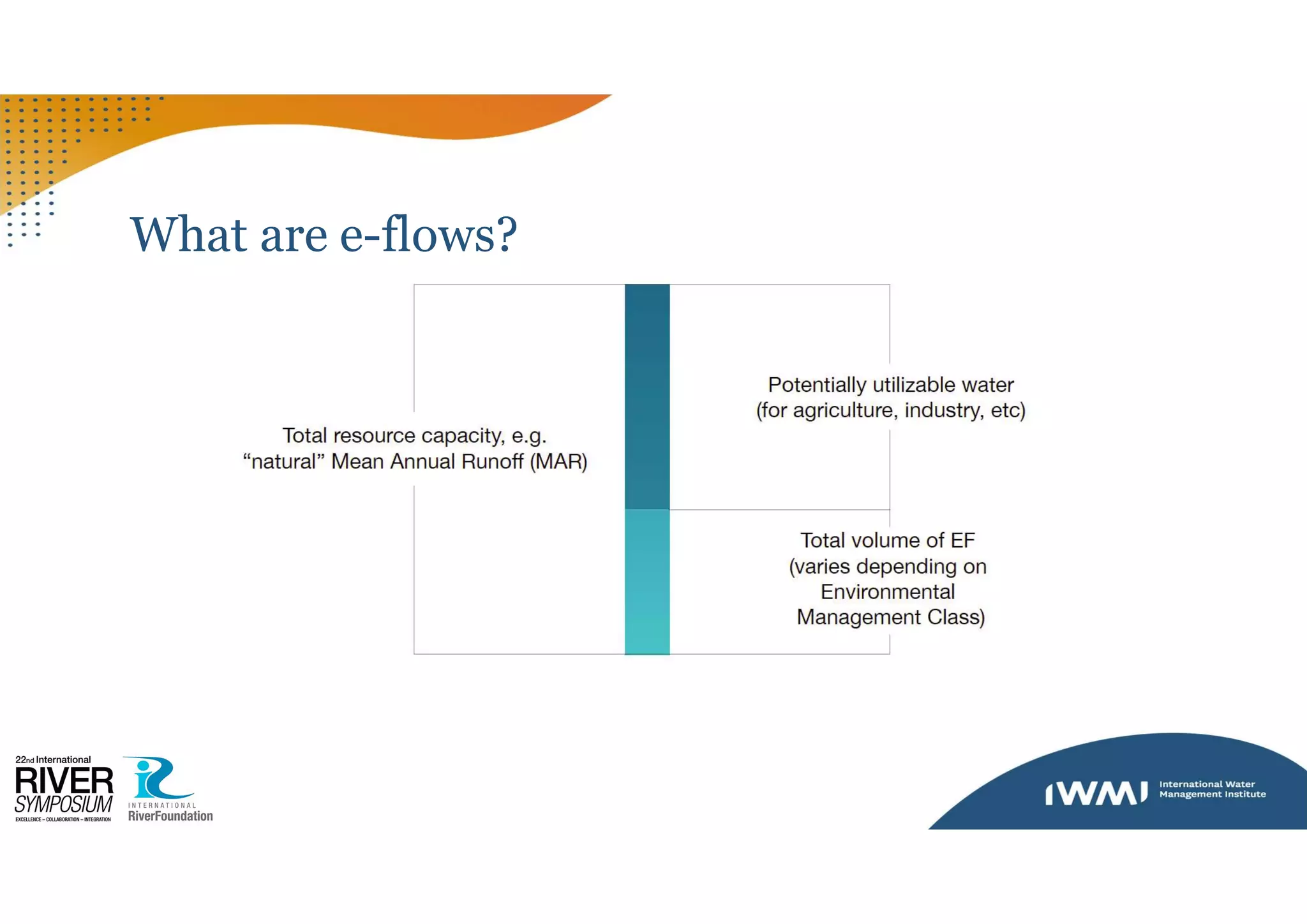
What are e-flows?
What are e-flows?
Water Stress SDG 6.4.2
Water Stress (%) =
Total freshwater withdrawn
Total renewable freshwater resource - Eflow
X 100
6.4.2 Level of water stress: freshwater withdrawal as a
proportion of available freshwater resources
Smakhtin et al,
2004
Water Stress SDG 6.4.2
Hydrographs at different ecological
management classes (EMC)
Flowincumecs
EMC classes
C Class
D Class
Natural
EMC
A
(natural)
B
(largely natural)
C
(moderately
modified or
“fair” condition)
D
(largely modified)
E
(seriously
modified)
http://eflows.iwmi.org
Vörösmarty et al. (2010) “Incident Biodiversity Threat Index”
The online GEFIS model
EF to maintain the existing ecological man. class
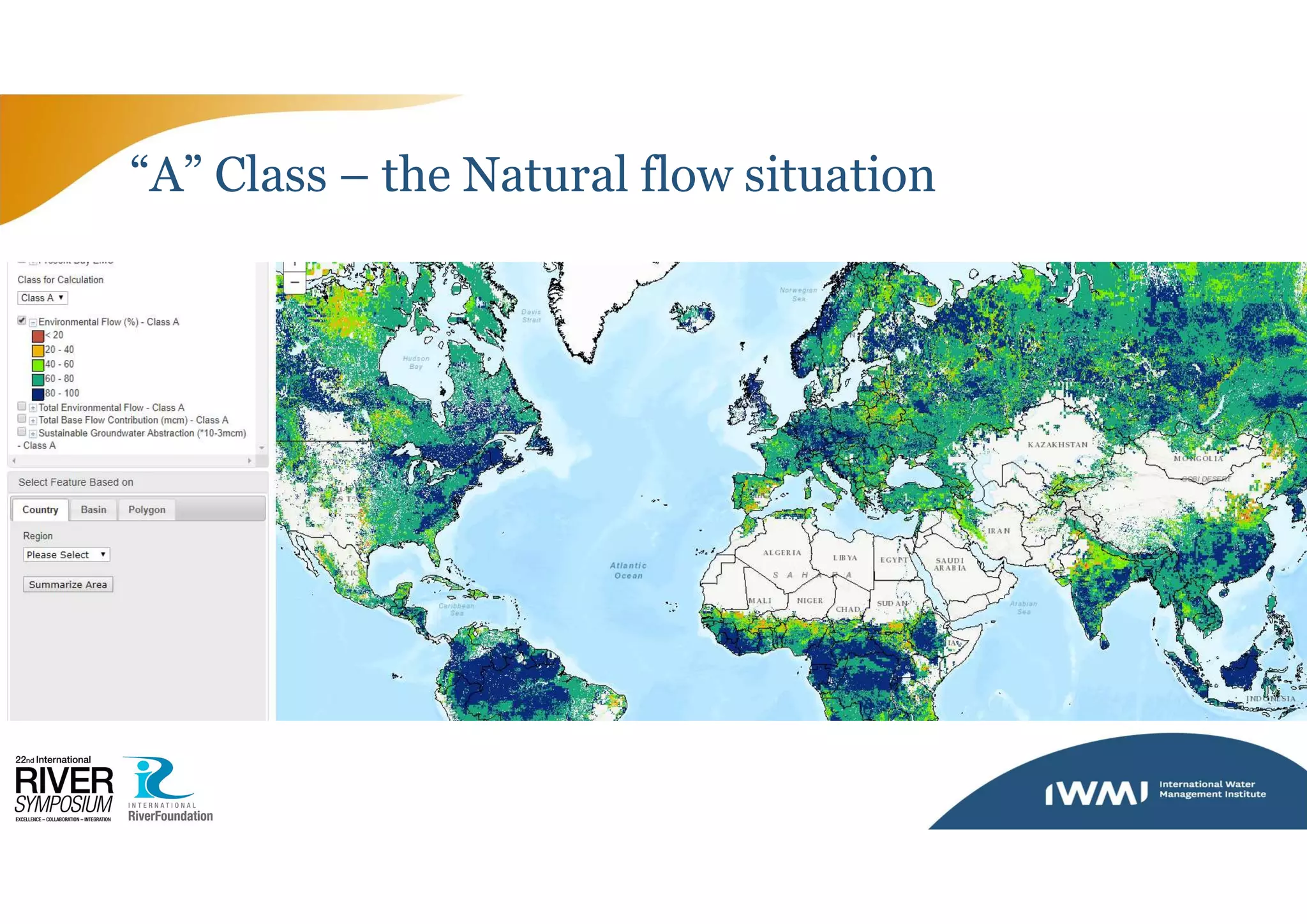
“A” Class – the Natural flow situation
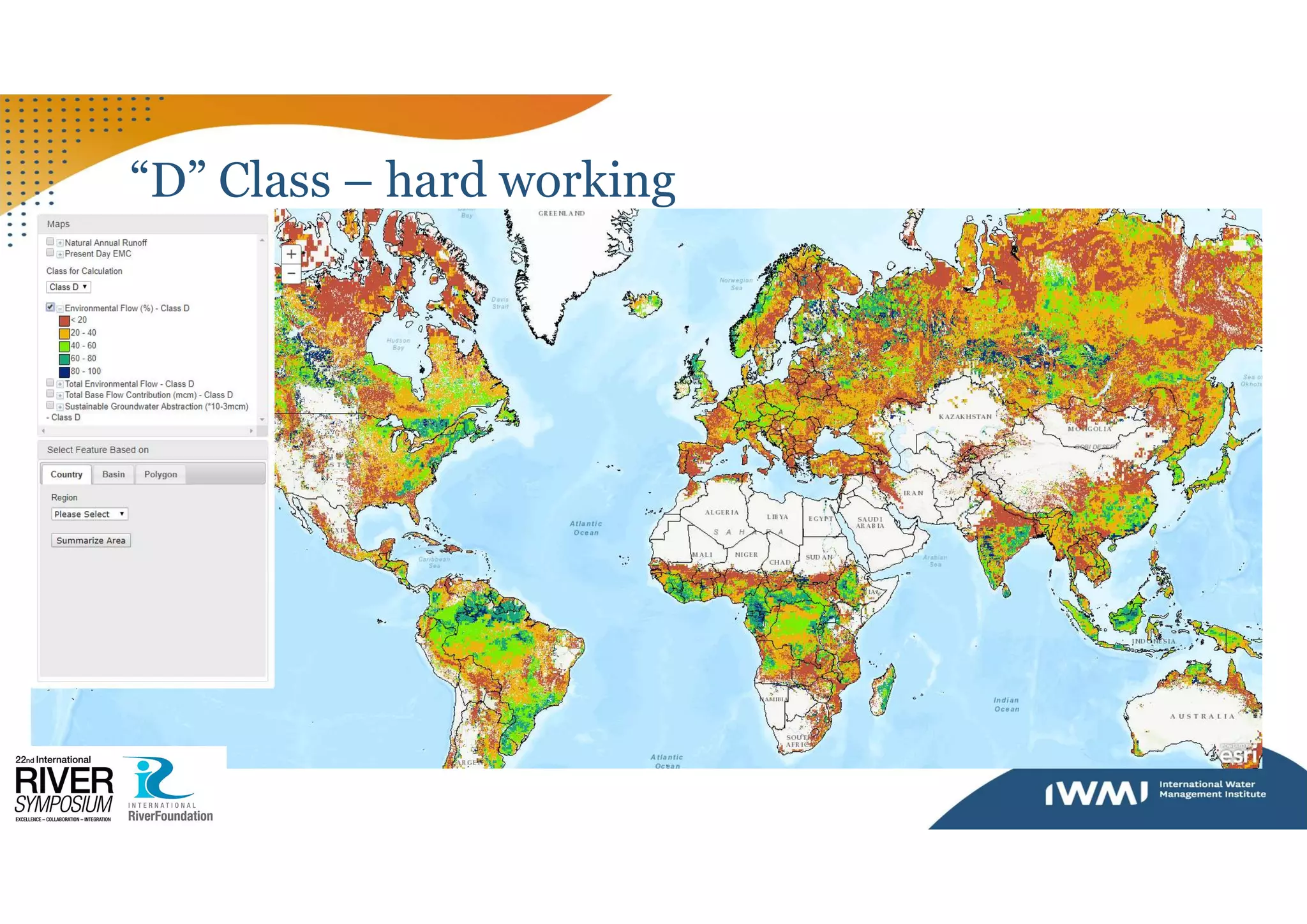
“D” Class – hard working
SDG 6.4.2 on Water Stress
• FAO provides countries with country aggregated EF to
maintain present day EMC
• To 187 countries in 2018 and 205 in 2019
• 77 questionnaires back in 2018 and so far 75 in 2019
• Countries can:
• Endorse the FAO data and return the FAO template
• Disapprove but can live with it
• Disaggregate data into smaller units (= 2nd step of the monitoring ladder)
• Disapprove and propose alternative using the template based on:
• Policy e.g national 10% of flow
• Evidence from country experience backed by credible methods (=3rd step of
monitoring ladder)
2019 data call
Country GEFIS e-
flow value
(km3)
Country
value
(km3)
Reason and comment
1 27.56 16.0 75% of water in the driest season of the year
2 529.3 279.5 Used older GEFIS model
3 46.1 37.4 for 2015
46.8 for 2016
41.3 for 2017
Used older GEFIS model with a different estimation of
annual renewable water resources
4 73.47 0 No comment
5 33.93 5.6 10% of surface water flow
6 9.3 5.1 Water Resources Management Strategic Plan prescribes
10% EF
• Out of 75 questionnaires returned in 2019:
– 6 countries proposed new EF
Voluntary national review
• Eflows can be reported in detail
• Progress to achieve goals and targets
• Plans to address issues
• Governance and management issues
• VNR presented to HLPF
Setting Targets
SDGs
Targets are defined as aspirational and global, with each government
setting its own national targets guided by the global level of ambition
but taking into account national circumstances (Agenda 2030:55)
Linked to EMC
Defined at basin level by country experts and authorities
Setting targets – Ecological Management classes
EMC
A
(natural)
B
(largely natural)
C
(moderately
modified or
“fair” condition)
D
(largely modified)
E
(seriously
modified)
Target values for e-flows
Example of a sub-basin target for e-flows
Thank you!

The SDGs and Environmental Flows

  • 1.
    The SDGs and Environmental Flows ChrisDickens (IWMI) Riccardo Biancalani (FAO) Virginie Gillet (FAO)
  • 2.
  • 3.
  • 4.
    Water Stress SDG6.4.2 Water Stress (%) = Total freshwater withdrawn Total renewable freshwater resource - Eflow X 100 6.4.2 Level of water stress: freshwater withdrawal as a proportion of available freshwater resources
  • 5.
  • 6.
    Hydrographs at differentecological management classes (EMC) Flowincumecs EMC classes C Class D Class Natural EMC A (natural) B (largely natural) C (moderately modified or “fair” condition) D (largely modified) E (seriously modified)
  • 7.
    http://eflows.iwmi.org Vörösmarty et al.(2010) “Incident Biodiversity Threat Index” The online GEFIS model
  • 8.
    EF to maintainthe existing ecological man. class
  • 9.
    “A” Class –the Natural flow situation
  • 10.
    “D” Class –hard working
  • 11.
    SDG 6.4.2 onWater Stress • FAO provides countries with country aggregated EF to maintain present day EMC • To 187 countries in 2018 and 205 in 2019 • 77 questionnaires back in 2018 and so far 75 in 2019 • Countries can: • Endorse the FAO data and return the FAO template • Disapprove but can live with it • Disaggregate data into smaller units (= 2nd step of the monitoring ladder) • Disapprove and propose alternative using the template based on: • Policy e.g national 10% of flow • Evidence from country experience backed by credible methods (=3rd step of monitoring ladder)
  • 12.
    2019 data call CountryGEFIS e- flow value (km3) Country value (km3) Reason and comment 1 27.56 16.0 75% of water in the driest season of the year 2 529.3 279.5 Used older GEFIS model 3 46.1 37.4 for 2015 46.8 for 2016 41.3 for 2017 Used older GEFIS model with a different estimation of annual renewable water resources 4 73.47 0 No comment 5 33.93 5.6 10% of surface water flow 6 9.3 5.1 Water Resources Management Strategic Plan prescribes 10% EF • Out of 75 questionnaires returned in 2019: – 6 countries proposed new EF
  • 13.
    Voluntary national review •Eflows can be reported in detail • Progress to achieve goals and targets • Plans to address issues • Governance and management issues • VNR presented to HLPF
  • 14.
    Setting Targets SDGs Targets aredefined as aspirational and global, with each government setting its own national targets guided by the global level of ambition but taking into account national circumstances (Agenda 2030:55) Linked to EMC Defined at basin level by country experts and authorities
  • 15.
    Setting targets –Ecological Management classes EMC A (natural) B (largely natural) C (moderately modified or “fair” condition) D (largely modified) E (seriously modified)
  • 16.
    Target values fore-flows Example of a sub-basin target for e-flows
  • 17.