The Role of Process Characterization in
Process Validation
Speaker
David A. Goodrich, P.E., CQE, CQA
Presented at
Greater Fort Worth ASQ Section 1416
2016 Cowtown Quality Roundup
22 April 2016
David A. Goodrich, P.E.
Process Validation
Establishing by objective evidence that a process
consistently produces a result or product meeting its
predetermined specifications.
Process Characterization - Identifying and quantifying
all significant sources of variation, especially
characterization of variation inherent to the materials
and technology as applied to the specific product
design.
David A. Goodrich, P.E.
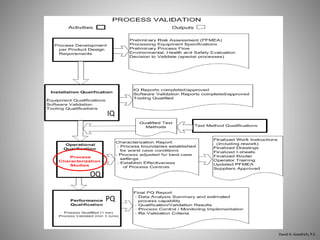
IQ
OQ
PQ
David A. Goodrich, P.E.
Characterization studies determine what happens when
conditions occur which stress the process. These conditions
are considered the "most challenging" or worst-case.
Must be completed prior to qualification testing, for
processes chosen to validate.
David A. Goodrich, P.E.
Worst-Case
A set of process settings and conditions
encompassing upper and lower processing limits.
These settings pose the greatest chance of process
or product failure when compared to ideal
conditions. Such conditions do not necessarily
induce product or process failure.
David A. Goodrich, P.E.
When Should We Begin Characterization?
Pre-Characterization Requirements:
- Product and Process Specifications
- Equipment Installation Qualifications
- Software Validations (as applicable)
- Process Risk Assessment Complete
- Characteristics of materials verified to meet requirements
- Applicable test methods qualified
Characterization may use pre-production work instructions.
David A. Goodrich, P.E.
When is a Characterization Study not Required?
Transferring a Mature (Robust) Process to Another Facility –
When operating limits are established at the developing or
transferring facility, the decision may be made to test the
operating limits, eliminating the need for a process
characterization study.
Replicating a Process with Identical Equipment –
When operating limits are established, the decision may be
made to test the operating limits, eliminating the need for a
process characterization study (usually done when several
identical machines are being validated at one time). Must
demonstrate consistency between processes.
The amount of qualification and validation testing required should
be determined based on risk assessment.
David A. Goodrich, P.E.
Look for Potential Sources of Process Variation
- Equipment
- Process
- Materials
- Measurement
- People
- Environment
David A. Goodrich, P.E.
Process Characterization Studies should identify and
control the sources that can affect the process
What are the effects of materials
variation on the process?
• Critical Component dimensions - MMC, LMC
• Material composition / hardness range
• Component variation from multiple mold cavities
• Cleanliness / Residual Process Materials
– Mold release agents
– Lubricants
– Particulate
• “Fresh” material vs. near end of shelf life
• May require advance planning to procure materials for
characterization activities ($$$ well spent!)
David A. Goodrich, P.E.
Some Common Examples:
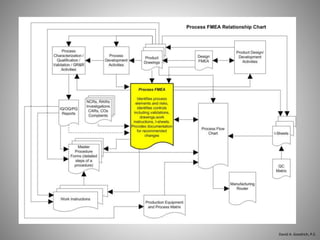
Risk Analysis
Process Failure Modes and Effects Analysis (PFMEA)
Identifies sources of process variability affecting essential design
requirements, and scores potential critical and key process parameters.
Failures are prioritized according to how serious their consequences are
(Severity), how frequently they occur (Occurrence) and how easily they
can be detected (Detection).
Calculate the risk priority number, or RPN, which equals S × O × D
The purpose of the FMEA is to take actions to eliminate or reduce
failures, starting with the highest-priority ones.
Provides a rationale for risk-based confidence and reliability
requirements (and corresponding sample size requirements)
http://asq.org/learn-about-quality/process-analysis-tools/overview/fmea.html
David A. Goodrich, P.E.
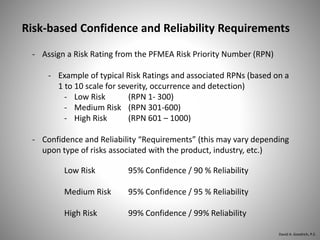
- Assign a Risk Rating from the PFMEA Risk Priority Number (RPN)
- Example of typical Risk Ratings and associated RPNs (based on a
1 to 10 scale for severity, occurrence and detection)
- Low Risk (RPN 1- 300)
- Medium Risk (RPN 301-600)
- High Risk (RPN 601 – 1000)
- Confidence and Reliability “Requirements” (this may vary depending
upon type of risks associated with the product, industry, etc.)
Low Risk 95% Confidence / 90 % Reliability
Medium Risk 95% Confidence / 95 % Reliability
High Risk 99% Confidence / 99% Reliability
Risk-based Confidence and Reliability Requirements
David A. Goodrich, P.E.
• Only the parameters thought to be critical should be included in the
characterization.
• Start with the essential design requirements and study the process
parameters that deliver those.
• Design of Experiments (DOE) is a recommended tool for process
characterization. The power of the DOE tool can identify significant
variation factors, and their interaction(s), that impact process
performance, product performance, and quality.
Process Characterization
Which process parameters should we study?
David A. Goodrich, P.E.
DOE is an efficient and effective method for quantifying process
factors and testing the limits of the process and/or technology.
Factorial DOE provides the objective evidence of interaction factors
and the Response Surface Method (RSM) can be used to predict
both Worst-Case, as well as best case or optimum conditions or
settings.
The output of DOE can include a transfer function, or mathematical
model of process behavior useful in describing process performance
and understanding relationships between various process factors.
Design of Experiments (DOE)
David A. Goodrich, P.E.
- Identify the factors that could impact the process
- Determine what levels of each factor to evaluate
- Design the experiment
- Run the experiment
- Analyze the results
Design of Experiments (DOE)
David A. Goodrich, P.E.
Case Study 1: Kiln-Fired Ceramic Coating Process
Existing Production Process
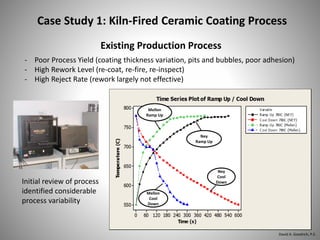
- Poor Process Yield (coating thickness variation, pits and bubbles, poor adhesion)
- High Rework Level (re-coat, re-fire, re-inspect)
- High Reject Rate (rework largely not effective)
Initial review of process
identified considerable
process variability
Mellon
Ramp Up
Ney
Ramp Up
Mellon
Cool
Down
Ney
Cool
Down
David A. Goodrich, P.E.
6420-2-4
99
95
90
80
70
60
50
40
30
20
10
5
1
Standardized Effect
Percent
A Mix Ratio
B Retract Speed
C Fire Temp
D Fire Time
E C rash C ool
Factor Name
Not Significant
Significant
Effect Type
DE
B
A
Normal Plot of the Standardized Effects
(response is Thickness, Alpha = 0.05)
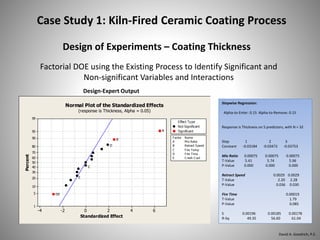
Stepwise Regression:
Alpha-to-Enter: 0.15 Alpha-to-Remove: 0.15
Response is Thickness on 5 predictors, with N = 32
Step 1 2 3
Constant -0.03184 -0.03472 -0.03753
Mix Ratio 0.00075 0.00075 0.00075
T-Value 5.41 5.74 5.96
P-Value 0.000 0.000 0.000
Retract Speed 0.0029 0.0029
T-Value 2.20 2.28
P-Value 0.036 0.030
Fire Time 0.00019
T-Value 1.79
P-Value 0.085
S 0.00196 0.00185 0.00178
R-Sq 49.35 56.60 61.04
Factorial DOE using the Existing Process to Identify Significant and
Non-significant Variables and Interactions
D
C
E
Design of Experiments – Coating Thickness
Case Study 1: Kiln-Fired Ceramic Coating Process
David A. Goodrich, P.E.
Design-Expert Output
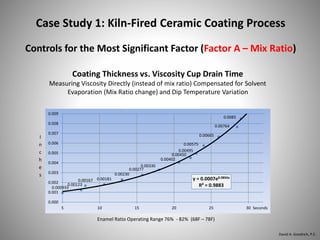
0.000933
0.00123
0.00167 0.00181
0.00230
0.00277
0.00330
0.00402
0.00450
0.00495
0.00575
0.00665
0.00764
0.0085
y = 0.0007e0.0856x
R² = 0.9883
0.000
0.001
0.002
0.003
0.004
0.005
0.006
0.007
0.008
0.009
5 10 15 20 25 30 Seconds
I
n
c
h
e
s
Coating Thickness vs. Viscosity Cup Drain Time
Measuring Viscosity Directly (instead of mix ratio) Compensated for Solvent
Evaporation (Mix Ratio change) and Dip Temperature Variation
Enamel Ratio Operating Range 76% - 82% (68F – 78F)
Case Study 1: Kiln-Fired Ceramic Coating Process
Controls for the Most Significant Factor (Factor A – Mix Ratio)
David A. Goodrich, P.E.
Case Study 1: Kiln-Fired Ceramic Coating Process
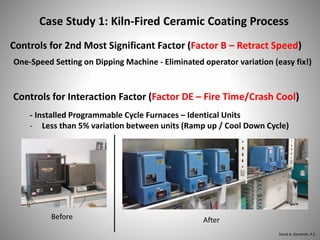
Controls for 2nd Most Significant Factor (Factor B – Retract Speed)
Controls for Interaction Factor (Factor DE – Fire Time/Crash Cool)
One-Speed Setting on Dipping Machine - Eliminated operator variation (easy fix!)
- Installed Programmable Cycle Furnaces – Identical Units
- Less than 5% variation between units (Ramp up / Cool Down Cycle)
Before After
David A. Goodrich, P.E.
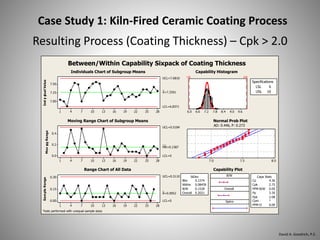
Resulting Process (Coating Thickness) – Cpk > 2.0
28252219161310741
7.50
7.25
7.00
IndividualValue
_
X=7.2591
UCL=7.6810
LCL=6.8371
28252219161310741
0.4
0.2
0.0
MovingRange
__
MR=0.1587
UCL=0.5184
LCL=0
28252219161310741
0.30
0.15
0.00
SampleRange
_
R=0.0952
UCL=0.3110
LCL=0
9.69.08.47.87.26.66.0
LSL USL
LSL 6
USL 10
Specifications
8.07.57.0
B/W
Overall
Specs
Btw 0.1274
Within 0.08439
B/W 0.1528
Overall 0.2021
StDev
Cp 4.36
Cpk 2.75
PPM-B/W 0.00
Pp 3.30
Ppk 2.08
Cpm *
PPM-O 0.00
Capa Stats
Between/Within Capability Sixpack of Coating Thickness
Individuals Chart of Subgroup Means
Moving Range Chart of Subgroup Means
Range Chart of All Data
Tests performed with unequal sample sizes
Capability Histogram
Normal Prob Plot
AD: 0.446, P: 0.273
Capability Plot
Case Study 1: Kiln-Fired Ceramic Coating Process
David A. Goodrich, P.E.
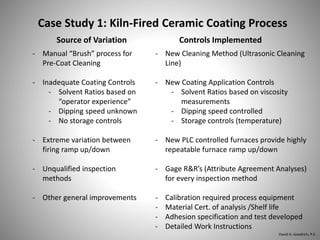
- New Cleaning Method (Ultrasonic Cleaning
Line)
- New Coating Application Controls
- Solvent Ratios based on viscosity
measurements
- Dipping speed controlled
- Storage controls (temperature)
- New PLC controlled furnaces provide highly
repeatable furnace ramp up/down
- Gage R&R’s (Attribute Agreement Analyses)
for every inspection method
- Calibration required process equipment
- Material Cert. of analysis /Shelf life
- Adhesion specification and test developed
- Detailed Work Instructions
Case Study 1: Kiln-Fired Ceramic Coating Process
Source of Variation Controls Implemented
- Manual “Brush” process for
Pre-Coat Cleaning
- Inadequate Coating Controls
- Solvent Ratios based on
“operator experience”
- Dipping speed unknown
- No storage controls
- Extreme variation between
firing ramp up/down
- Unqualified inspection
methods
- Other general improvements
David A. Goodrich, P.E.
Case Study 1: Kiln-Fired Ceramic Coating Process
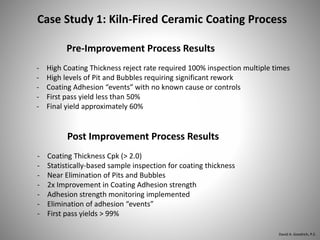
Post Improvement Process Results
- Coating Thickness Cpk (> 2.0)
- Statistically-based sample inspection for coating thickness
- Near Elimination of Pits and Bubbles
- 2x Improvement in Coating Adhesion strength
- Adhesion strength monitoring implemented
- Elimination of adhesion “events”
- First pass yields > 99%
Pre-Improvement Process Results
- High Coating Thickness reject rate required 100% inspection multiple times
- High levels of Pit and Bubbles requiring significant rework
- Coating Adhesion “events” with no known cause or controls
- First pass yield less than 50%
- Final yield approximately 60%
David A. Goodrich, P.E.
Case Study 2: Ultrasonic Welding Process
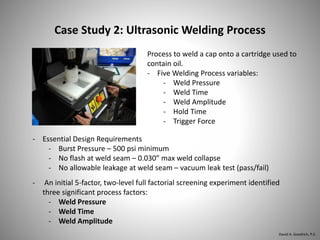
Process to weld a cap onto a cartridge used to
contain oil.
- Five Welding Process variables:
- Weld Pressure
- Weld Time
- Weld Amplitude
- Hold Time
- Trigger Force
- An initial 5-factor, two-level full factorial screening experiment identified
three significant process factors:
- Weld Pressure
- Weld Time
- Weld Amplitude
- Essential Design Requirements
- Burst Pressure – 500 psi minimum
- No flash at weld seam – 0.030” max weld collapse
- No allowable leakage at weld seam – vacuum leak test (pass/fail)
David A. Goodrich, P.E.
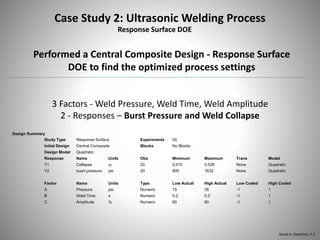
3 Factors - Weld Pressure, Weld Time, Weld Amplitude
2 - Responses – Burst Pressure and Weld Collapse
Case Study 2: Ultrasonic Welding Process
Performed a Central Composite Design - Response Surface
DOE to find the optimized process settings
Design Summary
Study Type Response Surface Experiments 20
Initial Design Central Composite Blocks No Blocks
Design Model Quadratic
Response Name Units Obs Minimum Maximum Trans Model
Y1 Collapse in 20 0.015 0.028 None Quadratic
Y2 busrt pressure psi 20 800 1632 None Quadratic
Factor Name Units Type Low Actual High Actual Low Coded High Coded
A Pressure psi Numeric 15 35 -1 1
B Weld Time s Numeric 0.2 0.3 -1 1
C Amplitude % Numeric 60 80 -1 1
Response Surface DOE
David A. Goodrich, P.E.
Case Study 2: Ultrasonic Welding Process
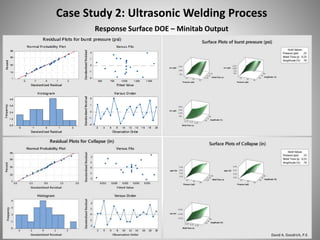
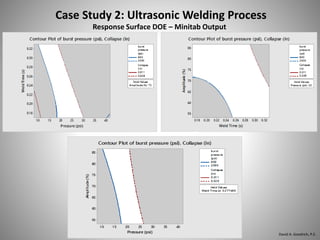
Response Surface DOE – Minitab Output
David A. Goodrich, P.E.
Case Study 2: Ultrasonic Welding Process
Response Surface DOE – Minitab Output
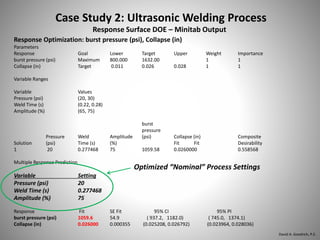
Response Optimization: burst pressure (psi), Collapse (in)
Parameters
Response Goal Lower Target Upper Weight Importance
burst pressure (psi) Maximum 800.000 1632.00 1 1
Collapse (in) Target 0.011 0.026 0.028 1 1
Variable Ranges
Variable Values
Pressure (psi) (20, 30)
Weld Time (s) (0.22, 0.28)
Amplitude (%) (65, 75)
burst
pressure
Pressure Weld Amplitude (psi) Collapse (in) Composite
Solution (psi) Time (s) (%) Fit Fit Desirability
1 20 0.277468 75 1059.58 0.0260000 0.558568
Multiple Response Prediction
Variable Setting
Pressure (psi) 20
Weld Time (s) 0.277468
Amplitude (%) 75
Response Fit SE Fit 95% CI 95% PI
burst pressure (psi) 1059.6 54.9 ( 937.2, 1182.0) ( 745.0, 1374.1)
Collapse (in) 0.026000 0.000355 (0.025208, 0.026792) (0.023964, 0.028036)
Optimized “Nominal” Process Settings
David A. Goodrich, P.E.
Case Study 2: Ultrasonic Welding Process
Response Surface DOE – Minitab Output
David A. Goodrich, P.E.
Case Study 2: Ultrasonic Welding Process
Response Surface DOE – Minitab Output
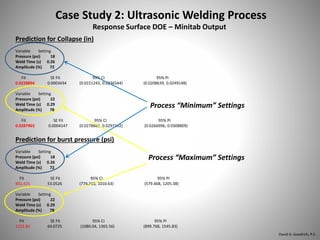
Prediction for Collapse (in)
Variable Setting
Pressure (psi) 18
Weld Time (s) 0.26
Amplitude (%) 72
Fit SE Fit 95% CI 95% PI
0.0228894 0.0003434 (0.0221243, 0.0236544) (0.0208639, 0.0249148)
Variable Setting
Pressure (psi) 22
Weld Time (s) 0.29
Amplitude (%) 78
Fit SE Fit 95% CI 95% PI
0.0287903 0.0004147 (0.0278663, 0.0297142) (0.0266996, 0.0308809)
Prediction for burst pressure (psi)
Variable Setting
Pressure (psi) 18
Weld Time (s) 0.26
Amplitude (%) 72
Fit SE Fit 95% CI 95% PI
892.425 53.0526 (774.216, 1010.63) (579.468, 1205.38)
Variable Setting
Pressure (psi) 22
Weld Time (s) 0.29
Amplitude (%) 78
Fit SE Fit 95% CI 95% PI
1222.80 64.0725 (1080.04, 1365.56) (899.768, 1545.83)
Process “Minimum” Settings
Process “Maximum” Settings
David A. Goodrich, P.E.
1800150012009006003000
20
15
10
5
0
PSI
Frequency
5000
1404 168.9 30
964.4 103.9 30
811.7 95.23 30
Mean StDev N
max
nom
min
Variable
Normal
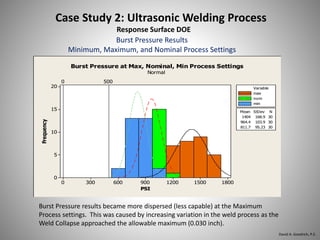
Burst Pressure at Max, Nominal, Min Process Settings
Burst Pressure Results
Minimum, Maximum, and Nominal Process Settings
Case Study 2: Ultrasonic Welding Process
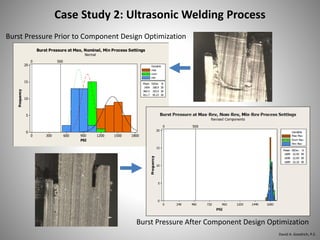
Burst Pressure results became more dispersed (less capable) at the Maximum
Process settings. This was caused by increasing variation in the weld process as the
Weld Collapse approached the allowable maximum (0.030 inch).
Response Surface DOE
David A. Goodrich, P.E.
Case Study 2: Ultrasonic Welding Process
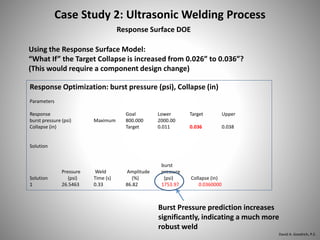
Response Optimization: burst pressure (psi), Collapse (in)
Parameters
Response Goal Lower Target Upper
burst pressure (psi) Maximum 800.000 2000.00
Collapse (in) Target 0.011 0.036 0.038
Solution
burst
Pressure Weld Amplitude pressure
Solution (psi) Time (s) (%) (psi) Collapse (in)
1 26.5463 0.33 86.82 1753.97 0.0360000
Response Surface DOE
Using the Response Surface Model:
“What If” the Target Collapse is increased from 0.026” to 0.036”?
(This would require a component design change)
Burst Pressure prediction increases
significantly, indicating a much more
robust weld
David A. Goodrich, P.E.
1800150012009006003000
20
15
10
5
0
PSI
Frequency
5000
1404 168.9 30
964.4 103.9 30
811.7 95.23 30
Mean StDev N
max
nom
min
Variable
Normal
Burst Pressure at Max, Nominal, Min Process Settings
Burst Pressure Prior to Component Design Optimization
Burst Pressure After Component Design Optimization
Case Study 2: Ultrasonic Welding Process
David A. Goodrich, P.E.
0
5
10
15
20
25
Frequency
Total Collapse (inches)
Total Weld Collapse
Minimum, Nominal, Maximum Process Settings
Lower Machine
Reject Limit
Upper Machine
Reject Limit
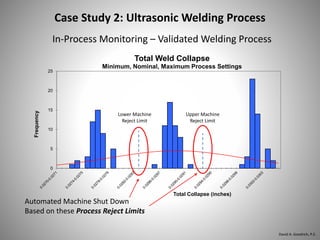
In-Process Monitoring – Validated Welding Process
Automated Machine Shut Down
Based on these Process Reject Limits
Case Study 2: Ultrasonic Welding Process
David A. Goodrich, P.E.
Process Characterization Study
Deliverables
• A fully defined process with appropriate process controls established.
• Products (product family) covered by the characterization.
• Material limitations (where applicable).
• Measurable process characteristics.
• Identification of Sources of anticipated significant process variation.
• Proposed process controls strategy (recommendations) such as:
- setup parameters,
- process instructions,
- nominal process settings (optimized for “best case”),
- operating limits of the process identified (anticipated operating
ranges including the “worst case” (min/max) settings.
- actions to be taken if control limits are exceeded
David A. Goodrich, P.E.
Characterization Study Deliverables
• Gauge R&R Studies Completed (where applicable)
• Attribute Agreement Studies Completed (where applicable)
• Include test data and methods used during the characterization study
• Updated Process Risk Analysis (e.g. Process FMEA, FTA)
• Formal (Approved) Characterization Report
Process Qualification runs that challenge the anticipated operating ranges including
the “worst case” (min/max) settings are typically done after the approved
characterization report as a part of an Operational Qualification Process Challenge
(risk based sample sizes apply here!)
David A. Goodrich, P.E.
Questions?
Comments?
Criticisms?
http://www.statease.com/dx10.html
Design-Expert Software Version 10 (45-day free trial)
http://www.minitab.com/en-us/
Minitab Software Release 17 (30-day free trial)
David A. Goodrich, P.E.
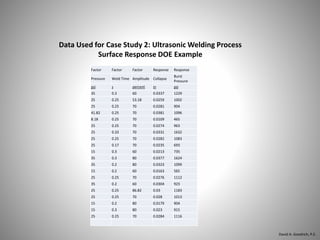
Factor Factor Factor Response Response
Pressure Weld Time Amplitude Collapse
Burst
Pressure
psi s percent in psi
35 0.3 60 0.0337 1229
25 0.25 53.18 0.0259 1002
25 0.25 70 0.0281 904
41.82 0.25 70 0.0381 1096
8.18 0.25 70 0.0109 465
25 0.25 70 0.0274 963
25 0.33 70 0.0331 1632
25 0.25 70 0.0282 1083
25 0.17 70 0.0235 693
15 0.3 60 0.0213 735
35 0.3 80 0.0377 1624
35 0.2 80 0.0323 1099
15 0.2 60 0.0163 565
25 0.25 70 0.0276 1112
35 0.2 60 0.0304 923
25 0.25 86.82 0.03 1183
25 0.25 70 0.028 1013
15 0.2 80 0.0179 904
15 0.3 80 0.023 915
25 0.25 70 0.0284 1116
Data Used for Case Study 2: Ultrasonic Welding Process
Surface Response DOE Example
David A. Goodrich, P.E.

The Role of Process Characterization in Process Validation

  • 1.
    The Role ofProcess Characterization in Process Validation Speaker David A. Goodrich, P.E., CQE, CQA Presented at Greater Fort Worth ASQ Section 1416 2016 Cowtown Quality Roundup 22 April 2016 David A. Goodrich, P.E.
  • 2.
    Process Validation Establishing byobjective evidence that a process consistently produces a result or product meeting its predetermined specifications. Process Characterization - Identifying and quantifying all significant sources of variation, especially characterization of variation inherent to the materials and technology as applied to the specific product design. David A. Goodrich, P.E.
  • 3.
  • 4.
    Characterization studies determinewhat happens when conditions occur which stress the process. These conditions are considered the "most challenging" or worst-case. Must be completed prior to qualification testing, for processes chosen to validate. David A. Goodrich, P.E.
  • 5.
    Worst-Case A set ofprocess settings and conditions encompassing upper and lower processing limits. These settings pose the greatest chance of process or product failure when compared to ideal conditions. Such conditions do not necessarily induce product or process failure. David A. Goodrich, P.E.
  • 6.
    When Should WeBegin Characterization? Pre-Characterization Requirements: - Product and Process Specifications - Equipment Installation Qualifications - Software Validations (as applicable) - Process Risk Assessment Complete - Characteristics of materials verified to meet requirements - Applicable test methods qualified Characterization may use pre-production work instructions. David A. Goodrich, P.E.
  • 7.
    When is aCharacterization Study not Required? Transferring a Mature (Robust) Process to Another Facility – When operating limits are established at the developing or transferring facility, the decision may be made to test the operating limits, eliminating the need for a process characterization study. Replicating a Process with Identical Equipment – When operating limits are established, the decision may be made to test the operating limits, eliminating the need for a process characterization study (usually done when several identical machines are being validated at one time). Must demonstrate consistency between processes. The amount of qualification and validation testing required should be determined based on risk assessment. David A. Goodrich, P.E.
  • 8.
    Look for PotentialSources of Process Variation - Equipment - Process - Materials - Measurement - People - Environment David A. Goodrich, P.E. Process Characterization Studies should identify and control the sources that can affect the process
  • 9.
    What are theeffects of materials variation on the process? • Critical Component dimensions - MMC, LMC • Material composition / hardness range • Component variation from multiple mold cavities • Cleanliness / Residual Process Materials – Mold release agents – Lubricants – Particulate • “Fresh” material vs. near end of shelf life • May require advance planning to procure materials for characterization activities ($$$ well spent!) David A. Goodrich, P.E. Some Common Examples:
  • 10.
    Risk Analysis Process FailureModes and Effects Analysis (PFMEA) Identifies sources of process variability affecting essential design requirements, and scores potential critical and key process parameters. Failures are prioritized according to how serious their consequences are (Severity), how frequently they occur (Occurrence) and how easily they can be detected (Detection). Calculate the risk priority number, or RPN, which equals S × O × D The purpose of the FMEA is to take actions to eliminate or reduce failures, starting with the highest-priority ones. Provides a rationale for risk-based confidence and reliability requirements (and corresponding sample size requirements) http://asq.org/learn-about-quality/process-analysis-tools/overview/fmea.html David A. Goodrich, P.E.
  • 11.
  • 12.
    - Assign aRisk Rating from the PFMEA Risk Priority Number (RPN) - Example of typical Risk Ratings and associated RPNs (based on a 1 to 10 scale for severity, occurrence and detection) - Low Risk (RPN 1- 300) - Medium Risk (RPN 301-600) - High Risk (RPN 601 – 1000) - Confidence and Reliability “Requirements” (this may vary depending upon type of risks associated with the product, industry, etc.) Low Risk 95% Confidence / 90 % Reliability Medium Risk 95% Confidence / 95 % Reliability High Risk 99% Confidence / 99% Reliability Risk-based Confidence and Reliability Requirements David A. Goodrich, P.E.
  • 13.
    • Only theparameters thought to be critical should be included in the characterization. • Start with the essential design requirements and study the process parameters that deliver those. • Design of Experiments (DOE) is a recommended tool for process characterization. The power of the DOE tool can identify significant variation factors, and their interaction(s), that impact process performance, product performance, and quality. Process Characterization Which process parameters should we study? David A. Goodrich, P.E.
  • 14.
    DOE is anefficient and effective method for quantifying process factors and testing the limits of the process and/or technology. Factorial DOE provides the objective evidence of interaction factors and the Response Surface Method (RSM) can be used to predict both Worst-Case, as well as best case or optimum conditions or settings. The output of DOE can include a transfer function, or mathematical model of process behavior useful in describing process performance and understanding relationships between various process factors. Design of Experiments (DOE) David A. Goodrich, P.E.
  • 15.
    - Identify thefactors that could impact the process - Determine what levels of each factor to evaluate - Design the experiment - Run the experiment - Analyze the results Design of Experiments (DOE) David A. Goodrich, P.E.
  • 16.
    Case Study 1:Kiln-Fired Ceramic Coating Process Existing Production Process - Poor Process Yield (coating thickness variation, pits and bubbles, poor adhesion) - High Rework Level (re-coat, re-fire, re-inspect) - High Reject Rate (rework largely not effective) Initial review of process identified considerable process variability Mellon Ramp Up Ney Ramp Up Mellon Cool Down Ney Cool Down David A. Goodrich, P.E.
  • 17.
    6420-2-4 99 95 90 80 70 60 50 40 30 20 10 5 1 Standardized Effect Percent A MixRatio B Retract Speed C Fire Temp D Fire Time E C rash C ool Factor Name Not Significant Significant Effect Type DE B A Normal Plot of the Standardized Effects (response is Thickness, Alpha = 0.05) Stepwise Regression: Alpha-to-Enter: 0.15 Alpha-to-Remove: 0.15 Response is Thickness on 5 predictors, with N = 32 Step 1 2 3 Constant -0.03184 -0.03472 -0.03753 Mix Ratio 0.00075 0.00075 0.00075 T-Value 5.41 5.74 5.96 P-Value 0.000 0.000 0.000 Retract Speed 0.0029 0.0029 T-Value 2.20 2.28 P-Value 0.036 0.030 Fire Time 0.00019 T-Value 1.79 P-Value 0.085 S 0.00196 0.00185 0.00178 R-Sq 49.35 56.60 61.04 Factorial DOE using the Existing Process to Identify Significant and Non-significant Variables and Interactions D C E Design of Experiments – Coating Thickness Case Study 1: Kiln-Fired Ceramic Coating Process David A. Goodrich, P.E. Design-Expert Output
  • 18.
    0.000933 0.00123 0.00167 0.00181 0.00230 0.00277 0.00330 0.00402 0.00450 0.00495 0.00575 0.00665 0.00764 0.0085 y =0.0007e0.0856x R² = 0.9883 0.000 0.001 0.002 0.003 0.004 0.005 0.006 0.007 0.008 0.009 5 10 15 20 25 30 Seconds I n c h e s Coating Thickness vs. Viscosity Cup Drain Time Measuring Viscosity Directly (instead of mix ratio) Compensated for Solvent Evaporation (Mix Ratio change) and Dip Temperature Variation Enamel Ratio Operating Range 76% - 82% (68F – 78F) Case Study 1: Kiln-Fired Ceramic Coating Process Controls for the Most Significant Factor (Factor A – Mix Ratio) David A. Goodrich, P.E.
  • 19.
    Case Study 1:Kiln-Fired Ceramic Coating Process Controls for 2nd Most Significant Factor (Factor B – Retract Speed) Controls for Interaction Factor (Factor DE – Fire Time/Crash Cool) One-Speed Setting on Dipping Machine - Eliminated operator variation (easy fix!) - Installed Programmable Cycle Furnaces – Identical Units - Less than 5% variation between units (Ramp up / Cool Down Cycle) Before After David A. Goodrich, P.E.
  • 20.
    Resulting Process (CoatingThickness) – Cpk > 2.0 28252219161310741 7.50 7.25 7.00 IndividualValue _ X=7.2591 UCL=7.6810 LCL=6.8371 28252219161310741 0.4 0.2 0.0 MovingRange __ MR=0.1587 UCL=0.5184 LCL=0 28252219161310741 0.30 0.15 0.00 SampleRange _ R=0.0952 UCL=0.3110 LCL=0 9.69.08.47.87.26.66.0 LSL USL LSL 6 USL 10 Specifications 8.07.57.0 B/W Overall Specs Btw 0.1274 Within 0.08439 B/W 0.1528 Overall 0.2021 StDev Cp 4.36 Cpk 2.75 PPM-B/W 0.00 Pp 3.30 Ppk 2.08 Cpm * PPM-O 0.00 Capa Stats Between/Within Capability Sixpack of Coating Thickness Individuals Chart of Subgroup Means Moving Range Chart of Subgroup Means Range Chart of All Data Tests performed with unequal sample sizes Capability Histogram Normal Prob Plot AD: 0.446, P: 0.273 Capability Plot Case Study 1: Kiln-Fired Ceramic Coating Process David A. Goodrich, P.E.
  • 21.
    - New CleaningMethod (Ultrasonic Cleaning Line) - New Coating Application Controls - Solvent Ratios based on viscosity measurements - Dipping speed controlled - Storage controls (temperature) - New PLC controlled furnaces provide highly repeatable furnace ramp up/down - Gage R&R’s (Attribute Agreement Analyses) for every inspection method - Calibration required process equipment - Material Cert. of analysis /Shelf life - Adhesion specification and test developed - Detailed Work Instructions Case Study 1: Kiln-Fired Ceramic Coating Process Source of Variation Controls Implemented - Manual “Brush” process for Pre-Coat Cleaning - Inadequate Coating Controls - Solvent Ratios based on “operator experience” - Dipping speed unknown - No storage controls - Extreme variation between firing ramp up/down - Unqualified inspection methods - Other general improvements David A. Goodrich, P.E.
  • 22.
    Case Study 1:Kiln-Fired Ceramic Coating Process Post Improvement Process Results - Coating Thickness Cpk (> 2.0) - Statistically-based sample inspection for coating thickness - Near Elimination of Pits and Bubbles - 2x Improvement in Coating Adhesion strength - Adhesion strength monitoring implemented - Elimination of adhesion “events” - First pass yields > 99% Pre-Improvement Process Results - High Coating Thickness reject rate required 100% inspection multiple times - High levels of Pit and Bubbles requiring significant rework - Coating Adhesion “events” with no known cause or controls - First pass yield less than 50% - Final yield approximately 60% David A. Goodrich, P.E.
  • 23.
    Case Study 2:Ultrasonic Welding Process Process to weld a cap onto a cartridge used to contain oil. - Five Welding Process variables: - Weld Pressure - Weld Time - Weld Amplitude - Hold Time - Trigger Force - An initial 5-factor, two-level full factorial screening experiment identified three significant process factors: - Weld Pressure - Weld Time - Weld Amplitude - Essential Design Requirements - Burst Pressure – 500 psi minimum - No flash at weld seam – 0.030” max weld collapse - No allowable leakage at weld seam – vacuum leak test (pass/fail) David A. Goodrich, P.E.
  • 24.
    3 Factors -Weld Pressure, Weld Time, Weld Amplitude 2 - Responses – Burst Pressure and Weld Collapse Case Study 2: Ultrasonic Welding Process Performed a Central Composite Design - Response Surface DOE to find the optimized process settings Design Summary Study Type Response Surface Experiments 20 Initial Design Central Composite Blocks No Blocks Design Model Quadratic Response Name Units Obs Minimum Maximum Trans Model Y1 Collapse in 20 0.015 0.028 None Quadratic Y2 busrt pressure psi 20 800 1632 None Quadratic Factor Name Units Type Low Actual High Actual Low Coded High Coded A Pressure psi Numeric 15 35 -1 1 B Weld Time s Numeric 0.2 0.3 -1 1 C Amplitude % Numeric 60 80 -1 1 Response Surface DOE David A. Goodrich, P.E.
  • 25.
    Case Study 2:Ultrasonic Welding Process Response Surface DOE – Minitab Output David A. Goodrich, P.E.
  • 26.
    Case Study 2:Ultrasonic Welding Process Response Surface DOE – Minitab Output Response Optimization: burst pressure (psi), Collapse (in) Parameters Response Goal Lower Target Upper Weight Importance burst pressure (psi) Maximum 800.000 1632.00 1 1 Collapse (in) Target 0.011 0.026 0.028 1 1 Variable Ranges Variable Values Pressure (psi) (20, 30) Weld Time (s) (0.22, 0.28) Amplitude (%) (65, 75) burst pressure Pressure Weld Amplitude (psi) Collapse (in) Composite Solution (psi) Time (s) (%) Fit Fit Desirability 1 20 0.277468 75 1059.58 0.0260000 0.558568 Multiple Response Prediction Variable Setting Pressure (psi) 20 Weld Time (s) 0.277468 Amplitude (%) 75 Response Fit SE Fit 95% CI 95% PI burst pressure (psi) 1059.6 54.9 ( 937.2, 1182.0) ( 745.0, 1374.1) Collapse (in) 0.026000 0.000355 (0.025208, 0.026792) (0.023964, 0.028036) Optimized “Nominal” Process Settings David A. Goodrich, P.E.
  • 27.
    Case Study 2:Ultrasonic Welding Process Response Surface DOE – Minitab Output David A. Goodrich, P.E.
  • 28.
    Case Study 2:Ultrasonic Welding Process Response Surface DOE – Minitab Output Prediction for Collapse (in) Variable Setting Pressure (psi) 18 Weld Time (s) 0.26 Amplitude (%) 72 Fit SE Fit 95% CI 95% PI 0.0228894 0.0003434 (0.0221243, 0.0236544) (0.0208639, 0.0249148) Variable Setting Pressure (psi) 22 Weld Time (s) 0.29 Amplitude (%) 78 Fit SE Fit 95% CI 95% PI 0.0287903 0.0004147 (0.0278663, 0.0297142) (0.0266996, 0.0308809) Prediction for burst pressure (psi) Variable Setting Pressure (psi) 18 Weld Time (s) 0.26 Amplitude (%) 72 Fit SE Fit 95% CI 95% PI 892.425 53.0526 (774.216, 1010.63) (579.468, 1205.38) Variable Setting Pressure (psi) 22 Weld Time (s) 0.29 Amplitude (%) 78 Fit SE Fit 95% CI 95% PI 1222.80 64.0725 (1080.04, 1365.56) (899.768, 1545.83) Process “Minimum” Settings Process “Maximum” Settings David A. Goodrich, P.E.
  • 29.
    1800150012009006003000 20 15 10 5 0 PSI Frequency 5000 1404 168.9 30 964.4103.9 30 811.7 95.23 30 Mean StDev N max nom min Variable Normal Burst Pressure at Max, Nominal, Min Process Settings Burst Pressure Results Minimum, Maximum, and Nominal Process Settings Case Study 2: Ultrasonic Welding Process Burst Pressure results became more dispersed (less capable) at the Maximum Process settings. This was caused by increasing variation in the weld process as the Weld Collapse approached the allowable maximum (0.030 inch). Response Surface DOE David A. Goodrich, P.E.
  • 30.
    Case Study 2:Ultrasonic Welding Process Response Optimization: burst pressure (psi), Collapse (in) Parameters Response Goal Lower Target Upper burst pressure (psi) Maximum 800.000 2000.00 Collapse (in) Target 0.011 0.036 0.038 Solution burst Pressure Weld Amplitude pressure Solution (psi) Time (s) (%) (psi) Collapse (in) 1 26.5463 0.33 86.82 1753.97 0.0360000 Response Surface DOE Using the Response Surface Model: “What If” the Target Collapse is increased from 0.026” to 0.036”? (This would require a component design change) Burst Pressure prediction increases significantly, indicating a much more robust weld David A. Goodrich, P.E.
  • 31.
    1800150012009006003000 20 15 10 5 0 PSI Frequency 5000 1404 168.9 30 964.4103.9 30 811.7 95.23 30 Mean StDev N max nom min Variable Normal Burst Pressure at Max, Nominal, Min Process Settings Burst Pressure Prior to Component Design Optimization Burst Pressure After Component Design Optimization Case Study 2: Ultrasonic Welding Process David A. Goodrich, P.E.
  • 32.
    0 5 10 15 20 25 Frequency Total Collapse (inches) TotalWeld Collapse Minimum, Nominal, Maximum Process Settings Lower Machine Reject Limit Upper Machine Reject Limit In-Process Monitoring – Validated Welding Process Automated Machine Shut Down Based on these Process Reject Limits Case Study 2: Ultrasonic Welding Process David A. Goodrich, P.E.
  • 33.
    Process Characterization Study Deliverables •A fully defined process with appropriate process controls established. • Products (product family) covered by the characterization. • Material limitations (where applicable). • Measurable process characteristics. • Identification of Sources of anticipated significant process variation. • Proposed process controls strategy (recommendations) such as: - setup parameters, - process instructions, - nominal process settings (optimized for “best case”), - operating limits of the process identified (anticipated operating ranges including the “worst case” (min/max) settings. - actions to be taken if control limits are exceeded David A. Goodrich, P.E.
  • 34.
    Characterization Study Deliverables •Gauge R&R Studies Completed (where applicable) • Attribute Agreement Studies Completed (where applicable) • Include test data and methods used during the characterization study • Updated Process Risk Analysis (e.g. Process FMEA, FTA) • Formal (Approved) Characterization Report Process Qualification runs that challenge the anticipated operating ranges including the “worst case” (min/max) settings are typically done after the approved characterization report as a part of an Operational Qualification Process Challenge (risk based sample sizes apply here!) David A. Goodrich, P.E.
  • 35.
    Questions? Comments? Criticisms? http://www.statease.com/dx10.html Design-Expert Software Version10 (45-day free trial) http://www.minitab.com/en-us/ Minitab Software Release 17 (30-day free trial) David A. Goodrich, P.E.
  • 36.
    Factor Factor FactorResponse Response Pressure Weld Time Amplitude Collapse Burst Pressure psi s percent in psi 35 0.3 60 0.0337 1229 25 0.25 53.18 0.0259 1002 25 0.25 70 0.0281 904 41.82 0.25 70 0.0381 1096 8.18 0.25 70 0.0109 465 25 0.25 70 0.0274 963 25 0.33 70 0.0331 1632 25 0.25 70 0.0282 1083 25 0.17 70 0.0235 693 15 0.3 60 0.0213 735 35 0.3 80 0.0377 1624 35 0.2 80 0.0323 1099 15 0.2 60 0.0163 565 25 0.25 70 0.0276 1112 35 0.2 60 0.0304 923 25 0.25 86.82 0.03 1183 25 0.25 70 0.028 1013 15 0.2 80 0.0179 904 15 0.3 80 0.023 915 25 0.25 70 0.0284 1116 Data Used for Case Study 2: Ultrasonic Welding Process Surface Response DOE Example David A. Goodrich, P.E.