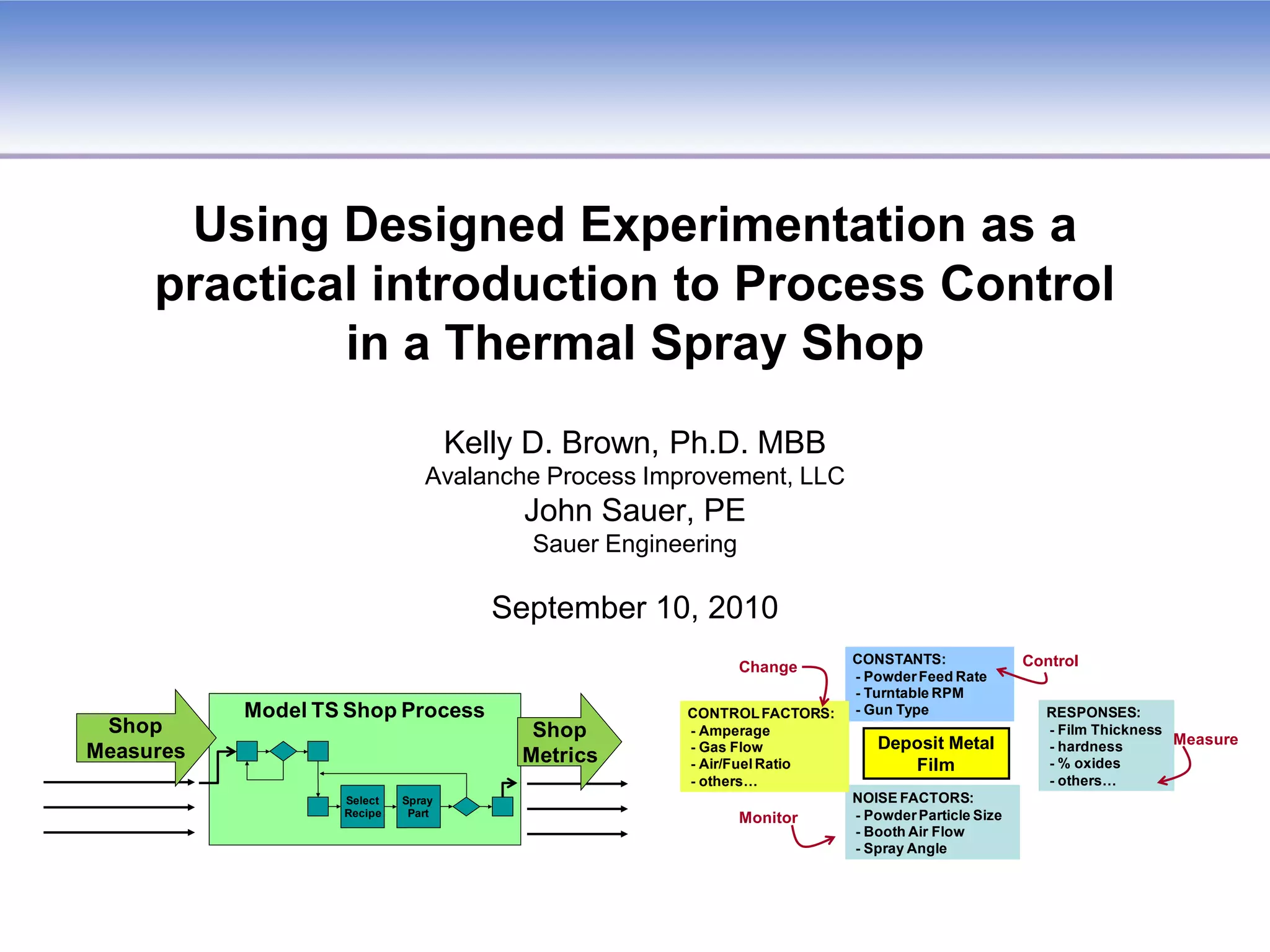
Using Designed Experimentation as a practical introduction to Process Control in a Thermal Spray ShopKelly D. Brown, Ph.D. MBBAvalanche Process Improvement, LLCJohn Sauer, PESauer EngineeringSeptember 10, 2010
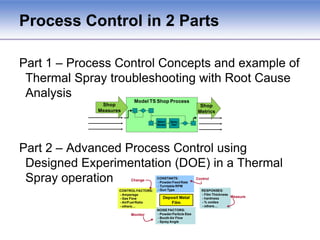
Process Control in 2 PartsPart 1 – Process Control Concepts and example of Thermal Spray troubleshooting with Root Cause AnalysisPart 2 – Advanced Process Control using Designed Experimentation (DOE) in a Thermal Spray operation
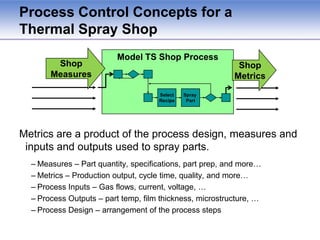
Process Control Concepts for a Thermal Spray ShopShopMeasuresShopMetricsModel TS Shop ProcessSelectRecipeSpray PartMetrics are a product of the process design, measures and inputs and outputs used to spray parts. Measures – Part quantity, specifications, part prep, and more…Metrics – Production output, cycle time, quality, and more…Process Inputs – Gas flows, current, voltage, …Process Outputs – part temp, film thickness, microstructure, …Process Design – arrangement of the process steps
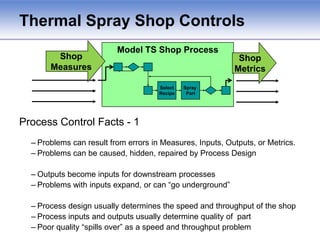
Thermal Spray Shop ControlsShopMeasuresShopMetricsModel TS Shop ProcessSelectRecipeSpray PartProcess Control Facts - 1Problems can result from errors in Measures, Inputs, Outputs, or Metrics. Problems can be caused, hidden, repaired by Process DesignOutputs become inputs for downstream processesProblems with inputs expand, or can “go underground”Process design usually determines the speed and throughput of the shopProcess inputs and outputs usually determine quality of  partPoor quality “spills over” as a speed and throughput problem
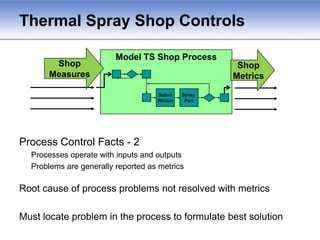
Thermal Spray Shop ControlsShopMeasuresShopMetricsModel TS Shop ProcessSelectRecipeSpray PartProcess Control Facts - 2Processes operate with inputs and outputsProblems are generally reported as metricsRoot cause of process problems not resolved with metricsMust locate problem in the process to formulate best solution
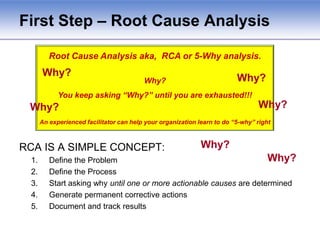
Root Cause Analysis aka,  RCA or 5-Why analysis.Why?You keep asking “Why?” until you are exhausted!!!An experienced facilitator can help your organization learn to do “5-why” rightFirst Step – Root Cause AnalysisWhy?Why?Why?Why?Why?RCA IS A SIMPLE CONCEPT:Define the ProblemDefine the ProcessStart asking why until one or more actionable causes are determinedGenerate permanent corrective actionsDocument and track resultsWhy?
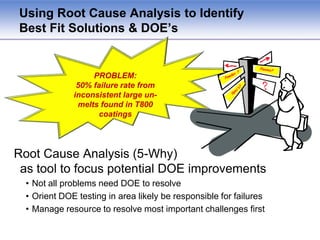
PROBLEM:50% failure rate from inconsistent large un-melts found in T800 coatingsUsing Root Cause Analysis to Identify Best Fit Solutions & DOE’sPlasma?Powder ?Root Cause Analysis (5-Why) as tool to focus potential DOE improvementsNot all problems need DOE to resolve
Orient DOE testing in area likely be responsible for failures
Manage resource to resolve most important challenges firstSpec’s?
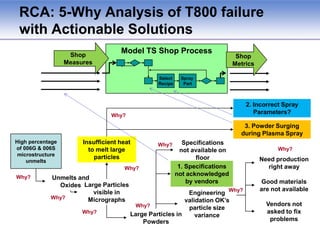
RCA: 5-Why Analysis of T800 failure with Actionable Solutions2. Incorrect Spray Parameters?ShopMeasuresWhy?ShopMetrics3. Powder Surging during Plasma SprayModel TS Shop ProcessHigh percentage of 006G & 006S microstructure unmeltsInsufficient heat to melt large particlesSpecifications not available on floorWhy?Why?Need production right awaySelectRecipeSpray Part1. Specifications not acknowledged by vendorsWhy?Why?Unmelts and Oxides Good materials are not availableLarge Particles visible in MicrographsWhy?Engineering validation OK’s particle size varianceWhy?Vendors not asked to fix problemsWhy?Why?Large Particles in Powders
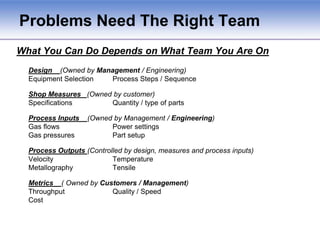
Problems Need The Right TeamWhat You Can Do Depends on What Team You Are OnDesign    (Owned by Management / Engineering)Equipment Selection	Process Steps / SequenceShop Measures   (Owned by customer)Specifications		Quantity / type of partsProcess Inputs    (Owned by Management / Engineering)Gas flows		Power settingsGas pressures		Part setupProcess Outputs (Controlled by design, measures and process inputs)Velocity		Temperature Metallography		TensileMetrics    ( Owned by Customers / Management)Throughput		Quality / SpeedCost
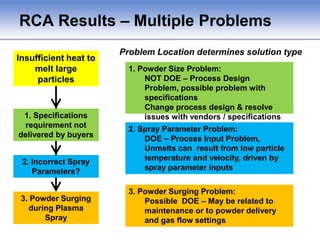
RCA Results – Multiple ProblemsProblem Location determines solution typeInsufficient heat to melt large particles1. Powder Size Problem:NOT DOE – Process Design Problem, possible problem with specificationsChange process design & resolve issues with vendors / specifications1. Specifications requirement not delivered by buyers2. Spray Parameter Problem:DOE – Process Input Problem,Unmelts can  result from low particle temperature and velocity, driven by spray parameter inputs2. Incorrect Spray Parameters?3. Powder Surging Problem:Possible  DOE – May be related to maintenance or to powder delivery and gas flow settings3. Powder Surging during Plasma Spray
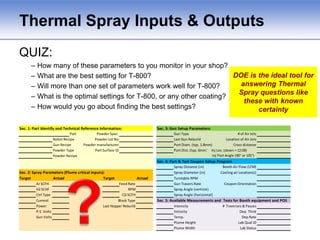
Thermal Spray Inputs & OutputsQUIZ:How many of these parameters to you monitor in your shop?What are the best setting for T-800?Will more than one set of parameters work well for T-800?What is the optimal settings for T-800, or any other coating?How would you go about finding the best settings?DOE is the ideal tool for answering Thermal Spray questions like these with known certainty?
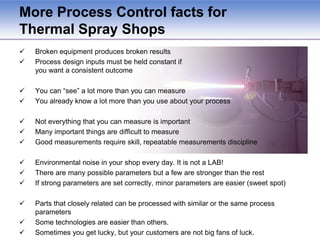
More Process Control facts for Thermal Spray ShopsBroken equipment produces broken results
Process design inputs must be held constant if you want a consistent outcome
You can “see” a lot more than you can measure
You already know a lot more than you use about your process
Not everything that you can measure is important
Many important things are difficult to measure
Good measurements require skill, repeatable measurements discipline
Environmental noise in your shop every day. It is not a LAB!
There are many possible parameters but a few are stronger than the rest
If strong parameters are set correctly, minor parameters are easier (sweet spot)
Parts that closely related can be processed with similar or the same process parameters
Some technologies are easier than others.
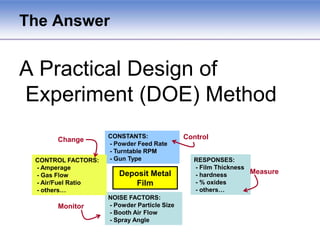
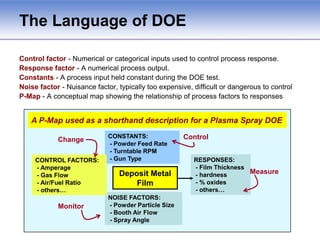
Sometimes you get lucky, but your customers are not big fans of luck.The AnswerA Practical Design of  Experiment (DOE) Method CONSTANTS: - Powder Feed Rate - Turntable RPM - Gun TypeControlChangeRESPONSES: - Film Thickness  - hardness - % oxides - others…CONTROL FACTORS: - Amperage - Gas Flow - Air/Fuel Ratio - others…MeasureDeposit Metal FilmNOISE FACTORS: - Powder Particle Size - Booth Air Flow - Spray AngleMonitor
Why DOE testing for Plasma?DOE is the recognized “World Class” approach for quickly solving difficult technical problems that have multiple controlling factors.Many “difficult” problems can be solved quicker with simpler quality tools, however the DOE planning process also uncovers and solves many of the same problems.DOE offers a “fine-tuning” approach for determination of the optimal combinations of  thermal spray parametersDOE is empirical, well suited to work in production environments and providing answers useful in realistic process environments
Progression of Engineering TestsCargo Cult - A persistent belief that wealth and beneficialresults come from spiritual means, deities, and ritualbehavior, in spite of evidence to the contrary. A common human behavior when confronted by advanced technology (see Cargo Cult Science, Pseudoscience).Trial and Error - an attempt to achieve a good process output based on intuition, guesses, and repeated testing. Often inspired but seldom repeatable.OFAT - One Factor At a Time - an attempt to define process behavior “one factor at a time”. Marginally more effective than trial and error, but conceptually blind to effect of one factor other active factors.DOE - Design of Experiments - A predetermined series of runs in which multiple factors are evaluated simultaneously to determine their individual and combined influence on the response.
Will DOE solve all my Thermal Spray Problems?One method does not work everywhere on every issueSometimes problems are easier than “DOE” solutionsComputers are great but we don’t need a computer when the only step is adding 2 numbers together…..Problems are usually complex and the RCA/DOE approach can identify what needs DOE help and what can be solved with other methods

Doe As Process Control Introduction

  • 1.
    Using Designed Experimentationas a practical introduction to Process Control in a Thermal Spray ShopKelly D. Brown, Ph.D. MBBAvalanche Process Improvement, LLCJohn Sauer, PESauer EngineeringSeptember 10, 2010
  • 2.
    Process Control in2 PartsPart 1 – Process Control Concepts and example of Thermal Spray troubleshooting with Root Cause AnalysisPart 2 – Advanced Process Control using Designed Experimentation (DOE) in a Thermal Spray operation
  • 3.
    Process Control Conceptsfor a Thermal Spray ShopShopMeasuresShopMetricsModel TS Shop ProcessSelectRecipeSpray PartMetrics are a product of the process design, measures and inputs and outputs used to spray parts. Measures – Part quantity, specifications, part prep, and more…Metrics – Production output, cycle time, quality, and more…Process Inputs – Gas flows, current, voltage, …Process Outputs – part temp, film thickness, microstructure, …Process Design – arrangement of the process steps
  • 4.
    Thermal Spray ShopControlsShopMeasuresShopMetricsModel TS Shop ProcessSelectRecipeSpray PartProcess Control Facts - 1Problems can result from errors in Measures, Inputs, Outputs, or Metrics. Problems can be caused, hidden, repaired by Process DesignOutputs become inputs for downstream processesProblems with inputs expand, or can “go underground”Process design usually determines the speed and throughput of the shopProcess inputs and outputs usually determine quality of partPoor quality “spills over” as a speed and throughput problem
  • 5.
    Thermal Spray ShopControlsShopMeasuresShopMetricsModel TS Shop ProcessSelectRecipeSpray PartProcess Control Facts - 2Processes operate with inputs and outputsProblems are generally reported as metricsRoot cause of process problems not resolved with metricsMust locate problem in the process to formulate best solution
  • 6.
    Root Cause Analysisaka, RCA or 5-Why analysis.Why?You keep asking “Why?” until you are exhausted!!!An experienced facilitator can help your organization learn to do “5-why” rightFirst Step – Root Cause AnalysisWhy?Why?Why?Why?Why?RCA IS A SIMPLE CONCEPT:Define the ProblemDefine the ProcessStart asking why until one or more actionable causes are determinedGenerate permanent corrective actionsDocument and track resultsWhy?
  • 7.
    PROBLEM:50% failure ratefrom inconsistent large un-melts found in T800 coatingsUsing Root Cause Analysis to Identify Best Fit Solutions & DOE’sPlasma?Powder ?Root Cause Analysis (5-Why) as tool to focus potential DOE improvementsNot all problems need DOE to resolve
  • 8.
    Orient DOE testingin area likely be responsible for failures
  • 9.
    Manage resource toresolve most important challenges firstSpec’s?
  • 10.
    RCA: 5-Why Analysisof T800 failure with Actionable Solutions2. Incorrect Spray Parameters?ShopMeasuresWhy?ShopMetrics3. Powder Surging during Plasma SprayModel TS Shop ProcessHigh percentage of 006G & 006S microstructure unmeltsInsufficient heat to melt large particlesSpecifications not available on floorWhy?Why?Need production right awaySelectRecipeSpray Part1. Specifications not acknowledged by vendorsWhy?Why?Unmelts and Oxides Good materials are not availableLarge Particles visible in MicrographsWhy?Engineering validation OK’s particle size varianceWhy?Vendors not asked to fix problemsWhy?Why?Large Particles in Powders
  • 11.
    Problems Need TheRight TeamWhat You Can Do Depends on What Team You Are OnDesign (Owned by Management / Engineering)Equipment Selection Process Steps / SequenceShop Measures (Owned by customer)Specifications Quantity / type of partsProcess Inputs (Owned by Management / Engineering)Gas flows Power settingsGas pressures Part setupProcess Outputs (Controlled by design, measures and process inputs)Velocity Temperature Metallography TensileMetrics ( Owned by Customers / Management)Throughput Quality / SpeedCost
  • 12.
    RCA Results –Multiple ProblemsProblem Location determines solution typeInsufficient heat to melt large particles1. Powder Size Problem:NOT DOE – Process Design Problem, possible problem with specificationsChange process design & resolve issues with vendors / specifications1. Specifications requirement not delivered by buyers2. Spray Parameter Problem:DOE – Process Input Problem,Unmelts can result from low particle temperature and velocity, driven by spray parameter inputs2. Incorrect Spray Parameters?3. Powder Surging Problem:Possible DOE – May be related to maintenance or to powder delivery and gas flow settings3. Powder Surging during Plasma Spray
  • 13.
    Thermal Spray Inputs& OutputsQUIZ:How many of these parameters to you monitor in your shop?What are the best setting for T-800?Will more than one set of parameters work well for T-800?What is the optimal settings for T-800, or any other coating?How would you go about finding the best settings?DOE is the ideal tool for answering Thermal Spray questions like these with known certainty?
  • 14.
    More Process Controlfacts for Thermal Spray ShopsBroken equipment produces broken results
  • 15.
    Process design inputsmust be held constant if you want a consistent outcome
  • 16.
    You can “see”a lot more than you can measure
  • 17.
    You already knowa lot more than you use about your process
  • 18.
    Not everything thatyou can measure is important
  • 19.
    Many important thingsare difficult to measure
  • 20.
    Good measurements requireskill, repeatable measurements discipline
  • 21.
    Environmental noise inyour shop every day. It is not a LAB!
  • 22.
    There are manypossible parameters but a few are stronger than the rest
  • 23.
    If strong parametersare set correctly, minor parameters are easier (sweet spot)
  • 24.
    Parts that closelyrelated can be processed with similar or the same process parameters
  • 25.
    Some technologies areeasier than others.
  • 26.
    Sometimes you getlucky, but your customers are not big fans of luck.The AnswerA Practical Design of Experiment (DOE) Method CONSTANTS: - Powder Feed Rate - Turntable RPM - Gun TypeControlChangeRESPONSES: - Film Thickness - hardness - % oxides - others…CONTROL FACTORS: - Amperage - Gas Flow - Air/Fuel Ratio - others…MeasureDeposit Metal FilmNOISE FACTORS: - Powder Particle Size - Booth Air Flow - Spray AngleMonitor
  • 27.
    Why DOE testingfor Plasma?DOE is the recognized “World Class” approach for quickly solving difficult technical problems that have multiple controlling factors.Many “difficult” problems can be solved quicker with simpler quality tools, however the DOE planning process also uncovers and solves many of the same problems.DOE offers a “fine-tuning” approach for determination of the optimal combinations of thermal spray parametersDOE is empirical, well suited to work in production environments and providing answers useful in realistic process environments
  • 28.
    Progression of EngineeringTestsCargo Cult - A persistent belief that wealth and beneficialresults come from spiritual means, deities, and ritualbehavior, in spite of evidence to the contrary. A common human behavior when confronted by advanced technology (see Cargo Cult Science, Pseudoscience).Trial and Error - an attempt to achieve a good process output based on intuition, guesses, and repeated testing. Often inspired but seldom repeatable.OFAT - One Factor At a Time - an attempt to define process behavior “one factor at a time”. Marginally more effective than trial and error, but conceptually blind to effect of one factor other active factors.DOE - Design of Experiments - A predetermined series of runs in which multiple factors are evaluated simultaneously to determine their individual and combined influence on the response.
  • 29.
    Will DOE solveall my Thermal Spray Problems?One method does not work everywhere on every issueSometimes problems are easier than “DOE” solutionsComputers are great but we don’t need a computer when the only step is adding 2 numbers together…..Problems are usually complex and the RCA/DOE approach can identify what needs DOE help and what can be solved with other methods

Editor's Notes

  • #2 Thanks to good folks at Tinker AFB and Mickey Carroll for providing much of the insight that makes this presentation possible.
  • #3 Good process control can be achieved without DOE, but failure to control your process will absolutely ruin your DOE efforts.Start with part 1, and continue with 2.In the best DOE applications – Part 1 and Part 2 evolve simultaneously and continuously.
  • #4 Metrics can’t drive the shop. People (and their decisions) drive the shop. Processes don’t care much about metrics, but care a lot about process inputs and outputs.Metrics can be used to drive people to excellence, or to lunacy!!!
  • #5 Process problems that “go underground” have a particularly annoying habit of showing up later, much like an unwanted house guest.Frequently we focus on the immediate source of the pain, when the best solution is far upstream.Quality problems are cheaper to fix, the further you catch them upstream.Inconsistent processes are a “for sure” sign that you have a hidden process problem upstream.
  • #6 Problems live in the “gritty details” of design/inputs/outputs Problems are felt at the system level as quality, cost, or delaysGOOD NEWS – Carefully mapping and defining your process can solve a lot of quality and throughput problems quickly.BAD NEWS – You must make follow through solving the various problems you uncover before you can expect improvement.GOOD NEWS / BAD NEWS – Problems interact with each other, like a gaggle of teenage girls. The more you have in a roomthe louder it gets! However solving the simple problems makes the difficult problems less challenging.
  • #7 Explicitly include a process map for a complex process like a thermal spray shop in your RCA analysis.It is important to make sure you understand the location of the problem, as well as some idea the quantity or frequency of the quality spill to ensure your RCA has gone “deep enough”.
  • #8 Actual Problem – persisted for months. Names of the process owners withheld to protect the innocent.
  • #9 A note the location of the RCA problems on the Process Map – important for more to be sure the solution fits!Problem is intermittent, which demands that the solution be “more” than a spray parameter change.Improvements in one part of the system will likely lead to overall improvements, i.e. failure rates improved from 50% to ??%
  • #10 What are additional parameters important for a Thermal Spray Shop?Are they all equally important all the time.Be certain you have the right team for the problem, and that the team has the authority to make the needed changes before you start creating solutions! If you don’t own the problem it can be very difficult to fix.
  • #11 Actual answers to 50% T-800 rejects problem.Improving the purchasing/lot qualification process impacts more than T-800Powder surging also not specific to T-800, but may be located in a particular booth where T-800 is sprayed.
  • #12 As many different opinions on how to fix the problem as there are parameters we need to control !!So how do we figure out what parameter to test and if we think it is more than oneWill have the answer in a couple years……………We are taught to only change one variable at a time to understand the effect……..What do you do when 1 parameter affects another parameter…..
  • #13 You don’t need DOE to benefit from these process control facts. However knowing something is quite a bit different thanputting what you know to practical use.Many of the benefits of running a DOE are achieved during the planning and preparation phase. Running a DOE will teachthese process control facts a lot more effectively than simply talking about them.
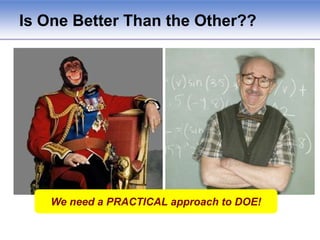
  • #15 DOE is NOT a science experiment, rather an Engineering experiment. What’s the difference?A good scientist is not beyond learning from an engineering experiment (and vice versa).The best DOE’s start incorporate the best available knowledge and then improve on those results.
  • #16 Engineers and scientist traditionally taught OFAT in school. Easy to understand. Many technical people Intuitively get “OFAT” testing, but then have a difficult time explaining and controlling “complex” processes.The problem is not with their brains, but with the tools they are using. Good Measurements are absolutelycritical to the learning process. No point in testing without measurements you trust.
  • #17 NO! But DOE is the only method that provides solutions for the class of problems with multiple inputs controlling process outputs.DOE for troubleshooting works best when a problem has been properly locate and isolated to a single process step.Leave DOE experiments across multiple process steps to experienced practitioners and process modelers.
  • #18 DOE experimentation provides multi-parameter solutions and can teach an organization about process fundamentals related to design, monitoring, measuring and controlling process inputs to achieve a desired and controllable output.
  • #19 The locations on the diagram indicate intentional “choices” of how to handle process inputs and outputs. The number andlocation of the parameters on the map determine the proper DOE matrix (i.e.) test to use. You must make every effort to locate and manage all the process inputs and output for DOE success.In many cases, you simply hold them constant (control), or monitor them (noise).
  • #20 Use an experienced DOE consultant to run this sort of test. You may not like the conditions or the approach of the consultant, But consider they have but “1-shot” to get it right in an environment not conducive to good process control.GOOD NEWS – Experience DOE practitioners can generate fantastic results even when they don’t have particular expertise inyour process area and work against many process constraints. Better still, make them part of your team and everyone will benefit.
  • #21 INVOLVE FOLKS IN ALL STEPS - LONGER IMPLEMENTATION TIME - MORE PRACTICAL APPLICATIONORGANIC - TRAINS STAFF FOR FUTURE EFFORTSConsultant able to work with and train with much smaller DOE tests in an incremental approach to improvement
  • #22 The Project and the Operational models address different needs and organizational expectationsA learning organization tends to move from the project model towards the operational model over timeBoth models work well and use the same process and planning stepsGOOD NEWS – DOE can be approached stepwise to gain some of the benefits of both models.Which model works best really depends on the culture of the receiving organization.
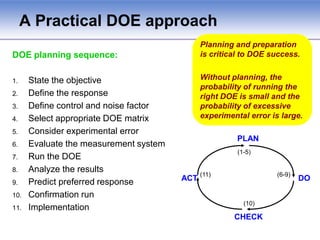
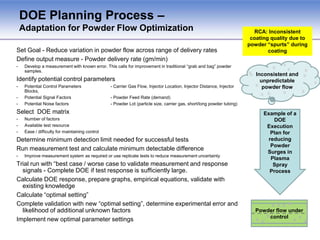
  • #23 Consistently successful DOE tests follow a process with a lot of controls, just like a good manufacturing process.DOE is no place to “plan” to get lucky. If the result you seek is not important enough to take the DOE process seriously, then the improvement need likely likes outside the parameters of the process. Mike Holbrook, a reliability engineer and renown DOE expert and Robust Engineering first showed me this DOE planning sequence.
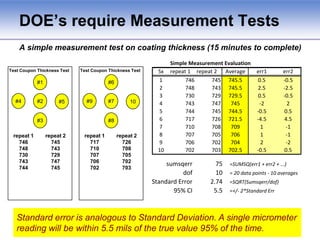
  • #24 DOE’s are empirical models of your test results. The DOE model is not any better than the quality of the test results. There are easy measurement tests that will guide the DOE practitioner in setting up a successful DOE test. Results from the Measurement Tests will be used to determine when a “difference” between 2 results is meaningful.
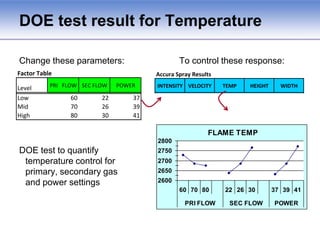
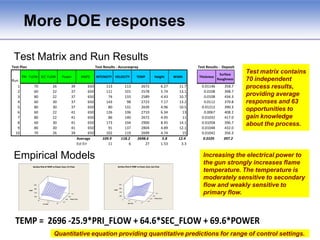
  • #25 A DOE calculates the effect of each parameter tested “independent” of the other parameters. This type of result makes it easyTo determine “which way to turn the knobs” without further calculations, and which parameters have the strongest impact.How do these results reflect your previous knowledge?
  • #26 BUT WAIT, THERE’S MORE!!! Much Much More…. Properly designed DOE’s also predict how factors interact with each other.(Good news for the process owner, interactions not observed for this test result. The process will be easier to understand and control!)DOE’s can be used to predict the process outcomes for any test point “inside the range”, allowing for predictions of the best possiblefactor combinations and settings. DOE model results are validated in the DOE confirmation step.
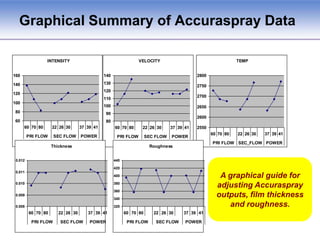
  • #27 A graphical guide to adjusting powder intensity, velocity and temperature, along with film thickness and roughness.Controlling your process no longer has to be with “trial and error” or rely on intuition and experience. This type of knowledge will let your organization “Engineer’ the process results.
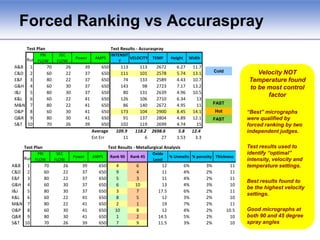
  • #28 Adaptation of Micrographic “forced ranking” to resolve most likely “best” parameters using a poorly qualified measurement system.The results are BETTER than the individual micrographs, as they combine NOISE observations for an improved average result.Trends in data can become apparent, even when many of the micrographs are “close”.