What is the Ring of Fire
   A zone along the edge of Pacific Ocean that has
    many Volcanoes and Earthquakes.( Source 2)
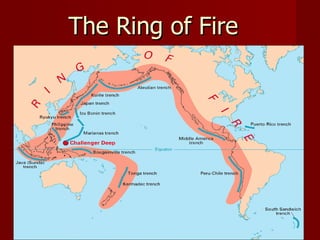
   The horseshoe shaped belt stretches about
    25,000 miles from New Zealand northwest to the
    Philippines, northeast to Japan, east to Alaska,
    and South to Oregon, California, Mexico, and the
    Andes Mountains of South America.( Source 2)
   It is a large ring of Stratovolcanoes circling the
    Pacific Ocean.( Source 3)
The Ring of Fire
How many Volcanoes and
    Earthquakes are in the Ring of
                Fire?
 About 350 historically active Volcanoes in
  the Ring of Fire.( Source 2)
 Home to 452 Volcanoes and 75% of
  worlds active and dormant Volcanoes.
  ( Source 1)
 90% of the worlds earthquakes are on the
  Ring of Fire.( Source 1)
 89% of worlds largest earthquakes
  happen along Ring of Fire.( Source 1)
How was the Ring of Fire made?
   It is associated with a nearly continuous
    series of oceanic trenches, volcanic arcs,
    and volcanic belts, and/or plate
    movements.( Source 1)
What is affected because of the
             Ring of Fire?
 4 Continents are affected because of the
  Ring of Fire ( Asia, Oceania, North
  America, and South America.) ( Source 1)
 8 Tectonic Plates are affected ( Pacific
  plate, Cocos plate, Nazca plate, Philippine
  plate, North American plate, Eurasian
  plate, Indo-Australia, and South American
  plate.) ( Source 2)
What is the best known dormant
     Volcanoes in the Ring of Fire?
 Top 5 most known Dormant Volcanoes in
  Ring of Fire are…. ( Source 4)
 1: MT. Rainier
 2: MT. Fuji
 3: MT. Hood
 4: MT. Shasta
 5: MT. Edgecumbe
Are the Volcanoes in the Hawaiian
 Islands part of the Ring of Fire?
   Mona Loa and Kilauea in the Hawaiian
    Islands are not part of the Ring of Fire.
    ( Source 2)
What are some examples of
    Volcanoes or Earthquakes that
        are on the Ring of Fire
   Some examples are……
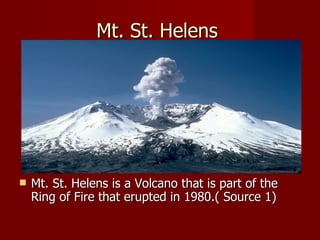
Mt. St. Helens


   Mt. St. Helens is a Volcano that is part of the
    Ring of Fire that erupted in 1980.( Source 1)
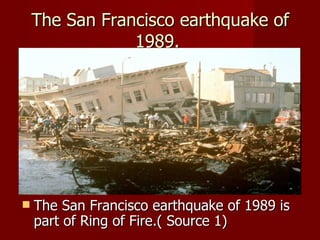
The San Francisco earthquake of
                1989.


   The San Francisco earthquake of 1989 is
    part of Ring of Fire.( Source 1)
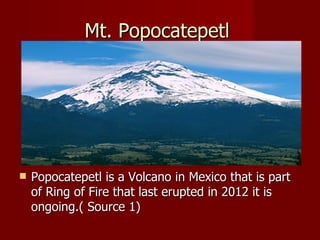
Mt. Popocatepetl


   Popocatepetl is a Volcano in Mexico that is part
    of Ring of Fire that last erupted in 2012 it is
    ongoing.( Source 1)
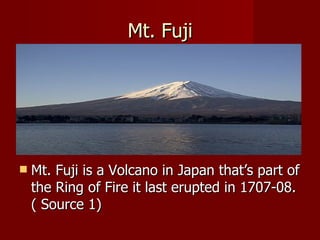
Mt. Fuji


   Mt. Fuji is a Volcano in Japan that’s part of
    the Ring of Fire it last erupted in 1707-08.
    ( Source 1)
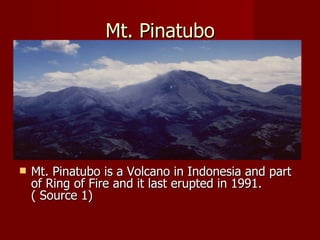
Mt. Pinatubo


   Mt. Pinatubo is a Volcano in Indonesia and part
    of Ring of Fire and it last erupted in 1991.
    ( Source 1)
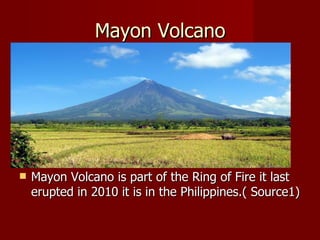
Mayon Volcano


   Mayon Volcano is part of the Ring of Fire it last
    erupted in 2010 it is in the Philippines.( Source1)
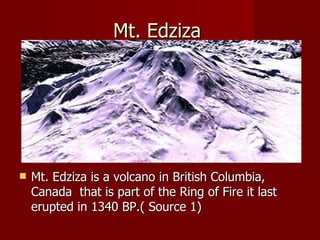
Mt. Edziza


   Mt. Edziza is a volcano in British Columbia,
    Canada that is part of the Ring of Fire it last
    erupted in 1340 BP.( Source 1)
Chile
   Chile ( located in South America and is
    part of Ring of Fire) holds the record for
    the largest earthquake ever recorded in
    1960 at 9.5.( Source 1)
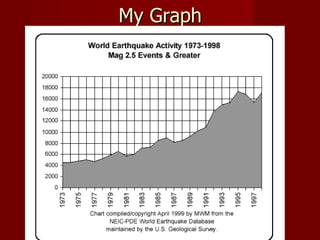
My Graph


           17
Bibliography
 Source 1: Wikimedia Foundation, INC.
  (March 19 2012) The Pacific Ring of Fire.
  Wikipedia. March 19 2012. <
  http://en.wikipedia.org/wiki/Pacific_Ring_of_Fir
  >
 Source 2: World Book, INC. (2005) World
  Book encyclopedia 2005 edition.
  Chicago,Illinois: World Book, INC.
 Source 3: BrainPOP. (1999-2012).
  Volcanoes. BrainPop. (March 19 2012). <
  http://www.brainpop.com/>
                                        18
                                        18
Bibliography (continued...)
   Source 4: Yahoo! (2012) What are the top
    5 most known dormant volcanoes in the
    ring of fire? Yahoo! Answers. (March 19
    2012). <http://answers.yahoo.com/>


                                      19
                                      19
My Experiment
Question:
Would the area surrounding Mt. Pinatubo or
 the Mayon Volcano be most effected by
 one volcanic eruption?
Hypothesis

    I think that the Mayon Volcano would be
    most effected because that the volcano is
    just going up like a roof and it has a lot of
    little trenches that would help the lava
    flow through them like streams and it
    would get to the towns quicker than it
    would to Mt. Pinatubo.

                                           21
                                           21
Materials
  2 5lb air dry modeling clay
 2 Gatorade bottles
 2 cookie pans
 Vinegar
 Baking Soda
 2 measuring cups
 Dawn dishwashing detergent
 Monopoly houses and hotels
                                 22
                                 22
Materials (continued...)
 a funnel
 a tablespoon
 warm tap water
 red food coloring


                                 23
                                 23
Procedure
 1. Place the empty Gatorade bottle on the
  cookie pan,
 2. Place the air dry clay around the
  Gatorade bottle
 3. Smooth out the clay to look like a
  replica of the volcano being compared.
 4. Repeat steps 1-3 once more
 5. Pick one of the volcanoes made to
  experiment on first
                                     24
                                     24
Procedure (continued....)
 6. Pour 3/5 of a cup of vinegar in one of
  the measuring cups
 7. Pour 1 cup of warm water in the other
  measuring cup
 8. Put 5 drops of red food coloring in the
  warm water
 9. Pour 1/2 of the water in the bottle
 10. Pour 2 drops of dishwashing detergent
  in the bottle
                                      25
                                      25
Procedure (continued...)
 11. Pour all 3/5 of the vinegar in the bottle
 12. Scoop 1 tablespoon of baking soda
 13. Place the 1 scoop in the bottle
 14. Watch and enjoy


                                        26
Variables
– Controlled Variables:
   Type of Clay
   Type/amount used of Baking soda
   Type/amount used of vineagar
   Type/amount used of dishwashing detergent
   Type of center for volcano
   Type/amount of food coloring
– Independent Variables:
   Size of Volcano
   Shape of Volcano
   Number of houses at base of volcano
– Dependent Variables:
   The formant of the surface of the volcano   27
                                                27
Conclusion
   My hypothesis was wrong I thought that
    the Mayon Volcano would do more
    damage because of the trenches in the
    area surrounding it. But it didn’t. The
    reason that Mt. Pinatubo did more
    damage is because that the mouth of Mt.
    Pinatubo is wider and would allow more
    lava to be released to the open area.
    Another reason is that Mt. Pinatubo on its
    eruption is that the lava poured down on
    all fours of the volcano.            28
                                         28
Conclusion (continued...)
   Also that since Mt. Pinatubo is smaller and
    closer to the ground the lava would flow
    faster from a smaller thing to the ground.
    I would change the fact to use
    dishwashing detergent and the volcanoes
    that are being compared.


                                         29
                                         29
My Experiment


                30
                30

The ring of fire 3

  • 1.
    What is theRing of Fire  A zone along the edge of Pacific Ocean that has many Volcanoes and Earthquakes.( Source 2)  The horseshoe shaped belt stretches about 25,000 miles from New Zealand northwest to the Philippines, northeast to Japan, east to Alaska, and South to Oregon, California, Mexico, and the Andes Mountains of South America.( Source 2)  It is a large ring of Stratovolcanoes circling the Pacific Ocean.( Source 3)
  • 2.
  • 3.
    How many Volcanoesand Earthquakes are in the Ring of Fire?  About 350 historically active Volcanoes in the Ring of Fire.( Source 2)  Home to 452 Volcanoes and 75% of worlds active and dormant Volcanoes. ( Source 1)  90% of the worlds earthquakes are on the Ring of Fire.( Source 1)  89% of worlds largest earthquakes happen along Ring of Fire.( Source 1)
  • 4.
    How was theRing of Fire made?  It is associated with a nearly continuous series of oceanic trenches, volcanic arcs, and volcanic belts, and/or plate movements.( Source 1)
  • 5.
    What is affectedbecause of the Ring of Fire?  4 Continents are affected because of the Ring of Fire ( Asia, Oceania, North America, and South America.) ( Source 1)  8 Tectonic Plates are affected ( Pacific plate, Cocos plate, Nazca plate, Philippine plate, North American plate, Eurasian plate, Indo-Australia, and South American plate.) ( Source 2)
  • 6.
    What is thebest known dormant Volcanoes in the Ring of Fire?  Top 5 most known Dormant Volcanoes in Ring of Fire are…. ( Source 4)  1: MT. Rainier  2: MT. Fuji  3: MT. Hood  4: MT. Shasta  5: MT. Edgecumbe
  • 7.
    Are the Volcanoesin the Hawaiian Islands part of the Ring of Fire?  Mona Loa and Kilauea in the Hawaiian Islands are not part of the Ring of Fire. ( Source 2)
  • 8.
    What are someexamples of Volcanoes or Earthquakes that are on the Ring of Fire  Some examples are……
  • 9.
    Mt. St. Helens  Mt. St. Helens is a Volcano that is part of the Ring of Fire that erupted in 1980.( Source 1)
  • 10.
    The San Franciscoearthquake of 1989.  The San Francisco earthquake of 1989 is part of Ring of Fire.( Source 1)
  • 11.
    Mt. Popocatepetl  Popocatepetl is a Volcano in Mexico that is part of Ring of Fire that last erupted in 2012 it is ongoing.( Source 1)
  • 12.
    Mt. Fuji  Mt. Fuji is a Volcano in Japan that’s part of the Ring of Fire it last erupted in 1707-08. ( Source 1)
  • 13.
    Mt. Pinatubo  Mt. Pinatubo is a Volcano in Indonesia and part of Ring of Fire and it last erupted in 1991. ( Source 1)
  • 14.
    Mayon Volcano  Mayon Volcano is part of the Ring of Fire it last erupted in 2010 it is in the Philippines.( Source1)
  • 15.
    Mt. Edziza  Mt. Edziza is a volcano in British Columbia, Canada that is part of the Ring of Fire it last erupted in 1340 BP.( Source 1)
  • 16.
    Chile  Chile ( located in South America and is part of Ring of Fire) holds the record for the largest earthquake ever recorded in 1960 at 9.5.( Source 1)
  • 17.
  • 18.
    Bibliography  Source 1:Wikimedia Foundation, INC. (March 19 2012) The Pacific Ring of Fire. Wikipedia. March 19 2012. < http://en.wikipedia.org/wiki/Pacific_Ring_of_Fir >  Source 2: World Book, INC. (2005) World Book encyclopedia 2005 edition. Chicago,Illinois: World Book, INC.  Source 3: BrainPOP. (1999-2012). Volcanoes. BrainPop. (March 19 2012). < http://www.brainpop.com/> 18 18
  • 19.
    Bibliography (continued...)  Source 4: Yahoo! (2012) What are the top 5 most known dormant volcanoes in the ring of fire? Yahoo! Answers. (March 19 2012). <http://answers.yahoo.com/> 19 19
  • 20.
    My Experiment Question: Would thearea surrounding Mt. Pinatubo or the Mayon Volcano be most effected by one volcanic eruption?
  • 21.
    Hypothesis  I think that the Mayon Volcano would be most effected because that the volcano is just going up like a roof and it has a lot of little trenches that would help the lava flow through them like streams and it would get to the towns quicker than it would to Mt. Pinatubo. 21 21
  • 22.
    Materials  25lb air dry modeling clay  2 Gatorade bottles  2 cookie pans  Vinegar  Baking Soda  2 measuring cups  Dawn dishwashing detergent  Monopoly houses and hotels 22 22
  • 23.
    Materials (continued...)  afunnel  a tablespoon  warm tap water  red food coloring 23 23
  • 24.
    Procedure  1. Placethe empty Gatorade bottle on the cookie pan,  2. Place the air dry clay around the Gatorade bottle  3. Smooth out the clay to look like a replica of the volcano being compared.  4. Repeat steps 1-3 once more  5. Pick one of the volcanoes made to experiment on first 24 24
  • 25.
    Procedure (continued....)  6.Pour 3/5 of a cup of vinegar in one of the measuring cups  7. Pour 1 cup of warm water in the other measuring cup  8. Put 5 drops of red food coloring in the warm water  9. Pour 1/2 of the water in the bottle  10. Pour 2 drops of dishwashing detergent in the bottle 25 25
  • 26.
    Procedure (continued...)  11.Pour all 3/5 of the vinegar in the bottle  12. Scoop 1 tablespoon of baking soda  13. Place the 1 scoop in the bottle  14. Watch and enjoy 26
  • 27.
    Variables – Controlled Variables:  Type of Clay  Type/amount used of Baking soda  Type/amount used of vineagar  Type/amount used of dishwashing detergent  Type of center for volcano  Type/amount of food coloring – Independent Variables:  Size of Volcano  Shape of Volcano  Number of houses at base of volcano – Dependent Variables:  The formant of the surface of the volcano 27 27
  • 28.
    Conclusion  My hypothesis was wrong I thought that the Mayon Volcano would do more damage because of the trenches in the area surrounding it. But it didn’t. The reason that Mt. Pinatubo did more damage is because that the mouth of Mt. Pinatubo is wider and would allow more lava to be released to the open area. Another reason is that Mt. Pinatubo on its eruption is that the lava poured down on all fours of the volcano. 28 28
  • 29.
    Conclusion (continued...)  Also that since Mt. Pinatubo is smaller and closer to the ground the lava would flow faster from a smaller thing to the ground. I would change the fact to use dishwashing detergent and the volcanoes that are being compared. 29 29
  • 30.