Etymology
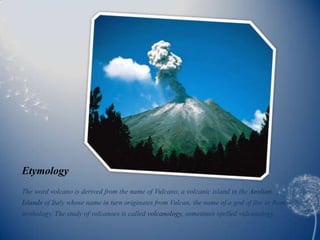
The word volcano is derived from the name of Vulcano, a volcanic island in the Aeolian
Islands of Italy whose name in turn originates from Vulcan, the name of a god of fire in Roman
mythology. The study of volcanoes is called volcanology, sometimes spelled vulcanology.
Defination


   A volcano is an opening, or rupture, in a planet's surface or crust, which
    allows hot magma, volcanic ash and gases to escape from below the
    surface.


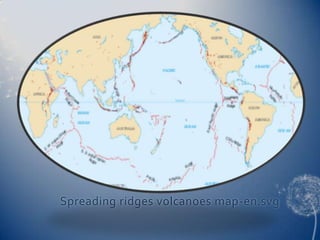
   Volcanoes are generally found where tectonic
    plates are diverging or converging. A mid-oceanic ridge, for example
    the Mid-Atlantic Ridge, has examples of volcanoes caused bydivergent
    tectonic plates pulling apart; the Pacific Ring of Fire has examples of
    volcanoes caused by convergent tectonic plates coming together.
Another form of Volcano
Volcanoes can also form where there is stretching and thinning of the Earth's
crust in the interiors of plates, e.g., in the East African Rift, the Wells Gray-
Clearwater volcanic field and the Rio Grande Rift in North America. This type
of volcanism falls under the umbrella of "Plate hypothesis" volcanism.

 Volcanism away from plate boundaries has also been explained as mantle
plumes. These so-called "hotspots", for example Hawaii, are postulated to arise
from upwelling diapirs with magma from the core-mantle boundary, 3,000 km
deep in the Earth.
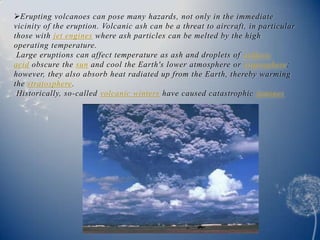
Erupting volcanoes can pose many hazards, not only in the immediate
vicinity of the eruption. Volcanic ash can be a threat to aircraft, in particular
those with jet engines where ash particles can be melted by the high
operating temperature.
 Large eruptions can affect temperature as ash and droplets of sulfuric
acid obscure the sun and cool the Earth's lower atmosphere or troposphere;
however, they also absorb heat radiated up from the Earth, thereby warming
the stratosphere.
 Historically, so-called volcanic winters have caused catastrophic famines.
Plate tectonics
Divergent plate boundaries
At the mid-oceanic ridges, two tectonic plates diverge from one another.
New oceanic crust is being formed by hot molten rock slowly cooling and
solidifying. The crust is very thin at mid -oceanic ridges due to the pull of the
tectonic plates. The release of pressure due to the thinning of the crust leads
to adiabatic expansion, and the partial melting of the mantle causing
volcanism and creating new oceanic crust. Most divergent plate boundaries are
at the bottom of the oceans, therefore most volcanic activity is submarine,
forming new seafloor. Black smokers or deep sea vents are an example of this
kind of volcanic activity. Where the mid -oceanic ridge is above sea-level,
volcanic islands are formed, for example, Iceland.

Convergent plate boundaries
Subduction zones are places where two plates, usually an oceanic plate and a
continental plate, collide. In this case, the oceanic plate subducts, or
submerges under the continental plate forming a deep ocean trench just
offshore. Water released from the subducting plate lowers the melting
temperature of the overlying mantle wedge, creating magma. This magma tends
to be very viscous due to its high silica content, so often does not reach the
surface and cools at depth. When it does reach the surface, a volcano is
formed. Typical examples for this kind of volcano are Mount Etna and the
volcanoes in the Pacific Ring of Fire.
Spreading ridges volcanoes map-en.svg
Volcanic features

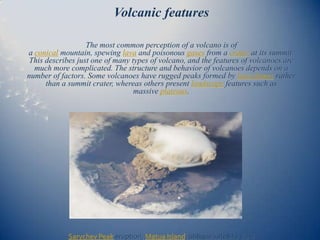
                   The most common perception of a volcano is of
a conical mountain, spewing lava and poisonous gases from a crater at its summit.
 This describes just one of many types of volcano, and the features of volcanoes are
  much more complicated. The structure and behavior of volcanoes depends on a
number of factors. Some volcanoes have rugged peaks formed by lava domes rather
      than a summit crater, whereas others present landscape features such as
                                  massive plateaus.


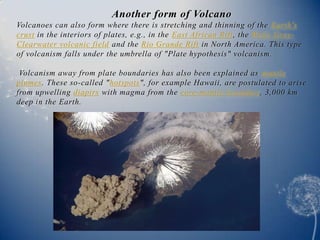
            Sarychev Peak eruption, Matua Island, oblique satellite view
Stratovolcanoes (composite volcanoes)
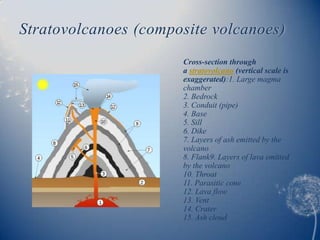
                      Cross-section through
                      a stratovolcano (vertical scale is
                      exaggerated):1. Large magma
                      chamber
                      2. Bedrock
                      3. Conduit (pipe)
                      4. Base
                      5. Sill
                      6. Dike
                      7. Layers of ash emitted by the
                      volcano
                      8. Flank9. Layers of lava emitted
                      by the volcano
                      10. Throat
                      11. Parasitic cone
                      12. Lava flow
                      13. Vent
                      14. Crater
                      15. Ash cloud
Effects of                            The concentrations of different volcanic gases can
                                        vary considerably from one volcano to the
 volcanoes                              next. Water vapor is typically the most abundant
                                        volcanic gas, followed by carbon dioxide and sulfur
                                        dioxide.

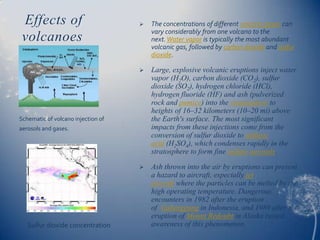
                                       Large, explosive volcanic eruptions inject water
                                        vapor (H2O), carbon dioxide (CO2), sulfur
                                        dioxide (SO2), hydrogen chloride (HCl),
                                        hydrogen fluoride (HF) and ash (pulverized
                                        rock and pumice) into the stratosphere to
                                        heights of 16–32 kilometers (10–20 mi) above
Schematic of volcano injection of       the Earth's surface. The most significant
aerosols and gases.                     impacts from these injections come from the
                                        conversion of sulfur dioxide to sulfuric
                                        acid (H2SO4), which condenses rapidly in the
                                        stratosphere to form fine sulfate aerosols.

                                       Ash thrown into the air by eruptions can present
                                        a hazard to aircraft, especially jet
                                        aircraft where the particles can be melted by the
                                        high operating temperature. Dangerous
                                        encounters in 1982 after the eruption
                                        of Galunggung in Indonesia, and 1989 after the
                                        eruption of Mount Redoubt in Alaska raised
   Sulfur dioxide concentration         awareness of this phenomenon.
Traditional beliefs about volcanoes
Many ancient accounts ascribe volcanic eruptions to supernatural
causes, such as the actions of gods or demigods. To the ancient
Greeks, volcanoes' capricious power could only be explained as acts
of the gods, while 16th/17th-century German astronomer
JohannesKepler believed they were ducts for the Earth's tears. One
early idea counter to this was proposed
by Jesuit AthanasiusKircher (1602–1680), who witnessed eruptions
of Mount Etna and Stromboli, then visited the crater of Vesuvius and
published his view of an Earth with a central fire connected to
numerous others caused by the burning of sulfur, bitumen and coal.
Teju ppt

Teju ppt

  • 3.
    Etymology The word volcanois derived from the name of Vulcano, a volcanic island in the Aeolian Islands of Italy whose name in turn originates from Vulcan, the name of a god of fire in Roman mythology. The study of volcanoes is called volcanology, sometimes spelled vulcanology.
  • 4.
    Defination  A volcano is an opening, or rupture, in a planet's surface or crust, which allows hot magma, volcanic ash and gases to escape from below the surface.  Volcanoes are generally found where tectonic plates are diverging or converging. A mid-oceanic ridge, for example the Mid-Atlantic Ridge, has examples of volcanoes caused bydivergent tectonic plates pulling apart; the Pacific Ring of Fire has examples of volcanoes caused by convergent tectonic plates coming together.
  • 5.
    Another form ofVolcano Volcanoes can also form where there is stretching and thinning of the Earth's crust in the interiors of plates, e.g., in the East African Rift, the Wells Gray- Clearwater volcanic field and the Rio Grande Rift in North America. This type of volcanism falls under the umbrella of "Plate hypothesis" volcanism. Volcanism away from plate boundaries has also been explained as mantle plumes. These so-called "hotspots", for example Hawaii, are postulated to arise from upwelling diapirs with magma from the core-mantle boundary, 3,000 km deep in the Earth.
  • 6.
    Erupting volcanoes canpose many hazards, not only in the immediate vicinity of the eruption. Volcanic ash can be a threat to aircraft, in particular those with jet engines where ash particles can be melted by the high operating temperature. Large eruptions can affect temperature as ash and droplets of sulfuric acid obscure the sun and cool the Earth's lower atmosphere or troposphere; however, they also absorb heat radiated up from the Earth, thereby warming the stratosphere. Historically, so-called volcanic winters have caused catastrophic famines.
  • 7.
    Plate tectonics Divergent plateboundaries At the mid-oceanic ridges, two tectonic plates diverge from one another. New oceanic crust is being formed by hot molten rock slowly cooling and solidifying. The crust is very thin at mid -oceanic ridges due to the pull of the tectonic plates. The release of pressure due to the thinning of the crust leads to adiabatic expansion, and the partial melting of the mantle causing volcanism and creating new oceanic crust. Most divergent plate boundaries are at the bottom of the oceans, therefore most volcanic activity is submarine, forming new seafloor. Black smokers or deep sea vents are an example of this kind of volcanic activity. Where the mid -oceanic ridge is above sea-level, volcanic islands are formed, for example, Iceland. Convergent plate boundaries Subduction zones are places where two plates, usually an oceanic plate and a continental plate, collide. In this case, the oceanic plate subducts, or submerges under the continental plate forming a deep ocean trench just offshore. Water released from the subducting plate lowers the melting temperature of the overlying mantle wedge, creating magma. This magma tends to be very viscous due to its high silica content, so often does not reach the surface and cools at depth. When it does reach the surface, a volcano is formed. Typical examples for this kind of volcano are Mount Etna and the volcanoes in the Pacific Ring of Fire.
  • 8.
  • 9.
    Volcanic features The most common perception of a volcano is of a conical mountain, spewing lava and poisonous gases from a crater at its summit. This describes just one of many types of volcano, and the features of volcanoes are much more complicated. The structure and behavior of volcanoes depends on a number of factors. Some volcanoes have rugged peaks formed by lava domes rather than a summit crater, whereas others present landscape features such as massive plateaus. Sarychev Peak eruption, Matua Island, oblique satellite view
  • 10.
    Stratovolcanoes (composite volcanoes) Cross-section through a stratovolcano (vertical scale is exaggerated):1. Large magma chamber 2. Bedrock 3. Conduit (pipe) 4. Base 5. Sill 6. Dike 7. Layers of ash emitted by the volcano 8. Flank9. Layers of lava emitted by the volcano 10. Throat 11. Parasitic cone 12. Lava flow 13. Vent 14. Crater 15. Ash cloud
  • 11.
    Effects of  The concentrations of different volcanic gases can vary considerably from one volcano to the volcanoes next. Water vapor is typically the most abundant volcanic gas, followed by carbon dioxide and sulfur dioxide.  Large, explosive volcanic eruptions inject water vapor (H2O), carbon dioxide (CO2), sulfur dioxide (SO2), hydrogen chloride (HCl), hydrogen fluoride (HF) and ash (pulverized rock and pumice) into the stratosphere to heights of 16–32 kilometers (10–20 mi) above Schematic of volcano injection of the Earth's surface. The most significant aerosols and gases. impacts from these injections come from the conversion of sulfur dioxide to sulfuric acid (H2SO4), which condenses rapidly in the stratosphere to form fine sulfate aerosols.  Ash thrown into the air by eruptions can present a hazard to aircraft, especially jet aircraft where the particles can be melted by the high operating temperature. Dangerous encounters in 1982 after the eruption of Galunggung in Indonesia, and 1989 after the eruption of Mount Redoubt in Alaska raised Sulfur dioxide concentration awareness of this phenomenon.
  • 12.
    Traditional beliefs aboutvolcanoes Many ancient accounts ascribe volcanic eruptions to supernatural causes, such as the actions of gods or demigods. To the ancient Greeks, volcanoes' capricious power could only be explained as acts of the gods, while 16th/17th-century German astronomer JohannesKepler believed they were ducts for the Earth's tears. One early idea counter to this was proposed by Jesuit AthanasiusKircher (1602–1680), who witnessed eruptions of Mount Etna and Stromboli, then visited the crater of Vesuvius and published his view of an Earth with a central fire connected to numerous others caused by the burning of sulfur, bitumen and coal.