by: Sam Oncken
The Earth rotates and this
happens…

 Day and night are caused by Earth rotating.
  No.1
 Because of Earths rotation the sun rises in the
  east and sets in the west. No. 1
 Even though it looks like the sun and stars are
  moving it is the Earth that is actually moving.
  No. 4
Solar/Sidereal day
 The Earth rotates more than once per solar
  day because it moves a little in its orbit
  around the sun each day. No. 2
 A sidereal ay is not one full day but 23 hours
  56 minutes and 4 seconds No. 2
Circumferences of…

 The circumference of Earths equator is
  25,000 miles long. No. 5
 The circumference of Earths orbit around the
  sun is 940 million kilometers. No. 5
Axis equator differences/facts

  The Earths rotates on its axis. No. 1
  The axis is the imaginary line in the middle of
   Earth. No.5
  The earths axis could be called its rotational
   axis. No.1
  The equator is the imaginary line that is zero
   degrees latitude which cuts Earth in two.
  The axis connects the north and the south
   poles. No. 2
How Earths rotation is
predicted…
 Scientist predict Earths rotation with Satellite
  Laser Ranging. No. 3
 Also with the Global Positioning system and
  Satellites. No. 3
 Also Lunar Laser ranging. No. 3
 With these brings information for the future.
  No. 3
Northern tip of Earth and
Southern tip of the Earth…
  The Northern tip of Earth and the southern tip of Earth
   are different amounts away from the sun. No. 4
  The Northern hemisphere is the closest to the sun on
   June 21,22and the southern hemisphere is the closest to
   the sun on December 21,22. No. 4
  The days are short in the winter in some places because
   as the earth is spinning and rotating the sun the North
   pole doesn’t always tilt toward the sun. No. 4
  When Earth is closest to the sun it is summer and when
   Earth is farther fro the sun it is winter. No 4
What Revolution is.

 A revolution is the orbiting of the orbiting of
  the sun that brings Earths seasons. No. 1
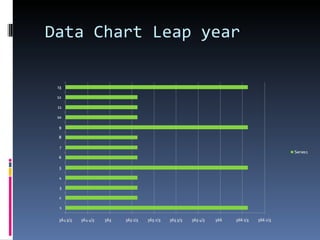
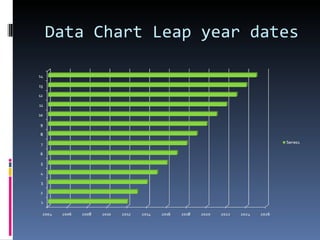
 We celebrate leap year because the
  revolution is not completely 365 days so we
  add a day every 4 years. No. 1
 The Earths revolution is basically Earth
  orbiting the sun. No. 1
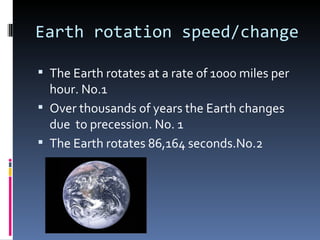
Earth rotation speed/change

 The Earth rotates at a rate of 1000 miles per
  hour. No.1
 Over thousands of years the Earth changes
  due to precession. No. 1
 The Earth rotates 86,164 seconds.No.2
Data Chart Leap year
Data Chart Leap year dates
Credits
          1. The Earths rotation, Randy Russell, January 13, 2005, March 8, 2012,
 http://www.window2universe.org/theuniverse/uts/earths2.html
        2. observing the sky: motion of Earth –rotation, office of naval research, March 8, 2012,
            http://www.onr.navy.mil/focus/spacesciences/observingsky/motion1.htm
3. IERS Rapid Service/Prediction Center, U.S Naval Observatory, June 2008, March 8, 2012,
                                   http://maia.usno.navy .mil
      4.     The days the sun stands still, Debora Dyess, KidsKnowIt, 2012, March 8, 2012,
           http://www.kidsgeo.com/geography-for-kids/0020b-solstices-and-equinoxes.php

 5.        Speed of the Earth’s rotation, Paul Butterworth, David Palmer, Ask a astronimist team,
                                 December 01, 2005, March 9, 2012,
              http://www.imagine.gsfc.nasa.gov/docs/ask_astro?answers/9740lc.html

Earths rotation ppt sam oncken

  • 1.
  • 2.
    The Earth rotatesand this happens…  Day and night are caused by Earth rotating. No.1  Because of Earths rotation the sun rises in the east and sets in the west. No. 1  Even though it looks like the sun and stars are moving it is the Earth that is actually moving. No. 4
  • 3.
    Solar/Sidereal day  TheEarth rotates more than once per solar day because it moves a little in its orbit around the sun each day. No. 2  A sidereal ay is not one full day but 23 hours 56 minutes and 4 seconds No. 2
  • 4.
    Circumferences of…  Thecircumference of Earths equator is 25,000 miles long. No. 5  The circumference of Earths orbit around the sun is 940 million kilometers. No. 5
  • 5.
    Axis equator differences/facts  The Earths rotates on its axis. No. 1  The axis is the imaginary line in the middle of Earth. No.5  The earths axis could be called its rotational axis. No.1  The equator is the imaginary line that is zero degrees latitude which cuts Earth in two.  The axis connects the north and the south poles. No. 2
  • 6.
    How Earths rotationis predicted…  Scientist predict Earths rotation with Satellite Laser Ranging. No. 3  Also with the Global Positioning system and Satellites. No. 3  Also Lunar Laser ranging. No. 3  With these brings information for the future. No. 3
  • 7.
    Northern tip ofEarth and Southern tip of the Earth…  The Northern tip of Earth and the southern tip of Earth are different amounts away from the sun. No. 4  The Northern hemisphere is the closest to the sun on June 21,22and the southern hemisphere is the closest to the sun on December 21,22. No. 4  The days are short in the winter in some places because as the earth is spinning and rotating the sun the North pole doesn’t always tilt toward the sun. No. 4  When Earth is closest to the sun it is summer and when Earth is farther fro the sun it is winter. No 4
  • 8.
    What Revolution is. A revolution is the orbiting of the orbiting of the sun that brings Earths seasons. No. 1  We celebrate leap year because the revolution is not completely 365 days so we add a day every 4 years. No. 1  The Earths revolution is basically Earth orbiting the sun. No. 1
  • 9.
    Earth rotation speed/change The Earth rotates at a rate of 1000 miles per hour. No.1  Over thousands of years the Earth changes due to precession. No. 1  The Earth rotates 86,164 seconds.No.2
  • 10.
  • 11.
    Data Chart Leapyear dates
  • 12.
    Credits 1. The Earths rotation, Randy Russell, January 13, 2005, March 8, 2012, http://www.window2universe.org/theuniverse/uts/earths2.html 2. observing the sky: motion of Earth –rotation, office of naval research, March 8, 2012, http://www.onr.navy.mil/focus/spacesciences/observingsky/motion1.htm 3. IERS Rapid Service/Prediction Center, U.S Naval Observatory, June 2008, March 8, 2012, http://maia.usno.navy .mil 4. The days the sun stands still, Debora Dyess, KidsKnowIt, 2012, March 8, 2012, http://www.kidsgeo.com/geography-for-kids/0020b-solstices-and-equinoxes.php 5. Speed of the Earth’s rotation, Paul Butterworth, David Palmer, Ask a astronimist team, December 01, 2005, March 9, 2012, http://www.imagine.gsfc.nasa.gov/docs/ask_astro?answers/9740lc.html