Page 1 of 3
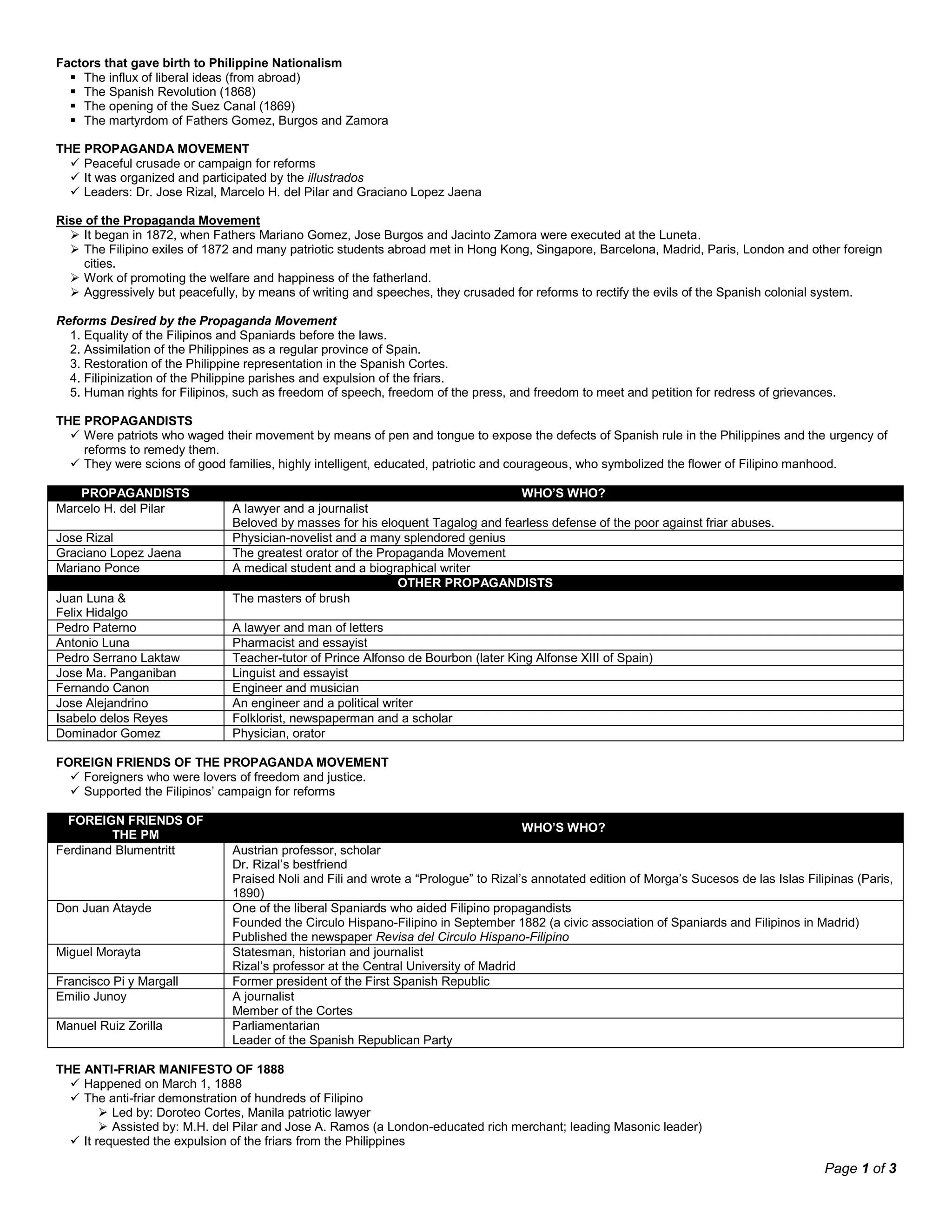
Factors that gave birth to Philippine Nationalism
 The influx of liberal ideas (from abroad)
 The Spanish Revolution (1868)
 The opening of the Suez Canal (1869)
 The martyrdom of Fathers Gomez, Burgos and Zamora
THE PROPAGANDA MOVEMENT
 Peaceful crusade or campaign for reforms
 It was organized and participated by the illustrados
 Leaders: Dr. Jose Rizal, Marcelo H. del Pilar and Graciano Lopez Jaena
Rise of the Propaganda Movement
 It began in 1872, when Fathers Mariano Gomez, Jose Burgos and Jacinto Zamora were executed at the Luneta.
 The Filipino exiles of 1872 and many patriotic students abroad met in Hong Kong, Singapore, Barcelona, Madrid, Paris, London and other foreign
cities.
 Work of promoting the welfare and happiness of the fatherland.
 Aggressively but peacefully, by means of writing and speeches, they crusaded for reforms to rectify the evils of the Spanish colonial system.
Reforms Desired by the Propaganda Movement
1. Equality of the Filipinos and Spaniards before the laws.
2. Assimilation of the Philippines as a regular province of Spain.
3. Restoration of the Philippine representation in the Spanish Cortes.
4. Filipinization of the Philippine parishes and expulsion of the friars.
5. Human rights for Filipinos, such as freedom of speech, freedom of the press, and freedom to meet and petition for redress of grievances.
THE PROPAGANDISTS
 Were patriots who waged their movement by means of pen and tongue to expose the defects of Spanish rule in the Philippines and the urgency of
reforms to remedy them.
 They were scions of good families, highly intelligent, educated, patriotic and courageous, who symbolized the flower of Filipino manhood.
PROPAGANDISTS WHO’S WHO?
Marcelo H. del Pilar A lawyer and a journalist
Beloved by masses for his eloquent Tagalog and fearless defense of the poor against friar abuses.
Jose Rizal Physician-novelist and a many splendored genius
Graciano Lopez Jaena The greatest orator of the Propaganda Movement
Mariano Ponce A medical student and a biographical writer
OTHER PROPAGANDISTS
Juan Luna &
Felix Hidalgo
The masters of brush
Pedro Paterno A lawyer and man of letters
Antonio Luna Pharmacist and essayist
Pedro Serrano Laktaw Teacher-tutor of Prince Alfonso de Bourbon (later King Alfonse XIII of Spain)
Jose Ma. Panganiban Linguist and essayist
Fernando Canon Engineer and musician
Jose Alejandrino An engineer and a political writer
Isabelo delos Reyes Folklorist, newspaperman and a scholar
Dominador Gomez Physician, orator
FOREIGN FRIENDS OF THE PROPAGANDA MOVEMENT
 Foreigners who were lovers of freedom and justice.
 Supported the Filipinos’ campaign for reforms
FOREIGN FRIENDS OF
THE PM
WHO’S WHO?
Ferdinand Blumentritt Austrian professor, scholar
Dr. Rizal’s bestfriend
Praised Noli and Fili and wrote a “Prologue” to Rizal’s annotated edition of Morga’s Sucesos de las Islas Filipinas (Paris,
1890)
Don Juan Atayde One of the liberal Spaniards who aided Filipino propagandists
Founded the Circulo Hispano-Filipino in September 1882 (a civic association of Spaniards and Filipinos in Madrid)
Published the newspaper Revisa del Circulo Hispano-Filipino
Miguel Morayta Statesman, historian and journalist
Rizal’s professor at the Central University of Madrid
Francisco Pi y Margall Former president of the First Spanish Republic
Emilio Junoy A journalist
Member of the Cortes
Manuel Ruiz Zorilla Parliamentarian
Leader of the Spanish Republican Party
THE ANTI-FRIAR MANIFESTO OF 1888
 Happened on March 1, 1888
 The anti-friar demonstration of hundreds of Filipino
 Led by: Doroteo Cortes, Manila patriotic lawyer
 Assisted by: M.H. del Pilar and Jose A. Ramos (a London-educated rich merchant; leading Masonic leader)
 It requested the expulsion of the friars from the Philippines
Page 2 of 3
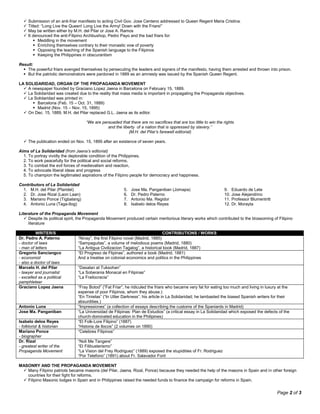
 Submission of an anti-friar manifesto to acting Civil Gov. Jose Centeno addressed to Queen Regent Maria Cristina.
 Titled: “Long Live the Queen! Long Live the Army! Down with the Friars!”
 May be written either by M.H. del Pilar or Jose A. Ramos
 It denounced the anti-Filipino Archbushop, Pedro Payo and the bad friars for:
 Meddling in the movement
 Enriching themselves contrary to their monastic vow of poverty
 Opposing the teaching of the Spanish language to the Filipinos
 Keeping the Philippines in obscurantism
Result:
 The powerful friars avenged themselves by persecuting the leaders and signers of the manifesto, having them arrested and thrown into prison.
 But the patriotic demonstrators were pardoned in 1889 as an amnesty was issued by the Spanish Queen Regent.
LA SOLIDARIDAD, ORGAN OF THE PROPAGANDA MOVEMENT
 A newspaper founded by Graciano Lopez Jaena in Barcelona on February 15, 1889.
 La Solidaridad was created due to the reality that mass media is important in propagating the Propaganda objectives.
 La Solidaridad was printed in:
 Barcelona (Feb. 15 – Oct. 31, 1889)
 Madrid (Nov. 15 – Nov. 15, 1895)
 On Dec. 15, 1889, M.H. del Pilar replaced G.L. Jaena as its editor.
“We are persuaded that there are no sacrifices that are too little to win the rights
and the liberty of a nation that is oppressed by slavery.”
(M.H. del Pilar’s farewell editorial)
 The publication ended on Nov. 15, 1895 after an existence of seven years.
Aims of La Solidaridad (from Jaena’s editorial)
1. To portray vividly the deplorable condition of the Philippines,
2. To work peacefully for the political and social reforms,
3. To combat the evil forces of medievalism and reaction,
4. To advocate liberal ideas and progress
5. To champion the legitimated aspirations of the Filipino people for democracy and happiness.
Contributors of La Solidaridad
1. M.H. del Pilar (Plaridel)
2. Dr. Jose Rizal (Laon Laan)
3. Mariano Ponce (Tigbalang)
4. Antonio Luna (Taga-Ilog)
5. Jose Ma. Panganiban (Jomapa)
6. Dr. Pedro Paterno
7. Antonio Ma. Regidor
8. Isabelo delos Reyes
9. Eduardo de Lete
10. Jose Alejandrino
11. Professor Blumentritt
12. Dr. Morayta
Literature of the Propaganda Movement
 Despite its political spirit, the Propaganda Movement produced certain meritorious literary works which contributed to the blossoming of Filipino
literature
WRITER/S CONTRIBUTIONS / WORKS
Dr. Pedro A. Paterno
- doctor of laws
- man of letters
“Ninay”, the first Filipino novel (Madrid, 1885)
“Sampaguitas”, a volume of melodious poems (Madrid, 1880)
“La Antigua Civilizacion Tagalog”, a historical book (Madrid, 1887)
Gregorio Sanciangco
- economist
- also a doctor of laws
“El Progreso de Flipinas”, authored a book (Madrid, 1881)
And a treatise on colonial economics and politics in the Philippines
Marcelo H. del Pilar
- lawyer and journalist
- excelled as a political
pamphleteer
“Dasalan at Tuksohan”
“La Soberania Monacal en Filipinas”
“La Frailocracia”
Graciano Lopez Jaena “Fray Botod” (“Fat Friar”, he ridiculed the friars who became very fat for eating too much and living in luxury at the
expense of poor Filipinos, whom they abuse.)
“En Tinielas” (“In Utter Darkness”, his article in La Solidaridad; he lambasted the biased Spanish writers for their
absurdities.)
Antonio Luna “Impressiones” (a collection of essays describing the customs of the Spaniards in Madrid)
Jose Ma. Panganiban “La Universidad de Filipinas: Plan de Estudios” (a critical essay in La Solidaridad which exposed the defects of the
church-dominated education in the Philipines)
Isabelo delos Reyes
- folklorist & historian
“El Folk-Lore Filipino” (1887)
“Historia de Ilocos” (2 volumes on 1890)
Mariano Ponce
- biographer
“Celebres Filipinos”
Dr. Rizal
- greatest writer of the
Propaganda Movement
“Noli Me Tangere”
“El Filibusterismo”
“La Vision del Frey Rodriguez” (1889) exposed the stupidities of Fr. Rodriguez
“Por Telefono” (1891) about Fr. Salavador Font
MASONRY AND THE PROPAGANDA MOVEMENT
 Many Filipino patriots became masons (del Pilar, Jaena, Rizal, Ponce) because they needed the help of the masons in Spain and in other foreign
countries for their fight for reforms.
 Filipino Masonic lodges in Spain and in Philippines raised the needed funds to finance the campaign for reforms in Spain.
Page 3 of 3
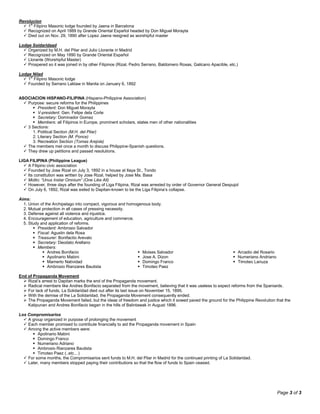
Revolucion
 1st
Filipino Masonic lodge founded by Jaena in Barcelona
 Recognized on April 1889 by Grande Oriental Español headed by Don Miguel Morayta
 Died out on Nov. 29, 1890 after Lopez Jaena resigned as worshipful master
Lodge Soidaridaad
 Organized by M.H. del Pilar and Julio Llorante in Madrid
 Recognized on May 1890 by Grande Oriental Español
 Llorante (Worshipful Master)
 Prospered so it was joined in by other Filipinos (Rizal, Pedro Serrano, Baldomero Roxas, Galicano Apacible, etc.)
Lodge Nilad
 1st
Filipino Masonic lodge
 Founded by Serrano Laktaw in Manila on January 6, 1892
ASOCIACION HISPANO-FILIPINA (Hispano-Philippine Association)
 Purpose: secure reforms for the Philippines
 President: Don Miguel Morayta
 V-president: Gen. Felipe dela Corte
 Secretary: Dominador Gomez
 Members: all Filipinos in Europe, prominent scholars, states men of other nationalities
 3 Sections:
1. Political Section (M.H. del Pilar)
2. Literary Section (M. Ponce)
3. Recreation Section (Tomas Arejola)
 The members met once a month to discuss Philippine-Spanish questions.
 They drew up petitions and passed resolutions.
LIGA FILIPINA (Philippine League)
 A Filipino civic association
 Founded by Jose Rizal on July 3, 1892 in a house at Ilaya St., Tondo
 Its constitution was written by Jose Rizal, helped by Jose Ma. Basa
 Motto: “Unus Instar Omnium” (One Like All)
 However, three days after the founding of Liga Filipina, Rizal was arrested by order of Governor General Despujol
 On July 6, 1892, Rizal was exiled to Dapitan-known to be the Liga Filipina’s collapse.
Aims:
1. Union of the Archipelago into compact, vigorous and homogenous body.
2. Mutual protection in all cases of pressing necessity.
3. Defense against all violence and injustice.
4. Encouragement of education, agriculture and commerce.
5. Study and application of reforms.
 President: Ambrosio Salvador
 Fiscal: Agustin dela Rosa
 Treasurer: Bonifactio Arevalo
 Secretary: Deodato Arellano
 Members:
 Andres Bonifacio
 Apolinario Mabini
 Mamerto Natividad
 Ambrosio Rianzares Bautista
 Moises Salvador
 Jose A. Dizon
 Domingo Franco
 Timoteo Paez
 Arcadio del Rosario
 Numeriano Andriano
 Timoteo Lanuza
End of Propaganda Movement
 Rizal’s arrest to Dapitan marks the end of the Propaganda movement.
 Radical members like Andres Bonifacio separated from the movement, believing that it was useless to expect reforms from the Spaniards.
 For lack of funds, La Solidaridad died out after its last issue on November 15, 1895.
 With the demise of the La Solidaridad, the Propaganda Movement consequently ended.
 The Propaganda Movement failed, but the ideas of freedom and justice which it sowed paved the ground for the Philippine Revolution that the
Katipunan and Andres Bonifacio began in the hills of Balintawak in August 1896.
Los Compromisarios
 A group organized in purpose of prolonging the movement
 Each member promised to contribute financially to aid the Propaganda movement in Spain
 Among the active members were:
 Apolinario Mabini
 Domingo Franco
 Numeriano Adriano
 Ambrosio Rianzares Bautista
 Timoteo Paez (..etc…)
 For some months, the Compromisarios sent funds to M.H. del Pilar in Madrid for the continued printing of La Solidaridad.
 Later, many members stopped paying their contributions so that the flow of funds to Spain ceased.

The Propaganda Movement

  • 1.
    Page 1 of3 Factors that gave birth to Philippine Nationalism  The influx of liberal ideas (from abroad)  The Spanish Revolution (1868)  The opening of the Suez Canal (1869)  The martyrdom of Fathers Gomez, Burgos and Zamora THE PROPAGANDA MOVEMENT  Peaceful crusade or campaign for reforms  It was organized and participated by the illustrados  Leaders: Dr. Jose Rizal, Marcelo H. del Pilar and Graciano Lopez Jaena Rise of the Propaganda Movement  It began in 1872, when Fathers Mariano Gomez, Jose Burgos and Jacinto Zamora were executed at the Luneta.  The Filipino exiles of 1872 and many patriotic students abroad met in Hong Kong, Singapore, Barcelona, Madrid, Paris, London and other foreign cities.  Work of promoting the welfare and happiness of the fatherland.  Aggressively but peacefully, by means of writing and speeches, they crusaded for reforms to rectify the evils of the Spanish colonial system. Reforms Desired by the Propaganda Movement 1. Equality of the Filipinos and Spaniards before the laws. 2. Assimilation of the Philippines as a regular province of Spain. 3. Restoration of the Philippine representation in the Spanish Cortes. 4. Filipinization of the Philippine parishes and expulsion of the friars. 5. Human rights for Filipinos, such as freedom of speech, freedom of the press, and freedom to meet and petition for redress of grievances. THE PROPAGANDISTS  Were patriots who waged their movement by means of pen and tongue to expose the defects of Spanish rule in the Philippines and the urgency of reforms to remedy them.  They were scions of good families, highly intelligent, educated, patriotic and courageous, who symbolized the flower of Filipino manhood. PROPAGANDISTS WHO’S WHO? Marcelo H. del Pilar A lawyer and a journalist Beloved by masses for his eloquent Tagalog and fearless defense of the poor against friar abuses. Jose Rizal Physician-novelist and a many splendored genius Graciano Lopez Jaena The greatest orator of the Propaganda Movement Mariano Ponce A medical student and a biographical writer OTHER PROPAGANDISTS Juan Luna & Felix Hidalgo The masters of brush Pedro Paterno A lawyer and man of letters Antonio Luna Pharmacist and essayist Pedro Serrano Laktaw Teacher-tutor of Prince Alfonso de Bourbon (later King Alfonse XIII of Spain) Jose Ma. Panganiban Linguist and essayist Fernando Canon Engineer and musician Jose Alejandrino An engineer and a political writer Isabelo delos Reyes Folklorist, newspaperman and a scholar Dominador Gomez Physician, orator FOREIGN FRIENDS OF THE PROPAGANDA MOVEMENT  Foreigners who were lovers of freedom and justice.  Supported the Filipinos’ campaign for reforms FOREIGN FRIENDS OF THE PM WHO’S WHO? Ferdinand Blumentritt Austrian professor, scholar Dr. Rizal’s bestfriend Praised Noli and Fili and wrote a “Prologue” to Rizal’s annotated edition of Morga’s Sucesos de las Islas Filipinas (Paris, 1890) Don Juan Atayde One of the liberal Spaniards who aided Filipino propagandists Founded the Circulo Hispano-Filipino in September 1882 (a civic association of Spaniards and Filipinos in Madrid) Published the newspaper Revisa del Circulo Hispano-Filipino Miguel Morayta Statesman, historian and journalist Rizal’s professor at the Central University of Madrid Francisco Pi y Margall Former president of the First Spanish Republic Emilio Junoy A journalist Member of the Cortes Manuel Ruiz Zorilla Parliamentarian Leader of the Spanish Republican Party THE ANTI-FRIAR MANIFESTO OF 1888  Happened on March 1, 1888  The anti-friar demonstration of hundreds of Filipino  Led by: Doroteo Cortes, Manila patriotic lawyer  Assisted by: M.H. del Pilar and Jose A. Ramos (a London-educated rich merchant; leading Masonic leader)  It requested the expulsion of the friars from the Philippines
  • 2.
    Page 2 of3  Submission of an anti-friar manifesto to acting Civil Gov. Jose Centeno addressed to Queen Regent Maria Cristina.  Titled: “Long Live the Queen! Long Live the Army! Down with the Friars!”  May be written either by M.H. del Pilar or Jose A. Ramos  It denounced the anti-Filipino Archbushop, Pedro Payo and the bad friars for:  Meddling in the movement  Enriching themselves contrary to their monastic vow of poverty  Opposing the teaching of the Spanish language to the Filipinos  Keeping the Philippines in obscurantism Result:  The powerful friars avenged themselves by persecuting the leaders and signers of the manifesto, having them arrested and thrown into prison.  But the patriotic demonstrators were pardoned in 1889 as an amnesty was issued by the Spanish Queen Regent. LA SOLIDARIDAD, ORGAN OF THE PROPAGANDA MOVEMENT  A newspaper founded by Graciano Lopez Jaena in Barcelona on February 15, 1889.  La Solidaridad was created due to the reality that mass media is important in propagating the Propaganda objectives.  La Solidaridad was printed in:  Barcelona (Feb. 15 – Oct. 31, 1889)  Madrid (Nov. 15 – Nov. 15, 1895)  On Dec. 15, 1889, M.H. del Pilar replaced G.L. Jaena as its editor. “We are persuaded that there are no sacrifices that are too little to win the rights and the liberty of a nation that is oppressed by slavery.” (M.H. del Pilar’s farewell editorial)  The publication ended on Nov. 15, 1895 after an existence of seven years. Aims of La Solidaridad (from Jaena’s editorial) 1. To portray vividly the deplorable condition of the Philippines, 2. To work peacefully for the political and social reforms, 3. To combat the evil forces of medievalism and reaction, 4. To advocate liberal ideas and progress 5. To champion the legitimated aspirations of the Filipino people for democracy and happiness. Contributors of La Solidaridad 1. M.H. del Pilar (Plaridel) 2. Dr. Jose Rizal (Laon Laan) 3. Mariano Ponce (Tigbalang) 4. Antonio Luna (Taga-Ilog) 5. Jose Ma. Panganiban (Jomapa) 6. Dr. Pedro Paterno 7. Antonio Ma. Regidor 8. Isabelo delos Reyes 9. Eduardo de Lete 10. Jose Alejandrino 11. Professor Blumentritt 12. Dr. Morayta Literature of the Propaganda Movement  Despite its political spirit, the Propaganda Movement produced certain meritorious literary works which contributed to the blossoming of Filipino literature WRITER/S CONTRIBUTIONS / WORKS Dr. Pedro A. Paterno - doctor of laws - man of letters “Ninay”, the first Filipino novel (Madrid, 1885) “Sampaguitas”, a volume of melodious poems (Madrid, 1880) “La Antigua Civilizacion Tagalog”, a historical book (Madrid, 1887) Gregorio Sanciangco - economist - also a doctor of laws “El Progreso de Flipinas”, authored a book (Madrid, 1881) And a treatise on colonial economics and politics in the Philippines Marcelo H. del Pilar - lawyer and journalist - excelled as a political pamphleteer “Dasalan at Tuksohan” “La Soberania Monacal en Filipinas” “La Frailocracia” Graciano Lopez Jaena “Fray Botod” (“Fat Friar”, he ridiculed the friars who became very fat for eating too much and living in luxury at the expense of poor Filipinos, whom they abuse.) “En Tinielas” (“In Utter Darkness”, his article in La Solidaridad; he lambasted the biased Spanish writers for their absurdities.) Antonio Luna “Impressiones” (a collection of essays describing the customs of the Spaniards in Madrid) Jose Ma. Panganiban “La Universidad de Filipinas: Plan de Estudios” (a critical essay in La Solidaridad which exposed the defects of the church-dominated education in the Philipines) Isabelo delos Reyes - folklorist & historian “El Folk-Lore Filipino” (1887) “Historia de Ilocos” (2 volumes on 1890) Mariano Ponce - biographer “Celebres Filipinos” Dr. Rizal - greatest writer of the Propaganda Movement “Noli Me Tangere” “El Filibusterismo” “La Vision del Frey Rodriguez” (1889) exposed the stupidities of Fr. Rodriguez “Por Telefono” (1891) about Fr. Salavador Font MASONRY AND THE PROPAGANDA MOVEMENT  Many Filipino patriots became masons (del Pilar, Jaena, Rizal, Ponce) because they needed the help of the masons in Spain and in other foreign countries for their fight for reforms.  Filipino Masonic lodges in Spain and in Philippines raised the needed funds to finance the campaign for reforms in Spain.
  • 3.
    Page 3 of3 Revolucion  1st Filipino Masonic lodge founded by Jaena in Barcelona  Recognized on April 1889 by Grande Oriental Español headed by Don Miguel Morayta  Died out on Nov. 29, 1890 after Lopez Jaena resigned as worshipful master Lodge Soidaridaad  Organized by M.H. del Pilar and Julio Llorante in Madrid  Recognized on May 1890 by Grande Oriental Español  Llorante (Worshipful Master)  Prospered so it was joined in by other Filipinos (Rizal, Pedro Serrano, Baldomero Roxas, Galicano Apacible, etc.) Lodge Nilad  1st Filipino Masonic lodge  Founded by Serrano Laktaw in Manila on January 6, 1892 ASOCIACION HISPANO-FILIPINA (Hispano-Philippine Association)  Purpose: secure reforms for the Philippines  President: Don Miguel Morayta  V-president: Gen. Felipe dela Corte  Secretary: Dominador Gomez  Members: all Filipinos in Europe, prominent scholars, states men of other nationalities  3 Sections: 1. Political Section (M.H. del Pilar) 2. Literary Section (M. Ponce) 3. Recreation Section (Tomas Arejola)  The members met once a month to discuss Philippine-Spanish questions.  They drew up petitions and passed resolutions. LIGA FILIPINA (Philippine League)  A Filipino civic association  Founded by Jose Rizal on July 3, 1892 in a house at Ilaya St., Tondo  Its constitution was written by Jose Rizal, helped by Jose Ma. Basa  Motto: “Unus Instar Omnium” (One Like All)  However, three days after the founding of Liga Filipina, Rizal was arrested by order of Governor General Despujol  On July 6, 1892, Rizal was exiled to Dapitan-known to be the Liga Filipina’s collapse. Aims: 1. Union of the Archipelago into compact, vigorous and homogenous body. 2. Mutual protection in all cases of pressing necessity. 3. Defense against all violence and injustice. 4. Encouragement of education, agriculture and commerce. 5. Study and application of reforms.  President: Ambrosio Salvador  Fiscal: Agustin dela Rosa  Treasurer: Bonifactio Arevalo  Secretary: Deodato Arellano  Members:  Andres Bonifacio  Apolinario Mabini  Mamerto Natividad  Ambrosio Rianzares Bautista  Moises Salvador  Jose A. Dizon  Domingo Franco  Timoteo Paez  Arcadio del Rosario  Numeriano Andriano  Timoteo Lanuza End of Propaganda Movement  Rizal’s arrest to Dapitan marks the end of the Propaganda movement.  Radical members like Andres Bonifacio separated from the movement, believing that it was useless to expect reforms from the Spaniards.  For lack of funds, La Solidaridad died out after its last issue on November 15, 1895.  With the demise of the La Solidaridad, the Propaganda Movement consequently ended.  The Propaganda Movement failed, but the ideas of freedom and justice which it sowed paved the ground for the Philippine Revolution that the Katipunan and Andres Bonifacio began in the hills of Balintawak in August 1896. Los Compromisarios  A group organized in purpose of prolonging the movement  Each member promised to contribute financially to aid the Propaganda movement in Spain  Among the active members were:  Apolinario Mabini  Domingo Franco  Numeriano Adriano  Ambrosio Rianzares Bautista  Timoteo Paez (..etc…)  For some months, the Compromisarios sent funds to M.H. del Pilar in Madrid for the continued printing of La Solidaridad.  Later, many members stopped paying their contributions so that the flow of funds to Spain ceased.