
EDMGT 716
Internationalization
of Education
Focus: Comparing
Educational
System of Finland
YHELMAR D. BAIT
T-I
Tumalim National High School
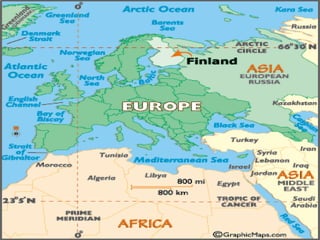
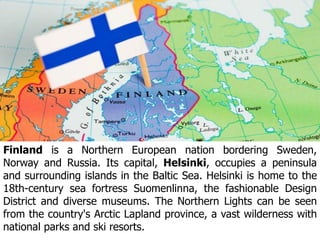
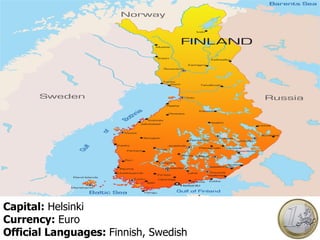
Finland is a Northern European nation bordering Sweden,
Norway and Russia. Its capital, Helsinki, occupies a peninsula
and surrounding islands in the Baltic Sea. Helsinki is home to the
18th-century sea fortress Suomenlinna, the fashionable Design
District and diverse museums. The Northern Lights can be seen
from the country's Arctic Lapland province, a vast wilderness with
national parks and ski resorts.
Capital: Helsinki
Currency: Euro
Official Languages: Finnish, Swedish
The Ministry of Education and
Culture drafts legislation and
government resolutions concerning
general education, and coordinates
activities in its administrative branch.
Finnish National Agency for Education (EDUFI) is a national
development agency. It is responsible for developing
education and training, early childhood education and care
and lifelong learning, as well as for promoting
internationalisation. EDUFI is subordinate to the Ministry of
Education and Culture and its tasks and organisation are set
in the legislation.
Education policy
Providing equal
opportunities for all
citizens to high-quality
education and training is
a long-term objective of
the Finnish education
policy. The key words in
Finnish education policy
are quality, efficiency,
equity and
internationalisation. The
basic right to education
and culture is recorded in
the Constitution.
The policy is built
on the principles
of lifelong
learning and free
education.
Education is seen
as a key to
competitiveness
and wellbeing of
the society.
There is a wide-spread
consensus of the main
pillars of education
policy and the policy is
characterized by
cooperation and
continuity - evolution
rather than revolution.
Tripartite partnership
among Government,
trade unions and
employer organisations
is an integrated part of
policy-making.
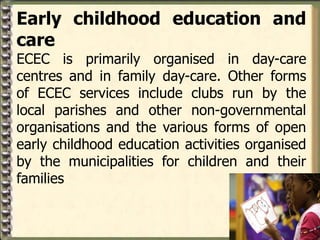
Early childhood education and
care
ECEC is primarily organised in day-care
centres and in family day-care. Other forms
of ECEC services include clubs run by the
local parishes and other non-governmental
organisations and the various forms of open
early childhood education activities organised
by the municipalities for children and their
families
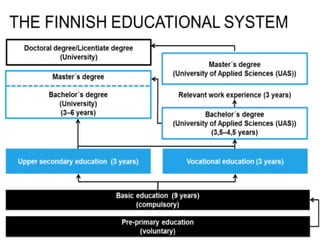
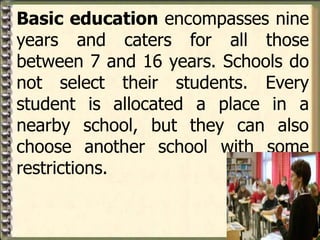
Basic education encompasses nine
years and caters for all those
between 7 and 16 years. Schools do
not select their students. Every
student is allocated a place in a
nearby school, but they can also
choose another school with some
restrictions.
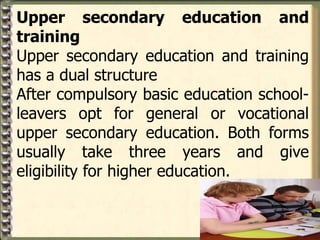
Upper secondary education and
training
Upper secondary education and training
has a dual structure
After compulsory basic education school-
leavers opt for general or vocational
upper secondary education. Both forms
usually take three years and give
eligibility for higher education.
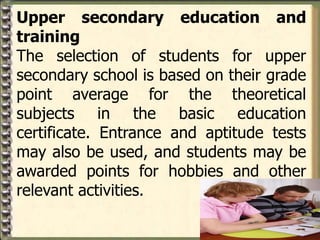
Upper secondary education and
training
The selection of students for upper
secondary school is based on their grade
point average for the theoretical
subjects in the basic education
certificate. Entrance and aptitude tests
may also be used, and students may be
awarded points for hobbies and other
relevant activities.
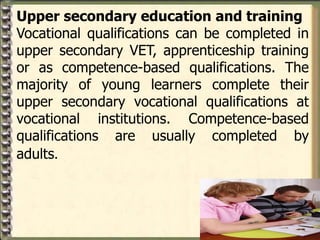
Upper secondary education and training
Vocational qualifications can be completed in
upper secondary VET, apprenticeship training
or as competence-based qualifications. The
majority of young learners complete their
upper secondary vocational qualifications at
vocational institutions. Competence-based
qualifications are usually completed by
adults.
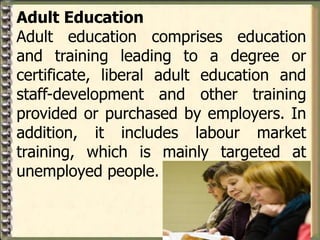
Adult Education
Adult education comprises education
and training leading to a degree or
certificate, liberal adult education and
staff-development and other training
provided or purchased by employers. In
addition, it includes labour market
training, which is mainly targeted at
unemployed people.
Higher Education
Higher education in Finland has a dual
structure. Higher education is provided
by universities and universities of
applied sciences (UAS). Both sectors
have their own profiles. Universities
emphasise scientific research and
instruction, whereas universities of
applied sciences adopt a more practical
approach. Higher education institutions
are very autonomous in organising their
instruction and academic year.
Higher Education
Equal access to higher education is
ensured by the wide institutional
network, the free education, student
financial aid as well as the flexible
pathways to higher education
Teacher Education
Teachers in Finland are highly trained. In
general education all teachers are
required a Master’s degree. In vocational
education teachers should have a
Master’s degree or Bachelor’s degree.
Teacher Education
Teachers at universities of applied
sciences are required to have either a
Master’s or a post-graduate Licentiate’s
degree, depending on their position.
They must also complete pedagogical
studies. University teachers are
generally required to hold a Doctoral or
other postgraduate degree
Teacher Education
Teacher training can be either
concurrent, with pedagogical training
integrated into the Master’s programme,
or consecutive, with the pedagogical
training completed after the initial
degree. The latter is the case for
example in vocational teacher
education
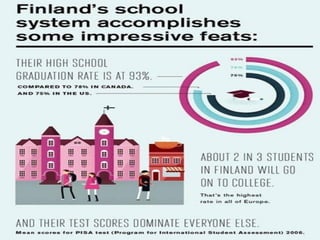
Finland’s Education System Model
1. Better standardized tests
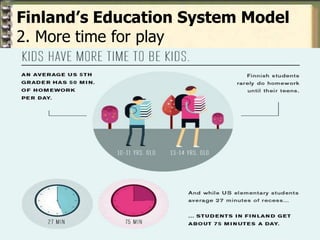
Finland’s Education System Model
2. More time for play
Finland’s Education System Model
2. College is free
3. Elevated teaching profession
4. Finland has no private schools
5. Kids have very little homework
6.Preschool is high-quality and universal.
References:
✓ http://www.oph.fi
✓http://minedu.fi
✓http://uk.businessinsider.com/finland-
education-beats-us-2017-5/#1-
competition-isnt-as-important-as-
cooperation-1
✓http://nordic.businessinsider.com/finla
nd-has-one-of-the-best-education-
systems-in-the-world--here-are-4-things-
it-does-better-than-the-us-2016-11

Comparing educational system of finland

  • 1.
    EDMGT 716 Internationalization of Education Focus:Comparing Educational System of Finland YHELMAR D. BAIT T-I Tumalim National High School
  • 3.
    Finland is aNorthern European nation bordering Sweden, Norway and Russia. Its capital, Helsinki, occupies a peninsula and surrounding islands in the Baltic Sea. Helsinki is home to the 18th-century sea fortress Suomenlinna, the fashionable Design District and diverse museums. The Northern Lights can be seen from the country's Arctic Lapland province, a vast wilderness with national parks and ski resorts.
  • 4.
    Capital: Helsinki Currency: Euro OfficialLanguages: Finnish, Swedish
  • 7.
    The Ministry ofEducation and Culture drafts legislation and government resolutions concerning general education, and coordinates activities in its administrative branch.
  • 9.
    Finnish National Agencyfor Education (EDUFI) is a national development agency. It is responsible for developing education and training, early childhood education and care and lifelong learning, as well as for promoting internationalisation. EDUFI is subordinate to the Ministry of Education and Culture and its tasks and organisation are set in the legislation.
  • 10.
    Education policy Providing equal opportunitiesfor all citizens to high-quality education and training is a long-term objective of the Finnish education policy. The key words in Finnish education policy are quality, efficiency, equity and internationalisation. The basic right to education and culture is recorded in the Constitution.
  • 11.
    The policy isbuilt on the principles of lifelong learning and free education. Education is seen as a key to competitiveness and wellbeing of the society.
  • 12.
    There is awide-spread consensus of the main pillars of education policy and the policy is characterized by cooperation and continuity - evolution rather than revolution. Tripartite partnership among Government, trade unions and employer organisations is an integrated part of policy-making.
  • 15.
    Early childhood educationand care ECEC is primarily organised in day-care centres and in family day-care. Other forms of ECEC services include clubs run by the local parishes and other non-governmental organisations and the various forms of open early childhood education activities organised by the municipalities for children and their families
  • 16.
    Basic education encompassesnine years and caters for all those between 7 and 16 years. Schools do not select their students. Every student is allocated a place in a nearby school, but they can also choose another school with some restrictions.
  • 17.
    Upper secondary educationand training Upper secondary education and training has a dual structure After compulsory basic education school- leavers opt for general or vocational upper secondary education. Both forms usually take three years and give eligibility for higher education.
  • 18.
    Upper secondary educationand training The selection of students for upper secondary school is based on their grade point average for the theoretical subjects in the basic education certificate. Entrance and aptitude tests may also be used, and students may be awarded points for hobbies and other relevant activities.
  • 19.
    Upper secondary educationand training Vocational qualifications can be completed in upper secondary VET, apprenticeship training or as competence-based qualifications. The majority of young learners complete their upper secondary vocational qualifications at vocational institutions. Competence-based qualifications are usually completed by adults.
  • 20.
    Adult Education Adult educationcomprises education and training leading to a degree or certificate, liberal adult education and staff-development and other training provided or purchased by employers. In addition, it includes labour market training, which is mainly targeted at unemployed people.
  • 22.
    Higher Education Higher educationin Finland has a dual structure. Higher education is provided by universities and universities of applied sciences (UAS). Both sectors have their own profiles. Universities emphasise scientific research and instruction, whereas universities of applied sciences adopt a more practical approach. Higher education institutions are very autonomous in organising their instruction and academic year.
  • 23.
    Higher Education Equal accessto higher education is ensured by the wide institutional network, the free education, student financial aid as well as the flexible pathways to higher education
  • 24.
    Teacher Education Teachers inFinland are highly trained. In general education all teachers are required a Master’s degree. In vocational education teachers should have a Master’s degree or Bachelor’s degree.
  • 25.
    Teacher Education Teachers atuniversities of applied sciences are required to have either a Master’s or a post-graduate Licentiate’s degree, depending on their position. They must also complete pedagogical studies. University teachers are generally required to hold a Doctoral or other postgraduate degree
  • 26.
    Teacher Education Teacher trainingcan be either concurrent, with pedagogical training integrated into the Master’s programme, or consecutive, with the pedagogical training completed after the initial degree. The latter is the case for example in vocational teacher education
  • 27.
    Finland’s Education SystemModel 1. Better standardized tests
  • 28.
    Finland’s Education SystemModel 2. More time for play
  • 29.
    Finland’s Education SystemModel 2. College is free 3. Elevated teaching profession 4. Finland has no private schools 5. Kids have very little homework 6.Preschool is high-quality and universal.
  • 30.