The term professional learning community describes a collegial group of administrators and school staff who are united in their commitment to student learning. Hord (1997b) notes, "As an organizational arrangement, the professional learning community is seen as a powerful staff-development approach and a potent strategy for school change and improvement." Professional Learning Communities1Professional LearningCommunities
They function as an effective strategy for building school capacity around core issues of teaching and learning (Darling-Hammond, 1995)
They can serve as a mechanism to transform school culture.Professional Learning Communities2Why are professional learning communities important ?
…connect teachers with information, strategies and best practices.Professional Learning Communities3In other words, PLCs…
Schools that are highly effective produce results that almost entirely overcome the effects of student backgroundsRobert Marzano,	What Works in Schools, 2003Professional Learning Communities4SCHOOLS AND TEACHERS DO MAKE A DIFFERENCE
To understand how collaborative communities (PLCs) can impact teacher learning and student achievement.To understand the role we will play in PLCs. To shift our thinking from teaching to learningProfessional Learning Communities5Our Objectives Today
Culturally Responsive TeachingEffective Instructional StrategiesExamining DataProfessional Learning Communities6Key Focus Areas
Building BasedContent BasedInterdisciplinaryProfessional Learning Communities7Types of PLCs at CHS
*PLCs will meet on Tuesdays (second faculty mtg. of the month)Professional Learning Communities8How will PLCs be organized, and when will we meet?
Focus on student performanceCollaborate with colleagues during PLC timeBecome students of teaching and consumers of researchAccept responsibility for implementing systems thatenable each student to be successfulProfessional Learning Communities9So, what’s my role?
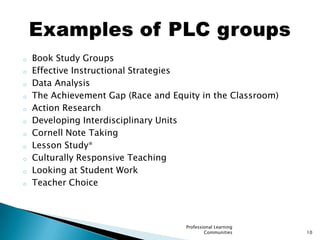
Book Study Groups
Effective Instructional Strategies
Data Analysis
The Achievement Gap (Race and Equity in the Classroom)
Action Research
Developing Interdisciplinary Units
Cornell Note Taking

Professional Learning Communities Made Easy

  • 1.
    The term professionallearning community describes a collegial group of administrators and school staff who are united in their commitment to student learning. Hord (1997b) notes, "As an organizational arrangement, the professional learning community is seen as a powerful staff-development approach and a potent strategy for school change and improvement." Professional Learning Communities1Professional LearningCommunities
  • 2.
    They function asan effective strategy for building school capacity around core issues of teaching and learning (Darling-Hammond, 1995)
  • 3.
    They can serveas a mechanism to transform school culture.Professional Learning Communities2Why are professional learning communities important ?
  • 4.
    …connect teachers withinformation, strategies and best practices.Professional Learning Communities3In other words, PLCs…
  • 5.
    Schools that arehighly effective produce results that almost entirely overcome the effects of student backgroundsRobert Marzano, What Works in Schools, 2003Professional Learning Communities4SCHOOLS AND TEACHERS DO MAKE A DIFFERENCE
  • 6.
    To understand howcollaborative communities (PLCs) can impact teacher learning and student achievement.To understand the role we will play in PLCs. To shift our thinking from teaching to learningProfessional Learning Communities5Our Objectives Today
  • 7.
    Culturally Responsive TeachingEffectiveInstructional StrategiesExamining DataProfessional Learning Communities6Key Focus Areas
  • 8.
    Building BasedContent BasedInterdisciplinaryProfessionalLearning Communities7Types of PLCs at CHS
  • 9.
    *PLCs will meeton Tuesdays (second faculty mtg. of the month)Professional Learning Communities8How will PLCs be organized, and when will we meet?
  • 10.
    Focus on studentperformanceCollaborate with colleagues during PLC timeBecome students of teaching and consumers of researchAccept responsibility for implementing systems thatenable each student to be successfulProfessional Learning Communities9So, what’s my role?
  • 11.
  • 12.
  • 13.
  • 14.
    The Achievement Gap(Race and Equity in the Classroom)
  • 15.
  • 16.
  • 17.