LIB604 Libraries in the School CurriculumSpring 2011What is a Learning Community?
2What is a learning community?What is a Learning Community? A learning community is a group of people who share a common interest in a topic or area, a particular form of discourse about their phenomena, tools and sense-making approaches for building collaborative knowledge, and valued activities. Professional Development Through Learning Communitieshttp://www.edutopia.org/professional-development-through-learning-communitiesKathleen P. Fulton and Margaret Riel
3Learning communities in higher edA more specialized use of the termLearning Communities are groups of students who take two or three classes together. The classes may be designed around a unifying theme or, as in the case of courses in specialized majors, based on courses that reinforce the students’ special needs or requirements. Students who take two or three courses together often get to know each other and the professors better. This often enhances learning. Learning Communities - Frequently Asked Questions
4Can schools be learning communities?Schools as Learning CommunitiesWhen people come together and work toward a common goal, a community is formed. In schools, that goal is learning. It seems almost trite to label schools as learning communities; of course schools bring groups of diverse people together with a common goal of student learning. Schools reflect the inherent characteristic of “community.”Professional Learning Communities Hold Promise for Schools
5What is a learning community?A community where all are learnersA learning community works together to facilitate participation by all members of the school community.  We work together and inspire one another to create, develop and share knowledge, each one assuming the complementing roles of leader, teacher, and learner at various points in time. What is a learning community? (scroll down the page to see the definition)© Wellspring LEARNING COMMUNITY
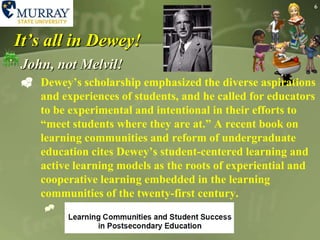
6It’s all in Dewey!John, not Melvil!Dewey’s scholarship emphasized the diverse aspirations and experiences of students, and he called for educators to be experimental and intentional in their efforts to “meet students where they are at.” A recent book on learning communities and reform of undergraduate education cites Dewey’s student-centered learning and active learning models as the roots of experiential and cooperative learning embedded in the learning communities of the twenty-first century.
7Maybe we need some PLCPLC?The term professional learning community describes a collegial group of administrators and school staff who are united in their commitment to student learning. They share a vision, work and learn collaboratively, visit and review other classrooms, and participate in decision making (Hord, 1997b). The benefits to the staff and students include a reduced isolation of teachers, better informed and committed teachers, and academic gains for students. Professional Learning Community
83 Cs of a PLC 1The First C: ConversationIn a PLC, conversations become the lifeblood of organizational learning, and the nature of those conversations can differ markedly from the types of conversations typically found in “business as usual” schools. What distinguishes conversation in a professional learning community? Primarily two things: the purposeful nature of the conversations and the underlying structure within which they occur.A purposeful conversation, in this context, is a conversation that has some underlying goal related to teaching and learning. The Role of Conversation, Contention, and Commitment in a Professional Learning Community
93 Cs of a PLC 2The Difficult C: Contention When educators are asked to make collaborative decisions, there are bound to be differences of opinion.The kinds of organizational learning purported to result from building community among teachers are deeply linked to how they manage the difference amid their collaboration. The processes of conflict are critical to understanding what distinguishes a professional community that maintains stability and the status quo from a community engaged in ongoing inquiry and change.The Role of Conversation, Contention, and Commitment in a Professional Learning Community
3 Cs of a PLC 3The Ultimate C: CommitmentPurposeful conversations will inevitably lead to some level of contention, but in a professional learning community the participants can ultimately deal with contention by relying on an underlying level of commitment to common goals. For a true professional learning community, these are likely to include a commitment to ensuring student learning, a belief in the power of true collaboration, a model of distributed leadership and decision-making, and an ongoing process of reflection and inquiry.The Role of Conversation, Contention, and Commitment in a Professional Learning Community10
11How do we get PLC?Becoming a communityDetermine School and Staff Readiness The openness and availability of the principal is a significant indicator of readiness at a school.
The overall climate of acceptance, growth, and learning among teachers is another important facet of readiness.  . . . This is not to say that all teachers must be enthusiastic about making changes; rather, it is an acknowledgment that such efforts will be more of a struggle, and will take more time, if a climate of distrust, disrespect, or disengagement exists.
First Steps12Getting PLCAnother First StepConsider the Use of an External Change Facilitator Much of an external change facilitator’s work with schools developing as professional learning communities centers around becoming acquainted with the school staff and assessing their way of operating as it relates to their school improvement goals.13Becoming PLCMore StepsIdentify Barriers and Boosters Begin with the Learning One powerful strategy is to identify a “problem” and then bring the staff together at regular intervals to learn together how to deal with the problem or goal and engage in dialogue about that learning.  . . . Once a school has identified its point of focus for improvement, that particular subject can be used as a catalyst for learning.14The role of the school librarian in a PLCDeveloping Teacher ContactsSurvive and Thrive Strategies for Leadership and CollaborationConsider some advice from the popular “Traveling Pants” series for young adults... “take up some space, girl.”Developed by Annette Lamb, and Larry Johnson. 2005 - 2008.Collaboration Words O’Wisdom From Deb Logan:Teachers 1st!Mum’s the word…Do the work…“Help me help you…”I’ll come to you…Schmooze!Be the geek!15Talk the talk.
Walk the walk.
Bend: don’t break!
Celebrate!
Evaluate!
SHOUT!But will the teachers cooperate?Where Does Your Authority Come From?Collaboration rooted in trust and respect among committed adults is the most essential condition for meaningful change in any organization. Specialists must communicate the vision and expectations for student learning in the library media center so that teacher and student alike are clear on what is expected when they work in this environment. Empowering the Library Media Specialist as a True Partner in Student Achievement by Allison Zmuda16

Learning community 2011

  • 1.
    LIB604 Libraries inthe School CurriculumSpring 2011What is a Learning Community?
  • 2.
    2What is alearning community?What is a Learning Community? A learning community is a group of people who share a common interest in a topic or area, a particular form of discourse about their phenomena, tools and sense-making approaches for building collaborative knowledge, and valued activities. Professional Development Through Learning Communitieshttp://www.edutopia.org/professional-development-through-learning-communitiesKathleen P. Fulton and Margaret Riel
  • 3.
    3Learning communities inhigher edA more specialized use of the termLearning Communities are groups of students who take two or three classes together. The classes may be designed around a unifying theme or, as in the case of courses in specialized majors, based on courses that reinforce the students’ special needs or requirements. Students who take two or three courses together often get to know each other and the professors better. This often enhances learning. Learning Communities - Frequently Asked Questions
  • 4.
    4Can schools belearning communities?Schools as Learning CommunitiesWhen people come together and work toward a common goal, a community is formed. In schools, that goal is learning. It seems almost trite to label schools as learning communities; of course schools bring groups of diverse people together with a common goal of student learning. Schools reflect the inherent characteristic of “community.”Professional Learning Communities Hold Promise for Schools
  • 5.
    5What is alearning community?A community where all are learnersA learning community works together to facilitate participation by all members of the school community.  We work together and inspire one another to create, develop and share knowledge, each one assuming the complementing roles of leader, teacher, and learner at various points in time. What is a learning community? (scroll down the page to see the definition)© Wellspring LEARNING COMMUNITY
  • 6.
    6It’s all inDewey!John, not Melvil!Dewey’s scholarship emphasized the diverse aspirations and experiences of students, and he called for educators to be experimental and intentional in their efforts to “meet students where they are at.” A recent book on learning communities and reform of undergraduate education cites Dewey’s student-centered learning and active learning models as the roots of experiential and cooperative learning embedded in the learning communities of the twenty-first century.
  • 7.
    7Maybe we needsome PLCPLC?The term professional learning community describes a collegial group of administrators and school staff who are united in their commitment to student learning. They share a vision, work and learn collaboratively, visit and review other classrooms, and participate in decision making (Hord, 1997b). The benefits to the staff and students include a reduced isolation of teachers, better informed and committed teachers, and academic gains for students. Professional Learning Community
  • 8.
    83 Cs ofa PLC 1The First C: ConversationIn a PLC, conversations become the lifeblood of organizational learning, and the nature of those conversations can differ markedly from the types of conversations typically found in “business as usual” schools. What distinguishes conversation in a professional learning community? Primarily two things: the purposeful nature of the conversations and the underlying structure within which they occur.A purposeful conversation, in this context, is a conversation that has some underlying goal related to teaching and learning. The Role of Conversation, Contention, and Commitment in a Professional Learning Community
  • 9.
    93 Cs ofa PLC 2The Difficult C: Contention When educators are asked to make collaborative decisions, there are bound to be differences of opinion.The kinds of organizational learning purported to result from building community among teachers are deeply linked to how they manage the difference amid their collaboration. The processes of conflict are critical to understanding what distinguishes a professional community that maintains stability and the status quo from a community engaged in ongoing inquiry and change.The Role of Conversation, Contention, and Commitment in a Professional Learning Community
  • 10.
    3 Cs ofa PLC 3The Ultimate C: CommitmentPurposeful conversations will inevitably lead to some level of contention, but in a professional learning community the participants can ultimately deal with contention by relying on an underlying level of commitment to common goals. For a true professional learning community, these are likely to include a commitment to ensuring student learning, a belief in the power of true collaboration, a model of distributed leadership and decision-making, and an ongoing process of reflection and inquiry.The Role of Conversation, Contention, and Commitment in a Professional Learning Community10
  • 11.
    11How do weget PLC?Becoming a communityDetermine School and Staff Readiness The openness and availability of the principal is a significant indicator of readiness at a school.
  • 12.
    The overall climateof acceptance, growth, and learning among teachers is another important facet of readiness. . . . This is not to say that all teachers must be enthusiastic about making changes; rather, it is an acknowledgment that such efforts will be more of a struggle, and will take more time, if a climate of distrust, disrespect, or disengagement exists.
  • 13.
    First Steps12Getting PLCAnotherFirst StepConsider the Use of an External Change Facilitator Much of an external change facilitator’s work with schools developing as professional learning communities centers around becoming acquainted with the school staff and assessing their way of operating as it relates to their school improvement goals.13Becoming PLCMore StepsIdentify Barriers and Boosters Begin with the Learning One powerful strategy is to identify a “problem” and then bring the staff together at regular intervals to learn together how to deal with the problem or goal and engage in dialogue about that learning. . . . Once a school has identified its point of focus for improvement, that particular subject can be used as a catalyst for learning.14The role of the school librarian in a PLCDeveloping Teacher ContactsSurvive and Thrive Strategies for Leadership and CollaborationConsider some advice from the popular “Traveling Pants” series for young adults... “take up some space, girl.”Developed by Annette Lamb, and Larry Johnson. 2005 - 2008.Collaboration Words O’Wisdom From Deb Logan:Teachers 1st!Mum’s the word…Do the work…“Help me help you…”I’ll come to you…Schmooze!Be the geek!15Talk the talk.
  • 14.
  • 15.
  • 16.
  • 17.
  • 18.
    SHOUT!But will theteachers cooperate?Where Does Your Authority Come From?Collaboration rooted in trust and respect among committed adults is the most essential condition for meaningful change in any organization. Specialists must communicate the vision and expectations for student learning in the library media center so that teacher and student alike are clear on what is expected when they work in this environment. Empowering the Library Media Specialist as a True Partner in Student Achievement by Allison Zmuda16