Curriculum Mapping
APPROACHES CLARIFYING AND ASSESSING THE RELATIONSHIPS OF CURRICULAR & CO-CURRICULAR ACTIVITIES, COURSES, AND PROGRAMS
PRESENTED BY RAYMOND BARCLAY, PHD
ENROLLMENT X DESIGN, LLC
ENROLLMENT X DESING, LLC
Agenda
I. Introductions
II. What is Curriculum Mapping?
III. Steps in the Mapping Process
IV. Analyzing and Interpreting Maps
V. Hands-On Exercise
VI. Lessons Learned / Tips for Success
VII. Questions / Discussion
5/25/2017 2
PROPERTY OF ENROLLMENT X DESIGN, LLC
Raymond Barclay - Brief Bio
Education (First Generation College Student):
◦ PhD, Psychology (Measurement/Statistics and Cognition),
Temple University, School of Education
◦ Specialization in Design Thinking – University of Virginia,
Graduate School of Business
◦ Design Thinking & Charrettes – Harvard Univ.-Graduate School
of Design
◦ MS , Sustainable Design – Thomas Jefferson Univ./Univ. of
Philadelphia, College of Architecture and Built Design (in
progress)
◦ MDIV, Princeton Theological Seminary
◦ Philosophy & Religious Studies - Indiana University of
Pennsylvania
Published in the following areas:
Online learning, assessment and learning, strategic planning,
resiliency, survey development, clinical psychology, statistical
methods, (hierarchical linear analysis, multivariate analysis,
cluster and factor analysis)
Current Role - President – Enrollment x Design, LLC (NJ) – present
Prior Roles
Associate Vice President/Associate Provost/Associate Vice
Chancellor Roles
o The New School (NY)
o Stetson University (FL)
o University of North Carolina (NC)
o College of Charleston (SC)
Director Roles
o The College of New Jersey (NJ)
o Burlington County College (NJ)
o The Bonner Foundation (NJ)
Senior Analyst Roles
o Arroyo Research Services (NC) - K-16 consulting/evaluation
firm)
o Rowan Univ./Burlington County Community College (NJ)
5/24/2017 3
ENROLLMENT X DESING, LLC
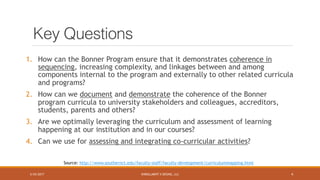
Key Questions
1. How can the Bonner Program ensure that it demonstrates coherence in
sequencing, increasing complexity, and linkages between and among
components internal to the program and externally to other related curricula
and programs?
2. How can we document and demonstrate the coherence of the Bonner
program curricula to university stakeholders and colleagues, accreditors,
students, parents and others?
3. Are we optimally leveraging the curriculum and assessment of learning
happening at our institution and in our courses?
4. Can we use for assessing and integrating co-curricular activities?
Source: http://www.southernct.edu/faculty-staff/faculty-development/curriculummapping.html
5/25/2017 4
ENROLLMENT X DESING, LLC
Curriculum map definitions
A graphical illustration of the relationship between a program’s
requirements/learning opportunities and the student learning
outcomes.
Source: https://manoa.hawaii.edu/assessment/workshops/pdf/SLOs_curriculummaps2008-10.pdf
A curriculum map is a visual representation of the structure of program
curriculum.
oThe map charts program courses, syllabi, classroom activities, and
assessments as they relate to the intended program learning
outcomes.
Source: http://www.southernct.edu/faculty-staff/faculty-development/curriculummapping.html
5/25/2017 5
ENROLLMENT X DESING, LLC
Benefits of Curriculum Map
➢Aligns instruction with learning outcomes
➢Documents learning process: what is taught, how, and when
➢Reveals gaps in the curriculum.
➢Helps design an assessment plan
➢ Improves communication
➢Improves program coherence
➢ Encourages reflective practice
SOURCE: https://manoa.hawaii.edu/assessment/workshops/pdf/SLOs_curriculummaps2008-10.pdf
5/25/2017 6
ENROLLMENT X DESING, LLC
Curriculum Maps Detail SLOs*
Guidelines for Developing and Assessing Student Learning Outcomes for Undergraduate Majors at
UCLA notes the following 4 dimensions that most typically pertain to what students should know,
be able to do, and value by the end of their undergraduate educational program (outcomes):
1. Knowledge outcomes pertain to grasp of fundamental cognitive content, core concepts or
questions, basic principles of inquiry, a broad history, and/or varied disciplinary techniques.
2. Skills outcomes focus on capacity for applying basic knowledge, analyzing and synthesizing
information, assessing the value of information, communicating effectively, and
collaborating.
3. Attitudes and values outcomes encompass affective states, personal/professional/social
values, and ethical principles.
4. Behavioral outcomes reflect a manifestation of knowledge, skills, and attitudes as
evidenced by performance, contributions, etc.
➢Knowledge, skills, and behavioral tend to more readily lend themselves to evaluation based
on “direct” evidence
➢Attitudes and value-based outcomes rely on indirect evidence
Source: http://www.wasc.ucla.edu/eer_endnotes/Learning_Outcomes_Guidelines.pdf
5/25/2017 7
ENROLLMENT X DESING, LLC
Other considerations
• Mapping should include co-curricular, special or distinctive program
elements (Examples: student research symposium, portfolios,
performances, clinical/practicum, internships, co-ops, etc).
• Authentic assessments curated through s curricula that is scaffolded
within a program or across content domains/breadth (vertical and
horizontal).
oMultiple assessment opportunities embedded in the program may minimize the
need for an “outside” assessment such as a standardized test (often not well
aligned with many program objectives).
Source: http://www.bu.edu/provost/files/2015/04/4.8.15-CEIT-Teaching-Talk-Assessment-Curriculum-Mapping-PowerPoint.pdf
5/25/2017 8
ENROLLMENT X DESING, LLC
Basic Program
Curriculum Map
Program
Outcome
1
Program
Outcome
2
Program
Outcome
3
Program
Outcome
4
Program
Outcome
5
Program
Outcome
6
Course 1 X X X X
Course 2 X X X X X
Course 3 X X X
Course 4 X X
Course 5 X X X
Course 6 X X X
Columns (Program Outcomes)
1. Sub Columns (for each
program outcome) can include:
o Communication of Program
Outcomes in the Course
Syllabus
o Level of Instruction
o Assessment of Program
Outcomes
2. Rows (Courses)
Source: http://www.southernct.edu/faculty-staff/faculty-development/
curriculummapping.html
5/25/2017 9
ENROLLMENT X DESING, LLC
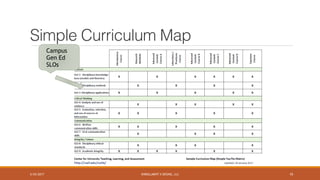
Simple Curriculum Map
Campus
Gen Ed
SLOs
5/25/2017 10
ENROLLMENT X DESING, LLC
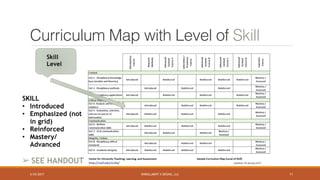
Curriculum Map with Level of Skill
Skill
Level
SKILL
• Introduced
• Emphasized (not
in grid)
• Reinforced
• Mastery/
Advanced
➢ SEE HANDOUT
5/25/2017 11
ENROLLMENT X DESING, LLC
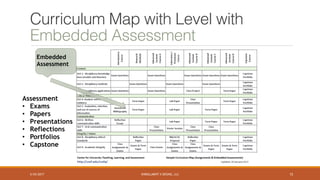
Curriculum Map with Level with 

Embedded Assessment
Embedded
Assessment
Assessment
• Exams
• Papers
• Presentations
• Reflections
• Portfolios
• Capstone
5/25/2017 12
ENROLLMENT X DESING, LLC
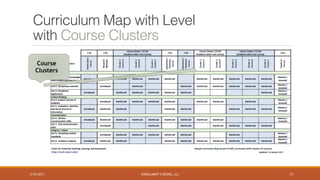
Curriculum Map with Level 

with Course Clusters
Course
Clusters
5/25/2017 13
ENROLLMENT X DESING, LLC
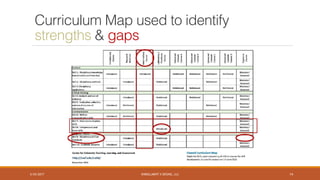
Curriculum Map used to identify 

strengths & gaps
5/25/2017 14
ENROLLMENT X DESING, LLC
Mapping: Co-Curricular and
Curricular
◦Wayne State Example
◦Curriculum & Student Affairs
5/25/2017 15
ENROLLMENT X DESING, LLC
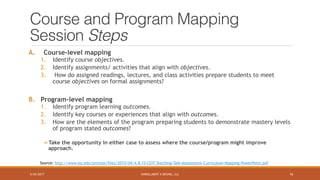
Course and Program Mapping
Session Steps
A. Course-level mapping
1. Identify course objectives.
2. Identify assignments/ activities that align with objectives.
3. How do assigned readings, lectures, and class activities prepare students to meet
course objectives on formal assignments?
B. Program-level mapping
1. Identify program learning outcomes.
2. Identify key courses or experiences that align with outcomes.
3. How are the elements of the program preparing students to demonstrate mastery levels
of program stated outcomes?
➢Take the opportunity in either case to assess where the course/program might improve
approach.
Source: http://www.bu.edu/provost/files/2015/04/4.8.15-CEIT-Teaching-Talk-Assessment-Curriculum-Mapping-PowerPoint.pdf
5/25/2017 16
ENROLLMENT X DESING, LLC
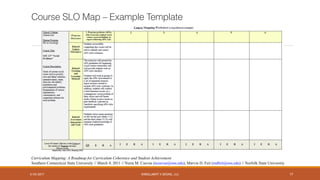
Course SLO Map – Example Template
Curriculum Mapping: A Roadmap for Curriculum Coherence and Student Achievement
Southern Connecticut State University // March 4, 2011 // Nuria M. Cuevas (ncuevas@nsu.edu), Marvin D. Feit (mdfeit@nsu.edu) // Norfolk State University
5/25/2017 17
ENROLLMENT X DESING, LLC
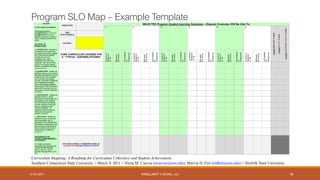
Program SLO Map – Example Template
Curriculum Mapping: A Roadmap for Curriculum Coherence and Student Achievement
Southern Connecticut State University // March 4, 2011 // Nuria M. Cuevas (ncuevas@nsu.edu), Marvin D. Feit (mdfeit@nsu.edu) // Norfolk State University
5/25/2017 18
ENROLLMENT X DESING, LLC
Quantitative Indicators (Often Optional)
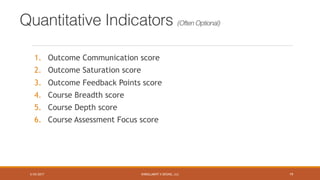
1. Outcome Communication score
2. Outcome Saturation score
3. Outcome Feedback Points score
4. Course Breadth score
5. Course Depth score
6. Course Assessment Focus score
5/25/2017 19
ENROLLMENT X DESING, LLC
Quantitative Indicators: A Word of Caution
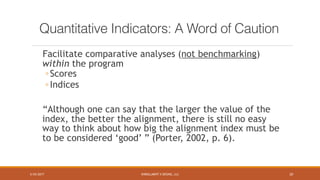
Facilitate comparative analyses (not benchmarking)
within the program
◦Scores
◦Indices
“Although one can say that the larger the value of the
index, the better the alignment, there is still no easy
way to think about how big the alignment index must be
to be considered ‘good’ ” (Porter, 2002, p. 6).
5/25/2017 20
ENROLLMENT X DESING, LLC
Meta-analysis of curriculum maps
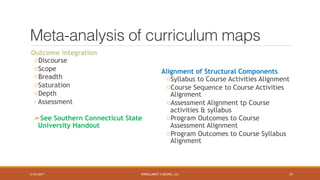
Outcome integration
oDiscourse
oScope
oBreadth
oSaturation
oDepth
◦ Assessment
➢See Southern Connecticut State
University Handout
Alignment of Structural Components
oSyllabus to Course Activities Alignment
oCourse Sequence to Course Activities
Alignment
oAssessment Alignment tp Course
activities & syllabus
oProgram Outcomes to Course
Assessment Alignment
oProgram Outcomes to Course Syllabus
Alignment
5/25/2017 21
ENROLLMENT X DESING, LLC
Contact Raymond Barclay, PhD at Enrollment x Design
ray@enrollmentxdesign.com
www.enrollmentxdesign.com
5/25/2017 22

Curriculum Mapping

  • 1.
    Curriculum Mapping APPROACHES CLARIFYINGAND ASSESSING THE RELATIONSHIPS OF CURRICULAR & CO-CURRICULAR ACTIVITIES, COURSES, AND PROGRAMS PRESENTED BY RAYMOND BARCLAY, PHD ENROLLMENT X DESIGN, LLC
  • 2.
    ENROLLMENT X DESING,LLC Agenda I. Introductions II. What is Curriculum Mapping? III. Steps in the Mapping Process IV. Analyzing and Interpreting Maps V. Hands-On Exercise VI. Lessons Learned / Tips for Success VII. Questions / Discussion 5/25/2017 2
  • 3.
    PROPERTY OF ENROLLMENTX DESIGN, LLC Raymond Barclay - Brief Bio Education (First Generation College Student): ◦ PhD, Psychology (Measurement/Statistics and Cognition), Temple University, School of Education ◦ Specialization in Design Thinking – University of Virginia, Graduate School of Business ◦ Design Thinking & Charrettes – Harvard Univ.-Graduate School of Design ◦ MS , Sustainable Design – Thomas Jefferson Univ./Univ. of Philadelphia, College of Architecture and Built Design (in progress) ◦ MDIV, Princeton Theological Seminary ◦ Philosophy & Religious Studies - Indiana University of Pennsylvania Published in the following areas: Online learning, assessment and learning, strategic planning, resiliency, survey development, clinical psychology, statistical methods, (hierarchical linear analysis, multivariate analysis, cluster and factor analysis) Current Role - President – Enrollment x Design, LLC (NJ) – present Prior Roles Associate Vice President/Associate Provost/Associate Vice Chancellor Roles o The New School (NY) o Stetson University (FL) o University of North Carolina (NC) o College of Charleston (SC) Director Roles o The College of New Jersey (NJ) o Burlington County College (NJ) o The Bonner Foundation (NJ) Senior Analyst Roles o Arroyo Research Services (NC) - K-16 consulting/evaluation firm) o Rowan Univ./Burlington County Community College (NJ) 5/24/2017 3
  • 4.
    ENROLLMENT X DESING,LLC Key Questions 1. How can the Bonner Program ensure that it demonstrates coherence in sequencing, increasing complexity, and linkages between and among components internal to the program and externally to other related curricula and programs? 2. How can we document and demonstrate the coherence of the Bonner program curricula to university stakeholders and colleagues, accreditors, students, parents and others? 3. Are we optimally leveraging the curriculum and assessment of learning happening at our institution and in our courses? 4. Can we use for assessing and integrating co-curricular activities? Source: http://www.southernct.edu/faculty-staff/faculty-development/curriculummapping.html 5/25/2017 4
  • 5.
    ENROLLMENT X DESING,LLC Curriculum map definitions A graphical illustration of the relationship between a program’s requirements/learning opportunities and the student learning outcomes. Source: https://manoa.hawaii.edu/assessment/workshops/pdf/SLOs_curriculummaps2008-10.pdf A curriculum map is a visual representation of the structure of program curriculum. oThe map charts program courses, syllabi, classroom activities, and assessments as they relate to the intended program learning outcomes. Source: http://www.southernct.edu/faculty-staff/faculty-development/curriculummapping.html 5/25/2017 5
  • 6.
    ENROLLMENT X DESING,LLC Benefits of Curriculum Map ➢Aligns instruction with learning outcomes ➢Documents learning process: what is taught, how, and when ➢Reveals gaps in the curriculum. ➢Helps design an assessment plan ➢ Improves communication ➢Improves program coherence ➢ Encourages reflective practice SOURCE: https://manoa.hawaii.edu/assessment/workshops/pdf/SLOs_curriculummaps2008-10.pdf 5/25/2017 6
  • 7.
    ENROLLMENT X DESING,LLC Curriculum Maps Detail SLOs* Guidelines for Developing and Assessing Student Learning Outcomes for Undergraduate Majors at UCLA notes the following 4 dimensions that most typically pertain to what students should know, be able to do, and value by the end of their undergraduate educational program (outcomes): 1. Knowledge outcomes pertain to grasp of fundamental cognitive content, core concepts or questions, basic principles of inquiry, a broad history, and/or varied disciplinary techniques. 2. Skills outcomes focus on capacity for applying basic knowledge, analyzing and synthesizing information, assessing the value of information, communicating effectively, and collaborating. 3. Attitudes and values outcomes encompass affective states, personal/professional/social values, and ethical principles. 4. Behavioral outcomes reflect a manifestation of knowledge, skills, and attitudes as evidenced by performance, contributions, etc. ➢Knowledge, skills, and behavioral tend to more readily lend themselves to evaluation based on “direct” evidence ➢Attitudes and value-based outcomes rely on indirect evidence Source: http://www.wasc.ucla.edu/eer_endnotes/Learning_Outcomes_Guidelines.pdf 5/25/2017 7
  • 8.
    ENROLLMENT X DESING,LLC Other considerations • Mapping should include co-curricular, special or distinctive program elements (Examples: student research symposium, portfolios, performances, clinical/practicum, internships, co-ops, etc). • Authentic assessments curated through s curricula that is scaffolded within a program or across content domains/breadth (vertical and horizontal). oMultiple assessment opportunities embedded in the program may minimize the need for an “outside” assessment such as a standardized test (often not well aligned with many program objectives). Source: http://www.bu.edu/provost/files/2015/04/4.8.15-CEIT-Teaching-Talk-Assessment-Curriculum-Mapping-PowerPoint.pdf 5/25/2017 8
  • 9.
    ENROLLMENT X DESING,LLC Basic Program Curriculum Map Program Outcome 1 Program Outcome 2 Program Outcome 3 Program Outcome 4 Program Outcome 5 Program Outcome 6 Course 1 X X X X Course 2 X X X X X Course 3 X X X Course 4 X X Course 5 X X X Course 6 X X X Columns (Program Outcomes) 1. Sub Columns (for each program outcome) can include: o Communication of Program Outcomes in the Course Syllabus o Level of Instruction o Assessment of Program Outcomes 2. Rows (Courses) Source: http://www.southernct.edu/faculty-staff/faculty-development/ curriculummapping.html 5/25/2017 9
  • 10.
    ENROLLMENT X DESING,LLC Simple Curriculum Map Campus Gen Ed SLOs 5/25/2017 10
  • 11.
    ENROLLMENT X DESING,LLC Curriculum Map with Level of Skill Skill Level SKILL • Introduced • Emphasized (not in grid) • Reinforced • Mastery/ Advanced ➢ SEE HANDOUT 5/25/2017 11
  • 12.
    ENROLLMENT X DESING,LLC Curriculum Map with Level with 
 Embedded Assessment Embedded Assessment Assessment • Exams • Papers • Presentations • Reflections • Portfolios • Capstone 5/25/2017 12
  • 13.
    ENROLLMENT X DESING,LLC Curriculum Map with Level 
 with Course Clusters Course Clusters 5/25/2017 13
  • 14.
    ENROLLMENT X DESING,LLC Curriculum Map used to identify 
 strengths & gaps 5/25/2017 14
  • 15.
    ENROLLMENT X DESING,LLC Mapping: Co-Curricular and Curricular ◦Wayne State Example ◦Curriculum & Student Affairs 5/25/2017 15
  • 16.
    ENROLLMENT X DESING,LLC Course and Program Mapping Session Steps A. Course-level mapping 1. Identify course objectives. 2. Identify assignments/ activities that align with objectives. 3. How do assigned readings, lectures, and class activities prepare students to meet course objectives on formal assignments? B. Program-level mapping 1. Identify program learning outcomes. 2. Identify key courses or experiences that align with outcomes. 3. How are the elements of the program preparing students to demonstrate mastery levels of program stated outcomes? ➢Take the opportunity in either case to assess where the course/program might improve approach. Source: http://www.bu.edu/provost/files/2015/04/4.8.15-CEIT-Teaching-Talk-Assessment-Curriculum-Mapping-PowerPoint.pdf 5/25/2017 16
  • 17.
    ENROLLMENT X DESING,LLC Course SLO Map – Example Template Curriculum Mapping: A Roadmap for Curriculum Coherence and Student Achievement Southern Connecticut State University // March 4, 2011 // Nuria M. Cuevas (ncuevas@nsu.edu), Marvin D. Feit (mdfeit@nsu.edu) // Norfolk State University 5/25/2017 17
  • 18.
    ENROLLMENT X DESING,LLC Program SLO Map – Example Template Curriculum Mapping: A Roadmap for Curriculum Coherence and Student Achievement Southern Connecticut State University // March 4, 2011 // Nuria M. Cuevas (ncuevas@nsu.edu), Marvin D. Feit (mdfeit@nsu.edu) // Norfolk State University 5/25/2017 18
  • 19.
    ENROLLMENT X DESING,LLC Quantitative Indicators (Often Optional) 1. Outcome Communication score 2. Outcome Saturation score 3. Outcome Feedback Points score 4. Course Breadth score 5. Course Depth score 6. Course Assessment Focus score 5/25/2017 19
  • 20.
    ENROLLMENT X DESING,LLC Quantitative Indicators: A Word of Caution Facilitate comparative analyses (not benchmarking) within the program ◦Scores ◦Indices “Although one can say that the larger the value of the index, the better the alignment, there is still no easy way to think about how big the alignment index must be to be considered ‘good’ ” (Porter, 2002, p. 6). 5/25/2017 20
  • 21.
    ENROLLMENT X DESING,LLC Meta-analysis of curriculum maps Outcome integration oDiscourse oScope oBreadth oSaturation oDepth ◦ Assessment ➢See Southern Connecticut State University Handout Alignment of Structural Components oSyllabus to Course Activities Alignment oCourse Sequence to Course Activities Alignment oAssessment Alignment tp Course activities & syllabus oProgram Outcomes to Course Assessment Alignment oProgram Outcomes to Course Syllabus Alignment 5/25/2017 21
  • 22.
    ENROLLMENT X DESING,LLC Contact Raymond Barclay, PhD at Enrollment x Design ray@enrollmentxdesign.com www.enrollmentxdesign.com 5/25/2017 22