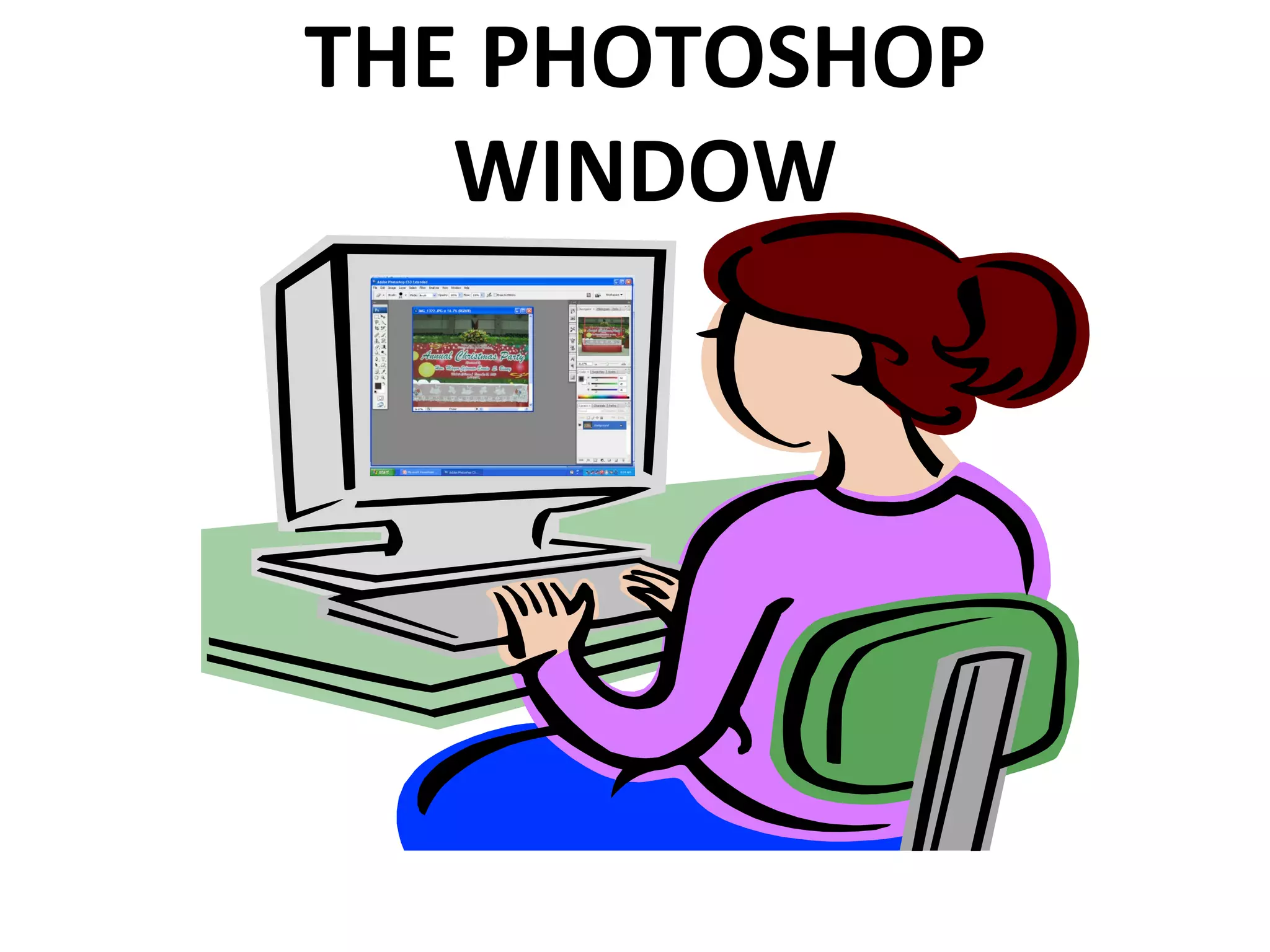
THE PHOTOSHOP
WINDOW
PARTS OF THE ADOBE PHOTOSHO
1. Title bar
It is where the name
of the program and
the name of the
document appears.
PARTS OF THE ADOBE PHOTO
2. Menu bar
It organizes the useful
commands into
menus across the top
of your screen.
PARTS OF THE ADOBE PHOT
3. Options bar
It provides options
to the currently
selected tool.
PARTS OF THE ADOBE PHOTO
4. Toolbox
It contains tools to
edit active image or
create graphics.
PARTS OF THE ADOBE PHOTO
5. Status bar
It displays the status of your
created document/file. It
also displays the current
setting you have done to
your work as well as file
properties and tools used.
PARTS OF THE ADOBE PH
6. Work area/ Canvass
It is the largest element of
the work space where your
work is done and displayed.
All of the content resulting
from your application of the
tools and palette options are
found in the canvass.
PARTS OF THE ADOBE
PHOTOSHOP WINDOW
7. Collapse to icon button
It helps to minimize clutter in
the work space by hiding
other palettes as an icon. You
can activate palettes one at a
time by clicking the icon that
represents the palette.
Parts of the Adobe
Photoshop Window
8. Palettes
Each palette contains related options
that you can use to modify your image.
It include: navigator, color, history and
layers. Each palette also includes a
palette options fly-out menu which is
located at the upper right hand of each
palette. This fly-out includes additional
options for actions for the created
palette.
PARTS OF THE ADOBE
PHOTOSHOP WINDOW CS3
9. Workspace dropdown menu
It displays preset workspaces that
you can choose from or with
which you can save your
customize d workspace. You can
go back to the default
workspace by choosing default
workspace from the options.
PARTS OF THE ADOBE
PHOTOSHOP WINDOW CS3
10. Adobe bridge button
Lets you organize your image files
efficiently. Other than organizing
image files, the bridge also offers
other functions such as batch
image processing, rating image
files and displaying images in
different modes.

The Adobe Photoshop Window

  • 1.
  • 2.
    PARTS OF THEADOBE PHOTOSHO 1. Title bar It is where the name of the program and the name of the document appears.
  • 3.
    PARTS OF THEADOBE PHOTO 2. Menu bar It organizes the useful commands into menus across the top of your screen.
  • 4.
    PARTS OF THEADOBE PHOT 3. Options bar It provides options to the currently selected tool.
  • 5.
    PARTS OF THEADOBE PHOTO 4. Toolbox It contains tools to edit active image or create graphics.
  • 6.
    PARTS OF THEADOBE PHOTO 5. Status bar It displays the status of your created document/file. It also displays the current setting you have done to your work as well as file properties and tools used.
  • 7.
    PARTS OF THEADOBE PH 6. Work area/ Canvass It is the largest element of the work space where your work is done and displayed. All of the content resulting from your application of the tools and palette options are found in the canvass.
  • 8.
    PARTS OF THEADOBE PHOTOSHOP WINDOW 7. Collapse to icon button It helps to minimize clutter in the work space by hiding other palettes as an icon. You can activate palettes one at a time by clicking the icon that represents the palette.
  • 9.
    Parts of theAdobe Photoshop Window 8. Palettes Each palette contains related options that you can use to modify your image. It include: navigator, color, history and layers. Each palette also includes a palette options fly-out menu which is located at the upper right hand of each palette. This fly-out includes additional options for actions for the created palette.
  • 10.
    PARTS OF THEADOBE PHOTOSHOP WINDOW CS3 9. Workspace dropdown menu It displays preset workspaces that you can choose from or with which you can save your customize d workspace. You can go back to the default workspace by choosing default workspace from the options.
  • 11.
    PARTS OF THEADOBE PHOTOSHOP WINDOW CS3 10. Adobe bridge button Lets you organize your image files efficiently. Other than organizing image files, the bridge also offers other functions such as batch image processing, rating image files and displaying images in different modes.