


The Periodic Table
An old story told in a new way …
Let’s start with a song …
So who can explain
the periodic table for
me now?
Hmmm … let’s start at the very beginning
What is the purpose of the Periodic Table?
To summarize and predict the chemical
properties of real elements
Now for a bit of history and fun facts …
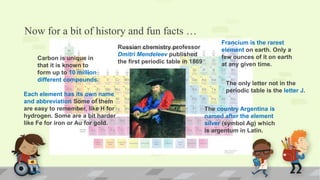
Russian chemistry professor
Dmitri Mendeleev published
the first periodic table in 1869
Carbon is unique in
that it is known to
form up to 10 million
different compounds.
Francium is the rarest
element on earth. Only a
few ounces of it on earth
at any given time.
The country Argentina is
named after the element
silver (symbol Ag) which
is argentum in Latin.
The only letter not in the
periodic table is the letter J.
Each element has its own name
and abbreviation Some of them
are easy to remember, like H for
hydrogen. Some are a bit harder
like Fe for iron or Au for gold.
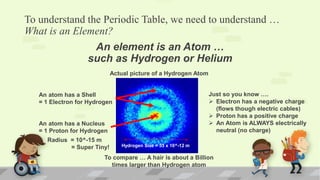
Actual picture of a Hydrogen Atom
To understand the Periodic Table, we need to understand …
What is an Element?
An element is an Atom …
such as Hydrogen or Helium
An atom has a Shell
= 1 Electron for Hydrogen
Just so you know ….
 Electron has a negative charge
(flows though electric cables)
 Proton has a positive charge
 An Atom is ALWAYS electrically
neutral (no charge)
Hydrogen Size = 53 x 10^-12 m
An atom has a Nucleus
= 1 Proton for Hydrogen
Radius = 10^-15 m
= Super Tiny!
To compare … A hair is about a Billion
times larger than Hydrogen atom
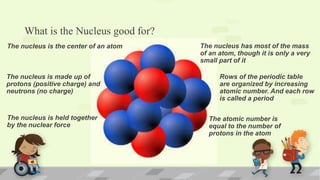
What is the Nucleus good for?
The nucleus is the center of an atom The nucleus has most of the mass
of an atom, though it is only a very
small part of it
The nucleus is made up of
protons (positive charge) and
neutrons (no charge)
Rows of the periodic table
are organized by increasing
atomic number. And each row
is called a period
The nucleus is held together
by the nuclear force
The atomic number is
equal to the number of
protons in the atom
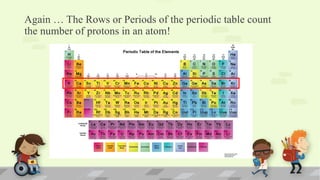
Again … The Rows or Periods of the periodic table count
the number of protons in an atom!
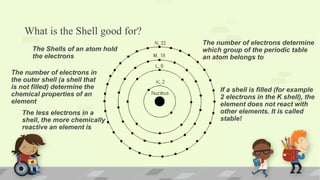
What is the Shell good for?
The Shells of an atom hold
the electrons
The number of electrons determine
which group of the periodic table
an atom belongs to
The number of electrons in
the outer shell (a shell that
is not filled) determine the
chemical properties of an
element
If a shell is filled (for example
2 electrons in the K shell), the
element does not react with
other elements. It is called
stable!
The less electrons in a
shell, the more chemically
reactive an element is
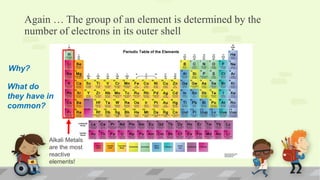
Again … The group of an element is determined by the
number of electrons in its outer shell
Alkali Metals
are the most
reactive
elements!
Why?
What do
they have in
common?
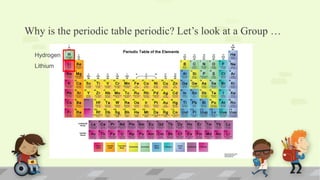
Why is the periodic table periodic? Let’s look at a Group …
Hydrogen
Lithium
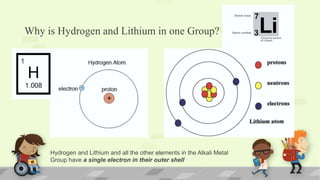
Why is Hydrogen and Lithium in one Group?
Hydrogen and Lithium and all the other elements in the Alkali Metal
Group have a single electron in their outer shell
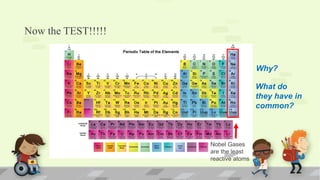
Now the TEST!!!!!
Nobel Gases
are the least
reactive atoms
Why?
What do
they have in
common?
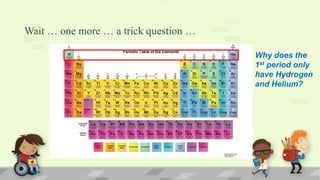
Wait … one more … a trick question …
Why does the
1st period only
have Hydrogen
and Helium?
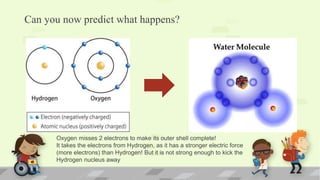
Can you now predict what happens?
Oxygen misses 2 electrons to make its outer shell complete!
It takes the electrons from Hydrogen, as it has a stronger electric force
(more electrons) than Hydrogen! But it is not strong enough to kick the
Hydrogen nucleus away
Congrats … You are Periodic Table Champions!!!

The Periodic Table - a not so serious Introduction

  • 1.
    The Periodic Table Anold story told in a new way …
  • 2.
    Let’s start witha song … So who can explain the periodic table for me now?
  • 3.
    Hmmm … let’sstart at the very beginning What is the purpose of the Periodic Table? To summarize and predict the chemical properties of real elements
  • 4.
    Now for abit of history and fun facts … Russian chemistry professor Dmitri Mendeleev published the first periodic table in 1869 Carbon is unique in that it is known to form up to 10 million different compounds. Francium is the rarest element on earth. Only a few ounces of it on earth at any given time. The country Argentina is named after the element silver (symbol Ag) which is argentum in Latin. The only letter not in the periodic table is the letter J. Each element has its own name and abbreviation Some of them are easy to remember, like H for hydrogen. Some are a bit harder like Fe for iron or Au for gold.
  • 5.
    Actual picture ofa Hydrogen Atom To understand the Periodic Table, we need to understand … What is an Element? An element is an Atom … such as Hydrogen or Helium An atom has a Shell = 1 Electron for Hydrogen Just so you know ….  Electron has a negative charge (flows though electric cables)  Proton has a positive charge  An Atom is ALWAYS electrically neutral (no charge) Hydrogen Size = 53 x 10^-12 m An atom has a Nucleus = 1 Proton for Hydrogen Radius = 10^-15 m = Super Tiny! To compare … A hair is about a Billion times larger than Hydrogen atom
  • 6.
    What is theNucleus good for? The nucleus is the center of an atom The nucleus has most of the mass of an atom, though it is only a very small part of it The nucleus is made up of protons (positive charge) and neutrons (no charge) Rows of the periodic table are organized by increasing atomic number. And each row is called a period The nucleus is held together by the nuclear force The atomic number is equal to the number of protons in the atom
  • 7.
    Again … TheRows or Periods of the periodic table count the number of protons in an atom!
  • 8.
    What is theShell good for? The Shells of an atom hold the electrons The number of electrons determine which group of the periodic table an atom belongs to The number of electrons in the outer shell (a shell that is not filled) determine the chemical properties of an element If a shell is filled (for example 2 electrons in the K shell), the element does not react with other elements. It is called stable! The less electrons in a shell, the more chemically reactive an element is
  • 9.
    Again … Thegroup of an element is determined by the number of electrons in its outer shell Alkali Metals are the most reactive elements! Why? What do they have in common?
  • 10.
    Why is theperiodic table periodic? Let’s look at a Group … Hydrogen Lithium
  • 11.
    Why is Hydrogenand Lithium in one Group? Hydrogen and Lithium and all the other elements in the Alkali Metal Group have a single electron in their outer shell
  • 12.
    Now the TEST!!!!! NobelGases are the least reactive atoms Why? What do they have in common?
  • 13.
    Wait … onemore … a trick question … Why does the 1st period only have Hydrogen and Helium?
  • 14.
    Can you nowpredict what happens? Oxygen misses 2 electrons to make its outer shell complete! It takes the electrons from Hydrogen, as it has a stronger electric force (more electrons) than Hydrogen! But it is not strong enough to kick the Hydrogen nucleus away
  • 15.
    Congrats … Youare Periodic Table Champions!!!