ATOMS AND THE
PERIODIC TABLE
1 BSED – SCIENCE
TOPIC 1
ATOMS, SUBATOMIC
PARTICLES, AND
ATOMIC STRUCTURE
Inorganic vs. Organic
Question: Is it under inorganic chemistry or
organic chemistry?
Inorganic vs. Organic
1. H2O
Inorganic vs. Organic
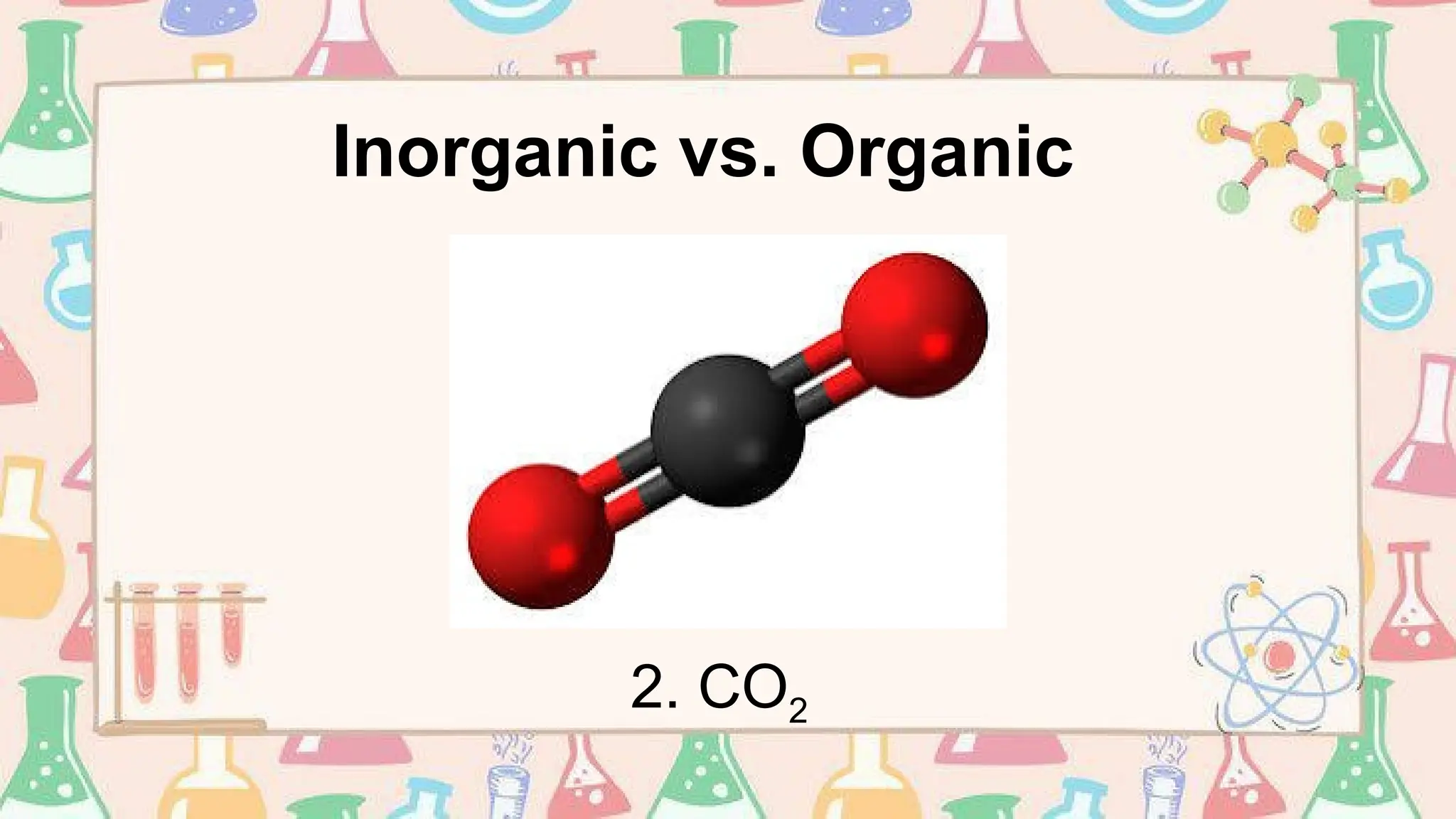
2. CO2
Inorganic vs. Organic
3. CH4
Be an Electron
Be an Electron
Be an Electron
Be an Electron
Be an Electron
Be an Electron
Order please!
Video link:
https://youtu.be
/v48u8hjqNBU?
si=YhFlGGzXHrT
Tux36
ATOM
ATOMIC THEORY
It is the scientific concept that matter
is composed of small fundamental
particles called atoms.
HISTORY OF ATOMS
Before 1800s - Democritus
“ATOMOS”
- Ancient Greek word meaning “indivisible”
Along with Leucippus, they outlined the idea
that everything is made of atoms
HISTORY OF ATOMS
1803 - John Dalton: Solid Sphere Model
English chemist
- atoms are indivisible
- atoms of the same
element are identical
- compounds are
combinations of different
types of atoms
HISTORY OF ATOMS
1803 - John Dalton: Solid Sphere Model
HISTORY OF ATOMS
1897 - Joseph John (JJ.) Thomson:
Electron
English physicist
- proved that something smaller
than atoms existed: “corpuscle”
HISTORY OF ATOMS
1904 - Joseph John (JJ.) Thomson:
Plum Pudding Model
HISTORY OF ATOMS
1911 – Ernest Rutherford: Nucleus and
Proton
Physicist
- discovered the small, dense,
positively-charged center: “nucleus”
HISTORY OF ATOMS
1911 – Ernest Rutherford: Nuclear
Model
HISTORY OF ATOMS
1913 – Niels Bohr: Planetary Model
Danish physicist
- Modified Rutherford’s model
- electrons
- Electrons move around the
nucleus in orbits of fixed
sizes and energies.
- The energy in this model
was quantized
HISTORY OF ATOMS
1913 – Niels Bohr: Planetary Model
HISTORY OF ATOMS
1926 – Erwin Schrodinger: Quantum
Model
Australian physicist
- electrons behave as waves
rather than the electrons
moving in fixed orbits or
shells
- electron cloud or “cloud of
probability”
HISTORY OF ATOMS
1926 – Erwin Schrodinger: Quantum
Model
HISTORY OF ATOMS
1932 – James Chadwick: Neutron
- performed beryllium bombardment
experiments and discovered particles with
mass approximately equal to a proton but
without charge: neutron
SUBATOMIC PARTICLES
SUBATOMIC PARTICLES
PROTON (p+
) - positively charged
- found in the nucleus, mass: 1.6726 x 10⁻²⁷
kg
ELECTRON (e-
) - negatively charged
- orbits the nucleus, mass: 9.11 x 10⁻³¹
kg
NEUTRON (n0
) - no charge
- found in the nucleus, mass: 1.6749 x 10⁻²⁷
kg
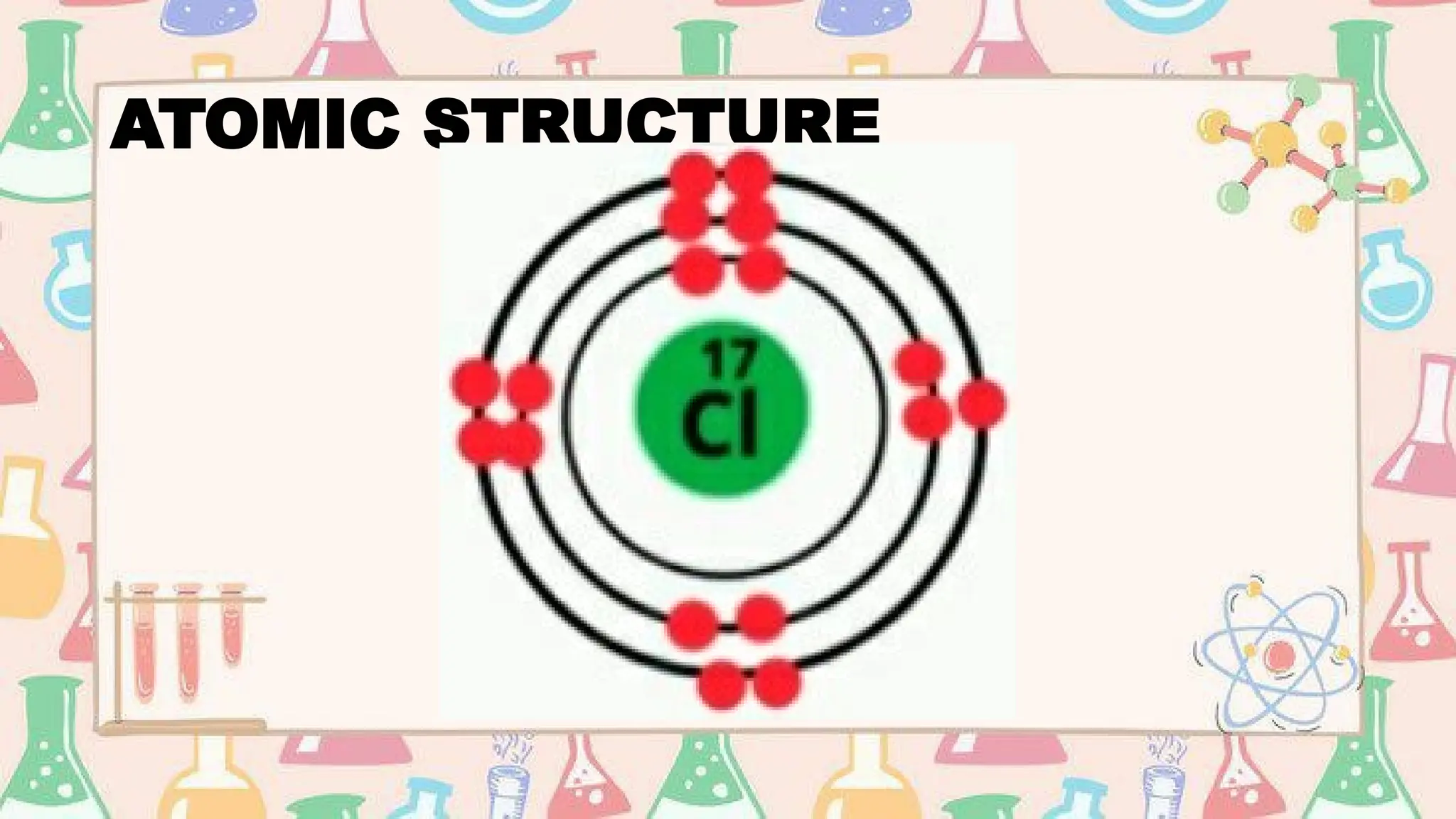
ATOMIC STRUCTURE
An atom consists
of a nucleus and
the associated
electrons that are
called orbital
electrons.
ATOMIC STRUCTURE
ATOMIC STRUCTURE
Video link:
https://youtu.be
/vxuBcOoGoD4?
si=VAgri8ZCzg_R
IM_s
ATOMIC STRUCTURE
ATOMIC STRUCTURE
ATOMIC STRUCTURE
ATOMIC STRUCTURE
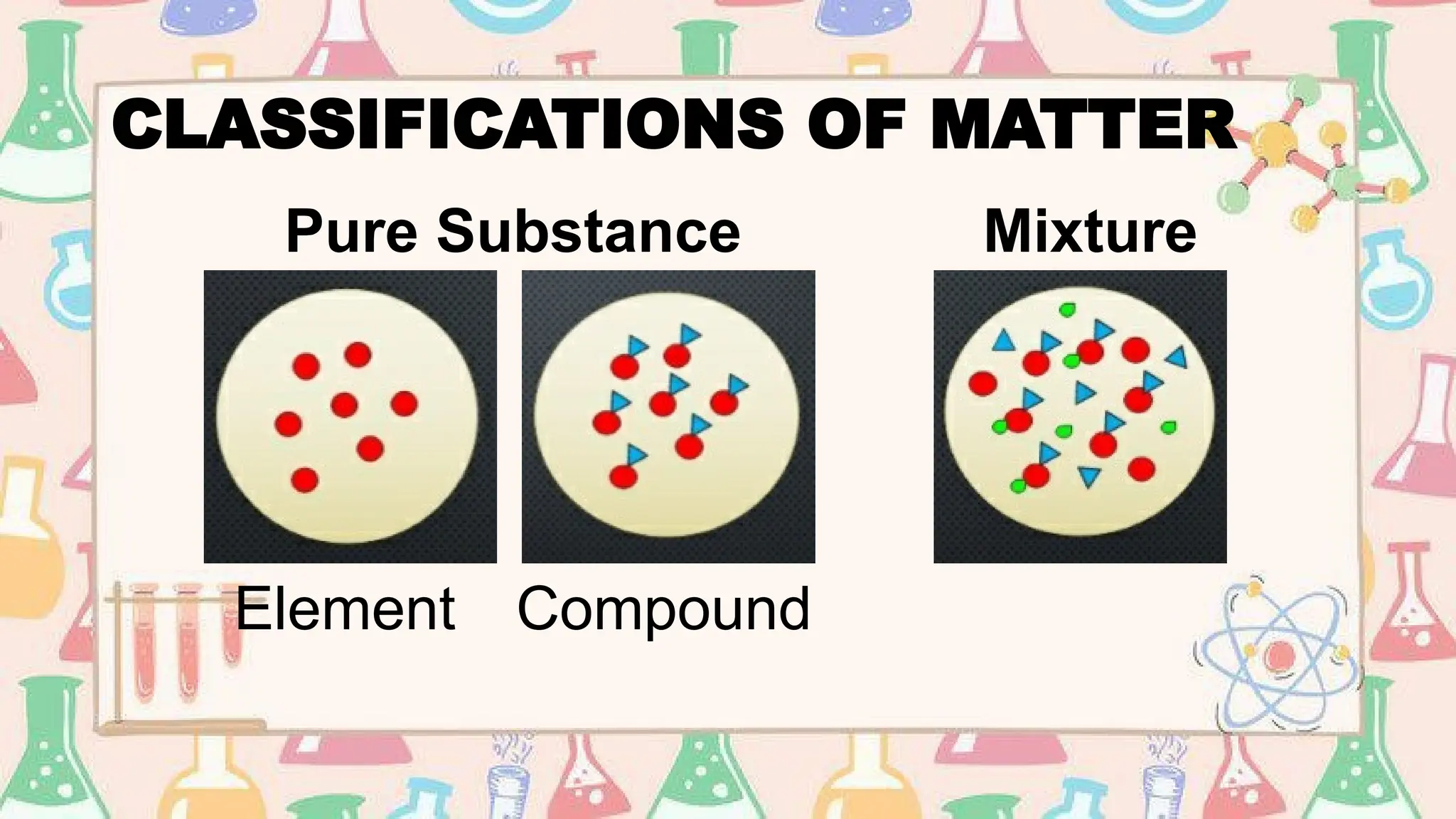
CLASSIFICATIONS OF MATTER
Pure Substance Mixture
Element Compound
EVALUATION
Choose the letter of the correct answer.
1. What subatomic particles are within an
atom's nucleus?
A. Neutron and electron
B. Electron and proton
C. Proton and neutron
D. Proton, neutron, and electron
Choose the letter of the correct answer.
2. What subatomic particles orbit around the
nucleus?
A. Protons
B. Neutrons
C. Electrons
D. Protons and neutrons
Choose the letter of the correct answer.
3. What do you call the outermost electrons?
A. Electrons
B. Nuclear model
C. Atomic structure
D. Valence electrons
Choose the letter of the correct answer.
4. What is the charge of an atom?
A. Electrically neutral
B. Electrically positive
C. Electrically negative
D. Sometimes positive, sometimes negative
Choose the letter of the correct answer.
5. The atomic number is unique for each atom,
therefore, there are no other atoms with the same
atomic number. True or false?
A. True, the atomic number is different with every atom.
B. True, the atomic number represents the atom's
electrons.
C. False, there are some that have the same atomic
numbers.
D. Both true and false, depending on the atom.
ATOMS AND THE
PERIODIC TABLE
1 BSED – SCIENCE
TOPIC 2
THE PERIODIC TABLE
ACTIVITY: Element Rumble
Group yourselves into two (2)
groups and choose a representative to
represent your group, the participants
will participate in this activity with
similar rules to a gameshow named
Rainbow Rumble.
(Choose an element to uncover the hidden
questions)
ACTIVITY: Tongue Twister (QnA Edition)
The participants will read the tongue
twisters presented in front, depending on
how good he/she read the tongue twisters
the teacher will decide if the participant is
exempted to get questioned or not.
1.Periodic products promptly placed, prevent
perpetual perplexity.
2.Xenon and xenophilic xenonates exhibit
extraordinary, exotic electron exchanges.
3.Phosphorus and platinum playfully
participate, producing patterns.
Q. There are 5 types of metals, give me at least 2
Q. The atomic number of an element is the(?)
______________
Q. What type of element the elements are in the
last column?
Q. How many periods are there in the periodic
table?
Q. How many elements are currently found in
the Periodic Table?
Activity: Modified True / False
Identify whether the statements below are true or
false, if false underline the word that makes the
statement incorrect and write down the correct
answer.
_______1. I am Flourine and I am a Halogen
_______2. I am Lithium and I’m an alkaline
earth metals.
_______3. I am Zinc and my atomic
number is 31.
_______4. We are the group 18
known as the noble gas.
_______ 5. We are the Alkali metals
the most reactive of all groups.
PERIODIC TABLE
Most chemical elements are represented
symbolically by two letters, generally the
first two in their name. A very few
elements have symbols which appear to
have no relationship with their names. In
those cases, the origin of the symbol used
is given.
Basic Structure
e.g.
Au derived from the latin
word “Aurum”
Pb derived from the latin word
“Plumbum” meaning liquid
silver
Atomic Number
The atomic number of an
element is the number of protons in the
nucleus of an atom of that element. It
is a fundamental property that defines
the identity of the element.
Key Points
hydrogen has an atomic number of 1,
meaning it has one proton in its nucleus,
while carbon has an atomic number of 6,
meaning it has six protons.
The periodic table, organizes all
discovered chemical elements in rows
(called periods) and columns (called
groups) according to increasing atomic
number.
Image of the Periodic Table
Periodic Trends
Periodic trends are specific patterns observed
in the periodic table that illustrate various
properties of elements. These trends arise
due to the arrangement of elements in the
periodic table and their atomic structure.
1. Atomic Radius: This is the distance
from the nucleus of an atom to its
outermost electron.
2. Electronegativity: This measures an
atom's ability to attract and bind
with electrons.
3. Ionization Energy: This is the energy
required to remove an electron from an atom.
4. Electron Affinity: This is the energy change
when an electron is added to a neutral atom.
5. Metallic Character: This refers to how
easily an element can lose electrons.
Periodic Trends
Types of Elements
1. Metals:
- Alkali Metals: Highly reactive, found in
Group 1 (e.g., Lithium, Sodium).
- Alkaline Earth Metals: Less reactive than alkali
metals, found in Group 2 (e.g., Magnesium,
Calcium).
- Transition Metals: Found in the center of
the table, known for their ability to form
various oxidation states (e.g., Iron, Copper).
- Post-Transition Metals: Softer and have
lower melting points than transition metals
(e.g., Aluminum, Tin).
2. Nonmetals:
- Halogens: Very reactive, found in Group 17
(e.g., Fluorine, Chlorine).
- Noble Gases: Inert and non-reactive, found
in Group 18 (e.g., Helium, Neon).
- Other Nonmetals: Include elements like
Carbon, Nitrogen, and Oxygen, which are
essential for life.
3. Metalloids:
- These elements have properties intermediate
between metals and nonmetals (e.g., Silicon, Boron).
ELECTRONIC CONFIGURATION
The electronic configuration of an atom
describes how its electrons are arranged in
different energy levels and orbitals, following
specific rules like the Aufbau principle, Pauli
exclusion principle, and Hund's rule.
Historical Development
Dmitri Mendeleev's
development of the periodic
table is a remarkable story
of scientific insight and
innovation.
In the mid-19th century,
many elements had been
discovered, but there was
no systematic way to
organize them.
📌INSTRUCTIONS!! KINDLY FILL UP THIS FORM,
ANG DI MAKAPAG RESPOND AUTOMATIC
REMOVE AGAD SA CLASS LIST!
https://forms.gle/4GH5b33oaGdQRSdC6
One of Mendeleev's key insights was
leaving gaps in his table for elements
that had not yet been discovered. He
predicted the existence and properties of
these elements with remarkable
accuracy.
Mendeleev’s Periodic Table
Activity: Pass the Ball
In this activity, you can randomly pass the ball to
anyone until the music stops, the last person who have
hold the ball in time when the music stop is the person
who will answer the questions prepared.
(The music that will be played is the Periodic Table
Song)
Questions:
1. Based on Mendeleev’s amazing predictions
about the existence of some undiscovered
elements, do you think there is a possibility that
the current total of elements found can increase?
2. How useful the periodic table is? In your own
point of view.
3. What is the importance of familiarizing the
periodic trends?
Activity: Review
Answer the following questions.
1-3. What are the three principles applied in
identifying the electronic configuration of
an element?
4. Au is derived of what Latin word?
5. The specific patterns observed in the
periodic table that illustrates the elements.
ATOMS AND THE
PERIODIC TABLE
1 BSED – SCIENCE
TOPIC 3
ATOMIC NUMBER,
MASS NUMBER
AND ISOTOPES
TOPIC :
Activity 1: Let us remember
•What have you learned about the
topic periodic table?
Activity: Guess me! (charades for 7 minutes)
Objectives: Guess the words and phrases based on
the acting of a player.
Rules:
•Divide the class into 2 groups
•Per group must choose a best player to act, and
for members they will guess what is being act.
•The first group to guess 3 correct answer will
be declared as a winner.
GUESS ME
START!!!!
Activity 3: “Name that thing (pictures and emoji
edition)”
+ 🎤 +
1.
• + ic +
🐘 +
2.
3.
+
🧊 + O + 🔝 + es
4.
5.
EXPLORE
Activity 4: Get to know more
a) How did you find the activity?
b) What have you observed while doing the
activity?
c) Based on the information you have
gathered in the activity called “Name that
thing” what do you think is our topic for
today’s discussion
ATOMIC NUMBER
atomic number, the number of a
chemical element in the periodic system
and on the periodic table that equals the
number of protons in the nucleus of the
atom.
MASS NUMBER
The mass number is defined as the
total number of protons and neutrons
in an atom. It can be calculated by
adding the number of neutrons and the
number of protons (atomic number)
together.
(Mass number = atomic number + number of neutrons)
(atomic number-mass number = neutrons)
(Mass number = atomic number + number of neutrons)
(atomic number-mass number = neutrons)
4 = 2 + 2
2 - 4 = 2
ISOTOPES
A family of people often consists of related
but not identical individuals. Elements have
families as well, known as isotopes. Isotopes
are members of a family of an element that
all have the same number of protons but
different numbers of neutrons.
example:
oxygen -16
8 protons and 8 neutrons
Oxygen -17
8 protons and 9 neutrons
Oxygen -18
8 protons and 10 neutrons
https://youtu.be/42gUZNYco0c
Two types of Isotopes:
1.Stable isotopes are non-radioactive forms of
atoms.
ex.
HYDROGEN
•Protium
•Deuterium
2. Unstable isotopes, also known as radioactive
isotopes, are atoms that have an unstable nucleus,
leading to the emission of radiation as they attempt
to reach a more stable state.
ex.
HYDROGEN
tritium
EVALUATE
In this application activity, students will
answer the following elements by finding it’s
atomic number, protons, neutrons and mass
number. Then don’t forget to write the
symbols of each element
1.Manganese
2. Arsenic
3.Titanium
4.Aluminum
5.Antimony
6.Lithium
7.Neon
8.Iodine
9.Tantalum
10.Barium
EXTEND
Multiple Choice (5 Points)
Instruction: Write the letter of the correct
answer.
1. The number of protons in an atom is
called?
A.Subatomic number B. Atoms
C.Atomic Mass D. Atomic Number
2. Protons + neutrons=?
A.Electrons B. Atomic Number
C.Mass number D. Isotopes
3. A family of people often consists of related
but not identical individuals.
A.Isotopes B. Carbon dioxide
C.Nuclei. D. Subatomic particles
4. Are atoms of the same element that have a
different number of neutrons in their nucleus?
A.Radioactive Isotopes B. nuclei
C.Stable Isotopes D. electrons
5. An isotopes that do not undergo nuclear
decay?
A. Unstable isotope B. Atomic number
C.Stable Isotopes D. mass number
ATOMS AND THE
PERIODIC TABLE
1 BSED – SCIENCE
TOPIC 4
AVERAGE ATOMIC
MASS
• Explain what is meant by the atomic mass
of an element;
• Calculate the atomic mass of an element
from the masses and relative percentages of
the isotopes of the element; and,
• Appreciate the importance of obtaining the
average atomic mass.
Objectives
ACTIVITY: My Mass is...
Using your periodic table, identify the
atomic mass of the given elements below.
1.Helium
2.Carbon
3.Potassium
4.Manganese
5.Copper
ACTIVITY: 4 Pics, 1 Word
Guess the word that is being described or
portrayed by the pictures.
__ __ __ __ __ __ __
__ __ __ __
2.
__ __ __ __ __ __
__
3.
__ __ __ __
Given below are the two (2) isotopes of
Chlorine
Video link:
https://youtu.be/dagoITYfEX0?si=cqJTyjx
mchLteshn
AVERAGE ATOMIC MASS
The average atomic mass of an
element is the weighted average of the
masses of its naturally occurring
isotopes. The average atomic mass of an
element can be determined from the
relative amounts of each isotope.
CALCULATING THE AVERAGE
ATOMIC MASS
Average atomic mass = (fractional
abundance of isotope 1)(atomic
mass of isotope 1) + (fractional
abundance of isotope 2)(atomic
mass of isotope 2) + …
Isotopes Abundance
(%)
Atomic
mass (amu)
Chlorine-35 75.76% 34.969
Chlorine-37 24.24% 36.366
Example:
Given below are the isotopes of chlorine.
Average atomic mass = (0.7576)(34.969) +
(0.2424)(36.366)
Average atomic mass = 35.453
Sample problem 1:
About 19.9% of all boron atoms are B-
10 with a mass of 10.0129 amu, and the
remaining 80.1% are 8-11 with a mass
of 11.0093 amu.
Sample problem 2:
A meteorite found in central Indiana contains
traces of the noble gas neon picked up from the
solar wind during the meteorite's trip through
the solar system. Analysis of a sample of the gas
showed that it consisted of 91.84% Ne-20 (mass
19.9924 amu), 0.47% Ne-21 (mass 20.9940
amu), and 7.69% Ne-22 (mass 21.9914 amu).
What is the average mass of the neon in the
solar wind?
ACTIVITY
Calculate the average atomic mass of the
following given data. Write your answer on a
piece of paper.
Isotopes
Abundance
(%)
Atomic
mass (amu)
Lithium-6 7.59% 6.015
Lithium-7 92.41% 7.016
1.
Isotopes
Abundance
(%)
Atomic mass
(amu)
Iron-55 14.50% 54.876
Iron-56 85.50% 55.998
2. Isotopes
Abundance
(%)
Atomic mass
(amu)
Hydrogen-1 99% 0.98
Hydrogen-2 0.80% 1.97
Hydrogen-3 0.20% 2.98
3.
Isotopes
Abundance
(%)
Atomic mass
(amu)
Gold-197 50% 196.56
Gold-198 50% 197.96
Isotopes Abundance (%)
Atomic mass
(amu)
Magnesium-24 78.70% 23.985
Magnesium-25 10.13% 24.986
Magnesium-26 11.17% 25.983
4.
5.
EVALUATE
Answer the following questions.
1. It is the weighted average of the masses of its naturally occurring
isotopes.
A. Atomic mass
B. Mass number
C. Atomic number
D. Average atomic mass
2. It refers to the percentage of abundance written in decimal form
A. Mass number
B. Atomic structure
C. Fraction abundance
D. None of the above
3. The necessary information in calculating the average atomic
mass is/are _______.
A. Isotopes
B. Atomic mass
C. Fractional abundance
D. All of the above
4. The first thing to do in calculating the average atomic mass is
_______.
C. add the atomic masses of the isotopes
D. Add the fractional abundance of the isotopes
C. multiply the first isotope’s fractional abundance with the
atomic mass
D. multiply the first isotope’s atomic number with the fractional
abundance
5. The mass number of the _______ isotope has
the closest value to the average atomic mass.
A. first
B. last
C. least abundant
D. most abundant
ATOMS AND THE
PERIODIC TABLE
1 BSED – SCIENCE
TOPIC 5
MOLE AND MOLAR
MASS
1 BSED - SCIENCE
IDENTIFY WHERE IS THE ATOMIC MASS,
ATOMIC NUMBER, AND SYMBOL
4.00260
A PAIR OF SOCKS
A DOZEN OF EGGS
A CASE OF COKE
A REAM OF PAPER
ACTIVITY:
WORK AS ONE
Video Link: https://youtu.be/4q2elWPfB6A
MOLE
Mole is a counting unit used for
measuring an amount of a
substance. Mole comes from the
Latin word which means heap or
pile.
MOLE
A German
chemist named
Wilhelm Ostwald
created the term
mole in 1893.
AVOGADRO’S NUMBER
It is the number of
particles found in one mole
of a substance.
1 mole = 6.022×10 23
particles
Avogadro’s
number is named
after the Italian
scientist Amadeo
Avogadro.
1 mole of C
weighs 12.01g,
so 12.01 g of C
contains 6.022
x 1023
molecules
MOLAR MASS
is the mass (in grams) of one mole
of a substance. The molar mass of
any element is numerically equal to
its atomic mass and has the units
of g/mol.
EXAMPLE
FORMULA
FORMULA
Sample Problem 1: How many grams are equivalent to 5 moles of H2O?
Given:
n=5 mol
molar mass of H2O = 18 g/mol
Required: mass = ?
Formula: mass = n x molar mass
Sample Problem 1: How many grams are equivalent to 5 moles of H2O?
Solution: mass = n x molar mass
mass = (5 mole) (18 g/ mole)
mass = 90 g of H2O
Sample problem 2: How many moles are in 64 grams of Mg?
Given:
mass of Mg = 64 g
molar mass of Mg= 24g/mol
Required: number of moles or n = ?
Formula: n = mass of Mg
molar mass of Mg
Sample problem 2: How many moles are in 64 grams of Mg?
Solution: n = mass of Mg
molar mass of Mg
n = 64g
24 g/mol
n = 2.67 mol Mg
Sample problem 3: How many atoms are in 3 moles of Mg?
Given: n = 3 moles
N= 6.02 x 10²³
atoms/mole
Required: no. of atoms of Mg = ?
Formula: no. of atoms = no. of moles x
Avogadro’s number
Sample problem 3: How many atoms are in 3 moles of Mg?
Solution: no. of atoms = no. of moles x
Avogadro’s number
= (3 moles) ( 6.02 x 10 23
atoms/ mole)
= 1.806 x 10 23
atoms Mg
FIND THE MOLAR MASS
1. C6H12O6
2. CCl4
3. H2O
Perform each of the following
conversions:
1.12.04x1023
atoms He to moles He
2.10 moles Na to mass
3.24 grams C to moles of C
EVALUATION
Direction: Choose the letter of the best answer.
1. It refers to the SI unit for measurement of number of
particles in a substance.
A. ampere B. candela C. kilogram D. mole
2. Who among these chemists and physicists created
the term mole?
A. Amedeo Avogadro C. John Dalton
B. Jacques Charles D. Wilhelm Ostwald
3. Which of these values represent the number of
particles in one mole of a substance?
A. 6.02x10^22 C. 6.02x10^24
B. 6.022x10^23 D. 6.02x10^25
4. It is the sum of the atomic weights or mass number
of all the atoms in the formula of the substance.
A. Mole C. Avogadro’s Number
B. Molar Mass D. Atom
5. What is the mass of 2.5 mol CaCl2?
A. 420 g
B. 720 g
C. 120 g
D. 277 g
ATOMS AND THE
PERIODIC TABLE
1 BSED – SCIENCE
TOPIC 6
NUCLEAR
CHEMISTRY
“Pass the Message!”
• Divide the class into two teams. Each
team lines up with their teammates.
• The facilitator assigns a unique sentence
(related to the new lesson) each team.
• Representatives pass the sentence down
the line; points awarded for correct
delivery at the front.
“Pass the Message!”
UNSCRAMBLE
Direction: Students will rearrange the
letters to form the correct word.
1. rcauenl imsethrcy
2. mboddbear
3. palha inssemio
4. noisfsi dan ufnois
5. aamgm yras
Video Link: https://www.youtube.com/watch?
v=U2ZNP5c58Rs
NUCLEAR CHEMISTRY
- is the study of the physical
and chemical properties of
elements which are influenced
by changes in the structure of
the atomic nucleus.
NUCLEAR REACTIONS
- is a process in which the
nucleus of an atom undergoes a
change, resulting in the formation
of a different element or isotope.
NUCLEAR REACTIONS
This change can occur through
various processes, such as
nuclear fission, nuclear fusion, or
radioactive decay.
FISSION
Nuclear fission is the process
in nuclear physics in which the
nucleus of an atom splits into
two daughter nuclei.
FUSION
fusion is when two or more atomic
nuclei fuse to form a single heavier
nucleus. In the reaction, the matter is
not conserved because some of the
mass of the fusing nuclei is converted
to energy.
Modern nuclear weapons are
made possible by a
combination of chemical
explosives, nuclear fission,
and nuclear fusion.
Video Link: https://www.youtube.com/watch?v=-
0Mg8Bu07fI&t=49s
RADIOACTIVE DECAY
is the spontaneous nuclear
transformations of unstable
atoms that result in the
formation of new elements.
RADIOACTIVE DECAY
This decay or loss of energy,
results in an atom of one type,
called the parent nuclide
transforming to an atom of a
different type, called the daughter
nuclide.
3 COMMON MODES OF
RADIOACTIVE DECAY
a. Alpha emission (α)
is a low-penetrating emission. An
alpha particle is a highly energetic
helium nucleus that is emitted from
the nucleus of an unstable atom
when the neutron-to-proton ration is
too low.
b. Beta particles (ß-)
are emissions having medium level
penetration. The resulting atom will
have an increase in the atomic
number by 1. There is no change in
the mass number.
c. GAMMA RAYS
commonly referred to as
highly penetrating and
dangerous emissions.
Gamma rays travel at the
speed of light.
0
EVALUATION
MULTIPLE CHOICE
CHOOSE THE APPROPRIATE ANSWER OF EACH
QUESTION.
1. It is a process in which the nucleus of an atom undergoes
a change, resulting in the formation of different element or
isotopes?
A. Fission and Fusion
B. Radioactive Decay
C. Nuclear Chemistry
D. Nuclear Reaction
2. Two or more atomic nuclei combine to form a
single heavier nucleus.
A. Nuclear Fission B. Nuclear Fusion
C. Reaction D. Radioactive Decay
3. Is the study of the physical and chemical
properties of elements which are influenced by
changes in structure of the atomic nucleus?
A. Nuclear chemistry B. Radioactive Decay
C. Alpha emission D. Electron capture
4. A process in nuclear physics in which
the nucleus of an atom splits into two
daughter nuclei?
A. Radioactive Decay B. Plutonium
C. Nuclear Fission D. Atomic
Mass
5. This change can occur through the
process of nuclear fission, fusion and
radioactive Decay?
A. Carbon Dating
B. Radioactive process
C. Nuclear chemistry
D. Nuclear Reaction
6. It is the process in which an unstable
atomic nucleus spontaneously loses
energy by emitting ionizing particles and
radiation.
A. Radioactive Decay
B. Alpha emission
C. Gamma rays
D. Nuclear Reactions
7. Radium-226 can undergo radioactive decay
to form Radon-222. Which of the following is
the most likely type of particle that is emitted?
226 88Ra → 222 86Rn + 4 2He
A. Alpha emission
B. Beta particle
C. Gamma rays
D. Positron emission
8. Which of the following emissions
travels at the speed of light?
A. Gamma ray B. Beta particle
C. Alpha particle D. Antineutrino
9. Is a low penetrating emission
A. Nuclear Chemistry B. Positron
C. Alpha emission D. Beta particle
10. These are emissions having medium
level penetration.
A. Nuclear Chemistry
B. Positron
C. Alpha emission
D. Beta particle
THANK YOU

Atoms-and-the-Periodic-Table inorganic chemistry.pptx

  • 1.
    ATOMS AND THE PERIODICTABLE 1 BSED – SCIENCE TOPIC 1
  • 2.
  • 3.
    Inorganic vs. Organic Question:Is it under inorganic chemistry or organic chemistry?
  • 4.
  • 5.
  • 6.
  • 7.
  • 8.
  • 9.
  • 10.
  • 11.
  • 12.
  • 13.
  • 14.
  • 16.
  • 17.
    ATOMIC THEORY It isthe scientific concept that matter is composed of small fundamental particles called atoms.
  • 18.
    HISTORY OF ATOMS Before1800s - Democritus “ATOMOS” - Ancient Greek word meaning “indivisible” Along with Leucippus, they outlined the idea that everything is made of atoms
  • 19.
    HISTORY OF ATOMS 1803- John Dalton: Solid Sphere Model English chemist - atoms are indivisible - atoms of the same element are identical - compounds are combinations of different types of atoms
  • 20.
    HISTORY OF ATOMS 1803- John Dalton: Solid Sphere Model
  • 21.
    HISTORY OF ATOMS 1897- Joseph John (JJ.) Thomson: Electron English physicist - proved that something smaller than atoms existed: “corpuscle”
  • 22.
    HISTORY OF ATOMS 1904- Joseph John (JJ.) Thomson: Plum Pudding Model
  • 23.
    HISTORY OF ATOMS 1911– Ernest Rutherford: Nucleus and Proton Physicist - discovered the small, dense, positively-charged center: “nucleus”
  • 24.
    HISTORY OF ATOMS 1911– Ernest Rutherford: Nuclear Model
  • 25.
    HISTORY OF ATOMS 1913– Niels Bohr: Planetary Model Danish physicist - Modified Rutherford’s model - electrons - Electrons move around the nucleus in orbits of fixed sizes and energies. - The energy in this model was quantized
  • 26.
    HISTORY OF ATOMS 1913– Niels Bohr: Planetary Model
  • 27.
    HISTORY OF ATOMS 1926– Erwin Schrodinger: Quantum Model Australian physicist - electrons behave as waves rather than the electrons moving in fixed orbits or shells - electron cloud or “cloud of probability”
  • 28.
    HISTORY OF ATOMS 1926– Erwin Schrodinger: Quantum Model
  • 29.
    HISTORY OF ATOMS 1932– James Chadwick: Neutron - performed beryllium bombardment experiments and discovered particles with mass approximately equal to a proton but without charge: neutron
  • 30.
  • 31.
    SUBATOMIC PARTICLES PROTON (p+ )- positively charged - found in the nucleus, mass: 1.6726 x 10⁻²⁷ kg ELECTRON (e- ) - negatively charged - orbits the nucleus, mass: 9.11 x 10⁻³¹ kg NEUTRON (n0 ) - no charge - found in the nucleus, mass: 1.6749 x 10⁻²⁷ kg
  • 32.
    ATOMIC STRUCTURE An atomconsists of a nucleus and the associated electrons that are called orbital electrons.
  • 33.
  • 34.
  • 35.
  • 36.
  • 37.
  • 38.
  • 39.
  • 40.
    CLASSIFICATIONS OF MATTER PureSubstance Mixture Element Compound
  • 41.
  • 42.
    Choose the letterof the correct answer. 1. What subatomic particles are within an atom's nucleus? A. Neutron and electron B. Electron and proton C. Proton and neutron D. Proton, neutron, and electron
  • 43.
    Choose the letterof the correct answer. 2. What subatomic particles orbit around the nucleus? A. Protons B. Neutrons C. Electrons D. Protons and neutrons
  • 44.
    Choose the letterof the correct answer. 3. What do you call the outermost electrons? A. Electrons B. Nuclear model C. Atomic structure D. Valence electrons
  • 45.
    Choose the letterof the correct answer. 4. What is the charge of an atom? A. Electrically neutral B. Electrically positive C. Electrically negative D. Sometimes positive, sometimes negative
  • 46.
    Choose the letterof the correct answer. 5. The atomic number is unique for each atom, therefore, there are no other atoms with the same atomic number. True or false? A. True, the atomic number is different with every atom. B. True, the atomic number represents the atom's electrons. C. False, there are some that have the same atomic numbers. D. Both true and false, depending on the atom.
  • 47.
    ATOMS AND THE PERIODICTABLE 1 BSED – SCIENCE TOPIC 2
  • 48.
  • 49.
    ACTIVITY: Element Rumble Groupyourselves into two (2) groups and choose a representative to represent your group, the participants will participate in this activity with similar rules to a gameshow named Rainbow Rumble.
  • 50.
    (Choose an elementto uncover the hidden questions)
  • 51.
    ACTIVITY: Tongue Twister(QnA Edition) The participants will read the tongue twisters presented in front, depending on how good he/she read the tongue twisters the teacher will decide if the participant is exempted to get questioned or not.
  • 52.
    1.Periodic products promptlyplaced, prevent perpetual perplexity. 2.Xenon and xenophilic xenonates exhibit extraordinary, exotic electron exchanges. 3.Phosphorus and platinum playfully participate, producing patterns.
  • 53.
    Q. There are5 types of metals, give me at least 2 Q. The atomic number of an element is the(?) ______________ Q. What type of element the elements are in the last column? Q. How many periods are there in the periodic table? Q. How many elements are currently found in the Periodic Table?
  • 54.
    Activity: Modified True/ False Identify whether the statements below are true or false, if false underline the word that makes the statement incorrect and write down the correct answer. _______1. I am Flourine and I am a Halogen _______2. I am Lithium and I’m an alkaline earth metals.
  • 55.
    _______3. I amZinc and my atomic number is 31. _______4. We are the group 18 known as the noble gas. _______ 5. We are the Alkali metals the most reactive of all groups.
  • 56.
    PERIODIC TABLE Most chemicalelements are represented symbolically by two letters, generally the first two in their name. A very few elements have symbols which appear to have no relationship with their names. In those cases, the origin of the symbol used is given. Basic Structure
  • 57.
    e.g. Au derived fromthe latin word “Aurum” Pb derived from the latin word “Plumbum” meaning liquid silver
  • 58.
    Atomic Number The atomicnumber of an element is the number of protons in the nucleus of an atom of that element. It is a fundamental property that defines the identity of the element.
  • 59.
    Key Points hydrogen hasan atomic number of 1, meaning it has one proton in its nucleus, while carbon has an atomic number of 6, meaning it has six protons.
  • 60.
    The periodic table,organizes all discovered chemical elements in rows (called periods) and columns (called groups) according to increasing atomic number.
  • 61.
    Image of thePeriodic Table
  • 62.
    Periodic Trends Periodic trendsare specific patterns observed in the periodic table that illustrate various properties of elements. These trends arise due to the arrangement of elements in the periodic table and their atomic structure.
  • 63.
    1. Atomic Radius:This is the distance from the nucleus of an atom to its outermost electron. 2. Electronegativity: This measures an atom's ability to attract and bind with electrons.
  • 64.
    3. Ionization Energy:This is the energy required to remove an electron from an atom. 4. Electron Affinity: This is the energy change when an electron is added to a neutral atom. 5. Metallic Character: This refers to how easily an element can lose electrons.
  • 65.
  • 66.
    Types of Elements 1.Metals: - Alkali Metals: Highly reactive, found in Group 1 (e.g., Lithium, Sodium). - Alkaline Earth Metals: Less reactive than alkali metals, found in Group 2 (e.g., Magnesium, Calcium).
  • 67.
    - Transition Metals:Found in the center of the table, known for their ability to form various oxidation states (e.g., Iron, Copper). - Post-Transition Metals: Softer and have lower melting points than transition metals (e.g., Aluminum, Tin).
  • 68.
    2. Nonmetals: - Halogens:Very reactive, found in Group 17 (e.g., Fluorine, Chlorine). - Noble Gases: Inert and non-reactive, found in Group 18 (e.g., Helium, Neon). - Other Nonmetals: Include elements like Carbon, Nitrogen, and Oxygen, which are essential for life.
  • 69.
    3. Metalloids: - Theseelements have properties intermediate between metals and nonmetals (e.g., Silicon, Boron).
  • 71.
    ELECTRONIC CONFIGURATION The electronicconfiguration of an atom describes how its electrons are arranged in different energy levels and orbitals, following specific rules like the Aufbau principle, Pauli exclusion principle, and Hund's rule.
  • 72.
    Historical Development Dmitri Mendeleev's developmentof the periodic table is a remarkable story of scientific insight and innovation. In the mid-19th century, many elements had been discovered, but there was no systematic way to organize them.
  • 73.
    📌INSTRUCTIONS!! KINDLY FILLUP THIS FORM, ANG DI MAKAPAG RESPOND AUTOMATIC REMOVE AGAD SA CLASS LIST! https://forms.gle/4GH5b33oaGdQRSdC6 One of Mendeleev's key insights was leaving gaps in his table for elements that had not yet been discovered. He predicted the existence and properties of these elements with remarkable accuracy.
  • 74.
  • 75.
    Activity: Pass theBall In this activity, you can randomly pass the ball to anyone until the music stops, the last person who have hold the ball in time when the music stop is the person who will answer the questions prepared. (The music that will be played is the Periodic Table Song)
  • 76.
    Questions: 1. Based onMendeleev’s amazing predictions about the existence of some undiscovered elements, do you think there is a possibility that the current total of elements found can increase? 2. How useful the periodic table is? In your own point of view. 3. What is the importance of familiarizing the periodic trends?
  • 77.
    Activity: Review Answer thefollowing questions. 1-3. What are the three principles applied in identifying the electronic configuration of an element? 4. Au is derived of what Latin word? 5. The specific patterns observed in the periodic table that illustrates the elements.
  • 78.
    ATOMS AND THE PERIODICTABLE 1 BSED – SCIENCE TOPIC 3
  • 79.
  • 80.
    Activity 1: Letus remember •What have you learned about the topic periodic table?
  • 81.
    Activity: Guess me!(charades for 7 minutes) Objectives: Guess the words and phrases based on the acting of a player. Rules: •Divide the class into 2 groups •Per group must choose a best player to act, and for members they will guess what is being act. •The first group to guess 3 correct answer will be declared as a winner.
  • 82.
  • 83.
    Activity 3: “Namethat thing (pictures and emoji edition)” + 🎤 + 1.
  • 84.
    • + ic+ 🐘 + 2. 3.
  • 85.
    + 🧊 + O+ 🔝 + es 4. 5.
  • 86.
    EXPLORE Activity 4: Getto know more a) How did you find the activity? b) What have you observed while doing the activity? c) Based on the information you have gathered in the activity called “Name that thing” what do you think is our topic for today’s discussion
  • 87.
    ATOMIC NUMBER atomic number,the number of a chemical element in the periodic system and on the periodic table that equals the number of protons in the nucleus of the atom.
  • 90.
    MASS NUMBER The massnumber is defined as the total number of protons and neutrons in an atom. It can be calculated by adding the number of neutrons and the number of protons (atomic number) together.
  • 91.
    (Mass number =atomic number + number of neutrons) (atomic number-mass number = neutrons)
  • 93.
    (Mass number =atomic number + number of neutrons) (atomic number-mass number = neutrons) 4 = 2 + 2 2 - 4 = 2
  • 95.
    ISOTOPES A family ofpeople often consists of related but not identical individuals. Elements have families as well, known as isotopes. Isotopes are members of a family of an element that all have the same number of protons but different numbers of neutrons.
  • 96.
  • 97.
    oxygen -16 8 protonsand 8 neutrons Oxygen -17 8 protons and 9 neutrons Oxygen -18 8 protons and 10 neutrons
  • 98.
  • 99.
    Two types ofIsotopes: 1.Stable isotopes are non-radioactive forms of atoms. ex. HYDROGEN •Protium •Deuterium
  • 101.
    2. Unstable isotopes,also known as radioactive isotopes, are atoms that have an unstable nucleus, leading to the emission of radiation as they attempt to reach a more stable state. ex. HYDROGEN tritium
  • 102.
    EVALUATE In this applicationactivity, students will answer the following elements by finding it’s atomic number, protons, neutrons and mass number. Then don’t forget to write the symbols of each element
  • 103.
  • 104.
    EXTEND Multiple Choice (5Points) Instruction: Write the letter of the correct answer. 1. The number of protons in an atom is called? A.Subatomic number B. Atoms C.Atomic Mass D. Atomic Number 2. Protons + neutrons=? A.Electrons B. Atomic Number C.Mass number D. Isotopes
  • 105.
    3. A familyof people often consists of related but not identical individuals. A.Isotopes B. Carbon dioxide C.Nuclei. D. Subatomic particles 4. Are atoms of the same element that have a different number of neutrons in their nucleus? A.Radioactive Isotopes B. nuclei C.Stable Isotopes D. electrons
  • 106.
    5. An isotopesthat do not undergo nuclear decay? A. Unstable isotope B. Atomic number C.Stable Isotopes D. mass number
  • 107.
    ATOMS AND THE PERIODICTABLE 1 BSED – SCIENCE TOPIC 4
  • 108.
  • 109.
    • Explain whatis meant by the atomic mass of an element; • Calculate the atomic mass of an element from the masses and relative percentages of the isotopes of the element; and, • Appreciate the importance of obtaining the average atomic mass. Objectives
  • 110.
    ACTIVITY: My Massis... Using your periodic table, identify the atomic mass of the given elements below. 1.Helium 2.Carbon 3.Potassium 4.Manganese 5.Copper
  • 111.
    ACTIVITY: 4 Pics,1 Word Guess the word that is being described or portrayed by the pictures. __ __ __ __ __ __ __
  • 112.
    __ __ ____ 2. __ __ __ __ __ __ __
  • 113.
  • 114.
    Given below arethe two (2) isotopes of Chlorine
  • 115.
  • 116.
    AVERAGE ATOMIC MASS Theaverage atomic mass of an element is the weighted average of the masses of its naturally occurring isotopes. The average atomic mass of an element can be determined from the relative amounts of each isotope.
  • 117.
    CALCULATING THE AVERAGE ATOMICMASS Average atomic mass = (fractional abundance of isotope 1)(atomic mass of isotope 1) + (fractional abundance of isotope 2)(atomic mass of isotope 2) + …
  • 118.
    Isotopes Abundance (%) Atomic mass (amu) Chlorine-3575.76% 34.969 Chlorine-37 24.24% 36.366 Example: Given below are the isotopes of chlorine. Average atomic mass = (0.7576)(34.969) + (0.2424)(36.366) Average atomic mass = 35.453
  • 119.
    Sample problem 1: About19.9% of all boron atoms are B- 10 with a mass of 10.0129 amu, and the remaining 80.1% are 8-11 with a mass of 11.0093 amu.
  • 120.
    Sample problem 2: Ameteorite found in central Indiana contains traces of the noble gas neon picked up from the solar wind during the meteorite's trip through the solar system. Analysis of a sample of the gas showed that it consisted of 91.84% Ne-20 (mass 19.9924 amu), 0.47% Ne-21 (mass 20.9940 amu), and 7.69% Ne-22 (mass 21.9914 amu). What is the average mass of the neon in the solar wind?
  • 121.
    ACTIVITY Calculate the averageatomic mass of the following given data. Write your answer on a piece of paper. Isotopes Abundance (%) Atomic mass (amu) Lithium-6 7.59% 6.015 Lithium-7 92.41% 7.016 1.
  • 122.
    Isotopes Abundance (%) Atomic mass (amu) Iron-55 14.50%54.876 Iron-56 85.50% 55.998 2. Isotopes Abundance (%) Atomic mass (amu) Hydrogen-1 99% 0.98 Hydrogen-2 0.80% 1.97 Hydrogen-3 0.20% 2.98 3.
  • 123.
    Isotopes Abundance (%) Atomic mass (amu) Gold-197 50%196.56 Gold-198 50% 197.96 Isotopes Abundance (%) Atomic mass (amu) Magnesium-24 78.70% 23.985 Magnesium-25 10.13% 24.986 Magnesium-26 11.17% 25.983 4. 5.
  • 124.
    EVALUATE Answer the followingquestions. 1. It is the weighted average of the masses of its naturally occurring isotopes. A. Atomic mass B. Mass number C. Atomic number D. Average atomic mass 2. It refers to the percentage of abundance written in decimal form A. Mass number B. Atomic structure C. Fraction abundance D. None of the above
  • 125.
    3. The necessaryinformation in calculating the average atomic mass is/are _______. A. Isotopes B. Atomic mass C. Fractional abundance D. All of the above 4. The first thing to do in calculating the average atomic mass is _______. C. add the atomic masses of the isotopes D. Add the fractional abundance of the isotopes C. multiply the first isotope’s fractional abundance with the atomic mass D. multiply the first isotope’s atomic number with the fractional abundance
  • 126.
    5. The massnumber of the _______ isotope has the closest value to the average atomic mass. A. first B. last C. least abundant D. most abundant
  • 127.
    ATOMS AND THE PERIODICTABLE 1 BSED – SCIENCE TOPIC 5
  • 128.
    MOLE AND MOLAR MASS 1BSED - SCIENCE
  • 129.
    IDENTIFY WHERE ISTHE ATOMIC MASS, ATOMIC NUMBER, AND SYMBOL 4.00260
  • 130.
    A PAIR OFSOCKS
  • 131.
  • 132.
  • 133.
    A REAM OFPAPER
  • 134.
  • 135.
  • 136.
    MOLE Mole is acounting unit used for measuring an amount of a substance. Mole comes from the Latin word which means heap or pile.
  • 137.
    MOLE A German chemist named WilhelmOstwald created the term mole in 1893.
  • 138.
    AVOGADRO’S NUMBER It isthe number of particles found in one mole of a substance. 1 mole = 6.022×10 23 particles
  • 139.
    Avogadro’s number is named afterthe Italian scientist Amadeo Avogadro.
  • 141.
    1 mole ofC weighs 12.01g, so 12.01 g of C contains 6.022 x 10²³ molecules
  • 142.
    MOLAR MASS is themass (in grams) of one mole of a substance. The molar mass of any element is numerically equal to its atomic mass and has the units of g/mol.
  • 143.
  • 144.
  • 145.
  • 146.
    Sample Problem 1:How many grams are equivalent to 5 moles of H2O? Given: n=5 mol molar mass of H2O = 18 g/mol Required: mass = ? Formula: mass = n x molar mass
  • 147.
    Sample Problem 1:How many grams are equivalent to 5 moles of H2O? Solution: mass = n x molar mass mass = (5 mole) (18 g/ mole) mass = 90 g of H2O
  • 148.
    Sample problem 2:How many moles are in 64 grams of Mg? Given: mass of Mg = 64 g molar mass of Mg= 24g/mol Required: number of moles or n = ? Formula: n = mass of Mg molar mass of Mg
  • 149.
    Sample problem 2:How many moles are in 64 grams of Mg? Solution: n = mass of Mg molar mass of Mg n = 64g 24 g/mol n = 2.67 mol Mg
  • 150.
    Sample problem 3:How many atoms are in 3 moles of Mg? Given: n = 3 moles N= 6.02 x 10²³ atoms/mole Required: no. of atoms of Mg = ? Formula: no. of atoms = no. of moles x Avogadro’s number
  • 151.
    Sample problem 3:How many atoms are in 3 moles of Mg? Solution: no. of atoms = no. of moles x Avogadro’s number = (3 moles) ( 6.02 x 10 23 atoms/ mole) = 1.806 x 10 23 atoms Mg
  • 152.
    FIND THE MOLARMASS 1. C6H12O6 2. CCl4 3. H2O
  • 153.
    Perform each ofthe following conversions: 1.12.04x1023 atoms He to moles He 2.10 moles Na to mass 3.24 grams C to moles of C
  • 154.
  • 155.
    Direction: Choose theletter of the best answer. 1. It refers to the SI unit for measurement of number of particles in a substance. A. ampere B. candela C. kilogram D. mole 2. Who among these chemists and physicists created the term mole? A. Amedeo Avogadro C. John Dalton B. Jacques Charles D. Wilhelm Ostwald
  • 156.
    3. Which ofthese values represent the number of particles in one mole of a substance? A. 6.02x10^22 C. 6.02x10^24 B. 6.022x10^23 D. 6.02x10^25 4. It is the sum of the atomic weights or mass number of all the atoms in the formula of the substance. A. Mole C. Avogadro’s Number B. Molar Mass D. Atom
  • 157.
    5. What isthe mass of 2.5 mol CaCl2? A. 420 g B. 720 g C. 120 g D. 277 g
  • 158.
    ATOMS AND THE PERIODICTABLE 1 BSED – SCIENCE TOPIC 6
  • 159.
  • 160.
    “Pass the Message!” •Divide the class into two teams. Each team lines up with their teammates. • The facilitator assigns a unique sentence (related to the new lesson) each team. • Representatives pass the sentence down the line; points awarded for correct delivery at the front.
  • 161.
  • 162.
    UNSCRAMBLE Direction: Students willrearrange the letters to form the correct word. 1. rcauenl imsethrcy 2. mboddbear 3. palha inssemio 4. noisfsi dan ufnois 5. aamgm yras
  • 163.
  • 164.
    NUCLEAR CHEMISTRY - isthe study of the physical and chemical properties of elements which are influenced by changes in the structure of the atomic nucleus.
  • 166.
    NUCLEAR REACTIONS - isa process in which the nucleus of an atom undergoes a change, resulting in the formation of a different element or isotope.
  • 167.
    NUCLEAR REACTIONS This changecan occur through various processes, such as nuclear fission, nuclear fusion, or radioactive decay.
  • 169.
    FISSION Nuclear fission isthe process in nuclear physics in which the nucleus of an atom splits into two daughter nuclei.
  • 171.
    FUSION fusion is whentwo or more atomic nuclei fuse to form a single heavier nucleus. In the reaction, the matter is not conserved because some of the mass of the fusing nuclei is converted to energy.
  • 173.
    Modern nuclear weaponsare made possible by a combination of chemical explosives, nuclear fission, and nuclear fusion.
  • 174.
  • 175.
    RADIOACTIVE DECAY is thespontaneous nuclear transformations of unstable atoms that result in the formation of new elements.
  • 176.
    RADIOACTIVE DECAY This decayor loss of energy, results in an atom of one type, called the parent nuclide transforming to an atom of a different type, called the daughter nuclide.
  • 178.
    3 COMMON MODESOF RADIOACTIVE DECAY
  • 179.
    a. Alpha emission(α) is a low-penetrating emission. An alpha particle is a highly energetic helium nucleus that is emitted from the nucleus of an unstable atom when the neutron-to-proton ration is too low.
  • 181.
    b. Beta particles(ß-) are emissions having medium level penetration. The resulting atom will have an increase in the atomic number by 1. There is no change in the mass number.
  • 183.
    c. GAMMA RAYS commonlyreferred to as highly penetrating and dangerous emissions. Gamma rays travel at the speed of light.
  • 184.
  • 186.
  • 187.
    MULTIPLE CHOICE CHOOSE THEAPPROPRIATE ANSWER OF EACH QUESTION. 1. It is a process in which the nucleus of an atom undergoes a change, resulting in the formation of different element or isotopes? A. Fission and Fusion B. Radioactive Decay C. Nuclear Chemistry D. Nuclear Reaction
  • 188.
    2. Two ormore atomic nuclei combine to form a single heavier nucleus. A. Nuclear Fission B. Nuclear Fusion C. Reaction D. Radioactive Decay 3. Is the study of the physical and chemical properties of elements which are influenced by changes in structure of the atomic nucleus? A. Nuclear chemistry B. Radioactive Decay C. Alpha emission D. Electron capture
  • 189.
    4. A processin nuclear physics in which the nucleus of an atom splits into two daughter nuclei? A. Radioactive Decay B. Plutonium C. Nuclear Fission D. Atomic Mass
  • 190.
    5. This changecan occur through the process of nuclear fission, fusion and radioactive Decay? A. Carbon Dating B. Radioactive process C. Nuclear chemistry D. Nuclear Reaction
  • 191.
    6. It isthe process in which an unstable atomic nucleus spontaneously loses energy by emitting ionizing particles and radiation. A. Radioactive Decay B. Alpha emission C. Gamma rays D. Nuclear Reactions
  • 192.
    7. Radium-226 canundergo radioactive decay to form Radon-222. Which of the following is the most likely type of particle that is emitted? 226 88Ra → 222 86Rn + 4 2He A. Alpha emission B. Beta particle C. Gamma rays D. Positron emission
  • 193.
    8. Which ofthe following emissions travels at the speed of light? A. Gamma ray B. Beta particle C. Alpha particle D. Antineutrino 9. Is a low penetrating emission A. Nuclear Chemistry B. Positron C. Alpha emission D. Beta particle
  • 194.
    10. These areemissions having medium level penetration. A. Nuclear Chemistry B. Positron C. Alpha emission D. Beta particle
  • 195.

Editor's Notes

  • #134 The teacher will be dividing the class into two groups. The teacher will give 1 envelop for each group with cutout words inside. The students will arrange it in order to form a sentence. Standards for doing this activity: 1. Participate actively in a group activity. 2. Do the activity silently. 3. Be time oriented. The teacher will ask one (1) representative in each group to share their answers and ideas about the Mole Concept and Molar Mass.
  • #135 Task: The teacher will present an educational video about the mole concept. The video is from YouTube that was uploaded by the Infinity Learn NEET Channel and last for about 3 minutes. After presenting the video, the teacher will ask the following questions for the entire class to answer: 1. What does 1 mole represent? 2. 1 mole of Aluminum Atoms is equal to? 3. What is a mole? 4. As a science student, what is the importance of learning about mole?
  • #137 The term "mole" was introduced by Wilhelm Ostwald in 1893, Ostwald formalized the concept by naming it and defining it as a way to count particles in chemistry. Just like 1 dozen means 12, 1 mole means 6.02x10^23 In counting the number of atoms, we use a constant number called Avogadro’s number which is equivalent to a MOLE.
  • #138 It is also called Avogadro’s constant, which means it can’t be changed.
  • #140 One mole is the amount of substance that contains the same number of particles as there in 12 grams of Carbon-12 atom. The actual number of atoms in 12 g of Carbon-12 isotope is equal to 6.02x10²³ particles. 1 mole of C weighs 12.01g, so 12.01 g of C contains 6.02 x 10²³ molecules
  • #141 The mole is used in chemistry to represent 6.022×10²³ of something, but it can be difficult to conceptualize such a large number. We cannot count 6.02 x 10²³, but we can weigh it by calculating its atomic mass or molar mass.
  • #174 The teacher will present an educational video about the Discovery of Radioactivity. The video is from YouTube that was uploaded by the Ecole Polytechnique Channel and last for about 4 minutes. (Marie Curie (the first woman to win a Nobel Prize, and the only person to win two Nobel Prizes in different sciences—chemistry and physics)) After presenting the video, the teacher will ask the students what they learned from the video.
  • #177 A nucleus of uranium-238 (the parent nuclide) undergoes α decay to form thorium-234 (the daughter nuclide). The alpha particle removes two protons (green) and two neutrons (gray) from the uranium-238 nucleus.
  • #183 They causes no change in the number of particles in the nucleus, it means both the atomic number and mass number remain the same. Gamma ray emission involves the release of energy from an atomic nucleus, but it does not change the element or its atomic structure. The atomic number and mass number remain the same; only the energy state of the nucleus changes.